
143 – Chasewater Railway Museum Bits & Pieces – From Chasewater News December 1991 – Part 2
Permanent Way News
The big news is that the extension has been passed for running by the Railway Inspectorate, and on Sunday October 13th the first passenger trains officially ran over it.
On Saturday 28th September the long awaited concrete platform for Willow Vale was delivered and has been stored next to the level crossing.
From information researched by Barry Bull, it appears that this kit of parts was once ‘Burlish Halt’ which was situated between Bewdley and Stourport. Built complete with electric lighting and a pagoda, it originally cost around £430 and was opened on 31st March 1930. It is not known how long the halt lasted, but that line closed on 5th January 1970. Our problem is now to rebuild it, re-name it and re-open it, hopefully by Easter 1992.
Work on this and other projects will be greatly speeded up by the use of the JCB and the dumper truck recently acquired by two of our members. Once their initial teething troubles have been sorted out, these two machines will be of immense value to the railway.
Work has continued on track maintenance, which of course now has to include the new extension. Particular attention is being paid to the packing and alignment of the section where the new platform is to be built, as this can then be used as a datum for the construction work.
For the next phase of the extension up to the causeway, Major Olver has said that he will expect standards to be somewhat higher and that he will not tolerate the use of concrete sleepers with ‘loose’ chairs as are currently on our running line. To get round this, several hundred ⅞ BSF nuts will have to be removed from these sleepers and replaced with new ones before track laying can begin.
Even with this extra work load it should still be possible to reach the causeway by the end of 1992, or even sooner if enough people help with the monthly ‘track bashes’.
Carriage & Wagon News

This department now appears to be expanding with a lot of new members, and a C & W yard is being established. Work has commenced on clearing the site for the new carriage shed by moving S100’s boiler onto a flat wagon, which has also allowed the Great Eastern to be shunted out.
Midland four-wheel passenger brake – Work has continued on this vehicle with the repair of the roof and the cleaning and repair of the solebars and headstocks.
Manchester, Sheffield and Lincoln six-wheel coach – This vehicle has had a number of wooden panels replaced and some of the windows glazed.
Great Eastern six-wheel passenger brake – Glazing has been refitted to the guards’ duckets and part of the interior repainted.
Maryport & Carlisle six-wheel coach – This vehicle has remained sheeted over and no work has been carried out.
London & North Western bogie full brake – This vehicle, which houses the museum collection, has had its upper half sheeted over ready for re-roofing work to be carried out.
Wickham Trailer E56171 – This vehicle has continued to be used on passenger trains and remains popular with the public, even though one or two of its windows are now cracked or missing.
Wickham power car E50416 0 This vehicle has remained out of use, although it was used to house a model railway exhibition for the Transport Rally on October 13th. Work on filling and priming of the bodywork has continued.
Gloucester Trailer E56301 – This vehicle has again remained in service on the passenger train, as indeed it has done for virtually every public train on our railway since the day it was bought in the early seventies. There are rumours that it may be taken out of service next year for repairs to the bodywork.

Derby Centre Car W59444 – This vehicle has still not entered service, and is still in blue and grey livery. Some work has been carried out cleaning and repainting the bogies.CCCC Brake Van – Work has at last commenced on this vehicle with the removal of rotten woodwork in the floor.
GW Brake vans – These two vans have run coupled together to form the works train.

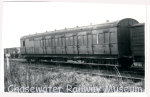
More on the Midland Railway Four-Wheel Passenger Brake
What started as a minor repair to the dog-box door has developed into a major restoration project. Back in the early part of 1990 the door had fallen off due to rot in the door post. This was the start of what looks like years of hard work.
Before starting it was decided that it should be returned to its original Midland condition, so research into the history of the vehicle began. What we had was clearly a four wheeled passenger brake van, heavily modified, and obviously early Midland.
Older members remember the vehicle was purchased from the Manchester Ship Canal Company during the 1960s but little other than this was known.

After a few months of fruitless digging, we contacted the Manchester Ship Canal Company. This one phone call produced more than all the previous ones put together. Within three hours of speaking to their Mr. Chambers he had returned my call advising that he had photocopied all the relevant documents and was posting them that night.MR Coach 22-3-1958
All of the information given to us by the MSCC relates to the vehicle after 26th January1953 when enquiries were being made by the MSCC as to the vehicle’s purchase. The period before this is still patchy, but some we do know.
Drawings and photographs of other vehicles tend to make us think that the vehicle was built between 1874 and 1890 at Derby to drawing D529. The number 68 is stamped on the inside of the solebar, so we may still be able to trace the original date of manufacture.
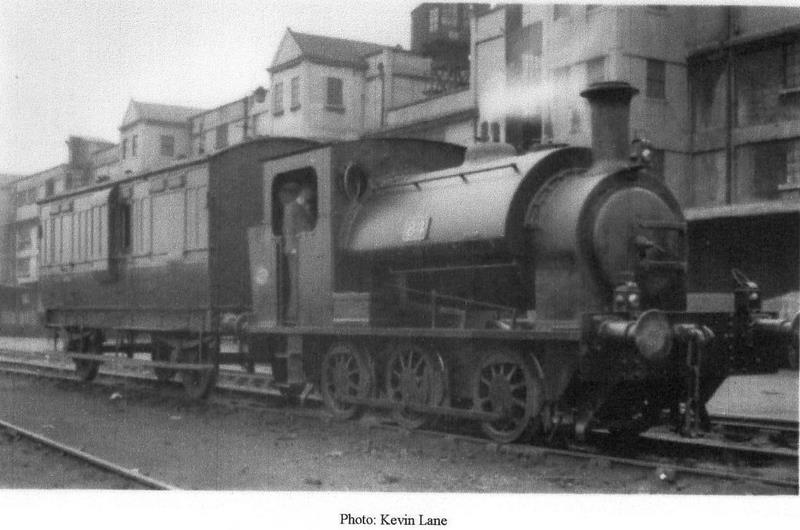
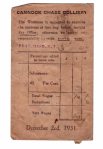
Apart from being taken into LMS stock on 21-7-1920, little is known of the vehicle’s movement except that it was part of a fire train. As M198718 the vehicle was moved to the Central Wagon Company Ltd. at Wigan on 21st March 1953. It was modified to ‘Cashier’s Coach No.2’ and entered MSCC service on 21st April 1953.
The vehicle was examined by members of the Southern Locomotive Preservation Co. Ltd. at Manchester Docks on 7th June 1966 and subsequently purchased for £40 and delivered by road.
The modifications performed by the Central Wagon Co. Ltd. for the MSCC included:
· Removal of the vacuum brake,
· Addition of extra roof-lights,
· Fitting of end doors,
· Fitting of a central partition,
· Toilet and washroom facilities added,
· Cashier’s pay-out window added,
· Re-positioning of stove and stack.
Work started during the early summer of 1990 with all roof fittings being removed. All old roof felt and canvas was carefully scraped off. The interior was stripped out and all sealed-up doors opened.
During the last eighteen months steady progress has been made, with the cashier’s window being removed and panels fitted. Damaged roof timbers are being removed and most of the panelling on one side has been renewed.
Assistance is always welcomed, so anyone wishing to help – just come along.
Thanks must be expressed to the Historic Carriage Dept at Butterley, and to the Manchester Ship Canal Company, for their help and support over the last two years.
D.Whittle






























 Chasewater Railway Museum