Tag Archives: Railways

197 Chasewater Railway Museum Bits and Pieces

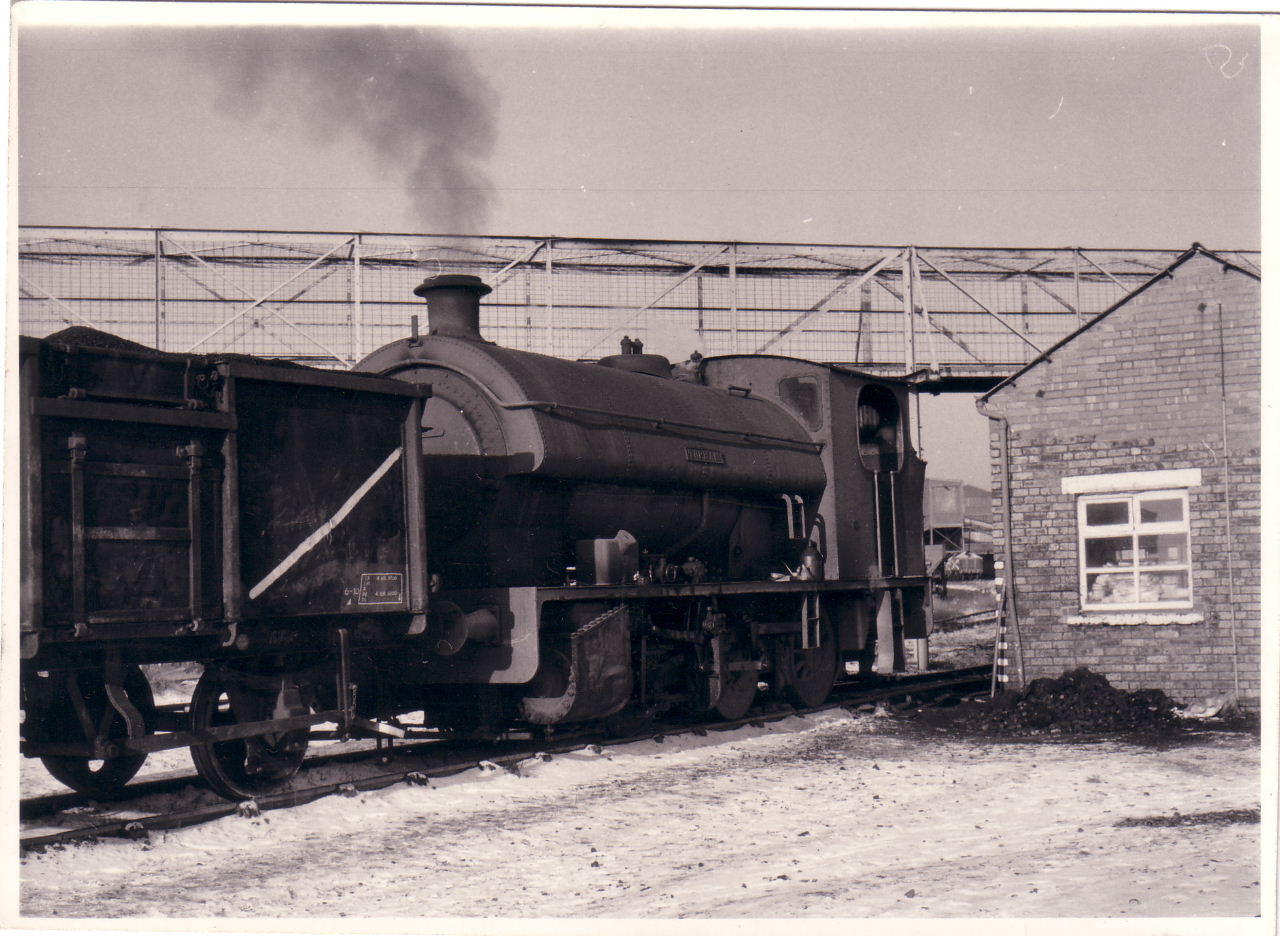
Loco ‘Topham’ 0-6-0ST Bagnall 2293-1922. Taken 18-12-1969

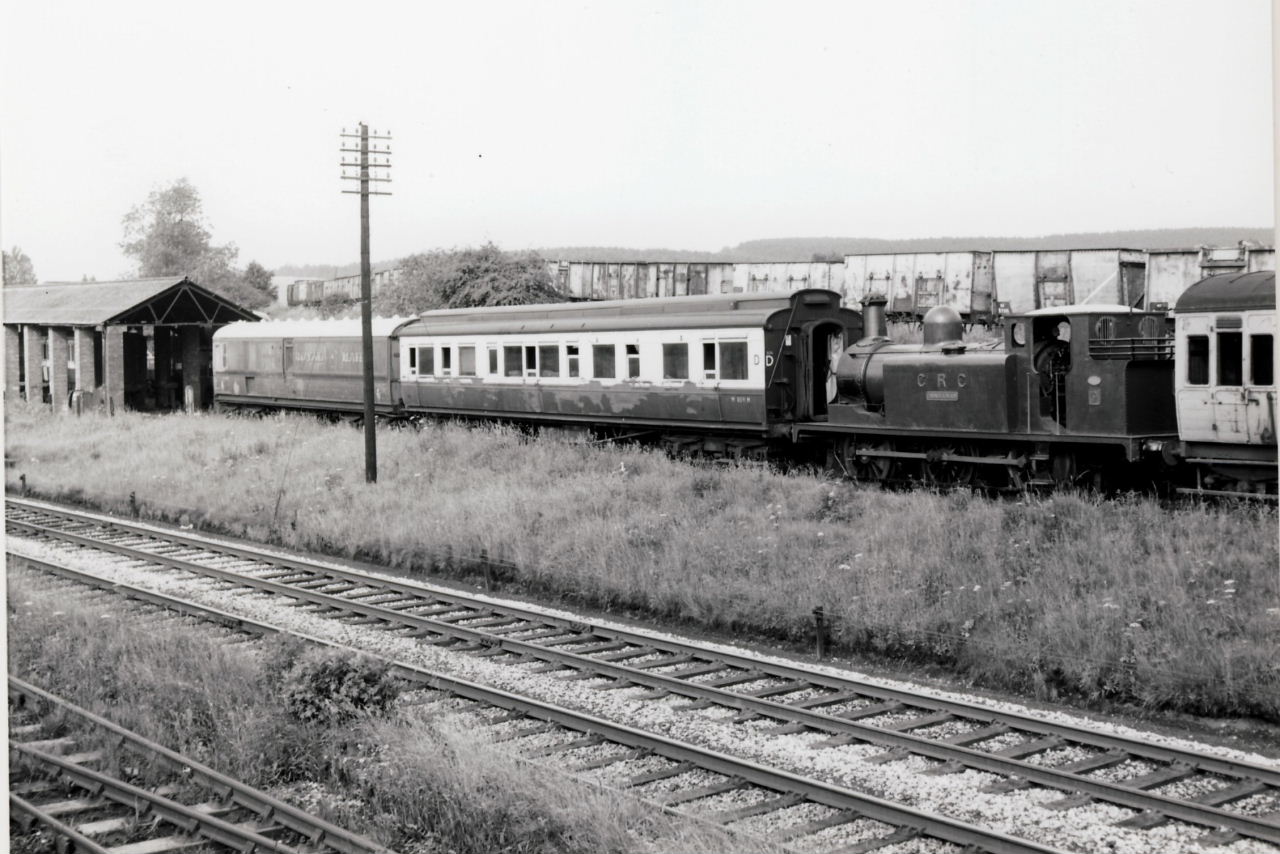
The photographs shown on this blog have been in the Museum since 1986. We regret that we cannot recall the names of the photographers. If you recognise any of them, please send us the details.

197 – Chasewater Railway Museum Bits & Pieces

From Chasewater News – Winter 1996 – Part 2

From the Board Room

David Bathurst – Chairman

Despite the fact that the festive season is getting ever nearer and the 1996 operating season has drawn to a close, there is no holiday period for the Board. Indeed, the Board has already agreed the pattern of train operations for 1997 to enable publicity leaflets, posters, etc. to be prepared.  Moreover, it has been agreed that the 1996 fare structure be retained, as the current ticket prices seem to have been pitched at just (perhaps exactly) the right levels and have been accepted by the travelling public.  It is pleasing indeed to watch prospective passengers, particularly those with family groups, buying tickets without feeling the need to complain about fares, how different from the days when many (maybe a majority) took one look at the fares and left the station without more ado.

With the help of our Publicity Officer, we aim to raise public awareness in 1997.  Indeed every member – whether a working member or otherwise – is a potential publicity officer in his/her own right.  We need to preach the Railway’s gospel, or at least ensure that its leaflets and publicity materials enjoy maximum exposure!

The Board has recently considered a variety of matters concerning the Railway, and some of these are outlined briefly below.

The ex LNWR ‘Paddy’

Following discussions with relevant members, the Board has formally acknowledged that the proper (or even partial) restoration of this vehicle is beyond the current or anticipated resources of the Railway, both in financial and manpower terms.  In its present condition, the vehicle is dangerous and a liability to the Railway.  Accordingly, the Board has agreed to try to find a more suitable home for the vehicle, which is to be advertised in the railway press for disposal.  Any such disposal would be on the basis of a commitment to restoration by the recipient.  Obviously, the Board would prefer to see it go to an organisation enjoying the necessary resources and expertise to bring it back into use.

Rallies

The board is examining in considerable detail the income/expenditure profit/loss profile of the rallies held in recent years.  There is much work associated with the organisation of our rallies, a lot of it out of view of the membership or the public.  The burden now being felt by a small minority of key members (who already have their own responsibilities for operation of the Railway) is becoming unacceptable.  For these members, the rallies are no longer an enjoyable challenge.  They have become more of a nightmare.  I am not prepared to allow this situation to continue.  I am not prepared to see our members and colleagues reaching a state of despair, which has happened on a number of occasions during 1996.  With Lichfield DC seeking for the first time to impose charges for hire of Chasewater Park for rallies in 1997, the Board is taking the opportunity of looking afresh at the Railway’s policies and options regarding future rallies.  The Rallies Organiser has been so successful in generating participant interest in our rallies that we have become vulnerable through a shortage of members prepared to make a direct contribution to rally organisation.  We have become a victim of, and hostage to, our own success.  If the Board’s aspirations come to fruition, we will have vastly increased public support for the rallies, but without the hassle experienced over recent times.  Our aim is to return to a situation where our rallies are enjoyed by the public, by the participants, and – more particularly – by our own members.

Invalid Toilet

The Railway’s Policy Statement includes a commitment to the provision for the disabled and our stations, buffet and trains are all accessible to people with mobility difficulties.  The one remaining omission is the provision of a disabled toilet and the Board has noted with pleasure that this will be available in good time for the Santa Specials in December.  The opportunity is being taken to ‘repair’ some defects in the plumbing system, hopefully with an improvement for the olfactory senses.

New Shop / Bric-a-Brac

The Board has given its support for a scheme whereby the recently adapted portacabin immediately next to the buffet at Brownhills West will become the new, enlarged, shop.  Shop sales, and children’s toys in particular, have increased markedly during 1996 thanks to the introduction of an enhanced commercial policy.  Consideration is being given to the use of other accommodation as a bric-a-brac shop.

Traction Inspector

The Board has formally endorsed the appointment of David Walker as the Railway’s Traction Inspector, although this is without prejudice to the Railway maintaining a relationship with other competent persons who have been prepared to assist in the past.  A driver and two firemen have already received their ‘ticket’ and further assessments are to be made in 1997.

Lichfield District Council

A lengthy letter has been received from Lichfield District Council in relation to the many matters which have been the subject of representations from the Railway since the Council became our landlords in 1993.  The Board’s preliminary impression is that the Council has failed to recognise or appreciate our concerns and that response is wholly unsatisfactory.  The Railway’s views will be communicated to the Council at an early date.

Christmas: Santa Specials

We are hoping for our most successful Christmas programme ever, providing the icing on the cake to complete a highly encouraging year.  Santa Specials will run on Sundays 15th and 22nd December, providing an opportunity for our ‘absentee members’ to visit the Railway and to judge for themselves what changes have taken place since their last visit.

P Way News

Arthur Edwards

In the autumn/winter plans for the P Way gang over the 1996/97 period is the laying of the sidings by the bottom compound.  This is expected to take up most of the winter months.  Some work has already commenced on laying out the first two roads with the first set of points going in after the Santa Specials.  The time scale for laying in the point work is expected to be around three months so that they should be up and running for the start of the next running season.  As the 1997 season will be starting early – the last week in March – and going through to the end of October, the P Way gang has a shorter period to get more things accomplished, therefore as our membership grows hopefully more volunteers will boost the numbers in the gang.  During this period it is also planned to lay 4 x 60ft lengths of rail on the extension so that the sleepers which are already in place can be keyed up and not tossed into the lake.  If the number of bodies available gets to a sufficient number, the causeway bank can be relaid with 60 ft lengths so if any able bodied volunteers are out there you can always find us on either a Saturday or Sunday, so don’t feel shy.

The weedkilling planned for the end of summer has had to be postponed due to the weather conditions not being suitable for it.  As the weedkiller has been purchased we should be able to spread it at the beginning or middle of March prior to the commencement of the new season.  This should be followed by a second application approximately half way through the running season so as to keep on top of the perennial problem of weed encroachment onto the track.  There are signs that some of the hedging planted several years ago is starting to take hold so that it should provide a permanent barrier along some of the more exposed fence line.  Further plantings should gradually fill out any gaps so making trespass onto the line more difficult.  I’d like to thank all the volunteers who have helped us during 1996 and look forward to seeing you in 1997.

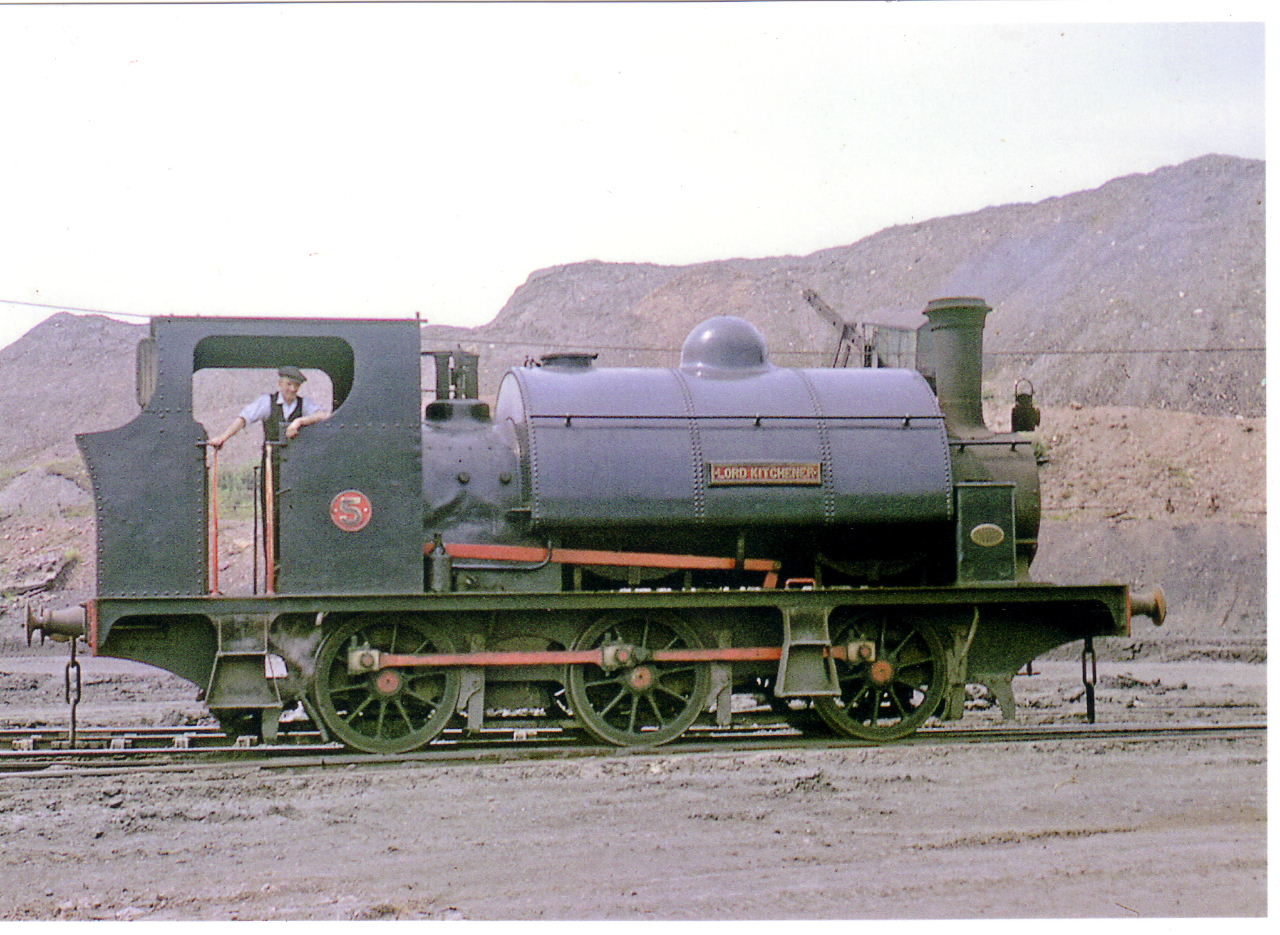
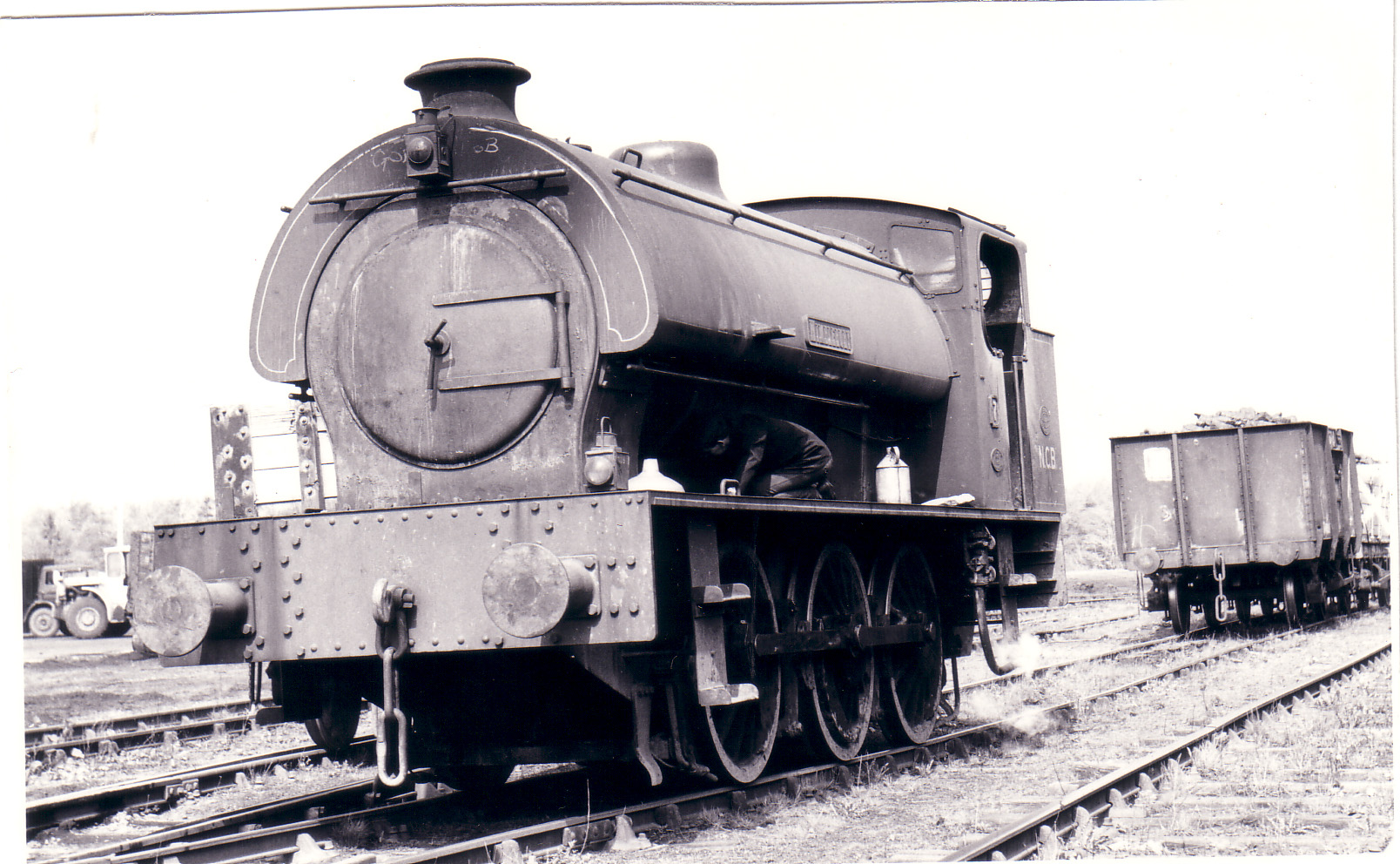
‘Lord Kitchener’ No5 0-6-0 ST Kitson 5158-1815 Photographer unknown
186- Chasewater Railway Museum Bits and Pieces

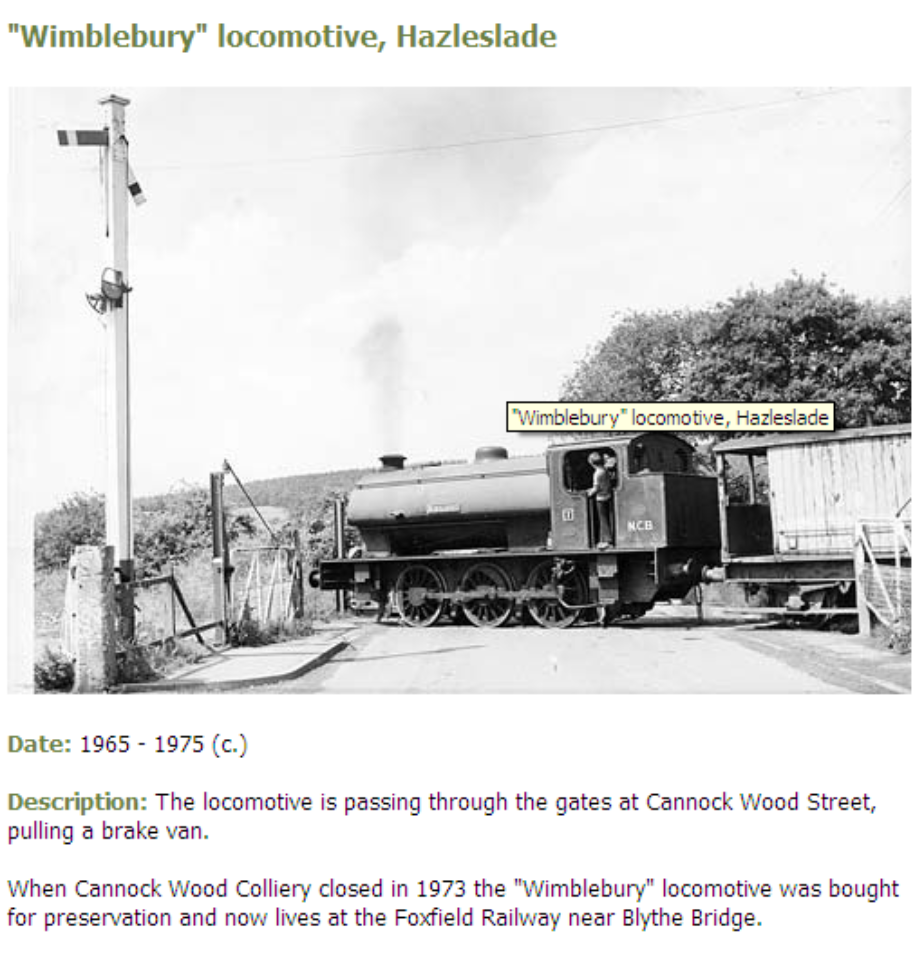
No.7 Wimblebury 0-6-0ST Hunslet 3839-1956 Cannock and Rugeley Collieries

186 – Chasewater Railway Museum Bits & Pieces

From Chasewater News Autumn & Winter 1995 – Part 3

 Loco Shed News

With the overhaul of the Sentinel nearing completion and the repairs to Asbestos well in hand, it is possible that the opening of Norton Lakeside Station on the 16th December could be another first with the special train being double-headed, which as far as I know has never been done at Chasewater before.  The work that has been done in the engine shed over the past few months has been incredible, and many thanks to Nigel Canning, Les Emery, Tony Sale and all the other willing hands that have helped.

Steam Locomotives

No.4 Asbestos – The casting for the main steam pipe was delivered during the second week in November.  After heat treating to reduce the stress on the casting it was machined courtesy of Tony Sale and the first trial fitting was on the 19th November.  A few minor adjustments were required but this has now been rectified and the casting fitted.  This should keep Asbestos running over the Christmas period and into the start of the new season.

No.5 Sentinel – The Sentinel has just about completed its long overhaul and is due for its test steaming at the end of November/beginning of December.  Hopefully this should be accomplished without any problems, and all credit to Nigel Canning for the first class job that he has done on his locomotive.  With the work completed on the Sentinel this should give us two steam locomotives in traffic.

S100 – Work continues on putting S100 back together again.  Two of the valve springs have had to be remade after a gap was found between the valve and the cylinder on one side.  One of the brake hangers has been dismantled, then cleaned and primed.  The work continues towards the completion of the chassis ready to receive its wheels.

Diesel Locomotives

Fowler diesel mechanical No.410013 – Further cosmetic work is being done to this locomotive to protect it from the winter weather and work will recommence on this locomotive after several other projects are finished.  The diesel still remains nominally serviceable.

Fowler diesel hydraulic No.422015 – The ‘Black Fowler’ remains temporarily out of service due to the breaking of three of its injector pipes whilst on works train duties.  The repairs to the pipes should be completed shortly and it should be back in service for Christmas and the start of the New Year.

L&Y No.1 – No.1 is well on the way to being put back together.  Work is proceeding on the engine with one of the two cylinder blocks now fully finished, and work is rapidly continuing on the second.  All being well the engine should be finished shortly after Christmas.  The next job on the agenda is to crane out the chassis and wheels, clean and paint them.  If all goes well No.1 could be running again by the end of 1996.  (See post No.183).

No.21 – The engine of No.21 is going back together at a slow but steady rate.  The second cylinder block has been replaced and the manifolds are being put back on.  Most of the basic repairs to the engine are now complete.  The next items on the agenda are the cooling system and the electrical systems.  This locomotive could also be finished by the end of 1996 with a bit of luck.

P.Way News

Blood, Sweat and Tears – Arthur Edwards

Most of the past several months have been taken up, in between the service trains running, with getting the track ready for the Inspector’s visit in September and again in October.  The ‘Blood, Sweat and Tears’ of the new extension has lived up to its name.

Blood – Because during the completion of the Causeway many a finger has been caught whilst either rolling in rail or keying up the track, so drawing blood.

Sweat – Of which a lot has flowed during the summer months, as it was one of the hottest few weeks on record, and for those who have done it, P.Way is hot and heavy work.  (Is it not, Tom?)

Tears – When things have gone wrong, and believe me they have, such as when Lakeside Station was nearing completion and we ran out of bricks to finish the platform, due to vandals knocking off the laid bricks and throwing them in the lake.  Then after the Inspector had been it was found that the rail was too close to the platform edge so that the clearances had to be altered by one or two inches, taking a dozen blokes to do it over a weekend.  (My back still remembers it.  Ed.)

In the end I received a phone call at about 5.20pm on the 25th October with the news that the extension had been passed for passenger traffic and we could now run into Norton Lakeside Station, which was very good news indeed.  I have only one request – could the P.Way lads get their breath back before we get any more track in to extend the running line, please!!

My thanks to Nigel Canning for the photos

Chasewater Railway Museum March 2024 Newsletter

Featured Loco Pic – ‘Tony’ – 0-6-0ST Hawthorn Leslie 3460-1921 at Hawkins.

More new additions to the collection in February and some new loan items too.

175 – Chasewater Railway Museum Bits and Pieces

175 – Chasewater Railway Museum Bits & Pieces

From Chasewater News Christmas 1994 – Part 1

Editorial

I am afraid I must again start by apologising for the lateness of the last magazine.  This was due to problems with its distribution rather than printing, but meant that the advertisements for the vehicle rally and the Warley Show were wasted.  In view of this, the only advertisements printed in future, such as those in this issue, will be checked to ensure that they are so far out of date that they are of no use to anyone!  There is, however, a rumour that a company called Regional Railways is still capable of operating to a few of the stations advertised, although I believe the fares have risen somewhat!

We at Chasewater are now on the verge of being able to run trains between two stations at last, but as the Christmas shopping facilities at Norton Lakeside are in fact somewhat limited, this year the Santa Specials will terminate short of the new station.

I would like to thank all the people who have helped with the magazine this year by writing articles, lending photos or with its production or distribution, and finally wish everyone a very

HAPPY CHRISTMAS AND PROSPEROUS NEW YEAR.

Locomotive News

Asbestos propels a train back towards Brownhills West on the day of the October 1993 Rally.

No.4 Asbestos – This engine has again managed to keep us in the steam railway business by carrying on single-handed without too many problems.  On the day of the October rally the regulator caused a few headaches when it became even more stiff to operate than usual, inducing the occasional bout of slipping.  Since then the gland has been stripped, cleaned and re-packed, and the dome cover has been removed to allow adjustment of the valve itself.  Hopefully some improvement will be apparent at Christmas, if not we have a second chance before Easter.

No further problems have been experienced with leaking tubes, although it is still planned to renew the complete set after Christmas.  One or two minor leaks have been re-caulked in the firebox, and again these will be checked during the Christmas steaming.

One or two minor repairs and improvements have been carried out, including the fitting of steam brake exhaust pipe in the smokebox so hopefully the fire will no longer blow-back when the brake is applied or released.

No.5 Sentinel – It has been decided to fit this loco with a new set of washout plugs as by the time the boiler has been tapped out to clean up the taper threads, the original plugs will be too small to fit.  In the meantime work has continued with the repair of a pin hole in the main exhaust steam pipe which runs along the left of the loco from the engine to the blast nozzles in the chimney.  The leak was first noticed during the last few steamings when emulsified oil started blowing down the frames.
The semi-circular slide valve which controls the rather complicated operation of the Weir pump has been repaired by the building up of its ports with weld and re-grinding back to shape.  This should hopefully improve the operation of the pump by making it more controllable and less noisy.

Other work has included cleaning of the cab interior ready for painting, painting of the boiler barrel and re-fitting of some of the pipework.

S100 – Work is still progressing on the frames of this loco.  The brake hangars are in place, and a new underkeep is being machined to replace a missing original.

No.3 Colin McAndrew – In a surprise move recently the boiler of this loco was sent away to Bridgnorth for the SVR boiler department to quote for repairs.

Fowler diesel hydraulic No.422015 – This loco has again been the mainstay of the diesel fleet, being used on works trains and for shunting.  It has recently been suffering from low engine oil pressure thought to be caused by fuel dilution, and in addition the axle boxes have started running hot.

Ruston diesel electric DL7 – This loco is still serviceable, although the cab windows were smashed in a recent attack.  This has not helped the loco’s usual winter problem of damp getting into the main generator and traction motor, as the rain can now drive in through the broken glass to soak the floor boards.  Hopefully, after a bit of work it will be available as standby for the ‘Santa Specials’.

The Fowler diesel machanical No. 4100013 sandwiched between DMUs at Brownhills West

Fowler diesel mechanical No.4100013 – Following yet further work to its engine, this loco has been run to the causeway and back under its own power.  Its use is limited at the moment, as due to its starter motor needing re-winding, it has to be started by another loco.  Quite a bit of work still needs to be done, including refurbishment of the air system, however, it has been used on the works train, but the lack of starter motor meant that it had to be left idling all day.
L & Y No.1 (Motorail No.1947) – A replacement bearing brass for this loco has been purchased to enable it to be stood back on its wheels.

No.21 diesel – The engine of this loco is still dismantled although the pistons have had new rings fitted and have been re-fitted to the engine.  The injectors have been cleaned and re-set ready for when the cylinder heads are re-fitted.  The sump has also been cleaned ready for re-fitting.

Image

Chasewater Railway Museum – January 2023 Newsletter

Image

Chasewater Railway Museum – 2011

Chasewater Railway Museum – 2011

A collection of photographs, mainly in the Museum, taken in 2011

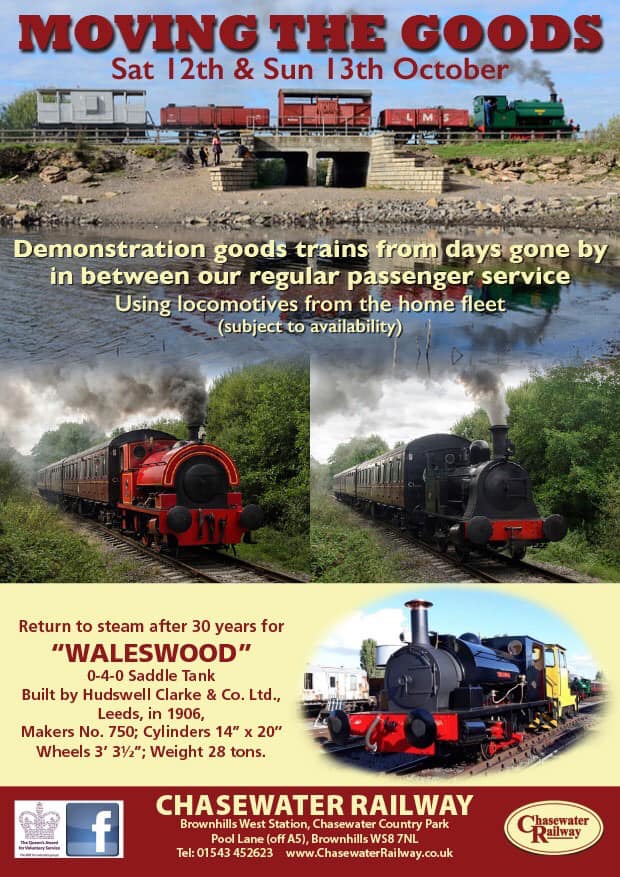
Chasewater Ralway Museum – Coming Soon – Moving the Goods – Oct 12/13 2019

Chasewater Ralway Museum – Coming Soon –

Moving the Goods – Oct 12/13 2019


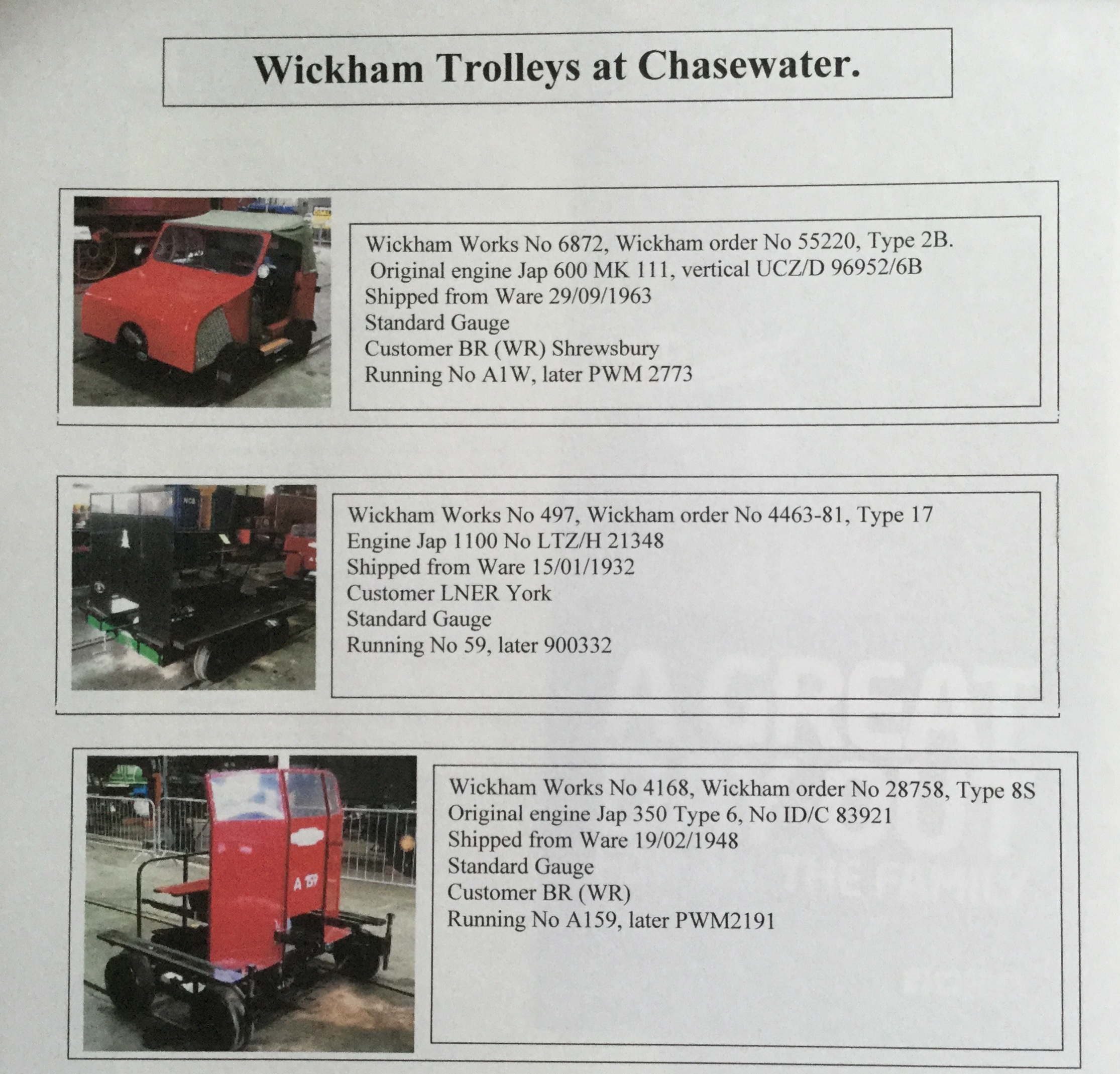
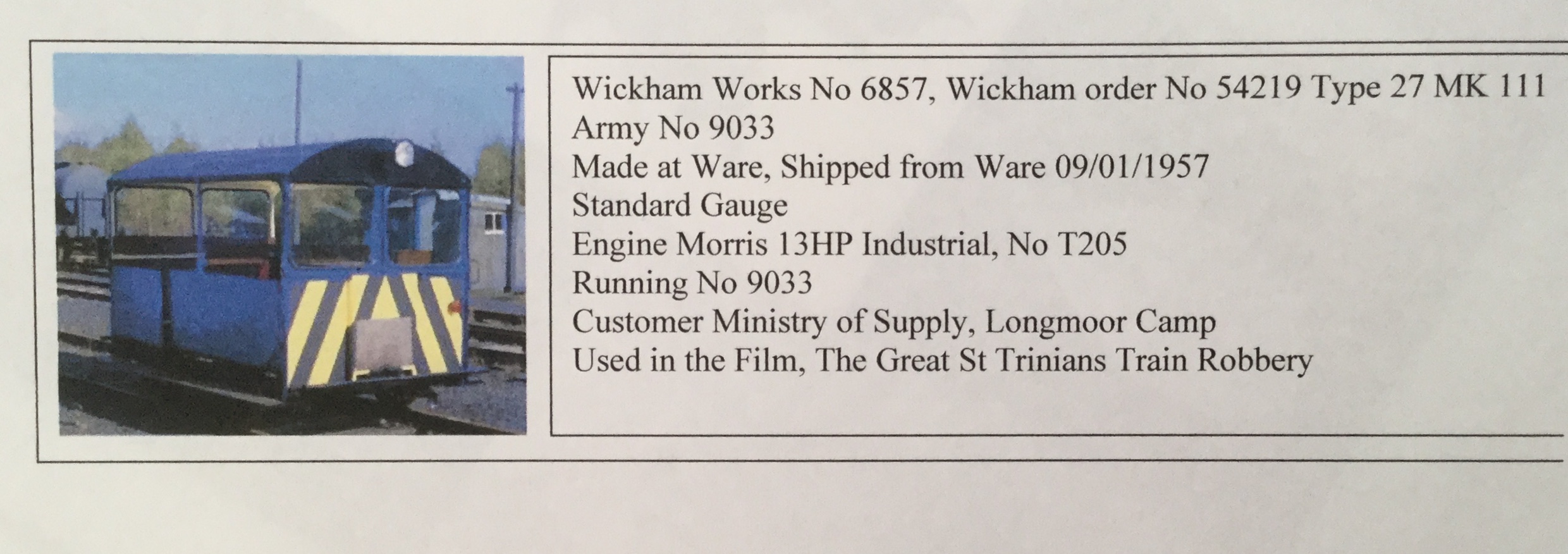
Chasewater Railway – Wickham Trolleys.

Some recent additions at Chasewater Railway, are 3 Wickham Trolleys on display in the Heritage Centre at Brownhills West Station. The Wickham Trolley was a Railway Engineering personnel carrier used on track inspection duties.

B44506FD-CDBB-41C5-9579-F7BA4453B955

Also at Chasewater is the Wickham No 6878, which was used by the ministry of supply at Longmoor Camp, and also used in the film The Great St Trinians Train Robbery.

465B8B31-50F2-4BA9-9E3F-F091CA01B48F

Some More Old Stuff

Some More Old Stuff

Chasewater Railway Museum

Bits and Pieces No.3

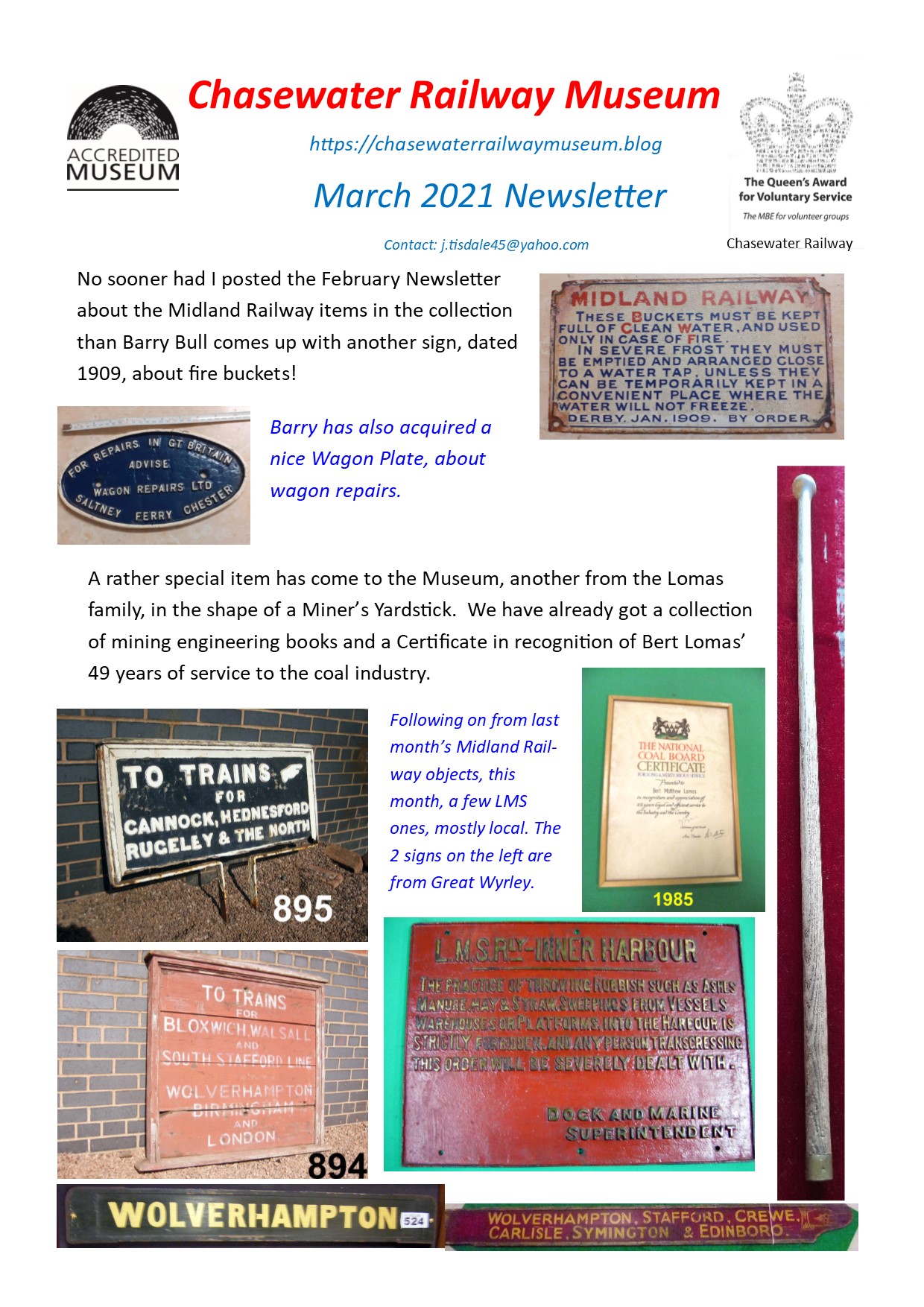
These posts are taken from old publications, newssheets and magazines produced by the Railway Preservation Society (West Midlands Division). Chasewater Light Railway Society and Chasewater Light Railway and Museum.

This post is taken from the earliest newsletter found so far amongst the ‘Duplicate Magazine ‘ file.

I reproduced the first part just to show that our aims haven’t really changed in the last 50 years.

Taken from the Railway Preservation Society Newsletter, Feb 1961

What is our eventual aim?

It is obvious that we want to run a railway.  But what sort of railway is this to be?   What picture do we want to give to the general public?  We could push together a train, grab a piece of line and say this is a preserved railway.  But will it mean anything to the general public?

Each district will, inevitably, form its own collection of smaller relics which eventually we hope to show to the public in exchange for money.  As a railway enthusiast, a mass of cast iron plates, old faded photographs, tattered maps, dog-eared tickets and general bric-a-brac fascinates me and I can spend hours contemplating such a collection, but I would strongly suspect this would leave the general public with a feeling of mental indigestion and a fixed idea that railway enthusiasts are really mad.

Any preserved railway depends on the general public for the main part of its traffic.  We must study their interests and make sure that we attract them back and their friends to which they have passed a recommendation.  It must not be an overcrowded museum, but a ‘vintage railway’ — a living example of how the railways were run, laid out so the general public can see it tick.  The steam engine is to us a balanced collection of boiler, firebox, cylinders, pistons, crossheads, etc.  But to the ordinary man-in-the-street it is largely a mystery.  Our exhibits must be self-explanatory.  We must try to explain why the railways grew into such a complex system of competitive lines with so many odd connections.

I am not suggesting that we forget the railway enthusiast.  I am asking that we consider the picture we are presenting to the general public.  These points are not immediately applicable, but we should give consideration to them and encourage the artists and architects amongst us to sketch out their ideas on this basis.

Arrival at Hednesford of our T.P.O

January 11th (1960) was a red letter day for members of the West Midlands District when a 27 ton 1909 Royal Mail coach, purchased by us for £200, rolled into our Hednesford depot.

Sold by British Railways the 50 foot bogey coach, complete with letter pigeon holes and half-penny stamp post-box – as good as new – it has joined our other two museum passenger coaches, an 1895 Great Eastern Railway brake vehicle and an 1875 Maryport & Carlisle Railway coach.

The mail coach travelled up from Verney, near Wolverton in Buckinghamshire, and celebrated its historic run by charging up the batteries to give full lighting inside.  It was shunted into the depot sidings by an NCB tank engine.

Unlike the other two vehicles, the T.P.O. is too high to be placed under cover in our vehicle shed, but members are planning to lower the track to enable it to enter.

Final Passenger Train on the Churnet Valley Line

Frank Harvey

Twenty R.P.S. members were among the passengers to travel on the last train from Macclesfield to Uttoxeter by the Churnet Valley line of the ex-North Staffordshire Railway on November 5th (1960).

Some of our members had departed from Macclesfield early in the afternoon in order to break the journey at Oakamoor and again make the acquaintance of the station master, Mr. Lister.

Macclesfield was reached early enough for members to have a look round the town before returning to catch the last train.  Several relics were noted at Macclesfield (Hibel Road) station, including a NSR/LNWR boundary post.

Bellringers

The train left on time at 8.35pm behind Stanier 2-6-4T No. 42670.  The coaches were quite full, two of the enthusiastic passengers ringing handbells loudly for most of the journey.

A few people had gathered at nearly every station to watch the train depart, and at 9.48pm the train arrived at its final destination, Uttoxeter.  It marked the last moments of a regular passenger service on the Churnet Valley line for 110 years.


The  present Churnet Valley Railway is a volunteer-run organisation. The operating company, the Churnet Valley Railway (1992) plc, is supported by the North Staffordshire Railway Co (1978) Ltd., a Charitable Trust.

Activities recorded on film

BBC television news cameras have filmed activities at our Hednesford depot on two occasions in recent weeks.  Both items were shown on ‘Midland News’ and have done much to foster interest in the Society.

On the occasion of the first visit, members were shown at work on the restoration of the Great Eastern Railway coach.  Several of our relics, housed in the coach, were also shown.

The cameras were again at the depot on January 11th 1960 to record the arrival of the T.P.O. Several newspaper representatives also visited us for this event, a very full report of the work, profusely illustrated with photographs, appearing in the ‘Cannock Courier’

The Coalport Branch Line


Notes by D. Noel Draycott

This was one of three lines under consideration when looking for a permanent home for the railway.

On Sunday, October 23rd 1960, a small party consisting of David Ives, James Slater, T. Jones, Frank Harvey and myself visited the Coalport to Hadley line in North Shropshire.  Built by the London & North Western Railway, it runs from the very attractive Vale of Severn across high land and through an early centre of the iron and steel industry to a junction on the Wellington to Stafford line.

The branch had a terminus at Coalport Station which stands on a long shelf, part cut out and part built up on the steep bank of the Severn.  The station buildings comprise a booking office, general and ladies waiting rooms, backing on to the station master’s house.  The signal box was demolished and a ground frame installed shortly before services were withdrawn in 1952.  The goods shed has also been demolished, but the three short sidings remain in the yard.

Further along the shelf past the station, there is a carriage shed sufficient for four bogie carriages, and an engine shed for two locomotives.  These buildings are in fair condition, and the engine shed contains a large workshop space as well as a pit.  All these buildings back on to the hillside, and on the opposite side there is a pleasant stretch of wooded land before it falls steeply away to the river which forms the boundary of the railway property.

The line rises steeply from Coalport Station with attractive views across and up the Severn Valley before it turns away to cross pleasant rolling countryside to the small town of Madeley.  Here the station building is used as an office by an engineering firm, but the yard of some half dozen sidings is practically disused.

The line then continues to Dawley and Stirchley Station where a total of some 15 wagons of coal showed that an active coal merchant used the yard.  As dusk was falling, the tour of inspection finished at this point.  All the members of the party were impressed by the potentialities of the line for day trippers.

Before we left the area, we were fortunate to meet a resident interested in the line who presented the R.P.S. with smaller relics. These included an LMS inkwell, labels and official books.  We were very pleased to receive these on behalf of the W.M.D.’s collection of local relics.