Tag Archives: Old Railway Lines

Chasewater Railway Museum Bits and Pieces No.9 More from the Early Days – From 1960 April RPS Newsletter Vol 1 No.4

More from the Early Days

From 1960 April RPS Newsletter Vol 1 No.4

West Midlands District

This picture shows the old headquarters in Hednesford.  The building which the carriages are partly inside is still standing, although it is bricked up now.  The white buildings on the other side of the line to Rugeley was the wagon works – long gone.

Public Meeting, Saturday, March 5th 1960

Mr. G. T. Cox,  WMD Chairman, opened the meeting at 3.00pm.  He expressed his regret that there were not more people present, and said that possibly the unusually fine weather had diverted persons to outdoor pursuits.

Mr. Cox went on to say, “Many of us often look back to the bygone days.  We younger ones can only remember the pre-nationalisation days, whilst older ones can remember quite clearly the pre-grouping companies and put down their memories in black and white.”

“The best way of showing any exhibition piece is in its natural surroundings, and this is what the RPS means by a ‘living’ museum.  You will not get one by asking, but you will if you support the RPS to the best of your ability.  There is little preserved in contrast to the vast scrapped during the last 50 years.  It is within our reach to extend the range, if action is taken now.”

The General Secretary, D. Noel Draycott, briefly described the origins of the RPS and the district organisation which gives local groups the chance to build p local collections.  The first programme for the WMD has been drawn up, covering the purchase of rolling stock and other large relics.  The programme is divided into three stages, but it is not necessarily the order in which items will be purchased.  The selection of relics depends on the speed with which our funds grow.

Mr. R. De Lacy-Spencer pointed out that many relics were kept by persons who did not realise their historic interest to railway enthusiasts.  An example of this was the Midland Railway stationmaster’s hat which had been presented to the RPS by a lady living in Lincolnshire.

The WMD Secretary, D. A. Ives, gave an account of progress in the area.  Membership was growing and a keen committee were considering more plans for the future.  Members were contributing many smaller relics, and a good selection was on view.  He had been corresponding with BR for some time about a possible depot site, but with no result to date.

Mr. F. J. Harvey read a branch line survey he had recently made.  It was an account of the present condition of the MR branch from Aldridge to Brownhills and Chasewater.  The civil engineering features appeared to be in good condition, but the permanent way was neglected towards the end of the branch and part had been lifted.  At present only a section of it was used for a daily freight trip.

The meeting was wound up at 4.30pm and Mr. A. Holden from the audience proposed a vote of thanks to the speakers which was carried.

Stop Press! – Depot established in WMD

We are pleased to announce that negotiations for the establishment of a depot have reached a definite stage.  The site is at Hednesford, about 11 miles from Wolverhampton, and contains 150 yards of siding, part of which is under cover.  Fuller details were given to members at the visit to the Stafford/Uttoxeter branch on Sunday, March 27th.  These details are not to hand at the time of writing this, and a description with information about working parties will appear in the next issue of the newsletter.

This will enable the WMD to launch an intensive campaign to purchase rolling-stock, etc., of the Cambrian, Great Western, London & North Western, Midland and North Staffordshire Railways.  All persons interested in these railways are invited to send donations direct to the West Midlands Treasurer, RPS.

Chasewater Railway Museum Bits and Pieces No.8. From the Railway Preservation Society Newsletter Vol 1, No 3

Chasewater Railway Museum Bits and Pieces No.8.

RPS Newsletter Vol 1 No.3

Early days of the Railway Preservation Society

(West Midlands Division)

( Later to become Chasewater Railway)


The General Secretary’s page discussed the setting up of a Carriage & Wagon Section, to include as much information, as detailed as possible, about vehicles which are still used as well as those no longer seen other than in photographs.

For Posterity

On looking forward to the continued expansion of the RPS over the next 50 years, I wish to express the view that it will be desirable to reproduce the trains of main and branch lines at different periods in the steam age.

Settle & Carlisle Railway

Assuming that it may be possible to acquire such secondary main lines as Settle – Carlisle, Exeter – Plymouth, Midland & South West Junction Railway, and Somerset & Dorset Joint Railway among others, in the event of them being closed by British Railways, which occurrence is not entirely without the bounds of possibility, the running of semi-fast and local services forming scenic excursions and conveying intermediate traffic would be possible.

The bridge carries Pine Road over the old S&D trackbed (closed 1966) to the east of the site of Corfe Mullen Halt (closed 1956). © Copyright David Spencer and licensed for reuse under this Creative Commons Licence

In this connection the point to stress is the need to acquire a few of the older express types such as the ‘Sandringhams’, ‘King Arthurs’, ‘Patriots’ and ‘Schools’ which are threatened with extinction.  Whatever weight restrictions exist on original branch lines to be acquired let us at least endeavour to save a few more typically British express engines before it is too late.

This bridge crosses the dismantled Midland and South Western Junction Railway just west of Notgrove. It is now a Site of Special Scientific Interest because of the Jurassic limestones exposed here. © Copyright Tamara Kwan and licensed for reuse under this Creative Commons Licence

It is also obvious that the efforts of various small preservation societies dedicated to the saving of one particular branch line would be better used within the united effort of the RPS as not all such branches could hope to survive by themselves.  The selection of branches in each area could then be carefully considered.

The point concerning all lines is that ‘period’ trains reproducing the locomotives, rolling stock and livery of, say, a Southern ‘Green Train’ or a 1930  ‘East Anglian Express’ could provide not only variety and colour in a standardised age, but would be in itself a strong appeal.

Of course this is assuming that the RPS becomes a railway company at some future date.  But why not?  Will someone design a suitable crest to super-impose on ‘period’ liveries?

Let us all contribute to making this a reality some day.

Platforms 5 and 4, for trains to and from upcountry, from the southern end. An Exmouth train is waiting at platform 1. © Copyright Derek Harper and licensed for reuse under this Creative Commons Licence

West Midlands District


Inaugural Meeting

About 20 people met at the Station Hotel, Stafford, on Saturday 21st November for the inaugural meeting.  The General Secretary opened the meeting and sketched out the reasons leading to the formation of the RPS and future plans.  He explained that this was the first District to be inaugurated and though the general outline had been planned out, the detailed application of this would be the concern of the WMD committee.

Mr. D. A. Ives, who has been acting as Secretary, gave a report on progress to date.  He reported that membership was over 25 and that they had received a good response from individuals contacted.  The first step was to secure a small depot in a convenient locality, where relics could be stored and members work on their restoration.  The ideal site would contain a certain amount of covered accommodation as well as rail space for carriages and wagons.  He believed the support was there in the West Midlands, it was only a question of publicity and personal contact.

The committee to serve for the current year was then elected.

Future plans were discussed and the decision taken to launch a publicity campaign leading up to a public meeting in the New Year.  The site of the public meeting was fixed as being Birmingham, but emphasis was laid on arranging future meetings in different towns to give better contact with the public and members.

Three reporters attended the meeting, leading to reports in the ‘Stafford Newsletter’ and the ‘Staffordshire Weekly Sentinel’.

The public meeting was fixed for Saturday, March 5th in the Small Theatre at the Birmingham & Midland Institute, Paradise Street, Birmingham at 2.30pm.  Everyone welcome.

Chasewater Railway Museum – November 2018 Newsletter

Chasewater Railway Museum 

November 2018 Newsletter


Chasewater Railway Museum – A New Local Addition

Chasewater Railway Museum

A New Local Addition

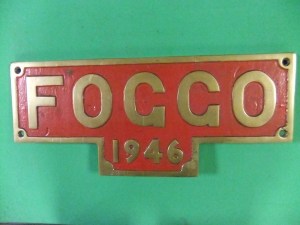
A worksplate from the locally built locomotive ‘Foggo’

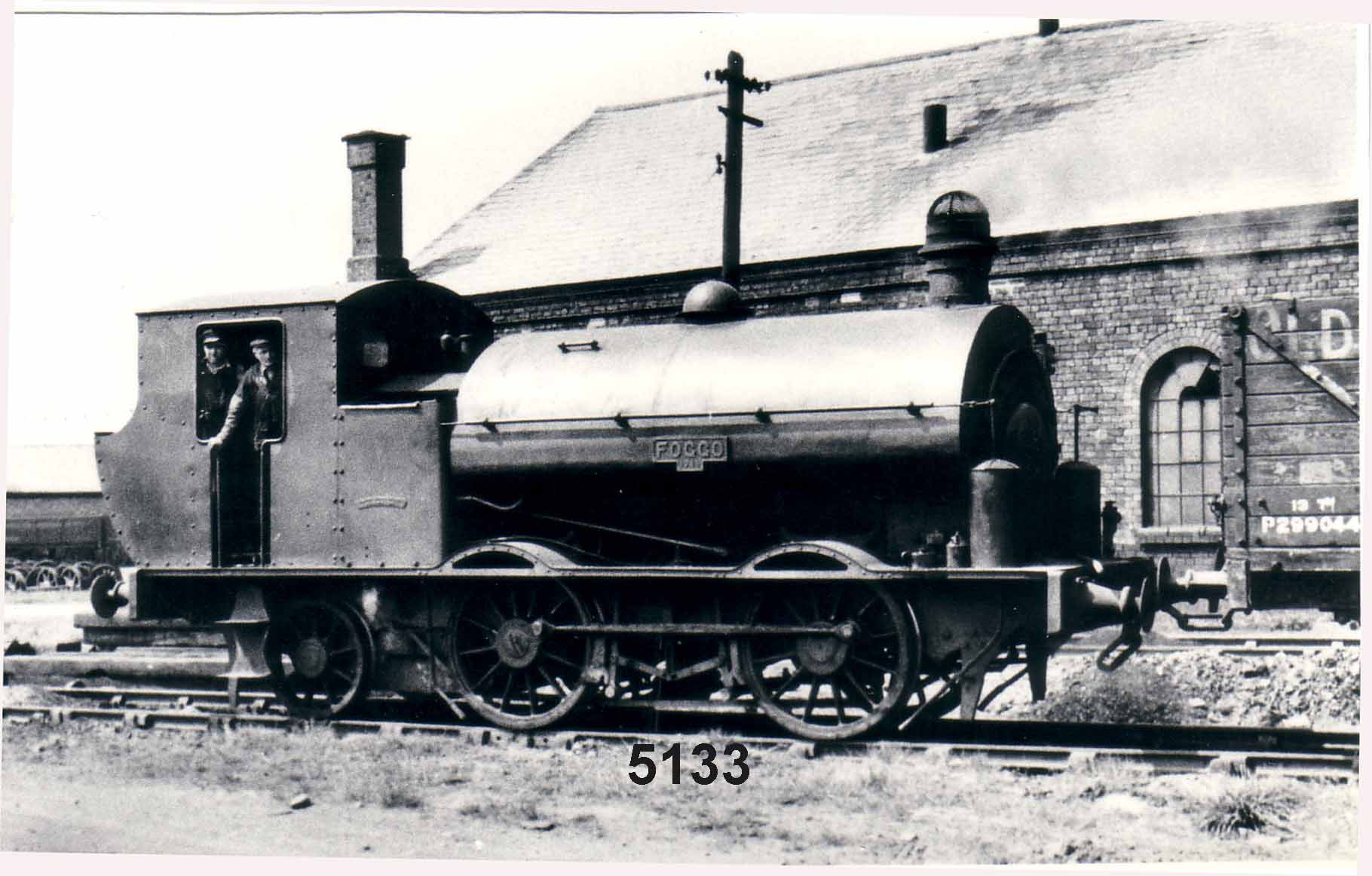
Foggo, 1946, from a standard gauge 0-4-2ST built at the Chasetown workshops of the Cannock Chase Colliery Co.Ltd. in 1946, using parts supplied by Beyer Peacock, together with spare parts accumulated over the years from similar locomotives already at work at the colliery.  The name derives from Mr. Foggo, the General Manager of the company at the time and the nameplate incorporates the year of build.  It became National Coal Board property on 1st January, 1947.  Transferred to Coppice Colliery in early 1954 and to Brereton Colliery later the year.  Scrapped by W.H.Arnott Young in January 1961.  Cast Brass, 21½”x 8¾”, the front repainted.

5133 Photograph Foggo 0-4-2ST Built Chasetown 1946 – taken 2-8-1942 from spares and parts supplied by Beyer Peacock Album 1

The worksplate can be seen on the side of the engine.

Chasewater Railway Museum – September Newsletter

Chasewater Railway Museum 

September Newsletter

Chasewater Railway Museum Bits and Pieces No.7 – Oct 1959

Chasewater Railway Museum Bits and Pieces No.7

From the Railway Preservation Society Newsletter October 1959

Vol 1  No.2

Chairman’s Page

Anything from a button to a branch line

Yes, we are interested in anything of railway origin and historic interest.  We have no prejudices.  We are anxious to preserve all classes of relics from all pre-grouping companies, the big four and British Railways.  In fact, we want to build up a truly comprehensive collection of relics that will form a supplement to the British Transport Commission’s own invaluable collection of historic relics.

At the moment we do not possess either a button or a branch line!    We own about 50 relics from the range in between these two types.  Our largest is a 6-wheeled carriage, and we expect that we shall soon have satisfactory accommodation for this so that our members can work on its restoration.

The rest of our collection comprises small items, and until we have acquired the necessary rail space and land, we cannot expand our collection of large relics.  Both the West Midland and London & Home Counties Districts are working on this problem, and both hope to be able to announce a satisfactory conclusion to their searches.

We already have our eye on a few larger items such as signals, 4-wheeled, 6-wheeled and bogie coaches, as well as goods vehicles.  The number of larger items we buy each year is governed by the speed by which our membership grows.

Once again we are enclosing a second copy of this newsletter.  Please pass it on to somebody who is interested in the activities of the only national society dedicated to the preservation of standard gauge relics.

West Midland District


Outing to the Much Wenlock Branch, Saturday, 19th September.

A rather small but enthusiastic party attended the District’s first get-together and outing, exact figures being seven members, plus seven relations and friends.

The smallness of numbers did not mar the day, however, and a very enjoyable time was had by all.  The main party started from Stafford station and was joined by another member at Wellington.  The Station Master at Wellington came over prior to departure for Much Wenlock; he appeared most sympathetic to our aims, and reflected sadly on the closure of branch lines.

Wellington Station – Roger Shenton

The train pulled out on time from Wellington, headed by a 57xx class pannier tank No.3732.  The quaint halts en route to Buildwas Junction were noted, the driver, leaning through his cab window, pointed out several places of interest.  Coalbrookdale Iron Works were keenly watched by members, with interest in the fact that the first iron bridge in the world was cast there.  This was seen spanning the Severn as the train passed over a parallel bridge further up-stream.

Much Wenlock – Wellington

This delightful photograph epitomises the action on so many evocative branch lines in the West Midlands.  2-6-2T No.4142 was running under easy steam at Farley Dingle on 23rd April 1957 on a Much Wenlock to Wellington afternoon local service.  As so often happens when rural railway services are withdrawn, the trackbed was transformed into part of the modern road system.

Geoff Bannister

Buildwas Junction proved of interest, an ancient wagon turn-table being spotted, also the two platform levels, one for the Wenlock branch and one for the Severn Valley line.Buildwas Junction

The train passed Buildwas Abbey, a very picturesque sight on the west bank of the Severn.Buildwas Abbey

The gradients and curves then became very pronounced as the train made its way to the Wenlock terminus through the beautiful Shropshire countryside.

A member living at Much Wenlock met the party on arrival and very kindly took four members to Longville in his car, this line being open to freight only.  This excursion through the lovely Wenlock Edge was greatly appreciated.

The goods yard, sidings box and single engine shed (without loco) were inspected by the remaining members.  The ladies of the party visited the ancient Guildhall and Abbey, which proved full of historical interest.

After tea and a final look around Much Wenlock station, the party caught the 7.05 back to Wellington headed by the same pannier tank, but a different crew.

A vote of thanks must be recorded to the BR Staff at WR Wellington, for the kind way in which they answered questions, thus making the trip thoroughly worthwhile.

It is to be hoped that another outing of this nature will be better attended so that the RPS will continue to thrive and gain more publicity.  How about it, WMD members.

Date: 2002

Description: Buildwas Junction formed part of the Severn Valley line that ran from Hartlebury, near Droitwich, to Shrewsbury through Bridgnorth and Ironbridge. However, the line was disbanded in 1963 following Dr Beeching’s review of the railways. A section of track between Kidderminster and Bridgnorth has been preserved by the Severn Valley Company, but the track from Bridgnorth onto Shrewsbury was pulled up in the 1960’s and can no longer be used.

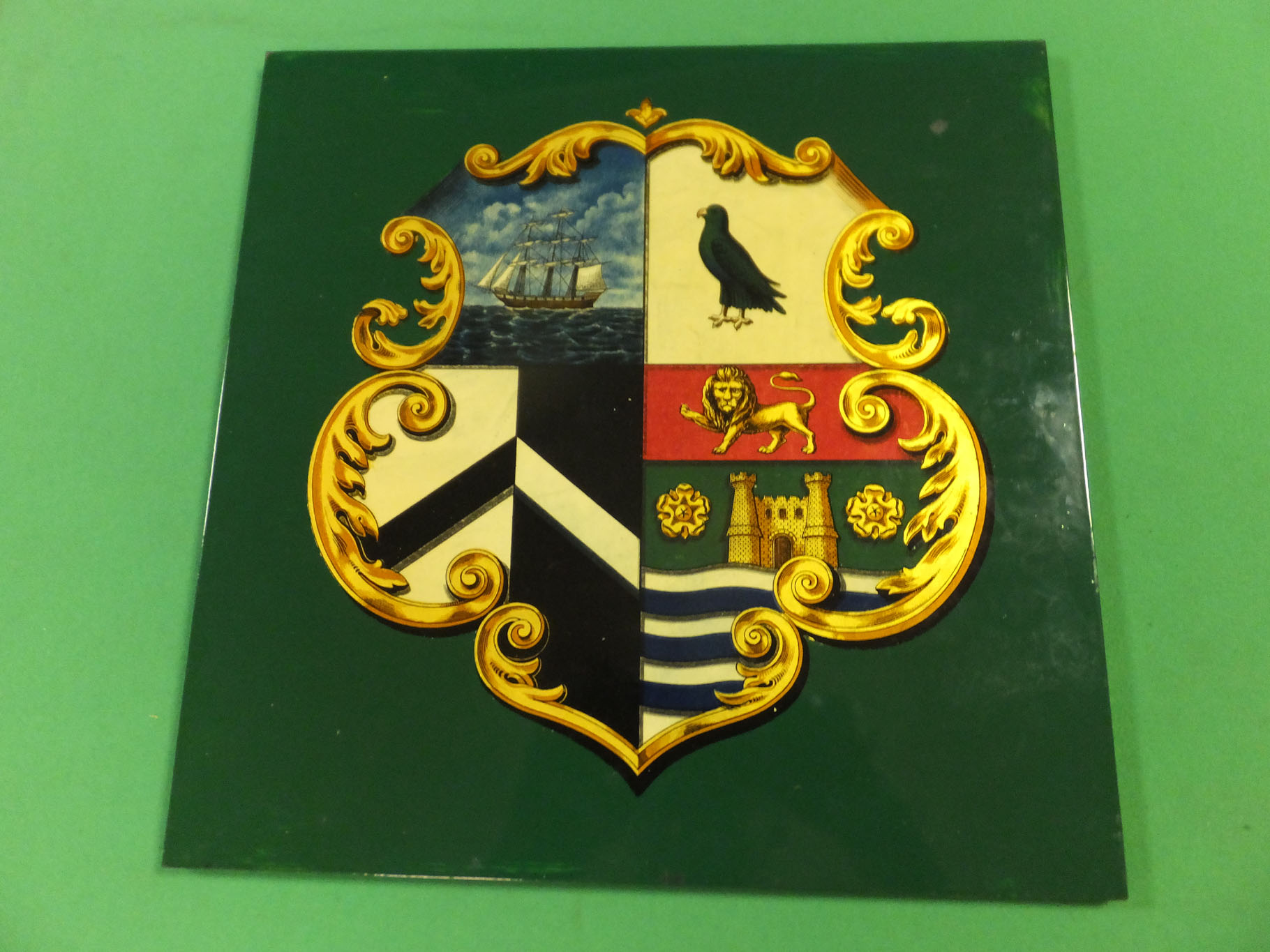
Another new addition to the collection – Coat of Arms, Maryort & Carlisle Railway

Another new addition to the collection,

Coat of Arms of the

Maryport & Carlisle Railway

Chasewater Railway has a 6-wheeled coach which belonged to the Maryport and Carlisle Railway, before being used as part of the Paddy Train at Cannock and Rugeley Colliery Pit at Cannock Wood.  The Coat of Arms is a long sought-after object for the Museum.

There were 27 subsidiary companies in the group of railways which made up the LMS, but only a handful of them owned locomotives and rolling stock.

The oldest was the Maryport & Carlisle, which was incorporated as long ago as 1837.  It was opened in instalments and completed throughout on 10th February 1845, eventually owning nearly 43 route miles of line.  It enjoyed an enviable dividend record, which rose to a peak of 13% in 1873, and it was one of the most prosperous of all British railways over a long period of years.  It contributed 33 locomotives, 71 coaching vehicles and 1,404 freight vehicles to the LMS.

Two early types of transfer for the decoration of the coaching stock, which was given a varnished teak external finish at the time, have been traced.  One was a conventional script monogram.  The other consisted of the initials ‘MCR’ on a red field surrounded by an Oxford blue garter with the usual gilt edging, ornamentation and legend bearing the full title.   It measures 9¼ in wide X 11¼ in high over black shading.

A livery of green with white upper panels was adopted in 1905 for the passenger train vehicles, which blended pleasantly with the green of the locomotives.  Five years later Tearnes produced for display on both an armorial device which shared with that of the Central London the distinction of embodying neither name nor motto.

The transfer measures 10¼in wide X 16¾in high and is simple and appropriate.  On an ornamental shield Maryport (top left) and Carlisle (bottom right) are quartered with the arms of J.P. Senhouse of Netherall (top right), represented by the popinjay, and those of Sir Wilfred Lawson (bottom left).  Senhouse and Lawson were the first and fourth chairmen the company had during its eighty-five years of life.

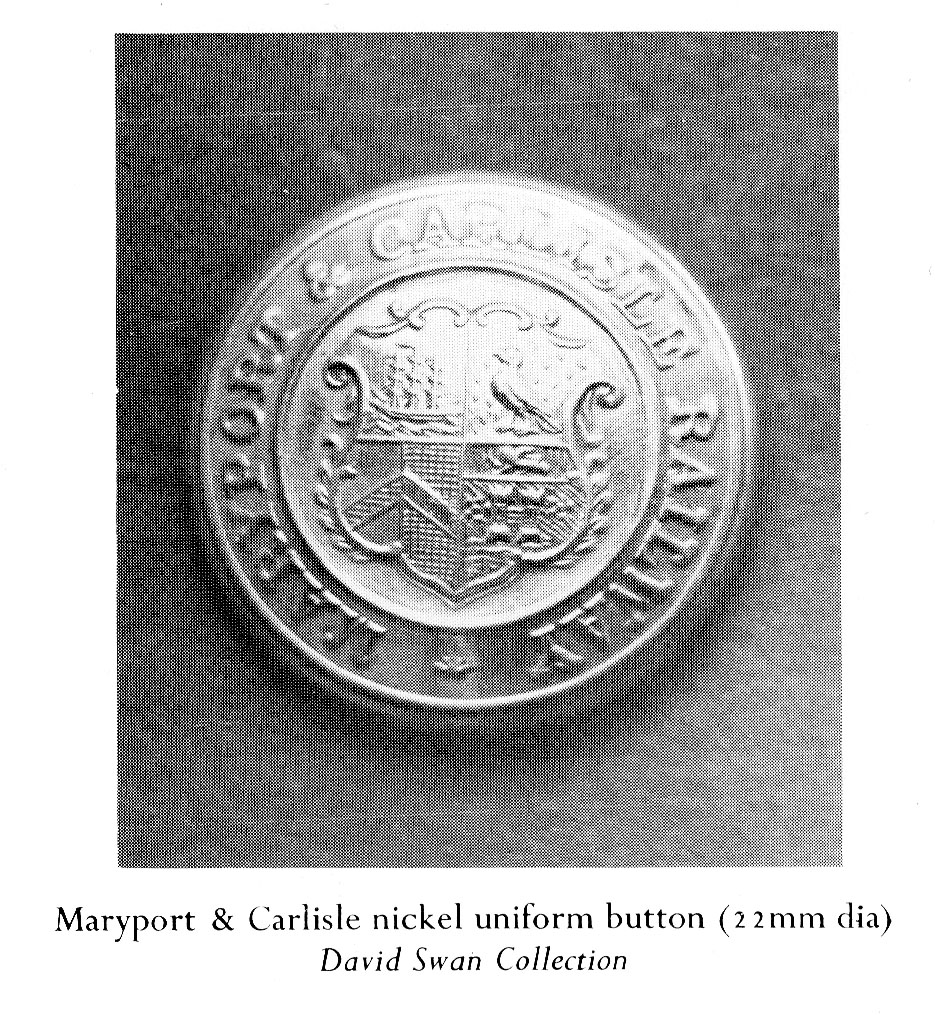
Uniform buttons carried the same device.

Chasewater Railway Museum – August Newsletter

Chasewater Railway Museum

August Newsletter

Chasewater Railway Museum Bits and Pieces No.5

Chasewater Railway Museum

Bits and Pieces No.5

These posts are taken from old publications, newssheets and magazines produced by the Railway Preservation Society (West Midlands Division). Chasewater Light Railway Society and Chasewater Light Railway and Museum.

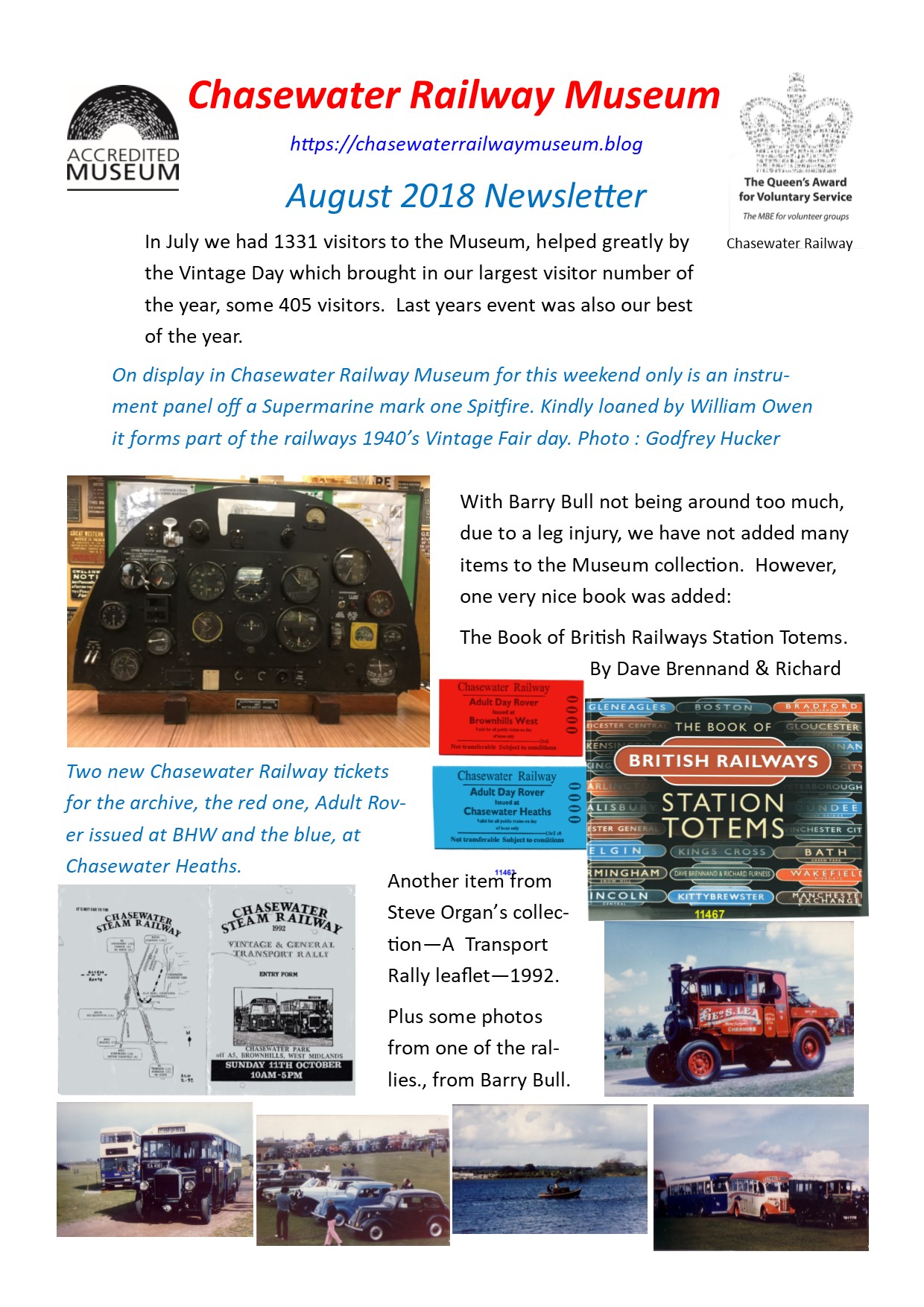
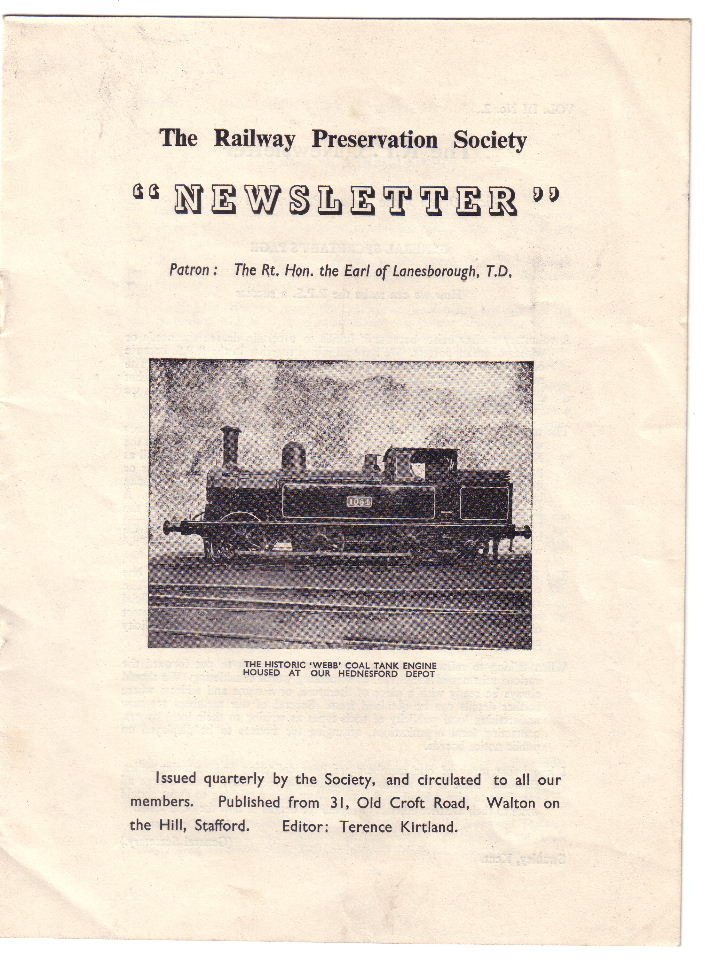
I know that it’s not the newsletter referred to but I needed a picture  in a hurry!!

Chasewater Railway Museum 1958 Bits & Pieces 5

This post was taken from the ‘Railway Preservation Society’ leaflet of 1958 – the start of the railway preservation movement in this country.  I found it interesting to know how the movement started – I hope that other people will  too!

Railway Preservation Society

The national society for the preservation of relics from the standard gauge railways of Great Britain.

Keep the steam era alive – join the RPS

Introduction

At the present time the railways of Great Britain are going through a period of complete change in the principal method of traction.  The steam engine is condemned, though many years will pass before it finally goes.  So as to provide a worthy memorial to the steam engine, the Railway Preservation Society was founded in 1958 by a group of railway enthusiasts.  We plan to co-ordinate the efforts of individuals and widen the field of railway preservation.  Our main aim is the establishment of living museums on our own branch lines, where the steam engine would still be the main source of power and the railway could be seen in the full glory of its Edwardian Splendour.

It is still possible to find engines of many of the old pre-grouping companies in use, and to recreate trains representative of those found on our lines 50 years ago.

But time is running out fast!

Organisation of the RPS

Our members are being grouped in Districts, each consisting of an area of dense population and the surrounding lesser populated area.  Each district will concentrate on collecting relics of the railways serving its area, re-capturing the individual character of the Edwardian railway companies.

The relics preserved will range from a button to a branch line.  Amongst the items we seek to recreate are the rural stations of yesterday, the signal boxes, the trains, each with its own appearance, which varied from company to company.

Each District will establish a depot as a short term project, until arrangements have been made for leasing or purchasing a branch line.  This will give it a working site for the restoration and display of engines, carriages, signals, etc., in a locality convenient to the greater part of the population of the District.  It will also enable us to concentrate our first efforts on the urgent need to preserve suitable locomotives.

Appearance of a branch line

The type of branch line we are interested in is one which runs through scenery of natural beauty to a place of tourist attraction.  The major proportion of our passengers would not be railway enthusiasts, and we must take them to a place that is attractive in itself and offers them ample facilities for recreation and refreshment.  It is only by satisfying our customers so that they recommend the service we offer, that we can hope to succeed.

The length of the line would depend on whether it was a combined effort by more than one District or a solitary venture.  It would have exchange facilities with BR at least at one end, so that traffic could be attracted from as wide an area as possible.  The stations would be restored to their Edwardian appearance, and the trains run in a similar manner to those of that era.  At the same time we should have to satisfy the stringent regulations of the Ministry of Transport, so that our passengers would be guaranteed a high degree of safety.

At the terminus will be found the engine shed, carriage sidings and museum.  Here rolling stock not in use at the time could be seen by the public, and their design and the methods of construction and maintenance be on show.  Displays of smaller relics, maps, prints, etc. will be arranged to show the growth of the railway network and its influence on the life and trade of the District.  Though primarily catering for the railway enthusiast, a keen eye would be kept on our exhibits so as to make sure they were intelligible and interesting to the general public.

The operation of the line on an all-the-year round basis would be actively considered.  But as the branch line would be one of the unremunerative lines closed by BR, the possibility of this is somewhat remote.  The main effort would be concentrated on running an intensive service during summer weekends and the months of July, August and September, when the large number of voluntary helpers could be fully employed.  We would provide hostel accommodation on the line, so that our members who wanted to spend a weekend or part of their holidays on the line, would be assured cheap, reasonable accommodation on site.

We would offer the general public the opportunity to travel in a similar manner to our grandparents in the early years of this (last) century.

There is still a  chance

We can succeed.  There are still thousands of steam engines on BR, but very few left from the early years of this (last) century  The British Transport Commission have announced their intention of applying for permission to close another 2,000 miles of unremunerative lines.  There will be plenty of branches for us to choose from.

We can preserve two typical trains of yesteryear for the price of a Rolls Royce car!

All this adds up to a great opportunity.  We must seize it now, or see it go for ever.

Keep the steam era alive – Join the RPS

Chasewater Railway Museum Bits and Pieces 2

Chasewater Railway Museum

Bits and Pieces 2

These posts are taken from old publications, newssheets and magazines produced by the Railway Preservation Society (West Midlands Division). Chasewater Light Railway Society and Chasewater Light Railway and Museum.

Another couple of bits and pieces from the Railway Forum – Winter 1965.  The first is a display of name and number plates, loaned by one of the members, and laid out in the Royal Saloon – which left Hednesford  in  1970 for the British Railways carriage works at Derby for restoration and then on to the Midland Railway Centre at Butterley.

Midlands RPS Open Day display

An interesting display of locomotive nameplates and numbers was arranged in the Royal Saloon for inspection by visitors at the Midlands R.P.S. Open Day.

New locomotives preserved in Midlands

Members of the Midlands area, R.P.S. expect to take delivery of another locomotive later this year which has been acquired through the generosity of one of their members, Dr. P.G. Plummer, who has offered to purchase it for them.

The locomotive is a Hudswell-Clarke 0-6-0ST built for the Sheepbridge Coal and Iron Company in 1895 (Works No. 431).  It was transferred to its present location, Desborough Warren Quarry, Northamptonshire, in March 1951 and was due for withdrawal in July.  It is believed to be the oldest Hudswell-Clarke locomotive still in working order and once carried the number 15.  Now it has no number or name, although known as “Sheepbridge No.25”.

Painted in apple green it should be a valuable addition to stock already acquired, and will be of considerable use at the Chasewater branch line which has been leased by this group.

Two other locomotives have also been donated by the Whitecross Co. of Warrington.  They are Peckett 0-4-0STs of 1900 and 1904 vintage.  They were withdrawn from service by the Company in 1961, being replaced by two Fowler diesel locomotives.  They carried names up to withdrawal, the older being “Baden Powell” and the younger “Lancet” the nameplates of the latter being transferred to the Diesel No.1, and those of the former being acquired by local enthusiasts.  Only “Lancet” will be able to run again.  It is hoped to exhibit “Baden Powell” statically.

The second is about new locomotives coming to Chasewater.  Sadly the Hudswell Clarke, although we still have the loco, has never steamed here. The two Pecketts fared even worse.  The ‘Lance’ (not Lancet) 1038/1906 was scrapped in March 1972, and another Peckett – 1823/1931 was also scrapped at the same time.  The Loco ‘Baden Powell’ was in too bad a condition to be moved.  The other loco was an 0-4-0F a fireless Andrew Barclay locomotive 1562/1917 – scrapped in March 1973.
The articles were writtten in 1965, the photos taken in 1969.