Category Archives: Photograph Collection

Chasewater Railway Museum – 2 new photographs

Chasewater Railway Museum

2 new photographs

Brereton Sidinngs Signal Box

Brereton Sidinngs Signal Box

The first photo is another photo of Brereton Sidings signal box.

Edward Dorricott paid £2.50 for the photo and gave it straight to Barry Bull.

Edward Dorricott is the author of te recently published book on Duttons Signal Works, Worcester, in which Chasewater Railway Museum gets more than one mention.

boat

This second photo has a couple of question marks hanging over it, which I hope we may get answers to.

‘Captain Midnight’ is a former naval officer named Glover, but we are not sure of his rank – possibly Lieutenant Commander or Commander.

Thank you Pete Styche for the following information:  GLOVER Gerald (Lt. Commander R. N. Rtd.) Passed away 12th October 2014 aged 76 years.

He was an occasional benefactor of the Railway, whenever he paid a visit there was always a donation in the box and maybe some good magazines donated.

The next question is who is his friend?

And finally, where was the photo taken?

Save

An old Chasewater Railway Photograph From the Industrial Railway Society’s September 2016 Magazine

An old Chasewater Railway Photograph

From the Industrial Railway Society’s September 2016 Magazine


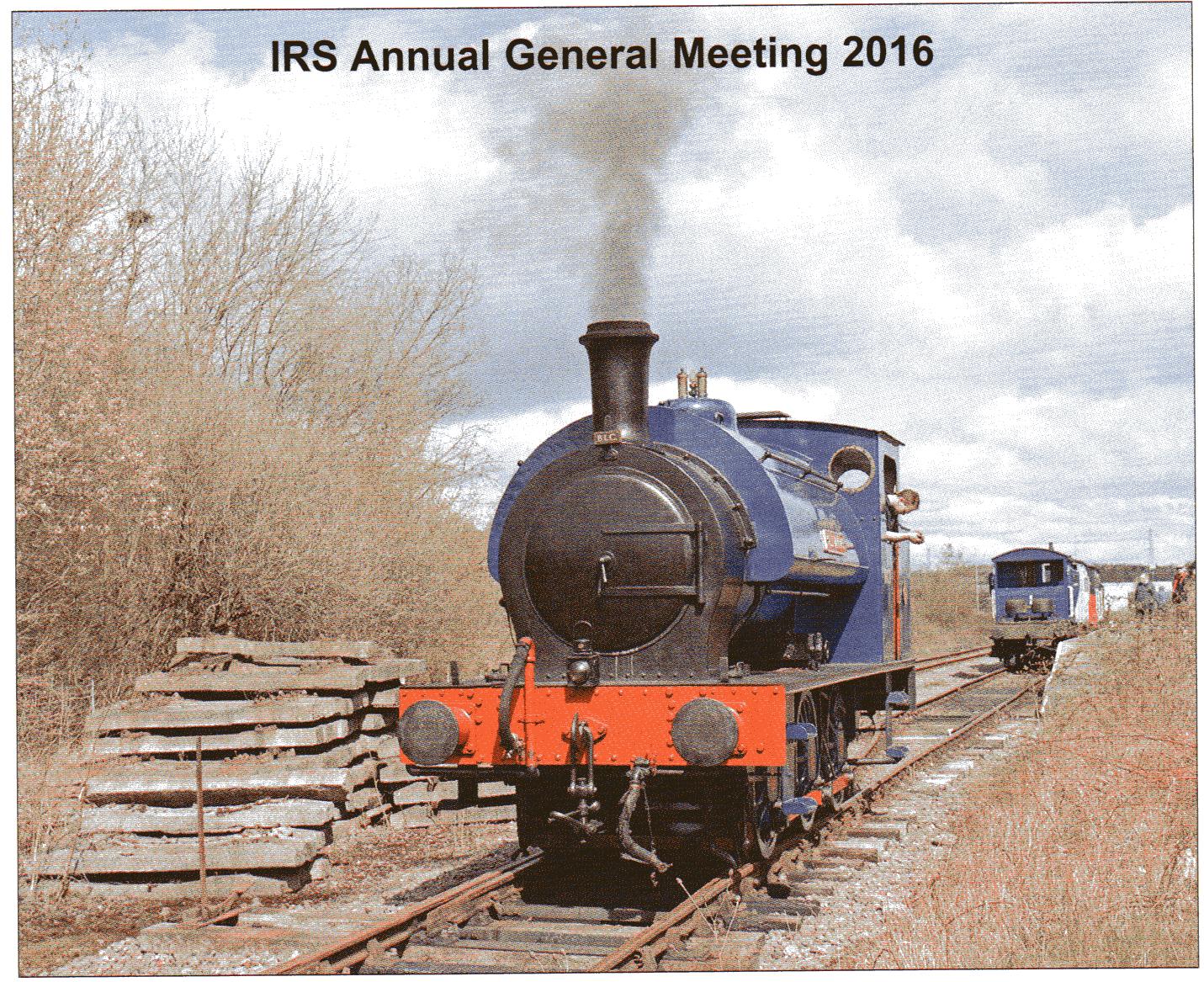
The IRS’s AGM took place on Saturday 16th April 2016 at Chasewater Railway.

It was enjoyed by IRS members and the members of the Railway who were involved in running special trains for the Society.

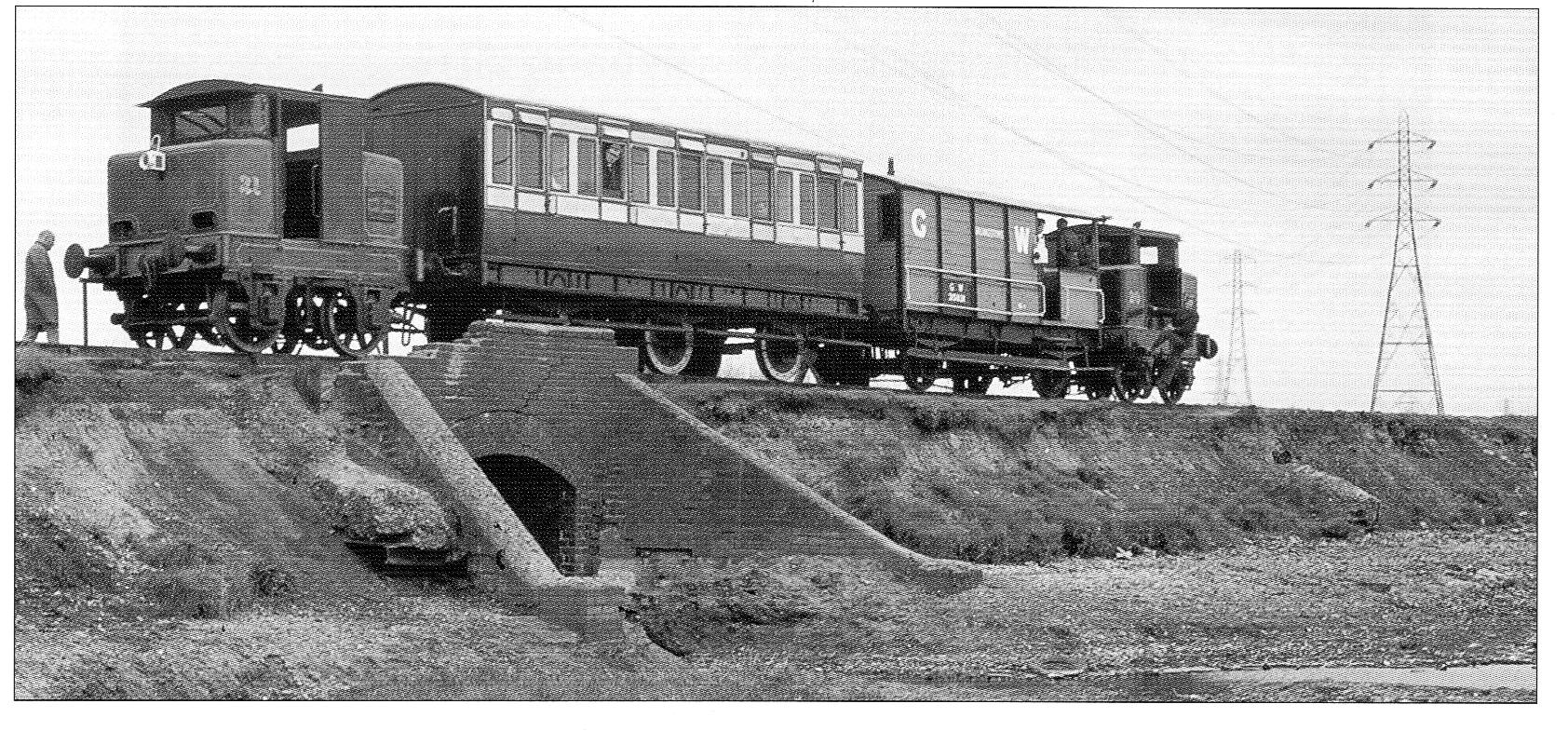
20&21This photograph was taken by Cliff Shepherd at the IRS AGM weekend in April 1972.

On the Sunday, visits were made to Chasewater and members travelled in the Maryport and Carlisle carriage of 1875 vintage and the Great Western Brake Van, which now, in 2016, is restored to its former glory.

The locomotives involved topping and tailing were two former Worthington Brewery Planet locomotives, nos. 20 and 21, on what was then a very basic railway.

Holly Bank IRS

Holly Bank No.3 (Hunslet 3783-1953) runs around after the first of the IRS trains at Chasetown Church Street Station on 16-4-2016.

Chasewater Railway Museum – Photos from 2006

Chasewater Railway Museum 

Photos from 2006

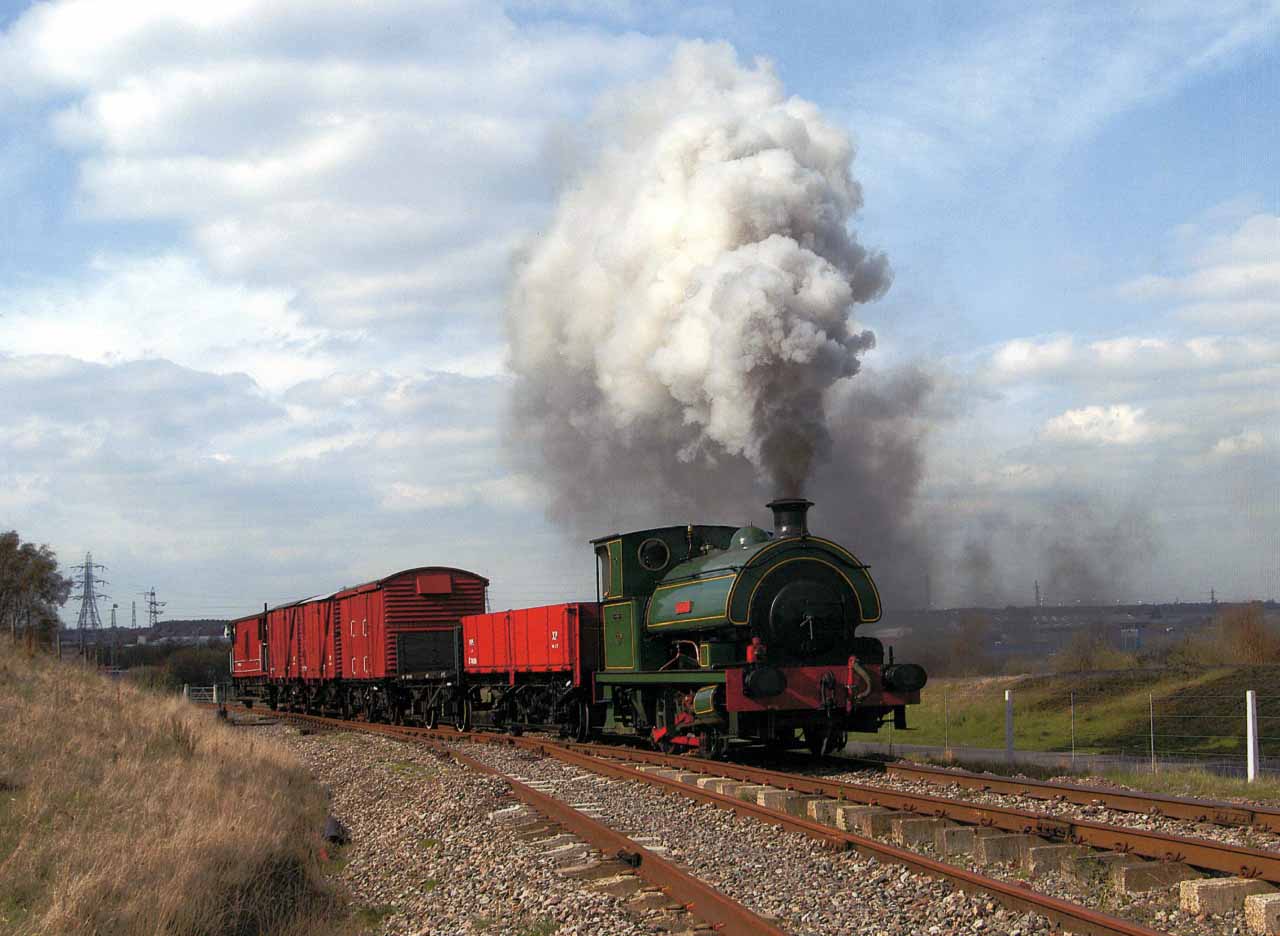
A few more photographs, taken by Robin Stewart-Smith, on the 28-4-2006, of a  J94 Austerity locomotive No.68009 on works train.

6842Our

Our thanks to Robin for sending us these excellent photographs, taken at Chasewater Railway, on the causeway and at Chasewater Heaths Station.

Chasewater Railway Museum – A Visiting Peckett, 2006

Chasewater Railway Museum 

A Visiting Peckett, 2006

No

Peckett 0-4-0ST 1738/1928

Supplied new to Birmingham Electricity Authority, Hams Hall Power Station, near Coleshill.

By 1968 the loco was disposed of by sale to a Severn Valley Railway member and the loco went to Bridgnorth on the embryonic Severn Valley Railway.

The locomotive saw very little use and was eventually sold privately, this time going to the South Devon Railway.

Later again resold, this time going to Titley Junction, Herefordshire. The loco masquerades as the Thomas the Tank Engine character ‘Percy’ and has visited several preserved railways at Thomas events.

Martin Evans Pic

Chasewater Railway Museum – And another visiting loco

Chasewater Railway Museum

And another visiting loco – Including video

2009_06200016

Wimblebury

A Hunslet 0-6-0ST Austerity class, 3839/1956

Built by Hunslet of Leeds, Wimblebury was delivered new to the National Coal Board at Cannock Wood Colliery near Hednesford in Staffordshire, and worked there until withdrawn in the early 1970s. Originally earmarked for spares for another engine, Wimblebury was purchased privately for preservation and moved to the Foxfield Railway in Staffordshire on 26th September 1973.

This, in 2009, is the second visit to Chasewater by this popular engine in recent years.

05164 Wimblebury 0-6-0ST Hunslett 3839-1956 CRC Taken Hazel Slade

Passing over Hazel Slade level crossing.

Train


Chasewater Railway Museum – ‘Things that got away!’

Chasewater Railway Museum

Things that got away!

From time to time various people advise us of the latest offerings on ebay, mostly these are of little interest and on occasions of dubious authenticity, for example, the Hawthorn Leslie worksplate 2780 of 1909. Very odd this one as our loco ‘Asbestos’, resident at Chasewater since 1968, came with worksplates affixed, which are still retained on the loco.

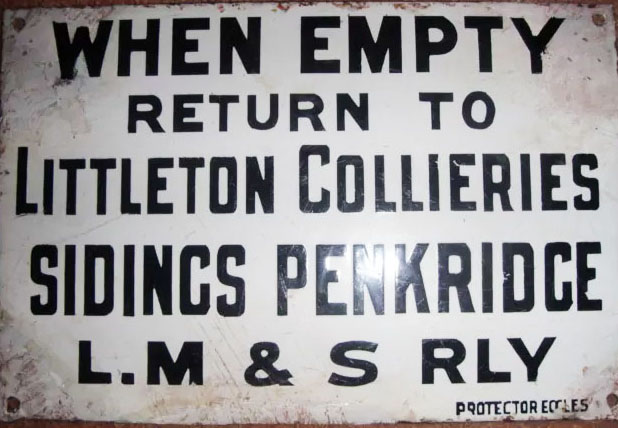
Littleton Wagon Plate
However, we were alerted recently to an enamel wagon plate – ‘When empty return to Littleton Collieries Sidings Penkridge. LM&S Rly’. This would have been a nice addition to our collection of local artefacts, but, despite the best efforts of Rob Cadman, acting on our behalf, we were unlucky with a bidder being found at £150 but prepared to go much higher.
Following this disappointment we then heard of a member who spotted a rather nice Midland Railway, Walsall Wood to Walsall third class return ticket available on ebay. Tickets to or from Walsall Wood and Brownhills (Midland) are pretty scarce and this example realised £102, which I suspect rather surprised our man who had expressed interest in it on our behalf.

Our thanks go to Rob Cadman, Simon Swain and Kevin Pettifor for trying their best for the museum.

Walsall Wood opened 1st July 1884 and closed 31st March 1930, along with Brownhills (Midland), the latter having been renamed Brownhills Watling Street 2nd June 1924. So two items which we would have liked ‘got away’ – but we have photos.

Walsall to Walsall Wood ticket

Chasewater Railway Museum – 3 photos of Hawthorn Leslie loco ‘Asbestos’ (Not forgetting ‘Sentinel’)

Chasewater Railway Museum

3 photos of Hawthorn Leslie loco ‘Asbestos’ (Not forgetting ‘Sentinel’)

A few photographs sent to us by Robin Stewart-Smith, taken at a Gala in 2004.  (Hard to believe that it’s 12 years ago).

The first two are of ‘Asbestos’ pulling into Chasetown Church Street, and the third was taken at Brownhills West, ‘Asbestos’ and Sentinel’.  Both locos on freight duties.

Asbestos 1

Asbestos 2

Sentinel & Asbo

‘Asbestos’  Hawthorn Leslie 0-4-0 ST 2780-1909

‘Sentinel’  4wVBT  9632-1957

Chasewater Railway Museum – Another visiting Loco – Port Talbot 0-6-0ST No. 26 (GWR 813)

Chasewater Railway Museum 

Another visiting Loco

Port Talbot 0-6-0ST No. 26 (GWR 813)

003_IMG_0211

Photo – Elja Trum

This locomotive is a six-coupled 0-6-0ST Saddle Tank No.813 under the Great Western Railway numbering system but was built for the Port Talbot Railway & Docks in 1901. The Port Talbot Railway & Docks Company was formed in 1894 to work the docks of the town. The Railway opened several branches especially those to the Llynfi & Garw valleys. This attracted a heavy coal traffic, which was dealt with at Duffryn Yard.
In 1901 the PTR ordered a number of small 0-6-0 saddle tank locomotives (six in all) from Hudswell Clark of Leeds & was given the works No. 555/01 & on delivery it became PTR No.26. In this guise it was put to work in Duffryn Yard & served in this capacity until 1908 when the PTR was absorbed into the GWR system. However, no changes were made to the loco at this time until the grouping which brought changes to No.26 in that it was first Westernised & given the GWR number 813.
The GWR decided later however that the older absorbed locos should be sold off out of service & No.813 fund itself on that list in 1934. It was sold to a Backworth Colliery, Northumberland where it was again renumbered as No.12 & remained there for the next 33 years. The No.12 did not stay for long though, as when the colliery was absorbed in to the National Coal Board when it was formed in 1947 it became NCB No.11
In 1950 it was fitted with a new boiler & firebox. However the original GWR boiler fittings were retained. As steam working was nearly at an end hastened by the closing of collieries, older locos were withdrawn in the late 1950’s & early 60’s with 813 lasting until the summer of 1967.
The loco was duly discovered by Mr. Paddy Goss & attempts to preserve it were ultimately successful for he was able, after a great struggle to raise funds as is ever the case in the preservation scene, to purchase the loco. The loco arrived at the Severn Valley Railway in November 1967 with sufficient finance available to pay for the removal charges. Since then much loving care & a great deal of money has been spent keeping 813 in its present condition.


Chasewater Railway Museum – A photo of a Tackeroo Military Railway loco & Brocton Camp Power Station, plus the loco’s history.

Chasewater Railway Museum

A photo of a Tackeroo Military Railway loco & Brocton Camp Power Station, plus the loco’s history.

Brocton Camp Railway Traffic Office Dave Bevington

The photo was sent to me by Dave Bevington, with the following information:
‘I have come across a Great War photo at Brocton of the power station and Brocton railway traffic office (a small shed). In the foreground is a small loco Grassholme which is mentioned on your blog
I got it from NZ so it must have been a photo card owned by a Kiwi based there.’

Grassholme

Grassholme
Manning Wardle Class L 0-6-0ST 1513-1901

New 6-9-1901 to the firm of contractors, Walter Scott & Middleton.
The contractors had work around 1901-2 for the Derwent Valley Water Board on a line Banford to Ashopton, Derbyshire, also for the Midland Railway on widening the New Mills to Chinley section, also in Derbyshire. Another job was at Pallion, in the Sunderland area.
It seems probable that the loco took its name from Grassholme in County Durham.
The contractors known to have worked on the Cannock Chase Military Railway and Brocton Camp were the firm of Baldry, Yerburgh and Hutchinson, but there is no 1513 in the list, although their loco No.4 is listed as No.1531 !
Grassholme was at Brocton during the period 1915 – 1919.
For more information about the railway, go to:

http://www.rmweb.co.uk

Tackeroo – The Military Railway

Model

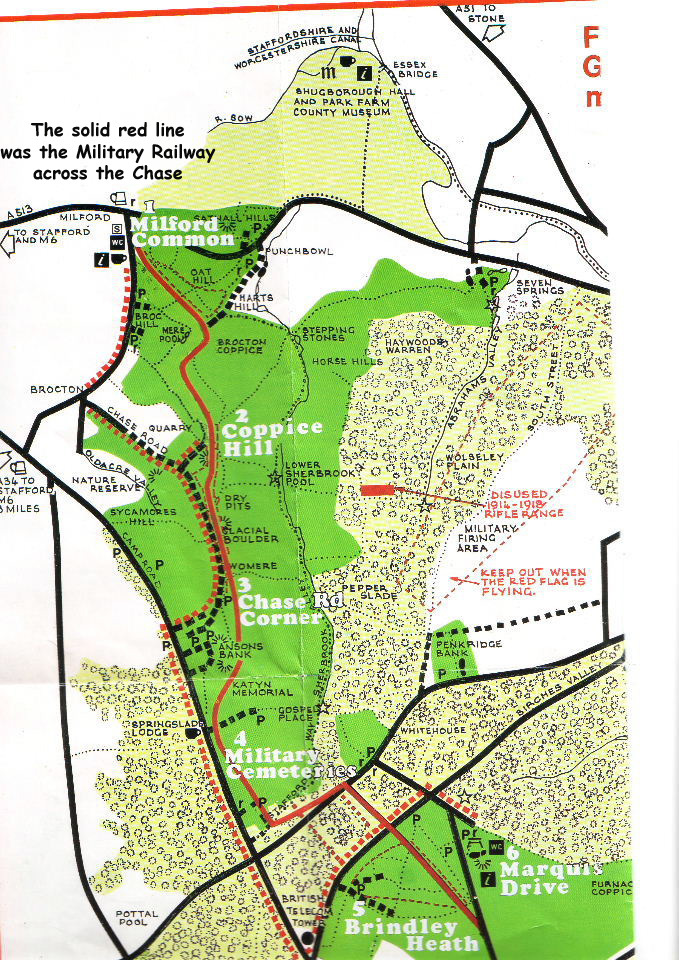
cannock-chase-great-war-trail Map

More about the loco

The original owners sold the loco to Thomas Summerson & Sons Ltd., Albert Hill Foundry, Darlington and it was seen at Crewe Works in June 1919 as war surplus before sale to Vivian & Sons, and then to one of Vivian’s Collieries – Mynyyd Newydd, Swansea.
The Colliery was sold in 1926 and the loco remained with the new owners. The Industrial Railway Society West Glamorgan book gives the loco as ‘disposal unknown’ after March 1932. The pit closed in November 1932. It re-opened in 1935, finally closing in 1955.
Thanks to Barry Bull, Pete Stamper and the IRS for the information and to Dave Bevington for the photograph.

Cannock Chase (Tackeroo) Railway in brief

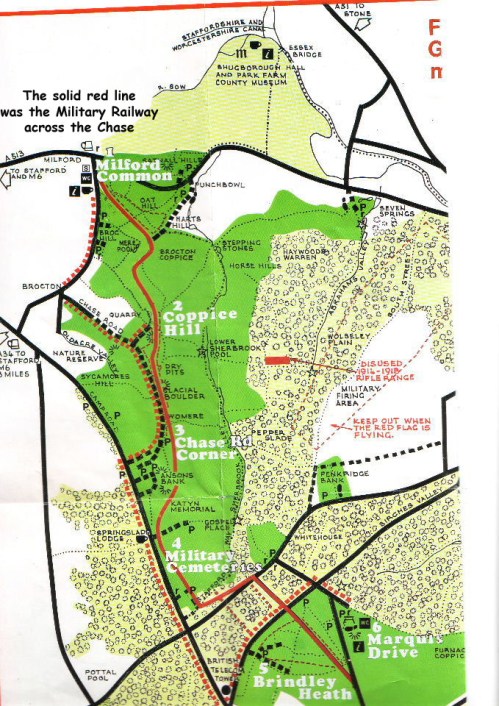
This railway was constructed during 1915 to serve the Brocton and Rugeley Military camps located on Cannock Chase.  One line was constructed during the spring of 1915 from the LNWR Cannock to Rugeley line near West Cannock No.5 Colliery across the Chase to the Rugeley Camp.  Between January and April a second railway was made from the LNWR Trent Valley line at Milford to the Brocton Camp, and by mid 1915 the lines had been joined.  In addition to army and prisoner of war camps this railway system served Central Stores Depots at Brocton Camp.  The locomotive shed was also located at Brocton Camp. After the war the camps and railway were dismantled and locomotives disposed of.

Chasewater Railway Museum – Another Visiting Loco – J94 No.68009

Chasewater Railway Museum

Another Visiting Loco – J94 No.68009

Including video

68009

68009

Information – Great Central Railway

Although locomotives of this type are generally known by their LNER classification, J94, the design originated with the Hunslet Engine Company of Leeds in 1937. The J94 locomotives gained their claim to fame when, in 1942, they were chosen as the basis for a standard shunting locomotive for war service.
68009 was built in 1953 as Hunslet works No. 3825 for the National Coal Board and sent to the Kent coalfield. Although the locomotive ran for many years on the Great Central Railway in early British Railways livery, it was never a BR locomotive and therefore the number it carries belongs to a locomotive long since scrapped. However, it was discovered that the boiler was first fitted to the real 68009 and so it was felt appropriate to finish the loco in this livery. 68009 operated at the Snowdown Colliery near Deal in Kent.


68009.3