Tag Archives: Chasewater Railway Museum

Chasewater Railway Museum – three new models

Chasewater Railway Museum

Three new models – Hornby ‘0’ Gauge

Our Curator has been busy again, acquiring 3 new (to us) Hornby ‘0’ gauge model wagons.

dscf5293

The first one is a Hopper Wagon, with its box.

dscf5299

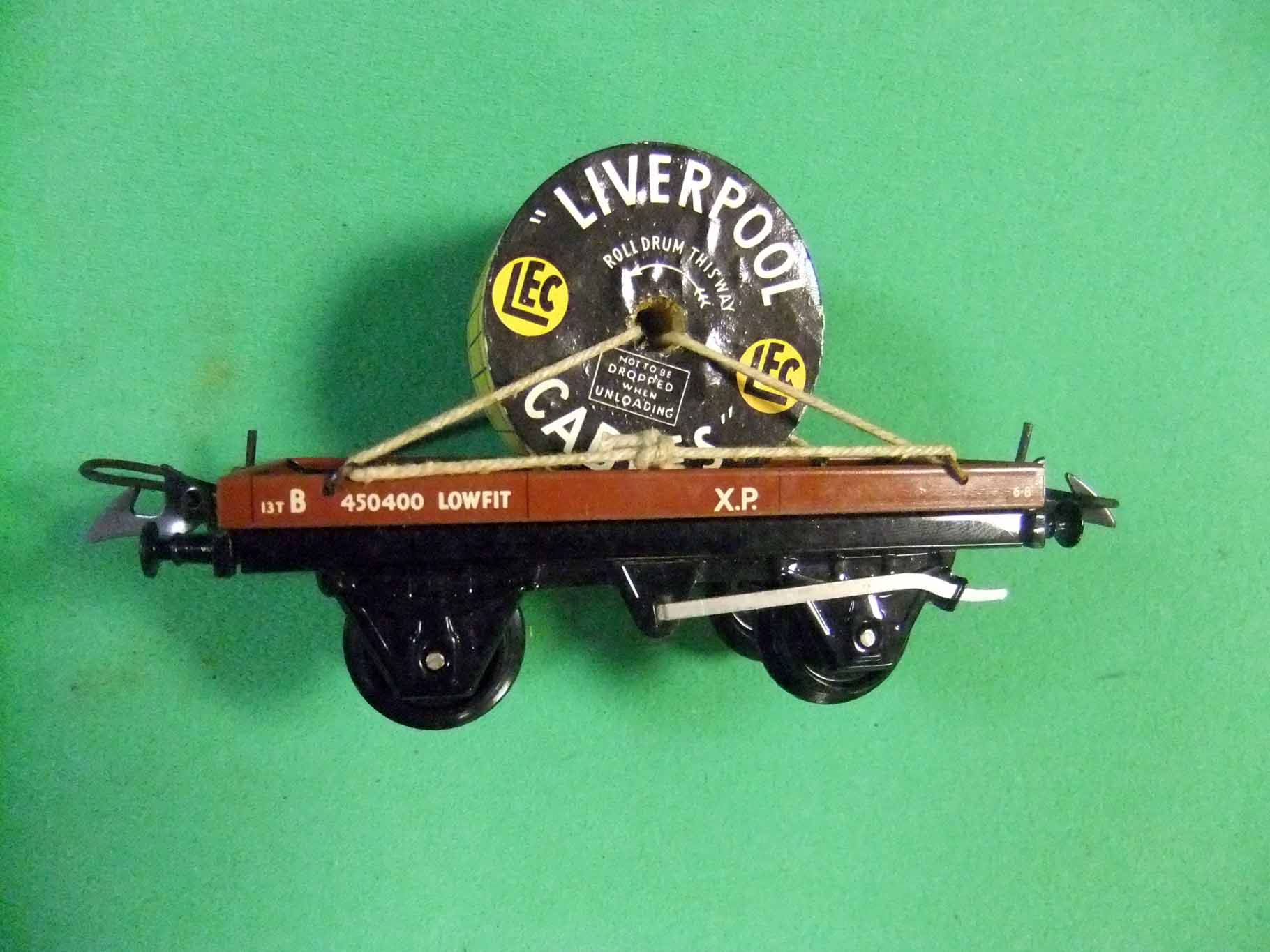
The next one is a Lowfit wagon, with cable drum and box.

dscf5298

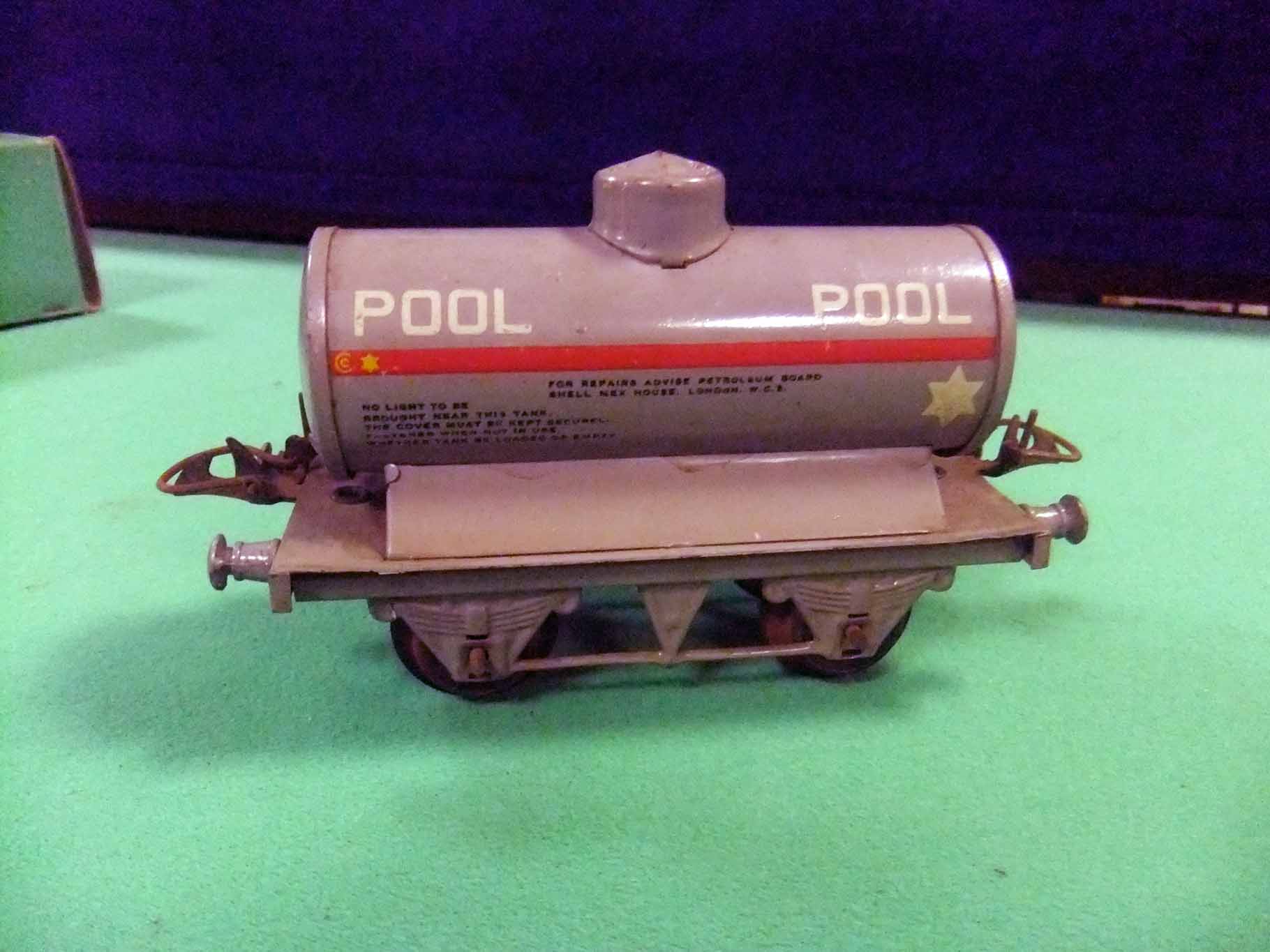
The final one is a ‘Pool’ Tank Wagon, this time without its box.

They are all in the museum, in Display Cabinet 2.

Chasewater Railway Museum – A photo from inside the museum

Chasewater Railway Museum

A photo taken inside the museum

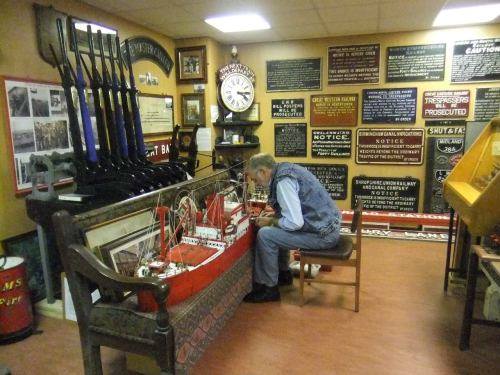
I have been sent this photograph of one of our ‘helpers’ inside the museum, working on one of the Meccano models.  It shows a view around part of the museum, including, among other items, some bridge plates and the lever frame from Hemyock.

joe-in-museum

This photo was taken before the bench was recovered – it is now covered in an attractive blue material.

Sad to relate, after all our man’s work, it still wouldn’t float!!!

Chasewater Railway Museum – 2 new photographs

Chasewater Railway Museum

2 new photographs

Brereton Sidinngs Signal Box

Brereton Sidinngs Signal Box

The first photo is another photo of Brereton Sidings signal box.

Edward Dorricott paid £2.50 for the photo and gave it straight to Barry Bull.

Edward Dorricott is the author of te recently published book on Duttons Signal Works, Worcester, in which Chasewater Railway Museum gets more than one mention.

boat

This second photo has a couple of question marks hanging over it, which I hope we may get answers to.

‘Captain Midnight’ is a former naval officer named Glover, but we are not sure of his rank – possibly Lieutenant Commander or Commander.

Thank you Pete Styche for the following information:  GLOVER Gerald (Lt. Commander R. N. Rtd.) Passed away 12th October 2014 aged 76 years.

He was an occasional benefactor of the Railway, whenever he paid a visit there was always a donation in the box and maybe some good magazines donated.

The next question is who is his friend?

And finally, where was the photo taken?

Save

An old Chasewater Railway Photograph From the Industrial Railway Society’s September 2016 Magazine

An old Chasewater Railway Photograph

From the Industrial Railway Society’s September 2016 Magazine


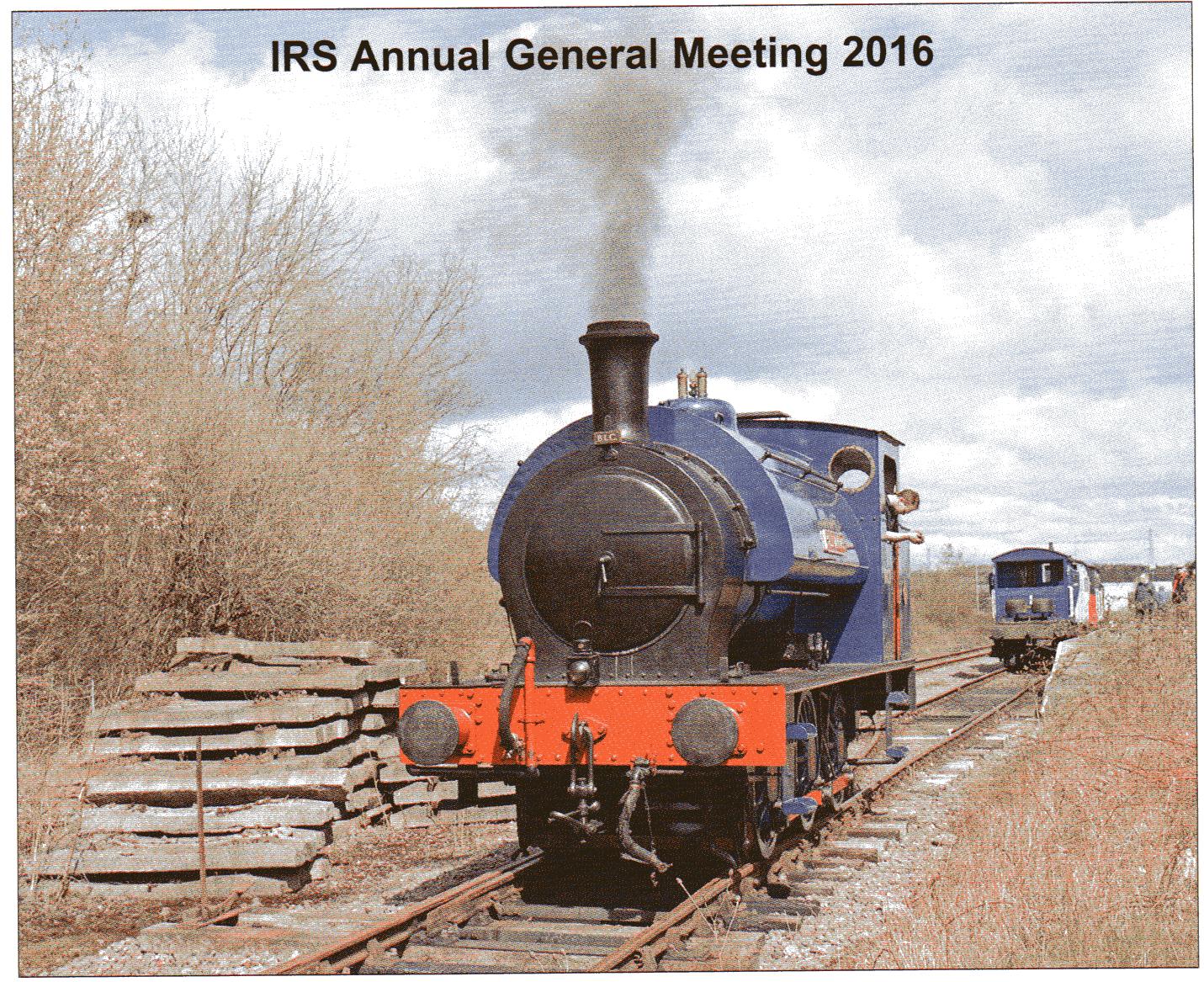
The IRS’s AGM took place on Saturday 16th April 2016 at Chasewater Railway.

It was enjoyed by IRS members and the members of the Railway who were involved in running special trains for the Society.

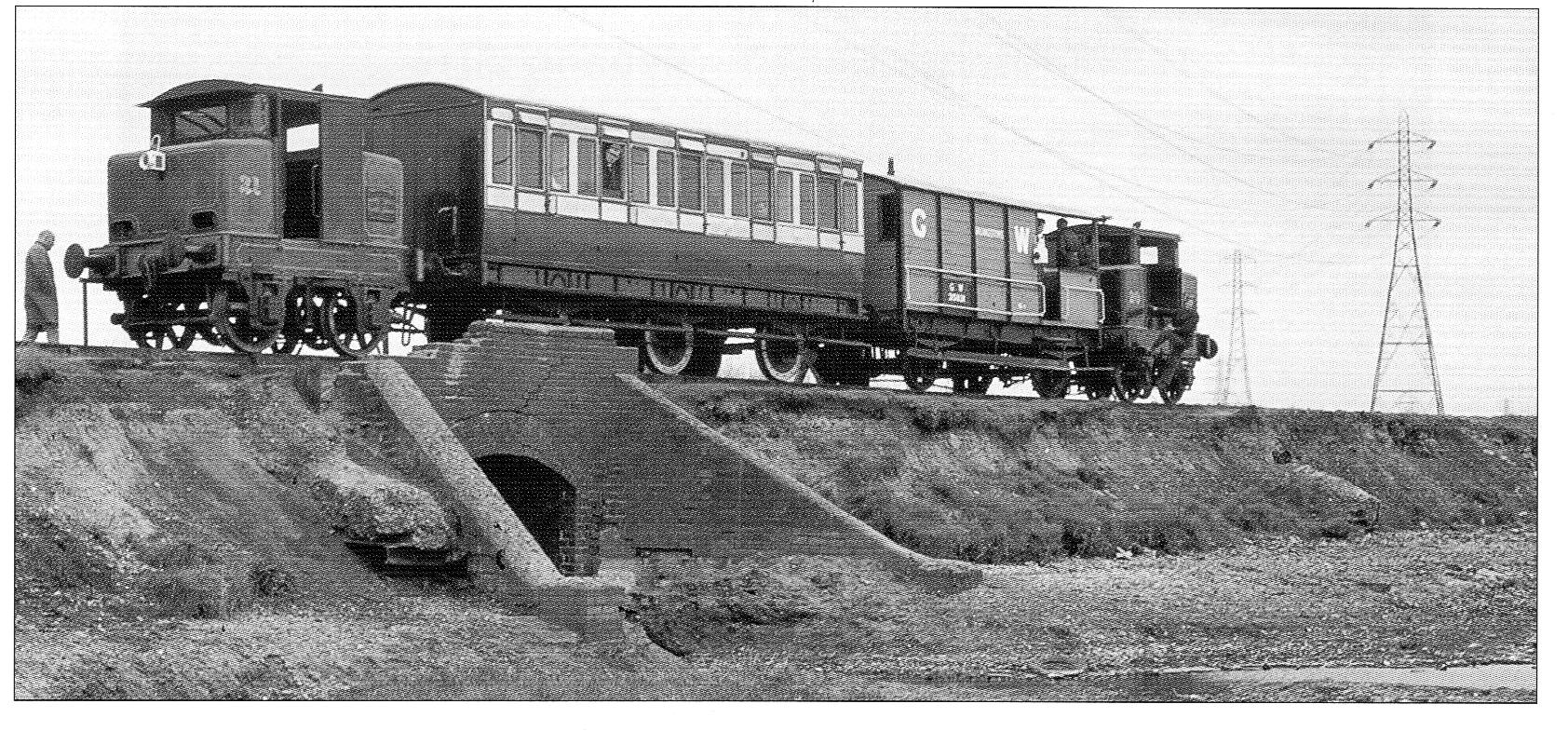
20&21This photograph was taken by Cliff Shepherd at the IRS AGM weekend in April 1972.

On the Sunday, visits were made to Chasewater and members travelled in the Maryport and Carlisle carriage of 1875 vintage and the Great Western Brake Van, which now, in 2016, is restored to its former glory.

The locomotives involved topping and tailing were two former Worthington Brewery Planet locomotives, nos. 20 and 21, on what was then a very basic railway.

Holly Bank IRS

Holly Bank No.3 (Hunslet 3783-1953) runs around after the first of the IRS trains at Chasetown Church Street Station on 16-4-2016.

Chasewater Railway Museum – Another Flyer comes to light

Chasewater Railway Museum –

Another Flyer comes to light

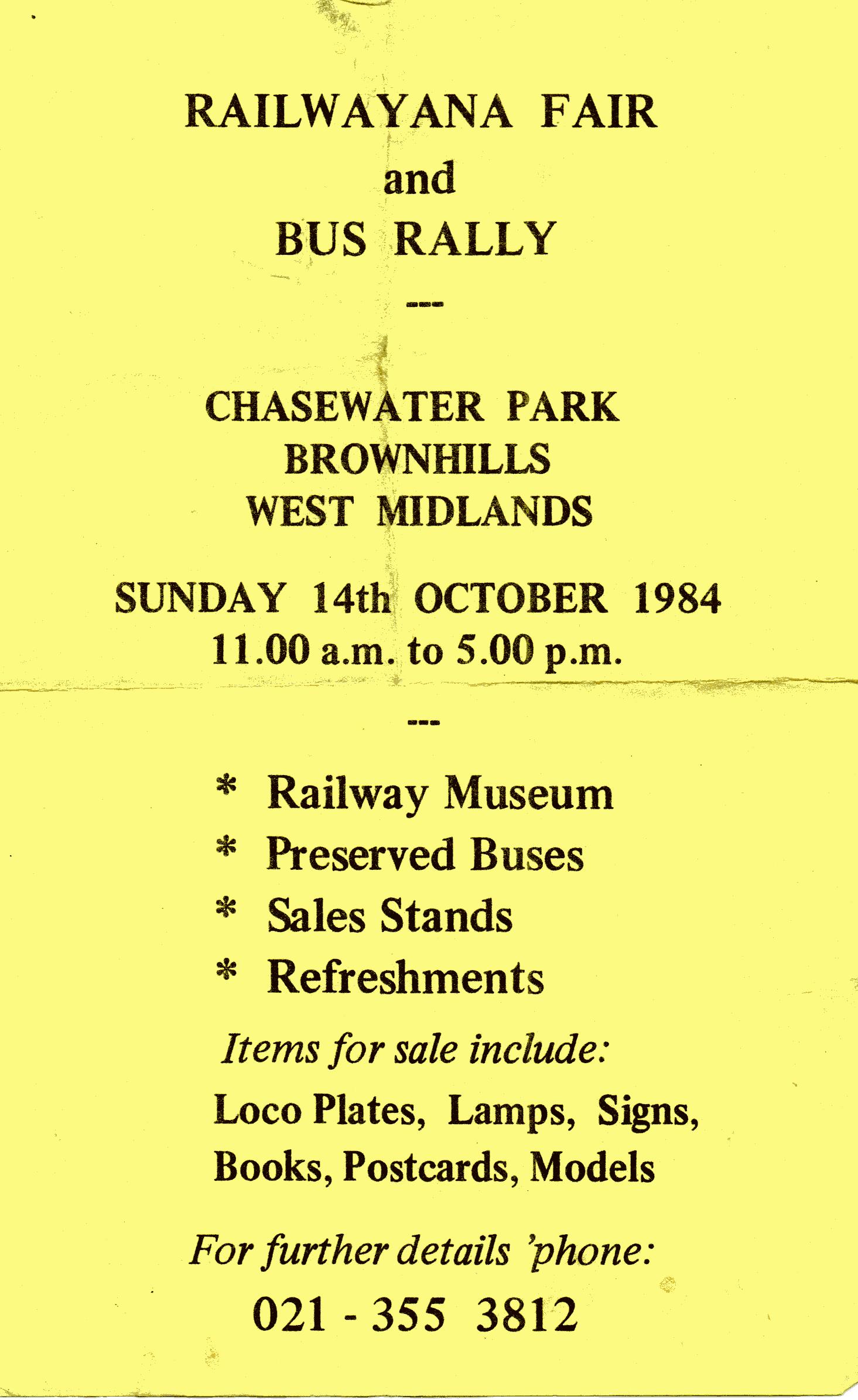
This time it’s a Railwayana Fair and Bus Rally, held at the time, in the early eighties, when Chasewater railway was not running trains.

A few enthusiasts kept going at Chasewater trying to raise funds for the time when the railway re-started operations.

Flier Railwayana 1984

Save

Chasewater Railway Museum – September Newsletter

Chasewater Railway Museum 

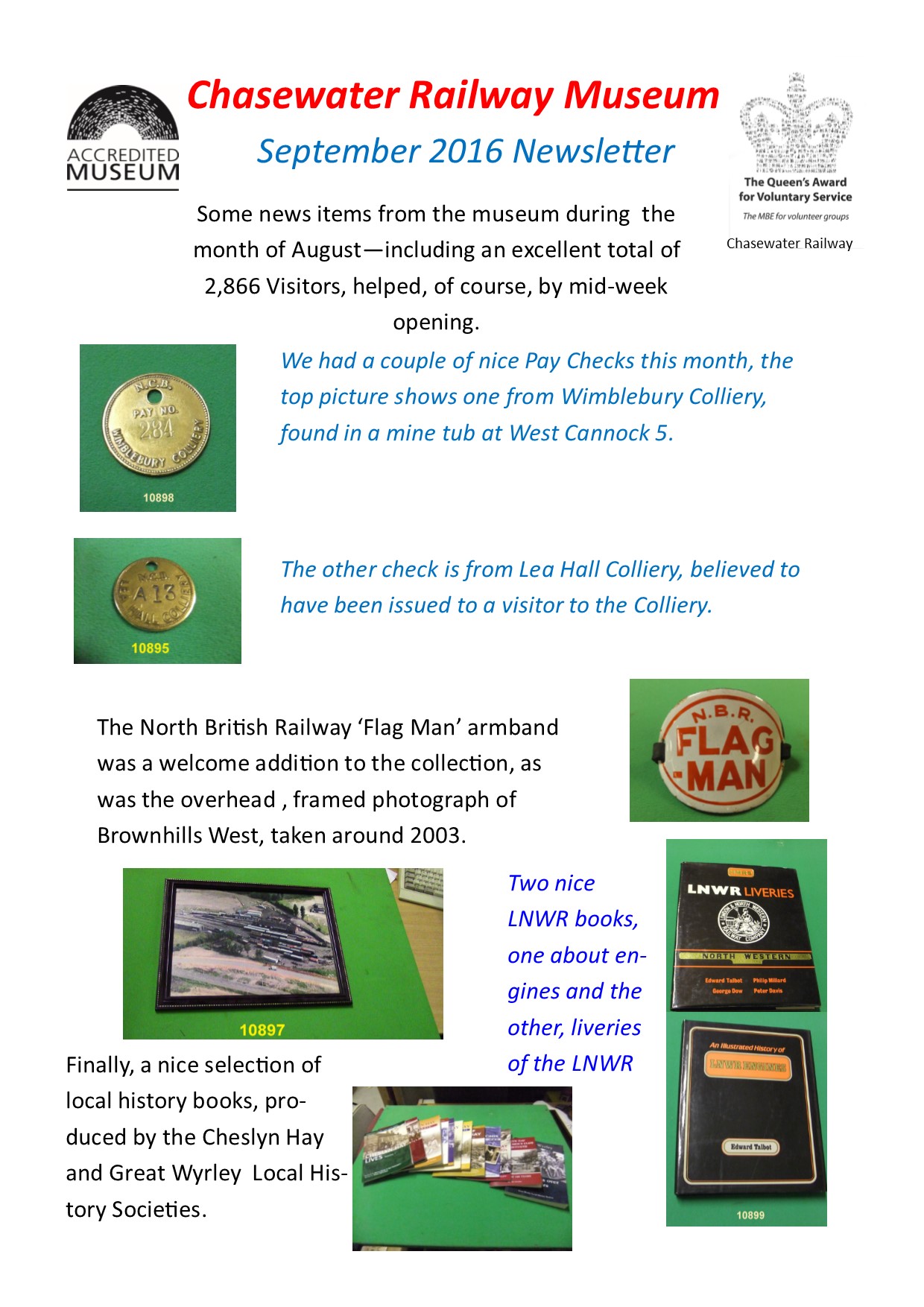
September Newsletter

September Newsletter

Save

Save

Save

Chasewater Railway Museum – An Addition to our collection of Armbands

Chasewater Railway Museum

An Addition to our collection of Armbands

Armbands in case.jpg 

The later years of the 19th century saw increasing standardization on the railways, not least in the armbands worn by three types of railway worker – pilotmen, flagmen and lookout men.  The one worn by pilotmen was issued by the signal department and was made of red cloth with white stitched letters, and was secured by leather or elastic straps.

The armbands for flagmen and lookout men were made of enamelled steel plate, cut into an oval and shaped to fit the arm.  A pair of slots was cut into the plate, through which a pair of leather straps, with buckles, was attached.  Issued by the permanent way department, these enamel armbands were finished in white with red lettering.

A pilotman was a signal department employee whose job was to ride on the locomotive acting as a kind of human staff or token if the signalling on a single line failed, or if there was an accident or obstruction which closed one of the lines of a double track.  No train could proceed without him in such an emergency, so that the possibility of a head-on collision was avoided.

The lookout man was quite simply that.  His job was to keep a sharp lookout when a permanent way gang was working on the track, and to give a warning for it to stand clear as soon as he saw an approaching train.

The flagman was another permanent way ganger, who used green, yellow or red flags to communicate with signalmen or other permanent way staff who were out of audible range.All three posts were – and still are – crucial to the safety of both passengers and railway employees, and armbands were issued to emphasize this fact and to avoid misunderstandings.  A modern variety, coloured pale blue with white letters, was used on British Rail.

London, Midland & Scottish Railway Armband.

317

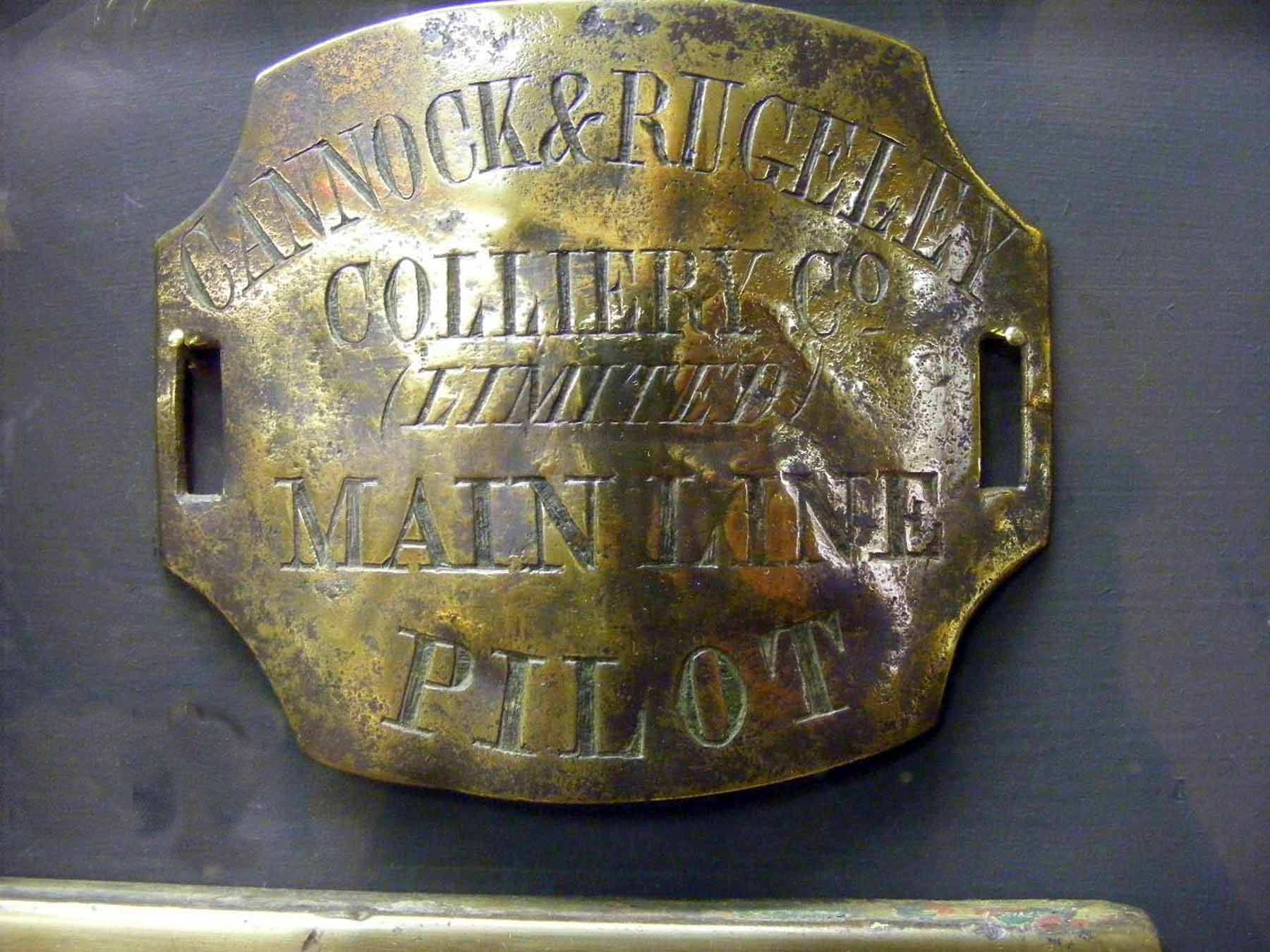
This armband is still my favourite.  A brass Cannock & Rugeley Colliery Main Line Pilot Armband, dug up in a field by a farmer while ploughing some years ago – considerably battered and bent over double!

Save

Save

Save

Very Early Days at Chasewater – With thanks to Trevor Cousens and Ian Pell

Very Early Days at Chasewater –

With thanks to Trevor Cousens and Ian Pell

Photo by Laurence Hodgkinson

Photo by Laurence Hodgkinson

Chasewater Railway Publications No.2 – Winter 1965

Chasewater Railway Publications

No.2 – Winter 1965

First posted in 2010

Another couple of bits and pieces from the Railway Forum – Winter 1965.  The first is a display of name and number plates, loaned by one of the members, and laid out in the Royal Saloon – which left Hednesford  in  1970 for the British Railways carriage works at Derby for restoration and then on to the Midland Railway Centre at Butterley.

Midlands RPS Open Day display

An interesting display of locomotive nameplates and numbers was arranged in the Royal Saloon for inspection by visitors at the Midlands R.P.S. Open Day.

New locomotives preserved in Midlands

Members of the Midlands area, R.P.S. expect to take delivery of another locomotive later this year which has been acquired through the generosity of one of their members, Dr. P.G. Plummer, who has offered to purchase it for them.

The locomotive is a Hudswell-Clarke 0-6-0ST built for the Sheepbridge Coal and Iron Company in 1895 (Works No. 431).  It was transferred to its present location, Desborough Warren Quarry, Northamptonshire, in March 1951 and was due for withdrawal in July.  It is believed to be the oldest Hudswell-Clarke locomotive still in working order and once carried the number 15.  Now it has no number or name, although known as “Sheepbridge No.25”.

Painted in apple green it should be a valuable addition to stock already acquired, and will be of considerable use at the Chasewater branch line which has been leased by this group.

Two other locomotives have also been donated by the Whitecross Co. of Warrington.  They are Peckett 0-4-0STs of 1900 and 1904 vintage.  They were withdrawn from service by the Company in 1961, being replaced by two Fowler diesel locomotives.  They carried names up to withdrawal, the older being “Baden Powell” and the younger “Lancet” the nameplates of the latter being transferred to the Diesel No.1, and those of the former being acquired by local enthusiasts.  Only “Lancet” will be able to run again.  It is hoped to exhibit “Baden Powell” statically.

The second is about new locomotives coming to Chasewater.  Sadly the Hudswell Clarke, although we still have the loco, has never steamed here. The two Pecketts fared even worse.  The ‘Lance’ (not Lancet) 1038/1906 was scrapped in March 1972, and another Peckett – 1823/1931 was also scrapped at the same time.  The Loco ‘Baden Powell’ was in too bad a condition to be moved.  The other loco was an 0-4-0F a fireless Andrew Barclay locomotive 1562/1917 – scrapped in March 1973.
The articles were writtten in 1965, the photos taken in 1969

Chasewater Railway Museum – A 1991 Flyer for the Railway

Chasewater Railway Museum

A 1991 Flyer for the Railway

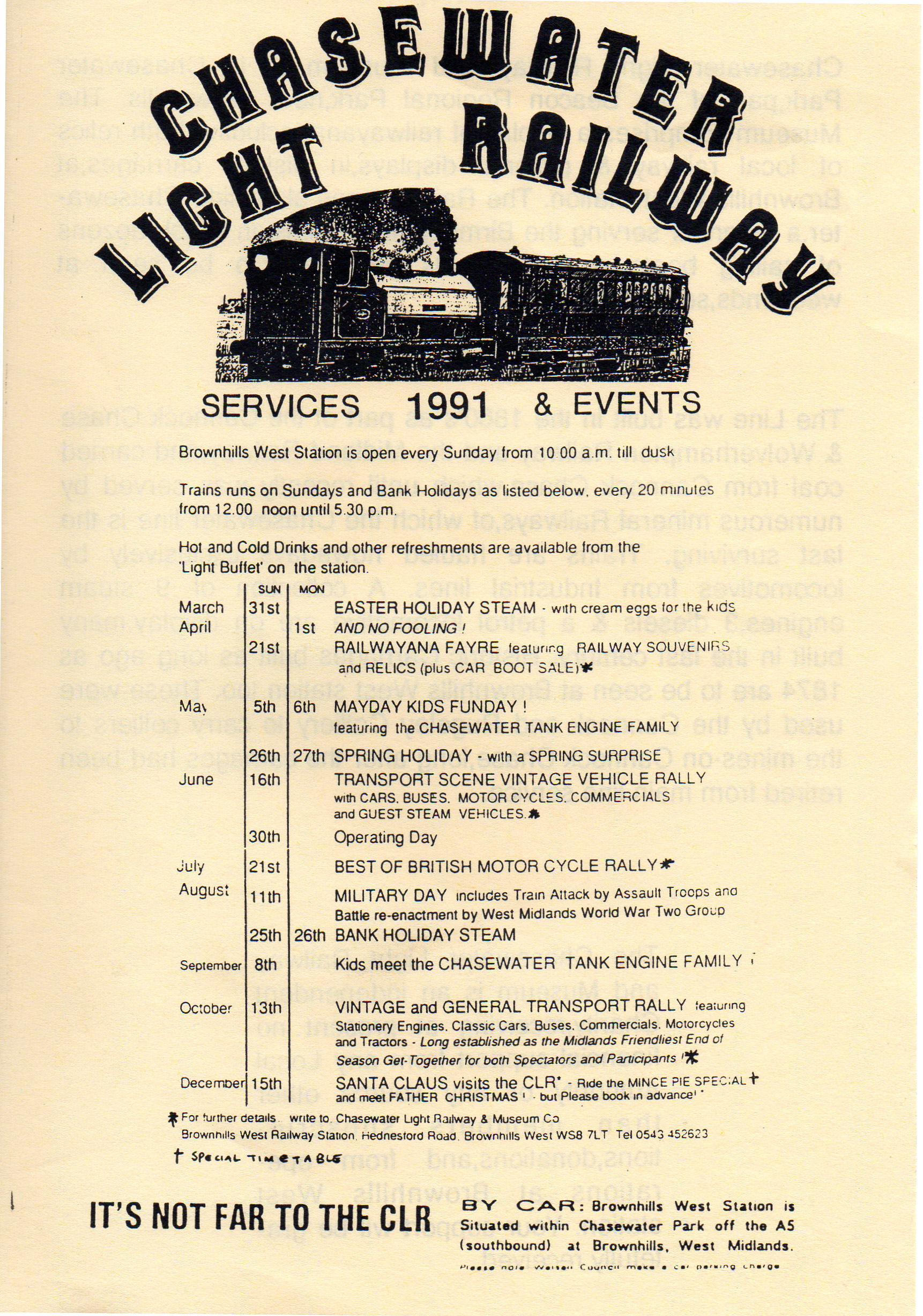
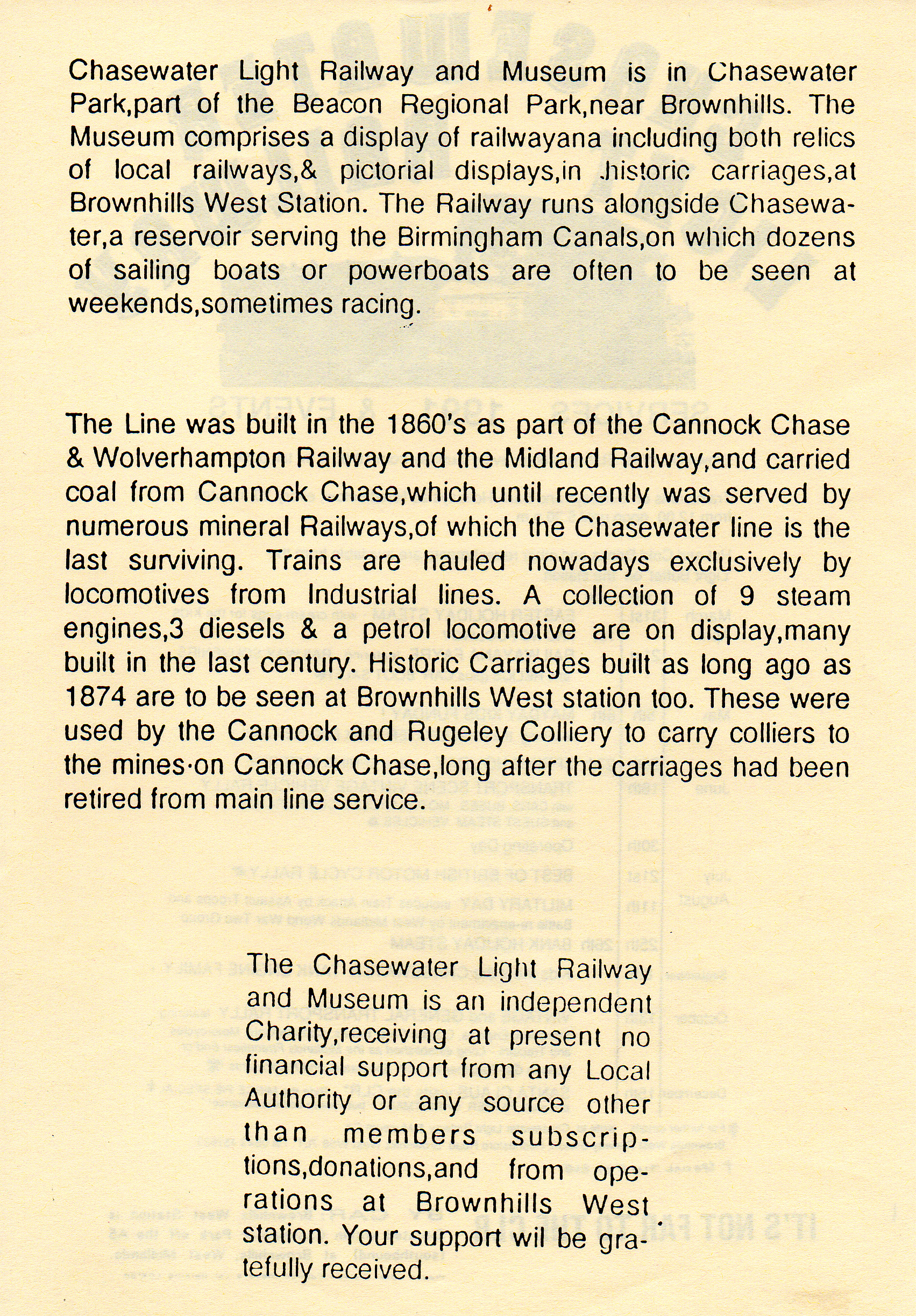
This double-sided flyer recently came to light in the museum.  It is now 25 years old and I found it to be interesting – I hope you do as well.

The running line in those days ran from the old Brownhills West Station (now in the middle of the M6 Toll) to the Willow Vale Bridge.  Push-pull obviously.

Front

Back

It will now be tucked away in our Chasewater Light Railway archives.