Tag Archives: Steam Trains

The Latest Addition to the Chasewater Railway Museum Loan Items

The Latest Addition to the

Chasewater Railway Museum Loan Items

Today, March 6th 2014, The Chasewater Railway Museum received a visit from members of the Industrial Railway Society.  The principal reason for this visit was for the IRS to receive, on loan, a nameplate from the locomotive ‘Rothervale No.0’ from Mr. Bernard Mettam, and in turn, and with Mr. Mettam’s approval, place it on loan with the Chasewater Railway Museum.

 Rothervale No.0 Nameplate

 DSCF9297

The above pic was taken on arrival, the one below was taken on 16-6-2015, after a little(!) attention from Pete Stamper.DSCF0792

‘Many industrial locomotives are names or numbered for identification purposes, or sentimental reasons.  For various reasons very few were given the number ’0’.  Perhaps the most famous in this category was locomotive ‘Rothervale No.0’ whose nameplate is displayed here.  The locomotive was cut up in October 1959, but fortunately both nameplates were rescued by Mr. Bernard Mottram.

The locomotive, an 0-6-0 inside cylindered saddle tank, was built in 1879 by Beyer Peacock (works number 1830) in Manchester and became No.1 on the East & West Junction Railway, which later (1909) became part of the Stratford-upon-Avon and Midland Junction Railway.  In April 1890 the loco was sold to the Rothervale Collieries Ltd. and carried its new name ‘Rothervale No.1’ on a pair of cast brass nameplates attached, one on each side, to the saddle tank.  The loco was employed at Treeton Colliery located in the River Rother Valley just to the east of Sheffield.

Further locos were acquired by the colliery and named in a similar manner, i.e. ‘Rothervale No.’ followed by a single digit up to ‘9’, in the order of arrival.  In 1929 a new outside cylinder 0-6-0 saddle tank adorned with the cast nameplates ‘Rothervale No.1’ was delivered from the Yorkshire Engine Co.  It is possible that a mistake was made and it should have been ‘No.10’, (following No.9).  Confusion could now arise because there were two ‘No.1s’ at Treeton.  One of them had to be renumbered and there was space for a single digit only on the nameplate.  The decision was taken to renumber the Beyer Peacock to ‘No.0’, possibly because it was an earlier build than the Yorkshire.  The ‘1’ was chiselled or ground off the nameplate and replaced by a brass ‘0’ digit screwed on in the space created.  Brass ‘0’digits, slightly smaller then those on the nameplate were also attached to cab side sheets.

DSCF9294

The photograph was taken on 12th March 1955 at Treeton Colliery by Mr. Bernard Mettam, to whom the Chasewater Railway Museum is indebted, by way of the Industrial Railway Society, for the loan of this most unusual nameplate.

Thanks are due to Mr. Adrian Booth for some of the above information.’

DSCF9304

After the presentation of the nameplate by Bernard Mettam to Ian Bendall of the IRS, ( with the Railway’s Mr Bull waiting patiently!) the group adjourned to the Sidings Tea Room to enjoy one of Craig Wilkinson’s excellent Carvery Lunches.

The Industrial Railway Society also  extended the existing loan agreement for the Eric Tonks Collection for a further two years.

The Chasewater Railway Museum is most grateful and proud to house all of these items.

IRS Coll

Photos from the Archives – the old Brownhills West

Photos from the Archives

The old Brownhills West


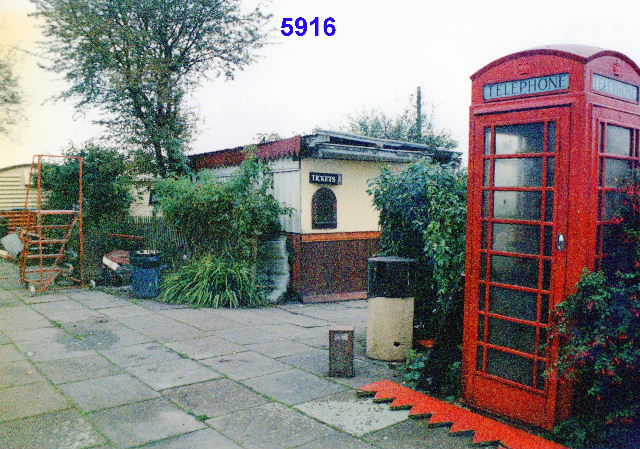
A couple of photos of the old Brownhills West Station

5900

5916

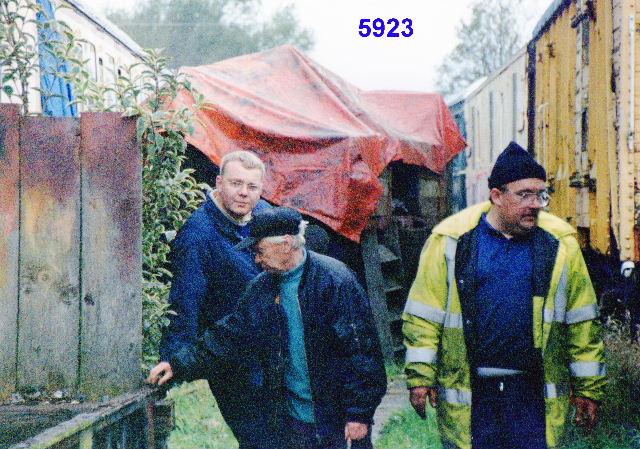
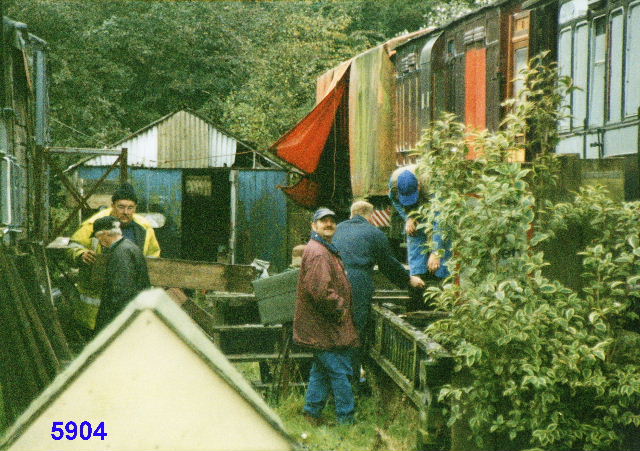
Clearing out the old Brownhills West Station Yard

5923 

5904

5912 

Before starting the new…5899

Photos from the Archives – These are from David Ives’ Collection – Sans Pareil

Photos from the Archives

These are from David Ives’ Collection

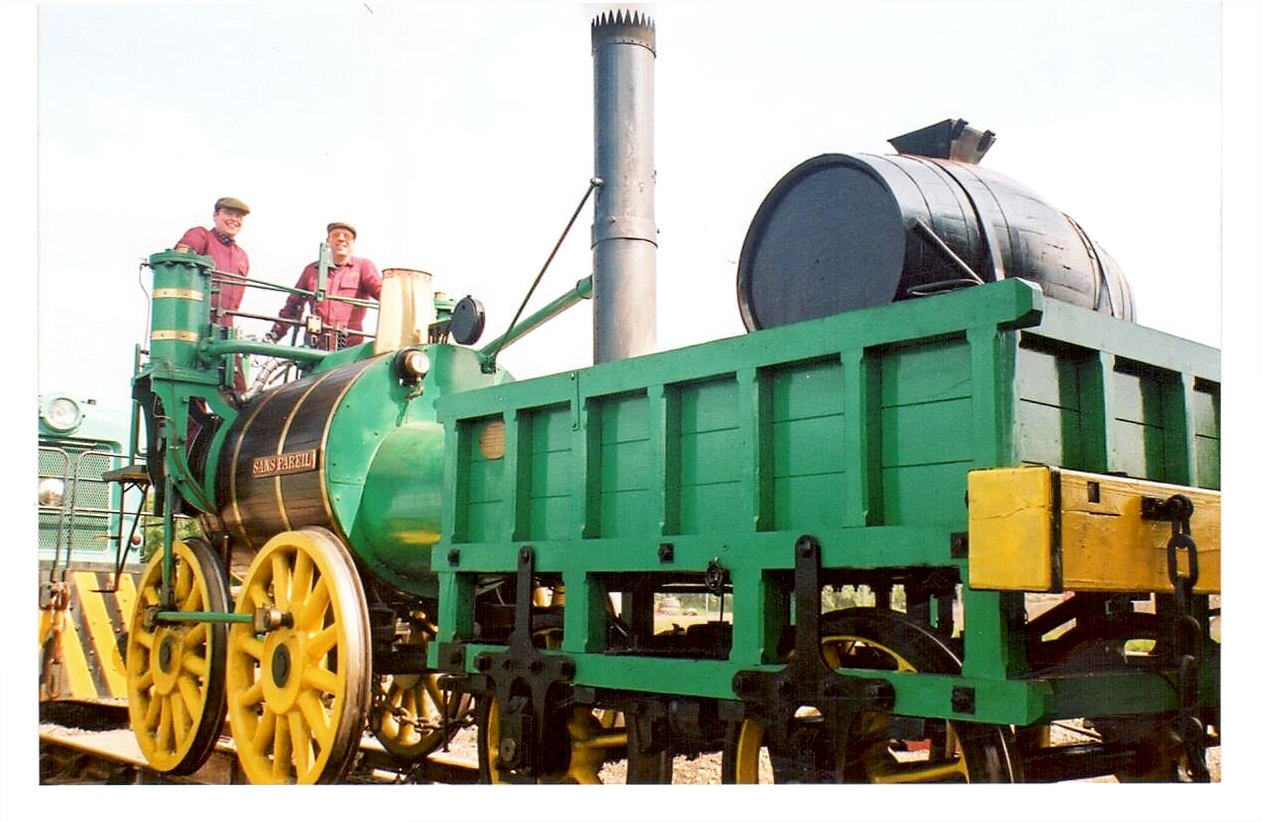
Sans PareilOutside the shed

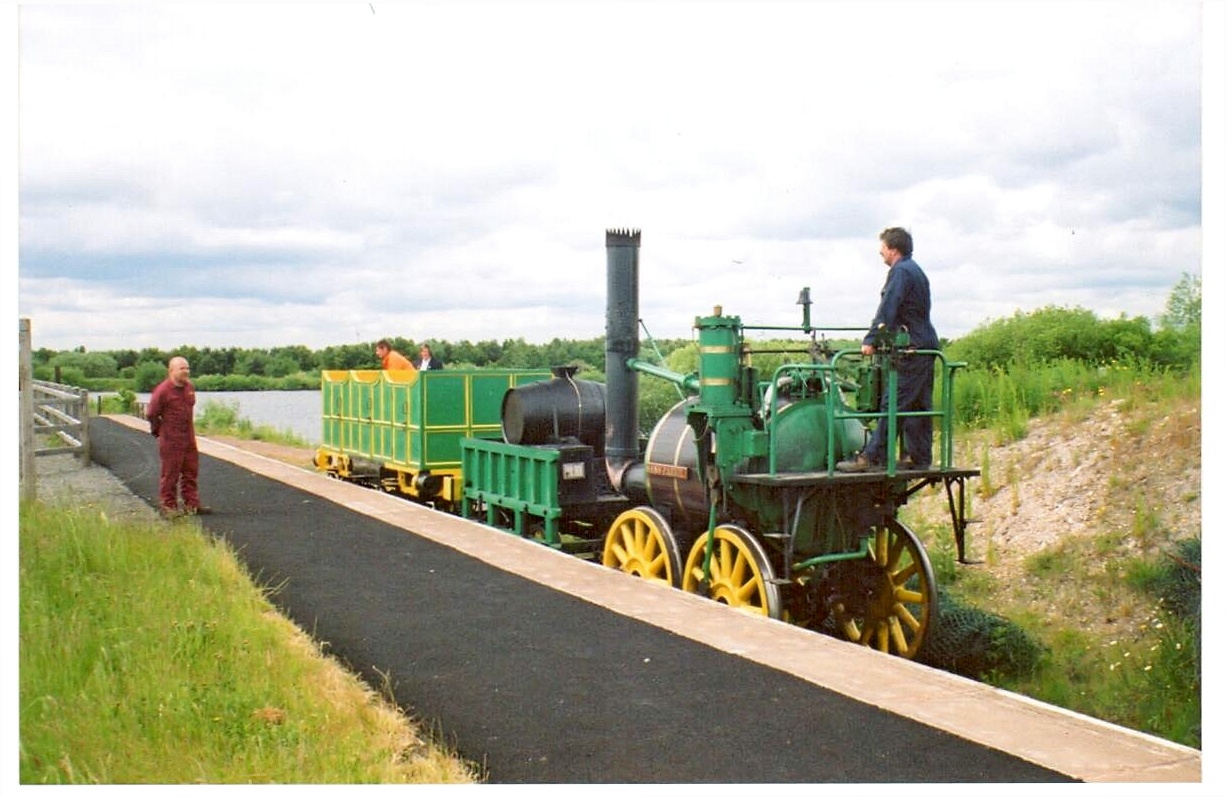
Sans Pareil is a replica of Timothy Hackworth’s 1829 locomotive which competed against Stephenson’s ‘Rocket’ at the famous Rainhill Trials.

This locomotive came to Chasewater in 2001 and 2002 and proved to be very popular with railway enthusiasts and the general public alike.

Passenger train services ran between Brownhills West and Chasewater Heaths, alternating between Sans Pareil and Sentinel.Engine ShedOutside the loco shedLoading up at Brownhills WestLoading up at Brownhills WestChasewater HeathsChasewater Heaths

LakesideAt Lakeside

Museum Exhibits – Sectioned model steam loco

Museum Exhibits

This item was given to the Chasewater Railway Museum by a gentleman from Cannock, Staffs in 2009 and is on display in the museum.

849 Sectioned Model in museum

This model was purchased by the donor from the makers in Bury, Lancs in 1979.   It was produced along with 3 other models for Bangladesh Railways, but was not sent due to there being no Letter of Credit forthcoming.  The other 3 were probably scrapped.  It is loosely based on a Royal Scot Class locomotive.

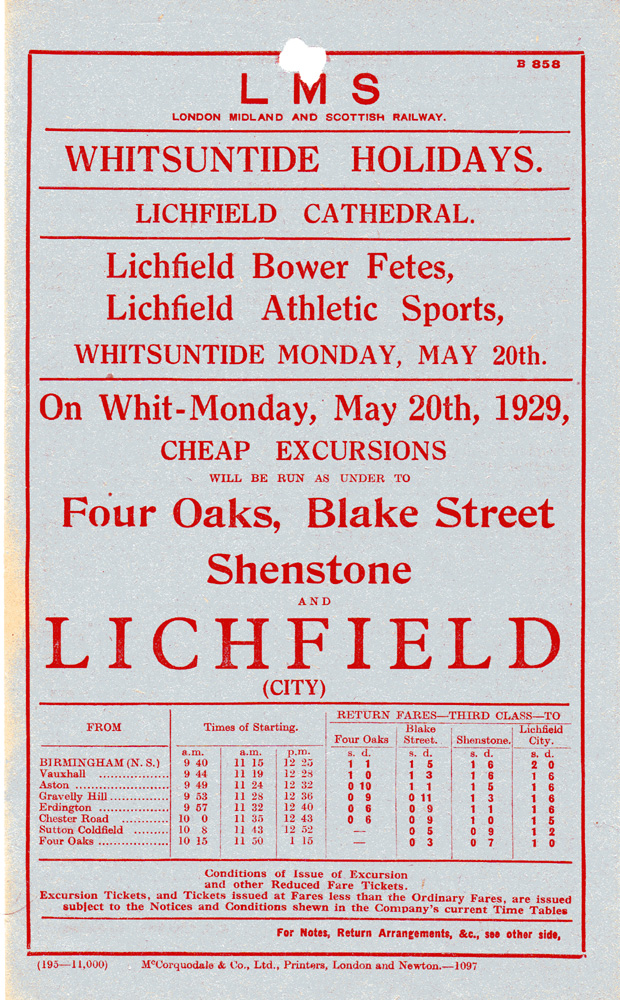
From the Archives – Another Handbill

From the Archives

Another Handbill

This time a Whitsuntide Holiday Excursion from New Street to Lichfield City for 2/-  (10p) return.  This was the May Bank Holiday before it was moved to the first Monday of the month.

An LMS trip in 1929 to the well-known Lichfield Bower.8076

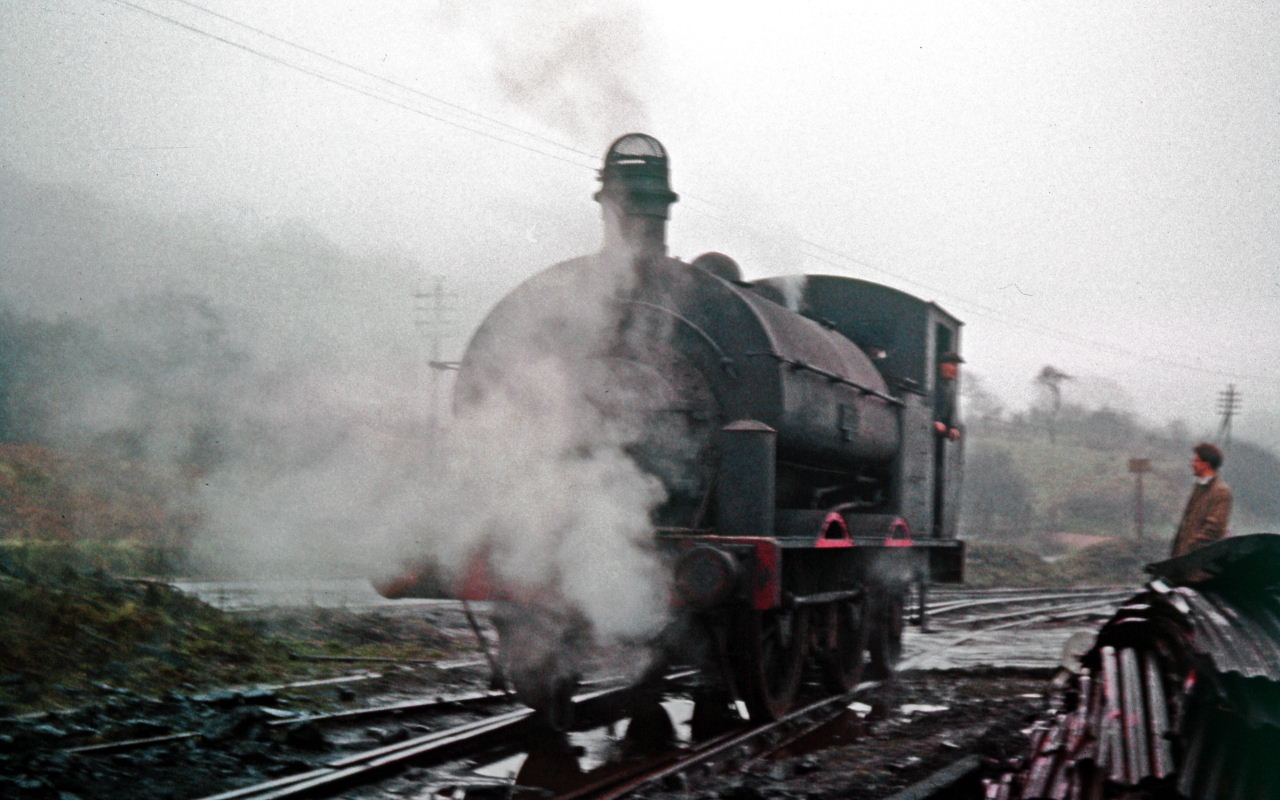
Colour photos of Cannock Chase Loco ‘Foggo’

05443 Foggo 0-4-2ST Self-Build 1946 BP Design CCC Yard

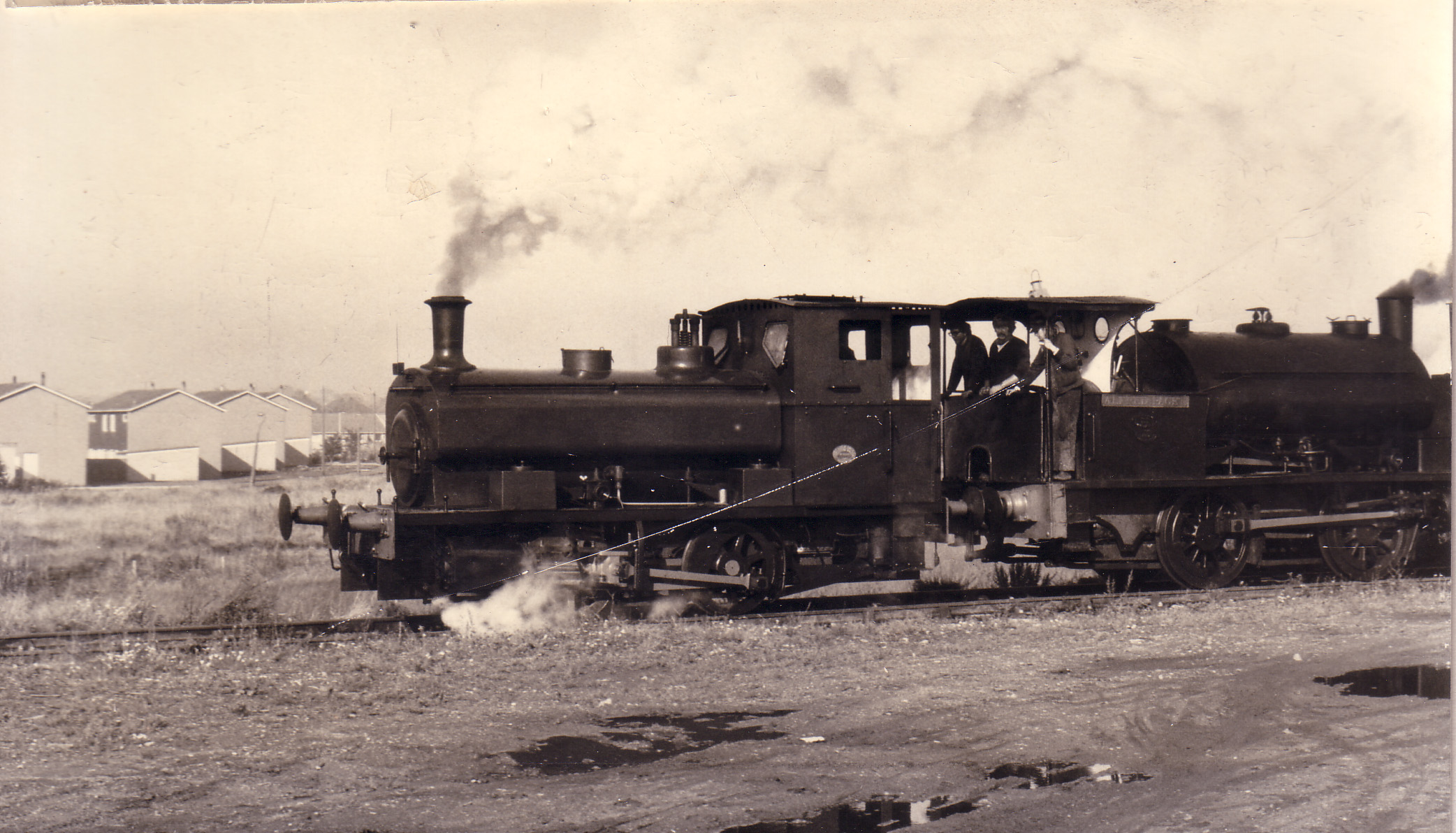
Black & White photo of ‘Foggo’ taken in the Cannock Chase colliery Co. yard at Chasetown

Foggo

‘Foggo’ was an unusual engine, 0-4-2ST being built at Chasetown in 1946 from spare parts supplied by Beyer Peacock and other spares accumulated over the years from other locos. The name came from the General Manager at the time – M.J.Foggo.BM13046EJ

BM13047EJ

These photos were taken by Bernard Mettam in winter 57/58 on a day with awful weather at Brereton.

These are the first colour photos of ‘Foggo’ that we in the Chasewater Railway Museum have ever seen, and were passed on to us, after enhancement, by Peter Stamper.  Thanks Pete.

‘Foggo’ ended her working life at Brereton Colliery, which closed in July 1960, and was scrapped by W.H.Arnott Young Co. Ltd in 1961.

From the ‘Mercian’ June 1972

From the ‘Mercian’ June 1972

I thought that it might be interesting to see the state of the rolling stock at that time, so here is the rolling stock report from the magazine.

Locomotives

Asbestos – The renewal of right hand hornblocks is complete and the wheels have been replaced.  A trial steaming is scheduled for June 5th and it should be in steam for the Chasewater Festival on July 8th.

Neilson – No work has been carried out for two years.  The saddle tank was removed and ten studs drilled out of the sides of the boiler and new ones fitted.  These studs secure the water feed clock boxes, stolen before the loco left Glasgow.  Fortunately Trevor Cousens was able to obtain replacements for us.  Shortage of labour has precluded further work being carried out but we hope to restart soon.

Barclay & NeilsonBarclay & Neilson

 E1 – No change.  A boiler survey may be made soon.

Barclay – The firebox was condemned at its last boiler test.  As the ‘Barclay’ soon to be delivered is of similar size, it will be used to supply spare parts to keep the newer loco running.

Hudswell Clarke – No work has been carried out for over three years. A hydraulic test was carried out and the results were not promising.  The boiler will need re-tubing and a considerable amount of mechanical work will be necessary.

Petrol No.1 – The petrol tank and associated plumbing were cleaned out recently and the engine run.  It will start by hand when warm.  Unfortunately the carburettor appears to be icing up when the engine is subjected to load.  The carb. Is probably not the original and information as to the whereabouts of a replacement would be welcome.

Diesel No.1 – Out of service with a smashed axlebox.  Once again information as to the whereabouts of a replacement would be welcome.

Diesel No.20 – One of the spare engines is being overhauled ready for fitting.  Messrs. Bass Charrington have kindly donated a quantity of their blue paint and both locos will be painted when time permits.

Diesel No.21 – An overhaul was carried out last year, the cylinder heads and fuel pump being renewed, and more recently repairs were carried out to the clutch once again.

 Coaching Stock

Midland Royal SaloonMidland Royal Saloon

Royal (or Special) Saloon – On loan to Derby Corporation for the Midland Railway Project.  They have undertaken to restore it

TPO – The small relics collection now looks quite orderly though the outside of the vehicle is in urgent need of attention.

LNWR 50’ Brake – One end has been painted out and will be used this summer to house the sales stand, a model railway and a display of relics.

Maryport & Carlisle – Restoration is nearly complete.  The roof was covered with galvanised sheets last summer, but the completion has been held up by the weather.  It saw considerable use last year carrying passengers on Open Days.

GER Brake – Now in use again as the Mess (!) Van.  It is in urgent need of re-roofing.  The outside was painted dark brown last year.

MSL – No further work has been carried out.  The bearing brasses are missing.

MR Brake – No change.

LNWR Brake Third – No change.  The LNWR Coaching Stock Fund is attempting to raise cash for the restoration of this coach.

TPO at HednesfordTravelling Post Office at Hednesford

 Goods Stock

GWR Brake – The interior has been repainted and the roof covered with galvanised sheets.

MR Crane – A new wire rope has been fitted and the woodwork painted.  Although it is 90 years old it still sees considerable use.

LYR Van – Now in use as a workshop and tool store.

MR Van – In use as a stores, mainly diesel.  It has been painted externally.

CCWR Brake – Repainted externally last summer.  Used as PW tool van.

NSR Coal Wagon – No change.

The remaining four vehicles, two flat wagons and two 12 ton coal wagons are used on the works trains.

Neilson on goods, causewayNeilson on Goods

An Article from The Mercian of June 1972


A B1223-1911Greening Wireworks Warrington

A B 1223-1911 At Greening Wireworks Warrington

The ‘Mercian’ is again under new management.  A publicity and ‘Mercian’ sub-committee has been formed, consisting of three members – B.J.Bull, R.Duffill and S.G.Allsopp, two of these are active members today in 2013.

Chasewater News

Work has started at long last on the erection of a station platform.  This will be 120 feet long and will be on the east side of No.1 road near the compound gates.  The retaining wall is to be of reinforced concrete for which shuttering is being constructed.  A short section should be ready for use within the next few weeks.

The removal of the concrete dam from under the bridge on the causeway has apparently resulted in the restoration of a more normal level in the main lake.  At first sight the level of the lake would appear to be of little interest to us but water has to be obtained from somewhere for the steam locos.

Mike Lewis has been erecting a fence, using the railings of possible Midland railway origin, on the east side of the running line and commencing where the platform will end.  It is hoped that sufficient components will be available for the fence to reach down to the platelayers’ cabin.  Alongside the cabin the running line is to be slewed eastwards about six feet to enable a point to be installed and the present ‘Elsley Siding’ to be made permanent.

An Andrew Barclay 0-4-0ST has been acquired jointly by the Society, Barry Bull and two of his friends.  Unfortunately it will not arrive until September at the earliest.  It should be in working order when it arrives but will require a major boiler examination next January.

Negotiations have started with BR for the purchase of a coach for passenger-carrying purposes.  A coach is essential to relieve the pressure on the 97 year old Maryport.  The South Eastern and Chatham Railway six-wheel ‘Birdcage’ Brake has been moved by its owners, the Southern Loco. Preservation Co. Ltd. to the Bluebell Railway.  As a result, along with the completion of No.3 road, all of our stock, including two platelayers’ trolleys, can be accommodated with room to spare.

Mr. D. Luker has been appointed to the post of Chasewater Foreman.  He is now responsible for the distribution of labour at Chasewater in accordance with the jobs to be carried out as instructed by Mr. Lewis.  Mr. Luker’s main interest is steam locomotives and he will start work on the ‘Neilson’ when work on ‘Asbestos’ is complete.

Flagged

From the ‘Mercian’ of January 1969

From the ‘Mercian’ of January 1969

From the Secretary’s Report  – Trevor G. Cousens

On 21 September 1968, the Society held its 9th Annual General Meeting at the Pear Tree Inn, Brownhills.  The attendance was very poor considering the attraction of a steam trip down the line afterwards.

Pear treePear Tree Cottage Inn, Brownhills West

3 years on from the photo Geoff Pick took and it is still standing, although a lot worse for wear – Now it’s gone  © Copyright Mick Malpass and licensed for reuse under this Creative Commons Licence

 After the meeting, sandwiches were supplied by Pete Parker, proprietor of the Pear Tree, and then members crossed the road where in brilliant evening sunshine stood the Andrew Barclay 0-4-0ST, (Colin McAndrew) immaculate in green and red, with polished brass and copper-work.

Members were invited on to the train comprising the Midland (or Coal Board) brake van, the Midland brake coach and the Great Western brake.  The train departed with Mr. Civil driving and Mr. Luker firing, the team, who with Mike Lewis had so painstakingly restored the locomotive.  She was opened up to pull the train up the 1 in 50 bank to the causeway causing the steam pressure to drop rather drastically to 40 lbs per square inch, but this is probably the longest run the loco has ever made without running over the same tracks twice, and its small boiler and firebox being designed more for a 3’ 6” gauge loco, this is not surprising.

Over the causeway, we ran on to the shore again until we were held up by some rather enthusiastic ditching by Bob Wormington, which caused the loco cylinders to come into contact with the spoil.  We ran on until we reached the end of the line, where a stop was made to raise steam for the return journey.  The loco was once again admired by the members, its rather peculiar mechanical pump a feature of interest on the running plate.

The return journey was made almost without incident, a point switched the wrong way round caused a minor sensation, but we returned safely to the Compound, where some rather complicated shunting was carried out before putting the engine to bed.  In fact, it was 9.00pm and dark when Laurence Hodgkinson finally put the diesel in with the rest of the stock which had been parked in the loop out of the way.

So ended the third RPS steaming at Chasewater, giving some encouragement to those who had worked so painstakingly to make this event possible.  But, it made one think about the amount of work still to be done, principally on track, but also on locos and stock before these steamings become a regular feature.

In the Treasurer’s Report by Frank Harvey, it was noted that, among others, Mr. R. Duffill  joined the Society!

C Mac Railway Forum Aut 1972

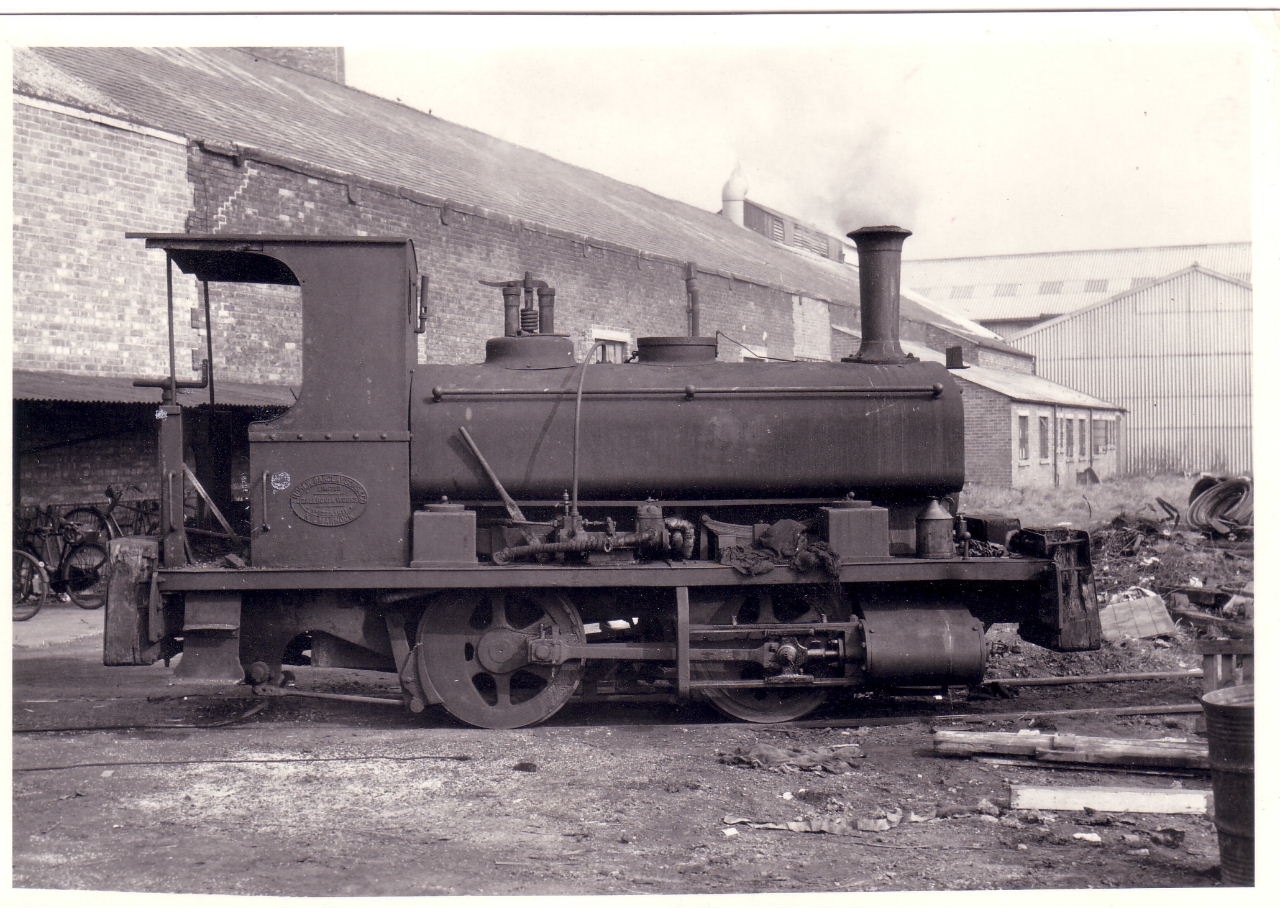
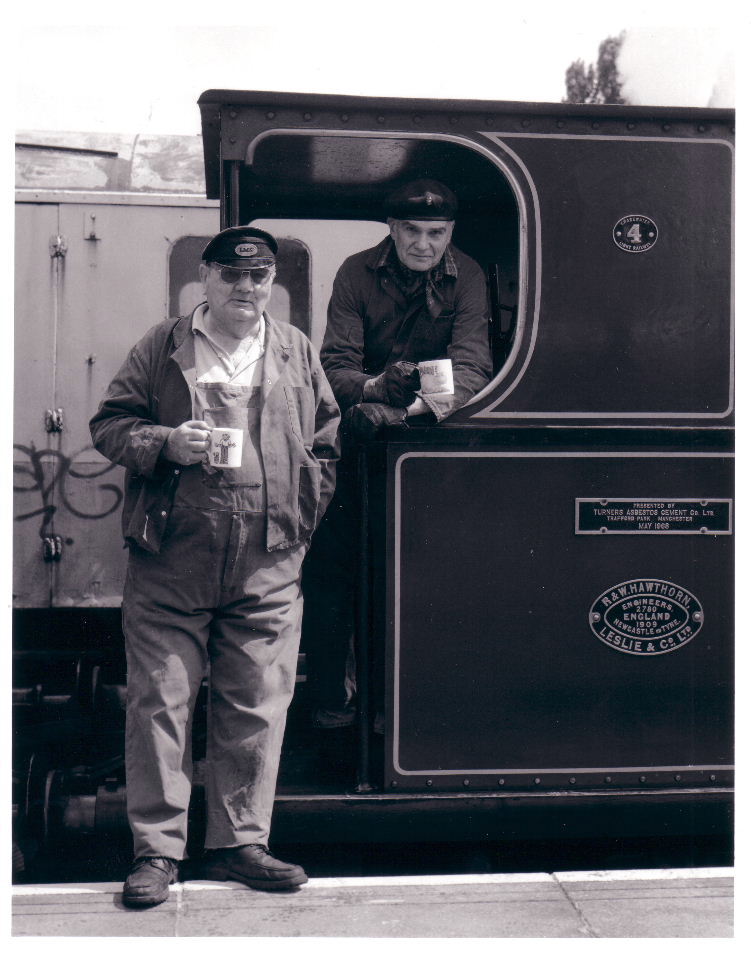
More from the August 1968 ‘Mercian’ Turner’s Asbestos Cement Co. Ltd ‘Asbestos’ Hawthorn Leslie 2780 of 1909

More from the August 1968 ‘Mercian’

 Turner’s Asbestos Cement Co. Ltd ‘Asbestos’

Hawthorn Leslie 2780 of 1909

 By Gerald Wildish

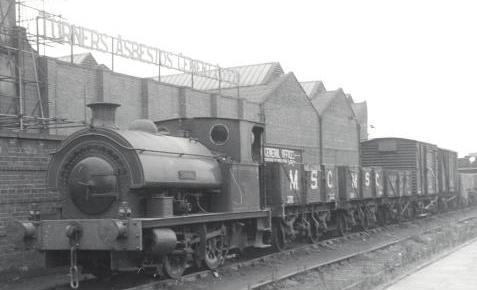
 asbestos at trafford park 2At Trafford Park

Many of you will by now have seen our splendid new locomotive.  Two years ago exactly to the day that she left Trafford Park, I first found ‘Asbestos’ – 15th June 1966.  She was not working on that particular occasion and had been specially hauled out of the shed for me and put in a photographic position.  She appeared in excellent condition.  On the occasion of my visit I learnt that she was likely to finish working that September, and I duly put in a bid for the RPS.  I was informed that the Society’s interest had been noted.

A little over a year later a letter arrived from Turner’s asking me if I would care to bid for the engine – I made an offer of £50, and shortly afterwards received a telephone call informing me that a scrap merchant had offered £100 – we could have her if we could reach that figure.  By this time we were in October and I was already engaged in trying to raise funds for the Neilson.  My reply said that if they could hold the locomotive until after our Christmas raffle, we would do our best, but I did not hold out a great deal of hope.  Considering all things, the raffle was a success, but we did not raise the sums necessary to allow us to move in two directions and I informed the Company that we would have to let her go.

My surprise could not have been greater, when Mr. Francis, the manager of the buying department, rang me to say that we could have ‘Asbestos’ free of charge.  Without doubt this was one of the happiest days of my life.  I made arrangements to go to Trafford Park to arrange the handover and had an excellent morning.  The handover was arranged for a date three weeks later when the presentation plaque could be fixed to the locomotive.

I could not have been dealing with nicer people throughout the negotiations, right from the time of my first visit to the works.  Our thanks must go to Mr. A.H.Wailes, the Works Director, Mr. T.Noble, the Purchasing Director, Mr. T.N.Chadwick, the Works Manager, who also arranged for the locomotive to be ‘done up’ for us during the week before the handover, to Mr. W.D.Francis, the Purchasing Manager, who dealt with most of the negotiations and Mr. S.McCormick.

Little is known of the history of ‘Asbestos’.  She was built by Hawthorn Leslie in 1909, for the Washington Chemical Co. in County Durham, where she became No.2, along with two other Hawthorn Leslies and a Fox Walker engine.  A further Hawthorn Leslie was added in 1918, and presumably replaced the Fox Walker.  In 1920, the Company became part of the Turner and Newall group.

In 1933, two of the locomotives were transferred to the Turner’s Asbestos Cement Company works at Trafford Park, becoming ‘Turnall’ and ‘Asbestos’.  Turnall was scrapped in 1965, leaving ‘Asbestos’ with two diesel locomotives (Planets).  ‘Asbestos’ was placed in store as the reserve engine in 1966 and presented to the RPS on 25th May of this year(1968);  she was transferred to Chasewater on 15th June, and started work in revenue service eight days later.

7423 B-Hills West 20-6-09

Brownhills West 2009