Tag Archives: Cannock Wood

Chasewater Railway Museum – newspaper cuttings wanted

Chasewater Railway Museum

Newspaper cuttings wanted

DSCF9057

Joan Lent has been beavering away in the Museum recently getting our collection of Chasewater Railway related newspaper cuttings in some sort of order.

Should anyone have any pieces relevant to Chasewater or its environs please bring them along to the Museum – they may fill a gap in our collection.

Thank you.

Chasewater Railway Museum – a small addition

Chasewater Railway Museum 

  A small addition

DSCF9031 smaller

A small addition to the Chasewater Railway Museum collection is a nickel button of slightly unusual origin being of both military and railway interest.

The 2nd Cheshire Royal Engineers (Railway) Volunteer Corps was formed in 1887 of employeesof the locomotive department of the London and North Western Railway and who became involved in active service during the Boer War up until 1901.  The Corps was disbanded in 1912.

The button bears the script initials VR with Volunteer Engineers in a garter surround with a crown above.

3 Photos – New to us

Chasewater Railway Museum

3 Photos – New to us

3 photographs came into the museum over the weekend, I think from the bric-a-brac on Brownhills West Station.

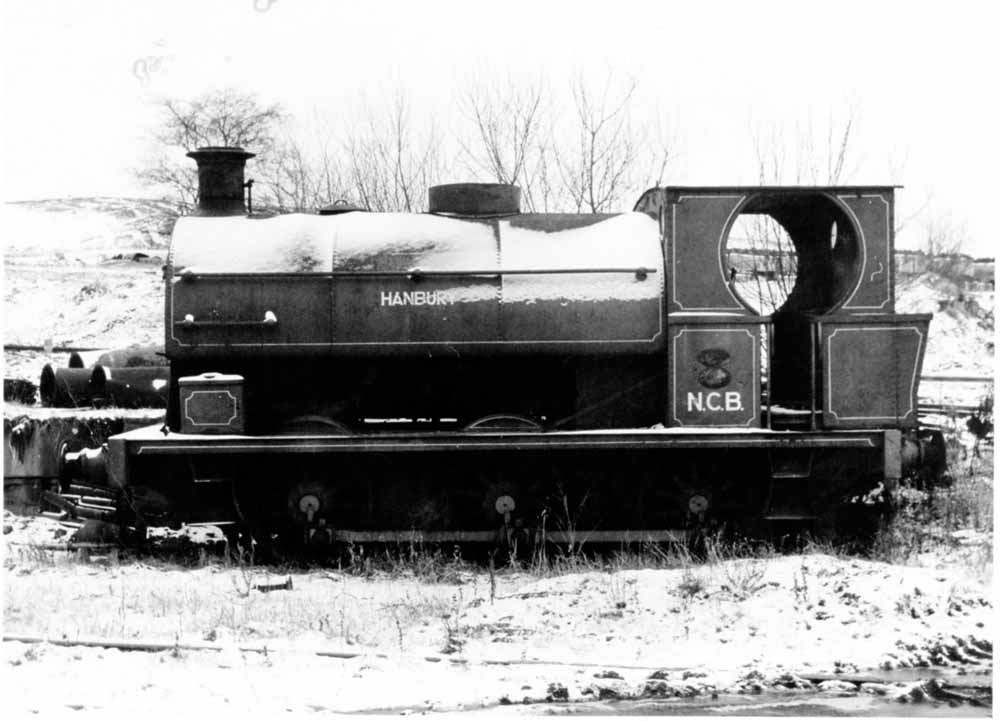
Hanbury in the snow

The first one is the Peckett loco ‘Hanbury’  of the West Cannock No. 5 Colliery,  No.587 of 1894, looking cool!

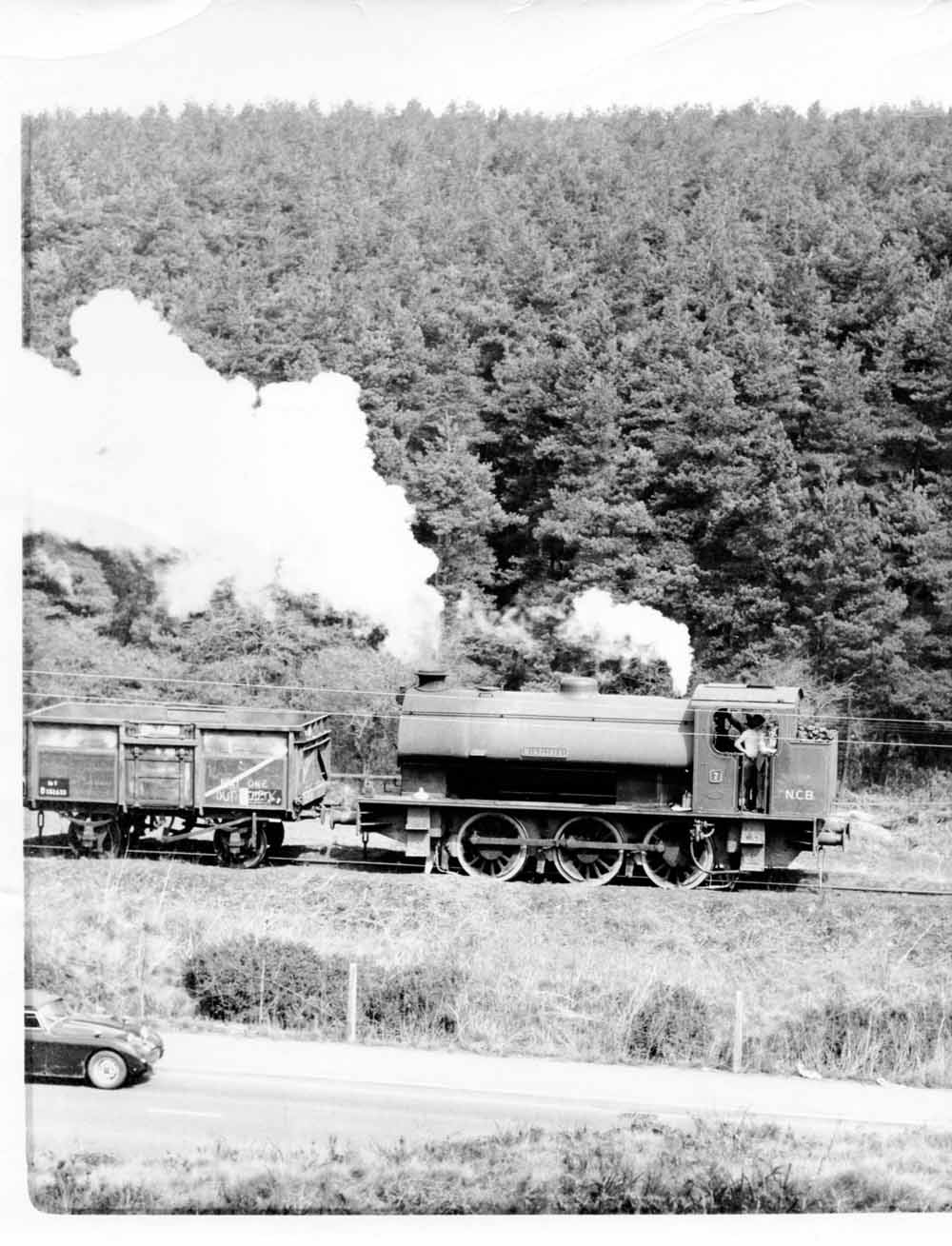
Wimblebury Rawnsley Road

Next is the Hunslet, ‘Wimblebury’ pictured on the Rawnsley Road on the way to Cannock Wood.  No.3839 of 1956.  Note the ‘frog-eye’ Austin Healey Sprite coming through on the inside!

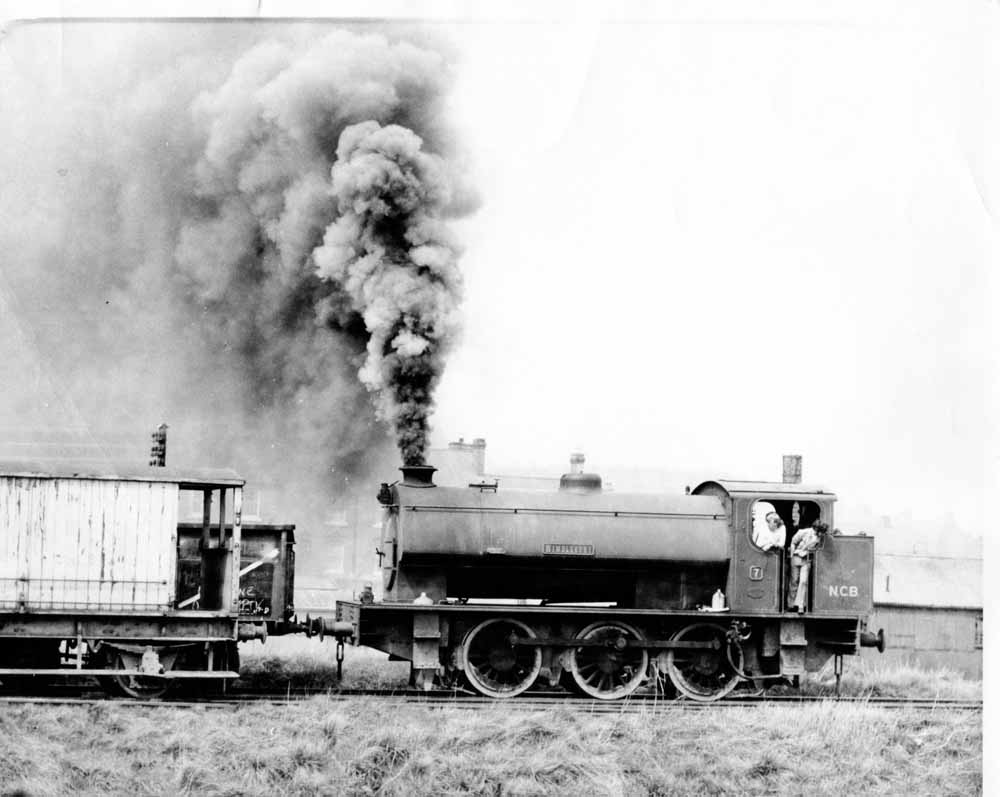
Wimblebury smoke

Finally, another study of ‘Wimblebury’ – hope nobody’s got their washing out!

Chasewater Railway Museum – Cannock Wood Paddy Train Starting Board

Chasewater Railway Museum –

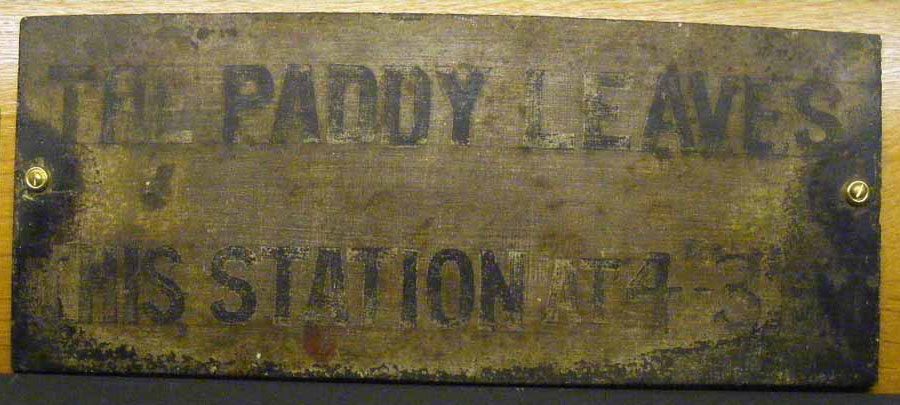
Cannock Wood Paddy Train Starting Board

It’s a bit faded but well worth keeping – another item in the Chasewater Railway Museum.  From the platform at Cannock Wood.

Paddy train leavingIt says ‘The Paddy Leaves This Station at 4.30’

NCB 9The platform it departed  from.

Rails around Walsall - John Boyton -2

The original 3-coach Paddy – later it changed to 1 large coach.

Rails around Walsall - John Boyton -3

Getting off at the corner of Rugeley Road and Rawnsley Road, Bates’ Bridge is to the left of the photo.

Chasewater Railway Museum – Cannock Wood Nameplate

Chasewater Railway Museum 

Cannock Wood Nameplate

21

One of the early, local, nameplates in the collection.  Part of the history of the loco follows.

No.9 Cannock Wood (The third and best-known ‘Cannock Wood’) 0-6-0T Built by the London, Brighton & South Coast Railway at Brighton in 1877 (LBSCR 110).  Bought from the Southern Railway (SR 110) in 1927.   Still working at Rawnsley in 1957, continued to work for the NCB into the mid 1960s then preserved by the Railway Preservation Society, originally at Hednesford and later at Chasewater.  Subsequently sold to members of the East Somerset Railway at Cranmore.  Was steamed there, but is now homed on the Isle of Wight for further renovation work.

05053 No.9 Cannock Wood 0-6-0T LBSC Rly 1877 C & R

Chasewater Railway Museum – a few old signs

Chasewater Railway Museum

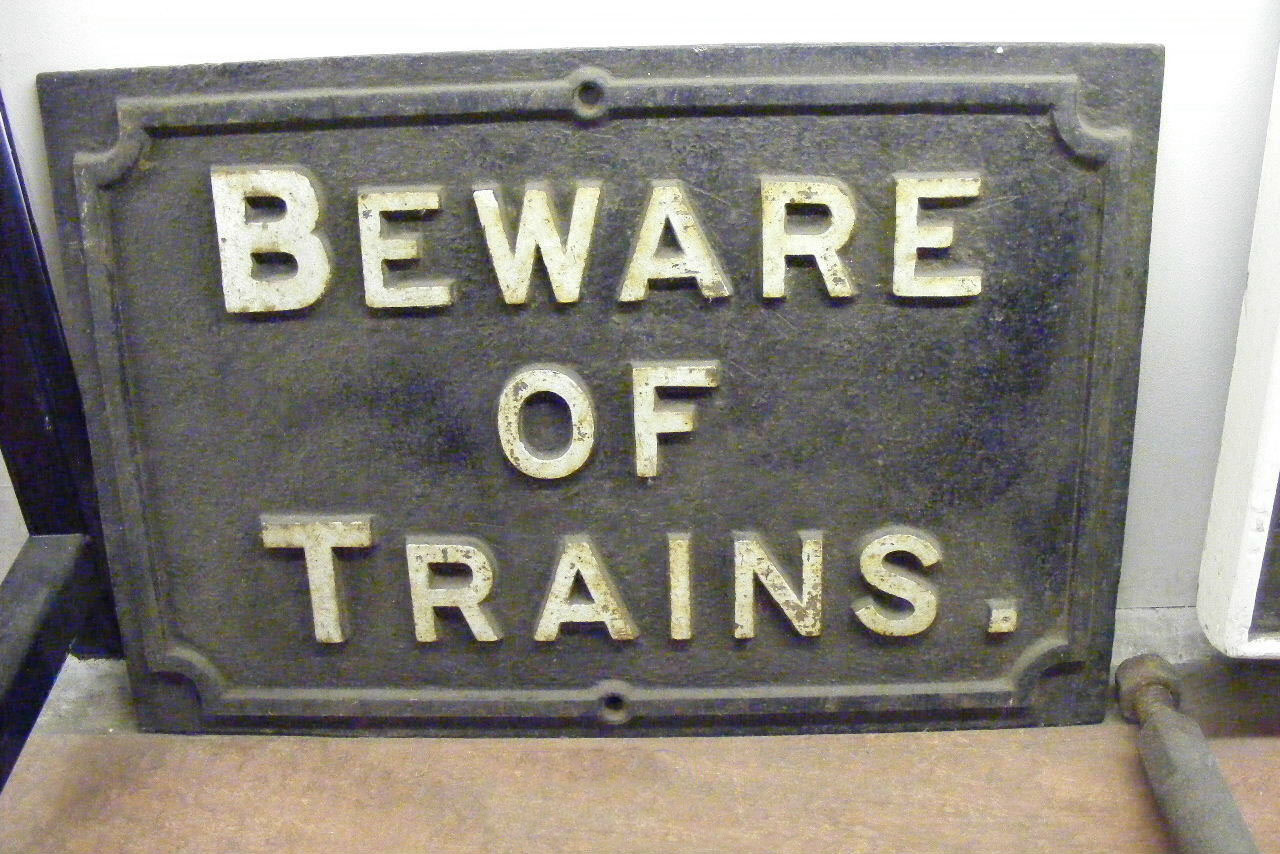
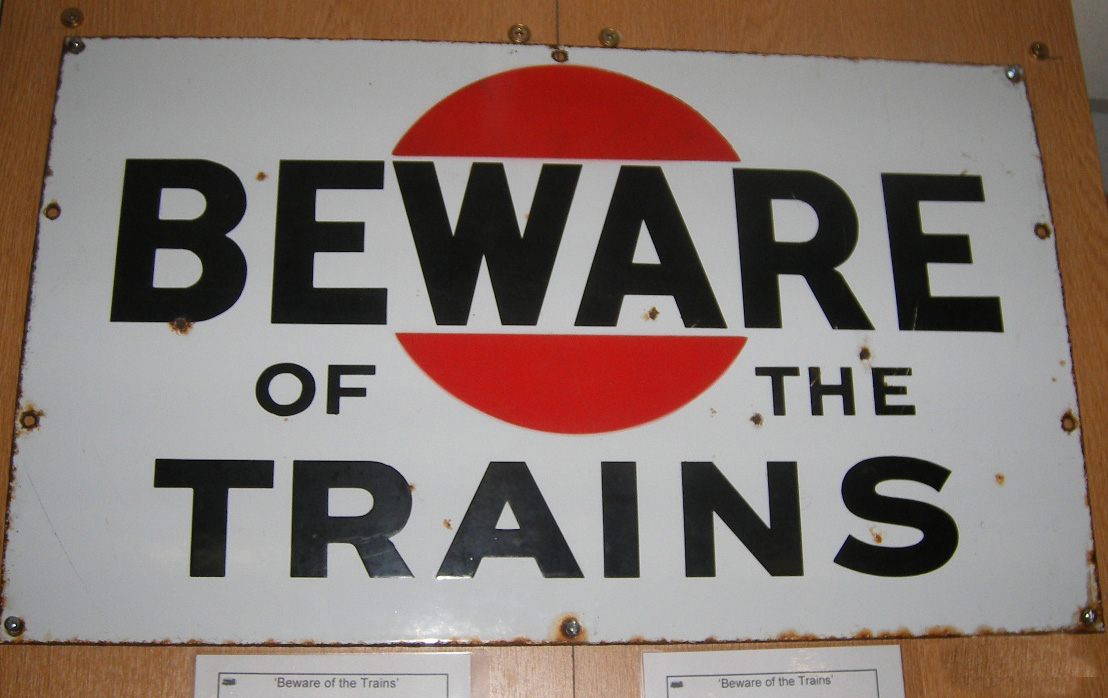
A few warning signs from our collectioN

564

The first one is made from wood with cast iron lettering.  We do not know which railway it came from.

560

Next is an LNWR cast iron notice


561

Now a London & South Western Railway Notice – cast iron.

562

A Midland Railway cast iron sign

652

Ex NCB line between Cannock Wood and Chase Terrace. Location: Ironstone Road, up from the ‘Rag’, seen in the photo below.

To the Rag

Two photos of a sign, before restoration and nearing completion.

1748

DSCF9064

This was found in the mid 1960s in the Wyrley Branch of the Wyrley & Essington Canal which is now under Vernon Way, in the New Invention, Essington area. The railway crossing of the A4124 Lichfield Road from Holly Bank Colliery to the canal basin at Short heath was about 150 yards away on the other side of the M6. It seems logical to assume that this was where the sign was originally placed.


629

Finally, one of the Railway’s own signs, from the early days at Chasewater.


Chasewater Railway Museum – Local loan item now on display

Chasewater Railway Museum

Local Loan item now on display

V.V.V.

VVV Info

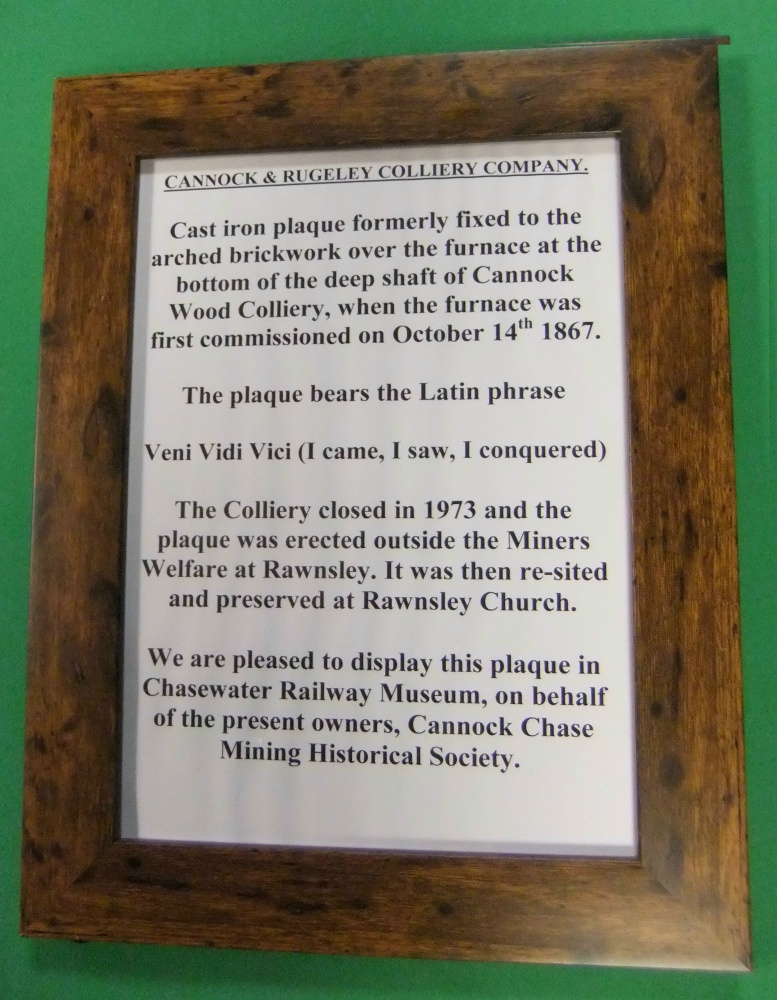
Our thanks to Alan Dean and the Committee of the Cannock Chase Mining Historical Society for allowing the Chasewater Railway Museum to display this plaque.

Chasewater Railway is known as the Colliery Line – if there had been no coal mines there would be no railway!

Also thanks to the Chasewater Railway members who helped to put the plaque in position – it’s not the lightest of objects!

Railway Relics – Cast locomotive nameplates

Railway Relics

Cast locomotive nameplatesCannock Wood

This nameplate belongs to Chasewater Railway and was carried by the LBSCR loco No. 110/1877, which worked at The Cannock and Rugeley Colliery, Cannock Wood from1927, when it was purchased from the Southern Railway until the mid 1960s.  It was preserved by the Railway Preservation Society (West Midland District) firstly at Hednesford and for a short while at Chasewater.  It was later sold members of the East Somerset Railway.

Locomotives have often been adorned with names from the earliest days.  Sometimes these have been painted on the engine’s sides, but the more common method was to fix cast-metal nameplates.  The raised lettering, frequently surrounded by a raised border, was usually finished in burnished brass, with a black or red painted background.

The plates were usually curved to fit on or over the locomotive’s driving wheel splasher, but for tank engines and some larger main line locomotives, straight plates were fitted elsewhere on the superstructure.  The Great Central Railway (GCR) provided most of its large passenger locomotives with combined straight-topped splashers covering all the driving wheels. The GCR’s straight nameplates had shaped ends to fit into the splashers’ decorative beading.

Both the London & South Western Railway (LSWR) and the London, Brighton & South Coast Railway adopted a similar pattern of plate, with curved or straight sides.  Either way, the plates had projecting lugs at the ends to accommodate fixing holes.Nuttall
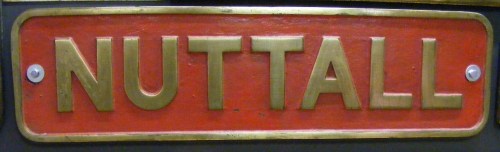
Another Chasewater Railway-owned nameplate, from a Hunslet 0-6-0ST loco 1685/1931.  Bought from Mowlem in 1948 and worked at Walsall Wood, Coppice Colliery and Chasetown.

New type of nameplate

The Southern Railway (SR) adopted the LSWR style of nameplate for most of its named engines, but often with a smaller panel beneath giving the class of the engine.   For its series of steamlined light Pacifics built during and after World War II – the Battle of Britain, West Country and Merchant Navy classes, the SR adopted a completely new type of nameplate which included a crest or badge.

The London, Midland & Scottish Railway used fairly modest curved plates for its non-streamlined classes, whilst its prestigious streamliners had straight plated fitted to the centre line of the boiler.  When streamlining went out of fashion in the late 1940s, the streamlined casings were removed and the plates were refitted in the same location.The Dean
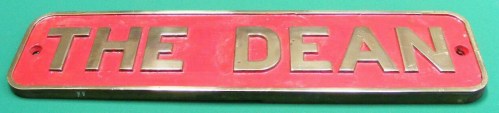
This plate is one of the Eric Tonks Collection, on loan from the Industrial Railway Society, and is from an 0-6-0ST Hunslet, 1496/1926.  New at the Oxfordshire Ironstone Co.Ltd., Banbury.

The streamliners of the London & North Eastern Railway’s Class A4 carried their nameplates high up at the front end of the boiler sides.  Ordinary locomotives were fitted with curved splasher top plates, though these were larger and heavier than those of the other companies.

The standard express classes built by British Railways mainly in the 1950s bore straight plates fitted near the top of the smoke deflectors.  Some of the mixed-traffic locomotives designed for use on the Southern Region were given names previously carried by members of the SR’s King Arthur class, itself a legacy of the SR’s predecessor, the LSWR.

Although most Great Western nameplates were made from steel and brass, a small number were cast in brass.  These were oval and gave the engine’s name and number, as well as its date of manufacture.

Ironstone

Another plate from the Eric Tonks Collection, ‘Ironstone’ was an 0-4-0ST Peckett with outside cylinders, No. 1050/1907.  Supplied new to Market Overton Ironstone Quarries, Rutland.

Many of the smaller independent railway companies fixed nameplates to their locomotives.  Since most of them were tank engines, the plates had straight sides.  Many industrial locomotives also had nameplates.  These sometimes included the name and address of the works or the names of the firm’s directors and members of their families.Carol Ann No.1

Carol Ann No.5  0-6-0ST Hunslet  1821/1936.  Bought new.  Still at Holly Bank 1957 – since scrapped.

Robert Nelson No.4 and Carol Ann No.5 (Hunslet 0-6-0ST  1800 and 1821 respectively, built 1936) were named after the Colliery Manager’s two children.

On transfer to Littleton Colliery in NCB days – November 1959  – Carol Ann was renumbered ‘1’ by grinding the ‘5’ off the nameplate and screwing in a ‘1’.  This was because Littleton already had a loco ‘Littleton No.5