Category Archives: Museum Exhibits

Chasewater Railway Museum – A photo from inside the museum

Chasewater Railway Museum

A photo taken inside the museum

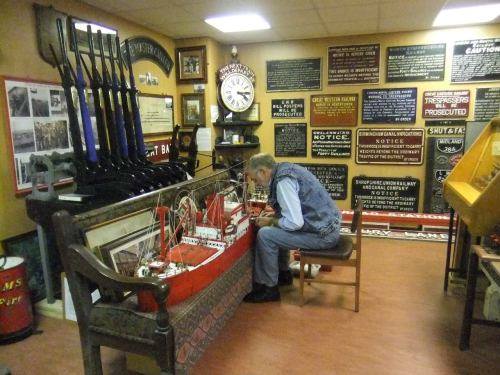
I have been sent this photograph of one of our ‘helpers’ inside the museum, working on one of the Meccano models.  It shows a view around part of the museum, including, among other items, some bridge plates and the lever frame from Hemyock.

joe-in-museum

This photo was taken before the bench was recovered – it is now covered in an attractive blue material.

Sad to relate, after all our man’s work, it still wouldn’t float!!!

Chasewater Railway Museum – An Addition to our collection of Armbands

Chasewater Railway Museum

An Addition to our collection of Armbands

Armbands in case.jpg 

The later years of the 19th century saw increasing standardization on the railways, not least in the armbands worn by three types of railway worker – pilotmen, flagmen and lookout men.  The one worn by pilotmen was issued by the signal department and was made of red cloth with white stitched letters, and was secured by leather or elastic straps.

The armbands for flagmen and lookout men were made of enamelled steel plate, cut into an oval and shaped to fit the arm.  A pair of slots was cut into the plate, through which a pair of leather straps, with buckles, was attached.  Issued by the permanent way department, these enamel armbands were finished in white with red lettering.

A pilotman was a signal department employee whose job was to ride on the locomotive acting as a kind of human staff or token if the signalling on a single line failed, or if there was an accident or obstruction which closed one of the lines of a double track.  No train could proceed without him in such an emergency, so that the possibility of a head-on collision was avoided.

The lookout man was quite simply that.  His job was to keep a sharp lookout when a permanent way gang was working on the track, and to give a warning for it to stand clear as soon as he saw an approaching train.

The flagman was another permanent way ganger, who used green, yellow or red flags to communicate with signalmen or other permanent way staff who were out of audible range.All three posts were – and still are – crucial to the safety of both passengers and railway employees, and armbands were issued to emphasize this fact and to avoid misunderstandings.  A modern variety, coloured pale blue with white letters, was used on British Rail.

London, Midland & Scottish Railway Armband.

317

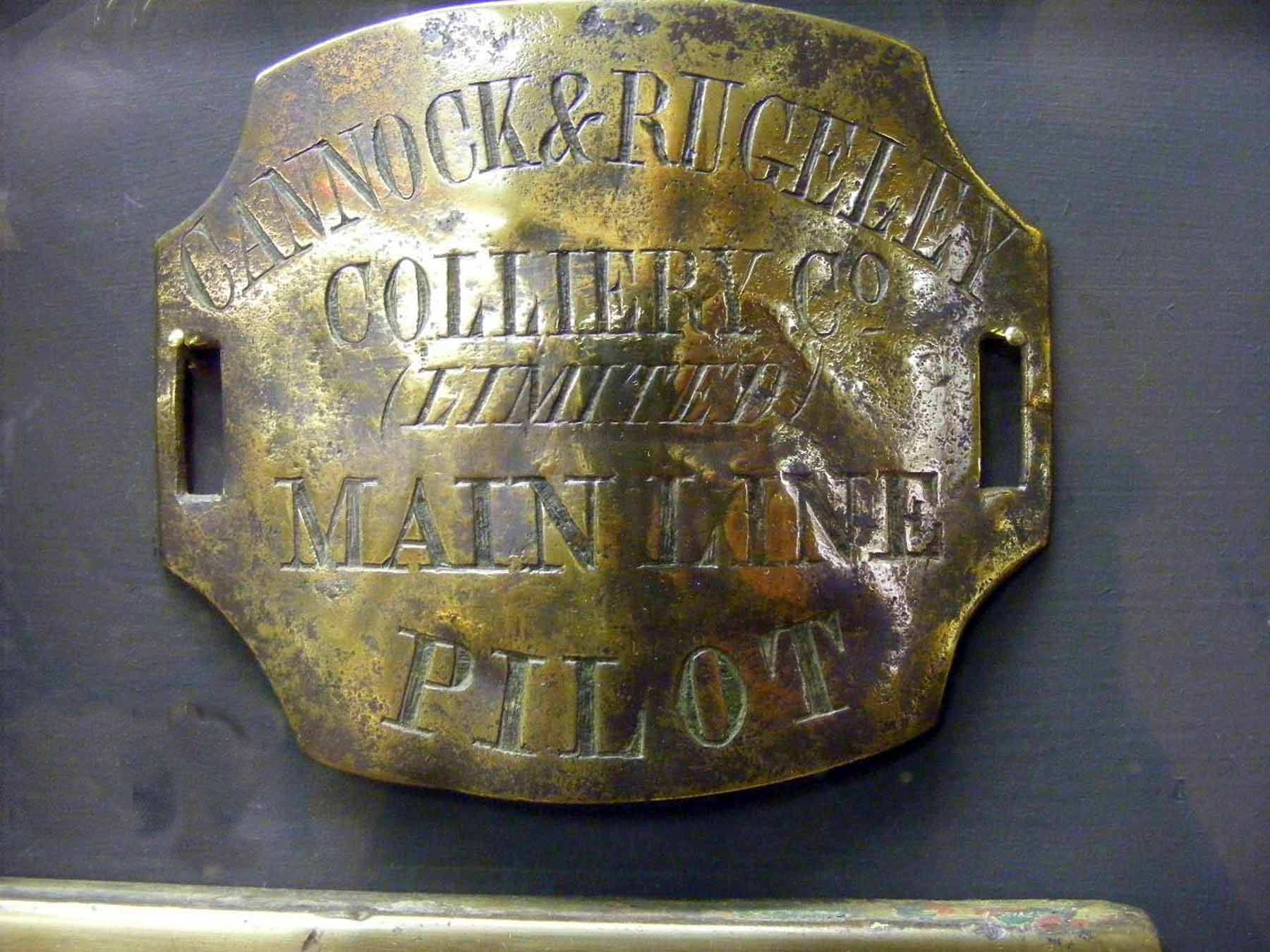
This armband is still my favourite.  A brass Cannock & Rugeley Colliery Main Line Pilot Armband, dug up in a field by a farmer while ploughing some years ago – considerably battered and bent over double!

Save

Save

Save

Chasewater Railway Museum – August Newsletter

Chasewater Railway Museum 

August Newsletter

August Newsletter

Chasewater Railway Museum – A New Boundary Marker

Chasewater Railway Museum

A New Local Boundary Marker
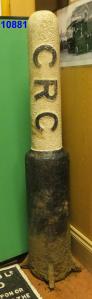
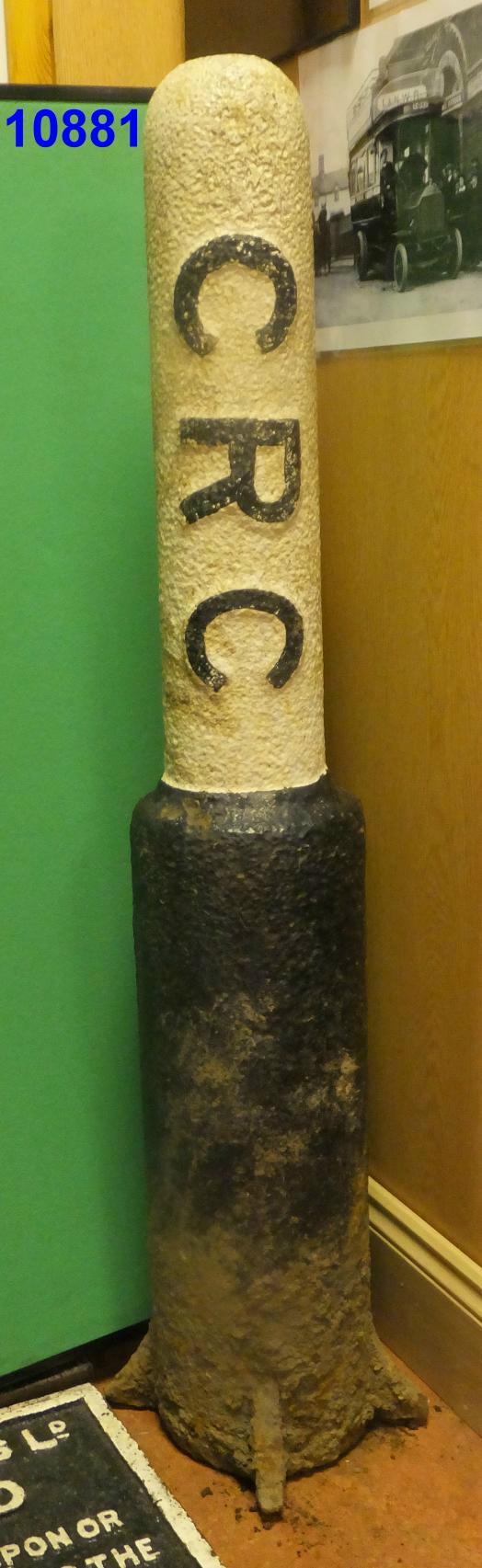
10881

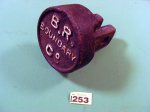
A recent purchase for the collection – a Cannock & Rugeley Colliery Boundary Marker.

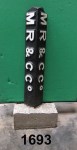
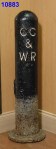
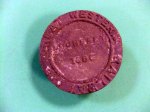
Other boundary markers in the collection are shown below.


Boundary Markers

 In their heyday, the railways were the biggest landowners in Britain after the Church, and it was inevitable that boundary disputes sometimes arose.  It was to resolve this problem that many railways designed boundary posts or markers.

The oldest tend to be in stone, while those from about 1870 onwards are in cast iron – some companies using lengths of surplus rail, suitably inscribed.

The Great Western Railway (GWR) markers were made of Brunel-designed bridge rails cut into lengths, with an angle iron T-piece on the bottom, and a cast iron top, moulded round the rail.  Between 1880 and 1920, the year of manufacture was included on the cast top.  The Midland Railway (MR) used pieces of ordinary bull-head rail whose tops were stamped into an oval shape, with the raised letters ‘MR’.

These two types are by far the most common available to collectors, though the cast iron posts of the London & North Western Railway (LNWR) and Great Northern Railway (GNR) are also frequently seen.

It appears that several railways never had any boundary posts, and no examples are known from the Great Eastern, London, Brighton & South Coast, South Eastern & Chatham, or from any of the five main Scottish lines.

On the other hand, two of the small South Wales companies had boundary posts which often come up for sale – the Barry and Rhondda & Swansea Bay railways.  The GWR, MR, GNR and LNWR all made boundary posts for their joint lines, and some of these are both exotic and extremely rare.

For example, the GWR produced posts for an area of land at Reading which abutted with the South Eastern& Chatham.  This was the only meeting point of the two companies, and just two markers are known to exist, both dated 1915.

Boundary markers are usually placed in the fence line at the side of the railway, or in adjacent land by bridges, viaducts or crossings.

Chasewater Railway Museum – Some very local Midland Railway mineral invoices

Chasewater Railway Museum

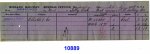
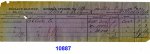
Some Midland Railway mineral invoices

Some of these passed through the site of the Chasewater Railway’s Brownhills West Station, and others started at Walsall Wood.

(Click to enlarge)

The Midland Railway Walsall Wood Extension Railway

In 1880 the Midland Railway gained permission to build their long-awaited foothold into the Cannock Chase coalfield.  The Walsall Wood Extension Railway would enable them to link their line from Aldridge with the Cannock Chase & Wolverhampton Railway near Chasewater.

The line opened in 1882 to bring coal out of the pits, but two years later, was also opened to passenger traffic as far as the Brownhills Midland Railway Station, between the Chester Road and the A5.  The passenger service was not a great success and was closed in 1930.

The Midland Railway continued as a mineral only line until September 1960 when, following the demise of the coalfield, it was closed.

The Brownhills West Station and the first half-mile or so of the track of the Chasewater Railway is on the former Midland Railway line.


Chasewater Railway Museum – Matchstick Models

Chasewater Railway Museum 

Matchstick Models

No.9 & Directors' Coach

No.9 & Directors’ Coach

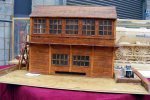
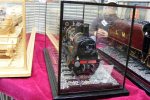
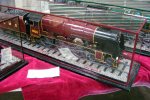
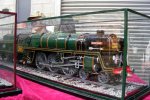
Some of our ever-popular exhibits are the matchstick models built and loaned by Peter Marshall.  The model above is of the Bass No.9 loco with the Directors’ Coach, the real version is in the National Brewery Centre, Burton-upon-Trent.

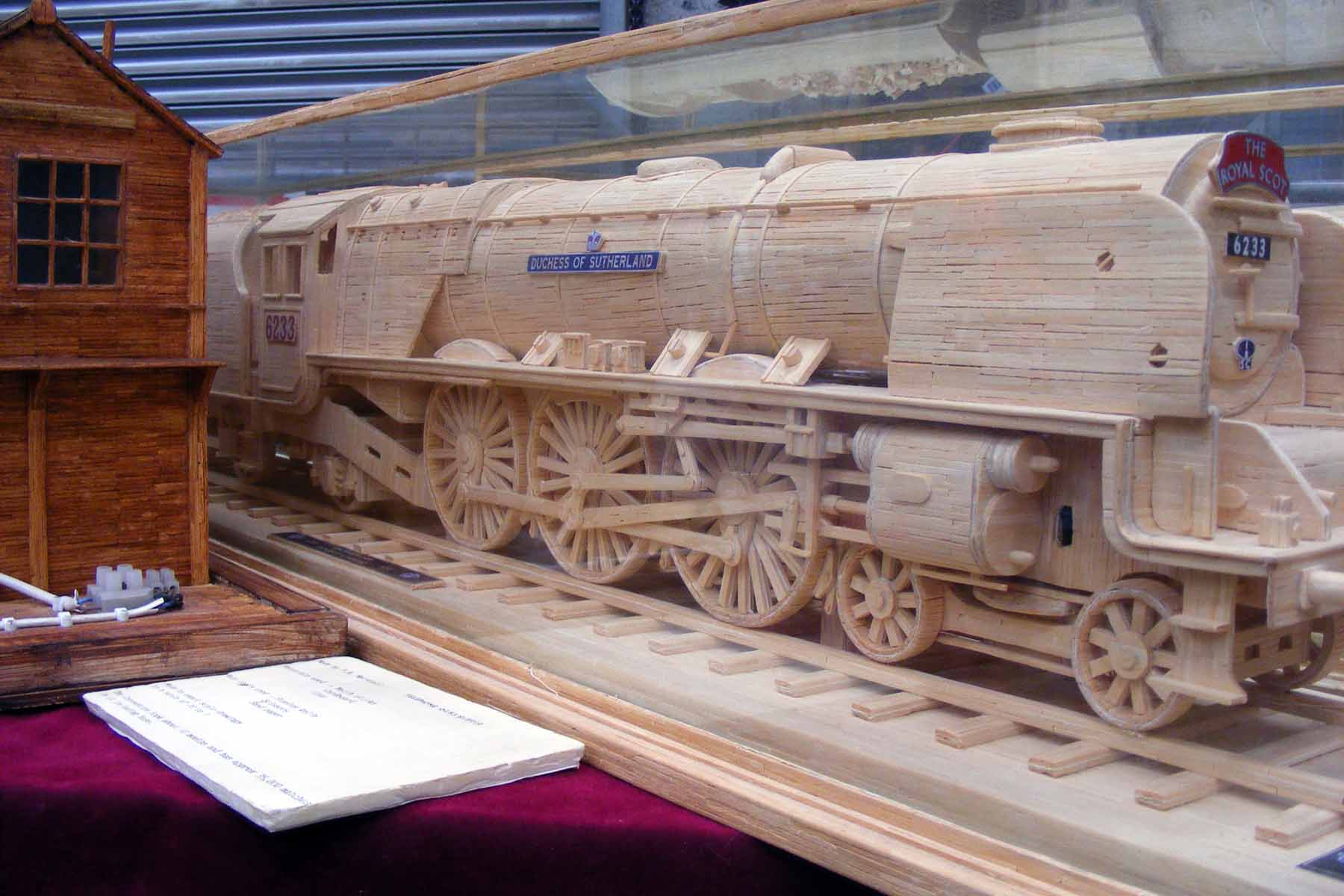
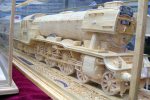
In addition to the models loaned to our museum, the owner has other models which we may also loan at some future date.  To give some indication of the work involved, below is a photo of the model of the ‘Duchess of Sutherland’ which is 48 inches long and contains 35,000 matches!

DSCF8094

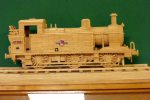
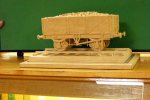
The last three photos are of Peter’s later models, when he started using cardboard instead of matchsticks!  They are amazing!

The models in the museum are the Bass loco and coach, the Jinty and the coal wagon.  As a matter of interest, the frames of the cases are also made from matchsticks.

Save

Save

Chasewater Railway Museum – Train staff from Walsall Wood


Train Staff from Walsall Wood

2009_08300002This is the staff which was used on the single track from Walsall Wood Colliery to Norton Junction on the LNWR at Pelsall.  Until the staff was given to the Museum, I must confess that I didn’t know that there was such a line.Walsall Wood to NortonThere it is – just below the word ‘Clayhanger’
The staff was donated to the Museum by Mr. Trevor Astbury and his son Tom.

For anyone who knew Brownhills some 50-odd years ago, there was a seed shop in the High Street called Cockram’s.  Mr. and Mrs. Cockram worked in the shop with an assistant by the name of Sid Pritchard.  (Anyone who does remember the shop must surely remember the warm, sweet smell of the seed in the sacks, and if you were a child, the feeling of running your hands through the seed – that shop will never be forgotten by anyone whoever paid a visit.)

Back to Sid – he had a brother who worked at Walsall Wood Colliery and when it closed, somehow or other, he kept the staff.  Sid was later given the staff, and later still, passed it on to his next door neighbour.  This was Trevor.  Trevor’s brother lives in Hednesford and is a good friend of mine, and he knows that I am a volunteer in the museum.  Ron, my friend, mentioned this to his brother and eventually he donated the staff to the Chasewater Railway Museum.  It is one of the few remaining items of railway equipment used on the local mineral lines.

The staff is marked on all four sides.  ‘Walsall Wood Colliery’  ‘Canal Bridge’ ‘Train Staff’ and ‘Norton Junction’.

Save

Save

Save

Save

Chasewater Railway Museum – two new badges

Chasewater Railway Museum 

Two new badges

DSCF5077

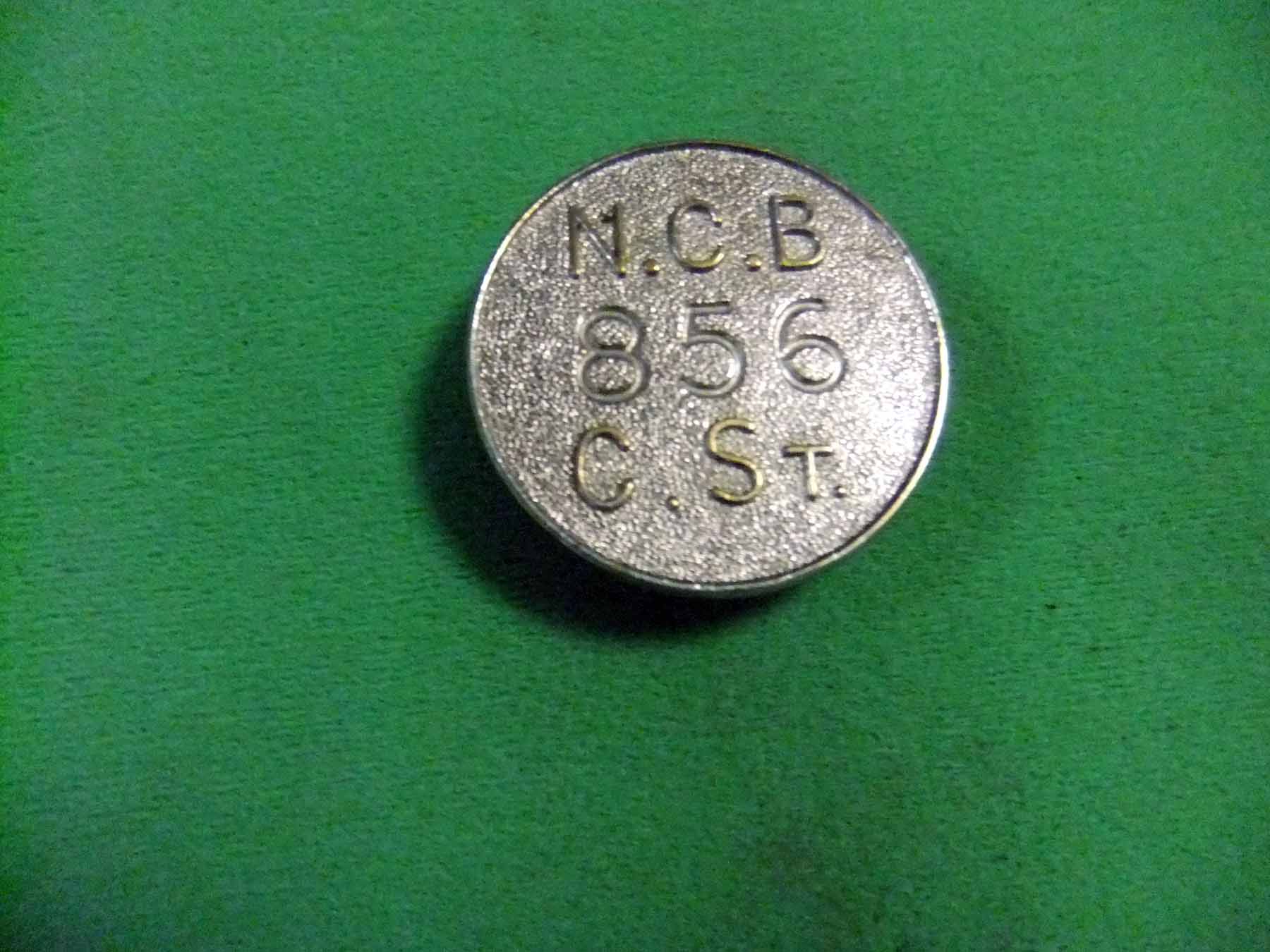
These two examples of lapel badges added to the collection were used for free travel by miners in South Wales, restricted for use between stations in the Pontypool area and various halts provided at such collieries as Hafodyrynys, situated between Pontypool Clarence Street and Crumlin (High Level).

These badges are numbered, one NCB 856 C.St, and the pther NCB 49 P.Rd and are round, 1⅜” diameter.

C. St = Clarence Street, P.Rd = Pontypool Road.

They were made by H.W.Miller Ltd., Branston Street, Birmingham 19.

DSCF5079

If anyone should have any further information about this sort of lapel badge, please let us know.


Railway Heraldry

Coats of Arms

The early railway companies went to great lengths to give themselves status and authority.  This was partly to reassure investors and the travelling public alike since both were initially sceptical of railways and railway travel.  Th achieve the desired effect, companies often used heraldic devices on their coats of arms and seals, even though few were officially entitled to use them.

The company armorial device appears on small items such as badges and buttons, headed notepaper and publications through to ornate ironwork supporting platform canopies and stonework at major stations.  But to the collector one of the favoured items is a genuine railway company armorial transfer, usually attractively mounted on a wooden plaque or backing.

Transfers were introduced in the 1850s by Tearne and Sons Ltd of Birmingham, offering the emerging railway companies an easy method of branding their rolling stock.  Soon locomotives and carriages were suitably embellished with the grand coat of arms belonging to the parent company.

The railway companies took liberties when it came to the heraldic devices they chose to use.  For example the London & North Western Railway (LNER) made free use of the national symbol Britannia.

Although railway companies had consulted the College of Arms about the design of their coats of arms, it was not until 1898 that arms were officially granted.  This was awarded to the Great Central Railway, formerly the Manchester, Sheffield and Lincolnshire.

After the Great Central’s achievement only four other transport companies were awarded armorial devices – the London & North Eastern Railway (LNER), the Southern Railway (SR), the British Transport Commission and the Ulster Transport Authority.

British Railways’ full armorial bearings included a crest (beneath a ‘Forward’ scroll) of a demi-lion on its hind legs clutching a wheel between its paws, while two further lions held the shield.  The three wheels at the top  railways, a portcullis and chains stood for ports and harbours, and straight and wavy lines represented road, rail and waterways.  Below this was  a further scroll ‘Velociter securiter‘: swift and sure.

The crest, replacing an earlier ‘lion and wheel’ device (also known as ‘ferret and dartboard’) was adapted by BR for use as a transfer on carriages and locomotives.  This design  survived until the introduction of the BR twin arrows emblem.  Chrome finished BR crests used on some 1960s electrics are popular.

Save