Chasewater Railway Museum
November 2018 Newsletter

A rather curtailed newsletter this month, however, our curator is slowly recovering from his injury and I am recovering from days-out (well, almost !!)
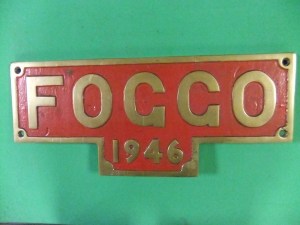
A worksplate from the locally built locomotive ‘Foggo’
Foggo, 1946, from a standard gauge 0-4-2ST built at the Chasetown workshops of the Cannock Chase Colliery Co.Ltd. in 1946, using parts supplied by Beyer Peacock, together with spare parts accumulated over the years from similar locomotives already at work at the colliery. The name derives from Mr. Foggo, the General Manager of the company at the time and the nameplate incorporates the year of build. It became National Coal Board property on 1st January, 1947. Transferred to Coppice Colliery in early 1954 and to Brereton Colliery later the year. Scrapped by W.H.Arnott Young in January 1961. Cast Brass, 21½”x 8¾”, the front repainted.
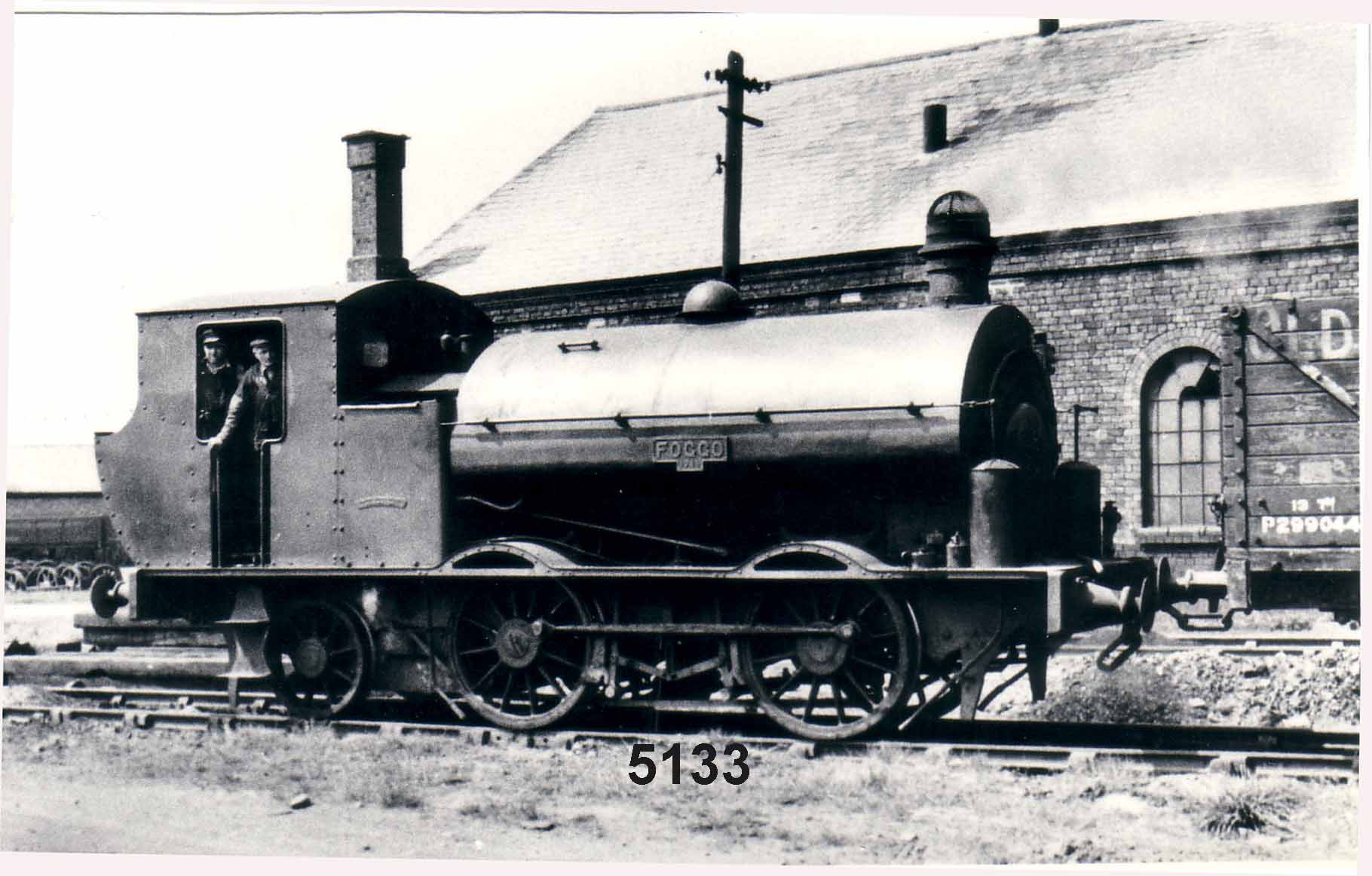
5133 Photograph Foggo 0-4-2ST Built Chasetown 1946 – taken 2-8-1942 from spares and parts supplied by Beyer Peacock Album 1
The worksplate can be seen on the side of the engine.

Posted in Newsletters
Tagged Brownhills, Burntwood, Chasewater Railway Museum, Old Railway Lines, Staffordshire, Steam Trains
Vol 1 No.2
Chairman’s Page
Anything from a button to a branch line
Yes, we are interested in anything of railway origin and historic interest. We have no prejudices. We are anxious to preserve all classes of relics from all pre-grouping companies, the big four and British Railways. In fact, we want to build up a truly comprehensive collection of relics that will form a supplement to the British Transport Commission’s own invaluable collection of historic relics.
At the moment we do not possess either a button or a branch line! We own about 50 relics from the range in between these two types. Our largest is a 6-wheeled carriage, and we expect that we shall soon have satisfactory accommodation for this so that our members can work on its restoration.
The rest of our collection comprises small items, and until we have acquired the necessary rail space and land, we cannot expand our collection of large relics. Both the West Midland and London & Home Counties Districts are working on this problem, and both hope to be able to announce a satisfactory conclusion to their searches.
We already have our eye on a few larger items such as signals, 4-wheeled, 6-wheeled and bogie coaches, as well as goods vehicles. The number of larger items we buy each year is governed by the speed by which our membership grows.
Once again we are enclosing a second copy of this newsletter. Please pass it on to somebody who is interested in the activities of the only national society dedicated to the preservation of standard gauge relics.
West Midland District
Outing to the Much Wenlock Branch, Saturday, 19th September.


A rather small but enthusiastic party attended the District’s first get-together and outing, exact figures being seven members, plus seven relations and friends.
The smallness of numbers did not mar the day, however, and a very enjoyable time was had by all. The main party started from Stafford station and was joined by another member at Wellington. The Station Master at Wellington came over prior to departure for Much Wenlock; he appeared most sympathetic to our aims, and reflected sadly on the closure of branch lines.
Wellington Station – Roger Shenton
The train pulled out on time from Wellington, headed by a 57xx class pannier tank No.3732. The quaint halts en route to Buildwas Junction were noted, the driver, leaning through his cab window, pointed out several places of interest. Coalbrookdale Iron Works were keenly watched by members, with interest in the fact that the first iron bridge in the world was cast there. This was seen spanning the Severn as the train passed over a parallel bridge further up-stream.
Much Wenlock – Wellington
This delightful photograph epitomises the action on so many evocative branch lines in the West Midlands. 2-6-2T No.4142 was running under easy steam at Farley Dingle on 23rd April 1957 on a Much Wenlock to Wellington afternoon local service. As so often happens when rural railway services are withdrawn, the trackbed was transformed into part of the modern road system.
Geoff Bannister
Buildwas Junction proved of interest, an ancient wagon turn-table being spotted, also the two platform levels, one for the Wenlock branch and one for the Severn Valley line. Buildwas Junction
The train passed Buildwas Abbey, a very picturesque sight on the west bank of the Severn. Buildwas Abbey
The gradients and curves then became very pronounced as the train made its way to the Wenlock terminus through the beautiful Shropshire countryside.
A member living at Much Wenlock met the party on arrival and very kindly took four members to Longville in his car, this line being open to freight only. This excursion through the lovely Wenlock Edge was greatly appreciated.
The goods yard, sidings box and single engine shed (without loco) were inspected by the remaining members. The ladies of the party visited the ancient Guildhall and Abbey, which proved full of historical interest.
After tea and a final look around Much Wenlock station, the party caught the 7.05 back to Wellington headed by the same pannier tank, but a different crew.
A vote of thanks must be recorded to the BR Staff at WR Wellington, for the kind way in which they answered questions, thus making the trip thoroughly worthwhile.
It is to be hoped that another outing of this nature will be better attended so that the RPS will continue to thrive and gain more publicity. How about it, WMD members.
Date: 2002
Description: Buildwas Junction formed part of the Severn Valley line that ran from Hartlebury, near Droitwich, to Shrewsbury through Bridgnorth and Ironbridge. However, the line was disbanded in 1963 following Dr Beeching’s review of the railways. A section of track between Kidderminster and Bridgnorth has been preserved by the Severn Valley Company, but the track from Bridgnorth onto Shrewsbury was pulled up in the 1960’s and can no longer be used.
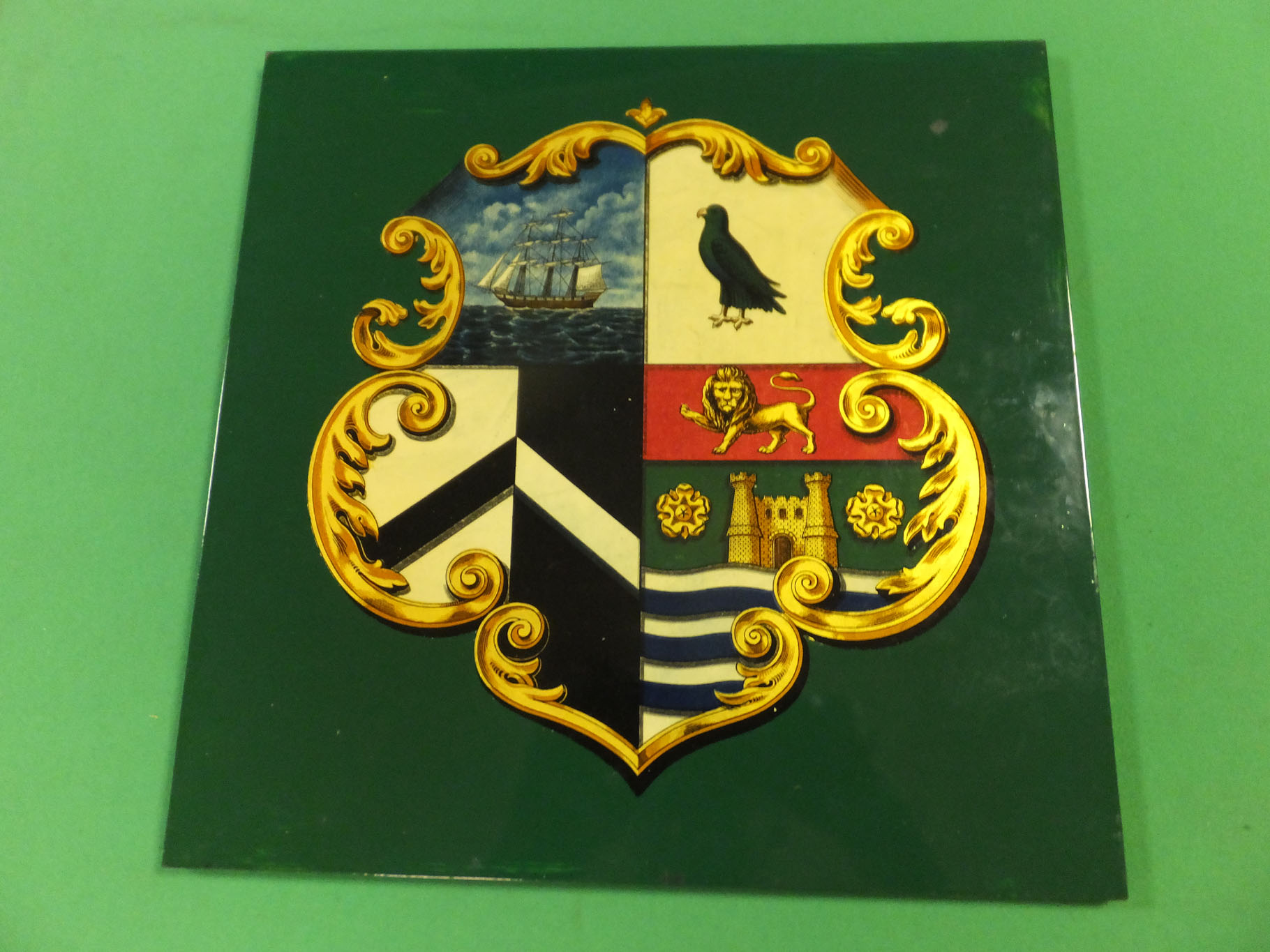
Chasewater Railway has a 6-wheeled coach which belonged to the Maryport and Carlisle Railway, before being used as part of the Paddy Train at Cannock and Rugeley Colliery Pit at Cannock Wood. The Coat of Arms is a long sought-after object for the Museum.
There were 27 subsidiary companies in the group of railways which made up the LMS, but only a handful of them owned locomotives and rolling stock.
The oldest was the Maryport & Carlisle, which was incorporated as long ago as 1837. It was opened in instalments and completed throughout on 10th February 1845, eventually owning nearly 43 route miles of line. It enjoyed an enviable dividend record, which rose to a peak of 13% in 1873, and it was one of the most prosperous of all British railways over a long period of years. It contributed 33 locomotives, 71 coaching vehicles and 1,404 freight vehicles to the LMS.
Two early types of transfer for the decoration of the coaching stock, which was given a varnished teak external finish at the time, have been traced. One was a conventional script monogram. The other consisted of the initials ‘MCR’ on a red field surrounded by an Oxford blue garter with the usual gilt edging, ornamentation and legend bearing the full title. It measures 9¼ in wide X 11¼ in high over black shading.
A livery of green with white upper panels was adopted in 1905 for the passenger train vehicles, which blended pleasantly with the green of the locomotives. Five years later Tearnes produced for display on both an armorial device which shared with that of the Central London the distinction of embodying neither name nor motto.
The transfer measures 10¼in wide X 16¾in high and is simple and appropriate. On an ornamental shield Maryport (top left) and Carlisle (bottom right) are quartered with the arms of J.P. Senhouse of Netherall (top right), represented by the popinjay, and those of Sir Wilfred Lawson (bottom left). Senhouse and Lawson were the first and fourth chairmen the company had during its eighty-five years of life.
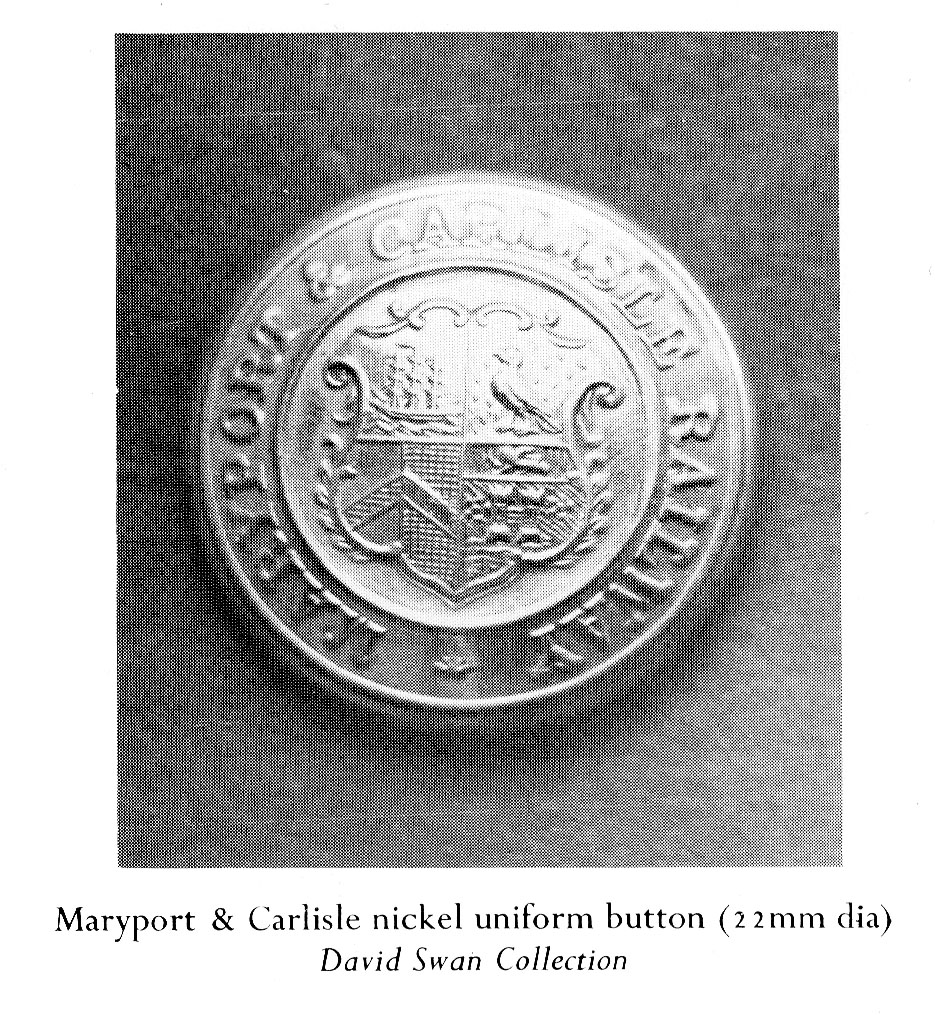
Uniform buttons carried the same device.
The photo has nothing to do with the article, but it’s old!
The first newsletter of the RPS was published in July 1959 and followed the information given in the previous leaflet.
It invited members “to send letters, articles and news items for inclusion in future issues”.
Other items raised were “Why don’t we take over a Branch Line?” The short answer was – not enough members.
“What type of Branch Line are we interested in?”
“The type of branch line we are interested in would have adequate storage space for relics and must be within easy access of large centres of population. The exact criteria will be the subject of investigation by your committee, but we must bear in mind that the bulk of traffic would come from visitors on summer weekends and Bank Holidays who would not necessarily be railway enthusiasts. We should be able to offer such people other attractions in the way of fine scenery and a terminus that is a natural tourist attraction with good facilities for meals, sight-seeing, etc”.
“Where will this Branch Line be?”
The early RPS members studied a proposal for taking over a line in South Devon but after consideration turned it down for two reasons
“1) Too small membership to make it possible.
2) Too far from the large centres of population where the greatest support would come from.”
The thinking behind ‘Districts’ was explained.
“We think it desirable that wherever possible members should be able to visit a place where active work is going on during summer weekends or even just for an hour or two in the evening. Also by concentrating our collection of relics in one place, we would deprive many members of the opportunity of seeing the relics of their local railways.
“Working from this basis, we have evolved the idea of an organisation built up of districts, each playing their own part within a national plan for preserving a collection of relics. The first district has been formed, covering the counties of Herefordshire, Shropshire, Staffordshire, Warwickshire and Worcestershire, and this is called the West Midland District. A meeting of local members has been called to discuss plans for a London and Home Counties District. The suggested area is the counties of Bucks, Essex, Herts, Kent, London, Middlesex, Surrey and Sussex. Other suggested areas for similar schemes are East Midlands, N.W England, Scotland, South Wales, Tyne/Tees and Yorkshire.”
Other items were – How do we form a District, Increasing our Membership, and the names and addresses of the officers of the RPS.
These posts are taken from old publications, newssheets and magazines produced by the Railway Preservation Society (West Midlands Division). Chasewater Light Railway Society and Chasewater Light Railway and Museum.
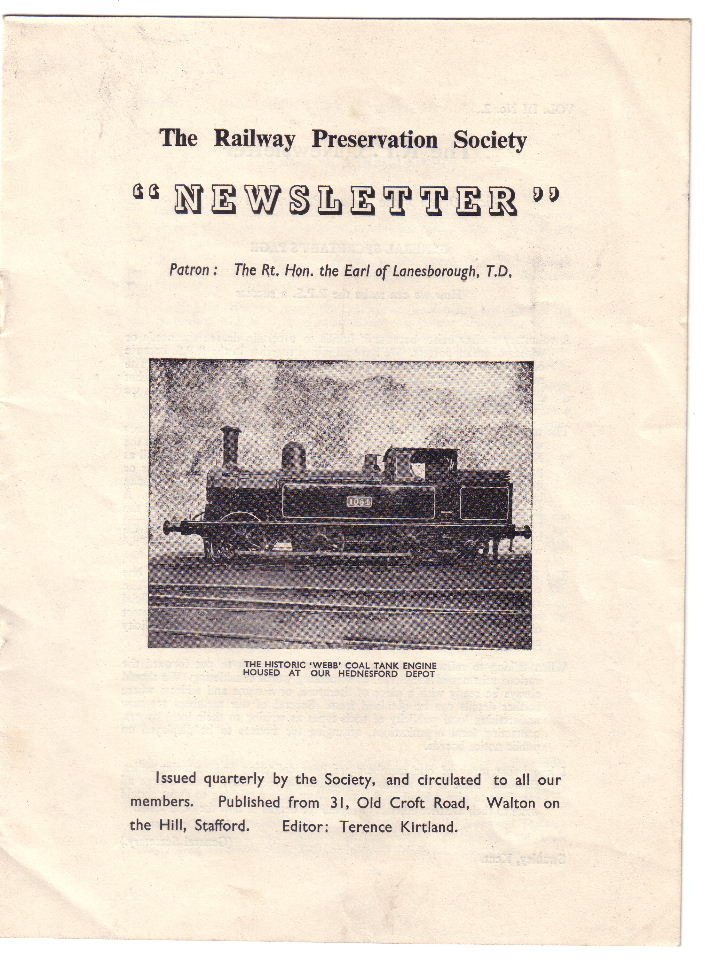
I know that it’s not the newsletter referred to but I needed a picture in a hurry!!
This post was taken from the ‘Railway Preservation Society’ leaflet of 1958 – the start of the railway preservation movement in this country. I found it interesting to know how the movement started – I hope that other people will too!
Railway Preservation Society
The national society for the preservation of relics from the standard gauge railways of Great Britain.
Keep the steam era alive – join the RPS
Introduction
At the present time the railways of Great Britain are going through a period of complete change in the principal method of traction. The steam engine is condemned, though many years will pass before it finally goes. So as to provide a worthy memorial to the steam engine, the Railway Preservation Society was founded in 1958 by a group of railway enthusiasts. We plan to co-ordinate the efforts of individuals and widen the field of railway preservation. Our main aim is the establishment of living museums on our own branch lines, where the steam engine would still be the main source of power and the railway could be seen in the full glory of its Edwardian Splendour.
It is still possible to find engines of many of the old pre-grouping companies in use, and to recreate trains representative of those found on our lines 50 years ago.
But time is running out fast!
Organisation of the RPS
Our members are being grouped in Districts, each consisting of an area of dense population and the surrounding lesser populated area. Each district will concentrate on collecting relics of the railways serving its area, re-capturing the individual character of the Edwardian railway companies.
The relics preserved will range from a button to a branch line. Amongst the items we seek to recreate are the rural stations of yesterday, the signal boxes, the trains, each with its own appearance, which varied from company to company.
Each District will establish a depot as a short term project, until arrangements have been made for leasing or purchasing a branch line. This will give it a working site for the restoration and display of engines, carriages, signals, etc., in a locality convenient to the greater part of the population of the District. It will also enable us to concentrate our first efforts on the urgent need to preserve suitable locomotives.
Appearance of a branch line
The type of branch line we are interested in is one which runs through scenery of natural beauty to a place of tourist attraction. The major proportion of our passengers would not be railway enthusiasts, and we must take them to a place that is attractive in itself and offers them ample facilities for recreation and refreshment. It is only by satisfying our customers so that they recommend the service we offer, that we can hope to succeed.
The length of the line would depend on whether it was a combined effort by more than one District or a solitary venture. It would have exchange facilities with BR at least at one end, so that traffic could be attracted from as wide an area as possible. The stations would be restored to their Edwardian appearance, and the trains run in a similar manner to those of that era. At the same time we should have to satisfy the stringent regulations of the Ministry of Transport, so that our passengers would be guaranteed a high degree of safety.
At the terminus will be found the engine shed, carriage sidings and museum. Here rolling stock not in use at the time could be seen by the public, and their design and the methods of construction and maintenance be on show. Displays of smaller relics, maps, prints, etc. will be arranged to show the growth of the railway network and its influence on the life and trade of the District. Though primarily catering for the railway enthusiast, a keen eye would be kept on our exhibits so as to make sure they were intelligible and interesting to the general public.
The operation of the line on an all-the-year round basis would be actively considered. But as the branch line would be one of the unremunerative lines closed by BR, the possibility of this is somewhat remote. The main effort would be concentrated on running an intensive service during summer weekends and the months of July, August and September, when the large number of voluntary helpers could be fully employed. We would provide hostel accommodation on the line, so that our members who wanted to spend a weekend or part of their holidays on the line, would be assured cheap, reasonable accommodation on site.
We would offer the general public the opportunity to travel in a similar manner to our grandparents in the early years of this (last) century.
There is still a chance
We can succeed. There are still thousands of steam engines on BR, but very few left from the early years of this (last) century The British Transport Commission have announced their intention of applying for permission to close another 2,000 miles of unremunerative lines. There will be plenty of branches for us to choose from.
We can preserve two typical trains of yesteryear for the price of a Rolls Royce car!
All this adds up to a great opportunity. We must seize it now, or see it go for ever.
Keep the steam era alive – Join the RPS
These posts are taken from old publications, newssheets and magazines produced by the Railway Preservation Society (West Midlands Division). Chasewater Light Railway Society and Chasewater Light Railway and Museum.
From the March/April 1962 ‘Mercian’
Bi-monthly news sheet of the Midlands Area of the R.P.S.
From the Hon. Secretary’s notes and reports.
These notes were from the early days when the depot was at Hednesford.
G.E. – Great Eastern, T.P.O. – Travelling Post office
News has been rather scarce this time. I have only had articles from the Hon. Treasurer and T. C. Jones, it is difficult to keep making up copy and I do hope that members will co-operate and send in articles. Otherwise the ‘Mercian’ will soon cease to function. Please send in articles, no matter how small, copy must be sent in by the 8th May.
(Some things don’t change!)
Progress Report
A new siding has now been completed, the G.E.Brake is now stabled on this siding, this has allowed room for the T.P.O. and the Coal Tank to be moved further under the covered space, giving greater protection from the weather. The whole scheme of the new siding was planned by the Assistant Depot Manager, John Elsley, the installation was very ably carried out by him and his small, but willing band of helpers. New glass has now been fitted in the windows of the G. E. Brake, the toilet of the T.P.O is now in the process of being repainted, whilst the interior of this vehicle has been thoroughly cleaned.

Restoration Plans
We hope that the T.P.O. will be finished this Summer (on one side at least) this could easily be achieved if we had a few more willing expert hands. Our woodwork expert Frank Harvey has had a considerable amount of new panelling to do, he is being ably assisted by Fred Lewis. A considerable amount of painting has yet to be done on the T.P.O. so any member who is handy with a paint brush will be very welcome indeed. The Maryport & Carlisle coach still has to be completely reglazed and we earnestly appeal to members for offers of glass
David A. Ives, Hon. Sec.
Working Parties at R.P.S. Depot, Hednesford
The Society holds working parties every Sunday, these commence at 2.30pm. There are however, a number of members who would like to attend working parties, but cannot attend those held on Sundays. During the Summer we are hoping to recommence working parties on Saturdays and Wednesday evenings. Would you please specify on the form below the days you wish to attend, and return form to the Secretary, alternatively contact by post card.
Posted in Bits and Pieces, New Post
Tagged Chasewater Railway Museum, Hednesford, Lichfield, Mercian, Railway, Railway Preservation Society, RPS, Steam
 Chasewater Railway Museum