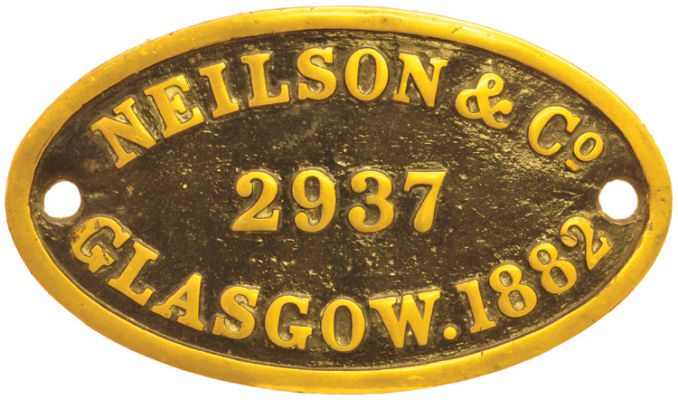
Tag Archives: Neilson 2937-1882 0-4-0ST

165 – Chasewater Railway Museum Bits and Pieces

Please note: the Museum will not be open this coming Sunday, 8th October 2023

5 – ChasewaterRailwayMuseum Bits & Pieces

From Chasewater News Winter 93 – Spring 94 – Part 1


From the Editorial

The latest news is that ‘Asbestos’ is to spend the first weekend in March running on the internal railway system at Bromford Tube Works in Birmingham.  The ‘Open Day’ comes just before the closure of the works and will involve running demonstration trains with the 20 ton GW Toad.

If you would like to put forward your views on a name for the new causeway station please complete and return the form later in the magazine.

 Locomotive News

No.4 Asbestos – This loco ran passenger trains to the top of the causeway bank for the first time in October, and again in December for the Santa Specials.  On both occasions the saddle tank was replenished at around mid-afternoon by a preserved fire engine, courtesy of Trevor Sharples of the Fire Service Preservation Society.  This alleviated the need for us to fill the station water tower in potentially frosty weather, as the longer run to the causeway means that it is no longer feasible to rely on the station hose-pipe between runs.  Following recent problems with firebars warping, a pattern has been made and a couple of samples cast from it.  These were fitted for the Christmas running, and as they seem to have stood up to the last of our Columbian coal quite well, a further batch of replacements will be cast and fitted ready for Easter.   The loco has now been partially stripped ready for a wash-out, cleaning and an intermediate boiler inspection.  Work has also commenced on a number of minor repairs to cure amongst other things, a very tight regulator, a leaking steam manifold joint in the cab, and leaking injector water valves.  If all goes well the loco should be ready to run again at Easter.

No.5 Sentinel – Some progress is now being made with the repair of this loco. A complete set of 96 new ¾” whitworth studs have been specially made to order in a special heat-resistant steel and fitted to the boiler.  The two halves of the boiler shell are now being re-assembled ready for hydraulic testing, hopefully in February.  The superheater coil will also be tested at the same time.  Other work being carried out is the refurbishment of all steam fittings and the boiler water feed pump.  All the fireman’s controls are being moved to the left-hand side of the cab to make life easier, as the loco was originally designed for one-man operation with all controls on the driver’s side.

New Peckett – Following the departure of ‘Lion’, another Peckett has arrived to take its place.  The loco, purchased recently by Mike Wood, appears to have been supplied in kit form, complete with smokebox tubeplate, rods, fittings and various machined and un-machined castings as loose items.  The loco is believed to be No.1903 ‘Little Lady’.  No doubt we will be able to persuade Mike to write an article giving full details in due course.

Fowler diesel – This loco has remained in service without any mechanical problems, being used mainly for the regular Sunday works trains.

Ruston DL7 – Whilst nominally operational, this loco has remained out of use in favour of the Fowler.

L&Y No.1 petrol loco – Dorman Diesels of Stafford have very kindly had specially made for us a new set of camshaft drive gears to fit the petrol engine which is currently dismantled in the shed awaiting re-assembly.  Work on the loco itself has continued with the refurbishment of its springs and axle boxes.

Carriage & Wagon News

Great Eastern six-wheel passenger brake – Work has continued on this coach during the winter, mainly on the interior for obvious reasons.  There can now be little doubt that this will be the first of our vintage coaches to be fully restored, it is well on the way already.

CRC 4-plank wagon – Rebuilding of the new wooden planking of the body is now well advanced, and various items of steelwork are being prepared ready for fitting.

GW Fruit ‘D’ – Following a great deal of hard work to sand down and prepare the wooden body, this van has been painted in chocolate and even has the GWR emblems hand-painted on making it a very smart looking vehicle indeed.  The only obvious outstanding work needed now is the re-covering of the roof to make it water-tight.  Assuming that the vacuum works satisfactorily when new bags are fitted, it would be nice to see it added to the occasional passenger train just for show.

20 ton GW Toad – This vehicle has remained in regular use on Saturday and Sunday works trains throughout the winter.  It is rumoured that it may go to Bromford Tube Works with ‘Asbestos’ in early March as part of a CLR arranged ‘closing down spectacular’ on that Company’s railway system.

Wickham DMU E56171 & E50416 – These two vehicles are now definitely destined for Llangollen at a time yet to be agreed, and dependant on our obtaining suitable asbestos-free replacements.  Meanwhile, the trailer ran again on the Santa Specials in December but is looking exceedingly tatty, especially when coupled to the centre car.  The power car has remained out of use.

Derby centre car W59444 – This coach is the only one of our four original DMUs destined to stay at Chasewater, and is therefore likely to be in constant use for the foreseeable future.  It ran in December when, after quite a bit of preparation, even the heaters worked.

Replacement DMU stock – There is still nothing definite to report, although ‘The Management’ are still working on the acquisition of replacements, and are submitting tenders for suitable vehicles as and when opportunities arise.

Chasewater Railway Museum – More about the Neilson Loco – 1968

More about the Neilson Loco

A Trip to Gartsherrie

From 1968 Mercian Vol.1 No.3

By Trevor Cousens

On Friday, 16th February at 6.00pm a small party consisting of Lawrence Hodgkinson, Mike Lewis and myself, departed from Chasewater in Mike’s 30 cwt. Van en route for Gartsherrie, near Glasgow.  The purpose of this trip was to purchase spare parts from the three Neilson locomotives remaining at Bairds and Scottish Steel Ltd.

A stop was made in Derby to pick up Steve Allsop, then we cut across to the M6 motorway.  The speed of Mike’s van was limited by a governor to 45 mph so the going was slow.

It was quite a relief when a stop was made at a service area for refreshment.  We made full use of the transport drivers eating facilities – in our overalls we did not really have much choice.  Back on the motorway we continued our journey northward.  I retired to the back of the van to try to sleep.  After rolling my sleeping bag out amongst several hundredweights of tools, bars, rucksacks and other bric-a-brac I tried persistently to sleep.  The noise of the engine and the tyres on the road, coupled with a sharp drop in the temperature precluded this.  I heard someone groan ‘snow’ from up front.  This is what we had dreaded.  A climb up Shap with eight inches of snow on the ground!!  After this, sleep was impossible.  I lay on my back and watched icicles form on the van roof.  About 3.30am on the Saturday morning the van halted.  After many gear changes, reverses and sliding of doors up front there was silence for a moment.  When I looked out we were parked on a small snow-covered country lane; fir trees on one side, a railway above us and the moon shining across snow-covered fields.  They had had enough for the evening, and Steve, Lawrence and Mike came aft for sleeping bags, blankets, camp beds and other items necessary for comfort!!  While the three sorted themselves out I got out with a camera and had a prowl around.  I found that we had parked practically under the West Coast main line at Beattock.

In front of us Brush type 4s pounded up to Beattock Summit, assisted by English Electric type 4s, 2s, and 1s on the night mail trains and sleepers.  One could not help thinking that there was something missing not seeing the flicker from the firebox silhouetting the fireman as he shovelled rapidly on a ‘Duchess’ at full pelt up the bank.

The others had comfortably settled down by now in the back of the van.  I chose the driver’s seat as I was sure that it could be no more uncomfortable than trying to lie down again.  With last reminders to wake up at 6.45 am to be in Glasgow for 8.30 am, we dozed off to sleep, a sleep punctuated by the clatter of trains over the bridge above and the wail of diesel horns as bankers attached and detached from the trains – we couldn’t have picked a quieter spot!!

At 7.00 am Lawrence and Steve spent 20 minutes trying to wake Mike, who seemed to be the only one who had really slept, despite the noise (still, he is a railwayman).  We slowly began to thaw out when we were back on the main road to  Glasgow, and the sun came out, picking out the snow-covered hills in a fiery pink light,

Arriving in Glasgow at 9.30 am we met the fifth member of our party – Gerald Wildish – who had travelled up on the overnight train from Darlington to Glasgow without any heating.

Neilson at Gartsherrie

After a meal we arrived at Bairds and Scottish Steel’s works about 11.00 am, where we weighed in and were directed to the loco shed.  We mat a Scottish RPS representative who was also buying spares for their Neilson.  After having a look at our Neilson tucked away in the workshops inside this gigantic, desolate steelworks, we proceeded to the engine sheds where we worked in pitch darkness with the odd brilliant ray of sunshine punching a dazzling beam across the shed, and with snow dripping from the smoke vents onto our heads.  We dismantled the spares from the three scrap Neilsons and filled Mike’s van with spare parts.  An amusing interlude was enacted when Gerald held tea-cups under the water crane to be washed out while I pulled the cord, drowning both the cups and Gerald in several hundred gallons of water.

The load was examined by Bairds and we were weighed out – 10 cwt. Of spares aboard.  We then proceeded to the coal mines at Gartshore where we saw the Scottish RPS Neilson and an Andrew Barclay still simmering next to a red hot brazier which we stood around for 15 minutes to warm ourselves before returning to Glasgow, to a hotel and a well-earned drink.  The hotel we had chosen to stay at was unfortunately a rather expensive one.  I think they were rather shocked to see four really scruffy individuals – black all over with soot and dirt and in need of shaves.  We were ushered up the back lift to two attic type rooms – but they had hot water and beds!!

The Saturday evening was spent feeding and drinking and we bade farewell to Gerald who was lodging in another part of Glasgow, prior to his departure back to Darlington.  We all turned in, forgetting to put forward the alarm clocks and so missing breakfast by one hour!!  Room service rang us at 10.00 am Sunday, and we cajoled the waitress to find us four late breakfasts.  At 11.00am we made a start back towards Chasewater, after buying all the Sunday newspapers.  We stopped for diesel at Lockerbie and continued south, the sun was beginning to thaw the snow and a thick mist was rising.  Suddenly out of the mist our way was blocked by two policemen!!  They directed us to the side, and asked why we carried no ‘C’ licence.  They asked to see the load.  When we opened the door what a sight must have met their eyes, with piping strewn diagonally across the floor of the van, a 20 ton lifting jack, and many other items, including a kettle boiling on a primus for tea!!  After lengthy explanations, the showing of membership cards, driving licenses, etc., we finally convinced them that we were law-abiding, but we could not help thinking of Gerald on his way home with the receipt in his pocket!

Arriving at Hixon at 8.00 pm Sunday evening, we unloaded the spares and drove over to Hednesford for a sandwich and a drink in the ‘Queens Arms’.  The rest of the RPS crew from Chasewater and Hednesford were there, and the tales of the week-end working parties were exchanged.  Mike’s van had changed colour from dark green to white as a result of the salt spray.

So ended a 700 mile excursion to salvage parts which we hope will be used to help keep our 85 year-old Neilson running.  If so, then it will have been worth while.At Chasewater – August 1969

The original ‘Alfred Paget’ – Newspaper cutting from Sue & Diana Windsor

The original ‘Alfred Paget’

Newspaper cutting from Sue & Diana Windsor

The original ‘Alfred Paget’  0-4-2ST No.204/1861, acquired new by the Cannock Chase Colliery Company, scrapped by NCB at Chasetown circa 1952.  ‘Paget’ was the family name of the Marquis of Anglesey, one of the major land-owners in the district, and Chasewater Railway has kept the name – now on a Neilson engine.

‘Alfred Paget’ – the Neilson version.- 2937-1882 0-4-0ST, 


Chasewater Railway Museum – a photo from the archives

Chasewater Railway Museum

A photo from the archives

7127

The Neilson loco 2937-1882 0-4-0ST, complete with ‘Alfred Paget’ nameplates, on a freight train at Chasewater Railway in early days.

Neilson plate & info

A locomotive worksplate, Neilson, No.2937 of 1882, from a 0-4-0ST O/C new to William Baird & Co (Ltd from 1893) at Bedlay Colliery near Glenboig, their No 11, becoming part of the Scottish Iron & Steel Co Ltd in January 1939, Bairds & Scottish Steel Ltd six months later and the National Coal Board in January 1947. It returned to Bairds & Scottish Steel Ltd at Gartsherrie Ironworks, Coatbridge, in about 1950 and following withdrawal, was acquired in June 1968 by Railway Preservation Society, Hednesford, Staffordshire and later went to the Chasewater Light Railway.
Cast brass 10 x 6″¼”, the front of the plate has been repainted.