Tag Archives: Narrow Gauge

172/173- Chasewater Railway Museum Bits and Pieces

172 – Chasewater Railway Museum Bits & Pieces

From Chasewater News Autumn 1994 – Part 1

Permanent Way News

The second and final batch of track has now arrived from Four Ashes and is being put to good use by the Permanent Way Gang.  The works train has had to spend every Sunday ‘out of section’ at the end of the causeway just to make enough room for passenger trains, as with the amount of rolling stock now on site there is insufficient siding space at Brownhills West.  The track gang have put this situation to good use, and at the present rate of progress track will be in front of the platform at Norton Lakeside well before the end of this year.

In order to quantify the progress already made, and to assist with the planning of the future extension of the line, David Bathurst has produced the chart below showing distances between various points on the railway.

All distances were measured by pushing a pedometer along the head of the rail, and sleeper ends were marked with yellow paint at 100 metre intervals.  The ‘Zero Point’ was chosen as the gate post at the end of the loco shed yard, as after the motorway is built it is likely to be the closest surviving landmark to Brownhills West station.  When the time comes, new measurements can be made into the replacement station from the same spot.

The chart shows that we are currently running passenger trains over a distance of about a mile to the present running line limit almost half-way across the causeway.  When we ultimately reach Anglesey Wharf the total distance (estimated over the final section) will be around 2¾ miles, assuming that nothing is lost or added by the repositioning of Brownhills West Station (nice dream, but that’s all!).

173 – Chasewater Railway Museum Bits & Pieces

From Chasewater News Autumn 1994 – Part 2

Locomotive News

No.4 Asbestos – This engine has run exceptionally well considering the dubious start to the season.  Since then a total of twenty-two boiler tubes have been renewed and seem to have cured the problem of leakage at the firebox end.  Another 124 new tubes have now been acquired and are stacked in the shed ready to complete the re-tubing at the end of the running season.  Slight weepage of a few stays and part of the foundation ring will also have to be corrected.

The latest batch of Russian coal, although somewhat smoky, is giving excellent results without the problem of clinkering inherent in the last lot.  This is just as well, as with trains running every Sunday in this summer’s hot weather the last thing anyone wants to do is rake the fire through after every other trip.

Asbestos with a three-coach test train stands on the causeway ready to return to Brownhills West

No.5 Sentinel – Progress on this loco remains slow, although the boiler is now ready for its hydraulic test.  All of the boiler fittings have been refurbished and will be hydrauliced along with the boiler.  The injector has been moved to the fireman’s side of the cab and that and the Weir pump are being re-piped in such a way  that they can be drained easily in winter to prevent frost damage.

S100 – Work has continued with the manufacture of new mountings for the brake hangers to replace the original items which were somewhat bodged and worn out.

Fowler diesel hydraulic No.422015 – Replacement injectors have been acquired and fitted to the engine of this loco with the result that its performance has been transformed.  A few other minor problems have occurred, but it has remained in regular use for shunting and works trains.

Ruston diesel electric DL7 – One of the starting air valves of this loco has had to be renewed due to a damaged seat in the original.  A fuel leak from one of the injector pipes has also been rectified.  The loco is serviceable but has remained out of use mainly due to passenger trains being steam hauled throughout July and August.

Fowler diesel mechanical No.410013 – Following arrival from Redditch this loco has had its engine de-seized, the injectors have received attention and the engine has been run.  Faults have been found with the injection pump and governor and these have now been removed for attention.  Following completion of the air system overhaul the loco should be able to enter traffic.The new Fowler stands in the platform shortly after its arrival from Redditch

L&Y No1 (Motorail No.1947) – All of the axleboxes and springs have now been stripped and rebuilt and a new bearing is being made to replace one which was stolen recently.  Once the sandboxes and inside of the body castings have been stripped and primed the loco will be ready for craning from its present position in front of the museum coach so that final erection can begin.

No.21 diesel – This loco is making steady progress, the engine is now complete but still awaiting cylinder head gaskets.  It is hoped that it may be running for the Diesel Gala which is a new event to be held for the first time in September.

Lion – Following its removal to Foxfield last Autumn this loco entered service at Easter, running initially double-headed with ‘Harwarden’ The vacuum brake hoses were apparently awkward to couple as ours at Chasewater are the opposite side to ‘normal’ to suit our DMU stock.

Smith Rodley crane – This again remained out of use awaiting a potential purchaser.  So far a couple of enquiries have been received but no offers have been forthcoming.

From the Board Room

The Board has been actively involved in a number of new initiatives, while various on-going matters have been subjected to scrutiny and, where necessary, review.  The following will be of general interest to the membership.

1.    Personal circumstances have brought about the resignation from the Board of Les Emery.  However, Les has indicated a willingness to continue with his other roles on the railway.

2.    The Board has agreed to the co-option of Company Secretary Andy Clegg to the Board.

3.    The trading name of the company has been changed to the “Chasewater Railway”.  Previous official and unofficial trading (‘Chasewater Steam Railway’, ‘Chasewater Light Railway’, etc.) are no longer considered suitable and are felt to give a misleading impression of the nature of our current and future operations.

4.    In an attempt to encourage family travel during this period of continual financial restraint, the price of the Family Rover has been reduced, until further notice, from £5.80 to £4.95.

5.    During the course of the nest few months, the Board is to produce a new business plan for the purpose of clearly defining objectives and priorities, and how they might be best achieved within the resources (including financial and manpower) expected to become available.  Associated with this proposal is the revival of the concept of departmental heads, holding pre-determined budgets, to give focus to the completion of the many and varied tasks necessary for the railway to both exist and develop.

6.    The Board has responded to a plea from Rallies Organiser Dave Whittle by delegating various aspects and responsibilities to specified individuals.  Thanks largely to the efforts of Dave, the Chasewater Rallies are rapidly gaining in reputation, with Paul Richards taking up much of the strain as Administrative Officer.

7.    On other fronts:

·        Negotiations are proceeding with HM Railway Inspectorate in relation to the extension into, and construction of, Norton Lakeside Station.

·        The railway was represented at a meeting of Chasewater user groups hosted by Lichfield DC, and arranged on a largely social basis for the various groups to meet the Members and relevant Officers of the District Council.

·        Lichfield District Council has generously offered grant aid to the railway in the sum of £1,000 by way of a contribution towards forthcoming expenditure.  This generous act by the District Council signals a solid measure of support for the railway by its new ‘landlord’.

·        Accommodation at Brownhills West has become a problem in consequence of stock acquisition, (4 DMU coaches plus one tanker wagon).  However, this should be relieved by the imminent removal of one (at least) of the Wickhams, and the Board is still anxious to dispose of the crane (preferably to a good home on another railway) as a matter of priority.

·        The transfer of records from Adrian Hall should enable Paul Richards to take up his responsibilities as Membership Officer with early effect.

·        The Board has agreed strategy towards bidding for the trackwork at Bromford Sidings, and has noted that the remaining trackwork at Four Ashes is due to transfer to Chasewater in August.

David Bathurst – Chairman.

162 Chasewater Railway Museum Bits and Pieces

The Museum will not be open this Sunday, September 17th


From Chasewater News Autumn 1993 – Part 1

Editorial

As you will read elsewhere in this magazine, we are now running trains to the top of the causeway bank.  Next year the run will be even longer, into the new station.  This is a great achievement, but we should not forget that the more track we have, the more it will require in money and manpower to maintain it.  As we still seem to be struggling a bit in both these respects, let us hope that our latest extension will at last encourage more members to come and help with the work, and a lot more passengers to buy tickets to pay for it!

Locomotive News

No.4 Asbestos – This loco has continued to run our passenger services single-handed and has held up very well despite the hectic summer steaming schedule.  A backlog of repairs is now building up which will have to be dealt with over the winter.  The motion is knocking very badly and if sufficient funds are available it is intended to cast new bearing brasses.  Other faults include the injector water valves leaking badly, which will have to be re-machined, and a number of warped firebars which will have to be renewed.Asbestos & L & Y No.1

No.5 Sentinel – Little progress has been made on this loco over the summer due to the need to keep the trains running and Asbestos operational.  All of the old studs have, however, been removed, and the boiler water spaces shot-blasted and painted ready for re-assembly.  The latest target for completion of the work is Easter next year.

No.2 Lion – The sad news about this loco is that its owner has decided to take it to Foxfield, and its transport has been arranged for Saturday October 9th.  Other than that, progress has continued with the completion of the vacuum, brake system, a re-paint and the fitting of a turbo generator for cab lighting.  We wish the loco well at its new home, and will no doubt keep in touch with it.

S100 – The re-machined hornguides of the centre driving axle have now been fitted, and the work is now being repeated for the rear axle.

Fowler Diesel – Following the fitting of a replacement set of batteries, the loco is back to normal, starting almost instantaneously.  It has again done the majority of the shunting and works train jobs.

No.21 Diesel – This loco still awaits its long lost engine, whilst work has been carried out on sanding and painting the body.

L&Y No.1 – A surprise move this summer has been the commencement of restoration on this very rare ‘petrol pudding’.  In the space of only a few hectic weekends the vehicle has been stripped of upper bodywork, engine, gearbox and axle boxes.  The engine itself has been un-seized, stripped and cleaned, and Dorman Engines contacted to help with replacements for the badly worn camshaft drive gears.  If the re-assembly of the loco proceeds at the same pace as the dismantling it should be runnable next year.

Smith Rodley Crane – This vehicle has again remained out of use.

Carriage & Wagon News

Great Eastern six-wheel passenger brake No.44 – Work has continued on the restoration of this vehicle with the chipping, priming and painting of the solebars and running gear.  Even the wheels now have white-wall tyres!  The bodywork is also improving with a coat of Great Eastern blue gloss.

CRC 4-plank wagon – This wagon now has one side and both ends rebuilt and awaits a shunt round the yard so that access can be gained to the other side.

20 ton Great Western Toad No.35251 – The bodywork of this vehicle has been undercoated and is awaiting a top coat.

Great Western Fruit ‘D’ No.2336 – Work has started on stripping paint and undercoating one side, but due to its being kept in the loco shed compound of late where no mains power is available, work on this van has been suspended.

21 ton mineral wagon No.B316711 – This wagon has now had its load of scrap metal removed but still needs the remaining coal dust and slack cleaning out before any restoration can begin.

16 ton Great Western Toad No.35831 – This vehicle is awaiting a space in the yard where work on the springs and running boards can be carried out.

Covered Carriage Truck S770 – This is a new arrival at Chasewater and belongs to one of our members.  It appears to be in excellent condition, requiring only a repaint to cover up the ‘condemned’ symbols painted on the sides by BR.  Even the vacuum brake worked first time as proved during a shunting session coupled to Asbestos.

LNWR West Coast Joint Stock 50’ Brake No.20 – The first section of this vehicle to be renovated internally has remained in use as our museum throughout the year.  Following this success, work has started on clearing and renovating the other end to initially become Santa’s Grotto at Christmas and then the second half of the museum for next year.

Little or no work has been carried out on the other items of vintage rolling stock, mainly due to the lack of manpower.  This is a great shame as there are now a number of half-stripped vehicles stood around under tarpaulins, and winter is approaching.

Wickham DMU E56171 & E50416 – Again, the trailer car ‘Wickham Bar’ has been used as part of our steam hauled passenger train, and in view of its impending departure from Chasewater, little or no work has been carried out on it.  The power car has remained out of use for the same reason, with the engines run up occasionally.  No date has yet been fixed for the departure of these two vehicles to Llangollen.

Derby Centre Car W59444 – This coach has run all this year coupled to the Wickham trailer to form our passenger train.  During the summer the repaint has been completed and it now looks superb in its early BR carmine and cream livery.  As a result of this it is rumoured that our Wickham and Gloucester replacements, whatever they may prove to be, will be painted in the same livery, and hopefully to the same excellent standard.

Gloucester trailer E56301 – Having remained at Chasewater throughout the summer, this vehicle finally left for Preston on Monday 4th October.  It was tidied up at short notice recently so that it could be used for a special train in August for a visit to Chasewater by the Forestry Commission and local Councillors in connection with the work being carried out to restore the causeway.

Replacement Coaching Stock – The search for replacements for the Gloucester and Wickhams is still on, but as yet nothing suitable has been found at the right price.  On one occasion, vehicles from BR which had appeared ideal were found at the last minute to have doubtful ‘asbestos free’ certification and so were not pursued further.  Confidence is, however, high that replacements will be found.

Chasewater Railway Museum August Newsletter

An apology – I’ve only just (2023) realised that I repeated a couple of clips twice in the following video.

Last Reminder – This weekend, 5th and 6th August, 2023


153 – 154 Chasewater Railway Museum Bits and Pieces

153 – Chasewater  Railway Museum Bits & Pieces from Chasewater News Dec 1992 – Part 3

This small gauge loco, with Isle of Man connections, used to make fairly regular visits to Chasewater , this picture and the one at the end of this post have absolutely nothing to do with ‘Carriage & Wagon News’, but they were in the magazine and I just wanted to use them!

Carriage & Wagon News

A sad note to start with is that at the last Board meeting, Dave Whittle stood down as C & W director.  There are many problems concerning the stock, and with Dave’s other duties including our very successful rallies which Dave helped to arange, the work load was too much.

Maryport & Carlisle six-wheel coach – Work has begun on the far side of the coach where a canopy has kept dry the rotting window frames and doors.  These will be treated and painted, but the stock of plywood has completely dried up with no funds for further supplies.

Midland four-wheel passenger brake – Tony Wheeler has undercoated the exposed main end timbers to protect against the weather until plywood sheeting becomes available.

Manchester, Sheffield & Lincoln six-wheel coach – This vehicle has remained sheeted up but will shortly be needed for the local colliery railway history information centre when the Southern brake van goes to Chatham in 18 months time.

16 ton Great Western Toad – Tony Wheeler has re-painted the superstructure of this vehicle which looks good on our permanent way train.  Unfortunately Tony could not gain permission to paint the mess van.

CCCC brake van – Unfortunately due to other projects, Keith Poynter has not had much time to work on his pride and joy.  Photographs from our museum showing this vehicle in service on local lines will soon prove their value during the restoration.

Great Eastern six wheel passenger brake – But for a missing door and one or two small panels, the whole of one side has been completed – albeit in four different colours.  The age of this coach has now been established in the preserved carriage handbook as being 1894, and being numbered 44, ties in with other coach dates.  So 1994 will be its centenary year.

Midland box van – Tony Wheeler has begun work on the exterior paintwork of this vehicle, scraping and painting.

Southern brake van – Work on re-painting this vehicle has been suspended for the time being at the request of its owner.  Tarpaulins have been put over the roof, and a pot-bellied stove fitted inside in an attempt to dry the inside out so that a start can be made on our colliery history information display.

Museum Coach – Although we have just suffered the worst November rain for ten years, Steve and Keith have almost completed the re-roofing (in a new tar-based material) of the LNWR ‘James’ coach.  The inside has been scraped and painted, with the help of the Duffs, to house our Santa’s Grotto before the relic collection is moved back in.

Gloucester trailer E56301 – Having remained in use throughout the year, this vehicle has now finally been withdrawn from service and will not run on the Santa Specials.

Wickham trailer E56171 – This coach has also been in use all year, and now that the loco is attached to the northern end of the train, it is the only one with the driving cab at the correct end for the guard.  A recent trip by CLR members to Tyseley produced an amazing amount of spare parts for our DMUs, bought at scrap prices.  As a result, this vehicle has benefited to the rune of a new set of batteries, a new heater and a new heater control in readiness for the Santa trains.

Derby centre car W59444 – This coach has also received a new set of batteries in the last few weeks and will run in service for the first time on the Santa trains.  Although still in undercoat the coach looks very impressive, possibly due to its being around 7½ft longer than our driving trailers and certainly helps fill the platform.

Wickham power car E50416 – Work has continued on the refurbishment of this vehicle which will also be receiving a new set of batteries (four coach sets in all were obtained).  A lot remains to be done to the interior and some broken windows renewed before it can enter service.

Dave Borthwick

Beyer Peacock Anglesey inside shed with McClean. Cannock Chase Colliery Company

154 – Chasewater Railway Museum Bits & Pieces

 From Chasewater News Dec 1992 – Part 4

Cannock Chase Colliery Company

Transport Development – The Formative Years

Mike Wood

Cannock Chase prior to 1840 was an expanse of barren, desolate heathland with no centres of population and without developed rail, road or water networks – on of the last great wildernesses of England.  The villages of Chasetown and Chase Terrace did not yet exist and were twenty years into the future.  Its few inhabitants made a living from the land selling agricultural produce at market in Cannock or extracting coal from shallow bell pits or drift mines.  There was not only coal on the Chase but also ironstone.  Local opencasters had been aware of its presence for many years but made no use of it as the smelting of iron required organisation and equipment well beyond their primitive means.  For the mineral resources of Cannock Chase to be exploited to the full, big business had to take a hand.  In the form of Henry William Paget, landowner and Marquis of Anglesey, and John Robinson McClean, civil engineer, big business was just around the corner.

The Marquis of Anglesey, whose estate encompassed almost entirely what was to become the Cannock Chase Coalfield, did not begin exploitation of the mineral wealth on his lands until the mid 1840s.  By this time, coal had superseded water as the new power base of the industrial revolution with the increasing use of steam driven machinery in factories and for producing iron.  The success of Stephenson’s ‘Rocket’ at Rainhill in 1829 had also led to the widespread adoption of steam traction on the new fast-growing railway network.  The comparative late development of the Chase as a coal producing area is almost certainly attributable to the absence of a satisfactory transportation network of roads, railways or canals.

The first canal to enter the region was not completed until 1797, when the Wyrley & Essington completed its north easterly course from Wolverhampton to Huddlesford Junction near Fradley where it joined the Trent & Mersey Canal.  In connection with this W&E scheme, a large feeder reservoir was created in 1798 by damming Crane Brook at a point one mile north of Watling Street between what are now the villages of Brownhills West and Chasetown.  Norton Pool, as it became known as, was constructed as a storage facility in connection with maintenance of water levels on the main W&E canal. Access from reservoir to canal was via a narrow drain-off channel of approximately 1¼ miles in length to Ogley along the exact course of what eventually became the Anglesey Branch of the W&E or ‘Curly Wyrley’ as it was known locally.

By 1840 the national canal network comprised over 4,000 miles of navigable waterways providing a means of high capacity, low cost transportation,

It is certain that the presence of a new waterway crossing the southern boundaries of his estate plus imminent construction of the South Staffordshire Railway, due to be opened in 1849, and padding by in the same area as the canal, finally encouraged the Marquis to exploit his underground wealth.

In 1845 the Marquis directed that shafts be sunk at Uxbridge, Hammerwich and Four Mounts on the south eastern shores of Norton Pool, 1½ miles north of the W&E canal and the proposed South Staffs Railway.

This photograph was taken from the same spot as the previous one – but after the M6 Toll road came into being!   The old bridge in Wharf Lane can be seen through the newer one.

The canal company built its Anglesey Branch in 1850 by enlarging its drain-off channel from a main line junction at Ogley.  This branch terminated at Anglesey Basin, a few yards south of Norton Pool where facilities included stables, offices, coal loading chutes and gantries, plus a railway interchange which opened in 1858.  Deep moorings accommodated the endless stream of high capacity canal boats which were to pour their black wealth south down the Birmingham Canal Navigation to fire the industries of Birmingham and the Black Country.

Chasewater Railway News – June 2023

A few stills and random video clips taken on the weekend of the Miniature Madness Event.

I must say it was good to see the Heritage Centre being used for something other than a workshop.

Chasewater Railway Museum News – June 17th & 18th 2023

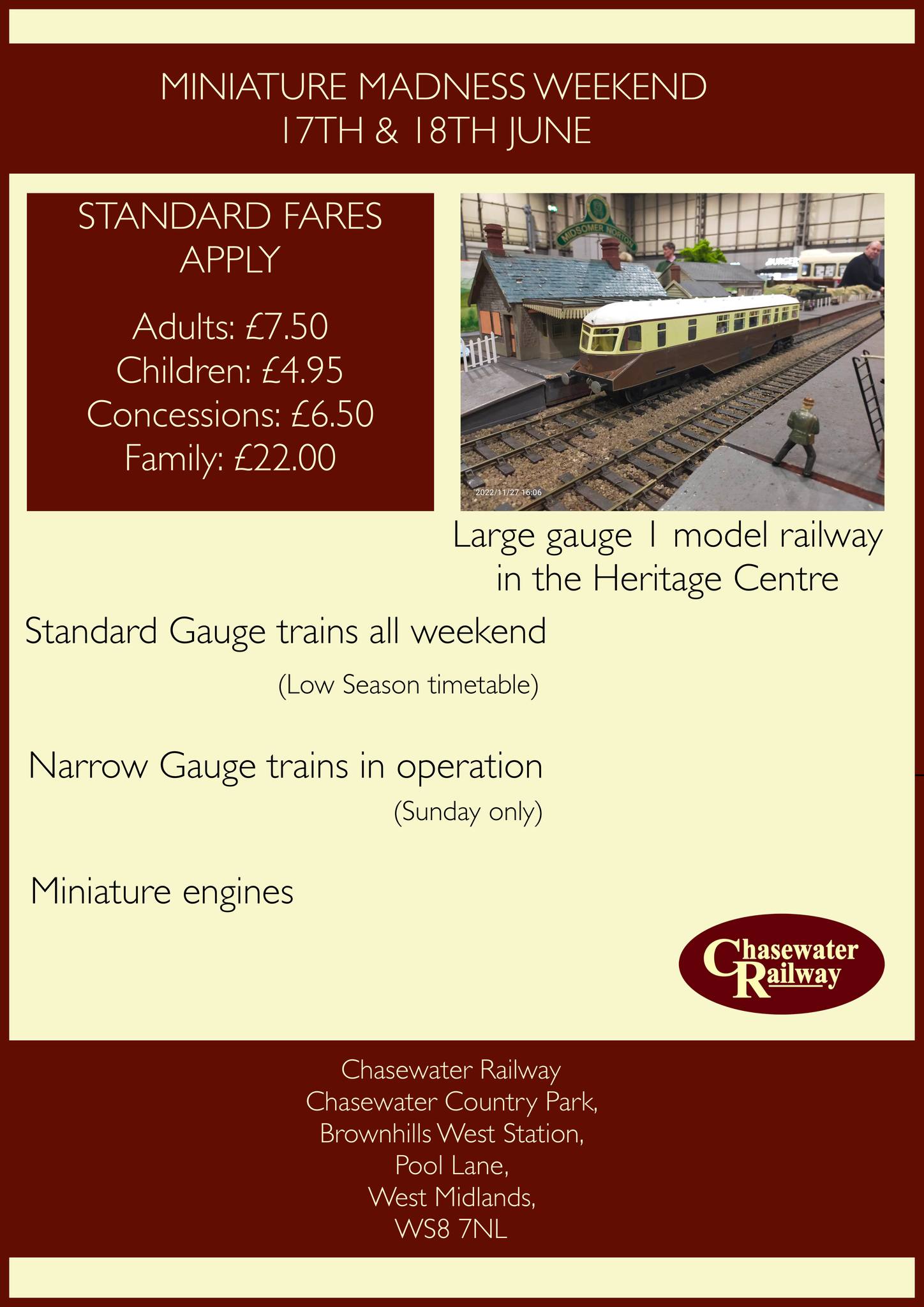
This weekend! Miniature madness weekend! Large gauge 1 model railway in our heritage centre, miniature engines, Narrow Gauge (Sunday only) The Museum will be closed on Sunday. Standard Gauge trains operating all weekend.

Standard fares apply! Don’t miss out!

133 – Chasewater Railway Museum Bits & Pieces From Chasewater News April 1991

133Chasewater Railway Museum Bits & Pieces

From Chasewater News April 1991

Editorial – Nigel Canning

This looks like being the year that the Railway Inspector finally pays us another visit, as he has written saying he will inspect our railway ‘in the summer’.  If what he sees meets with his approval we may have a longer length of line to run on, if it does not we might not have a line at all.  It is now up to all of us to do our best to ensure that he sees an improvement in the existing railway, and that the extension to Willow Vale and beyond meets his requirements.

Later this year ‘Lion’ should enter service, and hopefully after that, ‘Asbestos’, which means that by Gricers Day we could have three engines in steam together for the first time in nine years, and even the new platform fro them to run trains into.  Let us just hope the Railway Inspector is impressed during his visit!

Locomotive News

No.4 Asbestos – Work on this loco has continued through the winter months and in March it passed its visual/ultrasonic boiler inspection.  Examination, however, has revealed that part of the firebox crown is nearing its limit on plate thickness and it is only a matter of time before serious repairs will be necessary.  The boiler will now be prepared for its hydraulic test.

No.5 Sentinel – This loco also passed its boiler examination in March and again looks like being the only serviceable steam loco for at least the first half of the season.  Repair work over the winter has included re-machining of the steam brake valve, fitting of a new cast fire grate and work on the paintwork in preparation for the ‘gasworks red’ livery to be applied as soon as weather permits.

No.2 Lion – A brand new saddle tank was delivered to Chasewater and temporarily fitted to the loco in January to check its dimensions; it was virtually perfect!  Other work has included the installation of sliding cab shutters and the boiler has been washed out.  The boiler now awaits the fitting of new washout plugs before the hydraulic test can be carried out.

S100 – Work has continued on this loco with the redesign of the hornguide grinding machine.  Another of the four main leaf springs has been stripped, cleaned and re-assembled.

DL7 – This loco was taken out of service for a couple of weeks recently while the injectors were removed, overhauled and refitted.

Fowler – This loco has remained in service without problem over the winter hauling works trains to the extension pastWillow Vale.

Smith Rodley Crane – This vehicle has seen only minimal use lately although work has continued on its repair and restoration.

Permanent Way News

The majority of work carried out by this department recently has been concentrated on the extension of track pastWillowVale.  Whilst the number of volunteers has fallen slightly, those brave enough to carryon through the worst of the winter have at least had a comfortable works train.  The favourite formation for this appears for some reason to be: the Fowler diesel, the DMU centre car and the two GWR brake vans with, of course, the stove kept well stoked.

The concrete platform for Willow Vale Halt has yet to be collected from theSevernvalley Railway as it is planned to carry out this job when the evenings become lighter allowing longer hours to be worked if necessary.

One extra job urgently requiring attention is the repair of the bridge handrails, which having recently been repaired and increased in height, have now been totally destroyed by the local toe rags.

Carriage & Wagon News

Midland four-wheel passenger brake – This vehicle has remained sheeted over during the winter, but work will continue as soon as the weather improves.

Manchester, Sheffield & Lincoln six-wheel coach – Some progress has been made on this vehicle, but again the damp weather has limited the type of work that can be carried out.

Great Eastern six-wheel passenger brake – All of the doors have been removed from this vehicle for repair ‘off-site’, and the bodywork has been prepared and painted in yellow primer.

Wickham 2 car DMU E56171 & E50416 – The trailer car of this set has remained coupled to theGloucesterover the winter, and work has been carried out on refurbishment of the bar.                                                                                               A start has bee made on repairing, rubbing down and priming the bodywork of the power car ready for a repaint.  Work has also been carried out inside, removing seats and tables to make room for re-decoration.                                                                  Since the last issue of Chasewater News a preservation group dedicated to restoring the Wickham as a working DMU has been formed.  This organisation is currently drawing up its proposed constitution which is expected to be similar to that of the Hudswell Group in that the DMU will remain at Chasewater.

Gloucestertrailer E56301 – Little work has been carried out on this vehicle over the winter and there are rumours that another society may be interested in purchasing it for preservation elsewhere.  In the meantime it will be used on trains at Chasewater coupled to either the Wickham trailer or the new centre car.

Derby centre car W59444 – This coach arrived at Chasewater in January, having travelled from Tyseley diesel depot by low loader.  Before it enters passenger service, it is planned to fit a bar as a replacement for the one in the Wickham trailer.  Livery will probably remain BR blue and grey for the time being, although early BR carmine and cream has been rumoured as the intended replacement.  One problem has become apparent in that being a centre car, it has no handbrake so it has to be marshalled between another braked vehicle and the loco or the buffer stops.

General News From The Line

It now seems that the large portacabin which had been intended for use as a station buffet will not now be coming to Chasewater.  In view of this, work has started on renovating and converting the two smaller units which arrived in December to form a smaller buffet and separate kitchen.  As this work is likely to take quite a while, catering on a limited scale will take place on the train and possibly in the Wickham power car once more.                                                                                                                                           The portaloo is now in its final position next to the south end of the platform where it will be much appreciated by the loco dept.  Work on its refurbishment is progressing well and a race is now on to see whether the buffet or portaloo opens for business first.

Human Resources

An interesting meeting of working members was held in March to discuss ideas to improve work output on the railway by providing more organisation and planning so that priorities can be agreed in advance and last minute panics avoided.                 To achieve this, four departmental ‘foremen’, listed below, were appointed, whose job it is to liaise with each other to agree priorities and to suggest suitable jobs for anyone arriving at the railway and wishing to help out.

Permanent Way         Les Emery

Carriage & Wagon     Dave Whittle

Loco Dept                  Tony Sale

Station & Site             Steve Organ

If you don’t already have a project of your own and wish to help out, please contact any of the above people, or ask at the booking office where to find them.

 All photos – Nigel Canning

Chasewater Railway Museum – Photo info please?

Chasewater Railway Museum

Photo info please?

This is a photo in our collection but we don’t know anything about it except what it says underneath.  Does anyone have any idea where on the Chase this 2 ft. gauge railway was?  Or the identity of Colonel Wilson?

When the ground was being prepared for the Chasewater Heaths Station, rails of different gauges were uncovered, but we don’t know any more than that.

Latest information, from Phillip Halfpenny: It’s a Manning Wardle,  No. 1371/1897.  At Great Wyrley Colliery, rebuilt in 1911, scrapped in 1944.  Thanks to Phillip.

Cannock Chase c1902 Col Wilson