Chasewater Railway Museum
After the Gala
Bank Holiday Monday – May 27th

These posts are taken from old publications, newssheets and magazines produced by the Railway Preservation Society (West Midlands Division). Chasewater Light Railway Society and Chasewater Light Railway and Museum.
Another couple of bits and pieces from the Railway Forum – Winter 1965. The first is a display of name and number plates, loaned by one of the members, and laid out in the Royal Saloon – which left Hednesford in 1970 for the British Railways carriage works at Derby for restoration and then on to the Midland Railway Centre at Butterley.

Midlands RPS Open Day display
An interesting display of locomotive nameplates and numbers was arranged in the Royal Saloon for inspection by visitors at the Midlands R.P.S. Open Day.

New locomotives preserved in Midlands
Members of the Midlands area, R.P.S. expect to take delivery of another locomotive later this year which has been acquired through the generosity of one of their members, Dr. P.G. Plummer, who has offered to purchase it for them.
The locomotive is a Hudswell-Clarke 0-6-0ST built for the Sheepbridge Coal and Iron Company in 1895 (Works No. 431). It was transferred to its present location, Desborough Warren Quarry, Northamptonshire, in March 1951 and was due for withdrawal in July. It is believed to be the oldest Hudswell-Clarke locomotive still in working order and once carried the number 15. Now it has no number or name, although known as “Sheepbridge No.25”.
Painted in apple green it should be a valuable addition to stock already acquired, and will be of considerable use at the Chasewater branch line which has been leased by this group.
Two other locomotives have also been donated by the Whitecross Co. of Warrington. They are Peckett 0-4-0STs of 1900 and 1904 vintage. They were withdrawn from service by the Company in 1961, being replaced by two Fowler diesel locomotives. They carried names up to withdrawal, the older being “Baden Powell” and the younger “Lancet” the nameplates of the latter being transferred to the Diesel No.1, and those of the former being acquired by local enthusiasts. Only “Lancet” will be able to run again. It is hoped to exhibit “Baden Powell” statically.


The second is about new locomotives coming to Chasewater. Sadly the Hudswell Clarke, although we still have the loco, has never steamed here. The two Pecketts fared even worse. The ‘Lance’ (not Lancet) 1038/1906 was scrapped in March 1972, and another Peckett – 1823/1931 was also scrapped at the same time. The Loco ‘Baden Powell’ was in too bad a condition to be moved. The other loco was an 0-4-0F a fireless Andrew Barclay locomotive 1562/1917 – scrapped in March 1973.
The articles were writtten in 1965, the photos taken in 1969.
Inaugural Meeting
About 20 people met at the Station Hotel, Stafford, on Saturday 21st November 1959 for the inaugural meeting. The General Secretary opened the meeting and sketched out the reasons leading to the formation of the RPS and future plans. He explained that this was the first District to be inaugurated and though the general outline had been planned out, the detailed application of this would be the concern of the WMD committee.
Mr. D. A. Ives, who has been acting as Secretary, gave a report on progress to date. He reported that membership was over 25 and that they had received a good response from individuals contacted. The first step was to secure a small depot in a convenient locality, where relics could be stored and members work on their restoration. The ideal site would contain a certain amount of covered accommodation as well as rail space for carriages and wagons. He believed the support was there in the West Midlands, it was only a question of publicity and personal contact.
The committee to serve for the current year was then elected.
Future plans were discussed and the decision taken to launch a publicity campaign leading up to a public meeting in the New Year. The site of the public meeting was fixed as being Birmingham, but emphasis was laid on arranging future meetings in different towns to give better contact with the public and members.
Three reporters attended the meeting, leading to reports in the ‘Stafford Newsletter’ and the ‘Staffordshire Weekly Sentinel’.
The public meeting was fixed for Saturday, March 5th in the Small Theatre at the Birmingham & Midland Institute, Paradise Street, Birmingham at 2.30pm. Everyone welcome.

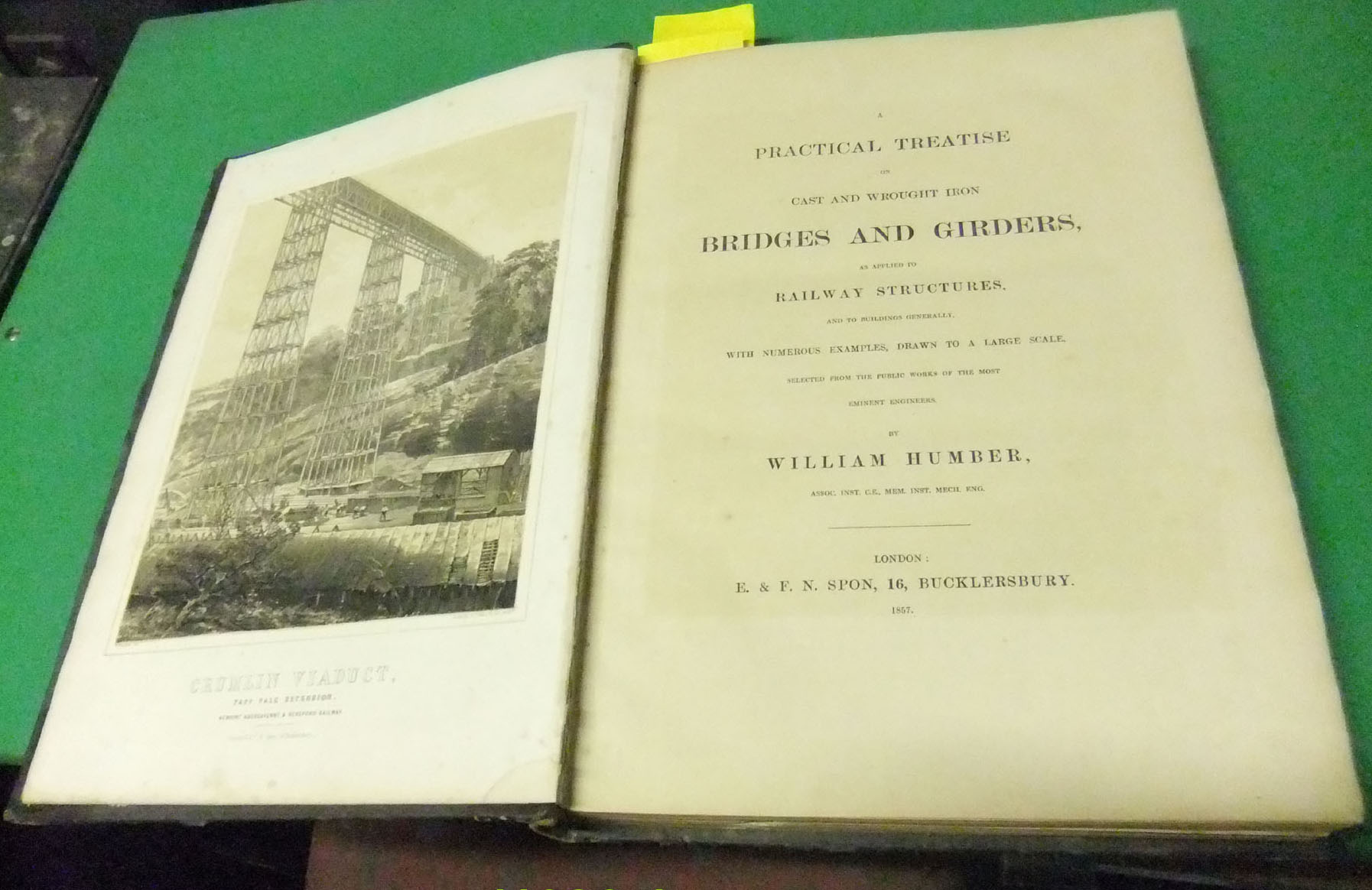

No.1:
South Staffordshire Railway
Aqueduct Cannock Chase
Messrs. McClean and Stileman, C.E. ( Consulting Engineers – John Robinson McClean and Francis Cloughton Stileman) John Robinson McClean was involved with the South Staffordshire Railway and the Cannock Chase Colliery Company, and is of particular interest to Chasewater Railway and the Museum.
In 1849 he took into partnership Mr. F. C. Stileman, with whom he engaged in the construction of the South Staffordshire Railway, the Birmingham Wolverhampton and Dudley Railway, the Staffordshire and Worcestershire Canal reservoirs, and the South Staffordshire Water Works supplying water from Lichfield to a very extensive district.
Constructed by Messrs. Lloyds, Forsters & Co.
This Aqueduct was erected to carry the Walsall and Birmingham Canal over the Bloxwich Branch of the South Staffordshire Railway. The work had to be completed before proceeding with the railway cutting to prevent interruption with the canal traffic, and also the supply to a water wheel, situated some distance below the ground of operations, in which the canal company was interested. Considerable difficulty was experienced in carrying out the work, because of the unfavourable nature of the soil, which was loose, sandy and, to some extent, marshy; increased by the continual sinking of the banks, caused by the coal and iron pits, which undermine the whole district.
The aqueduct is carried at right angles across the railway in two spans, each 14 feet wide, by 15 feet 4 inches from the level of the rails to the bottom of the girders. The trough 20 feet 4 inches wide by 5 feet 6 inches deep.

No.2:
South Staffordshire Railway
Cannock Branch
Messrs. J.McClean and Stileman C.E.
This bridge was erected for the purpose of carrying the Cannock Branch of the South Staffordshire Railway over the Wednesfield Branch of the Birmingham Canal. The peculiarity of this case consists in a better distribution of the metal in the top flange of the girders by which means the liability of that member to buckle when subjected to severe strains is in a great measure obviated.
The railway crosses the canal at a very acute angle, and to obviate as much as possible the effects of unequal deflection, each line of rail is supported by independent platforms so as to form two distinct bridges. The longitudinal or main girders are 63 feet 4 inches long, having a bearing of 6 feet at each end on the abutment, so that the span is only 51 feet 4 inches.
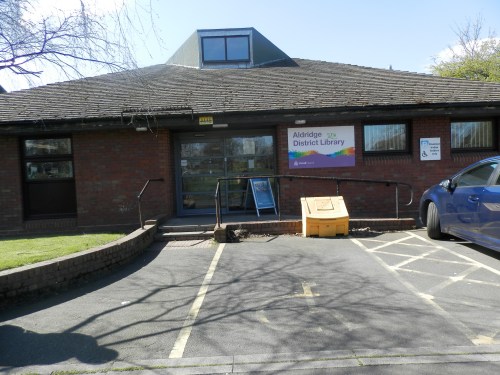
Aldridge Library situated in Rookery Lane Aldridge, is currently displaying an exhibition of Railway Memorabilia courtesy of Chasewater Railway Museum. The display is housed in two glass cabinets.


To compliment the cabinet display is a screen presentation of the aspects of Chasewater Railway.


The display which was organised by Susan Satterthwaite (a volunteer at Chasewater Railway) will run until the end of May. The Library is open from Tuesdays until Saturdays, (closed Mondays & Sundays).
The artifacts displayed are just a selection of the many on display in the free to enter, Chasewater Railway Museum, which is situated at Brownhills West Station, and is open on train running days.
Why not visit and relive the past.
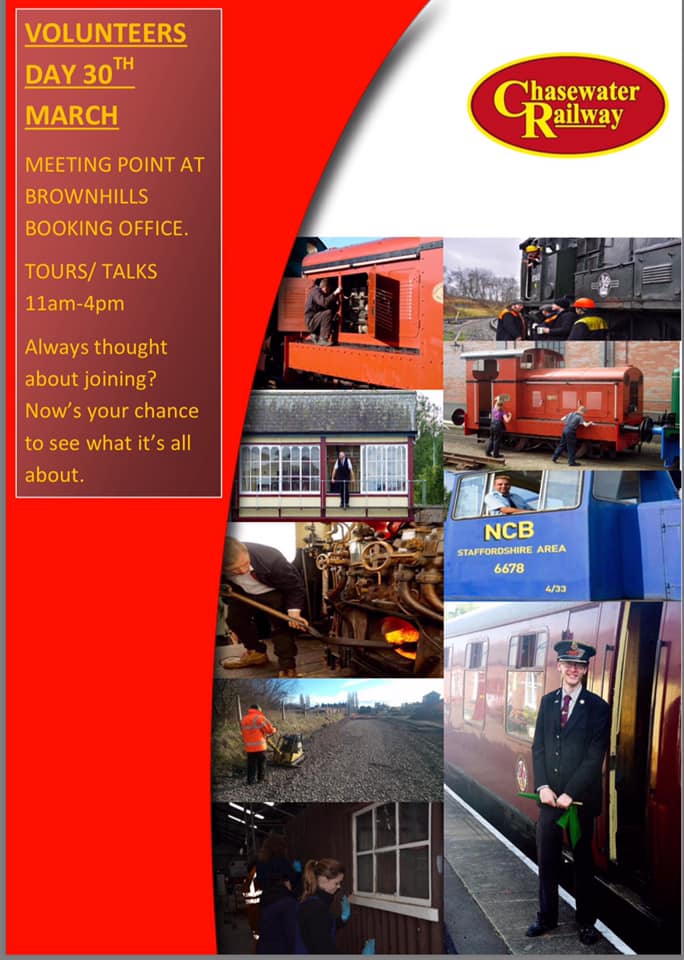
For those who would like to help but are not as young as they used to be there is always the Museum, we need more volunteers too – just move occasionally and we won’t stick a label on you!
 Chasewater Railway Museum