Category Archives: Chasewater Railway Museum

Chasewater Railway Museum – More about the Neilson Loco – 1968

More about the Neilson Loco

A Trip to Gartsherrie

From 1968 Mercian Vol.1 No.3

By Trevor Cousens

On Friday, 16th February at 6.00pm a small party consisting of Lawrence Hodgkinson, Mike Lewis and myself, departed from Chasewater in Mike’s 30 cwt. Van en route for Gartsherrie, near Glasgow.  The purpose of this trip was to purchase spare parts from the three Neilson locomotives remaining at Bairds and Scottish Steel Ltd.

A stop was made in Derby to pick up Steve Allsop, then we cut across to the M6 motorway.  The speed of Mike’s van was limited by a governor to 45 mph so the going was slow.

It was quite a relief when a stop was made at a service area for refreshment.  We made full use of the transport drivers eating facilities – in our overalls we did not really have much choice.  Back on the motorway we continued our journey northward.  I retired to the back of the van to try to sleep.  After rolling my sleeping bag out amongst several hundredweights of tools, bars, rucksacks and other bric-a-brac I tried persistently to sleep.  The noise of the engine and the tyres on the road, coupled with a sharp drop in the temperature precluded this.  I heard someone groan ‘snow’ from up front.  This is what we had dreaded.  A climb up Shap with eight inches of snow on the ground!!  After this, sleep was impossible.  I lay on my back and watched icicles form on the van roof.  About 3.30am on the Saturday morning the van halted.  After many gear changes, reverses and sliding of doors up front there was silence for a moment.  When I looked out we were parked on a small snow-covered country lane; fir trees on one side, a railway above us and the moon shining across snow-covered fields.  They had had enough for the evening, and Steve, Lawrence and Mike came aft for sleeping bags, blankets, camp beds and other items necessary for comfort!!  While the three sorted themselves out I got out with a camera and had a prowl around.  I found that we had parked practically under the West Coast main line at Beattock.

In front of us Brush type 4s pounded up to Beattock Summit, assisted by English Electric type 4s, 2s, and 1s on the night mail trains and sleepers.  One could not help thinking that there was something missing not seeing the flicker from the firebox silhouetting the fireman as he shovelled rapidly on a ‘Duchess’ at full pelt up the bank.

The others had comfortably settled down by now in the back of the van.  I chose the driver’s seat as I was sure that it could be no more uncomfortable than trying to lie down again.  With last reminders to wake up at 6.45 am to be in Glasgow for 8.30 am, we dozed off to sleep, a sleep punctuated by the clatter of trains over the bridge above and the wail of diesel horns as bankers attached and detached from the trains – we couldn’t have picked a quieter spot!!

At 7.00 am Lawrence and Steve spent 20 minutes trying to wake Mike, who seemed to be the only one who had really slept, despite the noise (still, he is a railwayman).  We slowly began to thaw out when we were back on the main road to  Glasgow, and the sun came out, picking out the snow-covered hills in a fiery pink light,

Arriving in Glasgow at 9.30 am we met the fifth member of our party – Gerald Wildish – who had travelled up on the overnight train from Darlington to Glasgow without any heating.

Neilson at Gartsherrie

After a meal we arrived at Bairds and Scottish Steel’s works about 11.00 am, where we weighed in and were directed to the loco shed.  We mat a Scottish RPS representative who was also buying spares for their Neilson.  After having a look at our Neilson tucked away in the workshops inside this gigantic, desolate steelworks, we proceeded to the engine sheds where we worked in pitch darkness with the odd brilliant ray of sunshine punching a dazzling beam across the shed, and with snow dripping from the smoke vents onto our heads.  We dismantled the spares from the three scrap Neilsons and filled Mike’s van with spare parts.  An amusing interlude was enacted when Gerald held tea-cups under the water crane to be washed out while I pulled the cord, drowning both the cups and Gerald in several hundred gallons of water.

The load was examined by Bairds and we were weighed out – 10 cwt. Of spares aboard.  We then proceeded to the coal mines at Gartshore where we saw the Scottish RPS Neilson and an Andrew Barclay still simmering next to a red hot brazier which we stood around for 15 minutes to warm ourselves before returning to Glasgow, to a hotel and a well-earned drink.  The hotel we had chosen to stay at was unfortunately a rather expensive one.  I think they were rather shocked to see four really scruffy individuals – black all over with soot and dirt and in need of shaves.  We were ushered up the back lift to two attic type rooms – but they had hot water and beds!!

The Saturday evening was spent feeding and drinking and we bade farewell to Gerald who was lodging in another part of Glasgow, prior to his departure back to Darlington.  We all turned in, forgetting to put forward the alarm clocks and so missing breakfast by one hour!!  Room service rang us at 10.00 am Sunday, and we cajoled the waitress to find us four late breakfasts.  At 11.00am we made a start back towards Chasewater, after buying all the Sunday newspapers.  We stopped for diesel at Lockerbie and continued south, the sun was beginning to thaw the snow and a thick mist was rising.  Suddenly out of the mist our way was blocked by two policemen!!  They directed us to the side, and asked why we carried no ‘C’ licence.  They asked to see the load.  When we opened the door what a sight must have met their eyes, with piping strewn diagonally across the floor of the van, a 20 ton lifting jack, and many other items, including a kettle boiling on a primus for tea!!  After lengthy explanations, the showing of membership cards, driving licenses, etc., we finally convinced them that we were law-abiding, but we could not help thinking of Gerald on his way home with the receipt in his pocket!

Arriving at Hixon at 8.00 pm Sunday evening, we unloaded the spares and drove over to Hednesford for a sandwich and a drink in the ‘Queens Arms’.  The rest of the RPS crew from Chasewater and Hednesford were there, and the tales of the week-end working parties were exchanged.  Mike’s van had changed colour from dark green to white as a result of the salt spray.

So ended a 700 mile excursion to salvage parts which we hope will be used to help keep our 85 year-old Neilson running.  If so, then it will have been worth while.At Chasewater – August 1969

Chasewater Railway Museum – A Bits & Pieces article from Mercian Vol.1 No.3 1968

A Bits & Pieces article from Mercian Vol.1 No.3 1968

Taken from the Mercian Vol.1 No.3 an article by Gerald Wildish about our Neilson Locomotive. (Now, in 2020, in private ownership.)Shown here carrying the ‘Alfred Paget’ Nameplate

Neilson & Son Ltd., No.2937 of 1882

Bairds & Scottish Steel  Ltd.’s No.11

Delving back through the records of Bairds & Scottish Steel Ltd., one comes across several interesting details about the locomotive which we hope will be at Chasewater before the summer is out.  Some of this information which has come into my hands is included in this article.

No.11 was the fifth locomotive built by Neilson’s for Bairds, two of which were six-coupled.  She was the second 14-inch four-coupled built for Bairds. (The first, No.13 – built in 1876 passed to the NCB in 1948 and will eventually find a home at Falkirk).  Supplied new to Bairds in 1882, she cost £1,275.  Engines built to this design cost Bairds between £925 and £1,300, the cheapest being the last, the second, No.3 delivered in 1889.

My own personal records of No.11 go back no further than 1889, but in May 1900 a new firebox and tubes were fitted.  The next major repairs were in 1911 when a further new firebox and tubes were fitted.  A minor overhaul took place when a new right-hand coal bunker was supplied and the tank replaced.

After 1916 the records became scant until 1934 when greater detail is once again recorded.  In January 1936 another semi-major overhaul took place: new plates were provided for the boiler and a new brake assembly was fitted.  A year later the firebox was patched and all mountings ‘done-up’.  In July 1938 she was stopped again for general repairs and in November was fitted with a new firebox, repairs continuing until March, 1939.

In 1941, 4 new tyres were fitted, new brasses being added at the same time during a heavy general repair.  She returned to the works in June 1943 when the boiler and firebox were condemned, but was back at work with new boiler and firebox, a patched tank and new brake cylinder block and shaft in less than six weeks.  It shows what work can be carried out quickly during war time. (Due to the pressure of keeping engines at work, No.1 – the ex GERJ 15 class was sent to Cowlairs for overhaul.)  A further new firebox was fitted in August, 1945 during another heavy overhaul.

New tyres were fitted in the general overhaul of 1947, but the next interesting occurrence came in the heavy overhaul of 1949, after fitting new tubes, a further new firebox was fitted and the boiler removed for hydraulic testing.  However, when being removed for testing, the rope broke damaging the boiler, which had then to be lifted into the shed and rebuilt on the frames for testing again.  Eventually the boiler was hydraulically tested to 200 lbs. and steam to 135lbs.

Fireboxes seemed to wear out very quickly on the Neilsons for the 1950 firebox fractured in 1954 and was presumably replaced although the records do not state this.  General repairs followed in 1958 and 1963, when the boiler was announced to be satisfactory and in June 1967, just before the works closed.

When the works closed in July, apart from being the second oldest working locomotive in the British Isles, No.11 was the last to be repaired at the Gartsherrie Works.  She is in excellent mechanical order and when inspected by the engineers in February of this year (1968), it was pronounced that she would be the best of the RPS stock in this direction.  She lacks paint – I have no record of her being painted after 1950 – and remains in the post-war black.  She was never repainted dark blue as were many of her contemporaries at Gartsherrie.  We hope, funds permitting, to move her to Chasewater at the end of May or early June.  We have enough money to complete the purchase but we are still short of removal funds by several pounds.

Summary of dimensions:

Weight: 28 tons, Boiler Pressure: 120lbs. per sq.in.

Overall Length: 23ft 7ins.  Tractive Effort: 8885lbs.  Height: 10ft 10ins.Line drawing of the Neilson also by Gerald Wildish

Chasewater Railway Museum 1968 Vol.1 No.3 Bits & Pieces 42.3

Chasewater Railway Museum 1968 Vol.1 No.3 Bits & Pieces 42.3

Plus Stocklist – 1968

This is one of a number of articles included in this magazine – there will be another couple to follow later. I don’t know what happened to this loco, but in spite of it being purchased and delivered to Chasewater, it hasn’t steamed since!

Hudswell Clarke 0-6-0ST No.431 – By Frank Harvey

Working at Desborough – V F Hall


The previous issue of the Mercian featured several photographs of this, our latest locomotive, and it was felt that a short article about it would not be out of place.

It was built by Hudswell Clarke & Co., Leeds in 1895, works number 431 and spent most of its life in the hands of the Sheepbridge Coal & Iron Company in whose fleet she became No.15.  It was allocated the name ‘Sheepbridge No.25’, but this was never carried and with the removal of its official number and works plates ran its last years without any identification at all.

It has on two occasions been rebuilt, first in 1928 and secondly in 1944, by the Sheepbridge Company themselves.

The engine was first suggested as a suitable candidate for preservation some two years ago when it was one of several locomotives at work at Desborough Warren Quarry near Kettering.  One by one its companions were withdrawn leaving No.15 as the only workable source of motive power.  After closure of the quarry it assisted with the lifting of the track, until the early part of 1967 when it too was withdrawn and stored in the engine shed at Desborough in company with an Avonside 0-6-0T.

The RPS then stepped in and after pleasing, successful negotiations with Stewarts and Lloyds Ltd., the locomotive was purchased.  The firm kindly allowed us to steam the engine before purchase – and members will have read about this eventful weekend in the last issue of the magazine. (CRM Bits & Pieces No.41).

It proved to be in good working order and required little in the way of attention save for the fitting of two new injectors which have now been purchased, and the repairing of a cracked blower pipe.  Evidence of this can be seen clearly in the photographs!

Desborough, 1968

The locomotive was delivered to Chasewater in November and restoration is now well under way.  When completed it will be resplendent in apple green, lined black, edged white and a high standard is being achieved.Chasewater August 1969

Purchase and transport charges tended to deplete the Society’s funds somewhat, but all agree that it was money well spent and in common with all other RPS stock, no money is outstanding, a fact of which we are justifiably proud.

Although restoration is unlikely to be completed before 1969, we look forward to seeing No.15, the oldest working Hudswell Clarke, in steam at Chasewater later this year.In the Heritage Centre, 2010
Stocklist – 1968

With so many new additions, it was decided to publish a stocklist in the 1968 Mercian, Vol.1 No.3

I hope you can read it ok, it’s interesting to see what’s still here after 40-odd years, and what’s gone.

Chasewater Railway Museum 1968 Vol.1 No.2 Bits & Pieces 42.1 & 2

Chasewater Railway Museum 1968 Vol.1 No.2 Bits & Pieces 42.1 & 2

From the Chairman’s Notes 1968 Vol.1 No.3.

The Society is now passing through a difficult stage, this is common with individual members, indeed the country as a whole, is suffering from a severe depression with the economic climate.  The loan for our museum building has now been deferred, may we hope for better tidings later in the year?  We are, however, most grateful to members who are coming forward with loans to cover the cost of the museum compound.  Once this compound has been erected and the track into it laid, we should have two of the locomotives installed in the compound and ready for steaming.  The target date is late June and should not prove too difficult, if help, both financial and practical, is immediately forthcoming.  Your committee is working extremely hard, both on administration and practical work.  I therefore appeal to all members to back the committee and so push the work along faster.  A colossal amount of work has to be done this summer.  I am going to itemise the list of vehicles which require immediate attention.

D. A. Ives.

From the other reports 1968 Vol.1 No.3. 42.2

From the Hon. Secretary’s Report

The work on the Andrew Barclay loco (Colin McAndrew) at Hixon is almost finished.

Trevor Cousens and Allen Civil visited Stewarts and Lloyds at Bromford Bridge to buy loco spares to replace parts on the Hudswell Clarke and the Barclay locomotives.

Early in March 1968 some track was stolen from Chasewater.  It has since been replaced and measures are in hand to prevent any further occurrence.  A security compound will be constructed in the very near future to house the stock there.

Restoration Work at Hednesford.

Slow progress has been made on the MR Royal Saloon, the clerestory roof has had pitch applied.  The damp has caused the roof inside to crack up.  We understand that work is now in hand to the two side panels which need attention.  The outside is now being given a coat of undercoat.

The LNWR TPO needs a good coat of red oxide, some of the woodwork needs replacing.  The roof has had some attention and is more waterproof.

The TPO needs a good sort out inside, with new relics arriving all the time, we are getting very short of room in this vehicle.  A great number of relics have to be stored because there is not enough space to display them.

The Maryport & Carlisle 3rd Class carriage is almost completed, the wheels need finishing with a white rim.  The underframes require another two coats of paint.  One door has been made complete by Frank Harvey and another door by Laurence Hodgkinson – this needs to be hung.

It is hoped to move the Midland Railway crane to Chasewater in the near future, where it will be used for track laying purposes.

The Midland Railway Crane at Chasewater 1969

The Midland Railway horse drawn delivery van requires another coat of paint and the roof needs re-canvassing.  Two of the wheels need repairing.  (I knew that we had this van, but I’ve never seen it and have no idea where it came from – there has been nothing in the magazines so far.  It is now on loan at Shugborough)

Robert A. Ives.

The Chasewater Report

At last we have permission to start the compound, I hope work will commence within the next month as so much depends on getting this site ready for steaming of locomotives this summer.  I think it is most important that we make an effort to attract the general public.

New arrivals this summer (all being well) will be a bolster wagon from Holly Bank and the Midland Railway crane from the Hednesford depot.  We hope during May, the Neilson from Glasgow and a Hawthorn Leslie from Manchester will have arrived, and there is also a likelihood of two salt wagons from Sandbach, Cheshire; and providing suitable transport can be found at a reasonable cost, the Manchester, Sheffield and Lincoln coach and the South Eastern and Chatham Railway brake from the Derwent valley should also be here by the late summer.  (There was an appeal for £400 for the transport costs later in the magazine.)MSL Coach in the Heritage Centre 2010

Track clearing is still making steady progress, although there have been one or two setbacks, e.g.  the extensive re-packing of the point at the south end of the passing loop, due to the continual burning of the bank; the work has now been successful.  The latest bit of vandalism as you no doubt have read was the removal of three lengths of track from the north end of the line by people of low moral character (I would have expressed it somewhat differently! Starts with a ‘b’ and ends with an ‘s’!), resulting in the derailment of the tool van and the flat wagon.  This has now been completely relaid.

During the next two months a total of 1053 feet of track has to be lifted and relaid on the compound site, as you will no doubt gather this will require a great deal of hard work by the Chasewater working party to meet the deadline, and we would appreciate very much the appearance of members whom we have not seen so far.

The Chasewater Working Party 1968

Due to the rapid expansion of the relics at both Hednesford and Chasewater, I think the need arises in the centralisation of work at these two depots.  There is a strong case for forming various departments i.e. loco footplate crews, signalling department fitters and permanent way staff.  If anyone has any ideas on the above departments, please let Frank Harvey or myself know.

Laurence Hopkins.

Hednesford Depot

This article was written as an appreciation of the work done at Chasewater and Hixon towards getting the Chasewater site and loco ready for steaming later this year (1968).

But it also asked for more work to be done at Hednesford, as the state of the Travelling Post Office and the Royal Saloon was giving rise to some concern.  Mr. Siberry was asking for a weekend in May to concentrate on painting these two items.

There are still more articles to come from this edition – about the Hudswell Clarke, the Neilson and the Chasewater Line – not to mention the stock-list!

Chasewater Railway Museum 1968 Vol.1 No.2 Bits & Pieces 41

More on the history of Chasewater Railway, now coming to the end of the 1960s

Taken from Mercian Early 1968 Vol.1 No.2

Hon. Secretary’s Report

This is the first time I have had the pleasure of writing a report for the ‘Mercian’.

As some of you are aware Mr. D.A.Ives resigned at the AGM from the post of Secretary, after eight years of Secretaryship of the Society, in which he has put in a tremendous amount of work.  I was elected Secretary for the coming year at the AGM, and Dave has very kindly stayed on as Joint Secretary, until I am fully conversant with the job.

There have been several interesting developments recently, which I might briefly mention, as they are all very new.  Firstly the Brownhills-Aldridge UDC have kindly filled in and levelled the plot of our proposed Museum at Chasewater.  Secondly our line at Chasewater is now an isolated railway – we have been cut off from BR by the removal of a level-crossing.  (Presumably the one at the entrance to Anglesey Sidings) Thirdly on Saturday 2nd December, 1967, a long-awaited member of our loco stud arrived – by road – a Hudswell Clarke 0-6-0ST, used until December, 1966, in the Ironstone Quarries at Desborough.  This locomotive was steamed by Mr. Civil and Mr. Luker (our expert loco-fitters) before purchase, and ran for some little while before they declared it a good purchase.  Fourthly we are now in possession of a weed-killing wagon from Holly Bank Colliery, which will be a useful vehicle.  Lastly we have the MR covered wagon ex bass Breweries, now at Chasewater.

Things have been happening in the last week or two, but as we still have to transport two coaches from Yorkshire, an engine from Warrington , and are assisting Mr. Wildish with the purchase of another engine for the Society, we cannot afford to be complacent.  We still desperately need labour and money!  Any help at all, in either of these directions, will be more than welcome, especially in the selling of Tote tickets amongst your friends, or coming along on a Saturday or Sunday afternoon fro a bit of track digging , or painting.

T.G.Cousens  Hon. Secretary


From the Chairman’s Notes

The Society had a new Chairman as well as a new Secretary, with Mr.C.E.Ives taking over from Albert Holden, who was thanked for his work for the Society, especially as the organiser of the weekly Tote, which has brought in hundreds of pounds to the Society.

In addition to the usual appeal for members to help with track work, there was also an appeal for help with the smaller relics in the museum, Mr. Nigel Hadlow was the Hon. Curator.

Also grateful thanks to our engineering staff both at Chasewater and Hixon, who are both restoring and maintaining motive power, I understand that before long, steam will be up at Chasewater.  Long may it blow off!!!

In conclusion a special thank you to one of our junior members Doug Hood, who spent most of his summer holiday painting and restoring stock at Hednesford.

Progress at Chasewater

As regular members will know a considerable amount of progress is taking place at Chasewater.  The present project is the complete clearing of all track.  This is a formidable operation but already a good portion of the Norton passing loop is complete and if progress is maintained the causeway over Chasewater should be reached by winter.  A weed killing wagon has been purchased and this will be put to use as each section is cleared.  The removal of the undergrowth has revealed the track to be in a remarkable state of preservation.

During the summer months the level of Chasewater dropped several feet ( the 2010 version really showed how it should be done!!) and the opportunity was taken to do some work on the bridge at the end of the causeway.

The works trains are now hauled by the ex Worthington diesel No.21 with diesel No.1 acting as spare engine.  The third diesel No.20 is at present being overhauled and will no doubt be in use in the near future.

At the beginning of October contractors working on behalf of Aldridge-Brownhills Urban District Council commenced the preparation of the ground on the site of the proposed museum and this stage is due to be completed by December bringing us one step nearer to our goal.

Although the winter is ahead work will proceed as usual.  General maintenance will continue to be done on Saturdays and track clearing on Sundays.  All members, old and new, are welcome.  The job is a hard one but as everyone who has helped agrees the sight of nice, clean permanent way is one of the most rewarding experiences we have yet had at Chasewater.

F.J.Harvey


Report on the Neilson Locomotive Fund

The fund was helped in no small measure by the running of a raffle, which made a profit of £92. 16s. 9d. (£92.84p) The figures seem very small by 2010 standards!

The income was £32.50 donations, £ 92.84 raffle and a loan of £80.00. The first payment on the loco of £75.00 had been made.  Payment for the locomotive has been guaranteed by the end of March – that is the other £75.  This leaves us £57.36 to move the Neilson which may well have to be moved to Chasewater in April, and another £100 will be required by then.

There followed an appeal for more funds – public appeals in the Railway Observer and the Railway Word had not brought in a penny despite good billings in both magazines.

Thanks to everyone for help with the raffle.  It is hoped that before the summer is very old we shall have Baird and Scottish Steel’s No. 11 in steam at Chasewater.

From an article by Gerald Wildish


A Weekend at Desborough by Laurence Hopkins.

Saturday 21st October, 1967. In spite of typical RPS weather, as members set out for Desborough we were in high spirits, and were looking forward to seeing the Hudswell Clarke in steam.  On arrival the members found a difficult task before them in that nearly three lengths of track had been lifted, between the points on the shed road.  While Mr. Civil and Mr. Luker got steam up, a start was made in lifting three lengths of track from an adjoining line.  This being done, and the engine having sufficient steam up, we proceeded to move the rail 60ft lengths up to the points.  This task was carried out in filthy weather, and half the distance was completed by nightfall.

Sunday 22nd October,1967. Transport was by Mike Lewis’s van, and having made ourselves comfortable, we proceeded on the way via the Chester Road, as Trevor had run out of petrol at New Oscott.  We then did a grand tour of Coventry City.  On arrival at Desborough, the remaining lengths of track were laid.  The track being completed, the engine was run out over the section laid.  After lunch the engine was put through its paces and found to be mechanically sound.  To sum up – we must thank Mr. Civil and Mr. Luker for the fine work they put in, getting the engine ready for its steaming test.

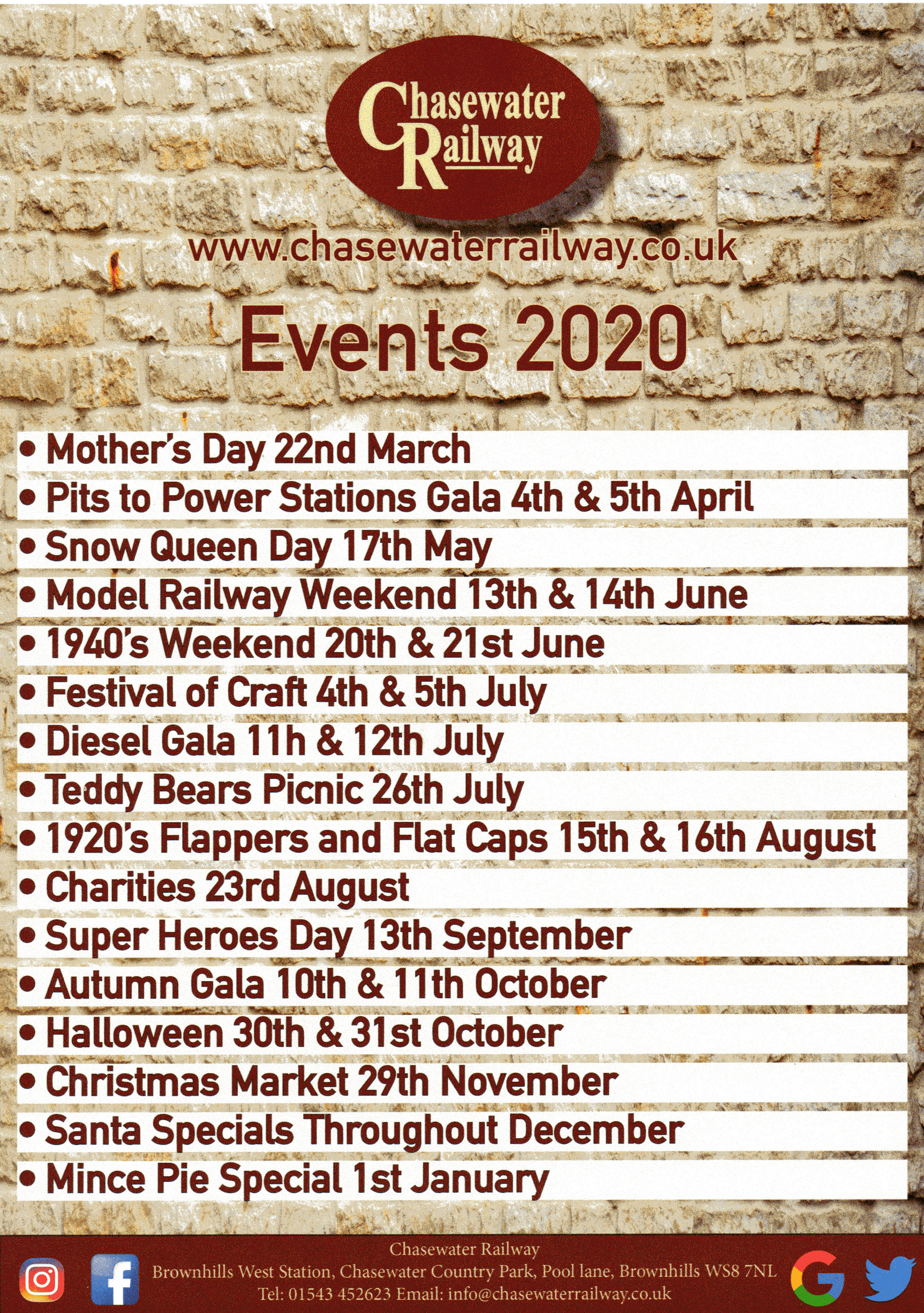
Chasewater Railway Museum – List of Chasewater Railway Events – 2020

Chasewater Railway Museum –

List of Chasewater Railway Events – 2020

A real diary filler for you – all the events happening at Chasewater Railway during 2020.

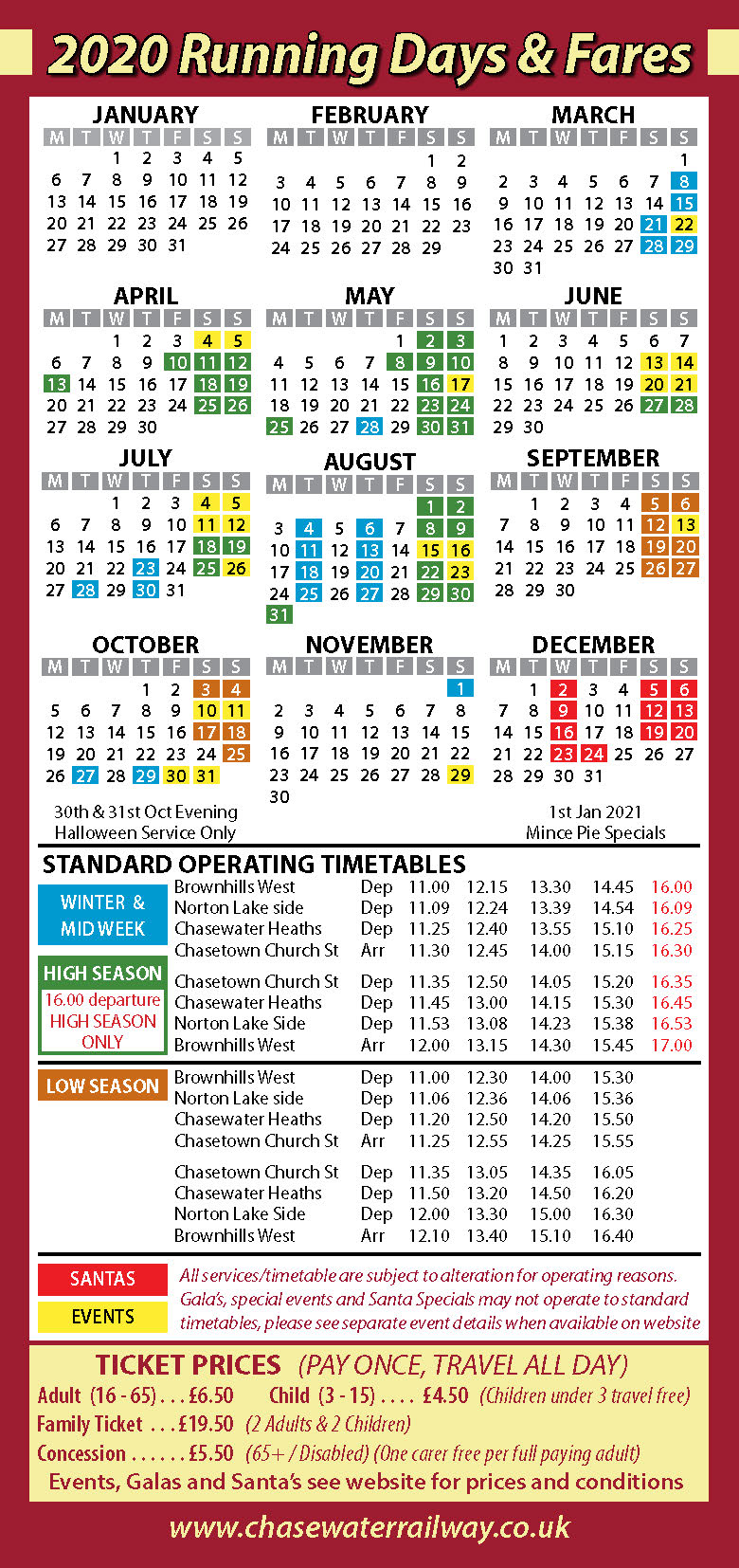
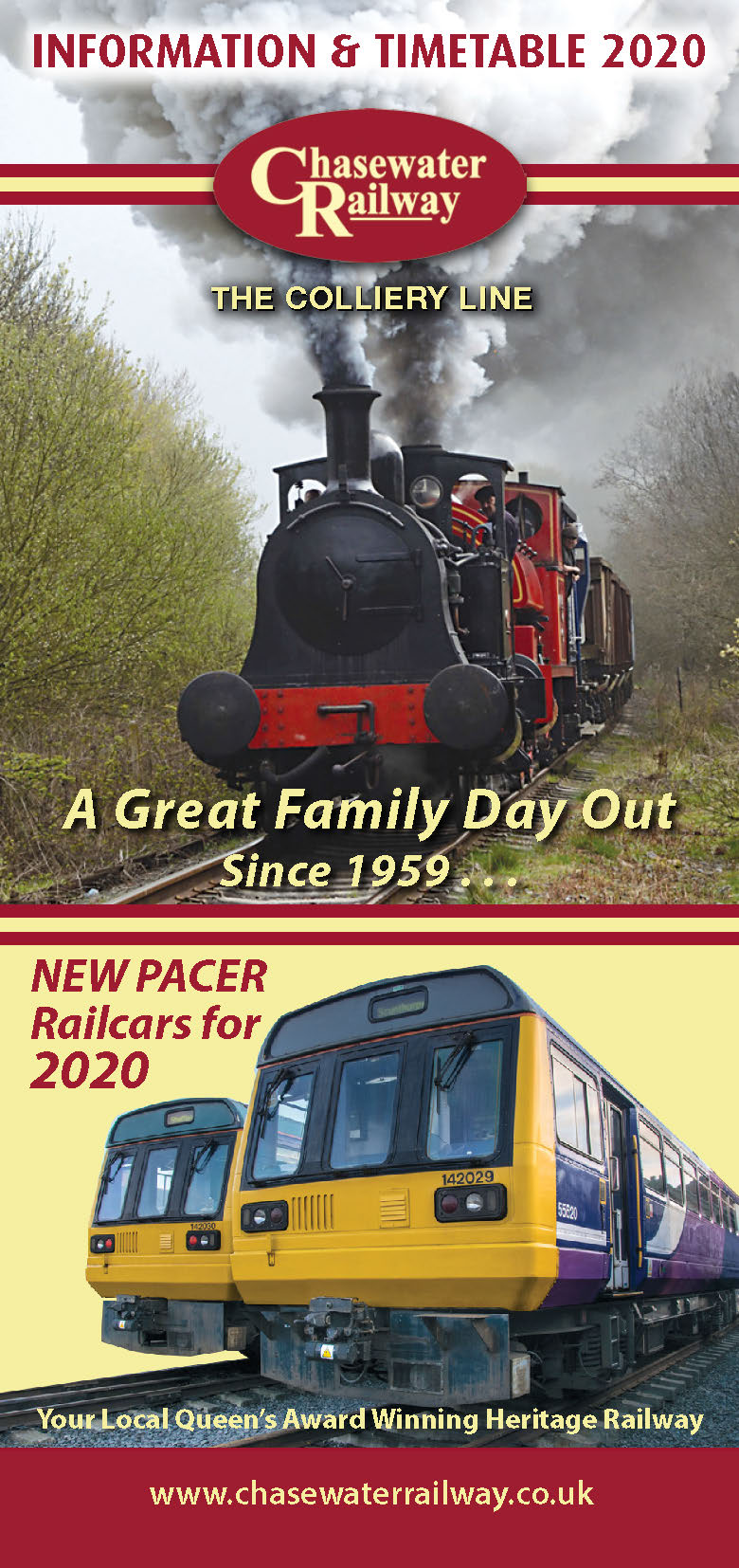
Chasewater Railway’s 2020 leaflet, including the timetable.

Chasewater Railway’s 2020 leaflet

including the timetable.


CR-2020-leaflet

Click link to open

Chasewater Railway Museum Nov-Dec 1966 Bits & Pieces 38

Chasewater Railway Museum Nov-Dec 1966 Bits & Pieces 38

From the ‘Mercian’ Nov-Dec 1966 Vol.5 No.6

From the Editorial


The AGM has come and gone together with the light summer nights which have speeded up the work at Chasewater.  Naturally more effort has to be concentrated where most needed during the few precious hours of daylight now left.

You will read elsewhere of the progress made to date both at Chasewater and Hednesford, so that when 1967 dawns we shall be taking our next big step forward, that of running a steam train at Chasewater.

There was a report about the ARPS meeting at Portmadoc, including a request for help with funds for theJ36 and ’C’ Class 0-6-0 when required so that the purchases might be concluded.

Under the heading of affiliations the following were accepted into the Association – M & G N R P S, and the Hull Preservation Syndicate as an observer only.  The following were deferred until the meeting in London on January 21st 1967 – Severn Valley, LCGB, GWR Trust, Westerham Railway Museum, Southern Railway Club and the Loco Preservation (Sussex) Co. Ltd.

There was a short report about the ‘Forum’ magazine, which was still struggling with finances.


Hon. Secretary

Progress Report

Work has continued at Chasewater, the main task being the reinforcing of the embankment with fly ash, this material has been tipped into the cavities caused by the embankment fire (slow combustion), and effectively snuffed it out.

An ex Midland Railway flat wagon has now joined the fleet at Chasewater for use on maintenance work.  This vehicle together with the NSR wagon has been finished in battleship grey and appropriately lettered.  The MR wagon was kindly donated by Messrs. Thomas Boultons Ltd., of Froghall, Staffs.., of

Delivery has also been taken of the Peckett 0-4-0ST ‘Lance’ donated by Messrs. Whitecross Ltd., Warrington.  This has also delivered to Chasewater where it has been given a quick coat of green oxide paint to repel the rust which was starting to get a hold on the superstructure.

Andrew Barclay 0-4-0ST. Colin McAndrew – Considerable work has been done on this locomotive by Allan Civil and his team of ex Bagnall fitters.

We are extremely grateful to this team for all the hard work they have put in to get it ready for the hydraulic test which it successfully passed.  The loco was steamed successfully on November 13th, albeit stationary.  We look forward to seeing her at Chasewater in the not too distant future.

Restoration Work – A small amount of work has been done at Hednesford on the E1 and coaching stock.  A start has been made on refelting the coach roofs, but has now been held up due to the weather and lack of manpower.  The small relics grow apace and receive the usual loving care from Nigel Hadlow.

Mention must be made of the wonderful job of restoration done to our Wolverhampton trolley bus No.616 by John Hughes and Robin Oliver.  These two members must be congratulated on their steadfast painstaking work in putting the interior back to its original layout.

Other than a couple of mentions for the Tote and the Annual Dinner that’s pretty much the lot for this edition.

Chasewater Railway Museum – Taken from the Mercian July – August 1966 Vol.5 No.4

Taken from the Mercian July – August 1966 Vol.5 No.4


From the Secretary’s Report.

Members will be pleased to hear that we have moved the Barclay saddletank to the Hixon yard of our friend Jake Bacon.  (I’ve not read anything about this loco in the magazines until now.  It’s now known as Colin McAndrew!  There’s a photo of it at Hixon.)

Barclay Loco Colin McAndrew at Hixon – Rob Duffill’s Collection.

Renovation work is in progress until such time as she can be moved to the safety of the Chasewater building.  It is hoped that the two Pecketts will join her in the very near future, and I would like to express thanks to all those who have responded to the call for cash to cover the removal expenses.

Progress at Chasewater has been maintained steadily by the faithful few and the line is now in up to the site of the building.  The other track here has been left for the time being to enable the contractors to work in the confines of the trackbed.  A start has been made at the causeway end of the line in re0laying a length taken out by the demolition people and then work will centre on track tidying, moving a considerable amount of shale and spoil to strengthen the embankment near the small overbridge and other remedial works.  We shall still need plenty of help so please come.

From the Treasurer’s Report

Finance is reasonable at the moment but Chasewater is a big drain on resources and we must try to stem the flow as much as possible without jeopardising the project. (Given the state of Chasewater water level at the moment, the wording seems very prophetic!)


Late Round Up – Hon. Editor

I must apologise most profusely for the lateness of this edition due to personal circumstances beyond my control.   The next edition will reach you on time, and will contain news of the AGM.  I hope you will bear with me this time as I do like to have the mag. out on time.  (Considering the fact that this was the fourth magazine of the year members nowadays would certainly bear with him!)

Chasewater Railway Museum – 1966 May-June Vol.5 No.3 Bits & Pieces 35

Chasewater Railway Museum

1966 May-June Vol.5 No.3 Bits & Pieces 35

From the ‘Mercian’ May – June 1966 Vo.5 No.3

From the Editorial


The past few weeks have seen a number of developments both at Hednesford and at Chasewater.  Much effort by Melvyn Balance, Brian Hames, Frank Craddock and Ken Martin has transformed a large number of our collection of iron and brass into gleaming exhibits for open days, and I thank the lads for this useful contribution. 

Further items to arrive have been some LNWR destination clocks and finger boards from Walsall Station, some roof vents and other parts for the GER Brake from our good friend Mr. Plyer and his colleagues of the GE Society, and a load of wooden rail keys for Chasewater from the Severn Valley Society for which we sent our grateful thanks.  Other work at Hednesford has involved a general tidying up of the site for Open Day at Easter which attracted a fair number of visitors, among them two or three new members.  Particular thanks to our attractive salesgirls, Penny, Pat, Pauline, Dorothy and Jean for their help in raising just over £20 for the funds.

The work on tracklaying at Chasewater has progressed slowly but surely and has now reached the point where it becomes double track up to the museum building.  Work has been speeded up considerably no doubt because of the acquisition of our first loco – albeit a diesel – which is working up at Chasewater and is proving a boon in moving the NSR wagon and heavily laden platelayers’ trucks.

The loco has cost £50 – all subscribed for by about a dozen members – to save the general funds, and it is being recorded here for all to see that we are deeply grateful for this fine gesture.  This is only the start; we have more offers to consider.  The next one is a small saddle-tank in full working order at about £75.  How about a few advance donations??  Offers to me in the first instance, please.  More details will be given when these are to hand.  Continuing the money matters section, we have three steam locos to move from Warrington to Chasewater at an approximate cost of £250.  The Treasurer has already received a few donations as a result of the appeal made in the January edition.  However this is far from enough and we MUST move the locos within two months or we shall have to forfeit them completely.  Please, PLEASE help us to raise the ‘lolly’ before the end of May.  Contact either the Treasurer or myself as soon as possible, donations (or interest-free loans) desperately wanted.

The weekly Tote has now been launched and is going very well thanks to the faithful few who are selling tickets each week.  To date over £20 has been raised for the funds; this could be trebled if we can sell more tickets.  I do appeal to all members within range of the Depot to call and collect books of tickets for sale among their workmates and other contacts, please contact Albert Holden at your earliest convenience for tickets and full details of the Tote.

A.A.Chatfield – Hon. Editor

The Tote was run successfully for a number of years, bringing in much needed funds for the Society.

Hon. Treasurer’s Report

Planet Diesel Loco.  Members will be interested to hear that we have now acquired a Planet four wheel diesel locomotive. It was built by F. C. Hibberd around 1930, the exact date and history of the loco is, as yet, unknown.  It is powered by a Paxman 50 hp 3 cyl. Engine, and is capable of pulling several wagons.Laurence Hodgkinson

The loco has been delivered to Chasewater where it is in regular use on P. Way trains.  Members are now at work on repainting and repairing the body where necessary.  This has to be done on weekday evenings as the loco is on duty every weekend.  Any members willing to assist should contact me so that definite working times can be arranged.

It is important to complete restoration work as soon as possible as the loco is on show to the general public to a greater extent than any other item of rolling stock at the present time.

We would like to express our thanks to members Roger Hateley of Lichfield who has done all the negotiating for this valuable item of equipment.