Tag Archives: Wolverhampton

176/177 – Chasewater Railway Museum Bits and Pieces

The featured loco today is ‘Rawnsley’, at Hednesford Canal Basin, a Lilleshall loco of 1872. Number 4 at Cannock and Rugeley Colliery.
Thanks to David Bathurst, Nigel Canning, Bob Duffill, Arthur Edwards and Keith Day for their contributions to these, and other, Chasewater Railway Magazines.

176 – Chasewater Railway Museum Bits & Pieces

From Chasewater News Christmas 1994 – Part 2

A Christmas Message from the Chairman

It is difficult to believe that we are about to enter the Christmas period yet again. The year has passed so quickly that it seems to have passed us by.  Yet for the railway, such a short period has witnessed so many exciting developments.

Anyone visiting the railway for the first time would wonder what it’s all about and why we are all so enthusiastic.  But for regular visitors and, more importantly, the intrepid band of volunteers who devote so much time to the welfare of the railway, the year has been full to overflowing.

This is not the time to review, in detail, the year’s events; the annual report is more appropriate for that.  However, the extension to the line merits comment, because of its importance to the public’s perception of our operations and, perhaps more vitally, our credibility as a passenger-carrying railway.

We had hoped to have laid the track into Norton Lakeside Station and to have completed the construction of the station during 1994.  That we did not achieve this ambition is of little importance; my colleagues will be familiar with my entreaty that “it is not a race”.  We cannot afford to compromise on quality by cutting corners in the interests of speed.  It is essential that the extension across the causeway, the station itself and the remainder of our line all meet the standards necessary to satisfy the Railway Inspectorate.  We have much work to do to consolidate our current line before we invite HMRI to return to Chasewater.

Having said all that, Easter 1995 now seems a realistic target for the opening of Norton Lakeside Station.  Pencil the Easter Weekend into your new diaries, and “watch this space” for further information.

1995 will also see an increase in momentum for the carriage shed fund.  If the spirit of Christmas moves you to make a donation to this worthy cause, then please do not hesitate to see Chris Chivers or myself.

May I remind you of the ‘Santa Specials’ on 11th and 18th of December when we can all find an excuse (if we need one) to open up the seasonal festivities.  Whether or not you are able to join us on one of these dates, may I take the opportunity to wish you all a very happy Christmas and a very prosperous New Year.

David Bathurst – Chairman

A view looking across the causeway back towards Brownhills West, just over a mile away.  On the left can be seen the platform face for the new Norton Lakeside Station with the first length of track in place.  A lot still remains to be done, but this could be a very popular place for photographers next year!

Synthetic Chemicals – Final Phase – by Arthur Edwards

It doesn’t seem like it, but this is the final part of the saga of retrieving the track from Synthetic Chemicals.  After a call from our ‘Fat Controller’, Steve Organ, on Friday 15th October to establish whether I was available for the Saturday morning, about a dozen people gathered at Synthetic Chemicals to collect what track was left there.

Anyway, Mick had called for me at 8.30am and we had been there about an hour when Steve asked Mick and I to return to Chasewater to get the JCB ready for when the lorry arrived with said track.  At about lunchtime the lorry duly arrived and Mick and I did our stuff unloading it.  An hour or so later ‘Curly’ the driver went off to get another load.  While he was away, Mick and I straightened up the rails and sleepers.  I had to go at 5.30pm but I believe the rest of the crew stayed until about 8.00pm to complete the job.

After that Saturday all there was left at Synthetic Chemicals was a buffer-stop, some smallish lengths of rail and a few sleepers.  After some hectic phone calls, Steve managed to get about six people on Saturday 22nd to go back and retrieve the last few remnants of track.

On the Sunday, with the help of the CS people, we actually laid the track through Norton Lakeside Station.  Once agreement has been reached with the Railway Inspectorate, it is our intention to just keep laying track down until we run out of either sleepers or rail, or until we reach our next objective which is Chasetown.  It is thought that we now have enough track to get us to the end of our lease, but hopefully we will have topped up our stocks before we get that far.

Whilst we continue to work on the track, the CS people have begun re-pointing the platform at Norton Lakeside Station, and preparing the top for the edging slabs.

  The arrival of a loaned ‘dogfish’ hopper wagon will hopefully make the job of ballasting a lot easier, and there are even rumours of a rented track-tamping machine being used in the near future!

Kenneth Judkins – by Dave Ives

It is my sad duty to inform you that Ken Judkins (Ken the Steam to his close friends), passed away on September 27th 1994 at Anson House Rest Home.  Ken was 91 last January, being born in Little Haywood in 1903.  Ken lived a very colourful and busy life in various parts of the country.  He moved to Stafford for the final few years of his life from Wimbourne Minster, Dorset, stating that he wanted his bones to rest in his native county, which has indeed now happened.  His remains lie buried in Colwich Churchyard.  He was Christened in Colwich Church and served as a chorister for a number of years.

Members will be aware of Ken’s long association with steam traction having started with Ralph Gee & Son, Wolseley Bridge, then on to Staffs County Council, Foden’s, Thomas Hill (Rotherham) Ltd. and Sentinel.

Ken was the author of two books “My Life in Steam” and “More of My Life in Steam”.  The books are worth a read and give a fascinating story of the tough and skilful job of steam driving in the 1920s and 30s.  Ken also served six years in the army RAOC in the war and was wounded in the lung whilst being evacuated from Dunkirk.

I suppose one can sum up by saying that this is the end of an era and that Ken is sorely missed by numerous friends, especially on the rally fields where he gave a lot of advice to scores of steam traction owners.

Alas! We shall no longer see him propping up the bar, staying overnight in one of our coach compartments, puffing his pipe on Brownhills West Station seat or in his brown slop coat and Foden hat on the footplate of the Sentinel.

More about Ken – Nigel Canning

“Ken the Steam” as he was known to his friends, spent the majority of his working life and the whole of his retirement closely involved with steam traction on both the road and railways.  His experiences and expertise were sufficient to fill a book – or two, to be precise – both now sadly long since out of print.

Ken was never happier than when he was showing off just what steam power was capable of, and in his last two jobs, at Foden, and then at Thomas Hill (Sentinel) as Chief Demonstrator and Test Driver, that is exactly what he was paid for, selling those Companies’ products and fending off the advance of the motor lorry and diesel loco.

In his retirement Ken continued to take an interest in steam by helping the preservation movement where his enthusiasm backed up by a lifetime of experience was of invaluable assistance to many an amateur locoman or fitter.

At Chasewater his advice was of particular assistance in the operation of the Sentinel.  On one occasion when one of the poppet valves on the engine was playing up, Ken was all set to ride down the line and back to observe the valve events and pinpoint the problem.  It took a lot of doing to convince him that it was not the done thing to run a passenger train with an engineman in his late eighties hanging on the side of the loco, but we eventually succeeded, and as a result of his advice the valves were alter re-set to operate correctly.

Ken once admitted that he didn’t really like Sentinels as they were dirty things, but that just reflected his real love, the Foden, and his exploits with those machines are well-documented and will be remembered for a long time.

177 – Chasewater Railway Museum Bits & Pieces

From Chasewater News Christmas 1994 – Part 3

Carriage & Wagon News

New Acquisition: ‘Dogfish’ DB992841 – This useful hopper wagon has recently arrived at Chasewater on loan for 12 months from Andy Goodman of Allely’s Transport.  Following minor attention to the chute actuating gearboxes the wagon has entered service as part of the PW works train to transport ash up to the new station and beyond.

Pressed Steel Co. DMBS W51372 – This car has remained in service coupled to W59444 to form the loco hauled train.  It was recently given an ‘A’ exam, and following the recent acquisition of some more spares one or two minor repairs may shortly be carried out.

Derby Works centre Car W59444 – The electrical system of this coach has recently been overhauled, including servicing of the batteries, cleaning and resetting of contactors and renewal of some of the invertors for the strip lights.

Derby Works Centre Car M59603 – This coach has remained stored out of use.

2-Car DMU: DMBS W51370 & DMS W 51412 – This train has remained in service, being run on non-steam Sundays until recently when declining passenger numbers made it uneconomical to continue.Summer congestion at Tysewater!

Manchester, Sheffield & Lincoln six-wheel coach – A great deal of progress has been made recently on this vehicle.  All of the doors now close properly, and all of the glass has been fitted in the windows and doors so that the interior can be kept dry.  The partially burnt panelling around the guard’s doors has been removed, and new locking bolts for the double doors made and fitted.  Various rotten mouldings are being renewed, and the exterior of the bodywork has been given a preliminary coat of paint to help protect it.  A certain amount of work has also been done on painting the interior.

LNWR (Paddy) Coach – Work has started on this coach by a carpenter working on the Community Service Scheme.  So far some of the doors have been re-fitted, and repairs have been carried out on the roof to try and waterproof it.

Battery charging – The station battery charger has now been rebuilt and connected into a network of underground cabling enabling a number of vehicles to be connected to it simultaneously.

Stop Press

The Board has agreed to purchase around 600 concrete sleepers, enough to relay track to the rear of the Burntwood Industrial Estate.  Delivery will commence in the New Year.

The Annual October Transport Rally – Arthur Edwards

This year’s rally seemed to surpass all of the rallies that we’ve had over the last five or so years.  There were more vehicles than previously, but all cordoned off in such a way that it seemed that we could have had at least half as many again.

I finished work at 2.45pm on the Friday afternoon to be at Chasewater by 3.00pm to help Dave Whittle, Rally Organiser, to put up the fencing.  This involved finding the fencing stakes before I could start.  Eventually it was time to make my way home, and I told Dave I would be there at 9.30am on Saturday.

I duly arrived at Brownhills West Station at the said time, collected the stakes and started to knock them in to cordon off all the stationary engines and their owners’ living quarters, caravans, mobile homes, etc.

Steam trains didn’t run until Sunday as one of Asbestos’ springs had to be re-fitted following its repair, but our illustrious General Manager (Steve Organ) decided to use his DMU set.

Sunday dawned with high skies and not a threat of rain.  A few of us had to take the permanent way works train down to the far end of the running line to work on the extension.  This had to be done as even after the departure of the Wickhams we were still a bit cramped in the available siding space.  I digress slightly, anyway all went according to plan, and next year they are planning an even bigger event.

All credit on this occasion must go to Dave Whittle for the red-hot phone calls, and to his associate Paul Richards, with their mind-boggling train of events.  All the best for next year’s rally.  Thanks chaps, very much appreciated.

Commercial Manager’s Update – Rob Duffill

The season, apart from the two Santa dates which are in the future at the time of writing, is now over until Easter.  However, we do continue to tick over during the winter months and any income we can generate from whatever source during this period is essential to keep the wheels turning.

In addition to the core aspects of running the buffet and shop, we have been to several exhibitions.  These have been at the bonded warehouse in Stourbridge organised by Trev Cousins who was Secretary of our group in the 60s.  Also the Warley Model Show at the NEC and the Societies and Hobbies Fair at Walsall Town Hall.

The NEC exhibition is in its second year and is over two days and very interesting.  As usual John and I set up on the Friday and all went very smoothly as the Warley Show is very well organised.  The hall was better laid out this year and the public avoided the jams of last year.  We were opposite an ‘0’ gauge layout of the Taff Vale and a colliery with lots of industrials.  Also, Trev Cousins has produced in ‘0’ and ’00’ a model of Hanbury from our own area.  This 0-6-0ST Peckett was of very neat outline.  Trev and Pete Stamper, both members from the 60s, would be pleased to sell you one.  Our stand was fairly busy with its blend of both toys and relics and we exceeded last year’s takings.

The Hobbies and Societies Fair at Walsall was successful, not from the actual sales, but from the publicity point of view.  A lot of interest in the Santa Specials was generated.  Quite a few people looked at the old photos we had taken and said they were ex-miners who remembered them.  We also displayed a Pelsall Millenium plate at both exhibitions.  The Brownhills paper also took photos and promised free publicity, and several potentially useful contacts were made.  This event was definitely worth John and Margaret’s (with Chris) time, and our fairly low entrance fee.

Well done to all who helped during 1994, the trick being to extract money from the public in as pleasant way as possible, and to try and make the most of it all and enjoy yourself.  We look forward to next year’s opportunities to increase income with the line open over the causeway.

Bass Brewers Community Awards

Bass’s Grand to Chasewater

Chasewater Railway has received a Bass Brewers Community Award of £500 towards the £20,000 required to build the proposed carriage & wagon shed which we intend to build when funds are sufficient, and the North Orbital Road route has been finalised.  The fund now stands at about £2,000, the majority having been raised by members through donations and profits from events and rallies.

For those who are not aware, this is the third year in succession that the railway has been a recipient of a Bass Brewers Community Award.  In 1882 we received £300 towards the transport costs of removing redundant trackwork out of Hams Hall power station.  1993 saw a £250 award towards the purchase of rail, and £500 this year to the Carriage and Wagon fund.The presentation of the cheque at the end of the platform of Brownhills West Station platform, surrounded by what appears to be total darkness!

The presentation of the cheque took place on 27th September at 7.00pm at Brownhills West, and was presented to Alwyne Marsden and Tony Wheeler of the Carriage and Wagon Dept.   (Looking at the official Bass picture, and the expression on Tony’s face, it would be easy to believe that it was Tony’s money he’s giving away rather than receiving it from Bass!).

The Award is now becoming an annual event with an open invitation to all working members and volunteers, to which over forty came, with husbands, wives and children.  After the presentation of the cheque and pictures taken rather quicker than normal due to failing light, there was a trip down the line in the newly acquired DMUs by Railway members, Janice Clark, Regional Communications Manager for Bass and her photographer.  This not only showed how previous awards had been wisely spent,  but also showed how much progress had been made enabling us to go to the extreme end of the line where no DMU had gone before, over Spikey Bridge.  (Since then the line has been laid through the platform at Norton Lakeside and on 30-10-1994, the first works train travelled through it).

On arrival at Brownhills West Station a buffet and liquid refreshment had been arranged, and was consumed by those present.  With the evening turning into a social event, members could find time to talk and joke with each other in a more relaxed atmosphere, which is not often the case when running trains or events, or generally going about the various tasks on the railway.

Many thanks to those who came on the evening of the 27th, to Janice Clark, who I feel enjoyed the evening as much as we did, but also to Bass for their contribution to our railway.

Thanks Bass – and Cheers.  Keith Day.

175 – Chasewater Railway Museum Bits and Pieces

175 – Chasewater Railway Museum Bits & Pieces

From Chasewater News Christmas 1994 – Part 1

Editorial

I am afraid I must again start by apologising for the lateness of the last magazine.  This was due to problems with its distribution rather than printing, but meant that the advertisements for the vehicle rally and the Warley Show were wasted.  In view of this, the only advertisements printed in future, such as those in this issue, will be checked to ensure that they are so far out of date that they are of no use to anyone!  There is, however, a rumour that a company called Regional Railways is still capable of operating to a few of the stations advertised, although I believe the fares have risen somewhat!

We at Chasewater are now on the verge of being able to run trains between two stations at last, but as the Christmas shopping facilities at Norton Lakeside are in fact somewhat limited, this year the Santa Specials will terminate short of the new station.

I would like to thank all the people who have helped with the magazine this year by writing articles, lending photos or with its production or distribution, and finally wish everyone a very

HAPPY CHRISTMAS AND PROSPEROUS NEW YEAR.

Locomotive News

Asbestos propels a train back towards Brownhills West on the day of the October 1993 Rally.

No.4 Asbestos – This engine has again managed to keep us in the steam railway business by carrying on single-handed without too many problems.  On the day of the October rally the regulator caused a few headaches when it became even more stiff to operate than usual, inducing the occasional bout of slipping.  Since then the gland has been stripped, cleaned and re-packed, and the dome cover has been removed to allow adjustment of the valve itself.  Hopefully some improvement will be apparent at Christmas, if not we have a second chance before Easter.

No further problems have been experienced with leaking tubes, although it is still planned to renew the complete set after Christmas.  One or two minor leaks have been re-caulked in the firebox, and again these will be checked during the Christmas steaming.

One or two minor repairs and improvements have been carried out, including the fitting of steam brake exhaust pipe in the smokebox so hopefully the fire will no longer blow-back when the brake is applied or released.

No.5 Sentinel – It has been decided to fit this loco with a new set of washout plugs as by the time the boiler has been tapped out to clean up the taper threads, the original plugs will be too small to fit.  In the meantime work has continued with the repair of a pin hole in the main exhaust steam pipe which runs along the left of the loco from the engine to the blast nozzles in the chimney.  The leak was first noticed during the last few steamings when emulsified oil started blowing down the frames.

The semi-circular slide valve which controls the rather complicated operation of the Weir pump has been repaired by the building up of its ports with weld and re-grinding back to shape.  This should hopefully improve the operation of the pump by making it more controllable and less noisy.

Other work has included cleaning of the cab interior ready for painting, painting of the boiler barrel and re-fitting of some of the pipework.

S100 – Work is still progressing on the frames of this loco.  The brake hangars are in place, and a new underkeep is being machined to replace a missing original.

No.3 Colin McAndrew – In a surprise move recently the boiler of this loco was sent away to Bridgnorth for the SVR boiler department to quote for repairs.

Fowler diesel hydraulic No.422015 – This loco has again been the mainstay of the diesel fleet, being used on works trains and for shunting.  It has recently been suffering from low engine oil pressure thought to be caused by fuel dilution, and in addition the axle boxes have started running hot.

Ruston diesel electric DL7 – This loco is still serviceable, although the cab windows were smashed in a recent attack.  This has not helped the loco’s usual winter problem of damp getting into the main generator and traction motor, as the rain can now drive in through the broken glass to soak the floor boards.  Hopefully, after a bit of work it will be available as standby for the ‘Santa Specials’.

The Fowler diesel machanical No. 4100013 sandwiched between DMUs at Brownhills West

Fowler diesel mechanical No.4100013 – Following yet further work to its engine, this loco has been run to the causeway and back under its own power.  Its use is limited at the moment, as due to its starter motor needing re-winding, it has to be started by another loco.  Quite a bit of work still needs to be done, including refurbishment of the air system, however, it has been used on the works train, but the lack of starter motor meant that it had to be left idling all day.

L & Y No.1 (Motorail No.1947) – A replacement bearing brass for this loco has been purchased to enable it to be stood back on its wheels.

No.21 diesel – The engine of this loco is still dismantled although the pistons have had new rings fitted and have been re-fitted to the engine.  The injectors have been cleaned and re-set ready for when the cylinder heads are re-fitted.  The sump has also been cleaned ready for re-fitting.

174 – Chasewater Railway Museum Bits and Pieces

Some passenger stock and other rolling stock.

174 – Chasewater Railway Museum Bits & Pieces

From Chasewater News Autumn 1994 – Part 3

Carriage & Wagon News

New Acquisitions – All four of the new DMU cars mentioned in the last magazine have now arrived at Chasewater and are in various stages of repair or modification.  This now makes a total of five asbestos-free coaches available for service.  The spares for these cars are to a large extent interchangeable, and a large stock has actually been collected together over the last twelve months and stored at Chasewater.W51372

Pressed Steel Co. DMBS W51372 – Since its arrival just before Whitsun, this unit has remained coupled to W59444 to form the steam-hauled train.  A bar, removed from the Wickham, has been installed in the Guard’s compartment, and a ramp is now available to allow access for disabled passengers through the double doors.  Repainting in carmine and cream livery to match W59444 is almost complete, giving us a very smart two coach train.  The history of this car is quite interesting.  It was built in 1960 without asbestos in its construction for Paddington suburban services and was later transferred to Tyseley for use on the Cross-City line.  In 1993 it was again transferred to TML and was the first DMU used to convey contractors through the Channel Tunnel during construction and has been through to France.W59603

Derby Works centre car M59603 – This car has remained out of use since its arrival at Chasewater.  It is intended to repaint it in carmine and cream livery to match our other loco hauled stock.  This centre car was built in 1959 and used on the St. Pancras to Bedford service.  Later it was transferred to Tyseley to strengthen their 3-car 116 and 117 sets from 3-car up to 4-car.

Derby Works centre car W59444 – This car has remained in service, running since Whitsun coupled to W51372 on steam-hauled trains.  The repaint into carmine and cream livery has recently received the finishing touches of lining and numbers.W51370

Pressed Steel Co. DMBS W51370 & DMS W51412 – This class 117 DMU has been purchased by Steve Organ for use at Chasewater.  Built in 1960 without asbestos in their construction, these two cars worked out of Paddington until they were transferred to work over the Cornish branch lines.  They eventually ended their working lives at Tyseley.  Both cars were in excellent condition on their arrival at Chasewater due to work carried out on them by our members whilst still at Tyseley.  They have already been put to use this summer on a number of mid-week school specials, and it is also intended to run the on non-steam Sundays and Saturdays.  Eventually the cars will be repainted in early BR green livery.

Wickhams E56171 & E50416 – Since their sale, these two cars have remained at Chasewater awaiting their removal to Llangollen.  In August contractors, paid for by the new owners, stripped both of these cars of their asbestos.  The interior of these vehicles was completely gutted right through to the steel framework and aluminium skin, which appeared to be in excellent condition.  Finally, on Monday 12th September the first car was removed by low-loader to its new home, followed the next day by the other half of the two-car set.  This has now relieved our immediate problem of lack of siding space for our own rolling stock, but more importantly, means the end of the liability of having asbestos insulated stock on our site.

Tank Wagon – Steve Organ has also purchased a tank wagon from Redditch Railway Society.  This vehicle, which is relatively modern, was built in 1963 by Chas, Roberts.  It is 15ft. wheelbase, with roller bearings and is vacuum brake fitted.  It was originally donated by Shell Oil UK and renovated by Wagon Repairs Ltd in 1981.  Whilst still in service the wagon had received a general repair in 1979.

4-Plank coal wagon – Tony Wheeler has now finished the re-paint of this wagon into the livery of the ‘Conduit Colliery’.  The only outstanding work is the renewal of one of the springs which looks to be highly dubious.The 4-plank wagon in the livery of one of our local pits, ‘Conduit Colliery’

Manchester, Sheffield & Lincoln 6-wheel coach – Work has begun on sanding down and painting the body panels of this coach.

Other Vintage Stock – Very little work appears to have been carried out on any other vehicles this summer.

Works Train – The 20-ton Great Western Toad and the Southern brake van have run together for most of the summer to form the basis of the works train.  The 21-ton steel mineral wagon which had been full of scrap has been emptied and the door hinges un-seized.  Since then it has been used to carry ash ballast to the causeway for track laying.  The flat (ex hopper) wagon has also assisted in this.  Obviously as the railway gets longer we are becoming more reliant on a works train to carry materials and provide shelter.  The middle of nowhere beyond Norton Lakeside is no place to be in the middle of winter with only a platelayer’s trolley.

Shed Fund – This fund is increasing steadily.  Meanwhile a rough track-bed has been cleared to give access to the proposed site on the side of the existing loco shed yard so that track can be laid for temporary storage of stock.

The Redditch Railway Society – Keith Day

The Society, formed 1981, whose original aims were to operate trains over the Redditch to Barnt Green Branch have given up its base and equipment at Dixon’s Sidings site, Enfield Industrial Estate, Redditch, together with plans of running trains.

It was decided by the Society that since the refurbishment and electrification of the branch, the Society’s original aims could never be brought to fruition.  On the land leased since 1983 by the Society from Redditch Council are remains of the old Redditch loco shed, which comprises of the shed wall footings and part of the inspection pit.  Apart from the track and various railway relics, the Society owned an 0-4-0DM Fowler No.410013/1948, plant N0.1301 donated to them from Garringtons of Bromsgrove.  The Society is to carry on as a film and social society.

Some 300ft. of trackwork and the diesel loco have been donated to us at Chasewater by the Society.  Lifting and dismantling of the track took place over several weekends by members of both societies.  Removal was only possible by mobile crane from access gained with consent of the cement works next door to the sidings.  Track was loaded onto lorries on Saturday 23rd April, and moved to Chasewater the same day.  The track is to be used on the causeway extension.

The Fowler, under the custodianship of Andy Mould and Chris Hatton, is to be returned to working order in Garrington’s livery in the near future, with work on its engine taking priority as it has been out of use for the last two years.

Redditch Railway Society’s tanker wagon has been purchased by Steve Organ, and was recently removed to Chasewater.

It is hoped that some members of the Redditch Railway Society will follow the loco and track to Chasewater, where a warm welcome will be given.

172/173- Chasewater Railway Museum Bits and Pieces

172 – Chasewater Railway Museum Bits & Pieces

From Chasewater News Autumn 1994 – Part 1

Permanent Way News

The second and final batch of track has now arrived from Four Ashes and is being put to good use by the Permanent Way Gang.  The works train has had to spend every Sunday ‘out of section’ at the end of the causeway just to make enough room for passenger trains, as with the amount of rolling stock now on site there is insufficient siding space at Brownhills West.  The track gang have put this situation to good use, and at the present rate of progress track will be in front of the platform at Norton Lakeside well before the end of this year.

In order to quantify the progress already made, and to assist with the planning of the future extension of the line, David Bathurst has produced the chart below showing distances between various points on the railway.

All distances were measured by pushing a pedometer along the head of the rail, and sleeper ends were marked with yellow paint at 100 metre intervals.  The ‘Zero Point’ was chosen as the gate post at the end of the loco shed yard, as after the motorway is built it is likely to be the closest surviving landmark to Brownhills West station.  When the time comes, new measurements can be made into the replacement station from the same spot.

The chart shows that we are currently running passenger trains over a distance of about a mile to the present running line limit almost half-way across the causeway.  When we ultimately reach Anglesey Wharf the total distance (estimated over the final section) will be around 2¾ miles, assuming that nothing is lost or added by the repositioning of Brownhills West Station (nice dream, but that’s all!).

173 – Chasewater Railway Museum Bits & Pieces

From Chasewater News Autumn 1994 – Part 2

Locomotive News

No.4 Asbestos – This engine has run exceptionally well considering the dubious start to the season.  Since then a total of twenty-two boiler tubes have been renewed and seem to have cured the problem of leakage at the firebox end.  Another 124 new tubes have now been acquired and are stacked in the shed ready to complete the re-tubing at the end of the running season.  Slight weepage of a few stays and part of the foundation ring will also have to be corrected.

The latest batch of Russian coal, although somewhat smoky, is giving excellent results without the problem of clinkering inherent in the last lot.  This is just as well, as with trains running every Sunday in this summer’s hot weather the last thing anyone wants to do is rake the fire through after every other trip.

Asbestos with a three-coach test train stands on the causeway ready to return to Brownhills West

No.5 Sentinel – Progress on this loco remains slow, although the boiler is now ready for its hydraulic test.  All of the boiler fittings have been refurbished and will be hydrauliced along with the boiler.  The injector has been moved to the fireman’s side of the cab and that and the Weir pump are being re-piped in such a way  that they can be drained easily in winter to prevent frost damage.

S100 – Work has continued with the manufacture of new mountings for the brake hangers to replace the original items which were somewhat bodged and worn out.

Fowler diesel hydraulic No.422015 – Replacement injectors have been acquired and fitted to the engine of this loco with the result that its performance has been transformed.  A few other minor problems have occurred, but it has remained in regular use for shunting and works trains.

Ruston diesel electric DL7 – One of the starting air valves of this loco has had to be renewed due to a damaged seat in the original.  A fuel leak from one of the injector pipes has also been rectified.  The loco is serviceable but has remained out of use mainly due to passenger trains being steam hauled throughout July and August.

Fowler diesel mechanical No.410013 – Following arrival from Redditch this loco has had its engine de-seized, the injectors have received attention and the engine has been run.  Faults have been found with the injection pump and governor and these have now been removed for attention.  Following completion of the air system overhaul the loco should be able to enter traffic.The new Fowler stands in the platform shortly after its arrival from Redditch

L&Y No1 (Motorail No.1947) – All of the axleboxes and springs have now been stripped and rebuilt and a new bearing is being made to replace one which was stolen recently.  Once the sandboxes and inside of the body castings have been stripped and primed the loco will be ready for craning from its present position in front of the museum coach so that final erection can begin.

No.21 diesel – This loco is making steady progress, the engine is now complete but still awaiting cylinder head gaskets.  It is hoped that it may be running for the Diesel Gala which is a new event to be held for the first time in September.

Lion – Following its removal to Foxfield last Autumn this loco entered service at Easter, running initially double-headed with ‘Harwarden’ The vacuum brake hoses were apparently awkward to couple as ours at Chasewater are the opposite side to ‘normal’ to suit our DMU stock.

Smith Rodley crane – This again remained out of use awaiting a potential purchaser.  So far a couple of enquiries have been received but no offers have been forthcoming.

From the Board Room

The Board has been actively involved in a number of new initiatives, while various on-going matters have been subjected to scrutiny and, where necessary, review.  The following will be of general interest to the membership.

1.    Personal circumstances have brought about the resignation from the Board of Les Emery.  However, Les has indicated a willingness to continue with his other roles on the railway.

2.    The Board has agreed to the co-option of Company Secretary Andy Clegg to the Board.

3.    The trading name of the company has been changed to the “Chasewater Railway”.  Previous official and unofficial trading (‘Chasewater Steam Railway’, ‘Chasewater Light Railway’, etc.) are no longer considered suitable and are felt to give a misleading impression of the nature of our current and future operations.

4.    In an attempt to encourage family travel during this period of continual financial restraint, the price of the Family Rover has been reduced, until further notice, from £5.80 to £4.95.

5.    During the course of the nest few months, the Board is to produce a new business plan for the purpose of clearly defining objectives and priorities, and how they might be best achieved within the resources (including financial and manpower) expected to become available.  Associated with this proposal is the revival of the concept of departmental heads, holding pre-determined budgets, to give focus to the completion of the many and varied tasks necessary for the railway to both exist and develop.

6.    The Board has responded to a plea from Rallies Organiser Dave Whittle by delegating various aspects and responsibilities to specified individuals.  Thanks largely to the efforts of Dave, the Chasewater Rallies are rapidly gaining in reputation, with Paul Richards taking up much of the strain as Administrative Officer.

7.    On other fronts:

·        Negotiations are proceeding with HM Railway Inspectorate in relation to the extension into, and construction of, Norton Lakeside Station.

·        The railway was represented at a meeting of Chasewater user groups hosted by Lichfield DC, and arranged on a largely social basis for the various groups to meet the Members and relevant Officers of the District Council.

·        Lichfield District Council has generously offered grant aid to the railway in the sum of £1,000 by way of a contribution towards forthcoming expenditure.  This generous act by the District Council signals a solid measure of support for the railway by its new ‘landlord’.

·        Accommodation at Brownhills West has become a problem in consequence of stock acquisition, (4 DMU coaches plus one tanker wagon).  However, this should be relieved by the imminent removal of one (at least) of the Wickhams, and the Board is still anxious to dispose of the crane (preferably to a good home on another railway) as a matter of priority.

·        The transfer of records from Adrian Hall should enable Paul Richards to take up his responsibilities as Membership Officer with early effect.

·        The Board has agreed strategy towards bidding for the trackwork at Bromford Sidings, and has noted that the remaining trackwork at Four Ashes is due to transfer to Chasewater in August.

David Bathurst – Chairman.

164 – Chasewater Railway Museum Bits and Pieces

164 – Chasewater Railway Museum Bits & Pieces

From Chasewater News Autumn 1993 – Part 3

General Manager’s Report and Boardroom Notes – Steve Organ

At the last meeting, the Board decided that certain changes should be made to reflect more accurately the roles required to be played by certain Board members.  As a result, I have relinquished the role of Chairman after seven years in office, and have been appointed General Manager.  David Bathurst has consented to act as Chairman.  The changes reflect the fact that I have perhaps more time than other Board members to supervise works being carried out during the week, and my new role gives me the opportunity to act as a liaising officer for the various projects being worked on at the railway.  I think that the Board also wants me to have the task of seeing to fruition the various projects that I have initiated during my tenancy as Chairman!

I first wish to thank Tony Sale for the work that he carried out as General Manager for more years than I care to remember, and to say how grateful I am that he has offered to administer the engineering records and locomotive examinations, as well as overseeing the Loco Department.

When Adrian Hall and I arranged the present company and administration in 1986, and engineered the amalgamation of the old Society and Company into the present Charitable Trust, the membership made it quite clear that the most desirable change to the old ‘set-up’ was to transform the Company into a real railway, running trains all the way along our leased trackbed to Burntwood, and perhaps towards Anglesey Basin and beyond.  In the first magazine produced by the new Company, I wrote a long piece entitled ‘The Lost Causeway’, about the perilous state of the old causeway that once carried the railway across the northern part of Chasewater, then severely eroded by wave action. It was quite clear that if we were ever to fulfil our ambitions, the causeway would need a huge scheme of works tore-establish the old link.  Mindful of that, it was decided that we would seek ways of carrying out those works, whilst in the meantime rebuilding the permanent way to the causeway from Brownhills West.  David Bathurst has described in previous magazines some of the ways we have attempted to bridge the causeway gap.  That scheme is at last well under way, with well over 30,000 tons of infill having already been delivered and landscaped, with completion envisaged around December 1993.  In the meantime, tracklaying gangs have achieved a great milestone marked by a visit  by HM inspector of Railways in September, during the course of which visit we were given authority, subject to completion of certain works, to operate passenger trains to the start of the causeway on and from our Autumn Vintage and General Rally on October 10th.A recent view of the causeway showing the scale of the earthworks, and the track in place.  The pylon on the left has been demolished since this photo was taken greatly improving the scene.

The most difficult of the outstanding works are to re-pack the whole of the relaid section as a certain amount of settlement has occurred, an inevitable result of the complete rebuilding of that section of line, so any Saturday or Sunday that you have time to spare, come on down.  We will find plenty for you to do.  This doubling of the railway’s operational line with passenger traffic to the start of the causeway for the first time ever can only happen if our efforts continue apace.

August Bank Holiday weekend saw an historic event, when the first four lengths of concrete-sleepered track were placed on the new causeway.  Using a sleeper refurbishment technique developed by Dave Borthwick and Keith Day, which received very favourable comment from the Railway Inspector, a very hard worked team really showed their pace.  No further tracklaying is likely to take place before early December, as the rest of the causeway is nowhere near complete.  It is also necessary to stockpile huge quantities of ash ballast and topsoil ready for the final shaping of the causeway once the arrival and compacting of fill materials is complete, and the only place available to stockpile is on the completed areas of the causeway itself.

The station on the northern side of the causeway is under construction, and by the time you read this, the platform should be complete except for coping stones and the northern ramp.

Our aim is to open to a Civic Reception on Good Friday, 1st April, 1994.  Come and help!!!Norton Lakeside 1992

Motorway Update

Revised plans for our new relocated station at Brownhills West, with associated works yard, are under preparation by Ove Arup and Partners after consultation between Midland Expressway and the Railway’s negotiators (i.e. David Bathurst and Steve Organ).  MEL’s Consultation Manager, John Burton, has told me today (21st September) that ‘a scheme’ will be ready by mid-October.  I hope that he is right, because new sidings are urgently needed, and we must plan them to tie up with the motorway’s scheme.

The railway is an exciting place just now.  Dreams have become plans and are now hardening into reality.  All members of our group have a part to play – come and help make it so!!

Halloween Specials

Chasewater Railway (Brownhills West), Walsall, WS8 7NL

Sat 28th October 2023 – Sun 29th October 2023

Board our Terrifying Train at Brownhills West Station for a spooky trip to the Haunted Heaths, beware the Ghostly Ghouls. 

If you make it back pay a visit to our Scare Centre if you dare!!!

There will be Spooky Stories in our Blood Curdling Brake Van and the Night time Narrow Gauge in operation.

153 – 154 Chasewater Railway Museum Bits and Pieces

153 – Chasewater  Railway Museum Bits & Pieces from Chasewater News Dec 1992 – Part 3

This small gauge loco, with Isle of Man connections, used to make fairly regular visits to Chasewater , this picture and the one at the end of this post have absolutely nothing to do with ‘Carriage & Wagon News’, but they were in the magazine and I just wanted to use them!

Carriage & Wagon News

A sad note to start with is that at the last Board meeting, Dave Whittle stood down as C & W director.  There are many problems concerning the stock, and with Dave’s other duties including our very successful rallies which Dave helped to arange, the work load was too much.

Maryport & Carlisle six-wheel coach – Work has begun on the far side of the coach where a canopy has kept dry the rotting window frames and doors.  These will be treated and painted, but the stock of plywood has completely dried up with no funds for further supplies.

Midland four-wheel passenger brake – Tony Wheeler has undercoated the exposed main end timbers to protect against the weather until plywood sheeting becomes available.

Manchester, Sheffield & Lincoln six-wheel coach – This vehicle has remained sheeted up but will shortly be needed for the local colliery railway history information centre when the Southern brake van goes to Chatham in 18 months time.

16 ton Great Western Toad – Tony Wheeler has re-painted the superstructure of this vehicle which looks good on our permanent way train.  Unfortunately Tony could not gain permission to paint the mess van.

CCCC brake van – Unfortunately due to other projects, Keith Poynter has not had much time to work on his pride and joy.  Photographs from our museum showing this vehicle in service on local lines will soon prove their value during the restoration.

Great Eastern six wheel passenger brake – But for a missing door and one or two small panels, the whole of one side has been completed – albeit in four different colours.  The age of this coach has now been established in the preserved carriage handbook as being 1894, and being numbered 44, ties in with other coach dates.  So 1994 will be its centenary year.

Midland box van – Tony Wheeler has begun work on the exterior paintwork of this vehicle, scraping and painting.

Southern brake van – Work on re-painting this vehicle has been suspended for the time being at the request of its owner.  Tarpaulins have been put over the roof, and a pot-bellied stove fitted inside in an attempt to dry the inside out so that a start can be made on our colliery history information display.

Museum Coach – Although we have just suffered the worst November rain for ten years, Steve and Keith have almost completed the re-roofing (in a new tar-based material) of the LNWR ‘James’ coach.  The inside has been scraped and painted, with the help of the Duffs, to house our Santa’s Grotto before the relic collection is moved back in.

Gloucester trailer E56301 – Having remained in use throughout the year, this vehicle has now finally been withdrawn from service and will not run on the Santa Specials.

Wickham trailer E56171 – This coach has also been in use all year, and now that the loco is attached to the northern end of the train, it is the only one with the driving cab at the correct end for the guard.  A recent trip by CLR members to Tyseley produced an amazing amount of spare parts for our DMUs, bought at scrap prices.  As a result, this vehicle has benefited to the rune of a new set of batteries, a new heater and a new heater control in readiness for the Santa trains.

Derby centre car W59444 – This coach has also received a new set of batteries in the last few weeks and will run in service for the first time on the Santa trains.  Although still in undercoat the coach looks very impressive, possibly due to its being around 7½ft longer than our driving trailers and certainly helps fill the platform.

Wickham power car E50416 – Work has continued on the refurbishment of this vehicle which will also be receiving a new set of batteries (four coach sets in all were obtained).  A lot remains to be done to the interior and some broken windows renewed before it can enter service.

Dave Borthwick

Beyer Peacock Anglesey inside shed with McClean. Cannock Chase Colliery Company

154 – Chasewater Railway Museum Bits & Pieces

 From Chasewater News Dec 1992 – Part 4

Cannock Chase Colliery Company

Transport Development – The Formative Years

Mike Wood

Cannock Chase prior to 1840 was an expanse of barren, desolate heathland with no centres of population and without developed rail, road or water networks – on of the last great wildernesses of England.  The villages of Chasetown and Chase Terrace did not yet exist and were twenty years into the future.  Its few inhabitants made a living from the land selling agricultural produce at market in Cannock or extracting coal from shallow bell pits or drift mines.  There was not only coal on the Chase but also ironstone.  Local opencasters had been aware of its presence for many years but made no use of it as the smelting of iron required organisation and equipment well beyond their primitive means.  For the mineral resources of Cannock Chase to be exploited to the full, big business had to take a hand.  In the form of Henry William Paget, landowner and Marquis of Anglesey, and John Robinson McClean, civil engineer, big business was just around the corner.

The Marquis of Anglesey, whose estate encompassed almost entirely what was to become the Cannock Chase Coalfield, did not begin exploitation of the mineral wealth on his lands until the mid 1840s.  By this time, coal had superseded water as the new power base of the industrial revolution with the increasing use of steam driven machinery in factories and for producing iron.  The success of Stephenson’s ‘Rocket’ at Rainhill in 1829 had also led to the widespread adoption of steam traction on the new fast-growing railway network.  The comparative late development of the Chase as a coal producing area is almost certainly attributable to the absence of a satisfactory transportation network of roads, railways or canals.

The first canal to enter the region was not completed until 1797, when the Wyrley & Essington completed its north easterly course from Wolverhampton to Huddlesford Junction near Fradley where it joined the Trent & Mersey Canal.  In connection with this W&E scheme, a large feeder reservoir was created in 1798 by damming Crane Brook at a point one mile north of Watling Street between what are now the villages of Brownhills West and Chasetown.  Norton Pool, as it became known as, was constructed as a storage facility in connection with maintenance of water levels on the main W&E canal. Access from reservoir to canal was via a narrow drain-off channel of approximately 1¼ miles in length to Ogley along the exact course of what eventually became the Anglesey Branch of the W&E or ‘Curly Wyrley’ as it was known locally.

By 1840 the national canal network comprised over 4,000 miles of navigable waterways providing a means of high capacity, low cost transportation,

It is certain that the presence of a new waterway crossing the southern boundaries of his estate plus imminent construction of the South Staffordshire Railway, due to be opened in 1849, and padding by in the same area as the canal, finally encouraged the Marquis to exploit his underground wealth.

In 1845 the Marquis directed that shafts be sunk at Uxbridge, Hammerwich and Four Mounts on the south eastern shores of Norton Pool, 1½ miles north of the W&E canal and the proposed South Staffs Railway.

This photograph was taken from the same spot as the previous one – but after the M6 Toll road came into being!   The old bridge in Wharf Lane can be seen through the newer one.

The canal company built its Anglesey Branch in 1850 by enlarging its drain-off channel from a main line junction at Ogley.  This branch terminated at Anglesey Basin, a few yards south of Norton Pool where facilities included stables, offices, coal loading chutes and gantries, plus a railway interchange which opened in 1858.  Deep moorings accommodated the endless stream of high capacity canal boats which were to pour their black wealth south down the Birmingham Canal Navigation to fire the industries of Birmingham and the Black Country.

151/152 Chasewater Railway Museum Bits and Pieces

You will be pleased to hear that the Museum will be open this Sunday – 25th June 2023.
Could we ask members, while we are still using the rear entrance, to take care parking their cars to leave room for mobility scooters to access the path to the rear of the Heritage Centre.


151 – Chasewater Railway Museum Bits & Pieces from Chasewater News Dec 1992 – Part 1

Editorial – Nigel Canning

Many thanks to all the people who have helped with the magazine this year either by providing articles of historical or technical interest, or by helping to create the news on our railway.   Both of these forms of contribution make the magazine easier to produce and as a result it has increased in size slightly.

Towards the end of 1991 certain people predicted that we could be running trains to the causeway by the end of 1992.  As you will see in this magazine they then proceeded to prove their point by relaying all the necessary track which now awaits a visit by the Railway Inspector.  This is a magnificent achievement which shows just what can be done.

Will Santa Specials be running across the causeway to Norton Bog in 1993??  Wait and see, or even better, come and make sure!!

Locomotive News

No.4 Asbestos – Following rectification of a large number of minor faults this loco will now be used on the Santa Specials on December 13th and will hopefully remain in traffic throughout next year.

No.5 Sentinel – Having run all year, this loco has now been taken out of service for its major boiler examination.  All steam fittings have been removed and the firebox separated from the boiler shell.  Over the winter various outstanding repairs and modifications will be carried out, and the loco repainted before re-entering service early next year.

No.2 Lion – Progress on this loco has continued with the casting of a complete new set of firebars.  The saddle tank has been bolted into place, the cast iron chimney cap fitted and new injector steam pipes and fittings made.  It is hoped that the loco will be seam tested early next year.

S100 – Work has continued on machining of the hornguides of this loco!!!!!!

Fowler – This loco has recently had a much needed service carried out and has remained in regular use on the Sunday works train to Norton.

DL7 – The cylinder heads for the main engine and for the donkey engine have now been re-worked, but due to a burned out piston revealed during cleaning of the bores, new pistons, rings and cylinder liners may now be required.  This means that the loco is unlikely to re-enter service very quickly.

No.21 Diesel

The spare engine has been rebuilt ready for re-fitting into the loco as soon as the crane is available.  As the radiator has rotted through beyond repair a complete new core will have to be found and fitted.

Smith Rodley Crane

This vehicle has remained out of use pending its annual inspection by the insurance company.

Permanent Way News – Arthur Edwards

Track laying on the extension has now come to a stop as we have finally got to the top of the causeway bank and are awaiting news of how and when the causeway will be repaired.  That doesn’t stop us from jacking and packing all the rail joints and so forth back towards Brownhills West.

The causeway, Dec 1992. Pic – D.M.Bathurst

During the run up to us finishing the track laying you probably heard that I had a slight accident with the dumper truck.  Since then it has been re-commissioned as ‘Dunk-an’ or ‘General Belgrano’ equipped with rubber ring and outboard propeller.

Well it happened like this.  I had had the bucket filled by the JCB and taken the load to the edge of the causeway for dumping.  When I started the hydraulic lifting mechanism, the load transferred from all four wheels to the front two.  I heard a crack-k-k and it started to slide down the bank.  No way was I going to stop it, the thing had been in neutral but as it went down it went into first gear and the sound was CHUG CHUG CHUG GLUG GLUG.  ‘Oh dear’, or words to that effect were said, and there was I, hands over my head trying to keep my ears warm, screaming at Ian for help, but he couldn’t hear me.  When he came over he did what everyone else did – laugh!  At the time I couldn’t see the funny side of it, but I can now.

There was nothing else for it but to get a hawser to pull it out, and who had to get in the water to attach it?  Yes – yours truly!  I kept looking round for Jeremy Beadle, and I’m sure that if we had a video of it we’d have got £250 for it being shown.

Full gratitude to Ken Dyde for taking time out from doing other things which were probably more important to strip down the dumper and get rid of the water – cheers Ken!


152 – Chasewater Railway Museum Bits & Pieces from Chasewater News Dec 1992 – Part 2

Restoration of the Causeway and Derelict Land Grant 

David BathurstCauseway 1992 DMB

Norton Bog Reclamation 1992 – DMB Norton Lakeside 1992.  DMB

149 – Chasewater Railway Museum Bits and Pieces

Chasewater Railway, including the Sidings Tea Room, will be closed this coming weekend, the 10th and 11th of June 2023, due to the Staffordshire Iron Man Competition.

149 – Chasewater Railway Museum Bits & Pieces


From Chasewater News Autumn 1992 – Part 2

Permanent Way News

Track Update – Keith Day

Work on the track is progressing well.  On most Sundays there is a regular crew working at the end of the line.  Timbers recovered from Hams Hall have already been used in extending the track.  In mid-July we calculated that we were only nine 60ft panels away from the causeway, and since then several of these have been laid.  Work has been made easier by the professional way in which we use the JCB and in Ian Buswell’s skill in driving it.A view of newly laid track on the extension curving towards the causeway bank.  A comparison between this photo and the one in the previous post reveals the fantastic improvement made during the first half of this year.

If anyone reading this article would like to join the permanent way gang, if only for an occasional Sunday, we would be pleased for you to come and join us.  Just ask for Les Emery or Arthur Edwards at Chasewater, or phone the station or just come along on any Sunday.

Willow Vale Bridge

Work on the metalwork has been completed with the addition of ”Chasewater Steam Railway” painted in large letters on the road side of the bridge.  Tony Wheeler and Arthur Edwards have cut back the trees and undergrowth compassionately before the nesting season, and now the railway has come alive to the many people who pass that way daily – another case of free advertising!

Brownhills West Station News

All weather working with power tools can now be accomplished safely following the installation of RCCBs (Residual Current Circuit Breakers) on all the power circuits at Brownhills West.

Adrian has almost finished the lighting on the station platform following his success with the shunters’ cabin, public loos and bric-a-brac stall.

We can be seen from the other side of the park now!In preparation for the spring and summer season a tidy up was needed around the station site.  A number of things have consistently offended the eye, such as the abandoned signal post once sited on the platform, but recently cut down on instruction from the Railway Inspectorate.  It was too heavy to lift very far, and too big to hide, so the ideal thing to do was to raise the damn thing.  A hole was dug; bull-head rail was pestered out from around the site and drilled to form two bracing pieces which were fixed to the base of the post.  The next week with the help of Keith Day, Ken, Larry, Dave whittle, Andy, and Paul Whittaker, and with no help from the rain we arrived to find our hole full of water.  With a rope on each side of the signal top (maypole-like) we heaved and stood the signal erect.  Newton’s gravitational theory nearly took effect on two occasions, but with frantic assembly of the other two bracing pieces of bull-head rail, and Paul Whittaker arc welding them into position, all became steady and perpendicular.  The signal mechanism can now be operated from just above ground level.

Turf was planted around the base and is now growing profusely.  Total cost of the project was just the welding rods supplied free by Paul Whittaker, but the main thing that was achieved was the free advertisement of the signal arm being visible from the other side of the park.

Donation boxes are a feature at most railways and bring in a modest income to fund various projects.  The chimney from our Peckett 917 was rusting away on its saddle tank, but painted and planted on the station it offers a home to our passengers’ nuisance change.

Can members think of ideas to utilise any other railway components?  Perhaps our modellers could show off their engines in a glass case where a donation could power the driving wheels to show off the workings.  We must amuse the mums and dads and kids as well as the rivet counters!  Pennies into Pounds!!

Dave Borthwick 

Meeting with Walsall Council – David Bathurst

A number of CLR members will have been aware of correspondence from Walsall Council instructing the railway to stop work on track preparation and re-laying and certain remedial works to repair the breach in the causeway.  It was suggested by the Council that the railway required planning permission for its works, and that the railway might be acting against the various nature conservation designations (SSSI & SINC) within Chasewater Park.

The Council’s ‘instructions’ caused some concern to the working members.

However, a meeting was quickly arranged between the Council and representatives of the railway, at the Council House, Walsall, on 14th May 1992.  Steve Organ, Les Emery and John Selway represented the railway, with the meeting both convened and chaired by David Bathurst – who was faced with the dilemma of having a foot in both camps!!

The meeting proved to be immensely satisfactory from the railway’s point of view with the Council conceding early on that the railway is in fact in possession of all the necessary planning permissions to carry out its immediate future programme.  It seems that the Walsall Council did not have on its files a copy of a very important planning consent granted in the 1970s by its predecessor planning authority, Staffs County Council, which fortunately was able to be located within the railway’s records.

Perhaps more important was the clear impression gained from the Council’s Officers that they wish to assist, and not obstruct, the railway in its proposals, while at the same time offer advice as to how best proceed in the best interests of preserving the environment.  Indeed, a meeting took place on site a couple of weeks later, when Steve Organ and others enjoyed a high-speed programme of plant recognition.  It should not be construed that the railway can do what it likes because certain future projects may well require planning consent, but at least proper lines of communication now exist between the railway and the Council.

In conclusion, the need for a good working relationship between the railway and the Council cannot be over-emphasised.  What could have been a confrontation resulted in exactly the opposite, thanks to a professional presentation by the railway’s representatives and good will on the part of the Council’s Officers.  At least on this front, the future looks good indeed. – David Bathurst

Vacancy Filled

Of the three posts recently advertised, the best job has already gone!  The successful applicant for the position of Company Treasurer checks the takings following Transport Scene.  Such youthful enthusiasm!!  Whatever happened?!

Is that really Chris Chivers??

Image

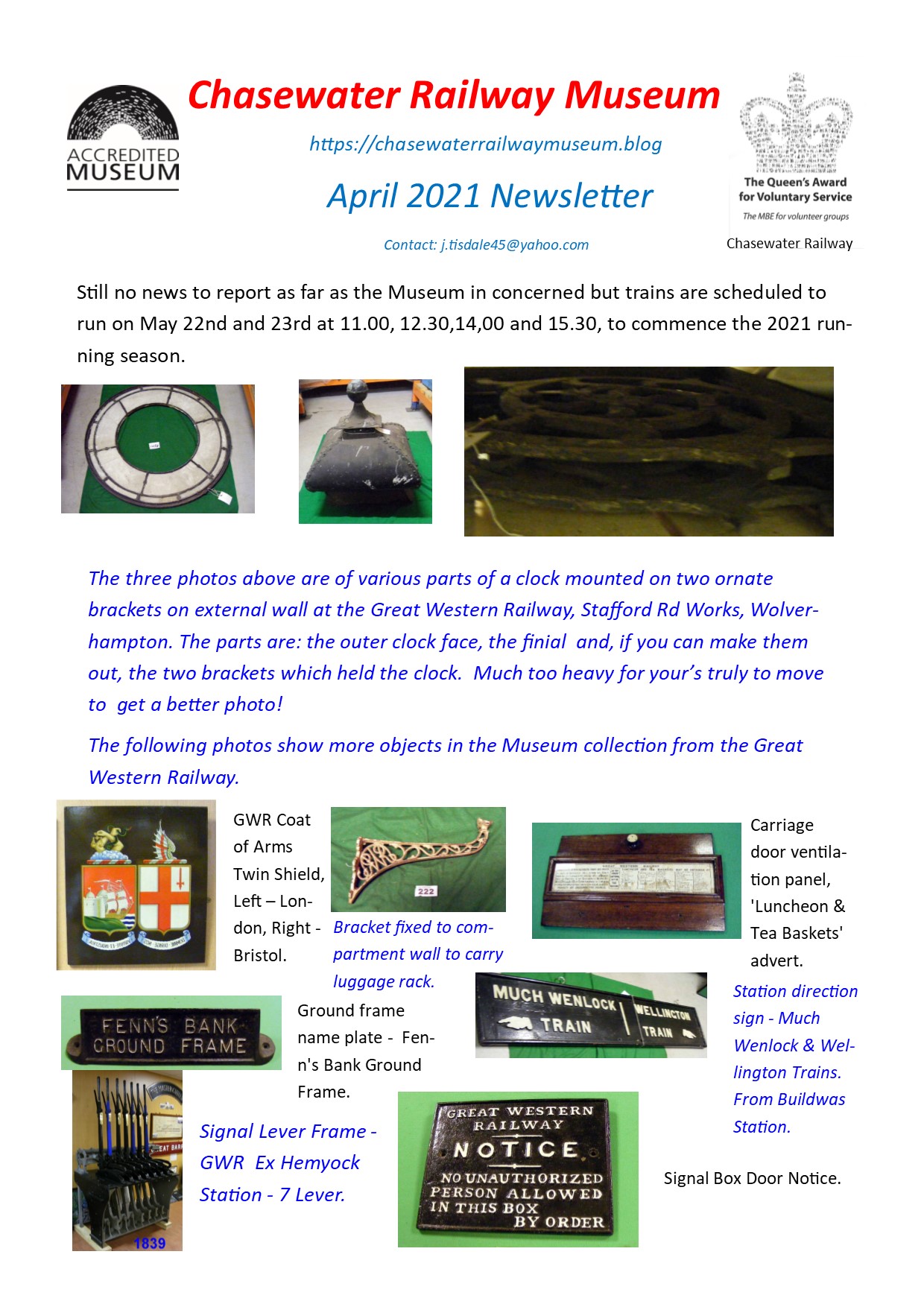
Chasewater Railway Museum April 2021 Newsletter

Chasewater Railway Museum wishes everyone a very Merry Christmas

Chasewater Railway Museum wishes everyone a very Merry Christmas

merry-christmas-2013