Chasewater Railway Museum
December Newsletter
The latest news from the museum – not as many visitors as normal months due to the perparations for Santa’s visit, when the Heritage Centre is closed.


The latest news from the museum – not as many visitors as normal months due to the perparations for Santa’s visit, when the Heritage Centre is closed.
Posted in Events, Museum Exhibits, News
Tagged Aldridge, Bloxwich, Brownhills, Burntwood, Cannock, Cannock Wood, Chasewater Railway, Chasewater Railway Museum, Cheslyn Hay, Great Wyrley, Hazel Slade, Hednesford, Lichfield, Norton Canes, Old Railway Lines, Pelsall, Staffordshire, Steam Trains, Walsall, Walsall Wood
These photos of Chasewater Railway were found by Godfrey amongst a collection given to the museum. They show Sentinel, hopefully back in steam next year, DL7 and an old DMU, all towards the Chasewater Heaths end of the line.



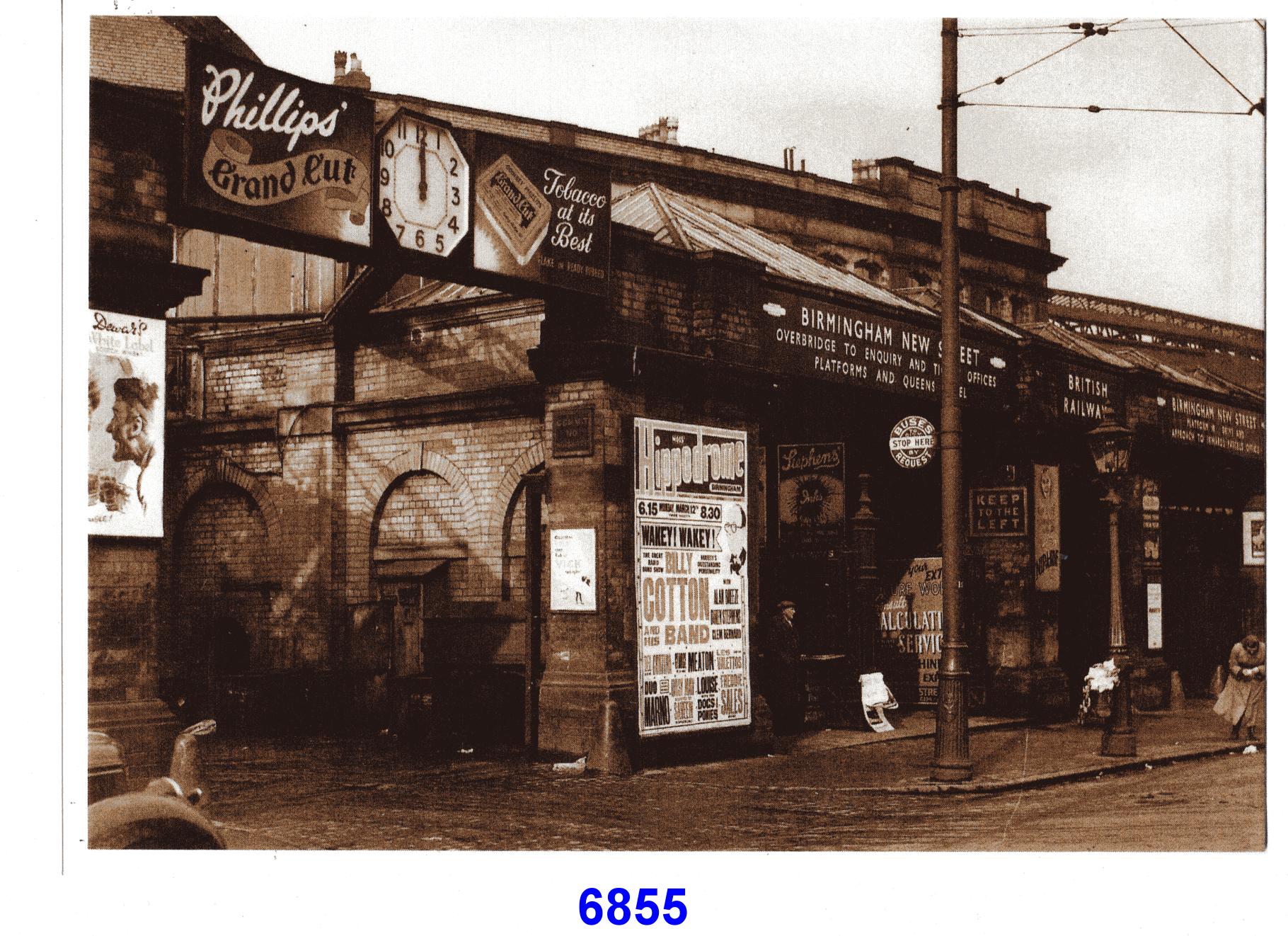
What is interesting , for people of a certain age, is the poster for the Hippodrome Theatre – top of the bill – Billy Cotton and his Band – used to be regulars on the BBC Light Programme on the wireless!
Our thanks to Graham for the phot0.
Posted in Photograph Collection
Tagged Billy Cotton Band, Birmingham New Street Station, Brownhills, Burntwood, Cannock, Cannock Wood, Chasewater Railway Museum, Cheslyn Hay, DL7, DMU, Great Wyrley, Heath Hayes, Hednesford, Lichfield, Norton Canes, Old Railway Lines, Pelsall, Sentinel, Staffordshire, Steam Trains, Walsall Wood

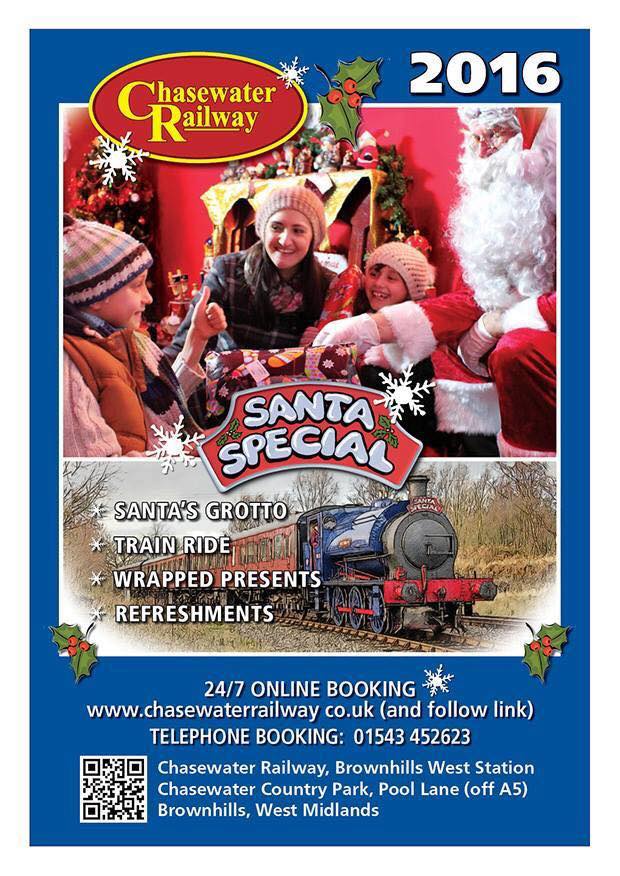
Come to Chasewater Railway this Christmas and join in the festivities with our ever popular Santa specials throughout December. With a steam train ride, a visit to Santa in his grotto, age appropriate wrapped gifts, light refreshments for adults and kids all included in the price of the ticket! If you are still feeling peckish our cafe The Sidings Tea Room will be open each day to providing hot and cold drinks, food and treats.
Santa’s grotto is located in our Heritage Centre so there is plenty to see and do!
Tickets are selling extremely fast with some of our trains already fully booked!!! Be quick and book now with our online booking system, follow the link to our Santa special page and click on book tickets
http://www.chasewaterrailway.co.uk/events/santa-specials/
You MUST pre book for our Santa specials as selling tickets on the day is not always possible.
There are no trains running and the Museum will not be open on November 20th or 27th due to preparations in the Heritage Centre…….
Archive material donated by John Hawkins
We have received a few photographs which we have not seen before.

Cannock Station

Brownhills LMS (LNWR) Station, High Street. 1967

Walsall Wood Station, just one platform left.

The Midland Railway line from Walsall Wood heading towards Chasewater. The track had been lifted on the left, where it headed for the canal. The bridge had been removed. The line on the right went into Walsall Wood Colliery (The Coppy Pit).

This photograph is most interesting. I think your original thoughts were that it was taken north of the Walsall Wood Colliery photo. If so, where? It is true that the landscape is similar to that found in that location but if the photo was taken looking north as the telegraph poles and the sun’s lighting would seems to suggest then where would the overbridge from which the photo is taken be located? There are also a couple of other issues – the slag heap on the left and the electricity cable crossing the photo from left to right in the mid-distance.
I think that the house is actually called “Bridge Cottage, 1900”. The date is a guess, but I believe the cottage was built around 1888 – 1902, i.e.:- after the railway. The bushes/scrub on the right hides Long Lane. The slag heap is that of Leacroft Colliery and the electricity cable is clearly shown on post-war maps running between Churchbridge Sub-station and Drakelow Power Station. The photographer was standing on Chapel Street Bridge in Norton Canes, looking north towards Littleworth Junction. Again a 1966-67 date is not unrealistic as the line remained in-situ at that time. The lane on the left is not a canal, the Wyrley and Essington Canal Extension branch being almost immediately to the left of the photographer. As usual, I will stand to be corrected but the above seems to firmly locate the photo to this site. The electricity cable is by far the biggest clue. – Ian Pell

This photo is definitely of Norton Crossing, Norton Canes. We are looking south towards Conduit Junction at the Hednesford – Walsall road. In later years the crossing was manned by Bernard Hurmson and his wife Bettie. Clearly, the photograph was taken after closure. The signal arm on the down line is for the original end of the branch at Norton Green, as per the attached signalling diagram from the John Swift Collection of signal box diagrams of the 1950’s. Ian Pell
Comment from Colin Noble: Bernard Hurmson was my stepfather, and as you refer, was the sole signalman at the Signalbox on Walsall Rd, Norton Canes, up to the closure of the line. His wife, Bessie, not Betty, was actually one of the Village Post Ladies, not working for the Railway!


As can be seen form the photo of Bessie at the crossing, the gates are the same in construction as per your photograph, and the box is the same, hence the conclusion that your photograph is of Norton Crossing, probably on around 1966-67? Ian Pell

The above photograph, taken in 1974 shows the crossing keeper’s cottage and Ryder’s Hayes Level Crossing with the traditional crossing gates in place. The following year these were replaced by rural barrier gates and the crossing keeper was removed and the buildings demolished. The view is looking south towards Railswood and Pelsall Station. From 1856-58 a station existed to the immediate south of the keeper’s building. Ryders Hayes signal box which was situated behind the photographer on the up side was an early LN&W box. It pre-dated Norton Junction No.1 box, but was retained even after the Norton Junction box was replaced by Norton Junction No.1 box in 1889. It closed as late as the 1950’s. Initially, it controlled Bloomer’s Sidings which were in place to serve the Pelsall Coal and Iron Company’s branch (1865) even before the Norton Branch (1858) and sidings (begun in 1889). Ian Pell

This 1884 maps clearly shows the two boxes – Ryders Hays Crossing box and Norton Junction box. The later is in its original location on the down side of the line. It also illustrates the lack of sidings to the north of the junction on the Norton Branch. The sidings shown were often called “Bloomer’s sidings”, a reference to the owner of the PC & I Company and were constructed, together with a further line (extended loop) onto the branch in 1875 (mt6/147/17). In 1875 the sidings consisted of 4 sidings on the down side and 1 siding on the up side. At this time (18th Nov 1875) the junction was upgraded and additions points and signalling were added. The beginning of Norton Junction sidings as we knew them started in earnest in 1889 when the new Norton Junction No.1 box was also added. The sidings were initially controlled by Ryders Haye’s box, with Norton Junction box controlling the junction with the Norton branch and the two down sidings which extended parallel to the down line towards Brownhills. Prior to the 1889 works , the Walsall Wood Colliery branch had been added, together with an additional up siding in October 1882 and the footbridge north of Ryder’s Hayes box had been approved for construction in December 1884.
By April 1884, the WTT indicated that Target No.74 shunted the Walsall Wood and the PC&I sidings, and that Target No. 78 “cleared out” all traffic from the above mentioned sidings. On weekdays there were 2 regular and 3 conditional freight workings on the Norton Branch, working to and from Norton Junction, These were:- 1 Norton Junction to Harrison’s Sdg. 1 Norton Junction to Conduit Colliery No. 80 – Norton Junction to Conduit Colliery as required.
Ryder’s Hayes signal box, which had a Tumbler frame, closed on 1st September 1954 when Norton Junction No.1 took control of the sidings and crossing (mt29/100/26).
Ian Pell
Our thanks to Peter Stamper for the first six photos, and to Ian Pell for the others and for his always worth-while comments.
Posted in Photograph Collection
Tagged Aldridge, Bloxwich, Brownhills, Burntwood, Cannock, Cannock Wood, Chasewater, Chasewater Railway Museum, Cheslyn Hay, Great Wyrley, Hazel Slade, Heath Hayes, Hednesford, Midland Railway Objects, Norton Canes, Norton Conduit Junction, Old Railway Lines, Pelsall, Photographs, Staffordshire, Walsall Wood, Wolverhampton
We still get so many visitors who, when they are finally in the museum, say ‘I didn’t know this was here’ so Godfrey decided to print a poster to put up in the stattion to tell visitors where we are hiding!!


A most important addition to the Museum’s archives is this programme of the evening’s event, held in the Heritage Centre on Friday evening, 23-9-2016

The award was presented to the Railway by Her Majesty’s Lord-Llieutenent for Staffordshire, Mr. Ian Dudson CBE Cst.
After the presentation there followed a train ride to Chasewater Heaths for the presentation of a replica crystal and scroll to the staff from the station.
On return to Brownhills West, an excellent buffet was on offer, which was enjoyed by everyone. Congratulations to the catering staff.
Following a tour of the buildings, including the Museum, the Lord-Lieutenant departed.
At the conclusion of the evening, Mark Sealey, Chairman of the Railway, presented all working volunteers with a commemorative QAVS badge.


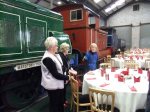


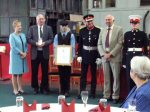
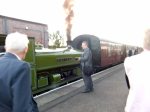
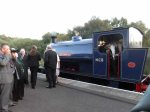


The IRS’s AGM took place on Saturday 16th April 2016 at Chasewater Railway.
It was enjoyed by IRS members and the members of the Railway who were involved in running special trains for the Society.
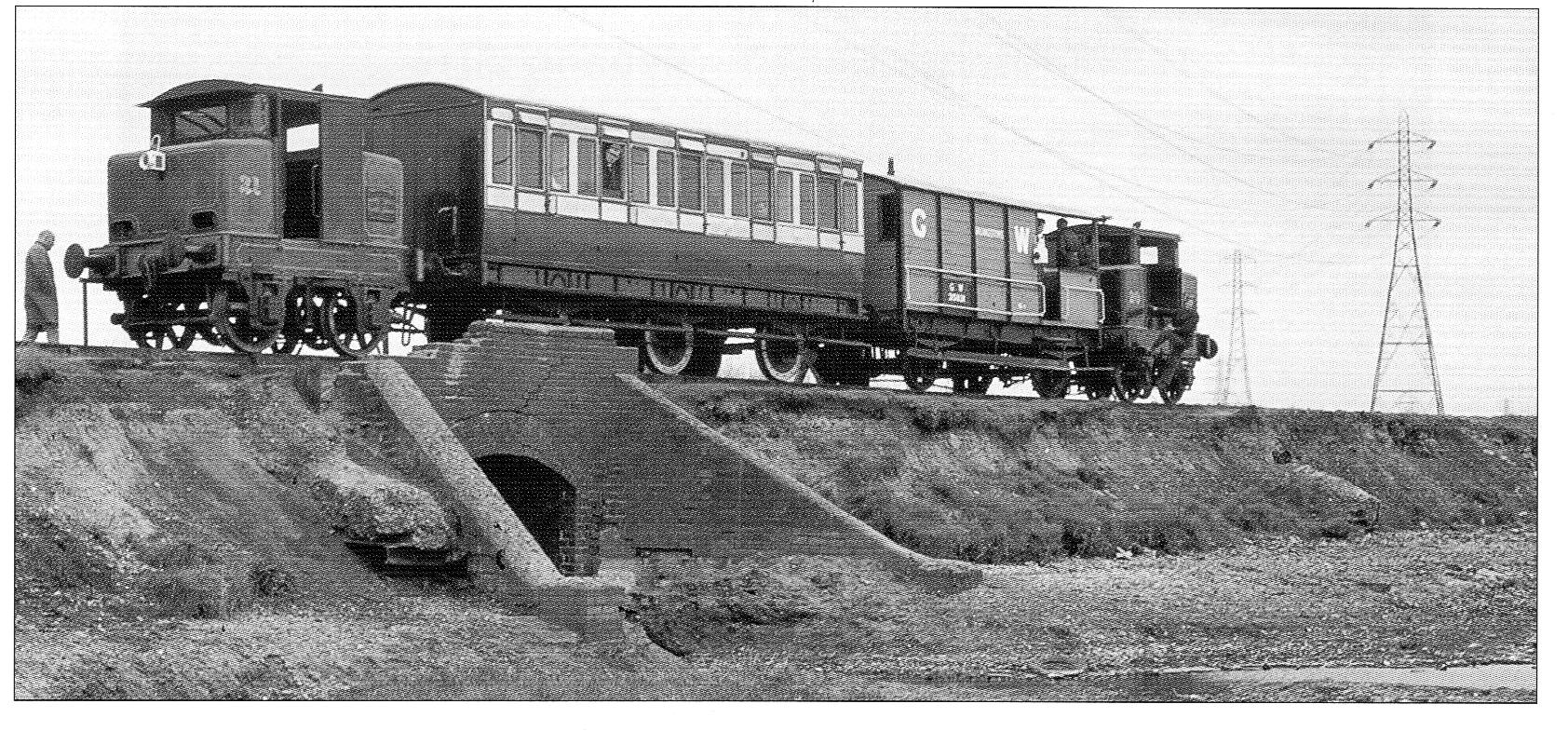 This photograph was taken by Cliff Shepherd at the IRS AGM weekend in April 1972.
On the Sunday, visits were made to Chasewater and members travelled in the Maryport and Carlisle carriage of 1875 vintage and the Great Western Brake Van, which now, in 2016, is restored to its former glory.
The locomotives involved topping and tailing were two former Worthington Brewery Planet locomotives, nos. 20 and 21, on what was then a very basic railway.
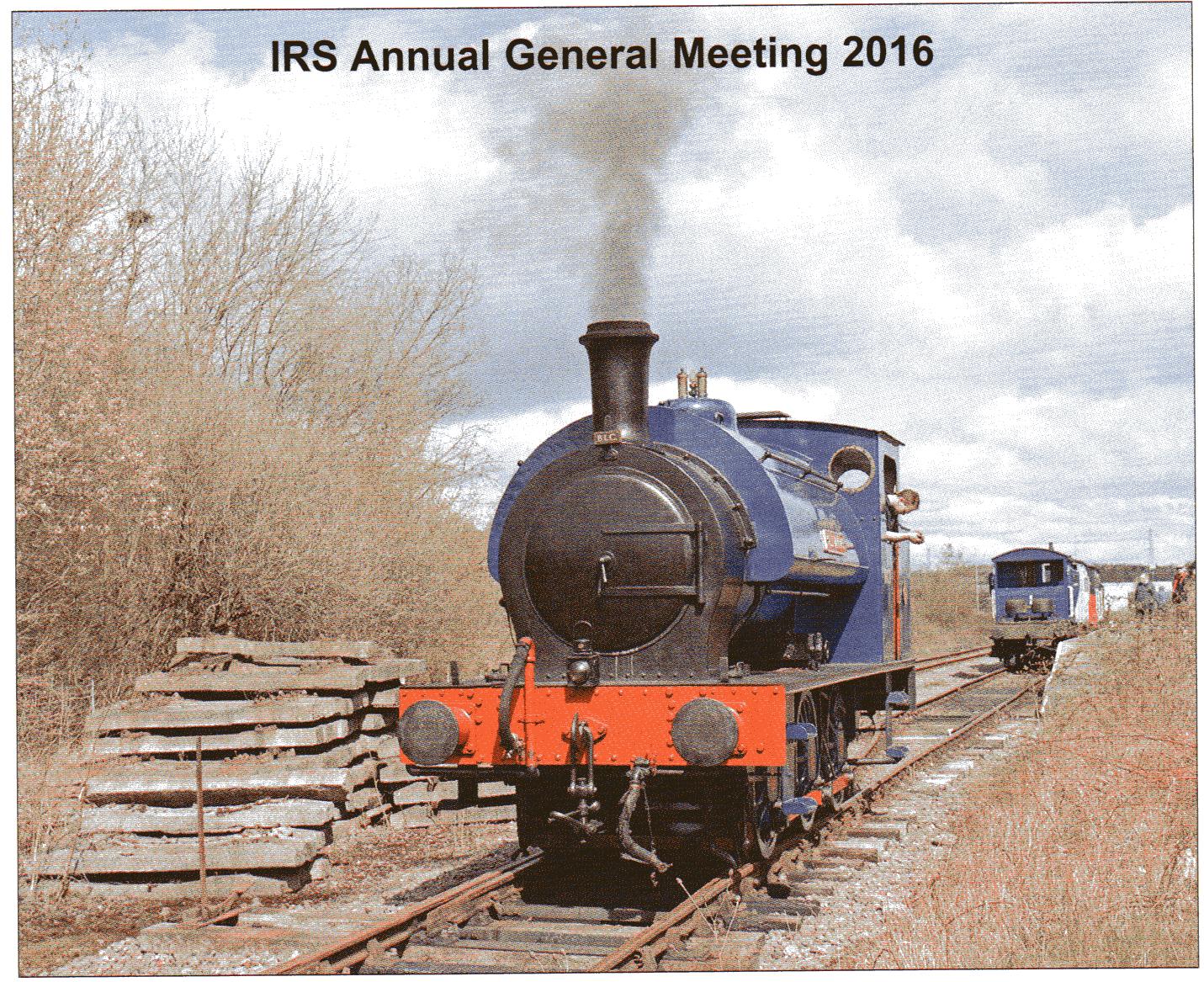
Holly Bank No.3 (Hunslet 3783-1953) runs around after the first of the IRS trains at Chasetown Church Street Station on 16-4-2016.
Posted in Locomotives, Photograph Collection
Tagged Aldridge, An old Chasewater Railway Photograph, Bloxwich, Brownhills, Burntwood, Cannock, Cannock Wood, Chasewater Railway Museum, Cheslyn Hay, Great Wyrley, Hazel Slade, Heath Hayes, Hednesford, Industrial Railway Society, IRS, Lichfield, Norton Canes, Old Railway Lines, Pelsall, Staffordshire, Walsall, Walsall Wood
First posted in 2010
Another couple of bits and pieces from the Railway Forum – Winter 1965. The first is a display of name and number plates, loaned by one of the members, and laid out in the Royal Saloon – which left Hednesford in 1970 for the British Railways carriage works at Derby for restoration and then on to the Midland Railway Centre at Butterley.

Midlands RPS Open Day display
An interesting display of locomotive nameplates and numbers was arranged in the Royal Saloon for inspection by visitors at the Midlands R.P.S. Open Day.

New locomotives preserved in Midlands
Members of the Midlands area, R.P.S. expect to take delivery of another locomotive later this year which has been acquired through the generosity of one of their members, Dr. P.G. Plummer, who has offered to purchase it for them.
The locomotive is a Hudswell-Clarke 0-6-0ST built for the Sheepbridge Coal and Iron Company in 1895 (Works No. 431). It was transferred to its present location, Desborough Warren Quarry, Northamptonshire, in March 1951 and was due for withdrawal in July. It is believed to be the oldest Hudswell-Clarke locomotive still in working order and once carried the number 15. Now it has no number or name, although known as “Sheepbridge No.25”.
Painted in apple green it should be a valuable addition to stock already acquired, and will be of considerable use at the Chasewater branch line which has been leased by this group.
Two other locomotives have also been donated by the Whitecross Co. of Warrington. They are Peckett 0-4-0STs of 1900 and 1904 vintage. They were withdrawn from service by the Company in 1961, being replaced by two Fowler diesel locomotives. They carried names up to withdrawal, the older being “Baden Powell” and the younger “Lancet” the nameplates of the latter being transferred to the Diesel No.1, and those of the former being acquired by local enthusiasts. Only “Lancet” will be able to run again. It is hoped to exhibit “Baden Powell” statically.


The second is about new locomotives coming to Chasewater. Sadly the Hudswell Clarke, although we still have the loco, has never steamed here. The two Pecketts fared even worse. The ‘Lance’ (not Lancet) 1038/1906 was scrapped in March 1972, and another Peckett – 1823/1931 was also scrapped at the same time. The Loco ‘Baden Powell’ was in too bad a condition to be moved. The other loco was an 0-4-0F a fireless Andrew Barclay locomotive 1562/1917 – scrapped in March 1973.
The articles were writtten in 1965, the photos taken in 1969
Posted in Chasewater Railway Publications
Tagged Aldridge, Barclay Fireless Loco, Bloxwich, Brownhills, Cannock, Cannock Wood, Chasewater Railway, Chasewater Railway Museum, Cheslyn Hay, Great Wyrley, Hazel Slade, Heath Hayes, Hednesford, Lichfield, Norton Canes, Old Railway Lines, Pelsall, Staffordshire, Steam Trains, Walsall Wood
This double-sided flyer recently came to light in the museum. It is now 25 years old and I found it to be interesting – I hope you do as well.
The running line in those days ran from the old Brownhills West Station (now in the middle of the M6 Toll) to the Willow Vale Bridge. Push-pull obviously.
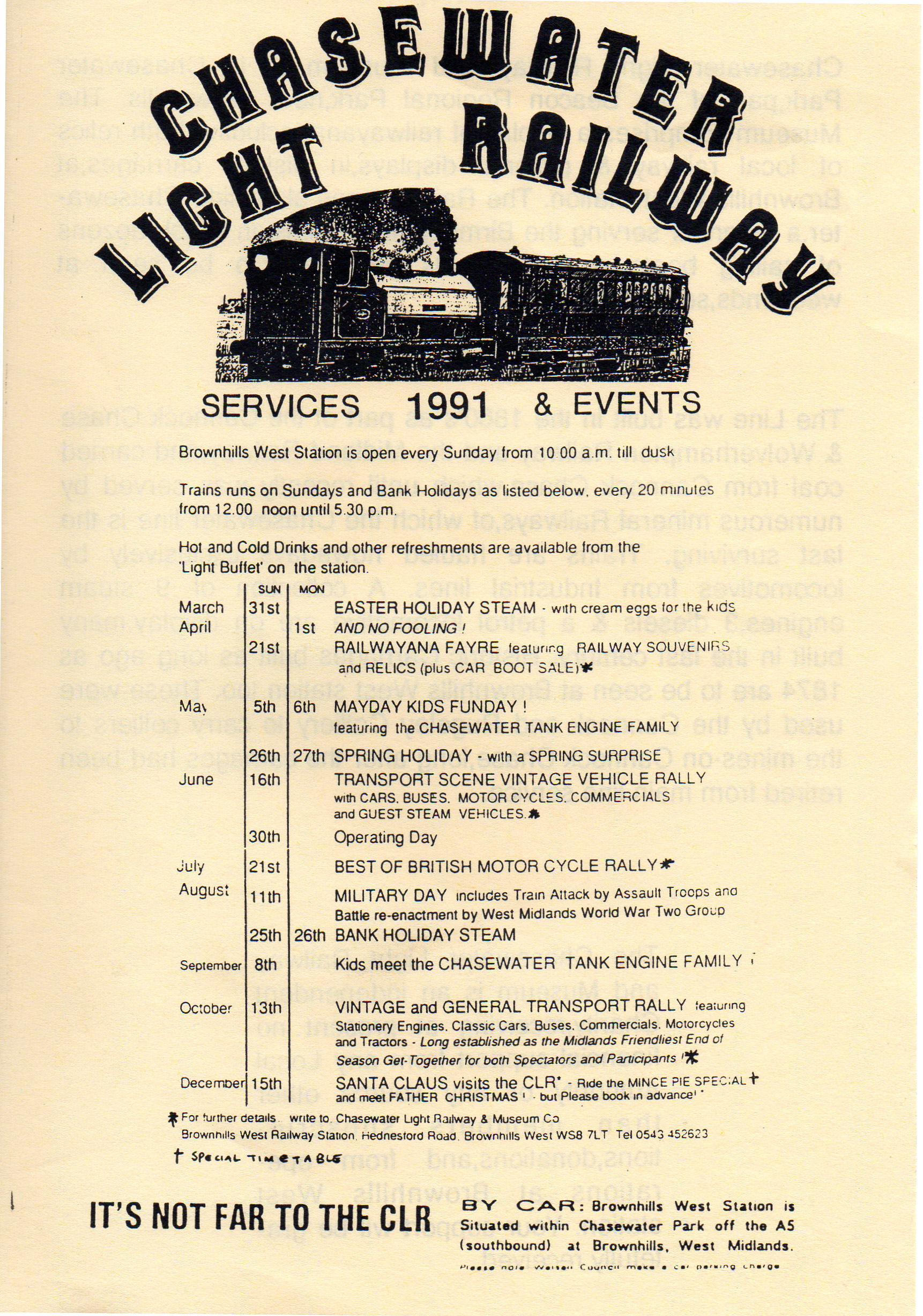
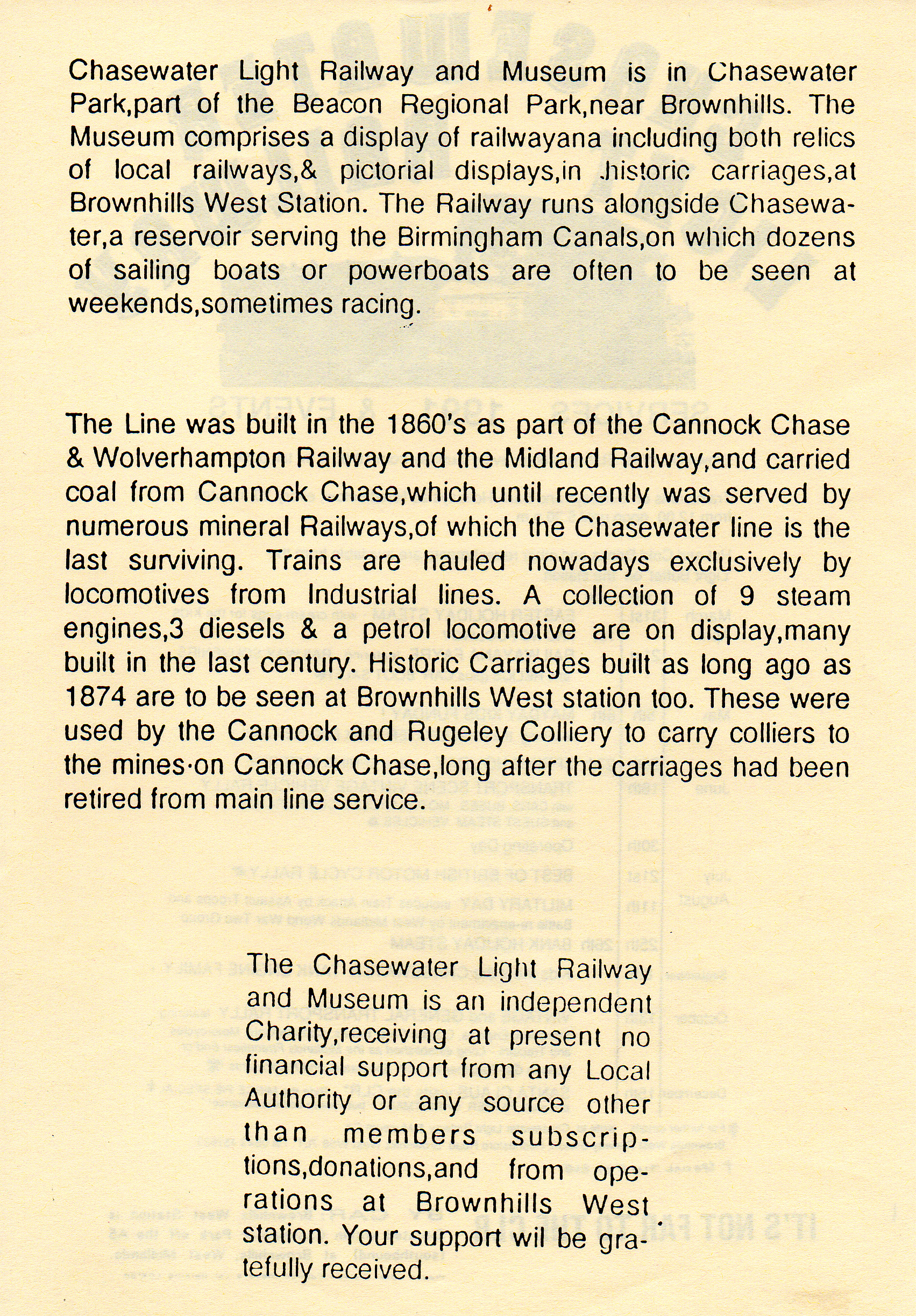
It will now be tucked away in our Chasewater Light Railway archives.
Posted in From the Archive, Museum & Artefacts
Tagged Aldridge, Bloxwich, Brownhills, Burntwood, Cannock, Cannock Wood, Chasewater Railway, Chasewater Railway Museum, Cheslyn Hay, Great Wyrley, Hazel Slade, Heath Hayes, Hednesford, Lichfield, Museum Collection, Norton Canes, Pelsall, Staffordshire, Walsall, Walsall Wood
 Chasewater Railway Museum