On Wednesday December 11th 2024, 48 children and 7 teachers from Littleton School enjoyed their trip on the Santa Special at Chasewater Railway. Part of their visit included a guided tour of the Museum, which houses memorabilia from Littleton Colliery, which is the site on which their school is built. The photograph was taken with permission from the school.
The photographer was Godfrey Hucker, one of the Railway Museum’s knowledgeable guides.
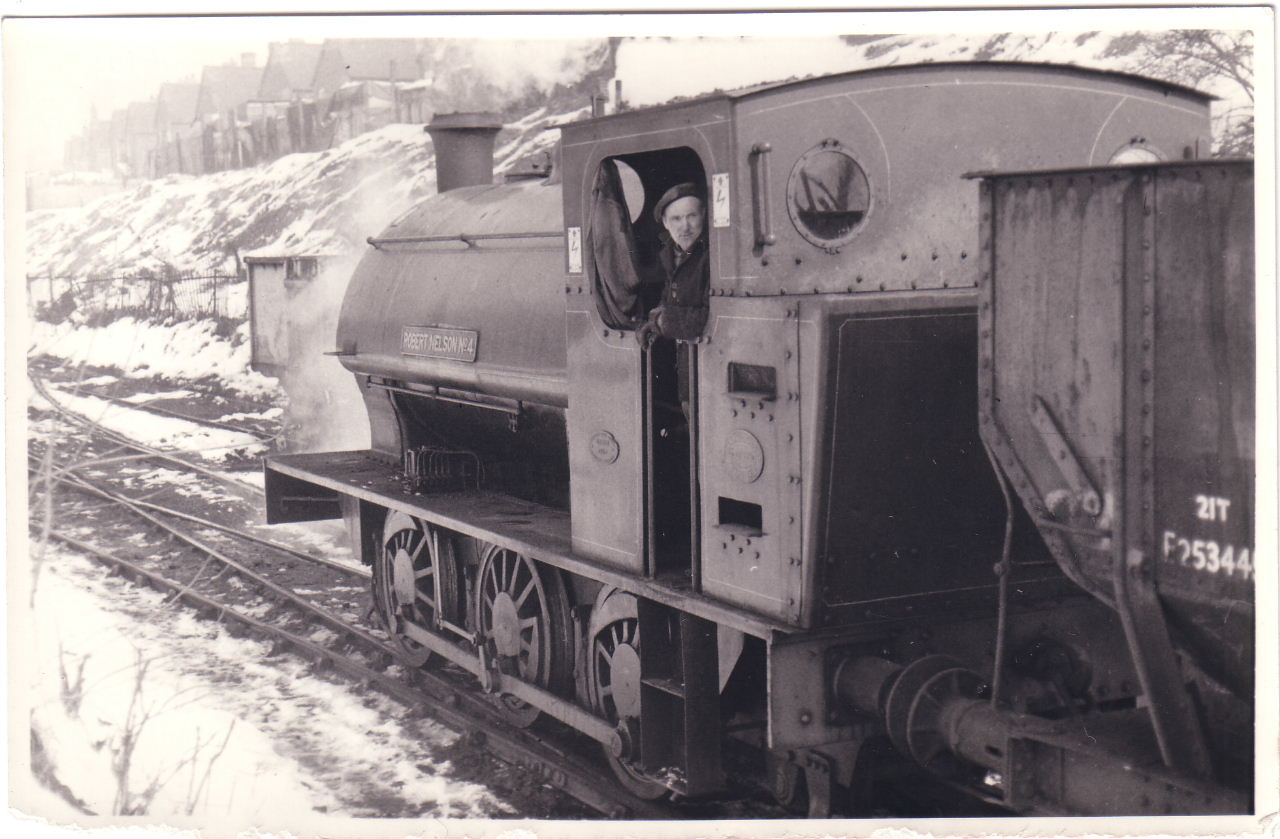
Robert Nelson No.4 Hunslet 0-6-0ST 1800-1936 Littleton Colliery.
196 – Chasewater Railway Museum Bits & Pieces
From Chasewater News – Winter 1996 – Part 1
From the Editorial
In putting the Winter edition of the Chasewater News together I am wondering where to start this Editorial. As this is the anniversary of my first full year as Editor of our members’ mag I have seen the number of articles which have been submitted grow along with the distribution of the Chasewater News. To the members who have contributed articles not yet published I would like to say a big thank you for your efforts, and that I still have them ready to put into the magazine. To all the members who have old memories of the Railway in its formative years and who have thought about putting pen to paper, please do so. Part of the Editor’s role is to take submitted articles in whatever form that they arrive in and see that they are in a presentable form for publication, and as you have probably seen in the odd edition that even with a spell-checker I have still dropped the odd clanger or two when it comes to spelling.
Not sure of the outside two but the fella in the centre looks vaguely familiar!!
On membership matters we now have a total of 305 members with a newsletter distribution of over 150 copies to individual households. This must be the highest number that we have had for many a year. I would like to welcome all new members who have joined since the last newsletter and hope that you will enjoy being a member of the Railway. I am looking forward to our newsletter reaching the 250 distribution mark. As the readership increases I can start to look at the possibility of things such as colour front covers and possibly some colour prints inside the magazine instead of the current black on white format. This of course is only possible as the quantity published grows and the scales of quantity come into effect.
The past years have seen a major turn around in the fortunes of the Chasewater Railway, from languishing in the doldrums for a number of years in the late 70s and early 80s we now have a railway which gives pleasure to hundreds of visitors every years. Many comments have been passed by the visiting public on ‘how friendly the people are at Chasewater’, and ‘how it reminds tem of railway preservation in the old days’. This I feel is due to the positive efforts of all the working members and also the membership at large who have helped to push the message that the Railway is alive and well and growing!
In looking forward to 1997 we have put in place possibly our most ambitious programme of steaming days yet. With more work being carried out on the restoration of the locomotives, both steam and diesel, the Railway can look forward to being able to run different locomotives throughout the running season, and let Asbestos have a well earned rest for maintenance and repairs. Chris Chivers.
Loco Shed News
With the completion of the shed heating it is hoped that life will be much easier for the locomotive volunteers, and there are mutterings from Andy Mould that the forge will finally be put back into working order. Personally I think he’s just looking for somewhere to cook his bacon and keep his tea hot! Also during the recent shunt round, the North Eastern brake is now residing in the shed road and has been dubiously named the ‘917 and Neilson support coach’ and during the recent bad weather it has seen rather more bodies using it for a mobile rest-room than usual!
Steam Locomotives
No.4 Asbestos – Still the mainstay of the Railway for steam haulage and at the moment only requires the usual maintenance necessary for any steam locomotive. She is expected to be in traffic during the Santa Specials.
No.5 Sentinel – With the arrival of the replacement links the repairs to the chain are well under way, and it is hoped to have Sentinel steam tested before Christmas.
No.11 Alfred Paget – The restoration of this engine continues at a pace. The ¾” steel plate for the repairs to the front steam chest and boiler saddle has been acquired and cut to the required profile. The broken pieces of the steam chest have been removed and sections have been cut away ready for the welding in of the new sections. The boiler has been fully painted in primer and all the protruding studs on the firebox have either been removed awaiting replacements, or have been given a thick coat of grease as a rust preventative measure. The locomotive is due to be moved into the shed before Christmas so that work can continue under cover over the winter months. Further fund raising is being actively pursued by Janet Whittaker as the members on site can testify; ‘I’ve even been ‘mugged’ myself by the lady in question!
S100 – The work continues at a steady pace with new pins for the brake hanger assemblies being manufactured on-site. The wheels should be back under the frames in their correct order before Christmas so that space can be made for the Neilson.
Diesel Locomotives
L&Y No.1 – Nearly all the new bearings for the gear box have now been acquired and the magneto and carburettor are nearing completion ready to be mounted on the engine. The main body has been partially stripped down to be needle gunned and primed n red oxide. The brake assembly and sand boxes have been moved to the shed to receive attention during the winter. Once the engine is completed it is the intention to mount it in No.21 for a period of test running.
No.21 – An attempt to start the engine running on No.21 was made during the autumn without success. There are still some problems with the cylinder heads and it seems that two new head gaskets will have to be found, as well as having the heads trimmed. It is a possibility that the 4J0 engine nearing completion at Dormans will be brought to Chasewater for testing in No.21; this has still to be confirmed.
DMU Set – The DMU set has been partially painted in BR green and this is expected to be completed as soon as the weather improves. The Company’s power car received a donation of £380 from the will of the late Geoff Young, with many thanks to his widow Brenda.
Carriage & Wagon Notes
Tony Wheeler
It has been some time since I have done anything from the carriage and wagon front for the Chasewater News, so here is a brief report on the ongoing restoration projects in hand at the present time.
Manchester, Sheffield & Lincoln Coach – The restoration of this coach is still ongoing. Work is now being done on the underside of the frames with cleaning and painting taking place. A broken panel on the guard’s door and two broken drop windows and frames have been replaced. These were caused by vandals at various times during the autumn. Due to the relatively minor damage caused we have still been able to concentrate on the braking gear and continued applying several coats of paint to the body as and when the weather has permitted.
Midland Brake Van – Work has re-started on this vehicle with the replacement of the missing roof boards. This was followed up by the roof being re-covered to keep out the worst of the weather. The missing end panels were replaced, along with some of the side panels being cleaned and undercoated. The membership had a whip-round and £66 was raised towards the cost of the roofing for this vehicle, with the balance of the expenditure, £39.75, being made up by the Company. The cost was as follows: Roof felt – £73.32, Screws – £6.96, Paint – £19.47. With many thanks to all who donated.
Rawnsley No.4 Lilleshall 1872 0-6-0ST on Paddy duties. Formerly 2-2-2 for Paris Exhibition.
As the running season gradually winds down, the working members can look forward to another winter of further extension work and getting on top of the ongoing maintenance. As the number of working members has increased, the overall appearance of the railway has improved.
A large new sign on the A5 entrance to the park means that a large number of the general public have visited the railway for the first time, with the usual comment ;I only live up the road but I never knew you existed’. This in conjunction with a board at the entrance to the park advertising our excellent buffet service as well as train rides seems to have brought more people up to the top end of the park instead of them staying by the swings and slides. The overall reaction from the first time general public visiting us is very favourable, which can only reflect on the working members generally.
The vacant position of Publicity Officer has been filled by Kim Wilkins and she has made a start on getting the running dates published in the railway press. This is probably one of the most unglamorous jobs on the railway with a lot of effort going in for what can seem like very little reward. I would like to thank the previous holder of this post, Keith Day, for all the effort that he put into the job when he was doing it.
On the subject of members, as of the date of this magazine, we currently have the largest number of members in the Railway’s history with nearly 150 magazines going to different households, and this translates to approximately 250 current members.
Thursday 12th October saw the running of a special service train to Norton Lakeside Station for the planting of a Silver Birch tree in memory of Geoff Young, whose funeral took place the previous Friday at Sutton Coldfield Crematorium. A good proportion of working members attended as well as members of Geoff’s family for an oration and prayers. Geoff’s wife Brenda scattered Geoff’s ashes across the causeway. I’m sure that I speak for all the members of the Chasewater Railway in giving Brenda our deepest condolences at her loss.
Chris Chivers.
Loco Shed News
With the running season nearly over, the mainstay of the steam services have been carried out by No.4 Asbestos. The coal from Hatfield Colliery has proved to be a good British alternative to the Russian coal purchased in the past. The small size of the coal which was brought in as it was primarily to be used in the boiler of the Sentinel, and any further purchases will be made in a size to accommodate both the larger grates of Asbestos and any further restored locomotives.
The loco shed has also had installed an oil fired heater and ducting and this should provide a warmer environment during the winter months.
Steam Locomotives
No.4 Asbestos – With the coal problem sorted out, Asbestos has performed well during the season. Several new firebars have been purchased to replace a number of banana-shaped ones and several of the tubes have been replaced over the season. One of the springs has been mended and the pressure gauge has been re-calibrated and certified.
No.5 Sentinel – The repairs to the Sentinel have been progressing at a steady pace with the damaged area cleaned out and the front casting being inspected to find out the easiest way to mend the front casting of the locomotive. The front drive sprockets have been straightened out and the broken links of the drive chain have been de-greased. The rest of the drive chain has also been cleaned up in readiness to be re-assembled.
No.11 Alfred Paget – Work is continuing at a steady pace on the restoration of this locomotive and the fund raising efforts of the group are doing well. The boiler has now received a coat of primer to prevent any further rusting. The badly rusted base of the front boiler that sits on the steam chest has been cut away and a new piece of metal has been curved and welded into place. Various fitting studs on the firebox have been removed and the facings have been cleaned up and given a liberal coating of grease.
S100 – Work is still progressing at the usual rate, slow but steady, and Tony Sale is gradually putting more and more bits back onto the frames. It is still hoped to have S100 back on its wheels in the no too distant future.
Diesel Locomotives
Fowler diesel hydraulic No.422015 – The Fowler has had a number of outings this year on passenger workings. It continues to receive minor attention during the season and has held up well. Sooner or later the Fowler will need a major overhaul to cure the problem of ‘clag’ that is chucked out while running.
Fowler diesel mechanical No.410013 – A final coat of paint has been applied to the locomotive and the front cover panels have been replaced. The engine still needs some attention as well as the drive shaft. There is still no final date on when this loco can be returned to traffic.
L & Y No.1 – Work is still continuing on finishing the rebuild of the engine with further parts being obtained from our friends at Dormans. As soon as the body can be removed from the bay platform road then it can be shot-blasted and painted. The buffers have been removed to the shed where they have been stripped down and the springs cleaned and oiled. As they have been rebuilt they have been painted, waiting to be re-united with the chassis. Most of the brake gear has also been removed from the body to be cleaned and re-assembled.
No.21 – The first attempts to run the engine have met with mixed results. The problem seems to be with the timing chain set in the wrong position. This is being rectified but it could mean a new head gasket being required for part of the engine.
DMU Set – Cars 51412 and 51370 have now been reunited. They are currently having the roof painted light grey and the body is being painted green, the handles white and small yellow warning panels fro the front and rear driver’s cabs. The rotten portions of the bodies are being replaced as well as the route indicator being converted to four digit route indicator, before work starts on the interiors. Car 51412 is also receiving attention to the motors and control circuits.
Ruston Hornsby DM48 – The latest addition to the Chasewater diesel fleet has now had the body stripped down to allow access to the engine. A start has been made on locating a new cylinder head and various other parts.
Please note – the Museum will not be open this Sunday – 23-6-2024
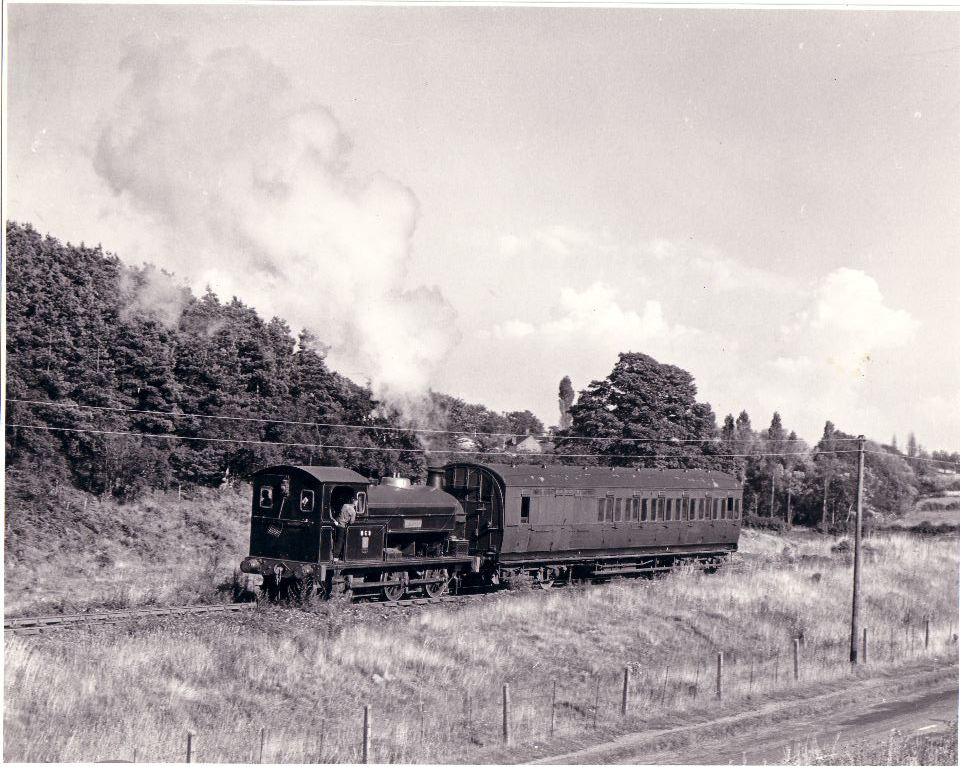
‘Asbestos’ Hawthorn Leslie 0-4-0ST 2780-1909 Passing the engine shed, before alterations!
Picture donated by David Bathurst
192 – Chasewater Railway Museum Bits & Pieces
From Chasewater News – Summer 1996 – Part 3
P Way News – Arthur Edwards
Since the last article was published the P Way gang has had a number of new members join us and the extra manpower has enabled us to carry on a number of tasks at a greater speed than originally planned. This has enabled us to fence in an area next to the lower compound entrance gates, so we now have a fenced in area for the storage of rail and other heavy items of P Way material.
Also the fence from the foot-crossing between the two compounds to the bottom compound has been realigned to allow the relaying of the sidings alongside the shed road. Work is also in progress to design the layout of a head shunt behind the current shed therefore allowing access to the shed from both ends.
Further down the line a number of fence posts have been replaced where they were broken down by trespassers onto the running line and along with bits of hedge growing up alongside is starting to make things much harder for the local idiots. The only bit of bad news about this fencing is that we can no longer use barbed wire where the public footpaths or public areas come up to our fence. I have mixed feelings about this as I know one or two of the members would like to use razor wire backed up with land mines!!
With the first decent spell of dry weather the perennial job of weed killing was carried out, and not before time as the track was starting to disappear beneath the undergrowth again. It has been proposed that a further application of the poisonous stuff be applied sometime later in the summer – weather permitting.
The P Way gang meet every Sunday at Brownhills West Station from 10.00am onward. Come and join us!!
Neilson Saddle Tank No.11 – Paget’s Progress – by Paul Whittaker
Neilson 2937/1882
Alfred Paget at Chasewater – June 1978
On the 13th January 1996, a freezing cold morning of -5ºC, I started the hard slog of removing the boiler tubes from No.11. After many a bruised finger and some colourful language, not to mention seven weekends at it, the final tube fell free from the boiler tube plate at 4.00pm on Saturday 6th April.
After long deliberation and much discussion I and several co-workers concluded that the next move would be to remove the water tank, thus allowing access to the boiler for closer inspection. As the cost of a crane was as yet out of our reach, we proceeded to jack up the tank until such time as it would be possible to slide it safely down two lengths of rail to its resting place on the platform in the engine shed compound.
The next job was to remove the boiler cladding and insulation, a dirty job but it had to be done. Meanwhile amongst the organised chaos that is generated when stripping a steam locomotive down, we removed the dome plate. This was in order to provide access to the interior of the boiler for a very slim young man, otherwise known as Christian Hatton to get inside and remove the remaining collapsed tubes, and around 3cwt of rust. While all this was going on, the washout and fusible plugs were removed from the firebox. The steam cleaner proved to be invaluable in removing the rust and crud from the water jacket around the firebox. As a result of all this, the boiler is now ready for the boiler inspector to cast a cursory eye over it a prelude to a proper test inspection.
As work progressed on No.11 that magic word ‘money’ reared its ugly head again, and after some serious consideration my very good friend and colleague David Borthwick and I decided to start a fund to raise the necessary cash to renovate Alfred Paget, and entitled the fund ‘Neilson Steam Aid’, to which my good wife Janet will administer and collect donations. In addition to this, Dave has put together a Stock Book, which documents basic information on most of Chasewater Railway’s rolling stock and locomotives. This booklet is on sale in the station buffet at 75p per copy.
On a more personal note, I would like to say that I am overwhelmed by the help and support, to say the least, and of the amount of technical information that I’ve received from fellow members at Chasewater, without which I would have been like a beached whale. And so I would like to take this opportunity to sincerely thank all of those involved with the on-going renovation of Neilson Saddle Tank No.2937, otherwise known as ‘Alfred Paget No.11.
Alfred Paget last steamed in 1982, and is still a way off yet – in 2012.
Those of our members who are associated with other preserved railways cannot fail to have noted from their magazines the increasing importance of health and safety. This sudden interest in safety awareness is neither coincidental nor accidental, it is a direct consequence of legislation.
Along with our sister organisations, we have had to prepare and submit a Risk Assessment for approval by the Health and Safety Executive. To operate as a passenger-carrying railway without having obtained the necessary acceptance of our Risk Assessment is unlawful and would expose the ‘management’ to prosecution.
Our Risk Assessment, underpinned by the proposed revised Rule Book, is now in the hands of HMRI for consideration and, hopefully, approval. In the interim, the Company is in possession of a temporary exemption which permits us to operate lawfully pending a decision by the Health and Safety Executive.
This situation has arisen in consequence of the Railway (Safety Case) Regulations 1994 (SI 1994 No.237) which applies to all passenger-carrying operators, including operators of heritage railways. Despite the ‘universal’ nature of the regulations, it has been generally recognised that the safety implications (and risks) associated with a preserved railway such as ours, operating with a 20 mph speed limit, are significantly different to a railway running trains at 125 mph. Yet in many respects the considerations are the same – it is only a matter of differing magnitude and scale. For example, the need for operator protection when using electrical equipment is as important to a Chasewater Railway volunteer as it is to a RailTrack employee, the risk to the individual at the time is the same if something were to go wrong.
Most of us have a degree of cynicism regarding the ever-increasing effects of legislation on our day-to-day operations. The ARPS and other supportive bodies have fought hard (and are continuing to fight) on our behalf to ensure that preserved railways are protected against some of the more onerous obligations being placed – quite properly – on our bigger brothers. For this we are most grateful. But at the same time we need to recognise the simple fact that running trains – in its widest definition – is potentially dangerous. We need to ensure to the utmost best of our ability that risks to both the public and our members are minimised and that our practices and policies are driven by safety considerations.
To some degree it’s a matter of good sense and adopting practices which will ensure our safety – whether during the lifting of sleepers, working on the footplate, or preparing sandwiches in the refreshment room.
The preparation of the Risk Assessment involved a number of ‘key players’ with Andy Mould taking the lead. As the process developed, the point of the exercise came more clearly into focus. The document includes a commitment to introduce changes in certain areas of activity, including accountability and the maintenance of proper records. Sometimes it proves very valuable to examine carefully what we do, why, and how ‘dangerous’ it is and how we might make changes to reduce potential risks to volunteers and the travelling public.
During the forthcoming months, it will be necessary to introduce the changes required to honour the commitments contained in the Risk Assessment. Most will be self-obvious improvements in our working practices and procedures. Those members or groups of members affected by such changes will be informed directly and as widely as possible so that there can be no areas of doubt or uncertainty.
Stop Press
The following is the text of a letter dated 13th May 1996 from the Health and Safety Executive:
“RAILWAYS (SAFETY CASE) REGULATIONS, 1994
Further to your conversation…. On 24 April, I am pleased to inform you that the Health and Safety Executive has now completed its evaluation of your application for exemption from the above regulations, and has found it satisfactory. Accordingly, I enclose a certificate exempting the Chasewater Railway from regulations 3, 4 & 5 of the Railways (Safety Case) Regulations, 1994.
The assessor also asked me to commend you on the responsible approach towards the running of (the) railway which is demonstrated in your application.”
How we look to others
In the past, our Railway has been criticised for its ‘appearance’. We have been seen as just a little short of a scrapyard. Not that we are on our own! Such is the very nature of railway preservation, with locomotives and rolling stock at various stages of dereliction (with little or no prospect of restoration ‘within the foreseeable future’) and a whole array of items and equipment which might, perhaps one day, fins some form of use.
1996 has been declared a year of good old-fashioned consolidation, presenting the opportunity of finishing unfinished jobs without the distraction of some major enterprise. Looking over the site, particularly at Brownhills West, the scale of improvements is immediately apparent compared with say, 12 months ago. A concerted effort to tidy the whole place up is producing dividends at last. The amount of rubbish and scrap disposed of has been impressive, to say the least.
We still have a long way to go, however. Some (perhaps even ‘most’) of our working members still seem unable to adopt the culture of tidiness. My message is worth repeating: please do not simply leave YOUR rubbish for someone else to clear up. And if you see rubbish, litter and the like – particularly in the station areas – please take the trouble to pick it up and drop it in a bin. Empty drinks cans littered around the site leave an appalling impression. Take pride in your railway.
The 1996 Annual General Meeting
The 1996 AGM agenda was completed in just 6 minutes. As a formal business meeting it began at the appointed time; those who arrived late missed it! I am delighted to welcome Arthur Edwards to the Board as a Company Director. His support has always been much appreciated and I am confident that Arthur will have much to offer to the future management of the Railway.
For those present at (or arrived later) the AGM, perhaps the more interesting part was the traditional open forum which followed and resulted in discussions on the usual wide range of subjects. The thorny problem of vandalism generated quite a lot of feeling.
Social Evenings
My personal commitments cry out for the introduction of an 8-day week (but with a 3-day weekend of course). Thus, I cannot attend every event, much as though I would wish to. But how pleasing it was to join so many working members and friends at the April Social Evening, with some interesting slides and a pleasant drink or two on offer. The Railway can only be strengthened by such events, especially as the older members in particular have a massive fund of knowledge, information and anecdotes to share with our colleagues.
“Chasewater News”
Building on the excellent work of his predecessor, our current Editor is producing a magazine which is going from strength to strength. Of course, access to modern technology is the key to the appearance and layout of the magazine – despite the curious effects which from time-to-time result owing to the use of an American spell checker!
Appearance and layout are two aspects only. The Editor can only produce an interesting magazine if he has the materials to include. On his behalf, can I make a plea to members to provide articles – especially articles about the Railway itself – for inclusion in the magazine. Don’t worry if you think that your grammar or spelling is poor, it doesn’t matter. Chris will ensure that your material is corrected before publication (well, that’s the theory at least!). Similarly, if you have any photographs (whether ancient or modern) which might be of interest, then please let Chris Chivers know.
On the Volunteer Front
The Annual Report presented to the 1996 AGM included a reference to the need for working members to respect one another’s work. For a variety of reasons, some valid but many unsustainable, the closing months of 1995 produced a Chasewater version of ‘A Winter of Discontent’. Perhaps it really did have something to do with the weather. With the onset of spring, the spirit of co-operation and harmony between working members has improved beyond belief. Doom and gloom have been replaced by confidence and optimism. With so many positive things in hand or on the horizon, it is vital that this spirit is maintained and developed. When all said and done, we’re supposed to be enjoying ourselves! Additional working members are always welcome – and they need to feel welcome. All Departments are always on the lookout for additional resources, whether manpower or material-wise. If you feel able to assist in any way, please let someone on the Railway know next time you visit Chasewater.
The last three photographs are of ‘our’ railway trackbed on the other side of the M6 Toll road, the final one, with Ellie, was taken in the area of the old Brownhills Midland station.
Featured Locomotive: No.7 Birch. Built at Rawnsley in1888 but not put to work till 1890. Worked at Brereton 1949/50. Scrapped at Brereton circa 1956.
178 – Chasewater Railway Museum Bits & Pieces
From Chasewater News Spring 1995 – Part 1
From the Editorial – Chris Chivers
This is the first issue of the Chasewater News for over five years without Nigel Canning at the helm. Nigel has decided to retire from the post of Newsletter Editor, a task which has at times been a thankless one but a job which has been vital to the railway and its members. From myself and the other members of the Board I would like to give Nigel our heartfelt thanks for the effort, patience and perseverance in trying to produce a newsletter that has increased in space and scope during his editorship. Many, many thanks Nigel.
Since the last newsletter, work on the railway has increased apace, Norton Lakeside Station has been lengthened and backfilled to accommodate a three coach train and the 55 coping slabs that came from British Rail’s Taunton Concrete Works are believed to be the last order that was processed there before the works were closed down. Fencing on the causeway is well in hand, trespass notices have gone up at each of the foot-crossings over the line between Brownhills West station and the new station with the accompanying whistle boards scheduled to be put in place shortly… The bridge between Chasewater and Jeffrey’s Pool has received new steelworks on the parapets and plans are being made to use the extra bricks in lengthening Brownhills West platform later in the year. At Brownhills West the new amenities block is being refurbished with a donation of materials from Lichfield District Council for the cladding of the temporary accommodation. This will give us at long last some decent sized toilets as well as facilities fro the disabled. Also a new facia for the booking office and shop has been constructed off-site by the Community Service lads and should be put in place shortly. The problem of extra storage space for stock alongside Elsley’s siding is being looked at, with it being earmarked as a summer job for the Community Service people.
The problem of lack of working members is again rearing its ugly head. In 1986 there were a handful of working members and this has grown steadily so that in 1994 there were 20 – 30 volunteers working on site. As the railway has grown, the demands on their time by the railway have increased. In 1986 it was all hands to man the station on a steaming day, in 1994 not only were we fully manned for steaming days but there were staff working in other departments as well. The railway is growing and growing fast, with 60 running days this season and the strain on our existing volunteers is growing. If you can spare some time or would like to become a regular working member come along any Sunday from about 9.30am, you would be more than welcome.
Loco Shed News
The loco shed has at long last got a fixed compressor which means that the engineering staff have got ‘wind’ to help with some of the jobs that consumed many valuable man-hours. The compressor was a donation from Oscott Air as they decided the faults on it were not worth repairing. On further inspection it was found that the only things needed were the small piston and con rod. The old ones having worn the circular hole for the piston and con rod for the gudgeon pin to an oval shape, so causing a rather loud knocking noise. It is hoped that jobs such as taking out old boiler tubes can be accomplished much more easily than having to do it by hand. With the tidying up of the engine shed the ‘diesel dismantlers department’ have installed a new bench allowing them to lay out and reassemble various bits of engines.
Steam Locomotives
No.4 Asbestos – Once again Asbestos has opened the season for passenger services but whether it will see the season out is doubtful. During the winter the crown of the firebox was built up with weld and a new fusible plug mounting was made and put into place. Several of the rivets at the base of the firebox have received attention, as well as the foundation ring. The new tubes purchased last year are in store and await the major overhaul that Asbestos needs.
David & Goliath – Asbestos & 60056
No.5 Sentinel – The Sentinel failed its hydraulic test at the first attempt with a blown tube. The boiler was lowered into the pit, the 14 outer tubes removed, new tubes purchased, replaced and the boiler hoisted back into position, all within 21 days. The boiler fittings have been replaced and the second hydraulic test was successful. Some of the pipework has had to be renewed because of the re-positioning of the Weir pump and it is hoped the Sentinel will be back in service later in the season.
S100 – The centre wheels for S100 that have for ages been in between one and two roads have at last been moved and are now in the shed against S100’s frames. The tanks at the top end of Brownhills West site are also scheduled to be moved to the shed compound in the near future. Several parts of the brake gear have been placed alongside S100’s frames and have received attention to free the pins and to clean the rust off them. New horn keeps for two of the axle boxes have been fabricated and attention has been given to re-assembling the valve gear. It is expected that S100 could be back on its wheels within the next 12 months.
Hudswell Clarke – The Hudswell Clarke has received a cosmetic coat of paint to smarten it up and to prevent any further corrosion to the bodywork.
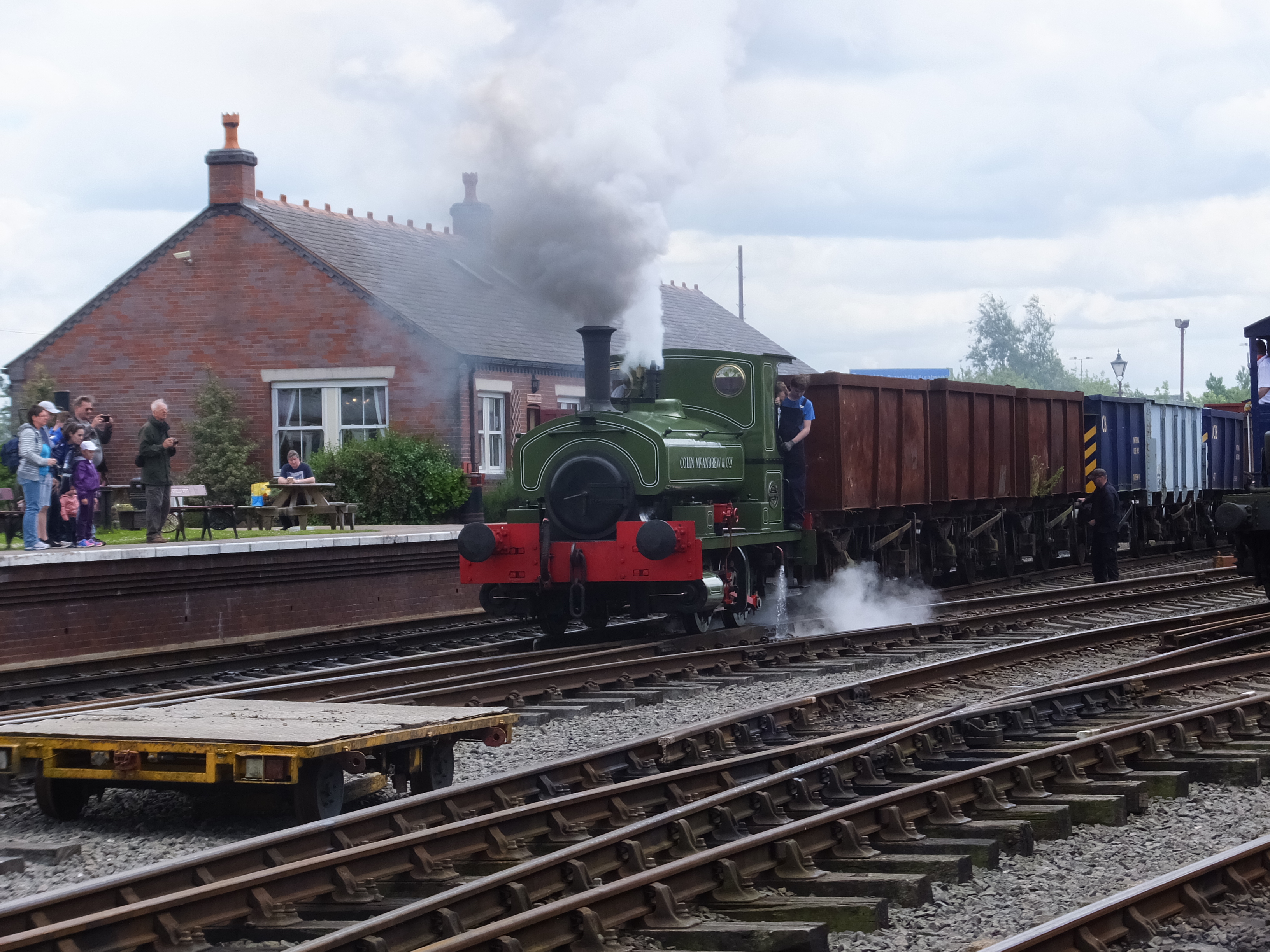
No.3 Colin McAndrew – The boiler is awaiting a decision after its departure for the SVR’s boiler shop at Bridgnorth and the outcome of the inspection there.
917 – A short section of track has been laid in the shed compound in preparation for receiving the chassis that is currently on three road. This is to enable some basic work to be done in cleaning and preparing the chassis for the long work of restoration back to working order.
917 at Albright & Wilson, Oldbury
Diesel Locomotives
Fowler diesel mechanical No.410013 – Work has continued on restoring the loco to full order. The cab roof has been needle-gunned and has received a coat of primer (causing a complaint from one of our neighbours over the noise). The air receivers have been removed for inspection and some of the pipework is scheduled to be renewed. The loco is nominally serviceable.
Fowler diesel hydraulic No.422015 – The Fowler has been the backbone of the works trains and now needs some attention. The problems with the engine due to diesel dilution of the lubricating oil have now been rectified. The pump for the torque converter has now been repaired and this in turn has cured the low oil pressure that has been a problem for some time.
DL7 – This loco has been returned to traffic with the faults from last year rectified. The broken cab windows have been replaced and some minor attention is needed to the instrument panel.
L & Y No.1 – Progress on rebuilding the engine maintains a steady pace. The old cast iron spark plug holders have been drilled out of one of the two cylinder heads with the second head awaiting its turn. New holders have been fabricated and are waiting to be fitted to the refurbished cylinder heads. The timing gears have been remade and hardened courtesy of Dorman Diesels of Stafford. A number of components for the 4JO engine have been loaned to Dormans to help them rebuild a similar engine from the Festiniog Railway’s Simplex ‘Mary Anne’. It is possible that the engine from No.1 could be loaned to Festiniog upon completion of rebuilding for running in ‘Mary Anne’ while No.1’s chassis and bodywork is finished.
No.20 – The loco on loan to Bass Brewery Museum is receiving some attention, with the eventual aim of getting No.20 back into running order.
No.21 – Work still continues on getting No.21 finished. A new radiator has been acquired and upon completion of a new sump gasket the sump should be fitted back to the engine. With only one head to be put back onto the main cylinder block No.21’s engine is nearly complete.
DMUs – Both of these have received A and B examinations. The brake blocks on one of the out-of-service units need replacing, and they will require some more maintenance work.












 Chasewater Railway Museum