Tag Archives: Neilson

198 – Chasewater Railway Museum bits and Pieces

195 – Chasewater Railway Museum Bits & Pieces

From Chasewater News – Autumn 1996 – Part 3
Railcars on the Chase

27 Years of DMU Preservation

Steve Organ

The first ‘Modernisation Plan’ Diesel Multiple Unit vehicle to go into preservation was Gloucester Carriage & Wagon 1957 built Driving Trailer Composite (DTC) No.SC56301, which came to Chasewater from the Scottish region of British Railways at Easter 1969.  The vehicle was one of a fleet formed into two car sets which worked in Scotland and in East Anglia, as well as in the West Midlands.  The purchase was by the Railway Preservation Society (West Midlands District), as we then were, who had taken a lease on the line and trackbed at Chasewater which had formerly carried coal traffic.

The Park was being developed at the time by the local authorities keen to reclaim the spoil heaped, ruined landscape that had recently ceased production.  A preserved railway was welcomed, and so much traffic was being carried in very old and fragile stock we had inherited from the Colliery at Rawnsley, that a more modern vehicle was needed to take the load, relieving the historic stock.  The Gloucester, which seated 12 passengers in first class, and 54 in second was 57 feet 6 inches long and weighed only 25 tons.

Immediately on arrival at Chasewater, still in its recently acquired Rail Blue livery, with small yellow warning panel and 2-digit route indicator below the cab front window, the car was adapted with the buzzer circuit carried through the lighting circuit jumper and through to the locomotive which had a buzzer fitted to enable the vehicle to be used for push-pull working, with the Guard (or Coach Driver) signalling from the coach cab to the Loco Driver to stop, start, etc. by buzzer code.  Permission was received from the Railway Inspectorate to operate in this fashion despite there being no through vacuum brake, thanks to the simple communication system, the excellent look-out position for the Guard, his access to a handbrake and the line’s ‘U’ shaped gradient profile at both ends!

The DMU was a great success, and we no longer worried about the underframe of the train snapping!  The windows, large and almost continuous around the vehicle, together with the light green flecked Formica finish, and seating in vertically striped red and grey (second class) and blue and gold (first class), made for a very welcoming appearance, and the Chasewater system of working push-pull with DMU cars in conjunction with a steam or diesel locomotive was established.

The paytrain concept was adopted by BR in the sixties, and at Chasewater we often steamed on an unscheduled Sunday if the weather was fine (we only advertised trains every fortnight at this time), and used an ex Birmingham Corporation Transport Ultimatic ticket machine when the guard had to collect fares because no staff had been rostered for the station.  Often in the summer of 1974 with trains running over the then 300 yards of track and with only five minutes to collect up to 90 fares, I felt as though my thumb was dropping off by the end of the day operating that machine.

1974 saw the Gloucester painted into maroon, with a light grey roof.  A gold and white bodyside line was added below the windows in 1976.  1979 saw the front route indicator panel plated over, and a further coat of maroon paint applied.

In 1979, the Board identified two needs which could be satisfied with the purchase of a further two vehicles, firstly to use one as a ‘Railway environment’ buffet, and the other for use as a bar car, to be attached to the passenger train on busy or festival days.  A two-car Wickham-built set, recently used as a General Manager’s Inspection Saloon was identified and purchased for £1500 plus VAT and transported by rail from Leeds to Wolverhampton steel terminal, then by road to Chasewater.

The Wickham two-car set had been converted into an inspection saloon car for the General Manager, British Railways Eastern Division, in the mid-sixties.

The diving motor brake second (DMBS) was No.E50416, 57 feet long and weighed 27 tons 6 cwt.  Stripped of its original interior, a kitchen had been fitted in place of the original Guard’s compartment, and the Guard’s vestibule end windows had been plated over.  A corridor ran from the gangway around the kitchen.  The engines (two 150 HP BUT Leylands), transmission and general mechanical condition were fairly good.

The driving trailer composite, No.E56171, was 57 feet long and weighed 20 tons 10 cwt.  Again, this vehicle was internally stripped for its inspection role, and was altered thus:  one of the two toilets was removed and replaced with shelves: two huge seats, each 3’ 6” wide were installed next to the toilet, adjacent to a vacuum stand pipe, emergency brake handle and vacuum gauge.  A single compartment installed and folding steps complete with vacuum pipe release trips (to prevent the train from moving whilst the steps were down) installed below the passenger doors.  Both vehicles had had the passenger doorways nearest the front of the vehicles removed and plated over.

Both vehicles had aluminium bodies over angle-iron frames and were in good condition, however the gutters leaked and the gutter strip was eventually replaced – steel gutters fitted against aluminium bodysides need only water to start electrolytic transmission, resulting in bodyside holes against the gutter.  (This was a problem we would encounter again later with the 1994 acquisitions).  The doors were however a problem, with only a short production run, softwood frames with an aluminium skin were fitted, rather than the more normal single cast alloy that are on so many DMUs, so warping and rot were a constant problem.

At the time of the Wickhams’ arrival, the Company was suffering certain problems.  The Society, which was the group founder, had formed a company in the early seventies for the purpose of administering the public services provided by the group, a YOPS (Youth Opportunities Programme) scheme was in progress, and the two parts of the group failed to see eye to eye, the result being ultimately that the volunteer-led Society failed to co-operate with the ‘employees’ of the Company.  The track fell into rack and ruin and Society morale dissolved, members feeling squeezed out by the ‘Company’.  Of course, in reality the two needed to co-exist.

The planned use of E56171 as a second train vehicle was not proceeded with, although a rudimentary bar, built in the Officers’ compartment, did see several static days of service in 1981, and after a few excursions with E50516, as a DMU was laid up.  E56171 was however opened as a static buffet in 1981, parked against a sleeper-built platform.

1982 saw the Railway close down.  The condition of the track was awful and volunteers had disappeared, also a huge debt had been run up by the YOPS scheme.  The platform at Brownhills West was declared unsafe and demolished under the Company’s auspices, only to be found to be almost indestructible (but too late, the track had been removed and the ground excavated).  The group’s only income for the next three years was from the static buffet car E50416 and very little of significance occurred on site.

1985 saw a new start for the Railway.  A new Company was designed, and only a week after incorporation was registered as a Charity.  The aim was to incorporate the assets and accumulated debts of the old Company and Society, safeguarding the vintage stock and line, and to address the debt, so that things could start moving away from the moribund state.  With the track re-laid in concrete sleepers and a few of the old volunteers in harness, trains operated again for the first time in three years in October 1985.

The Gloucester car was repainted – yes – maroon again! And the now very worn maquette was replaced by yours truly in his first stab at upholstery.  A straw and green cloth was used in the Second class and a deep purple in the First.  Care was taken to retain and renovate all the other original fittings, wall covers, etc.

For the 1986 season both Wickham cars were repainted into – you guessed it – maroon to match the Gloucester.  The buffet car remained static, but the now derelict E56171 was re-worked, starting with the replacement of19 windows which had been smashed during its three years of abandonment.  A new large bar was built, and original pattern ‘curly back’ seats arranged around tables.  An open lounge area was created using seats from BR Mk ll carriages and the Officers’ compartment was fitted with First class seating from a Mk l carriage.  Whitsun 1986 saw the car in service with the Gloucester on the now 400 yard shunt.

One special problem had arisen during the carriage repairs; a mechanical and structural survey had shown them all to be very contaminated with blue asbestos in the body side and roofs.  A solution to the inevitable eventual stripping cost, at that time estimated at around £15,000, meant that something would have to be done!

From ‘Letters to the Editor’ Winter 1996 Chasewater News

While browsing through the next magazine to see if there was a part two to Steve Organ’s article (there is!) I came across this letter from our Museum Curator, Barry Bull.  I decided to include it here to save any long-standing members commenting on any errors.

Dear Sir,

Having just received and read the Autumn 1996 Chasewater News I would like to add a little background detail and correct a few inaccuracies in Steve Organ’s article ‘Railcars on the Chase – 27 Years of DMU Preservation’.

I’m afraid that Steve has exaggerated by some 4 years here as the Gloucester trailer E56301 did not arrive at Chasewater until May 1973.  As the E prefix indicates it came from the Eastern Region and not, as Steve suggested, from Scotland.  The vehicle was on open tender from BR and lay at March, Cambridgeshire.  We had been looking for a suitable vehicle to relieve the use of the Maryport and Carlisle six wheeler and the 16 ton GWR Brake van on passenger services, and needed something suitable for push-pull use, the Gloucester, as Steve mentioned was just right.  Our bid of £330 with our proviso that this included removal at BR’s cost to our nominated place for transfer to road transport (Long Street, Walsall) was accepted.

However, before the Gloucester trailer arrived at Chasewater, we could have disposed of it!  The North Yorkshire Moors Railway had acquired off the same BR tender list two Gloucester power cars and just one trailer.  As you can imagine they were probably a trifle peeved at having lost a trailer and we were duly contacted with a request to forego our new acquisition.  Our response was to give the NYMR a short time to provide and transport to Chasewater at their cost a similar suitable vehicle with an amount of cash to be paid to us for our ‘inconvenience’.  We received no response and the Gloucester duly arrived at Chasewater with its road journey from Walsall featured on the local independent TV News, thanks to Paul Mason who apparently drank in the same pub as Bob Warman.  At least one RPS member who knocked a day off work to help in the operation was spotted on TV and got into a bit of bother at work the day after.

It wasn’t until 1977 that the Gloucester was repainted maroon, with the work being done by outside contractors, just in time for the Queen’s Silver Jubilee celebration when we ran in conjunction with a local Brownhills West street party and we squeezed in 108 passengers on one run.  It was around that time when Adrian Pearson took the photograph of the Neilson together with the Gloucester which John James had 5.000 postcards printed at a cost of just 2.8 pence each.  John stood the cost of these cards himself as the Society couldn’t afford the bill.  I wonder how many are still left to sell?  (Enough. Ed.)  (All gone now, given to young visitors as a memento and much appreciated.  CWS).

The Wickhams were inspected as lying at Stourton, Leeds and I must admit to being keen on them as soon as I saw them there.  The purchase price I seem to recall was £1,000 for the power car and £750 for the trailer – plus I suppose VAT.  The deal was concluded by Derek Cartwright then working on the YOPS programme at Chasewater.

Finally may I congratulate you on the quality of the Chasewater News these days including the photographic reproductions.

Barry Bull

                                                      In through the farm gate                                                                                (Transport photos from Laurence Hodgkinson’s Collection)
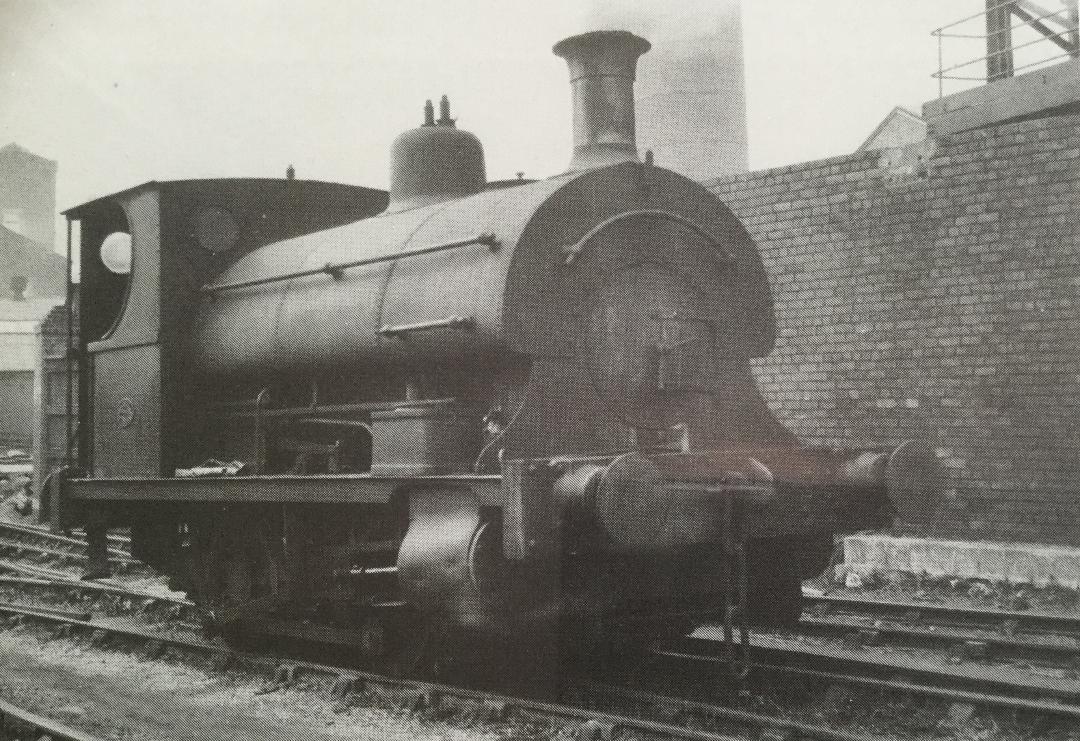
Still at Chasewater,

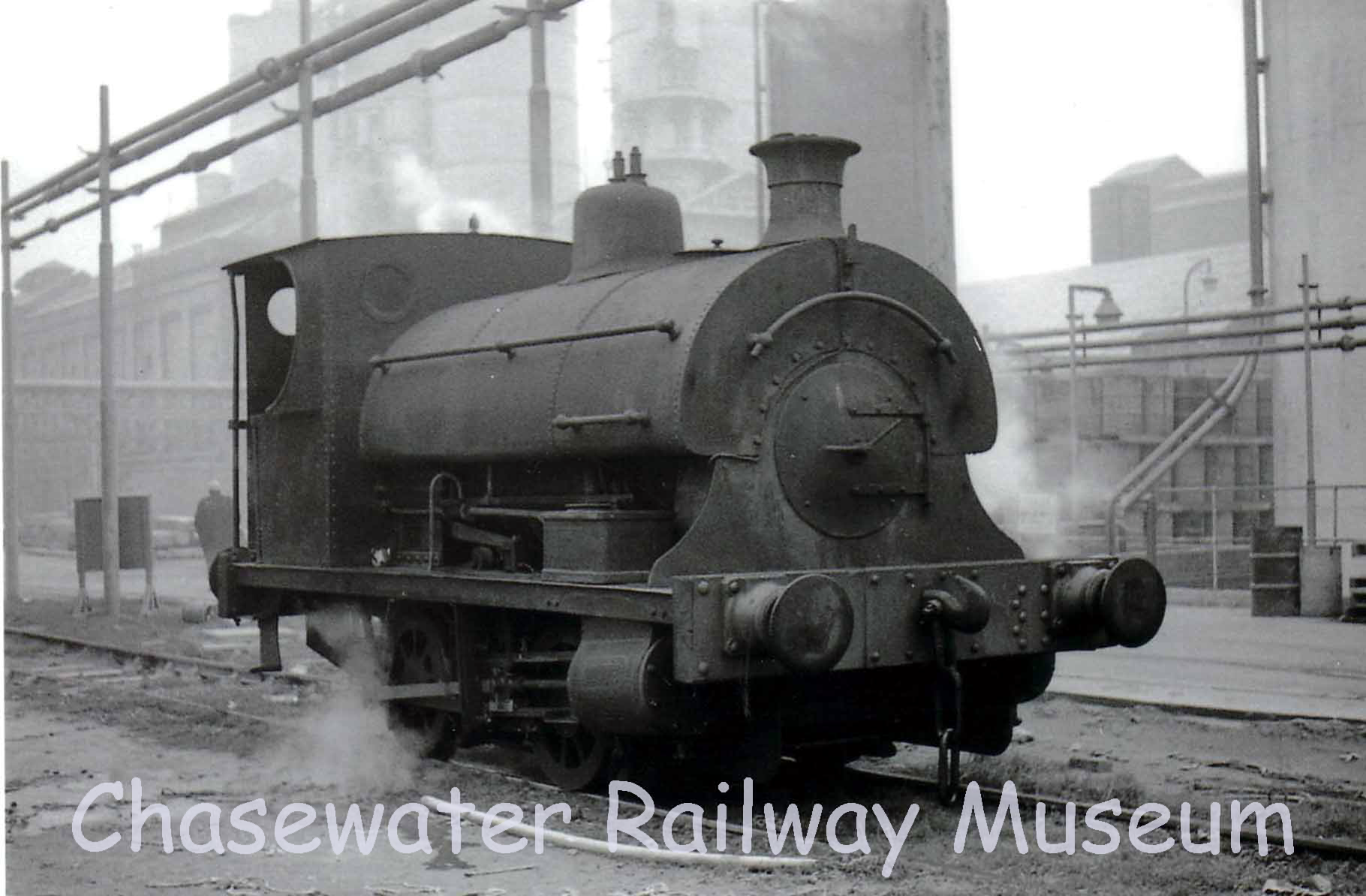
Peckett 917-1902 came from Albright and Wilson, photographer unknown.
192 – Chasewater Railway Museum Bits and Pieces

Please note – the Museum will not be open this Sunday – 23-6-2024

‘Asbestos’ Hawthorn Leslie 0-4-0ST 2780-1909 Passing the engine shed, before alterations!

Picture donated by David Bathurst

192 – Chasewater Railway Museum Bits & Pieces

From Chasewater News – Summer 1996 – Part 3

P Way News – Arthur Edwards

Since the last article was published the P Way gang has had a number of new members join us and the extra manpower has enabled us to carry on a number of tasks at a greater speed than originally planned.  This has enabled us to fence in an area next to the lower compound entrance gates, so we now have a fenced in area for the storage of rail and other heavy items of P Way material.

Also the fence from the foot-crossing between the two compounds to the bottom compound has been realigned to allow the relaying of the sidings alongside the shed road.  Work is also in progress to design the layout of a head shunt behind the current shed therefore allowing access to the shed from both ends.

Further down the line a number of fence posts have been replaced where they were broken down by trespassers onto the running line and along with bits of hedge growing up alongside is starting to make things much harder for the local idiots.  The only bit of bad news about this fencing is that we can no longer use barbed wire where the public footpaths or public areas come up to our fence.  I have mixed feelings about this as I know one or two of the members would like to use razor wire backed up with land mines!!

With the first decent spell of dry weather the perennial job of weed killing was carried out, and not before time as the track was starting to disappear beneath the undergrowth again.  It has been proposed that a further application of the poisonous stuff be applied sometime later in the summer – weather permitting.

The P Way gang meet every Sunday at Brownhills West Station from 10.00am onward.  Come and join us!!

Neilson Saddle Tank No.11 – Paget’s Progress – by Paul Whittaker

Neilson 2937/1882

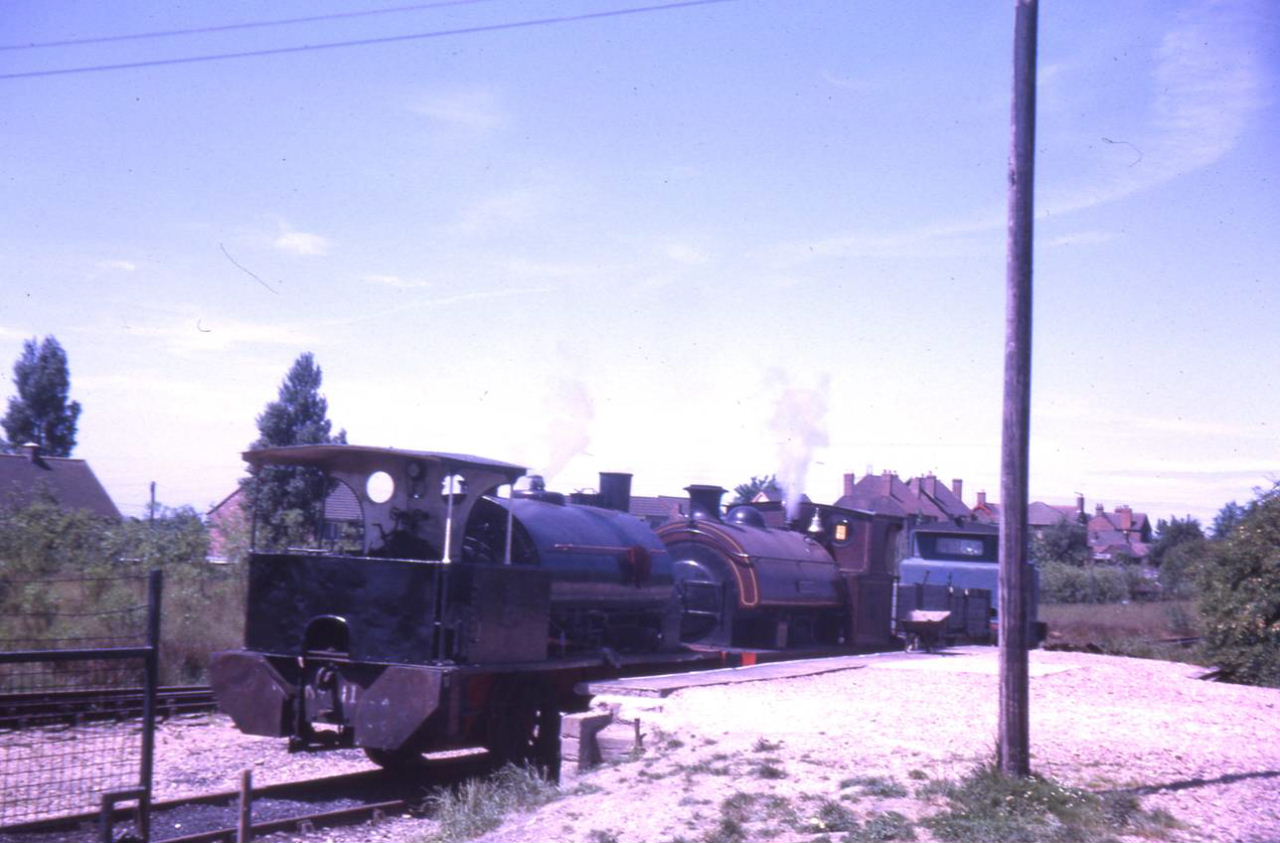
Alfred Paget at Chasewater – June 1978

On the 13th January 1996, a freezing cold morning of -5ºC, I started the hard slog of removing the boiler tubes from No.11.  After many a bruised finger and some colourful language, not to mention seven weekends at it, the final tube fell free from the boiler tube plate at 4.00pm on Saturday 6th April.

After long deliberation and much discussion I and several co-workers concluded that the next move would be to remove the water tank, thus allowing access to the boiler for closer inspection.  As the cost of a crane was as yet out of our reach, we proceeded to jack up the tank until such time as it would be possible to slide it safely down two lengths of rail to its resting place on the platform in the engine shed compound.

The next job was to remove the boiler cladding and insulation, a dirty job but it had to be done.  Meanwhile amongst the organised chaos that is generated when stripping a steam locomotive down, we removed the dome plate.  This was in order to provide access to the interior of the boiler for a very slim young man, otherwise known as Christian Hatton to get inside and remove the remaining collapsed tubes, and around 3cwt of rust.  While all this was going on, the washout and fusible plugs were removed from the firebox.  The steam cleaner proved to be invaluable in removing the rust and crud from the water jacket around the firebox.  As a result of all this, the boiler is now ready for the boiler inspector to cast a cursory eye over it a prelude to a proper test inspection.

As work progressed on No.11 that magic word ‘money’ reared its ugly head again, and after some serious consideration my very good friend and colleague David Borthwick and I decided to start a fund to raise the necessary cash to renovate Alfred Paget, and entitled the fund ‘Neilson Steam Aid’, to which my good wife Janet will administer and collect donations.  In addition to this, Dave has put together a Stock Book, which documents basic information on most of Chasewater Railway’s rolling stock and locomotives.  This booklet is on sale in the station buffet at 75p per copy.

On a more personal note, I would like to say that I am overwhelmed by the help and support, to say the least, and of the amount of technical information that I’ve received from fellow members at Chasewater, without which I would have been like a beached whale.  And so I would like to take this opportunity to sincerely thank all of those involved with the on-going renovation of Neilson Saddle Tank No.2937, otherwise known as ‘Alfred Paget No.11.

Alfred Paget last steamed in 1982, and is still a way off yet – in 2012.

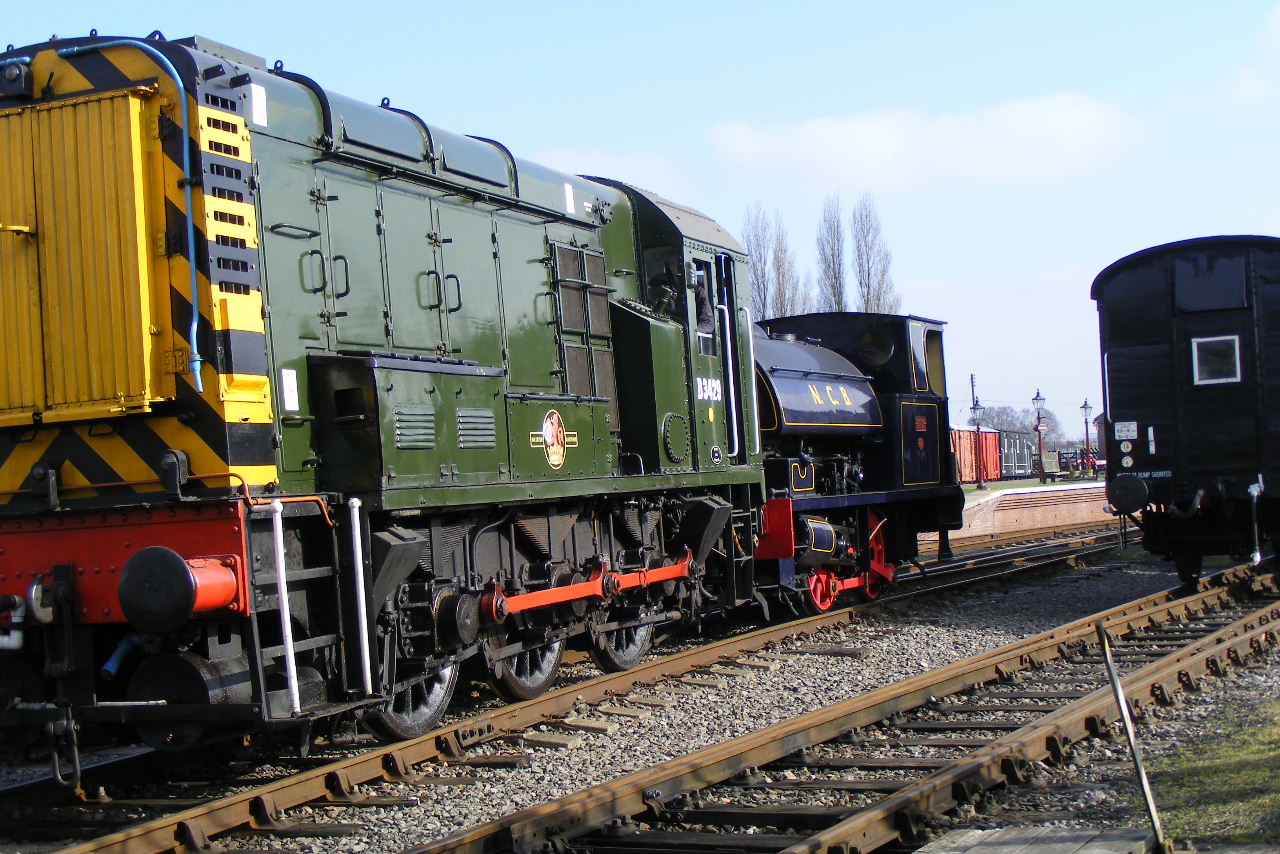
Class 08 and Bagnall ‘Linda’ 2-3-2011

155 – Chasewater Railway Museum Bits and Pieces (1993)

155 – Chasewater Railway Museum Bits & Pieces

 From Chasewater News Spring 1993 – Part 1

I’m guessing that the Editor was still Nigel Canning, with contributions from Dave Borthwick and Steve Organ.

Editorial

On the back cover of this magazine (reproduced below) is a copy of the 1993 timetable, and for the first time in the history of the CLR it is actually a timetable rather than just a calendar.  It remains to be seen whether the trains will actually run on time, or whether we can stretch the journey time to suit, but at least it will give the operating staff something definite to work to, and hopefully create a more business-like impression for potential passengers.  In addition, all the usual special events are planned for this season and will keep us all stretched to the limit.  If anyone would like to help out at any of these events they would be most welcome. 

Locomotive News

No.4 Asbestos – This loco ran successfully at Christmas on the Santa Specials, and will continue in use this year.  In order to guarantee a water supply for the loco in the event of frost, the water tower had to be put back into use, a job which required the removal of a large amount of green slimy pond weed and the fitting of two new plastic floats to the supply valves, hopefully early this year the long-missing balance pipe will be fitted to Asbestos’ saddle tank thus helping to prolong the interval between top-ups.

No.5 Sentinel – The two halves of the boiler have now been cleaned and await a visit from the Boiler Inspector when a decision will be made as to whether a new set of tubes will be required.  Work has progressed with the moving of the injector to the fireman’s side of the cab and re-routing of all the water and steam pipes to make them more easily drainable in frosty weather.  Work is also being carried out to refurbish various steam fittings which had been leaking towards the end of last year.

Sentinel – Jan 2012 – Now heading for completion of the major inspection following the one written about.  It had a good ten years running in between.

No.2 Lion – This loco is still progressing towards its first steam test with the continued manufacture of replacement pipework.  Work has also been carried out to repair a turbo generator which is to be fitted to the loco to provide cab lighting and battery charging for the coaching stock.

Work is still progressing, albeit slowly, on S100. 

S100 – 2011  A lot of work has gone into this loco over the last few years but there is still a lot of boiler work to be done.

The Fowler diesel has again remained in use on works trains throughout the winter.

Contrary to the report in the last magazine, DL7’s engine has been re-assembled and the loco run on test.  Once one or two minor faults have been corrected the loco should be able to re-enter service.

No.21 diesel and the Smith Rodley crane have remained out of use.

Carriage & Wagon News

The good news to begin with is that Ken Dyde has agreed to fill the void and represent the C&W dept until the next board meeting.  Ken has past experience working in the C&W dept on the SVR, and one of his valuable talents is that he can organise a team to tackle most jobs.  Ken lives locally and spends most weekends at Chasewater.

Great Eastern 6-wheel passenger brake – All of the doors have now been fitted, although the missing door from the end compartment has been found, 75% destroyed, which highlights the problems of past abandoned projects.  A dummy door has been modified from one, which according to Chris Hatton, came off a DMU.

Midland Box Van – Tony has continued scraping and painting.  On one side he has exposed from beneath layers of paint a red triangle not too dissimilar to the Bass Charrington sign.  Black letters are also distinguishable which could read ‘Bass Railway’.

North Eastern box van – During his winter Saturdays when not carrying out his PW duties, Arthur Edwards has started replacing some of the rotten side planking prior to repainting.

CRC (CCCC) brake van An inspection has been carried out on the rotting timbers around the spring hangers.  Use of temporary steel plate cladding will strengthen the solebars enough for the vehicle to be shunted to where more substantial work can be carried out on the 6” x 12” timbers after jacking.

In the past a number of projects on wooden-bodied stock have been started with no plan of attack or materials in stock.  Consequently, main frame timbers, vital metal items and wagon parts left scattered around the yard have all been left to rot in the open with no work being carried out for months on end.  I think all members must agree that a restoration project started on a whim should not be accommodated by the C&W dept.  In the future, any members who would like to start restoration projects on wooden-bodied stock should please request permission in writing from the Carriage & Wagon Director, who will offer all possible assistance.

Dave Borthwick

 Maryport & Carlisle 5 compartment all 3rd coach – Thorough examination has revealed a need for urgent attention to panelling.  A survey was carried out on the vehicle in January revealing almost all waist and lower panelling rotten and with very active wet rot fungus, roof galvanising starting to fail, and several doors in need of removal, de-rotting and repair.  There was only minor rot to the main frame, but soft wood noggins are in need of replacement.  Many windows and droplights are also in need of replacement or repair.  All springs need to be replaced, all running boards need to be repaired and replaced and the complete vehicle needs to be treated against rot.

The first job was to erect a tent, then a platform alongside to work from.  These were in place in late January and restoration is now proceeding.

New panels of beech marine ply have been cut and fitted for most of the lower and waist panelling following removal of most of the old panelling.  The new panelling is being treated and painted at a member’s home workshop, to be fitted to the coach after the body frame has dried out and been rot treated.  Doors will be repaired off-site to enable a rapid restoration to take place.

Manchester Sheffield & Lincoln composite brake – This lovely vehicle has had a little luck lately.  During conversation with the Butterley C&W team, it was revealed that they had recently stripped a derelict MS&L coach body and had some doors from it.  Hasty retreat to the stores and hey presto! Four doors of exactly the right profile, window pattern and size to fit the opening left in the doorway of the guard’s compartment of our own fire-damaged vehicle!  Enthusiastic fitter now required!

CRC 4 plank coal wagon – Examination of this vehicle in January revealed a completely rotten floor, some completely rotten side planks and very corroded springs.  Other than that, the frame and most of the ironwork, apart from some straps, appear to be very good.  An immediate start was made on removing rotten timbers to reveal the frame properly so that it could be dried out and rot-treated.  New side and floor planking has been acquired, and this vehicle should be coupled to the Midland box van in a resurrected state by Easter.

LNWR West Coast Joint Stock 50’ Brake – The new roof has been fitted and ventilators replaced.  New toplights have been fitted to completely seal the roof.  Much attention has been given to interior panelling, and three-quarters of the interior repainted.  Following use of the vehicle as Santa’s Grotto at Christmas, the historic displays are now being mounted, and re-opening as a museum is on line for Easter!  Repairs to upright framing and solebars will commence after the Maryport repairs are complete, and will be followed by re-panelling, subject to raising a further £500.

Wickham DMU E56171 & E50416 – These vehicles are the subject of much discussion.  At present they have a liability value in that £14,000 is needed to strip them of asbestos.  On the other hand, as a unique, working DMU they could be very useful.  Ken Dyde and his gang (The Battery Boys!) continue to work on the mechanics and body of the power car, and replacements for the missing windows are now on site, thanks to a very generous price from Brownhills Glass.

Gloucester trailer E56301 – This coach has remained out of use and would require repairs to the bodywork to be carried out before it could be used in service again.  There have been rumours that an outside party is interested in purchasing the vehicle for preservation elsewhere, but so far nothing definite has been agreed and it remains stored on No.2 road

Derby Centre Car W59444 – This coach ran in service at Chasewater for the first time at Christmas on the Santa Specials coupled to the Wickham trailer.  This looks likely to be the train formation used for the foreseeable future, meaning that the loco will remain on the ‘north’ end of the train.  The ‘blood & custard’ livery still requires top coating but hopefully this will be finished by Easter.

Steve Organ

130 – Chasewater Railway Museum Bits & Pieces Alfred Paget nearly got to Bescot – August 1990 – (Or the Not-so-Flying Scotsman) – P. Aldridge

130Chasewater Railway Museum Bits & Pieces

Alfred Paget nearly got to Bescot – August 1990

(Or the Not-so-Flying Scotsman) – P. Aldridge

BR’s ‘Bescot Open Day’ took place on Sunday, 6th May.  BR had requested that they borrow our venerable Neilson ‘Alfred Paget’ for the event.  We replied ‘yes’ but only if they cosmetically restored the engine, insured it and provided the transport.

Photo: P.Aldridge

Ian Edwards then spent many hours repainting the loco and even applied ‘No.11’ to the tank sides and buffer beams, so that the old engine looked very fine.  Arrangements were made to move the loco on Good Friday – but were then cancelled (pity no-one thought to tell me!) and re-scheduled for 3rd May.  Various Society members told the BR representative that a lifting frame would be needed and that trying to lift the loco with slings under the frames would not be permitted for fear of damaging our loco.

‘Don’t worry’ they said ‘we are professionals.’

The day arrived, and the said ‘professionals’ brought a low loader and a crane, but no lifting frame! Predictably they were unable to lift the loco, and, after six hours of struggling, gave up!

Thanks are due to Ian Edwards for restoring the loco, even though it did not get to Bescot.  Thanks are also due to Messrs. Emery, Newbold and Organ, plus a hologram of myself (I wasn’t there as I was off work sick) for organising the shunting and supervising the ‘lift’ – or lack of it!

Photo: P.Aldridge

Further thanks are also due to BR who provided the low loader and the crane.  Perhaps next time the ‘professionals’ will listen to us ‘AMATEURS’ who do, after all , have some idea what we are talking about!

Despite this disappointment it wasn’t a total waste of time, for even though our Neilson did not get to the Open Day, our sales stand did, and Mr. Bull added £200 to our coffers in a very successful day’s sales.

116 – ChasewaterRailwayMuseum Bits & Pieces – January 1988

116 – Chasewater Railway Museum Bits & Pieces

 From Chasewater News January 1988

 From the Editorial

It is eleven years since I last prepared an edition of our Railway’s magazine.  I do so now following our Publicity Director’s decision not to stand for re-election fro personal reasons.  As Company Chairman, however, I intend to act purely as a commissioning editor, so as to avoid any accusation of bias in editorial policy. Rob Curtis has also decided to stand down, as he is about to start a new job and sadly no longer has the time to be as active on the Railway as in the past.

 From the first AGM of the Chasewater Light Railway & Museum Company

The new Board for 1988/89 is composed thus:

Chairman – Steve Organ

Engineering Mgr – T.R.Sale

Operations Mgr – N.V.Canning

Commercial Mgr – B.J.Bull

Financial Mgr – L.J.Emery

Ex Officio – I.M.Newbold, A.C.R.Hall

In addition, the vacant posts of General Manager and Publicity Manager will be covered for the time being by Tony Sale and Steve Organ respectively.  Further, Adrian Hall has offered to continue as Company Secretary.

 The (lost) Causeway

Many of our members have in recent weeks expressed concern about the condition of the causeway which we hope to run passenger trains across to the far side of the lake eventually.  The problem is that some years of neglect, and very high levels of water in Chasewater, coupled with long periods of high winds causing severe wave action to erode the sides of the causeway have combined to completely breach the causeway.Our Company is powerless to do any remedial work, since we at present have no ‘Lawful Interest’ in the causeway, i.e. we don’t lease it at the moment.

Representations have been made to the local authority, Walsall Council, and at a recent meeting of the local authority’s recreation and amenities committee, the Engineer’s Department of Walsall Council were invited to make a detailed study of the problems and to investigate ways of restoring the whole of the causeway to an overall width which would allow both a Railway and a footpath to cross it.  Further, the Waterways Board have said that they will from now on abstract water from Chasewater before any of their BCN reservoirs, and also that this summer, the water level will be kept at a very low level.  This would allow for remedial works to be carried out.

One further point is that a Consulting Civil Engineer has, at our Company’s request, and without charges, examined the causeway, and suggested a relatively low-coast solution to the problem, and as soon as we receive his report, the local authority would like a copy – so perhaps all is not lost.  I hope to bring further news in the July edition of Chasewater News, but be assured that the Board are making as strong a representation as possible to Walsall Council about this vital link to Chasetown.Engineering Manager’s Report

Following a late start in 1987, we were able to run a train service for the first time since 1982, for which two locos, Asbestos and the Sentinel, and the Gloucester trailer coach were available.  No failures or serious faults occurred, although it has become apparent in this first season of continuous brake operation that improvements to the system can be made by relatively simple alterations to the system.  This work, along with annual maintenance, is now being carried out in readiness for the 1988 season, for which initially the same locos and coach will be used.

Work on four privately owned locos is currently being carried out on site, and their owners continue to put in a great deal of work on the Railway as well as their own locos.  The most likely of these to be steamed first is No.2 ‘Lion’ probably followed by No.7 ‘Invicta’ or No.3 ‘Colin McAndrew’.  Please feel free to come and see work in progress on these on any Sunday.

One priority job for the loco dept in 1988 must be the fitting of vacuum brake gear to one of the diesels to enable trains to be run on non-steaming days, and to provide cover in the event of a steam loco failure.  The cost of fitting this equipment, about £250, would be easily covered by the train fares taken on the event of ‘opportunist’ train operations i.e. where lots of people are in the park and we are not scheduled to run trains.

Another project for 1988 is the repair and restoration of the Wickham Trailer car.  This will allow us to run two-car trains for the first time, and doing so will allow us to generate extra income through the opening of a bar car, will give us extra braking power on trains, and will allow us the luxury of a spare coach in the event of a failure.

The coach is in basically sound condition, but requires seven new windows, and the doors require stripping and re-building.

Extension News

On 7th March, I formally applied to British Railways Board for License to operate passenger trains over the section of line from Willowvale Bridge to the Causeway.

The application to BR followed the purchase of the land from BR by Walsall Council, which was completed in November last.  Our Company’s predecessors bought the track on the land some years ago, but the Council slowed down the procedure of buying the land when our group ran out of steam in the early eighties, and only revived when our New Company breathed new life into the Chasewater Railway Project in October 1986.

Because we bought the track, BR gave us permission some years ago to maintain the formation of this section of line, so we very recently carried out work on the bridge, so that if BR give us the license we need, we can very rapidly move on to the section: I would feel we should be running trains along this stretch within 9 months of possession, to maintain the impetus of development of the line.  Steve Organ

 Civil Engineering

Work in this area has been concentrated in the last year on maintenance and simplification of the trackwork, incorporation of the Railway Inspectorates requirements, such as the installation of trap points, Annets locks, fencing, etc.  Whilst this work may seem tiresome, it is part and parcel of the business of running a railway and allows us to operate in confidence and in SAFETY.  We are fortunate in the field of trackwork to have over the last year, gained a member, Chris Chivers, with experience and enthusiasm for p-way work (when he’s not setting things on fire).

We have also to thank Mr.J.L.Townsend, M.I.C.E., who has recently undertaken an inspection of Willowvale Bridge, and provided a formal report and detailed specifications for remedial work to it, work which is likely to be largely complete by the time you read this.

In view of the progress made in the last year, we are now making detailed plans for the future.

108 Chasewater Railway Museum Bits & Pieces – Autumn 1985 – 4 and 109 – Chasewater Railway Museum Bits & Pieces From ‘Chasewater News’ April 1986

108 Chasewater Railway Museum Bits & Pieces – Autumn 1985 – 4

Another true anecdote in the series of an excerpt from the Chasewater Fat Controller’s diary.  Date line Sunday, 24th March, 1985.

It was about 2 o’clock on a relatively mild afternoon when four men and a dog set off from 21G Hednesford Road to replace stolen chairs from the loop.  The freshly greased bearings on the trolley ran easily on the falling gradients towards Norton, with Hairy Youths dog bounding along the four foot a couple of yards in front.

Once over the facing point, the going became much harder as the ever helpful Task Force (remember them?) had dug the ballast out between each sleeper so the dog was having to negotiate ten inch high hurdles, two foot six inches apart.  Finally with the leading axle of the trolley rapidly closing on his right ear he decided he had had enough and leapt over the rail to his right – a split second too late.  ‘Klunk, klunk, klunk – yelp, yelp, yelp’.  The fully laden trolley had run over his back leg leaving a six inch tear in his flesh.

Having bitten his owner and growled at everyone else in range the dog was loaded onto the trolley and sent back to Brownhills West Station where the ubiquitous Spitfire was waiting to take him home. That evening, Nurse Gillian is reputed to have taken the dog to work and rebuilt him bionically – this dog now has a starting tractive effort of 17,000lbs in full gear at 85% boiler pressure and may be used to work passenger trains when we get a Light Railway Order.

The cover photo shows CLR No.11, the Neilson now known as Alfred Paget, shunting near Brownhills West on a special steaming on Saturday, 17th April 1982 for the Industrial Railway Society.  Photo by Mike Wood.  Good timing as the Society was at Chasewater again only a few weeks ago (2011).

109 – Chasewater Railway Museum Bits & Pieces

 From ‘Chasewater News’ April 1986

Our late friend, Mick Doman, preparing to take ‘Asbestos’ out from Brownhills West, Easter 2007.

 News from the line

 Loco Dept.

Asbestos and the Sentinel both performed satisfactorily at Gricers’ Day and both have undergone further work during the winter months.  Asbestos has had the vacuum brake finished and the regulator has been the subject of much attention due to its tendency to remain open when shut!  The Sentinel (alias No. 59632) is being fitted with vacuum brakes and its water feed pump has been completely stripped and rebuilt.  Both engines will be test steamed prior to the Transport Extravaganza in May.

On other fronts, No.6 the Albright & Wilson Peckett needs the extension to its smokebox takeplate replacing due to the severe wastage, as well as replacement of some of the rivets which fix the takeplate to the boiler barrel.  It could be that the boiler will have to be removed from the frames.  Tony Sale is progressing with overhauling the axle boxes of S100 and it is hoped that re-wheeling will take place soon.  The small Andrew Barclay has had a patch let into the side of its firebox so progress should speed up once several stays have been renewed.Sentinel Feb 2004 – Nigel Canning

On the diesel front, No.21 has had its engine removed to enable Colin Marklew to piece together a decent working engine from this and the two spare engines that we possess.

Task Force

Like the Phoenix, from the rubble of Brownhills West has arisen a splendid new platform which was 90% finished before the West Midlands County Council was abolished at the end of March, and the Task Force left Chasewater, supposedly for good.  However, at the beginning of April they reappeared under the guise of Wolverhampton Task Force to finish the job and to complete the drainage of the station site.  The Society is left with the job of removing the remaining rubble and fashioning a track bed adjacent to the platform before the Wickham buffet car can be installed.

Motorway Madness

Just as the railway is recovering from the enforced siesta that it has enjoyed since 1982, comes the news that the infamous North Orbital Route (as an alternative to the crumbling M6) is to plough straight through Chasewater, in fact, it is likely to plough straight through the new platform at Brownhills West!!  This of course is a major blow to the intended development of the park, not least the railway.

Despite the likelihood of a public enquiry it is almost certain that this ‘preferred route’ (out of nine possible options) will be built, construction not due to start until 1991.  As it will be some 12 to 18 months before detailed plans are published then the Railway will have to have its own plans ready to make maximum use of any compensation it is eligible for.  The main options open to the Railway are:

  1. To forget it all and disperse the collection
  2. To move lock, stock and barrel to somewhere else
  3. To move Brownhills West some 200-300yards down the line
  4. To move operations to the other side of the lake.

The executive committee have appointed Messrs. Hall and Patterson to investigate the feasibility of these and any other options and to find out what the chances of gaining compensation are.

“431 Hudswell Group”

At the Chasewater Light railway Society AGM on 13th November a resolution was passed empowering the Executive Committee to sell the Hudswell Clarke Locomotive No. 431 of 1895 to a consortium of Chasewater members and others.  A price of £2,500 was agreed upon provided that the locomotive would remain at Chasewater.

All this led to the formation of the “431 Hudswell Group” which is offering 25 shares in the locomotive at £300 each.  This covers £2,500 for purchase, leaving £5,000 for restoration.  An easy payment scheme has been set up whereby prospective shareholders pay a minimum of £5 per month per share. (There is a maximum shareholding of two shares per person) and to date 18 shares have been taken up.  Each shareholder will be issued with two certificates:

a)    When £100 has been donated representing 1/25th of the purchase price – i.e. 1 share – and

b)    On completion of restoration work to certify ownership of 1/25th of the locomotive.

No heavy restoration work will take place until the CLRS has been paid in full for the locomotive and there is enough money available to allow restoration to proceed unhindered.

Late News – A deposit of £500 has been paid by the 431 Hudswell Group to the CLRS.

Catering News

No doubt you will have read elsewhere about Gricers Day.  However, from a catering point of view it was both good news and bad.  The good news was that we literally sold out of everything and had to send out scouts to locate further supplies.  This resulted in the maximum profit being made.  The service went well except for the bottleneck around the hatch and doorway, and everyone drank the tea and coffee so it couldn’t have been too bad!

However, running the kitchen is hard work and we would not have coped except for volunteers who turned up who are not Society members via the Hon.Sec.  Thanks go to all concerned.  For future occasions if they are not available, ordinary members will have to be rostered for these duties, as the money raised by this service will be essential.  Other Societies have learnt that they can increase their income considerably by offering an efficient service and although none of us joined to make tea and wash up, this is part of the price you pay to see the engines running again and to keep them running.

Barry Bull is again providing sterling service on Saturdays and Sundays to members and the few brave souls who appear during the winter months.

On November 17th we ran the first ever “Chase Diner Train”, which taught us a few lessons – we must be mad!!  However, despite a few obvious points such as the gap between courses and lack of heat in the vehicle, it went reasonably well considering it had never been done before.  Apart from a longer cooking time than anticipated, due to overloading of the electricity supply, it proved what can be done when we are fully organised and better equipped.

Remember – help support our project “Eat, drink and be merry”.

Re-organisation Committee Report

We are still dealing with the Charity Commissioners who require more information than previously thought and so this is taking longer than expected, though there should be no problem in having the new Company set up by the Autumn.  Meanwhile, the Re-organisation Committee (gang of four!) are working hard to ensure a smooth changeover when the time comes.

The management structure was agreed at the last committee meeting and consists of seven Director Offices covering the main area of the business – the sub-board structure being a matter for the Directors to determine later.  The intention is for seven (of the possible maximum of ten) Directors to be elected to office concurrent with their election as Directors at the AGM.  The offices are:

  1. Chairman  (usual duties and to ensure Directors pull in one direction – the one the members want).
  2. General Manager  (control, planning, budgeting of on-site work).
  3. Engineering Manager  (ensuring that the Railway meets the Inspector’s requirements).
  4. Operations Manager  (rue book, staff training, rostering and timetabling).
  5. Commercial Manager  (sales, catering, etc., planning of rallies).
  6. Marketing Manager  (marketing the Railway, including publicity and advertising, magazine and public relations).
  7. Financial Manager  (treasury, liquidity and cash-flow management, budgetary control system, VAT/Revenue).

Association of Railway Preservation Societies  (ARPS) AGM25-1-1986

For the first time in over four years the Society sent a delegation to an ARPS meeting, this year’s AGM being held in London.

The only really useful part of the meeting was a talk by Major Olver of the Railway Inspectorate on various current problems facing the preservation movement, certain aspects of which were discussed in a private conversation between Major Olver and the CLR delegation (Steve Organ and Adrian Hall) after the meeting.

The need for agreement between railways and private owner stock was raised which is something the CLR will have to look at before we recommence train operations.  The Annual ARPS Award was intended for BR for organising the Marylebone – Stratford dinner trains but as they are ineligible – not being members of ARPS you understand – the Award was given instead to the owners of the engines used on said trains.  As the Award is supposedly for an outstanding contribution to the Railway Preservation movement, there were surely better qualified contenders such as the KWVR for the splendid restoration of the unique Haydock Foundry built ‘Bellerophon’;Bellerophon at Caverswall Road, Foxfield Railway

City of Truro at Hampton Loade

the SVR’s restoration of ‘City of Truro’; the North Norfolk’s Gresley buffet car; the Llangollen Railway’s extension to Berwyn, etc., (or even the CLR’s nine year restoration of ‘Asbestos’!).Berwyn Station on the Llangollen Railway – and the former Chasewater Wickham.  Hondawanderer.com

The Best Preserved Station Award went to the SRPS for Boness Station.  This is interesting in that it is not strictly a preserved station, being an amalgam of various Scottish station buildings brought in from other sites.  Enquiries were made to see if Brownhills West would be eligible – apparently it would so we shall have to see what can be done in the future!!  – Any (sensible) ideas are welcome!

Chasewater Transport Rally Report

Sunday October 13th not only brought a return to steam to the railway but also the largest event held since the last Transport Scene in June 1982.  It was also one of the warmest days of the year!  A total of 129 exhibits were in attendance, ranging from buses to stationary engines.  As organiser of the event it was a great pleasure to realise that although we may have gone through bad times over the past three years we have certainly not lost our friends in the world of preserved vintage transport.  Thinking back to the original Transport Scene organised by Andrew Louch in 1977 when we had about 70 exhibits over a summer weekend, who would have thought that an October day eight years later would see almost double the number of exhibits and sales stands with free admission and still enough money raised on sales stands, our own refreshment and miscellaneous sales to make a healthy profit.

Aside from the obvious thanks to all the exhibitors who attended and members who assisted on the day, I would like a special vote of thanks to be accorded to Angela, the two Sues and Tim – all non-members who were coerced into helping out in the Wickham buffet.  It is fair to say that without their help profits would have been minimal as most of the profit came from refreshment sales.  The day’s refreshment sales realised £165, by far the highest achieved in the Wickham in one day.

One spin-off from the event was our first major publicity in the railway press for years, with photos of the Sentinel and/or Asbestos appearing in ‘Steam Railway’, ‘Railway Magazine’ and ‘Railway World’.  We were also featured in the Lichfield Mercury and shortly afterwards a photo of the ex-Walsall Gasworks Sentinel appeared in the Walsall Observer.

Chasewater Transport Extravaganza

Yes, another transport event is in the formative stages.  A group of enthusiasts headed by our friend Peter Magee of Lichfield are hoping to organise a weekend event in the Park on May 17th – 18th.  Admission will be free and they hope to cover costs by selling trade space and by means of donation.  An enjoyable informal event is promised and will include guest appearances by up to half-a-dozen steam traction engines.  Any profit made is being donated to the Chasewater Light Railway Society.

The unique 1957 built Wickham & Co Class 109 DMU (50416 & 56171) pulls away from Berwyn station on 26 June 2010 with the 16:50 Llangollen to Carrog service, during the Llangollen Railway’s Railcar Gala. The station occupies a very restricted site, next to the main Llangollen to Corwen road, and perched high above the River Dee.

Chasewater Railway Museum Bits and Pieces No.93

93 Chasewater Railway Museum Bits & Pieces Autumn 1979 – 2

Loco Department

As it’s the end of a decade, a complete rundown of locos is given.

Invicta’  AB 2220/1946The loco was kept in reserve at the start of the season and was not steamed until June 10th and then chose to run hot!  As there was only two weeks to go before Transport Scene there was much gloom and despondency around as well as a fair amount of bickering.

The offending bearing was the rear driver’s side axle box and this was duly removed following sterling work by those stout fellows Messrs. Hames and Luker.  Inspection of said bearing revealed the cause of the trouble.  It was a well known fact that during her latter years at Chatham, ‘Invicta’ had been fitted with a brand new rear axle and someone had obviously forgotten to cut oil grooves in the bearing brass, leaving only two small holes to lubricate the axle – not very good – especially as one had got blocked leading to overheating so bad as to actually melt the bearing surface.

Swift alterations to the bearing saw the loco back in service within four hours and the loco has performed without trouble ever since.

‘Invicta’ is undoubtedly the loco to be used at the start of the 1980 season, following the annual boiler test.

‘Alfred Paget’ N 2937/1882The ancient Neilson has performed without trouble all season and is now awaiting its hydraulic test, after Christmas, which will entail the removal of the saddle tank and boiler lagging and cladding.  As its firebox has overcome its leakage problems it would seem probable that the boiler test will be passed without too much trouble.  The opportunity will be taken for a thorough repaint and perhaps even new boiler cladding sheets will be provided to replace the current motley collection.  There is every confidence of the loco working next season – the loco’s 98th year in fact.

‘Asbestos’ HL 2780/1909This loco has been the centre of great activity this year with up to seven people working on it at one time – unheard of before!.

The loco is completely dismantled and a thorough mechanical and cosmetic job is being done to ensure trouble-free running when it resumes earning its keep.

The boiler was lifted out of the frames in June and was finally despatched to Park Holland Ltd. of Hanley on August 12th.  It now seems as though the firebox repairs will be of the welding and riveting kind rather than uplifting of the foundation ring, following a further examination by our tame boiler inspector.  The boiler is said to be ready around Christmas time which will ensure plenty of work in the New Year.

Following the removal of the boiler the motion was completely taken down, followed by jacking the frames clear of the wheels to enable the wheels to be rolled out.  Removal of the wheels has enabled a thorough paint job to be done on the frames, at present five coats have been applied with at least one more to follow.  To enable all members to feel part of the restoration team a couple of carriage and wagon tappers were roped in for a paint session (only undercoats of course!) though with the onset of stormy weather they have been despatched back to their rightful place fending off the bitter easterly winds off the workshop area.

Removal of the wheels will enable tyre turning to take place, probably at Bridgnorth.  The valves and motion have had attention with reassembly following, as far as the lack of wheels will allow anyway!  Whilst Brian has been busy machining the regulator valve to allow greater use of the steam produced.  All concerned with the restoration of the loco are confident of seeing it in steam next year.

‘The Colonel’ P 1341/1914The hydraulic test was passed in July, followed by refitting of the boiler cladding and lagging since when not much has been done save for the two Bobs (and others) finishing off the new coal bunker which looks rather fine.  Providing the tank can be repaired the loco should see service next year.

‘Peckett’ 917/1902No work has been done on this loco apart from routine preservative maintenance, but the situation should change once ‘Asbestos’ is back in traffic, as it is the next loco due for ‘works’ treatment.

Hudswell Clarke 431/1895Following a relatively ‘light job’ on Peckett 917 the ‘old Hudswell’ should get the full treatment though this is probably a good 18 months away at the moment. (32 years and counting!)

Andrew Barclay 1223/1911

This loco is in a presentable state at the moment but needs heavy boiler and firebox repairs before it can steam again – pity as the mechanics are in first-class condition.

’S100’ HC 1822/1949

The loco migrated into the compound and the boiler received a coat of paint, since when nothing, – where are you, Tony?

DL7 (RH 458641/1961)Once the loco was cajoled into action after removal to Chasewater it has proved to be a fine acquisition and it is to be hoped that the CLR Co. will have sufficient funds to buy it off the STEPS scheme.

Apart from working 5 days a week it has proved its worth on shunting duties on steam days, as well as hauling a couple of passenger trains on Gricers’ Day.  Once its future is secure the NCB green will disappear under a coat of CLR livery of some colour or another.

Others

Of the two Bass-Worthington diesels, No.21 sees occasional use whilst No.20 is rumoured to be going off on loan to the Bass Museum, Burton-on-Trent, which will be a useful advert for the Railway and give us a bit of room.(It went and is still there, 2011)

The two No.1s are performing sterling work as a stop block on ‘Three Road’ whilst various people mutter darkly about getting them going again.

Whilst on the subject of infernal combustion it must be mentioned that Bob Curtis has offered to paint No.21 as the Society is 21 years old next year.  Well done that man.

Carriage & Wagon Department

He DMU trailer coach has performed well as usual but the paintwork is now in need of some touching up, especially around the windows – so hopefully this will be done before it gets worse as, having seen similar coaches on a North Yorkshire Moorland Railway, it wouldn’t be advisable to wait too long.

Messrs. Pearson and Curtis have been busy painting the ex LNWR TPO and nailing panels back onto the Maryport and Carlisle coach.  We are hoping they will move onto the LNWR full brake after finishing the TPO as the paint is fast peeling off.

John Elsley is busy rebuilding the fire-damaged brake end of the ex MSL six-wheeler and it is looking better with every panel.  The only other item to receive attention has been the Great Western brake van which should get repainted during the New Year, following some welding to the platework which is rather thin in places.

johntisdale50@gmail.com

Chasewater Railway Museum Bits and Pieces No.87, Gricers’ Day.

Chasewater Light Railway

Gricers’ Day

8th October 1978

In recent years the final steam day of the year, on the second Sunday in October, has taken a different form from the normal twice-monthly summer season steaming.  Amongst popular attractions with photographers has been the freight train run pasts at intervals during the day and this will again feature.The success of the first steam spares and tools sale held at Chasewater last February has prompted the organisation of another similar event to coincide with this ‘Gricers’ Day’.  The idea of the sale is to provide an avenue for preservationists to get together, discuss mutual problems and conduct exchanges or sales of parts and tools surplus to their own requirements, but perhaps much sought after by other preserved lines.

Alfred Paget with Asbestos and one of the Kent Construction diesels – 1976

At least two locos will operate during the day – ‘Alfred Paget’ built by Neilson & Co., Glasgow (works no. 2937 of 1882), the oldest loco regularly at work in the Midlands, and ‘Invicta’ built by Andrew Barclay, Sons & Co. Ltd., Kilmarnock  – 2220/1946.  It is likely that one of the two Kent Construction diesel locomotives will also see use during the day, as well as the 5-ton capacity Smiths of Rodley diesel crane (formerly steam powered).The ex Cambrian Railways Merryweather fire pump will also be steamed and a 1929 ex West Bromwich Corporation single decker bus has been booked to attend.

Merryweather Fire Pump

Apart from the Chasewater Light Railway Society sales stand which enjoys a good reputation locally for reasonably priced Railwayana, we would ask you to support the other stalls attending today; at the time of writing these are expected to be Mercian Model Rail, selling both new and second-hand model railway items and who also enjoy a reputation for fair prices, Walsall Railway Museum and Winchcombe Railway Museum who specialise in relics, the Princess Elizabeth Society who are in urgent need of funds for re-staying their famous LMS Pacific, and finally the Worcester Loco Society who carry a reasonable range of books.

We hope that everyone attending has an enjoyable and interesting day out, perhaps even an amusing one – how about a real ale tombola for instance?

For those wishing to partake of liquid refreshment, opening hours are 12.00 – 14.00 hours, the nearest hostelry being the Pear Tree Cottage Inn (Ansells) on the Hednesford Road where excellent cheese flans, etc., can be obtained, or the White Horse almost adjacent to the A5 road heading south which serves an excellent pint of Banks’.

Review of the Year

The year has been both happy and sad for the small but faithful band of followers of the Chasewater Light Railway, January was a disastrous month as vandals broke into the compound and set fire to our former Easingwold Railway MSLR coach, completely burning out the brake end and destroying materials contained therein, as well as partially damaging the exterior of the LNWR brake third which thoroughly deserves the nickname ‘the football special’.  Our grateful thanks go to the Transport Trust who have granted the Society £275, being approximately half the cost of materials needed for renovation, although this cannot take into account the number of man hours needed to restore the vehicle.

Following the fire, thought was given to moving one or two of the wooden bodied coaches elsewhere for safekeeping, but as the obvious answer lay in providing covered accommodation at Chasewater this matter was pursued with renewed vigour and two buildings have since been acquired.  Both are of agricultural type – one has been dismantled and removed to Chasewater; the other, larger, building has still to be dismantled.

New arrivals during the year included S100, a Hudswell Clarke 0-6-0T No.1822/1949, privately owned and previously preserved on the Yorkshire Dales Railway, Embsay.   The loco is presently being dismantled to enable firebox repairs, de-tubing and wheel turning to take place.  The whole project will probably take another three years to complete (still counting!).

5263 P 0-4-0ST 917-1902 Albright -Wilson Peckett

Through the kindness of the Directors of Albright and Wilson Ltd., Peckett 0-4-0ST, 917/1902 arrived on loan together with coal, 27 spare boiler tubes and various tools.

The day following the arrival of the Peckett saw the arrival of the Smith’s of Rodley 5-ton diesel crane, a purchase from the Mersey Docks and Harbour Board, Victoria Dock, Birkenhead.  The crane’s first job on arrival was the lifting of the two tanks off S100.

To enable the purchase of the BR owned 600 yards of double track immediately beyond our present operating limit to be effected, the former LBSCR E1 loco was sold to the Lord Fisher Loco Group, Cranmore (see previous post). The monies from the sale of the loco together with that put aside from donations, etc., has given the railway a financial security never enjoyed previously, although this will be greatly depleted when the £5,400 purchase price of the track is paid.

Current projects include the erection after repair of the former Manchester Ship Canal water tank, and the preparation of the oil-fired Peckett (The Colonel) for a major boiler examination.  The Hawthorn Leslie ‘Asbestos’ is being de-tubed and the boiler sent away to Park Holland for the raising of the foundation ring about four inches to overcome the problem of badly wasted corners at the bottom of the firebox.  A complete retube with tubes purchased earlier this year will follow.

It is hoped that the Chasewater Light Railway Company will be able to take advantage of the Government Special Temporary Employment Scheme whereby lads of nineteen plus, out of work for a period of at least six months can be employed and paid their wages by the Government.

1979 promises to be a year to look forward to and it is to be hoped that some of you visiting us today will return again next year.

Chasewater Railway Museum Bits and Pieces No.77

Chasewater Railway Museum Bits & Pieces 77 – June 1977

The Railway Preservation Society Newsletter

Chasewater News 20

The Editorial pointed out  that the more active members of the RPS are just getting over the ‘Jubilee Weekend’ to be straight away flung into the run in to the ‘Transport Scene’ weekend – the same dozen or so have to carry on the normal operating season as well!  There followed the usual appeal for more help, but explained that ‘if the response to this appeal is the usual one, then I’ve been wasting my time, but unless we get more active support then the Chasewater Project will go backwards, not forwards, and disillusionment will set in amongst the members, ending in the folding of the RPS in the not too distant future.  I’m not being alarmist but unless we are able to purchase the loop line then the active membership will be decimated and that is fact, remember ‘Bridge that gap – buy a Yard of Track’.

News from the line

There’s been plenty going on at Chasewater since the last report.  On the locomotive front ‘Invicta’ passed its boiler and steaming tests and is in the final stages of a repaint, whilst ‘Alfred Paget’ carries on regardless, being smartened up in between steamings. ‘Asbestos’ has had its tank jacked up and boiler lagging removed in preparation for an ultrasonic boiler test, which will ascertain what, if any, repairs are necessary.  Depending upon what the result and cost is, it will be reassembled as a static exhibit or be returned to traffic, hopefully the latter.

The DMU vehicle has been professionally repainted in maroon livery at great expense.  It is to be lined out and have transfers added as and when time permits.  The repainting of this vehicle has, in my opinion, been the greatest step forward taken by the railway for some considerable time.  The interior of the vehicle is to be refurbished during the wintertime.

The extension to the platform continues and the lever frame is being installed with associated interlocking and track improvements.

Stop Press: it is hoped to acquire Hednesford No.3 signal box to house the lever frame, negotiations with BR are underway.  The station has been improved by the installation of two gas lamp standards and a few cast iron signs to give a more business like appearance.  The present terminus will be named ‘Brownhills West’ on completion of the platform.

Further up the line much packing and levelling, along with spot sleeper replacement, has gone on in order to finish off the present stretch of line and to give a smoother run.

Operating Days

As you may realise we are chronically understaffed on operating days with the brothers Curtis performing sterling work in the bookstall as well as being the usual guard/ticket collector crew and managing to be in three places at once.

Train receipts are down on last season, mainly due to the inclement weather of our operating days.  Easter Monday has been the most successful day, over 700 people taking a journey.

Over Jubilee weekend, another RPS first was notched up, with trains being run on the Sunday, Monday and Tuesday, all being hauled by the Neilson locomotive ‘Alfred Paget’.

No.11 Neilson 0-4-0ST 2937-1882 Taken at either Bedlay or Gartsherrie, still working for a living!

Receipts were poor and the Tuesday steaming was done mainly for good public relations, 93 people from the Hednesford Road street party being given free rides to strengthen relations between the railway and the local people.  This has also resulted in a good publicity plug, as we were the only railway to run in conjunction with a street party.

The TPO roof is now watertight and re-panelling of the sides will take place in due course, whilst its tarpaulins have been placed over the LNWR 3rd brake coach in order to hide it as it continues to fall apart!

The GWR brake van has suffered at the hands of some juvenile delinquents who set fire to it.  Fortunately damage was confined to the verandah but restoration will not be speedy unless someone volunteers to take it on – outside of the usual workforce.

Chasewater Light Railway Company notes

The Kraken hath awoke and the first AGM for eighteen months was held in April.  The Board are now trying to formulate future policy for the railway in conjunction with the RPS Committee and hopefully sensible plans will emerge in the next few weeks, details of which will be placed in the newsletter for members’ comments.

Track Fund

Only £120 has been raised so far, a pathetic reflection upon the concern about the future of the Society by the members.  Money is needed now as time is running short.

E1 Fund

Most of the money so far raised has been spent on advertising.  If you feel you can contribute anything to this fund contact us.

The locomotive has been inspected by Messrs. Barlow of Warrington, a reputable firm of boiler makers, who have given an extremely reasonable set of quotes for repair of the locomotive boiler.  Time is running short if this locomotive is to remain at Chasewater as the AGM two years ago instructed the committee to dispose of the loco as a last resort to buy the loop line, and unless someone pumps a hell of a lot of money into either the E1 fund or the track fund, then the Society will have to face what seems to be inevitable – the loss of our only ‘local engine’ which is also  our only ‘main line’ loco, and the  most interesting of all our locos.

Notes from Barry Bull Hon. Sec.

The arrival of a complete 7¼” gauge railway, with a steam loco, heralded a possibility of something being in steam every Sunday at Chasewater this summer.  Unfortunately the loco blew its superheaters on a trial steaming and has been relegated to a static display.  The loco is based on the Southern Region ‘Schools’ class of loco and was one of a pair built in 1934 and so is a worthy exhibit in its own right.

Items purchased or donated during the past few months include an LNWR ‘Beware of the Trains’ sign, a concrete GCR boundary post, a few items of LNER cutlery, a selection of Kent & East Sussex Railway paper work, a Wemyss Private Railway rule book and a sign of LMS origin.

Transport Scene July 23/24

Rapid developments regarding this event have taken place and the organiser sent the following note for inclusion:-

‘This event is aimed at raising money towards our track fund and towards giving our railway a publicity boost.  This is perhaps the most important event to have been organised by the RPS so far, so I would have thought that some of our armchair members would have offered their services to our already hard pressed stalwarts.  However, this does not appear to be so.  In fact, so far, I have received only three offers of help.  We are in our most critical year, which could literally make or break our Society, so please, please help us, even if it is only in a small way’.

‘Chasewater News’ is written by Ian Patterson, typed by Dorothy Ives and printed by Rob Ives.

Chasewater Railway Museum – Bits and Pieces No. 76

Chasewater Railway Museum Bits & Pieces 76 – April 1977

The Railway Preservation Society Newsletter

Chasewater News 19

Editorial

With the operating season nearly upon us, it is becoming increasingly obvious that the same few regular volunteers will be responsible for the operation of the railway during the coming season.  Appeals for extra help during the closed season have had the usual minimal response but the usual crowd have ensured that the railway will reopen as scheduled on the 10th April.  In many ways the RPS is the Cinderella of the operating preserved railways, but it reflects great credit upon the dozen or so people who have turned up week in, week out, enduring rain, sleet and snow, that we have entered our sixth season of steam-hauled services, which promises to be our most successful yet.

Locomotives

Pride of place must go to the ancient Neilson ‘Alfred Paget’.  Although built as long ago as 1882 it passed its steam test on 17th March with flying colours.  This was the result of much hard work by the engineering department in re-machining parts of the motion, which had earned it the nickname of ‘shake, rattle and roll’ in some circles.  The planned repaint for the Neilson has had to be delayed due to the adverse weather conditions.

‘Invicta’ the Andrew Barclay saddletank has passed its visual inspection and now awaits re-assembly of cab fittings, etc., and then a steam test before re-entering service again.  Its owner is still threatening to complete its restoration by giving it a uniform coat of Great Western green!

Unfortunately ‘Asbestos’ repairs are beyond our financial resources at the moment and so it has been put to one side until we have the necessary cash.

The next major locomotive job is to strip the Peckett 0-4-0ST ‘Lion’ in preparation for its major hydraulic test.  The two Worthington diesels have had repairs as and where necessary and are both serviceable at the moment.

Lion in 1978 with ‘Colonel’  Plate

It is pleasing to report that the Company are financing a complete repaint of the DMU trailer coach by a local firm of contractors, in the early stages of the season.  The expected final livery is grey roof, crimson lake bodywork and black underframe and running gear.  Great progress has been made with regard to trackwork with the construction of a point for a siding at the crossing.  This took less than a month despite the fact that the recently restored petrol crane broke its main shaft whilst lifting the first piece of rail into place.  Several crossing timbers were obtained by our general manager at a bargain price.  Ballasting and packing has been completed, considerably eased by the use of the tractor and bucket scoop, kept in trim by Brian Hames.

The footings of the lever frame have been laid.  The necessary walls should be built during Easter week, enabling the platform to be extended to its full length.

Other work carried out on site has been mainly in tidying up in preparation for the coming season.  A scrap drive resulted in a load of scrap being sold to bolster the Society’s coffers.  The sale of the engine out of the scrapped J4 van realised £25.

The Travelling Post Office has been partially re-roofed, with more to follow to make it water-tight again.  Re-panelling of this vehicle is to commence when the weather becomes drier.

The visit to South Yorkshire area of the Coal Board 9mentioned in the last Newsletter) was not entirely unsuccessful, as, although we failed (only just) to obtain the locomotive ‘Beatrice’, the Hon. Sec. was successful in obtaining many locomotive spares, notably boiler tubes and firebars from Rockingham Colliery.

Stroudley E1 Locomotive Centenary FundNo.110 Southern No. 4

Not a lot to report this month, but ads in Railway Magazine have been paid for to counter the apathy amongst Society members.  A rather neat handout has been produced and is obtainable.   Certain preservative work has been done on the locomotive and a repaint is planned before the high season.  More help and money is urgently needed for this project to succeed.

Track Fund

Negotiations within Walsall Council continue and a final decision is awaited.

The Chasewater Light Railway Company has awakened from its apparent siesta and a general meeting will shortly be arranged.

Meanwhile all members are urged to take up the offer of buying a yard of track, as the success of this fund will decide the fate of our Society.  Albert Haywood is the person to contact regarding the track fund and every £10 donation is certified.

Museum

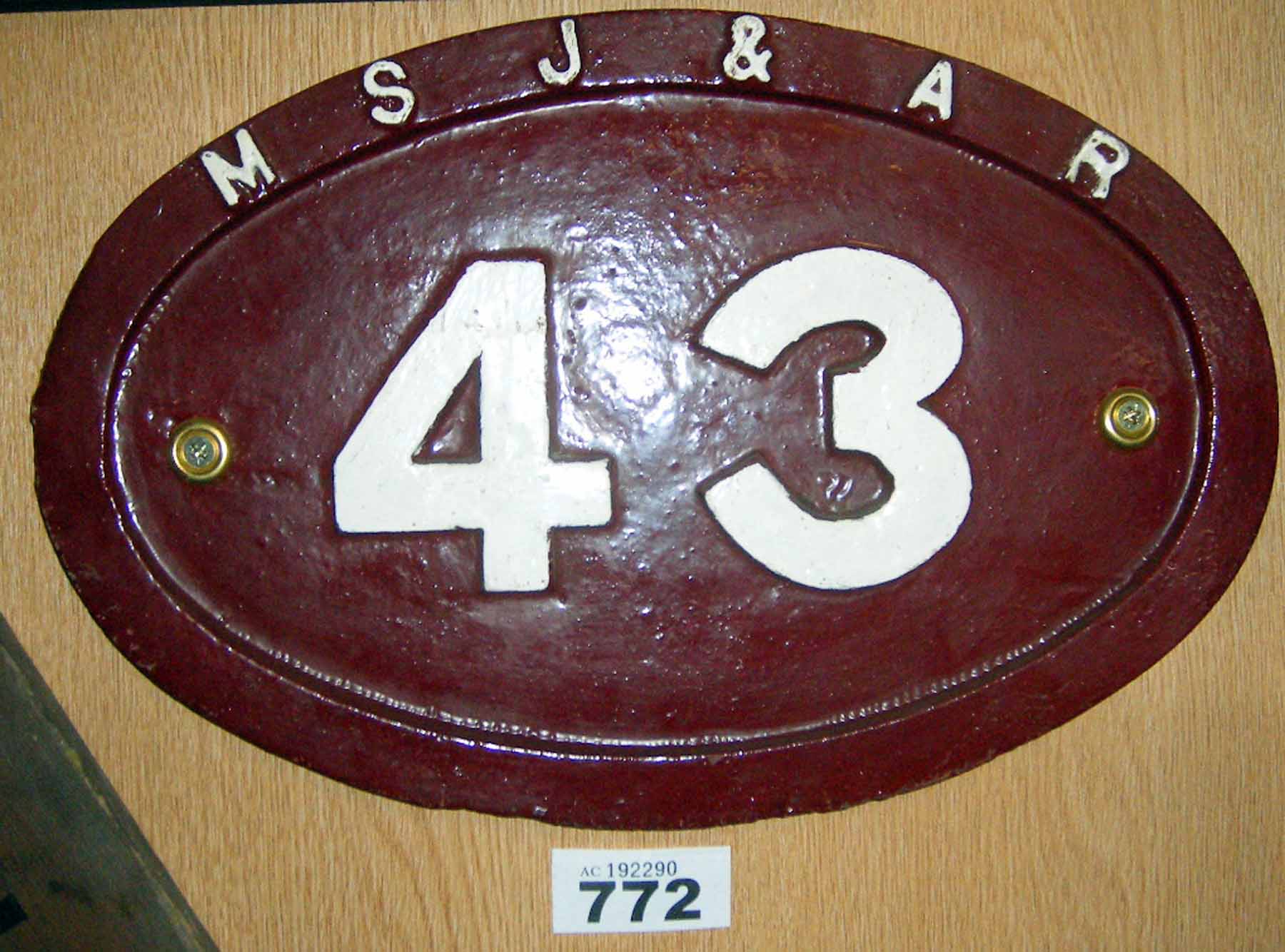
Thanks are due once again to Mr. Clift of Chase terrace, who has donated a 25 ton locomotive jack, once used in the Central Workshops at the far end of our line, and a pile of magazines for resale.  On the museum front latest acquisitions have included a Great Western and Midland Railway joint cast iron notice and two very nice bridge numbers of Manchester South Junction and Altrincham and West Riding and Grimsby Joint origins.  Smaller items include a GWR paycheck, an LNWR (Walsall) paycheck, an LNWR 1894 handbill, LSWR carriage blind, a small GWR cream jug complete with crest and six LMS tickets, mostly from the Brownhills area.

The March meeting was a slide competition and there were close on 100 entries of varying quality, though every entrant had at least one slide in the last twenty.  The competition was won convincingly by Nigel Canning’s photo of ‘Asbestos’ taken from within the dark confines of the cab of the Hudswell Clarke.