Tag Archives: Cannock

150 – Chasewater Railway Museum Bits and Pieces

Please Note –  The Museum is closed next Sunday, 18-6-2023

150 – Chasewater Railway Museum Bits & Pieces

From Chasewater News Autumn 1992 – Part 3

Carriage & Wagon News

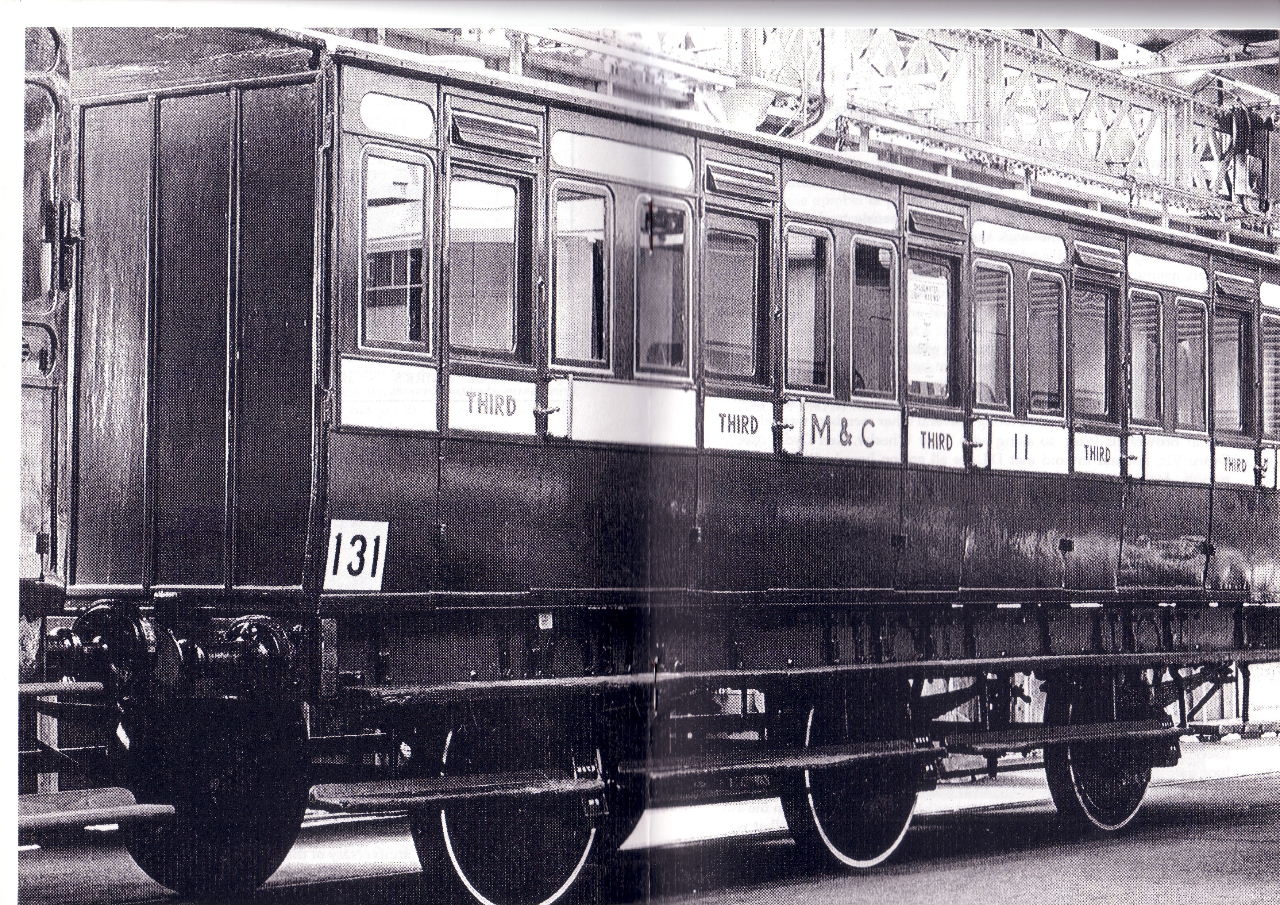
Maryport & Carlisle six-wheel coach – During early May Keith Day uncovered the coach from its winter wraps to find no further deterioration has occurred.  He then fitted small plastic sheets to deflect the rain from the missing windows.  Work was also carried out to make doors and windows fit on the other side.  All seems to be intact now, but on close inspection every coach panel was suffering from weather rippling due to the use of plywood, and I’m afraid that even a coat of paint couldn’t make this vehicle look any better.

Midland four-wheel Passenger Brake – This vehicle remains sheeted up awaiting attention, but strides have been made for attaining roof timbers from Butterley.

Manchester, Sheffield and Lincoln six-wheel coach – This coach has remained sheeted up for some time.  John Elsley unfortunately hasn’t been down to see us recently.  ‘Are you well John?’ Please contact us.

16 ton Great Western Toad – Repainting the visible end of this vehicle has helped the appearance of this trusty tool van.

CCCC (CRC) Brake Van – The flooring has been prepared and painted, but the theft of valuable plywood sheeting from underneath the vehicle has put Keith Poynter back several months.  Members please note not to leave items around the yard.  Lock them up either in the C&W shed or conceal them in the coaches, otherwise they will get used for other projects, burnt or stolen.

Wickham Trailer E56171 – Due to the loco changing ends this season, a rather shabby cab end has been exposed on this vehicle especially when the train enters the station n the return journey.  For the day of the transport rally a hurried black, red and maroon coat of paint was applied, producing a better result.  A cab front window had been fitted a few weeks earlier, so all isn’t too bad.

Wickham Power Car E50416 – Again great steps have been made towards the restoration of this vehicle.  In April, after a major shunt of the station yard, the power car ventured down through the platform under its own power and the reversed onto No.2 road where work on the interior, brakes and exhausts is being carried out.  When stuck for details and internal components fro the brake air receiver bypass valve, Andy Clegg and Chris Hatton visited BR Tyseley and were given everything they needed.  Our thanks to all those concerned!

Derby Centre Car W59444 – During March and April much work was carried out to get this coach into reasonable condition externally, all be it in engineering grey.  Through three weekends of rain and sun the seating upholstery was vacuumed, the floors mopped and windows cleaned, however a management decision was made to put the Gloucester back into service.  Since then work has resumed with Dave Whittle pink undercoating and rubbing down for top coats.

Gloucester Trailer E56301 – This vehicle has remained in service with the Wickham Trailer to form the passenger train.  Initially this was necessary as the Railway Inspectorate had not given permission for the loco to propel the train from the northern end.  Permission was, however, eventually received and on Monday May 4th the loco changed ends.  Since then the Gloucester seems to have remained in service instead of 59444 as originally intended.

Maunsell Southern Brake Van 62861 – This vehicle has received attention from two of our new members, Helena Day and Kate Rogersin, in the form of painting the side visible from the park.  After preparing one side and the two ends, members may be surprised that a 5 litre tin of undercoat was used just to cover them.  Work on this vehicle had to be suspended in May due to a pair of blue tits nesting between the panelled sides.

Great Eastern six-wheel passenger brake – The doors have had their frames undercoated and painted, with slide windows fitted when possible.  A recent trip to the East Anglian Railway was to determine the outside panel design, but variations from 1876-1895 contrasted quite considerably.  It appears that a number of such vehicles were constructed at the Birmingham Carriage and Wagon Works under contract from either Holden or Wordsell.  If anyone has details or photographs of this or any vintage GER coaches please contact Dave Borthwick.

Midland Box Van – During another wet weekend this vehicle was tidies up and has now become our spare sparks van where our electrical equipment can be stored.  As many of us will appreciate, cable, switch gear, starter motors, etc. must have a secure home.  Repairs made good the detached sliding door by the addition of a new top runner and bottom door support bracket.

Cadbury Van – this vehicle has been tidied up internally by ‘righting’ the two fallen diesel engines which had been stored in there.  This will give clearance for Chris Hatton to inspect each engine in turn with a view to restoring No.21 to working order.

16 ton Mineral Wagon – This has been prepared and painted in grey top coat by Arthur and Tony.  Numbers and markings will be researched and applied shortly.  This vehicle, which is currently standing on No.1 road siding gives the railway a touch of its origins, and also shields the rusting parts of S100 from the public gaze!   Dave Borthwick.

The Peak Rail Jolly Boys Outing

During May, early one Saturday morning, the twin steer Bedford ‘Fair Spares’ coach drew to a halt in Brownhills West station yard, and so began a very enjoyable day at and around the Peak Railway.

A few of us remarked on the £3 return ticket price on the railway for a trip to Matlock (Riverside) in the middle of nowhere and back.  At the CLR you can travel all day on our train to nowhere and back for half the price.

 There was one pathetic occurrence that happened with all the natural beauty of the Peak District hills, dales and river walks, with the delight of art and craft museums everywhere, the depraved few, namely the PW Gang, Catering and C&W Depts all homed in with no prior arrangement, on the nearest boozer – where silliness began!

Thanks to Sue and Les, and the driver who kept us laughing with his ‘Murphy’ tapes.   Dave Borthwick

149 – Chasewater Railway Museum Bits and Pieces

Chasewater Railway, including the Sidings Tea Room, will be closed this coming weekend, the 10th and 11th of June 2023, due to the Staffordshire Iron Man Competition.

149 – Chasewater Railway Museum Bits & Pieces


From Chasewater News Autumn 1992 – Part 2

Permanent Way News

Track Update – Keith Day

Work on the track is progressing well.  On most Sundays there is a regular crew working at the end of the line.  Timbers recovered from Hams Hall have already been used in extending the track.  In mid-July we calculated that we were only nine 60ft panels away from the causeway, and since then several of these have been laid.  Work has been made easier by the professional way in which we use the JCB and in Ian Buswell’s skill in driving it.A view of newly laid track on the extension curving towards the causeway bank.  A comparison between this photo and the one in the previous post reveals the fantastic improvement made during the first half of this year.

If anyone reading this article would like to join the permanent way gang, if only for an occasional Sunday, we would be pleased for you to come and join us.  Just ask for Les Emery or Arthur Edwards at Chasewater, or phone the station or just come along on any Sunday.

Willow Vale Bridge

Work on the metalwork has been completed with the addition of ”Chasewater Steam Railway” painted in large letters on the road side of the bridge.  Tony Wheeler and Arthur Edwards have cut back the trees and undergrowth compassionately before the nesting season, and now the railway has come alive to the many people who pass that way daily – another case of free advertising!

Brownhills West Station News

All weather working with power tools can now be accomplished safely following the installation of RCCBs (Residual Current Circuit Breakers) on all the power circuits at Brownhills West.

Adrian has almost finished the lighting on the station platform following his success with the shunters’ cabin, public loos and bric-a-brac stall.

We can be seen from the other side of the park now!In preparation for the spring and summer season a tidy up was needed around the station site.  A number of things have consistently offended the eye, such as the abandoned signal post once sited on the platform, but recently cut down on instruction from the Railway Inspectorate.  It was too heavy to lift very far, and too big to hide, so the ideal thing to do was to raise the damn thing.  A hole was dug; bull-head rail was pestered out from around the site and drilled to form two bracing pieces which were fixed to the base of the post.  The next week with the help of Keith Day, Ken, Larry, Dave whittle, Andy, and Paul Whittaker, and with no help from the rain we arrived to find our hole full of water.  With a rope on each side of the signal top (maypole-like) we heaved and stood the signal erect.  Newton’s gravitational theory nearly took effect on two occasions, but with frantic assembly of the other two bracing pieces of bull-head rail, and Paul Whittaker arc welding them into position, all became steady and perpendicular.  The signal mechanism can now be operated from just above ground level.

Turf was planted around the base and is now growing profusely.  Total cost of the project was just the welding rods supplied free by Paul Whittaker, but the main thing that was achieved was the free advertisement of the signal arm being visible from the other side of the park.

Donation boxes are a feature at most railways and bring in a modest income to fund various projects.  The chimney from our Peckett 917 was rusting away on its saddle tank, but painted and planted on the station it offers a home to our passengers’ nuisance change.

Can members think of ideas to utilise any other railway components?  Perhaps our modellers could show off their engines in a glass case where a donation could power the driving wheels to show off the workings.  We must amuse the mums and dads and kids as well as the rivet counters!  Pennies into Pounds!!

Dave Borthwick 
Meeting with Walsall Council – David Bathurst

A number of CLR members will have been aware of correspondence from Walsall Council instructing the railway to stop work on track preparation and re-laying and certain remedial works to repair the breach in the causeway.  It was suggested by the Council that the railway required planning permission for its works, and that the railway might be acting against the various nature conservation designations (SSSI & SINC) within Chasewater Park.

The Council’s ‘instructions’ caused some concern to the working members.

However, a meeting was quickly arranged between the Council and representatives of the railway, at the Council House, Walsall, on 14th May 1992.  Steve Organ, Les Emery and John Selway represented the railway, with the meeting both convened and chaired by David Bathurst – who was faced with the dilemma of having a foot in both camps!!

The meeting proved to be immensely satisfactory from the railway’s point of view with the Council conceding early on that the railway is in fact in possession of all the necessary planning permissions to carry out its immediate future programme.  It seems that the Walsall Council did not have on its files a copy of a very important planning consent granted in the 1970s by its predecessor planning authority, Staffs County Council, which fortunately was able to be located within the railway’s records.

Perhaps more important was the clear impression gained from the Council’s Officers that they wish to assist, and not obstruct, the railway in its proposals, while at the same time offer advice as to how best proceed in the best interests of preserving the environment.  Indeed, a meeting took place on site a couple of weeks later, when Steve Organ and others enjoyed a high-speed programme of plant recognition.  It should not be construed that the railway can do what it likes because certain future projects may well require planning consent, but at least proper lines of communication now exist between the railway and the Council.

In conclusion, the need for a good working relationship between the railway and the Council cannot be over-emphasised.  What could have been a confrontation resulted in exactly the opposite, thanks to a professional presentation by the railway’s representatives and good will on the part of the Council’s Officers.  At least on this front, the future looks good indeed. – David Bathurst

Vacancy Filled

Of the three posts recently advertised, the best job has already gone!  The successful applicant for the position of Company Treasurer checks the takings following Transport Scene.  Such youthful enthusiasm!!  Whatever happened?!

Is that really Chris Chivers??

148 – Chasewater Railway Museum Bits and Pieces

The Museum will be open on Sunday 28th and Monday 29th May 2023

148 – Chasewater Railway Museum Bits & Pieces

From Chasewater News Autumn 1992 – Part 1

Editorial – Nigel Canning

Work on the railway is still progressing well and the number of volunteers has increased to the extent that even on our busiest day, Transport Scene, there were still people working on the new extension, and on carriage restoration.  As if to reflect the amount of work going on, even this issue of the magazine contains a few extra pages.  If all goes well, the Railway Inspector will be asked to pass off the line for passenger running to the causeway early next year.  If YOU would like to help on the track or in any other department on the railway, please come along – you will be most welcome.

Locomotive News

No.4 Asbestos – This loco is almost ready to return to traffic on a regular basis.  A couple of steam tests have been carried out, and a number of minor leaks corrected.  A small amount of finishing off is now required, such as fitting of the new saddle tank balance pipe and the extension of the buzzer wiring to the front buffer beam.

No.5 Sentinel – This has remained the only steam loco in service and has run well.  The problem of rust from the superheater blocking valves has been kept under control by regular inspections and cleaning.  The loco will need to be taken out of service before Christmas for its 5 yearly major boiler examination.

No.2 Lion 

This loco has passed its hydraulic test, and boiler fittings and pipework are now being fitted.  The boiler has been lagged, the cladding sheets fitted and the tank lowered into position.  Work is now being carried out to align the tank mounting brackets.

S100 – Work is continuing on the hornguides, and new fitted bolts have been made to secure them to the frames following machining.  The boiler has been unloaded from the flat wagon and is now in the loco shed yard where the shell has been cleaned and painted.The boiler from S100 is lowered into its new position in the loco shed yard.

Fowler – This loco is still running well and is in regular use.  Work has now begun on machining the various parts required to fit the loco for working the vacuum brakes on our passenger stock.

DL7 – Work is in progress on cleaning the cylinder heads and re-seating their valves ready for the engine rebuild.

No.21 Diesel – Work has concentrated on the two spare engines for this loco, the best of which may shortly be refitted to the frames

Smith Rodley Crane – This vehicle has remained out of use.

Bass Community Award – Keith Day

In the early part of this year, a poster appeared on the notice board at work saying ‘Bass Community Awards’ open to employees who are involved with a charitable organisation.  Now being a volunteer on the permanent way gang at Chasewater, and an employee of Bass, Mitchells & Butlers, both conditions were met, so I applied for an application form and sent it to the address stated on the poster.

A week later the application form appeared on my bench at work, and, after a lot of thought, I filled it in and with it wrote a potted history of the CLR.

In it I told briefly of the construction of the railway in 1860, and of how Chasewater Light Railway has been at Chasewater for 25 years, and of our plans to relay the track across the causeway and around the far side of the lake.  To do this we need money to buy materials to replace badly rotted sleepers, and rail which has staggered joints or had been criminally taken away for scrap.  I also wrote of what had already been achieved – the re-laying of the track to extend the running line, the repairs to Willow Vale bridge handrails to allow passenger trains to run over it, and finally, the passing of the extension by the Railway Inspectorate for passenger carrying trains.  The application was posted and almost forgotten about, until, on 24th April, a letter came through the door. I opened it up and read:

‘Bass Community Awards’

‘Further to your recent application for consideration under the above scheme, I am pleased to advise you that your organisation, Chasewater Light Railway & Museum Co. has been successful and has been awarded £300.  Could you please contact me on the above telephone number in order that we can discuss details of the cheque presentation.’

I telephoned the said number and arranged a date for the presentation at 7.00pm on Wednesday 27th May.  After a lot of thought and discussion, it was decided to use the £300 award to pay for the transport of redundant track materials from Hams Hall Power Station on 26th May.

Chris Chivers, Andy Clegg, Chris Hatton, Adrian Hall and myself, with ‘DJ’ Geoff running a shuttle service in his van were the crew who went to Hams Hall to load the trackwork, while Steve Organ, Arthur Edwards and others stayed at Chasewater to receive and unload the lorries.  Unfortunately, things did not run to plan, and what was supposed to be the first load at 9.00am departure from Hams Hall was in fact 6.30pm.  The second load arrived late afternoon on the 27th – the day of the presentation.

As it happened, this worked in our favour as Janice Clarke, PR Officer for Bass, and her photographer were able to take a picture  of the last load, unloaded with Yours Truly presenting the cheque to Chris Chivers, while Steve, Arthur and Chris Hatton posed in the background.  (Working for Bass is just like working at Chasewater – if you want anything done, you have to do it yourself!).  The picture and story were released to the press and appeared in the ‘Express and Star’ on 15th June.What we recovered from Hams Hall were: 4 sets of points, a rail drilling machine, 1 buffer stop complete, a number of point timbers, 2 point levers, some sleepers, rail, chairs and numerous other materials.

A small buffet was given at Brownhills West on the occasion, and I would like to thank Bass personally for their award of £300, and also everyone who took time to turn up on the 27th.

The Bass awards are an annual event, so if anyone has a suggestion for next year, please let me know.

115 Chasewater Railway Museum Bits and Pieces, January 1988

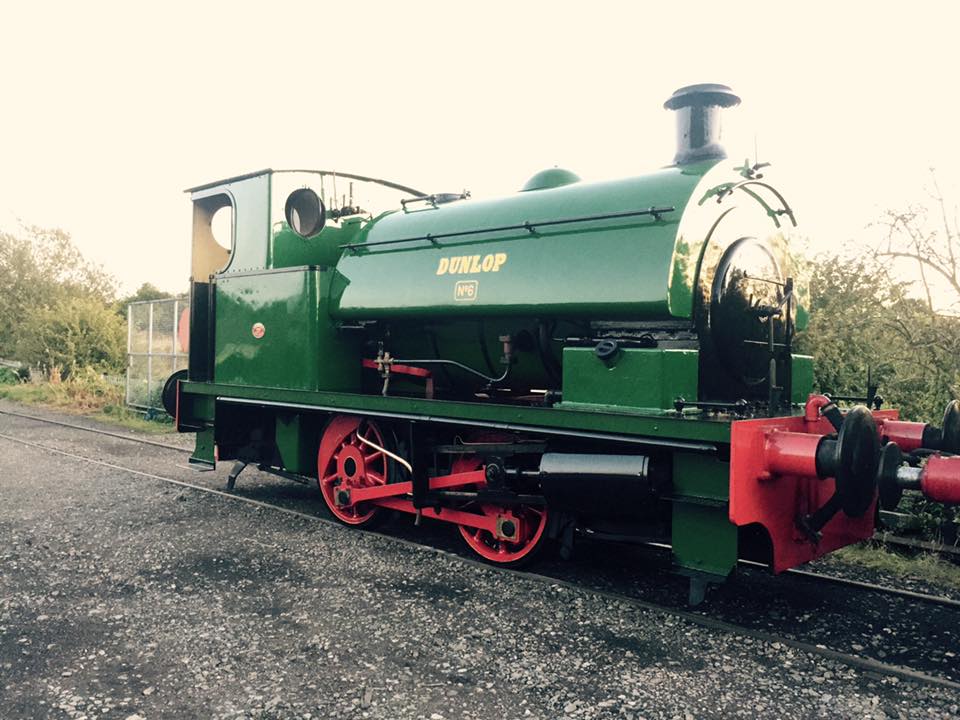
Our latest picture of my personal favourite Cannock Chase Colliery Loco, Sharp Stewart No. 6, 2643/1876,  complete with ‘tender’.  Nothing to do with the post but I like it!

115 – Chasewater Railway Museum Bits & Pieces

 From Chasewater News January 1988

 This Newsletter is issued with the annual membership renewal form.  If you do not renew your membership you will not receive the next magazine, due out in time for Easter.

The photographs included are those of Bagnall 0-4-0 ST 2648-1941 in various liveries.

Boardroom Notes

The Chasewater Light Railway Co. Ltd. AGM was held in the expected ten minutes.  The accounts for both the Company and the Society are being brought up to date and a Society AGM will be held shortly.

The Chasewater Light Railway & Museum Co. Annual Report is currently being compiled for distribution in early February, with the CLR & M Co. AGM being held at Brownhills West Station on Saturday 5th March at 2.30 pm.

Some progress has been made on the office/shop development though more work is still needed.

On the motorway front, the Public Enquiry is expected to begin in mid-April and will take about eight weeks to hear 1,500 objections to the scheme, 75% of which centre on the proposed development in the Chasewater area!

Anyone interested in joining the Board should contact the Company Secretary.

Membership Report

The renewal form for those whose membership is due on 28th February is enclosed with this Newsletter.  Please complete it NOW, not in two months time.  We need the membership money now to complete our Winter work programme.  Failure to renew will deprive you of the Easter edition of Chasewater News and the opportunity of helping on operating days.  All train crews, station staff and other helpers must be members for insurance purposes.

News from the Line

Trackwork – Work on the point connecting 2 & 3 roads is almost complete with 3 road re-connected to the rest of the railway whilst 2 road is at present being relaid.  It is hoped to construct the southern end of the run round at Brownhills West during the year – weather, manpower and materials permitting.

Engineering – Work is in hand to finish the equipment demanded by the Railway Inspector’s last report, namely Annetts Key locks on point lever frames, facing point locks and level crossing gates as well as several minor items.

Rolling Stock

It is hoped to restore and refurbish the Wickham trailer car so that it can be used to form a two coach train set for steam hauled services this season.  Extra help for this work would be most appreciated as would finance for the internal refurbishment and re-glazing required.  Use of the Wickham trailer with its ‘bar’ facilities will enable on train catering to be attempted and help increase our profit margins on operating days.

Extension of Services

The Railway inspectorate have given us provisional approval to extend services to the bottom of the causeway bank, now that this land is owned by Walsall Council, who are prepared to lease it to us, (i.e. the end of the former BR owned section of line) providing a license is obtained from British Rail.  (This license will enable us to extend services whilst a Light railway Order for the whole of the Railway is obtained).  The Railway Inspectorate is prepared to let us propel trains over this length of line initially, providing an extra coach is used to increase braking power, hence the urgency in getting the Wickham trailer ready for services.  However, run round facilities will have to be installed as a matter of some urgency.  Extension of services can only take place when the aforementioned license is granted (work on obtaining this is under way) and when the relevant track is brought up to standard as well as the necessary fencing and ancillary fittings.  Hopefully extended services can begin during the 1988 season provided the necessary work is done.

Extension of the running line will give us a chance of running services from somewhere to somewhere (Brownhills West to Norton East/Willow Vale Halt?) for the first time, as well as giving a decent length of line for our engines to show their paces.  It is hoped to build a platform at the ‘end of the line’, enabling passengers to walk up to the lakeside and view the increasing variety of wildfowl which reside upon the lake as well as enjoying the chance of using the north side of the lake which is grossly under-used and inaccessible at present.

Since 1971 (when diesel hauled services using Nos. 20 & 21 started) the CLR has patiently awaited the day when services could be extended – at last the opportunity is within our grasp – with your help it will happen this year!

Looking to the future, Walsall Council are planning to undertake a full survey of the causeway with regard to rebuilding it to a suitable width for railway and footpath and are concerned about the ‘massive erosion’ caused by wave action due to British Waterways Board keeping the lake level too high.

Mutual Improvement Classes

A series of classes are to be held during late February and March and all members wishing to take part in train operations in the coming season are urged to attend as only participants will be considered for future footplate and station duties.

The course will consist of the following subjects:

  1. First Aid
  2. General Safety
  3. Footplate Management
  4. Railway Operations at Chasewater

Although there is of necessity a certain amount of technical content, much of the course is based on common sense and is of a basic nature.

During the season further practical instruction will be given to any members new to the operating side of things.

Bagnall Linda in action – leaving Chasewater Heaths for Chasetown Church Street with Our late friend Mick Doman driving.

Chasewater Railway Museum Bits and Pieces – No.97

Chasewater Light Railway Society

1982-1985

Newsletter January 1983

News from the line

Loco Shed

The loco shed is now completed and the engineering department has taken up occupation.  At present the shed houses the Sentinel 4wVBT, MSLR 6-wheeled coach and Asbestos.

The shed was built with the aid of a Manpower Services Commission Youth Opportunities Programme under the direction of Derek Cartwright. Unfortunately the scheme overspent by a sum well into four figures.  Whilst a small sum was inevitable on the end of the final scheme, the size of the present liability has to be met by the Company is of particular concern to the Directors.

West Midlands County Council Task Force

The Directors have chosen this as a means of achieving further developments at Chasewater, in the light of experience with the loco shed.  A special thanks goes to John Selway for getting the scheme off the ground.

The scheme is exclusively devoted to improving trackwork and associated facilities to a standard acceptable to the Railway Inspectorate.  This will entail the relaying of the track on the entire length of the line and the construction of a run round loop at Brownhills West Station. A material grant of £10,000 is available which has been earmarked for the purchase of rail and concrete sleepers.  Labour is provided by WMCC, who are also responsible for day to day administration.

Work on this scheme will shortly begin in earnest, with progress dependant on the weather conditions during the coming months.  This work will commence before the 1983 running season and it is likely that the running season will not start at Easter.

Asbestos

This loco will operate the first passenger train in 1983, after its prolonged overhaul is completed.  The loco will emerge in a new blue livery and will be fitted with vacuum brake equipment, which is a necessary feature of all future working locos.

Society members are currently working on the loco which is the first priority, ahead of the striping for boiler examination of the Sentinel.

That is the end of the Jan 1983 Newsletter, and considering the piece which follows, mainly taken from the history of Chasewater Railway, they really didn’t know what was coming!  There were no passenger trains from October 1982 until Spring 1985.  And, just as a matter of interest, ‘Asbestos’ in blue wasn’t a success either!

The Society had been proud to be represented at the Stockton & Darlington 150th celebrations in 1975 by the restored Maryport & Carlisle coach, but by 1982 things were not going too well at Chasewater. Vandalism and theft were rife, especially during the time when a Manpower Service Commission programme had been engaged on construction work for a new engine shed and some track work.

The Railway effectively closed in October 1982 when a miserable wet Saturday saw just two fare-paying passengers carried on the last train of the day. Although no trains were to be run for the foreseeable future, it was decided to soldier on behind the scenes as a Society. However, further problems occurred during a West Midlands County Council Task Force Scheme the following year when, after construction of a bay platform to accommodate the museum coach, the remainder of the platform was demolished by the Task Force – who then failed to return to rebuild and extend the platform as promised, for nearly 18 months.

It was not until 1985 that regular steamings began again, but in the intervening three steam-less years, membership had dropped by some 50 per cent. The Society deemed it necessary to prune its stock as it was realised that without an injection of cash, the whole affair might fold. The L&NWR Travelling Post Office went to Tyseley; a small “Planet” diesel went to Brian Roberts’ Tollerton Farm Railway, while individual members purchased two steam locos and one diesel loco in order that they could remain safely at Chasewater.

Working membership fell to single figures, but that small band succeeded in rescuing this early standard gauge preservation scheme from the brink of extinction. Subsequently, as described later, a new company was formed in 1985 – the Chasewater Light Railway and Museum Company – and achieved status as a Registered Charity.

Chasewater Railway Museum Bits and Pieces No.88

Peckett No 917

88 Chasewater Railway Museum Bits & Pieces

Chasewater News No.25 – November 1978 – 1

Editorial

This Newsletter is somewhat late but is somewhat lengthy, reflecting the great progress being made these days at Chasewater.  Unfortunately to progress one has to be somewhat ruthless and differences of opinion result in some people opting out of active roles and it is extremely unfortunate that several people have resigned this year as the railway is, after all, primarily a leisure activity (though I’m beginning to wonder!) but that’s life, I suppose.

However, the end of 1978 finds the Society in perhaps its strongest position ever, especially with regard to finance.  The money for the line is at present in the building society, earning interest, as the sale of the land and track to Walsall Council has been held up by technicalities, again, purchase not being likely until the New Year.

1979 promises to be a year of great strides forward, especially with the STEPS scheme and the realisation of re-opening the railway, if all goes to plan.

The Committee and the Board are all firmly convinced that the Chasewater Light Railway has got great potential and the past two years, and the resultant changes, have been essential to enable that potential to be tapped.  There is now a greater degree of professionalism about the railway which is essential as the railway expands – you cannot ’play trains’ on two miles of standard gauge railway.  Despite all these changes the railway is still great fun and the active members amongst us derive a great deal of pleasure from it and that alone justifies its continued existence.  I am sure that the amount of fun will increase along with the size of the railway.

Dave IvesIt was with a good deal of sadness that Dave Ives stepped down as President of the Society at the recent Annual General Meeting.

Dave Ives on the left – in front of one of the Worthington diesel locos, early days at Chasewater.

Dave was present at the inaugural meeting of the Railway Preservation Society at the Station Hotel, Stafford, in October 1959 and holds membership number 2.

He was Secretary of the Society from 1959 till 1968 and has been on the Committee until his recent resignation.

In recent years he has been in disagreement with certain policies, notably the sale of the ‘E1’, which others have seen as being essential to the continued progress of the railway.  I personally feel that this is in part due to a change in emphasis on the railway – away from the original static museum concept and towards a fully operational Light Railway.

Having only been in the Society since 1972, I scarcely feel qualified to comment on Dave’s contribution to the Society and to the preservation movement as a whole.  Perhaps it is sufficient to say that the Chasewater Light Railway is testimony to the belief of those people present at Stafford in 1959 that Standard Gauge railway preservation was possible and that ‘the man in the street’ could play an active role – provided he had the necessary enthusiasm.

Dave’s presence at Committee meetings and Board meetings will be missed and I am sure that everyone involved with the railway wishes him the best of health in his ‘retirement’ from the preservation movement.

Ian Patterson.

News from the Line

The past months have seen a series of comings and goings with a vast amount of work getting done in the meantime.

On Friday August 4th the Peckett locomotive from Albright & Wilson Ltd. was moved from Oldbury to the railway, transported by Messrs. Brackmills of Northampton who handled the move with their customary efficiency.  This was the start of a somewhat hectic weekend as the next day we moved the ex Mersey Docks and Harbour Board Crane from Victoria Docks (South Side) Birkenhead to Chasewater.  This was a somewhat tricky operation as there was a good 25 feet of the jib overhanging the rear of the low-loader, which caused one or two motorists anxious moments, especially the idiotic ones who tried to drive underneath the jib.  However the move was completed successfully and the next day the crane was put through its paces, lifting the side tanks off S100.

The crane was built by Messrs. Smith and Rodley of Leeds in 1947 as a vertical boilered steam crane.  In 1968 it was completely rebuilt with a new Perkins diesel engine fitted with a torque converter.  The crane is self-propelled, weighs 24 tons, has a jib 45 feet long and has a maximum lift of five tons.  It has already proved its worth and by the end of the year it will have paid for itself by the amount of work it is performing at present.  Needless to say it is in excellent condition and has been little used since 1968.

Thanks are due to Mr. J.C.James for spotting the crane and to Messrs. John Moores Lid. of Hixon for the transport.

Monday 11th September saw the departure of the ‘E1’ locomotive to Cranmore.  The move was quite involved and beset by difficulties.At Chasewater ‘Alfred Paget’ was in steam to push the loco onto the low-loader, which was achieved after much effort.  On the journey down the low-loader was subject to a blowout which caused much delay, the loco being offloaded at 10.30 pm, assisted by Cranmore’s Dubs crane tank locomotive. 

Dubs steam crane at East Somerset – pic by R.P.Wiesham, 1981, now at Foxfield Railway, Staffs.

The locomotive was unloaded in a neighbouring field and temporary track was laid to the loco shed as their site is somewhat restricted and British Rail would not allow the loco over their lines.

The Lord Fisher Loco Group plan to start work on the loco soon and it will be turned out as BR No.32110 which will no doubt shock many purists, but this is the number the loco would have carried had it lasted into British Rail ownership.

Saturday 28th October saw the arrival of a box van body from Cashmore’s Ltd. of Great Bridge.  During the winter the body will be turned out as a waiting room cum refreshment room and it is at present situated on the platform.  Thanks are due to Bassett Roadways of Tittensor for the transport of the van body.

Chasewater Railway Museum Bits and Pieces Nos.85 and 86

Chasewater Railway Museum Bits & Pieces

No. 86

From the Chasewater News Magazine No. 24 July 1978 – 2

E1 Locomotive

‘Lord Fisher’ Barclay 0-4-0ST 1398/1915 – Pic by John CorneliusThis loco is now at the Yeovil Railway Centre where it will be restored with the Gartell Light Railway.

At the committee meeting of the 22nd March it was decided that positive action to safeguard the loopline was needed and in the view of the committee the best course of action was to offer the ex. LBSCR (London, Brighton & South Coast Railway) ‘E1’ locomotive for sale.  This decision was reached after much heated discussion, during the course of the meeting Andrew Louch resigned.  The rest of the members of the committee present were unanimous in their decision to sell the locomotive.  The Hon. Sec. was instructed to obtain offers for the locomotive and at the meeting of 24th May it was decided to sell the loco to ‘The Lord Fisher Loco Group’ who reside at the East Somerset Railway at Cranmore, Somerset. ‘Lord Fisher’ Barclay 0-4-0ST 1398/1915 – Pic by John CorneliusThis loco is now at the Yeovil Railway Centre where it will be restored with the Gartell Light Railway.

The LFLG own five engines at present, the ‘E1’ will be their sixth locomotive and if it is restored to their previous standards, then it will be well worth a visit.  They have every confidence of seeing the loco in steam during the early eighties and work will start as soon as it leaves Chasewater.

Members of the Chasewater Light Railway Society will be informed of progress upon the locomotive in this newsletter and the locomotive’s plates will remain at Chasewater as well as the unique tapered Rawnsley chimney, which will be mounted on the platform at Brownhills West.

The sale of the locomotive realised £5,000, which has virtually paid for the loopline.  Appeals in the newsletter and elsewhere have raised over £2,000, which gives us room to breathe a little easier, though we estimate at least another £5,000 is needed to realise our plans for the Chasewater Light Railway during the next three years.

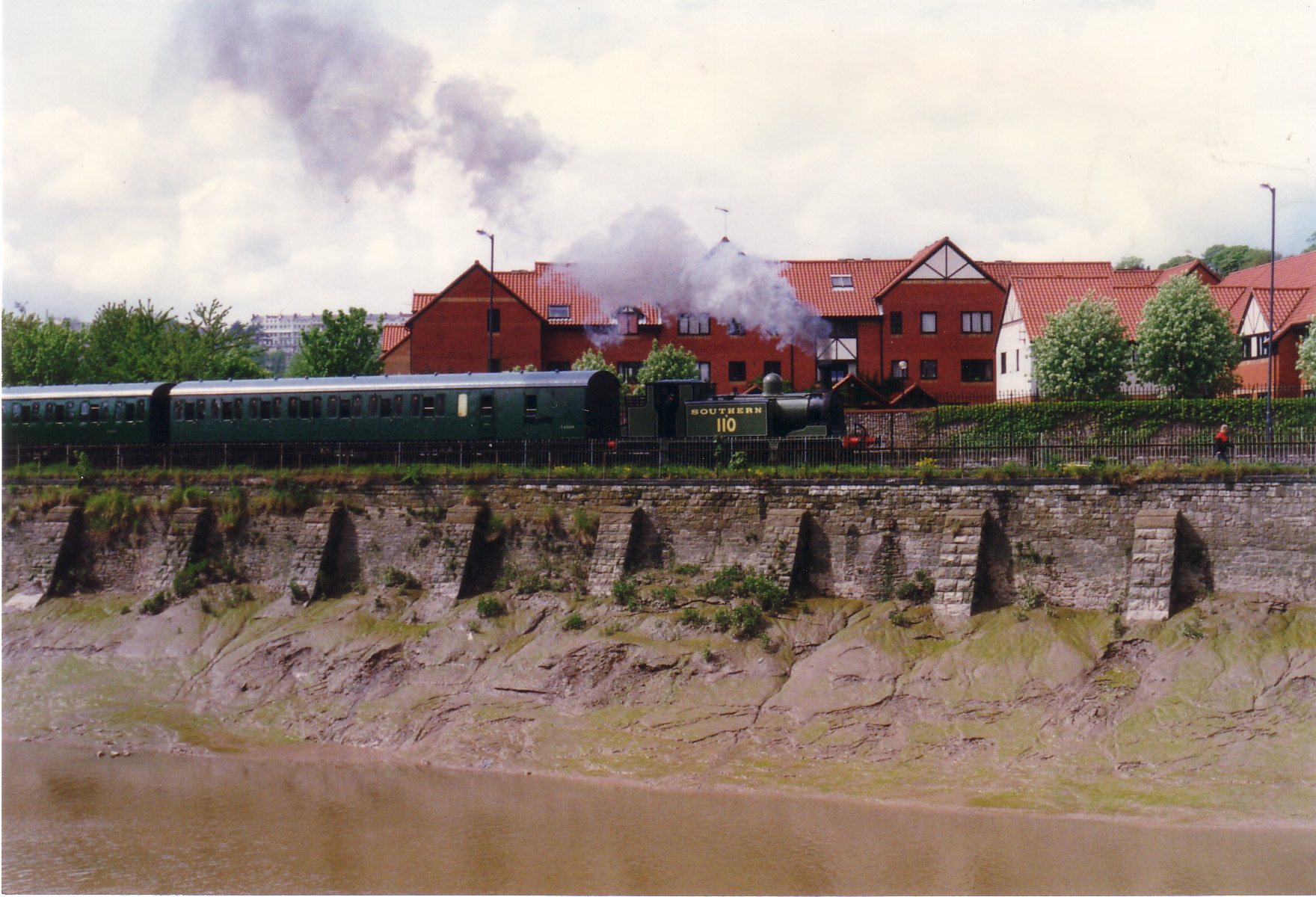
The E1 arrived at Cranmore, Somerset in September, 1978.  The overhaul started in 1986 and she returned to service in 1993 – in green livery, number 110.  Firebox problems forced a premature withdrawal from traffic in 1997.  During 2000 work commenced stripping the loco down to assess the state of the firebox.The chimney is still at Cranmore, last heard of being used as a donation box.In the yard at Cranmore – Pic Bob Fowler

News from the line

The main news is that the purchase of the loopline is secure, as we have the money.  British Rail granted access to works trains as from the 18th April and completion of the purchase should be made by the end of this month (July).  However, this is just the start, as the line must be completely fenced before we can think of extending our services to satisfy the Railway Inspectorate and quite a bit of trackwork is needed, though generally the loop is in excellent condition.

Engineering Works

Over Easter weekend the point at the south end of the loop was dismantled and a start made upon reassembling it on a new alignment away from the edge of the embankment.  Part of the loop has been slewed to meet the new alignment and hopefully the gap will be completed before August Bank Holiday, to enable works trains to start removing scrub from the loopline.  The extension to the platform is now virtually complete, lacking only coping stones before it can be put into use.  The majority of the wall was built by Brian Hames over Spring bank Holiday weekend, infilled with hardcore supplied by courtesy of Walsall Council and surfaced with red ash by courtesy of Chasewater Power Boat Club.

Train Operations

This year has seen a welcome increase in the amount of money taken per steaming, only partially due to the modest fare increase implemented at the start of the season.  After 13 steamings receipts were 230% up on last year with an average of 380 people visiting the railway per operating day.

Small Relics Collection.Recent additions to the collection include a St. Helens Canal & Railway memo; an LMS/GWR joint lines trespass sign; a Midland and Great Northern Tyers tablet (Long Sutton – Gedney) and an LNER ‘Carter to Call’ card.Tyers Tablet

Brownhills CID has apprehended two local youths (thanks to the help of several CLRS members), who are due in court shortly to explain why they were in possession of many items from the museum coach.  Following the trial the missing items will be returned – at present Brownhills Police Station has a fair collection of railway relics!!

A visit to Derby Carriage Works is being arranged so that Society members can view progress on the restoration of our Royal Saloon (ex Midland Railway), which many members will know is on loan to Derby Corporation until 2020 if they take up their full option. (I think this was another of the crown jewels to be sold!)

Chasewater Railway Museum Bits & Pieces

No. 85

From the Chasewater News Magazine No. 24 July 1978

Time to get back to some Bits & Pieces – I found this article in Magazine 24.

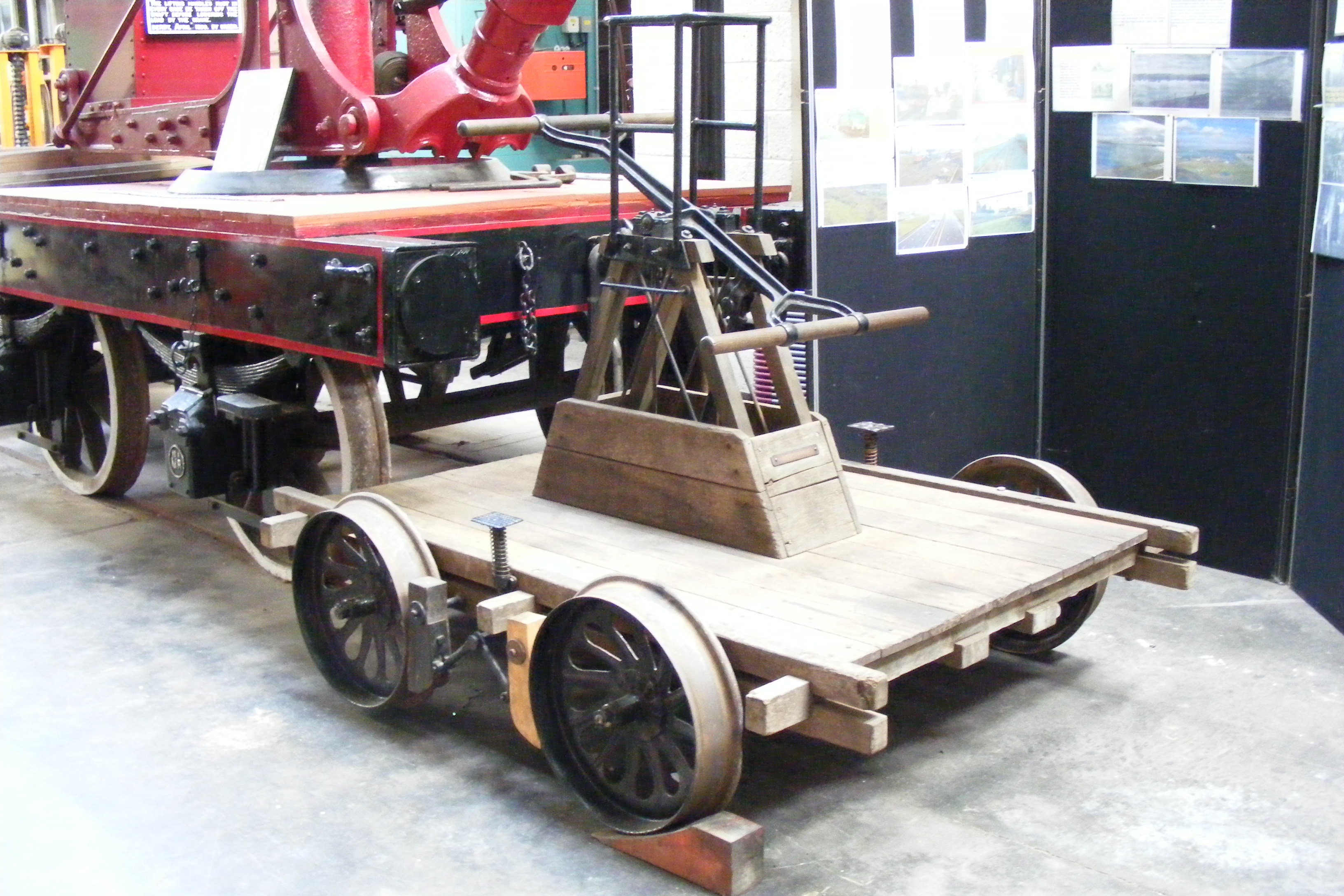
The Society’s Pump Handle Trolley’s next adventure.

Since the summer of 1975, when three anonymous persons were jettisoned off the causeway at great speed, the Society’s pump handle trolley has been living in retirement (or was it disgrace?) off the rails, festooned with various cast iron signs.

During a recent tidy-up the trolley was ‘re-discovered’ by one of our younger members and once the day’s running was over the trolley was re-railed, oiled and found to be in a rather sorry state of repair.  Gary Kay foolishly offered to rebuild the trolley, so it was decided to give it a final run prior to overhaul.  The party was formed of the more lunatic fringe of the Society (though Graham has since had his hair cut) namely Messrs. Attwood, Bull, Owen, Webb, Patterson and last but not least, the brothers ‘Grimm’.

At first the run was to be to the crossing and return, but before we could say ‘every confidence’ or even ‘doom and despondency’ we were carrying the trolley across the infamous ‘gap’ (the ‘gap’ was out of the Brownhills West gate and over the bridge by the fishing pool) and onto the loopline.  The loopline was found to be passable – well almost – despite a few hassles with the odd wayward bush, but an attempt at a run down the Norton branch (to the Norton East Road and Conduit No. 3, not the Pelsall to Hednesford line) was thwarted by the locals having covered the track with rubbish – everything from a three piece suite to a dead cat.  After this an attempt at ascending the causeway was made, but this too was blocked, this time by several tons of hardcore tipped by the Council.

The return trip provided more excitement, a hasty start left Mr. Bull stranded brandishing a shovel, and quite a speed was attained.  Unfortunately we were halted in full steam by a large overgrown gorse bush, which forced an evacuation of the trolley rather sooner than most of the crew anticipated as they were jettisoned, arms and legs akimbo, and ended up with rather sore arms and legs and backs, though the elder ‘Grimm’ was more concerned about his station master’s hat which landed dangerously near a large puddle.

After several minutes of recovery time the trolley was re-railed and a slow return to Brownhills West was made, and although it had been proved that track still existed beyond the ‘gap’ there are several members who are beginning to think that perhaps 800 yards of railway is more than enough, especially for pump handle trolley racing!!Following the successful  re-enactment of the bucket-chain a couple of years ago, I asked Mr. Bull about a possible re-enactment of the trolley trip-  unfortunately his reply is not for publication!

Now tucked away in the Heritage Centre

Hand Pump Trolley

This trolley was purchased (after a whip –round!) from the British Rail permanent way yard in Walsall in the 1970s.  A few years later, in their 1981 session, it was renovated by students of the West Bromwich College of Commerce and Technology.

Chasewater Railway Museum – Correction

Chasewater Railway Museum

Correction to Friday’s Post

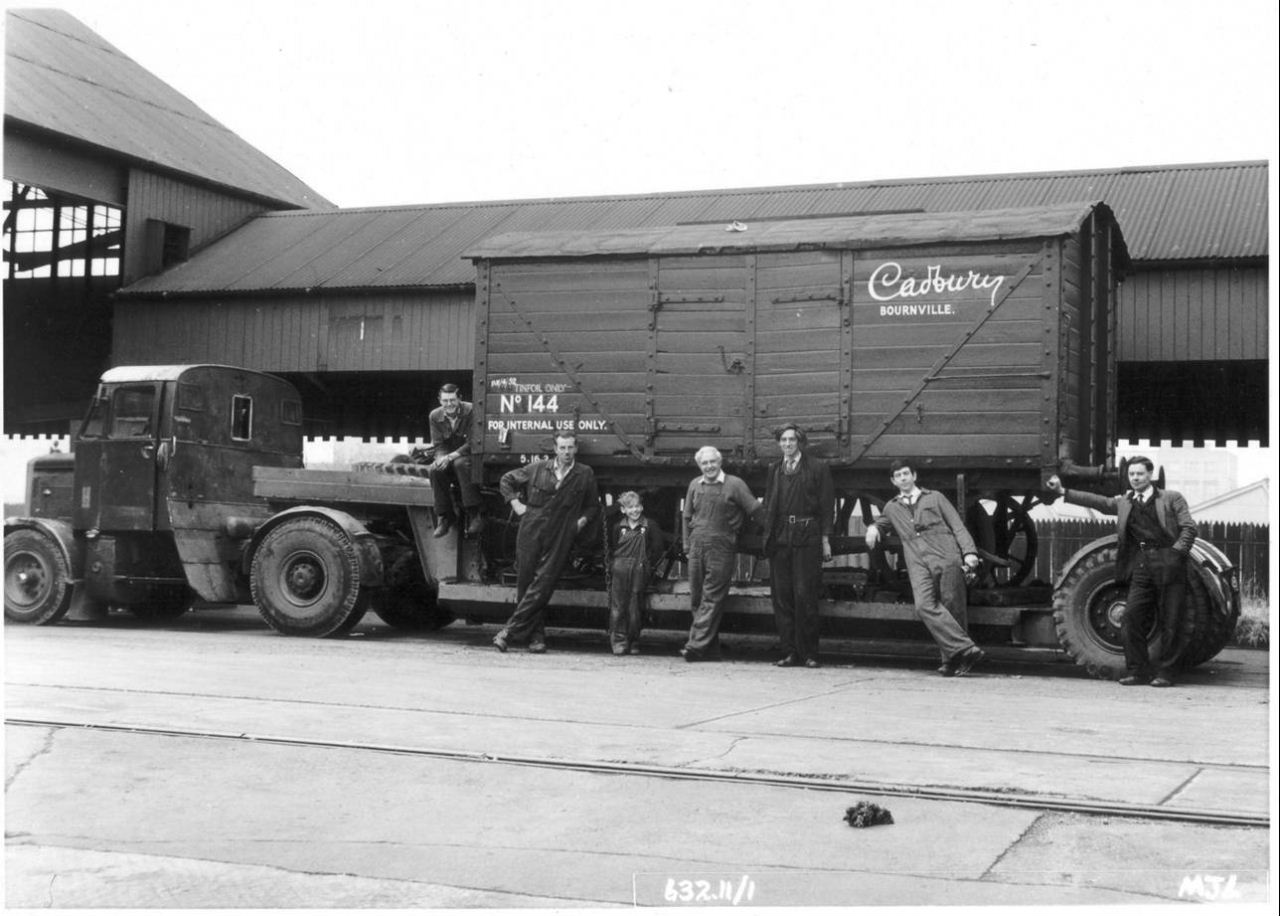
Just seen the blog but there’s a slight snag.  The photo is of the former Lancashire and Yorkshire Railway van Cadbury No 144, which arrived at Chasewater in 1970, having been at Hednesford for several years previously following a donation from Cadbury’s.  The 1973 acquisition, also a kind donation, was the North Eastern Railway box van number 100 684, this being the last wooden-bodied box van left at Bournville amongst a fleet of steel bodied vans. The van had been kept for the storage of permanent way equipment.  I recall the road transport bill to bring it to Chasewater was £28.  Not long after the van arrive a photo of it’s unloading at Chasewater was published in Railway Forum.

Barry Bull

Chasewater Railway Museum – Bits and Pieces No 60 March 1973 and No 61 May 1973

Taken from the ‘Mercian’ of December 1970

There doesn’t appear to have been another ‘Mercian’ for some time.


The Railway Preservation Society produced a newsletter, starting in March 1973 – Here are extracts from the first one.


‘This newsletter is not intended to replace our Society journal ‘Mercian’, we (the Committee) must apologise for the non-appearance of ‘Mercian’, but this has been due to technical hitches, etc.  We shall endeavour to maintain a newsletter at least every two months, and may we all hope that ‘Mercian’ will put in an appearance before too long.’


The remainder of the newsletter covers various on-going renovation work, including the overhaul of the Neilson, in the very capable hands of the General Manager, Derek Luker, ably assisted by Keith Sargeant and Colin Thomas – repairs to the smokebox and fire box – further expense is envisaged for retubing the engine.

Restoration of the MSLR carriage was continuing, with one compartment beautifully restored, fitted with new seats and original GC pictures re-hung.  This vehicle has been completely re-roofed and original ventilators and gas lamps refurbished and fitted.  A lot of work still has to be done to complete the vehicle and more volunteers were needed.


Other work included the relaying of track to the crossing from the Hednesford Road, another 300 yards needs to be done.  Work was progressing on the new platform at the Chasewater Terminus (now under the M6 Toll!).  Work had been started on tidying up the site, ready for the 1973 running season.  The Worthington Diesel No.20 (now on loan at Coors Museum, Burton-on-Trent) was having an overhauled replacement engine fitted and should be ready by the end of March 1973.


The final piece of news was regarding  a Railway Exhibition to be held at the Forum Theatre, Cannock, on the weekend of 30th June and 1st July.  It will consist of Model Railway Layouts, our own ‘Railwayana’ display, plus other preservation stands, Model Engineering Society stands refreshments and bar.  As usual, more help was needed.

Compiled by D.A.Ives (Chairman)

Also taken from the ‘Mercian’ of December 1970


Chasewater Railway Museum Bits & Pieces No.61


RPS Newsletter No.2 – May 1973


Since the last newsletter (March) we have been pleased to see a few members turn up at Chasewater as a result of the appeal for more support.  We would like to see a few more however.  There is an interesting variety of jobs, i.e. trackwork, platform building, locomotive and carriage restoration, installation of signals and signalling equipment. (Sounds familiar!!)

There was a successful Easter Weekend Steaming in spite of awful weather, and a thank you to the members who stayed overnight to light up, and those who operated the service in such vile weather.

DMU Trailer UnitPic – Lawrence Hodgkinson

This vehicle has now arrived at Walsall from March, Cambs. And is now awaiting collection and transportation by low-loader from Walsall to Chasewater.  This should prove a spectacular operation (albeit a costly one). We deserve to get maximum publicity from this enterprise.  As most members will realise, this carriage has been purchased to give maximum seating capacity for the summer season’s running, also to replace our vintage Maryport & Carlisle coach now in service.  The M & C now needs some restoration work, new panelling and a complete repaint.Pic – Lawrence Hodgkinson – Top of Pleck Road, Walsall

Stop Press – 3rd May!!

This vehicle is now safely in the compound at Chasewater, after a hectic day by a small party of members and being filmed going through the streets of Walsall by ‘ATV Today’

Pic – Lawrence HodgkinsonComing through the farm gate at Chasewater.

NER 8 Ton Box Van

Due to the efforts of our Hon. Sec. Barry Bull, the Society has acquired the last wooden bodied Box Van used by Messrs. Cadbury of Bournville.  Messrs. Cadbury have very kindly donated the vehicle to the Society, arrangements have now been made for collection of this vehicle on May 5th.  Our grateful thanks to both Messrs. Cadbury for donating this vehicle and to Barry Bull for negotiating the deal.

Chasewater Railway Museum – List of Chasewater Railway Events – 2020

Chasewater Railway Museum –

List of Chasewater Railway Events – 2020

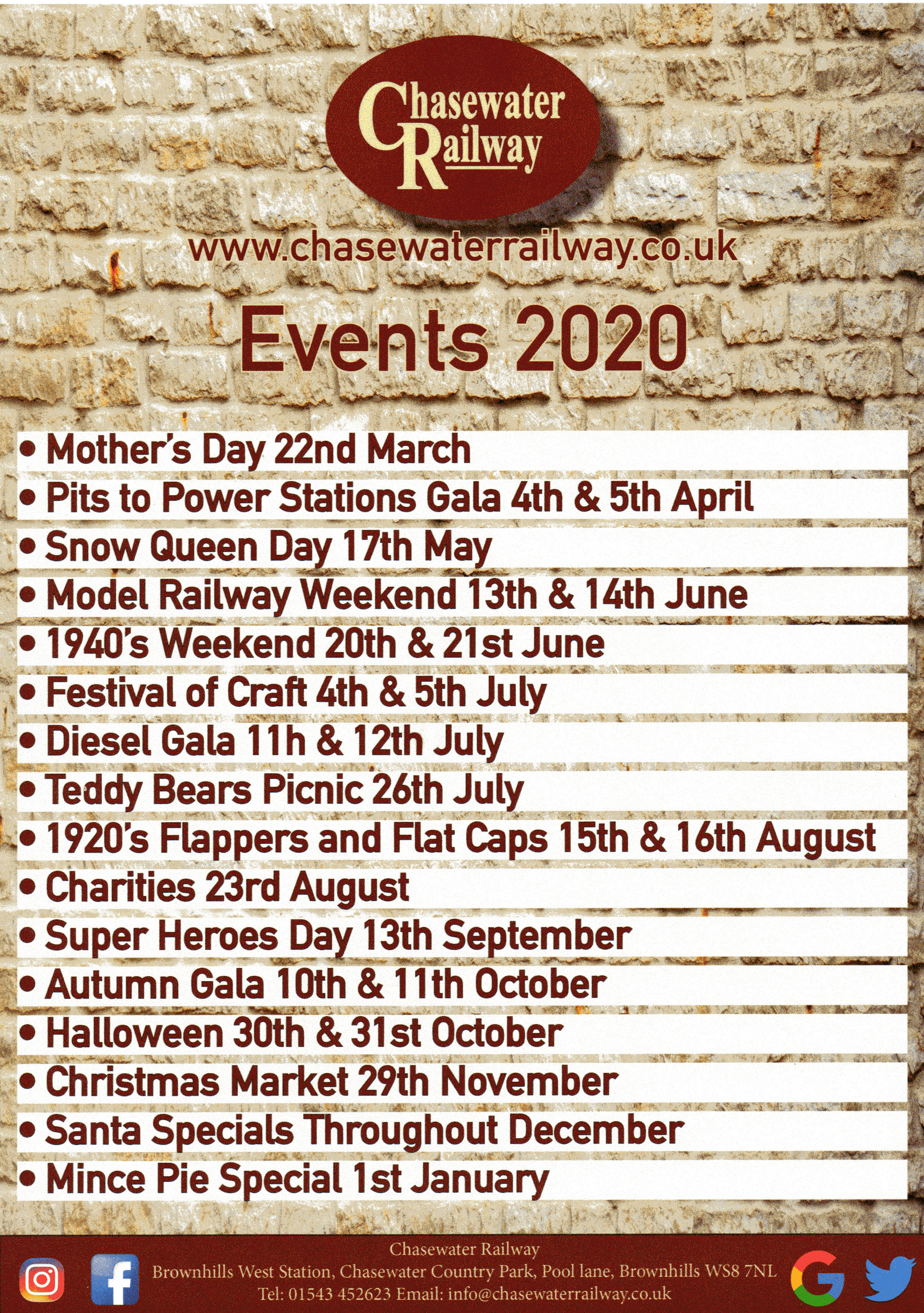
A real diary filler for you – all the events happening at Chasewater Railway during 2020.