
Tag Archives: Cannock Chase

197 Chasewater Railway Museum Bits and Pieces

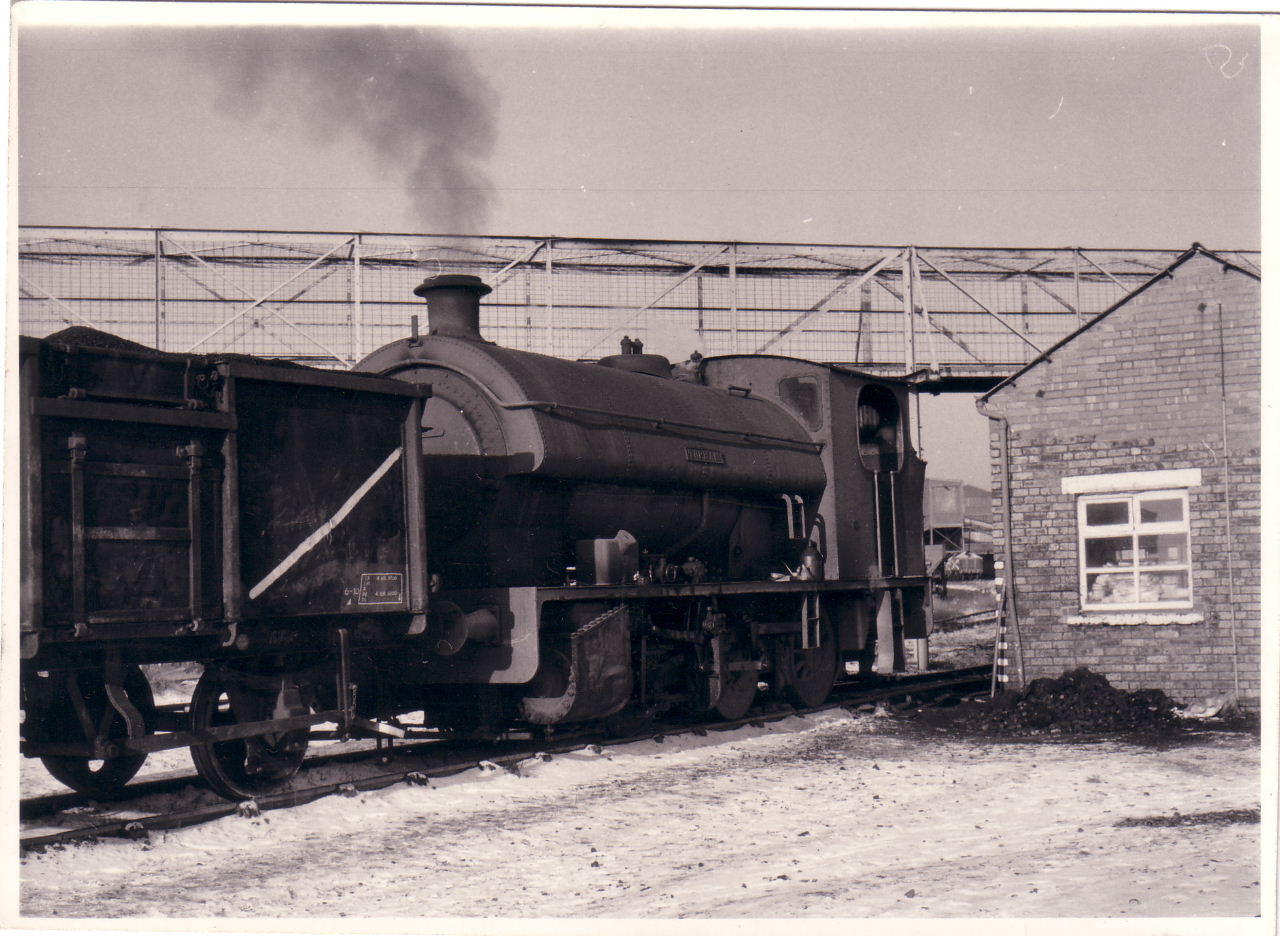
Loco ‘Topham’ 0-6-0ST Bagnall 2293-1922. Taken 18-12-1969

The photographs shown on this blog have been in the Museum since 1986. We regret that we cannot recall the names of the photographers. If you recognise any of them, please send us the details.

197 – Chasewater Railway Museum Bits & Pieces

From Chasewater News – Winter 1996 – Part 2

From the Board Room

David Bathurst – Chairman

Despite the fact that the festive season is getting ever nearer and the 1996 operating season has drawn to a close, there is no holiday period for the Board. Indeed, the Board has already agreed the pattern of train operations for 1997 to enable publicity leaflets, posters, etc. to be prepared.  Moreover, it has been agreed that the 1996 fare structure be retained, as the current ticket prices seem to have been pitched at just (perhaps exactly) the right levels and have been accepted by the travelling public.  It is pleasing indeed to watch prospective passengers, particularly those with family groups, buying tickets without feeling the need to complain about fares, how different from the days when many (maybe a majority) took one look at the fares and left the station without more ado.

With the help of our Publicity Officer, we aim to raise public awareness in 1997.  Indeed every member – whether a working member or otherwise – is a potential publicity officer in his/her own right.  We need to preach the Railway’s gospel, or at least ensure that its leaflets and publicity materials enjoy maximum exposure!

The Board has recently considered a variety of matters concerning the Railway, and some of these are outlined briefly below.

The ex LNWR ‘Paddy’

Following discussions with relevant members, the Board has formally acknowledged that the proper (or even partial) restoration of this vehicle is beyond the current or anticipated resources of the Railway, both in financial and manpower terms.  In its present condition, the vehicle is dangerous and a liability to the Railway.  Accordingly, the Board has agreed to try to find a more suitable home for the vehicle, which is to be advertised in the railway press for disposal.  Any such disposal would be on the basis of a commitment to restoration by the recipient.  Obviously, the Board would prefer to see it go to an organisation enjoying the necessary resources and expertise to bring it back into use.

Rallies

The board is examining in considerable detail the income/expenditure profit/loss profile of the rallies held in recent years.  There is much work associated with the organisation of our rallies, a lot of it out of view of the membership or the public.  The burden now being felt by a small minority of key members (who already have their own responsibilities for operation of the Railway) is becoming unacceptable.  For these members, the rallies are no longer an enjoyable challenge.  They have become more of a nightmare.  I am not prepared to allow this situation to continue.  I am not prepared to see our members and colleagues reaching a state of despair, which has happened on a number of occasions during 1996.  With Lichfield DC seeking for the first time to impose charges for hire of Chasewater Park for rallies in 1997, the Board is taking the opportunity of looking afresh at the Railway’s policies and options regarding future rallies.  The Rallies Organiser has been so successful in generating participant interest in our rallies that we have become vulnerable through a shortage of members prepared to make a direct contribution to rally organisation.  We have become a victim of, and hostage to, our own success.  If the Board’s aspirations come to fruition, we will have vastly increased public support for the rallies, but without the hassle experienced over recent times.  Our aim is to return to a situation where our rallies are enjoyed by the public, by the participants, and – more particularly – by our own members.

Invalid Toilet

The Railway’s Policy Statement includes a commitment to the provision for the disabled and our stations, buffet and trains are all accessible to people with mobility difficulties.  The one remaining omission is the provision of a disabled toilet and the Board has noted with pleasure that this will be available in good time for the Santa Specials in December.  The opportunity is being taken to ‘repair’ some defects in the plumbing system, hopefully with an improvement for the olfactory senses.

New Shop / Bric-a-Brac

The Board has given its support for a scheme whereby the recently adapted portacabin immediately next to the buffet at Brownhills West will become the new, enlarged, shop.  Shop sales, and children’s toys in particular, have increased markedly during 1996 thanks to the introduction of an enhanced commercial policy.  Consideration is being given to the use of other accommodation as a bric-a-brac shop.

Traction Inspector

The Board has formally endorsed the appointment of David Walker as the Railway’s Traction Inspector, although this is without prejudice to the Railway maintaining a relationship with other competent persons who have been prepared to assist in the past.  A driver and two firemen have already received their ‘ticket’ and further assessments are to be made in 1997.

Lichfield District Council

A lengthy letter has been received from Lichfield District Council in relation to the many matters which have been the subject of representations from the Railway since the Council became our landlords in 1993.  The Board’s preliminary impression is that the Council has failed to recognise or appreciate our concerns and that response is wholly unsatisfactory.  The Railway’s views will be communicated to the Council at an early date.

Christmas: Santa Specials

We are hoping for our most successful Christmas programme ever, providing the icing on the cake to complete a highly encouraging year.  Santa Specials will run on Sundays 15th and 22nd December, providing an opportunity for our ‘absentee members’ to visit the Railway and to judge for themselves what changes have taken place since their last visit.

P Way News

Arthur Edwards

In the autumn/winter plans for the P Way gang over the 1996/97 period is the laying of the sidings by the bottom compound.  This is expected to take up most of the winter months.  Some work has already commenced on laying out the first two roads with the first set of points going in after the Santa Specials.  The time scale for laying in the point work is expected to be around three months so that they should be up and running for the start of the next running season.  As the 1997 season will be starting early – the last week in March – and going through to the end of October, the P Way gang has a shorter period to get more things accomplished, therefore as our membership grows hopefully more volunteers will boost the numbers in the gang.  During this period it is also planned to lay 4 x 60ft lengths of rail on the extension so that the sleepers which are already in place can be keyed up and not tossed into the lake.  If the number of bodies available gets to a sufficient number, the causeway bank can be relaid with 60 ft lengths so if any able bodied volunteers are out there you can always find us on either a Saturday or Sunday, so don’t feel shy.

The weedkilling planned for the end of summer has had to be postponed due to the weather conditions not being suitable for it.  As the weedkiller has been purchased we should be able to spread it at the beginning or middle of March prior to the commencement of the new season.  This should be followed by a second application approximately half way through the running season so as to keep on top of the perennial problem of weed encroachment onto the track.  There are signs that some of the hedging planted several years ago is starting to take hold so that it should provide a permanent barrier along some of the more exposed fence line.  Further plantings should gradually fill out any gaps so making trespass onto the line more difficult.  I’d like to thank all the volunteers who have helped us during 1996 and look forward to seeing you in 1997.

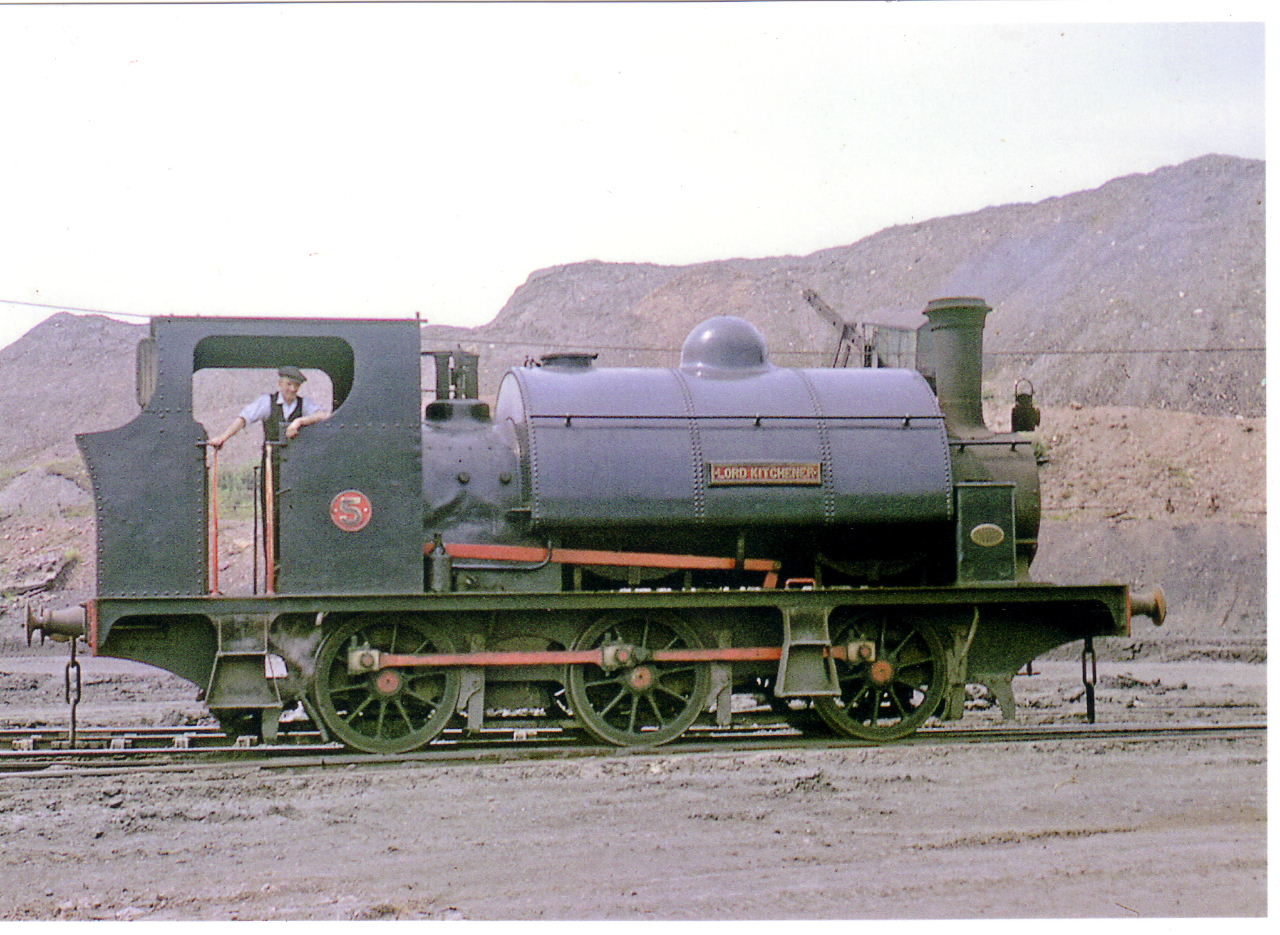
‘Lord Kitchener’ No5 0-6-0 ST Kitson 5158-1815 Photographer unknown

180/181 – Chasewater Railway Museum Bits and Pieces

Featured Loco – No.8 Harrison 0-6-0T Yorkshire Engine Co. 185-1870 C & R Paddy 15-3-1934

180 – Chasewater Railway Museum Bits & Pieces

 From Chasewater News Spring 1995 – Part 3

From the Boardroom

Lichfield District Council and the Railway

By David Bathurst – Chairman

It is a little over 12 months since Lichfield District Council (LDC) assumed responsibility for Chasewater in succession to Walsall MBC.  Maybe now is the opportune time to reflect on the Railway’s relations with our new landlords during this period.

It is generally recognised that LDC has inherited an area of recreational land and some very modest amenities where ‘investment’ had become an unknown concept.    Whilst Walsall MBC must accept some responsibility for this state of affairs, it is however a fact that the plans for the Birmingham Northern Relief Road (BNRR) have prevented any serious attempt to maximise the commercial and leisure potential of the area.  The BNRR may or may not happen and whichever way it goes, it will have a major impact on both the Park and the Chasewater Railway.  Until a decision is made and the first contract has been let, Chasewater will inevitably remain in limbo.

It is in this context the Board has made a number of proposals to LDC and it is similarly in this context that LDC has been unable to offer anything other than a series of courteous and sympathetic acknowledgements.

This does not mean that LDC is sitting back on Chasewater issues.  The council recently approved a document on Chasewater’s future with a view to inviting public participation and consultation.  The Railway is awaiting a copy of the document with interest and will certainly be wishing to make representations.  It will also be interesting to see whether the results of the Municipal Elections on Thursday May 4th 1995 will have any effect on LDC’s policies towards the future of Chasewater.

For the information of members, the following is an indication of the matters currently with LDC, awaiting decision.

Presentation to the Council

The Railway has indicated a willingness to make formal presentation to LDC’s Leisure Services Committee to define more clearly the current and potential roles of Chasewater Railway within the context of Chasewater Park.

Lichfield District Local Plan

The Railway has submitted a formal objection to the Draft Local Plan.  The Railway wishes to see an additional policy added to the section related to Chasewater, namely “The District Council will continue to make provision for the development of the Chasewater Railway”.

The Railway will be represented at the Public Local Enquiry which commences on 5th September 1995 and which is expected to last 8 weeks.

Extension to AngleseyWharf

The Railway has asked LDC to give planning protection to the alignment of a possible extension to our operational line, to Anglesey Wharf.  Unfortunately the proposed line of the Burntwood By-pass means that the Railway extension would need to intrude into two SSSIs (Sites of Special Scientific Interest).  This could represent a major threat to the plans for extending our operational line.

At the same time the Railway has invited LDC to examine the land ownership issues and to agree, in principle, to the grant of any necessary leases.

BNRR (M6 Toll): Brownhills West Station

The Railway has asked LDC to honour a commitment made by Walsall MBC to provide an alternative site for the relocation of Brownhills West Station and associated facilities should this be necessary because of construction of the BNRR.

Causeway/Norton Lakeside Station

LDC has been invited to assist in undertaking finishing works on the Causeway where the Railway has neither the expertise nor finance to carry out a substantial scheme of environmental improvement.  In particular the concealment of materials at the water’s edge by proper treatment works could well bring about a significant improvement in appearance.

In a related proposal, LDC has been invited to ’adopt’ the footpath across the Causeway and in the vicinity of Norton Lakeside Station within a co-ordinated approach to access the north shore area of Chasewater.  This would not involve the footpaths becoming formal public footpaths but would nevertheless be of benefit in a wide range of senses.

LDC has been asked to participate in some tangible form of official opening of the extension across the Causeway and opening of Norton Lakeside Station.

Land Tenure

LDC has been made aware of the Railway’s concern regarding the current leases which may not be sufficient to enable the Railway to gain access to finance potentially available through various funding regimes (see also below).

Boundaries

LDC has been asked to undertake a survey, in conjunction with the Railway’s surveyors, for the purpose of identifying the physical boundaries of the land held on lease by the Railway.  Significant changes in the landscape at the easterly end of our line makes it extremely difficult, if not impossible, to pinpoint the extent of our lease without resort to modern surveying technology.

Carriage Shed

LDC has been asked to consider making a deemed application for outline planning permission for the provision of covered accommodation at Brownhills West adjacent to the shed compound.  The close proximity of houses might represent some difficulty although this would be removed if the BNRR were to proceed as the houses referred to would be demolished.

If the Railway were to seek National Heritage Lottery Funding for this project, it would need greater security of tenure (that is to say, a freehold interest or a long leasehold interest in the land concerned.  As an alternative, an application for Lottery funding could be made as a collaborative application between LDC and the Railway.  LDC have been asked to consider the implications.

In view of the fact that Lottery funding provides a contribution only towards cost and that a partnership approach is essential, LDC have agreed to enquire into what other grant regimes may be available to help the Railway to construct this essential covered accommodation.

Light Railway Order

Walsall MBC actually made a number of applications in the 1980s to the Department of Transport for a Light Railway Order.  The applications were so flawed that they were eventually withdrawn and put into abeyance.  The Railway has invited LDC to pick up the pieces and to seek the modern day equivalent of a LRO on the Railway’s behalf.

Conclusion

From this summary, members will surely form an appreciation of the importance of a good relationship between the Railway and our landlords.  Each of the items mentioned has generated considerable correspondence and has involved lengthy meetings with LDC Officers.  We must not allow ourselves to become impatient, particularly in view of the uncertainties surrounding the BNRR.  Operating a Railway involves a wide range of activities not generally known to the membership and where it is necessary for a highly trained professional and mature approach to be taken by all concerned.  There can be no certainty as to the response of LDC in relation to any or all of the matters which are currently on the table with them.  What is certain, however, is that the Council is committed to the development of Chasewater Park and, once the BNRR issue is determined, there must inevitably be significant changes on the horizon.

181 – Chasewater Railway Museum Bits & Pieces

From Chasewater News Summer 1995 – Part 1

 From the Editorial

The first of this year’s rallies has now come and gone, and the overall figures for the rally were disappointing, but I understand that, like so many other events on over that weekend, we all lost out to the England – New Zealand semi-final in the Rugby World Cup.  The overall passenger figures for the first two months of the running season on the Railway have remained fairly level with last year which means that we are carrying about the same number of passengers as we were for the same period last year if you factor in the decrease in ticket prices.  This is also in spite of some miserable weather for the first two months of the running season which has kept the park fairly empty over the weekends.  The Railway is still running from hand to mouth, but 1994/5 has been an exceptionally remarkable period in the history of the Chasewater Railway.

As nearly all the major expenditure has now been cleared there is at long last a light at the end of the tunnel, and as there are no more ‘major’ projects on the horizon, it should give the Railway time to gather its breath before the next phase of expansion.  The critical areas are now engineering and restoration.  The team in the locomotive shed have been doing a fantastic job, but the amount of repairs required to maintain the running locomotives that we have has been stretching them to the fullest, and this is without restoring further engines back to running condition.  Some cosmetic work is due to be carried out on one of the locos to stop any further deterioration of the bodywork, and this will have the effect of putting the loco back together so finding out whether any parts are missing and also clearing areas of the site where they are currently stored.

Work is nearing completion on the new amenities block and at last it is beginning to present a neat and tidy face to the general public, as parts of the awning/roof facia, which were finished by the Community Service people are put into place.  As the timber work is finished so the undercoat and top coat of paint have been applied in all but a few sections.  The guttering now needs to be put into place so that the exterior can be completed.  Tony Wheeler has also tidied up the ‘one road’ side of the portacabins by enclosing them in with corrugated iron sheets, after the placement of an amount of concrete to further secure the foundations of the area.  This has also been finished off with topsoil and planted flowers.

The station area is gradually being cleared of all rubbish, scrap metal and junk, and the departure to the bottom compound of S100’s tanks and cab roof have allowed the area between the end of one and two road to see the light of day for the first time in many years.  It also means that all the relevant pieces of S100 are gradually being brought together as the work on this locomotive gathers pace.  (This was written 17 years ago!)

Also a large number of plants have been planted throughout the section between the booking office and the new toilet blocks so considerably enhancing the area.  In conjunction with this work, the main fence is currently receiving a coat of paint to smarten up the front facing the road.  The chain link fence that is still standing should have been renewed some time ago but with the outcome of the third public inquiry into  the BNRR (M6Toll) still not resolved it seems pointless in replacing the rest of the main compound fence only to have it demolished if the motorway is constructed.

I would also like to ask members working on site not to throw any litter on the floor but place it in the bins provided, that’s if the wasps don’t make it a hazardous operation, as this reflects on the Railway in the eyes of the general public.  Also if you see litter lying around don’t just look at it, pick it up and ‘bin it’.  Following this plea of ‘Good Housekeeping’ please don’t leave any unnecessary lights, equipment or other electrical appliances turned on, not only does it cost but it could also lead to an accident – live cables lying around being accidentally cut giving somebody a nasty shock.  The site is a lot tidier than it used to be but there is still some way to go.

Brownhills West Station 1992

From the Boardroom

Working Members Meeting

David Bathurst – Chairman

At the 1995 AGM, members expressed a wish to hold occasional meetings with Board members to discuss a wide range of topics associated with the management and operation of the Railway.  The first such meeting was held on Wednesday 21st June, 1995, when an encouraging number of members attended at Brownhills West Station.

For the benefit of working members who were unable to attend, the following is a brief summary of the principle matters which were discussed:-

Platform adjacent to the locomotive shed – Concern was expressed regarding the safety of this platform and short/medium term remedies were discussed.

Restoration of No.917 – An enquiry was made with regard to which steam locomotive was next to be restored into working condition.  It was the opinion of a number of members that No.917 was the obvious choice.  The meeting was informed that the restoration of the locomotive was in fact on the agenda for the next meeting of the Board, as a written proposal having already been made to the Company regarding its cosmetic (at least) restoration.

Water supply for steam locomotives – A member expressed concern that the demand for water for steam locomotives would increase once the extension into Norton Lakeside Station was open to regular traffic.  However, it was generally agreed that the current arrangements are satisfactory as the locomotive crews had proved their ability to take water without major disruption to the timetable.

Rallies – The rallies organiser, Dave Whittle, spoke at some length on the shortcomings of the June Festival of Transport.  He questioned the members’ commitment to rallies and referred to the need for a stronger communications chain and team work in particular.  The Board had indicated an intention to invite Dave to attend the next Board meeting with a view to examining in detail has specific areas of concern.

Junior Members Section – It was suggested that the time had now arrived to harness the interest of younger members by establishing, on a more formal basis, a junior members’ section.  Health and Safety legislation prescribes certain minimum age limits for undertaking different categories of work but it was acknowledged that the junior members have much to offer in the operation of the Railway.  Andy Clegg and Keith Pointer were invited to submit written proposals to the Board in due course.

Miscellaneous Matters

·        The number and distribution of keys was to be reviewed.  Members were urged to’ lock up behind them’ when leaving the premises or individual buildings.

·        To avoid misunderstandings and to promote greater public confidence, it was agreed that when the bar is in operation, alcohol is not to be served to persons in high visibility vests or known to be operationally active on the day.

·        Concern was expressed with regards to the gates not having been replaced at the entrance to the bottom yard.  In a related matter, members were urged to be respectful of work undertaken by other members.  Instances had come to light of members doing things with good intention but without consulting with other colleagues who may have already been involved in previous work.

·        It was confirmed that a members’ notice board is to be erected in the members’ mess.

·        Tony Wheeler confirmed that he could generally be available, given reasonable notice, for members needing to gain access to the premises and where the alarms needed to be de-activated.

·        The Magazine Editor would be asked to include in all future editions a list of Board members together with the Heads of Department.

The meeting, which commenced at 7.30pm, closed at 10.30pm and the members present were appreciative of the opportunity to raise matters of personal interest to them.  By common consent, it was agreed that further meetings be held on a similar basis during the course of the year.

Brownhills West Station 1978

179 – Chasewater Railway Museum Bits and Pieces

Featured loco – No.6 Adjutant. 0-6-0ST Manning Wardle 1913-1917 Cannock and Rugeley.

 From Chasewater News Spring 1995 – Part 2

Carriage & Wagon Department – Tony Wheeler

 GWR 20 ton Toad 35251

This vehicle has been stripped and repainted into GWR Grey and lettered Moat Lane.  This is not its true location but a suitable representation.  It is currently in use with the P-Way team.

Ballast Plough Van S62861

The Maunsel brake van has had its roof re-felted to waterproof the inside of this vehicle.  It requires further work in replacing some of the external woodwork which is gradually deteriorating. The vehicle is in regular service with the P-Way train.

21t Mineral Wagon B316711

A temporary floor has been placed inside this vehicle after a cleanout of the remaining coal and slack left inside.  The larger deposits left provided some fuel for the stove inside the p-way brake van over the past winter.

16T Mineral Wagon B274600

This wagon has proved useful over the winter months ferrying bricks to the site of the new platform at Norton Lakeside and alongside the 21 tonner has seen some very heavy use lately.

8T 4-plank open wagon (Conduit Colliery)

This wagon is currently awaiting a more permanent resting place, so that the springs can be removed and replacements can be obtained and fitted.  It currently has one set of spring ‘on loan’ from the Midland Crane!

GWR 16T Toad 35831

This brake van still resides in one road awaiting some repairs, which consist of a replacement spring buckle, running boards and hangers and also brake block replacements.  Some minor attention is needed to the bodywork.

MS&L 1470

Work has resumed on the restoration of this coach after the winter lay-off.  A temporary platform has been erected round it so that the exterior work can carry on safely.  Alwyn and myself have carried on with rebuilding the interior of the brake end which was damaged some time ago.  The coach has had covering sheets removed from the roof and work has started on cleaning and repainting the roof vents.  New guttering has been fabricated and fitted to the side of the coach facing the lake; this is to replace the old burnt out pieces over the guard’s compartment.

MR Brake 68

Some panelling timber has been obtained to replace missing panels on the Midland Brake van.  The location of this vehicle at the end of two road means that the open end is exposed to the weather and some roof timbers will need to be obtained in the near future.

Permanent Way – Arthur Edwards

It seems a long time ago since I last wrote an article about anything that is happening on the Permanent Way of the railway.

Firstly, as I’m sure you know, if not I’m sure you soon will, that the Railway Inspector was due to visit us on Friday May 12th 1995, and in between this and his last visit quite a lot has happened.  New ‘No Trespass’ and whistle boards have been fabricated and put up, as the original ones being made of cheaper material and with the amount of vandalism that is rife around Chasewater, they did not last as long in position as they took to make.  New gates have been made for each of the crossing points and they have been put into place.

Secondly, our illustrious General Manager, Mr. Steve Organ, acquired a hopper wagon (dogfish) with which to re-lay ash ballast all along the line for the next monumental task, which was the use of a tamping machine on hire from Tarmac.  The tamper and its two-man crew started work on the line from the new platform, across the causeway and back to Brownhills West.  In conjunction with this work fishplates have had to be greased and tightened (again!), along with some sleepers which had to be re-spaced.

Thirdly, and most importantly since the Inspector’s last visit we have laid up to nearly a third of a mile of track into Norton Lakeside platform, which has been refurbished and extended to cope with a three coach train, and should hopefully be open to the public after the Inspector’s visit.  During the last few weeks our General Manager has been going round like a headless chicken trying to get the scheme finished in time for the Inspector’s visit, and I must admit it’s coming along pretty well, even though Steve himself will admit it was touch and go with the unkindly weather which has put all of us who helped on this project, quite a few weeks behind schedule, and Steve began to think that maybe it was a bit overbearing on all of us.  So there have been harsh words spoken at heated moments of which we all apologised to each other afterwards.  Although we are not in the major league of steam centres, contrary to popular belief we are holding our own, even if our members have dwindles slightly.  You must realise that this is our hobby and not our profession, and therefore we have to earn a living at our ‘proper’ jobs, and three of our current working members’ jobs incorporate working on refrigeration, so, being summer, their jobs call for their expertise.  And that’s basically it, except to say thanks to everyone for their exhaustive efforts, Tom especially.

From Chasewater Heaths to Church Street, the original trackbed – still a bit of P-Way work to do!

142 – Chasewater Railway Museum Bits and Pieces

We are sorry but due to other commitments, the Museum will not be open this Sunday, 16-4-2023.

142 – Chasewater Railway Museum Bits & Pieces – From Chasewater News December 1991 – Part 1

Editorial – Nigel Canning

On September 3rd this year our hard work finally paid off when Major Olver inspected the railway and gave us permission to run on the extension past Willow Vale.  Next year when our newly delivered concrete platform has been built, we could even be running trains to a timetable.  A lot of hard work still remains to be done, but by the end of 1992 we could well be running to the causeway.  It is now entirely up to us, the more effort we put in, the further we will be able to run trains, so if YOU can help: PLEASE HELP EXTEND THE LINE IN 1992!!

Locomotive News – Including extensive news about Asbestos

Asbestos leaves Brownhills West propelling the Gloucester trailer.

No.4 Asbestos – Many members will have been wondering what has happened to Asbestos and why it has not yet been returned to traffic.  When the loco last worked (in 1989) it was suffering from a number of ailments, none of which were particularly bad, but all added to make the loco a rather cantankerous old lady.  When the boiler became due for inspection it was decided to rectify as many of the faults as possible.

One major worry was the state of the foundation ring rivets at the base of the firebox.  A few of these were found to be leaking and needed replacing.  Some of the quotes for the repair were alarming.  One company quoted £1,500, if we took the boiler to their factory on Leicester.  Fortunately we found a boilersmith who was prepared to travel to Chasewater and do the repairs ‘in situ’.  This saved a great deal of work lifting the boiler out of the frames.  The bottom three rows of tubes were also removed as these were older than the rest and in need of replacement.

With the repairs complete, the boiler was cleaned to allow the inspector to use his ultra-sonic tester to measure the thickness of the boiler plate.  One unpleasant surprise was the state of the inner firebox around the fusible plug.  The plate was corroded and was only 7mm. thick, very close to the minimum allowed.  Nevertheless the inspector pronounced the boiler OK with the proviso that we keep a close eye on the thickness of the plate around the fusible plug.

The next problem was replacing the two dozen boiler tubes.  Fortunately the tubes in Asbestos are the same diameter as a Hunslet ‘Austerity’ 0-6-0, and we happened to know of just such a loco which was undergoing a mayor re-build.  The tubes were only a couple of years old, and once cut down to length would be just the job.

Then, suddenly, the CLR finances took one of its periodical downturns and there was no money to spend, even on second-hand tubes.  The time was not entirely wasted, as the loco was blanked off ready for its hydraulic test, and the cab fittings were overhauled to make them steam-tight.  Even so, many weeks were lost.

The boiler tubes arrived at the end of June, and were then cut to length, cleaned, annealed and expanded into place.  The regulator will also receive attention and, hopefully, the loco will pass its hydraulic examination.

The long term future of the loco is somewhat doubtful.  The firebox will need further repairs, and although it may be possible to weld a circular boss in the firebox crown relatively cheaply, the loco is still likely to need a full set of tubes costing around £1,500.  Will the money be available to pay for the repairs?  We shall have to wait and see! – P.Aldridge

No.5 Sentinel – This loco has continued to work all of the passenger trains, and whilst running on the free coal found in the ex Lea Hall mineral wagons is very economical indeed.  With the opening of the new track extension, bunker capacity is again becoming critical and may have to be further improved,Ken Judkins poses for the camera with his 200hp Sentinel during a demonstration at Cargo Fleet Steelworks in Middlesborough in the 1950s.  The loco on the right is an earlier Sentinel rebuild of a conventional loco.

No.2 Lion – This loco is still awaiting a new set of washout plugs so that it can be hydraulically tested.

S100 – Work has started on moving the boiler from the site now required by the C & W Dept down to the loco shed yard.  Now that the hornguide grinding machine has been perfected, work will start on the actual grinding process.

DL7 – This loco has stood with one of its cylinder heads missing for a number of weeks.  Apart from a valve being stuck open, the valve seats are in an extremely bad condition, requiring re-machining and grinding in.

Fowler – This loco has again carried out all the shunting and works train duties without problem.

No.21 Diesel – Work has started on the restoration of this little loco with the cleaning and painting of the bodywork and frames.

 No.21 in the Heritage Centre at Chasewater,  2011

Smith Rodley Crane – The crane has remained out of use and requires adjustment of its clutches before it can be used on its next big job – the building of Willow Vale platform.

139 – 137 Chasewater Railway Museum Bits and Pieces

139 – Chasewater Railway Museum Bits & Pieces

From Chasewater News Autumn 1991 – Part 2

How it was, how it is and the 1st Burntwood Scouts

 Initially we started the track attack around Jan/Feb 1990, but an accumulation of other, more pressing jobs needed our attention.  As a result, it was decided to leave the planned track extension until a later date, which was more or less twelve months later.

How it was.

After laying 50 odd concrete sleepers between two of us, just Pete and I, we came to the conclusion that the rails were out of true, that is, they were not in uniform lengths.

We concluded that it would take more than two of us to correct this problem so we decided to leave it until later in the year, and, as stated earlier, other jobs required more urgent attention.

Meanwhile, it had been decided that the various departments of our railway required better leadership, and as a result, Les Emery became our Permanent Way foreman.

Firstly, I suppose he felt like any other p-way ganger would, that trundling down 1,000 or so yards of track to nowhere specific causes enthusiasm to wane a little.  Secondly, he seems the kind of bloke who has the uncanny knack of proving the need for his actions, and if a job should crop up, would rather do it first than answer for it later.  Now the p-way gang get even the most tedious jobs done, whether it is weedkilling, tightening fishplate bolts, or even cutting back the grass banks or trees.  Using a shovel and sweat (unless some kind soul out there has got an old JCB to lend us?) quite a lot has already been achieved.How it is.

Things are coming on nicely thank you.  Since starting the ‘track attack’ in February, Les came up with a brilliant idea for moving 60 foot lengths of rail with only about three blokes, by the use of three small rollers onto which the rail can be jacked and then pushed along.

Our gallant leader believes that we could be at the bottom of the causeway bank by the end of October, others reckon spring 1993, and that id laying the track, ballasting and having it passed by the Railway Inspectorate.

Ur long term ambition is to relay the track as far as Anglesey Wharf, which is close to the bad canal bridge in Wharf Lane.  Mind you, that’s a long way off yet, but the way things are going, could be in the next ten years or so.

Our main concern will shortly be the causeway bank which has got to be braced and backfilled as the water has eroded the banks on either side.  The ‘spiky bridge’ also needs repair; I wonder if it will still be called the ‘spiky bridge’ once it is repaired?  We are fortunate to have no underbridges on this railway, just the two overbridges.

It is hoped to use the existing platform built years ago by the Manpower Services Scheme on the other side of the causeway.  This would be the end of our extended run until further rail and sleepers could be obtained.

Our track attacks take place once a month, with minor maintenance jobs done in between.  With our line getting ever longer, weedkilling by watering can is tending to become an all day job.  A big tank with a spray pipe at one end could be a solution to the problem.After the toe rags smashed the Willow Vale bridge handrails off completely, Dave, Keith and Paul fabricated new handrails using old bullhead rail so that should, I pray, be that job done.

I should mention the great help we had from the Burntwood Scouts during the May track attack – it was much appreciated – cheers.

Arthur Edwards

The 1st Burntwood Scouts and the May Track Bash

1st Burntwood scouts were one of the largest scout groups in the Lichfield District.  They had just under 200 members ranging from 7 year old Beavers through to 20 year old young men and women in the Venture section.

Whilst many of the activities have changed over the years, to meet the challenges of today’s society, one activity which is still central to scouting is that of helping others.  This can take many forms, but one in particular is that of becoming involved in the local environment.

When Dave Whittle mentioned that the Chasewater Light Railway hold regular sessions to clear and extend the running line, the Jupiter Troop of scouts thought that this would not only be a worthwhile environmental project to become involved in, but might also be good fun.

As it turned out the boys who came along all thoroughly enjoyed themselves, put a bit of work in as well, and went home both tired and wanting to return.  Now that we have made the contact, we will be bringing parties of scouts along to help out in any way that we can.

1st Burntwood Scouts.The scouts pose with the CLR track gang in front of the works train at the end of the May ‘track bash’.

137 – Chasewater Railway Museum Bits & Pieces

From Chasewater News April 1991 – Part 5

More Sid Browne Memories – Pete Aldridge

Flat Tyres

Whilst industriously playing cards one morning in the1960s at Bescot, Sid was summoned to the foreman’s office.

‘Sid’ said the foreman, ‘There’s a special test train waiting at Wolverhampton.  They haven’t got a guard, so I’m sending you along.’Gateway to the high level railway station

This building is described thus on a blue plaque erected by the Wolverhampton Civic Society:
“The Queen’s Building. Gateway to the High Level Railway station. Erected 1849. Edward Banks, Architect.”
It is located a short walk away from the mainline station. The bus station is located beside it.   © Copyright Ruth Sharville and licensed for reuse under this Creative Commons Licence.

Sure enough a taxi arrived and took Sid to Wolverhampton High Level.  The special train consisted of four brand new electric locomotives, two at each end of a test coach.  It all looked very impressive.  Alas, no-one had a key to open the doors on the coach, so Sid, a petite sixteen and a half stone, had to force his way in through the corridor connection.  The key was hanging up in a corner of the coach.

Eventually everyone got on board.  The driver of the electric loco was told ‘You’ve got a clear path through to Stafford.  Go as fast as you can from here and don’t stop no matter what we do with the brakes until we get to Stafford.

‘Hello!’ thought Sid ‘This should be fun.’

The train started off and rapidly picked up speed.  ‘Just a minute! called one of the inspectors, ‘The handbrake’s still on the coach!’

‘So take it off then’ chimed another inspector.

‘Could be tricky,’ said Sid ‘It’s external; there’s no way of getting at it from in here.’

The inspector applied the vacuum brake, but to no avail, the driver was carrying out hid instructions to the letter.

What a sight it must have been, four gleaming electric locos, pantographs sparking and flashing, with the tyres of the test vehicle flashing and sparking as well.  As it turned out, the driver did not get the clear run he had been promised, and the train stopped near Penkridge.  The inspectors hurriedly released the handbrake and climbed back onto the train.  The signals changed and the driver set off once more.

‘THUMP THUMP THUMP’ went the coach wheels, which had huge flats on their tyres.  The train accelerated up to Ninety miles an hour.  ‘THUBITY THUBITY THUBITY’ the coach shook and vibrated.   Things fell of shelves and out of cupboards.  This was unbearable.

At long last the train arrived at Stafford.  ‘Everything OK?’ asked the driver as he climbed down from his electric.  The test crew, plus Sid, were ashen faced and feeling far from well.

‘No, not really,’ replied the inspector, and was promptly sick!The first ‘Peak’ Diesel leaving Stafford on an Up express View NW, towards Crewe etc. on the WCML. By 1960 many WCML expresses had been handed over to Diesel haulage: here No. D1 ‘Scafell Pike’, the first BR/Sulzer ‘Peak’ 2,300hp Type 4 1-Co-Co-1 (later Class 44 No. 44.001), pulls the 08.30 Carlisle – Euston out of Stafford station.  © Copyright Ben Brooksbank and licensed for reuse under this Creative Commons Licence.

136 and 138 – Chasewater Railway Museum Bits and Pieces

138ChasewaterRailwayMuseum Bits & Pieces

From Chasewater News Autumn 1991 – Part 1

Editorial – Nigel Canning

This summer has seen a number of achievements on our railway.  The station and its facilities have been improved, the track is gradually being extended towards the causeway and the existing running line maintained to the best of our ability.  One big problem, however, still hangs over the line – the proposed motorway.  The latest news is that it will be a toll road, and for various reasons may not now be completed until 1997.  If we had a tiny percentage of the money already spent just planning and re-planning the motorway we could probably complete our railway and finance it for the next fifty years!

Locomotive News

No.4 Asbestos – Work on this loco has continued with the fitting of twenty four boiler tubes to replace those leaking when the loco was taken out of service.  The steam manifold in the cab has now been re-machined and a new main shut off valve fitted.  It is now likely that the hydraulic test will be carried out in the next couple of months.

No.5 Sentinel – This loco has worked all the passenger trains so far this year without major incident.  The recent closure of Lea Hall Colliery brought about a brief change of fuel on the railway, and 9632 seemed to be much happier running on the replacement Littleton coal, however with the arrival of our two new mineral wagons and their unexpected contents the loco is again running on Lea Hall coal.                          One consequence of a Sentinel powered railway is that the water column has fallen into disuse and has not even been filled this year as the loco will run all day on its 500 gallon thankful with perhaps a little topping up from the hosepipe.

No.2 Lion – Four new mud doors have been made and fitted to the firebox, but the loco still awaits a set of washout plugs before it can be hydraulically tested.  Already two sets have been specially made and found to be wrong to the dimensions specified.  A third set is now being made!

S100 – Work is still progressing on the building of a machine to re-grind the hornguides of this loco.

DL7 – Upon attempting to start the engine after its having stood out of use for a few weeks yet another valve jammed, bending its pushrod.  This time the damage appears more serious, requiring the removal of one of the cylinder heads to allow a repair to be effected.  As a consequence the loco has been out of service throughout the summer.

Fowler – This loco has remained in regular use for shunting and for works train duties without problem, although it seems to have developed a loud hiss from the exhaust outlet, the reason for which has yet to be established.

Smith Rodley Crane – The crane has remained out of use lately although some work has been carried out in preparation for the fitting of safety guards over the exposed gearing in the cab.

Permanent Way News

As usual a lot of hard work has been put in on track maintenance and relaying.  Work on the extension has been restricted to the monthly ‘track bashes’, but even so we are now getting very close to the houses at Norton.  The May ‘track bash’ was boosted by help from the 1st Burntwood Scouts, although since then the holiday season has reduced numbers quite dramatically (to four on the August ‘bash’.Flier included with the magazine!

On other weekends effort has been concentrated on the existing running line.  Various sections have been re-packed and aligned, as a result of which the ride is much smoother than it has been.

The whole of the running line as far as Willow Vale has been weed killed by hand using watering cans, a mammoth task by any standards, and now looks very tidy indeed.  In July a large area of weeds was dug out from the end of the line by a party of pupils from Brownhills Comprehensive School, making a great improvement.  Even the bridge handrails have been renewed, this time using toe-rag proof bullhead rail and point rodding.

The concrete platform for Willow Vale was scheduled to arrive in July, but due to the SVR’s crane driver being ill, has been delayed for a while.  Hopefully we can still get it delivered to Chasewater before the start of the dark evenings.

Carriage & Wagon News

It looks as if work will shortly begin on building a small carriage shed to allow restoration of wooden stack to continue in bad weather.  It is intended that this ’temporary building’ will be erected against the buffer stops on No.1 road using steelwork and sheeting which has been in storage in the loco shed yard since last year.  Work will commence with the painting of the metalwork and clearing of the proposed site.

Midland four-wheel Passenger Brake – A number of wooden panels have been removed for repair and to give access to the framework beneath.  Because of this, the vehicle has remained partially sheeted over.

Manchester, Sheffield & Lincoln six-wheel coach – This vehicle has also received attention to its wooden panelling.

Great Eastern six-wheel Passenger Brake – This is yet another vehicle which has had body panels repaired, and this time painted in blue temporarily in order to keep out the weather.

Maryport & Carlisle six-wheel coach – This vehicle has been completely sheeted over and no further restoration has been carried out.

Wickham 2-Car DMU E56171 & E50416 – These two vehicles are still separated as the trailer is still; running as part of the passenger train.  With the new station buffet now open for business, and the Derby centre car soon to take over on the passenger train, they will shortly be re-united so that their restoration to a working DMU can begin.

Gloucester Trailer E56301 – This vehicle has remained in service on the passenger train without problem, although the bodywork is now somewhat tatty to say the least.

Derby Centre car W59444 – This vehicle has not yet entered service but will do so shortly as soon as the Guard/Driver buzzer system has been modified.  Up until now a separate wiring harness has been added to each coach for this purpose, but to simplify things, a special jumper cable has now been made so that coaches can connect via their own cabling, and to the loco via the new jumper lead.   Once the Wickham is taken out of service, a new bar will be needed, possibly the ‘Derby Bar’.

Wagons – Details of the two new steel-bodied mineral wagons are given in a later post.  The two GWR brake vans have remained in use as mess and tool vans on the works train.  No work has been carried out on any other vehicle.

General News From The Line

Bric-a-Brac Stall – This now well established feature of Brownhills West Station continues to make a large contribution to the upkeep of our railway, typically £50 or £60 over a Bank Holiday weekend.  Many thanks to Jan Forrest for the donation of books for the stall.

Station Buffet – The new station buffet is now open for business and requires only minor work such as the fitting of steel roller shutters over the windows to complete the structure.  Named the ’Shunters’ Cabin’, this establishment is also making money and is a fantastic improvement over the previous arrangement.  Mains water and electricity, and a staff toilet, are among the facilities not previously available in the old Wickham buffet.

Portaloos – The ‘Ladies’ and ‘Gents’ have also opened for business.  This feature of the station will no doubt be appreciated by the public, and stands as a tribute to Walsall Council’s total disinterest in facilities at Chasewater.  The building has been painted in maroon and cream with strategically positioned flower beds to hide the wheels.

136 – Chasewater Railway Museum Bits & Pieces From Chasewater News April 1991 – Part 4 More Sid Browne Memories – Pete Aldridge

136 Chasewater Railway Museum Bits and Pieces

From Chasewater News April 1991 – Part 4

More Sid Browne Memories – Pete Aldridge

One Upmanship

During the 1960s many long cherished traditions on the railways were swept away.  The scrapping of steam and the closure of many branch lines are well known, but in fact almost every aspect of railway life was changed.  For many decades the railwaymen had worked to their own hierarchy, whereby the most senior guards got the best pay, and generally easier jobs.  Then the tide of change began to sweep in.

As a goods senior guard at Bescot, Sid was among the more senior of the staff and had become used to the ‘plum jobs’.  One of these was the Bescot to Sheffield goods train as this involved maximum pay for minimum effort.  One morning, however, a new policy was introduced.

The foreman introduced a slightly scruffy looking young man to Sid.

‘This is Norman’ he said, ‘He’ll be taking over some of the Sheffields, so can you show him the road and make sure he’s OK?’

Sid was far from pleased.  The youth was a new recruit and had what we would call today an attitude problem.  Sid was determined to show him just who was the boss.  Once all their duties were done, Sid and Norman climbed into the brake van.  The driver of the Sheffield bound train also knew what was at stake, and intended that this new youth should be put in his place.

To Norman’s surprise, Sid lay stretched out on the bench in the brake van and apparently dozed off.  Norman did not know that in this position Sid had a good view of the train through the ducket in the side of the van.  Through half closed eyes Sid watched the loco until its cylinder drain cocks opened prior to the train moving off.  Sid yawned and appeared to wake up.  ‘It’s about time we were off’ he said nonchalantly.  ‘How do you know?’ began the youth, but before any explanation was given the van jolted forwards.  They were off.  ‘It’s a sort of sixth sense you get’ said Sid mysteriously.  Sid pretended to doze off once more while all the time looking carefully through the ducket.

After a few minutes Sid stirred again.  ‘I reckon the peg’ll be against us at Brownhills’ he said.

‘Why do you say that?’ said Norman.

‘Just a feeling’ explained Sid, not, of course, admitting that he could see the approaching signals.  Sure enough, the train slowed and Sid laconically pulled the hand brake on.

At every junction, station or landmark along the way Sid would mystify his unwanted pupil, pretending to be asleep until his mysterious sixth sense popped up/

‘Smell that?’ said Sid ‘That’s the hops at Marston’s Brewery.  It’s a totally different smell to the hops at Bass brewery.  If you’re going to work this line at night you’ll have to tell the difference or you’ll not know what part of Burton you’re in.’

Young Norman’s self-confidence was beginning to crack.  Did you really have to be a beer expert to become a railway guard?

Just outside Sheffield Sid drove his point home.

‘Ah!’ he said ‘Roast mutton’.  Poor Norman was mystified.

‘What day is it?’ asked Sid.

‘Err… Thursday’ replied Norman.

‘Then we must be at Millhouse, you see the Victoria pub serves roast mutton on Mondays and Thursdays.  The pub’s right next to the railway, so you can’t miss the smell.   The trouble is, the Railway Hotel at Heeley also serves mutton, but on Tuesdays, Wednesdays and Saturdays, so you need to remember what day of the week it is and who serves what on what day of the week, otherwise if it is foggy, you might not know where you are.  Is that all quite clear?’

Norman just did not know what to think.  Not only did you need to be psychic and a beer expert, you had to be familiar with all the pub menus on either side of the railway and a walking almanac.

Needles to say, Norman soon left the railway and the ‘Sheffields’ remained in the hands of the senior men a while longer.

(Actually, those railwaymen who knew Sid would probably say that he DID know the pub menus on the line from Bescot to Sheffield!)

 Experience at Chasewater proves the answer to this question to be a resounding ‘YES!’

Please note: While these stories are as they were told to Sid’s grandson, and have not been knowingly embellished, the author cannot be held responsible for any inaccuracy!  If they are not true, they ought to be!

134 and 135 – Chasewater Railway Museum Bits and Pieces

134Chasewater Railway Museum Bits & Pieces

From Chasewater News April 1991 Part 2

The “Derby Works” Centre Car

After several months of anticipation, former BR Class 116 DMU centre car No.59444 finally made it to Chasewater on 22nd January 1991.  This coach, purchased by Mr. Les Emery, started its journey on the previous Sunday when it was shunted from the BR maintenance depot to the Birmingham Railway Museum.  On Monday 21st it was loaded on to the low-loader and set out for Brownhills West.  Unfortunately, a mix up with the police escort for this abnormal load led to it being left overnight at the transport café known as the ‘Greasy Spoon’, just off the M6 at Gailey.

The following morning, however, the journey continued and by 11.30 the huge lorry was in position for unloading.  All that we had to do was to propel the flat wagon up to the unloading ramp, couple up, and pull the coach down the ramp.

At this point, the lorry with Mr. Newbold’s new saddle tank arrived causing a few minute’s delay as the tank had to be unloaded onto the flat wagon we were about to use.

After about twenty minutes, the flat wagon, complete with its £6,000 worth of saddle tank was cautiously propelled up to the coach.  Remembering the entertaining few hours we had recently spent unloading the two recently acquired brake vans, all those present were rather anxious, as I am sure readers will understand.  We need not have worried, as the coach came down the ramp and onto our tracks without any problem.  By the time we has shunted the coach into ‘Elseley’s Siding’ and coupled it to a brake van, the haulage company were already off down to London to take a coach from Stuart’s Lane to the steam railway at Swanage.

Once safely coupled to the brake van, (remember that there are no handbrakes on a 116 centre car), we indulged in a brief trip down the line to Willow Vale and took the opportunity to take a few photographs.  With a 20 ton ‘Toad’ one end and the Fowler diesel on the other, the latest CLR acquisition was certainly a heart warming sight.

It is anticipated that this coach, which requires almost no interior work, will enter service early this year, but will be repainted in a suitable colour scheme in the summer.  The coach will carry theCLR number 104, and its old BR number of 59444 to keep the gricing fraternity happy.

Although many steam railways have whole rakes of coaches delivered at a time, we can feel suitably pleased with our coach, the first of its type in preservation.  Many thanks and congratulations are due to its proud owner, Mr. Emery.

135 Chasewater Railway Museum Bits & Pieces From Chasewater News – April 1991 Part 3 A new Tank for Lion – Ian Newbold

135 Chasewater Railway Museum Bits & Pieces

From Chasewater News -April 1991 Part 3

A New Tank for Lion – Ian Newbold

When I bought this loco, I was aware that its saddle tank had seen better days, but I was naively optimistic despite over a decade of playing with other people’s locos. I should have known better! As the loco’s rebuild progressed, in the normal far from smooth manner, I started to investigate the tank more closely. Now some of the older hands at Chasewater were probably having a quiet snigger at this stage, and after a few days of shovelling debris out of the tank and hitting it with a hammer I realised I had quite a problem. This problem is known by a number of names, in Italian it is Fiat, in Japanese it is Datsun, in plain English – rust, and it has an iceberg-like quality – you only initially see the tip of the problem. At this point, I went away and started asking for advice. In reality, patching the tank was unlikely to solve the problem for more than a very short while, also, how do you weld to a lace petticoat-like structure? I think it would be a case of ‘chasing the dragon’. Anyway, I tried to keep all the options open in my mind, including a lorry-load of glass fibre and car body filler. If Flying Scotsman’s second tender could have six tons of concrete in the bottom to stop it leaking, I’m sure I could find a solution to Lion’s tank. Enquiries gave a guide commercial price of around £3,500 to £4,500 for a replacement saddle tank which to be honest was a little outside my price bracket, and as I didn’t want to upset the bank manager, it was find a cheaper option time. A feasibility study into the loading effects of side tanks proved that they were a contender which, while still pricey, were a fair bit cheaper than a saddle. Rubberised and other coatings for the inside of the original tank also came in for investigation. Whilst all this was going on, a chance question from an acquaintance at work started the ball rolling in a different direction. For the benefit of those who are unaware, I have the dubious fortune of working in the newspaper industry – not one of the world’s most stable jobs these days, and noted for its internal politics. Anyway, I was asked how the loco was coming on and I remarked ‘Fairly well except for the tank’. Later the same week a ‘piece’ appeared in the Birmingham Post about a chap who wanted a new saddle tank for his loco. The next day a gentleman named Peter Johnston, Director of the Coventry fabricating and plant installing firm of A.G.Brierly Ltd. contacted me at work, and after a phone chat he asked me if I could send a sketch with dimensions, and if he could handle the size he would do his best to help, provided I could wait until his workload was slack. That sketch was in the post to him later the same day. In the intervening time, I attempted to prise a copy of the loco’s drawings out of the NRM at York, however it seems that if you have a hairbrained scheme such as trying to re-create a mainline loco you can have the drawings, but to repair an existing industrial you have got no chance. Personally I think someone has got their priorities a bit wrong, why bother to keep these drawings if they cannot be used for what they were intended? Why not just have a nice bonfire? Anyway, about eighteen months later, last November, I received a phone call from Peter Johnston asking if the tank was ready to be taken away. It was, and about a week and a half later it was in Coventry. It was a few weeks later that my work roster allowed me to go and have a look at how things were progressing. What I saw came as a surprise, for I had been expecting the rotten section of the old tank to be renewed. What I was witnessing was the creation of a brand new faithful copy of the original made without drawings using modern construction techniques. A.G.Brierly Ltd. even went to the trouble of fitting false rivets to keep the appearance the same. My own feelings at the time were difficult to sum up simply, but elated gives a fair impression of them. Peter Johnston, it transpired, had been a coppersmith at Swindon Works and was undertaking this as a one-off project. Basically it was his donation to railway preservation. Also, having talked to him and to those associated with him, he is a very genuine person, a true gentleman. The new tank made its appearance at Chasewater the same day that the new coach arrived. I had attempted to ensure it arrived the day after, but a foul up over police escorts meant the coach arrived a day late – the best laid plans of mice and men and all that…. Needless to say that it proved to be a fairly exciting sort of day! As a public thank you, I managed to get the ‘Birmingham Post’ to do a follow-up ‘piece’ with a photograph of the new tank being fitted. I will admit to being a little apprehensive as the tank was lowered into position, as the fit between the front of the cab and a lip around the smokebox is rather snug. I needn’t have worried, to quote a friend of mine who watched the proceedings ‘it fitted like a glove’, an example of true craftsmanship. The gift of this new tank has helped ensure a reasonable future for ‘Lion’ as a working loco and I personally will always be indebted to Peter Johnston. I would also like to say thank you to all those at Chasewater who helped – especially Peter Aldridge for painting the inside of the tank – I believe his appearance afterwards was a sight to behold.

The Chasewater News magazine cover on No. 133 shows Lion with the new tank.

133 – Chasewater Railway Museum Bits & Pieces From Chasewater News April 1991

133Chasewater Railway Museum Bits & Pieces

From Chasewater News April 1991

Editorial – Nigel Canning

This looks like being the year that the Railway Inspector finally pays us another visit, as he has written saying he will inspect our railway ‘in the summer’.  If what he sees meets with his approval we may have a longer length of line to run on, if it does not we might not have a line at all.  It is now up to all of us to do our best to ensure that he sees an improvement in the existing railway, and that the extension to Willow Vale and beyond meets his requirements.

Later this year ‘Lion’ should enter service, and hopefully after that, ‘Asbestos’, which means that by Gricers Day we could have three engines in steam together for the first time in nine years, and even the new platform fro them to run trains into.  Let us just hope the Railway Inspector is impressed during his visit!

Locomotive News

No.4 Asbestos – Work on this loco has continued through the winter months and in March it passed its visual/ultrasonic boiler inspection.  Examination, however, has revealed that part of the firebox crown is nearing its limit on plate thickness and it is only a matter of time before serious repairs will be necessary.  The boiler will now be prepared for its hydraulic test.

No.5 Sentinel – This loco also passed its boiler examination in March and again looks like being the only serviceable steam loco for at least the first half of the season.  Repair work over the winter has included re-machining of the steam brake valve, fitting of a new cast fire grate and work on the paintwork in preparation for the ‘gasworks red’ livery to be applied as soon as weather permits.

No.2 Lion – A brand new saddle tank was delivered to Chasewater and temporarily fitted to the loco in January to check its dimensions; it was virtually perfect!  Other work has included the installation of sliding cab shutters and the boiler has been washed out.  The boiler now awaits the fitting of new washout plugs before the hydraulic test can be carried out.

S100 – Work has continued on this loco with the redesign of the hornguide grinding machine.  Another of the four main leaf springs has been stripped, cleaned and re-assembled.

DL7 – This loco was taken out of service for a couple of weeks recently while the injectors were removed, overhauled and refitted.

Fowler – This loco has remained in service without problem over the winter hauling works trains to the extension pastWillow Vale.

Smith Rodley Crane – This vehicle has seen only minimal use lately although work has continued on its repair and restoration.

Permanent Way News

The majority of work carried out by this department recently has been concentrated on the extension of track pastWillowVale.  Whilst the number of volunteers has fallen slightly, those brave enough to carryon through the worst of the winter have at least had a comfortable works train.  The favourite formation for this appears for some reason to be: the Fowler diesel, the DMU centre car and the two GWR brake vans with, of course, the stove kept well stoked.

The concrete platform for Willow Vale Halt has yet to be collected from theSevernvalley Railway as it is planned to carry out this job when the evenings become lighter allowing longer hours to be worked if necessary.

One extra job urgently requiring attention is the repair of the bridge handrails, which having recently been repaired and increased in height, have now been totally destroyed by the local toe rags.

Carriage & Wagon News

Midland four-wheel passenger brake – This vehicle has remained sheeted over during the winter, but work will continue as soon as the weather improves.

Manchester, Sheffield & Lincoln six-wheel coach – Some progress has been made on this vehicle, but again the damp weather has limited the type of work that can be carried out.

Great Eastern six-wheel passenger brake – All of the doors have been removed from this vehicle for repair ‘off-site’, and the bodywork has been prepared and painted in yellow primer.

Wickham 2 car DMU E56171 & E50416 – The trailer car of this set has remained coupled to theGloucesterover the winter, and work has been carried out on refurbishment of the bar.                                                                                               A start has bee made on repairing, rubbing down and priming the bodywork of the power car ready for a repaint.  Work has also been carried out inside, removing seats and tables to make room for re-decoration.                                                                  Since the last issue of Chasewater News a preservation group dedicated to restoring the Wickham as a working DMU has been formed.  This organisation is currently drawing up its proposed constitution which is expected to be similar to that of the Hudswell Group in that the DMU will remain at Chasewater.

Gloucestertrailer E56301 – Little work has been carried out on this vehicle over the winter and there are rumours that another society may be interested in purchasing it for preservation elsewhere.  In the meantime it will be used on trains at Chasewater coupled to either the Wickham trailer or the new centre car.

Derby centre car W59444 – This coach arrived at Chasewater in January, having travelled from Tyseley diesel depot by low loader.  Before it enters passenger service, it is planned to fit a bar as a replacement for the one in the Wickham trailer.  Livery will probably remain BR blue and grey for the time being, although early BR carmine and cream has been rumoured as the intended replacement.  One problem has become apparent in that being a centre car, it has no handbrake so it has to be marshalled between another braked vehicle and the loco or the buffer stops.

General News From The Line

It now seems that the large portacabin which had been intended for use as a station buffet will not now be coming to Chasewater.  In view of this, work has started on renovating and converting the two smaller units which arrived in December to form a smaller buffet and separate kitchen.  As this work is likely to take quite a while, catering on a limited scale will take place on the train and possibly in the Wickham power car once more.                                                                                                                                           The portaloo is now in its final position next to the south end of the platform where it will be much appreciated by the loco dept.  Work on its refurbishment is progressing well and a race is now on to see whether the buffet or portaloo opens for business first.

Human Resources

An interesting meeting of working members was held in March to discuss ideas to improve work output on the railway by providing more organisation and planning so that priorities can be agreed in advance and last minute panics avoided.                 To achieve this, four departmental ‘foremen’, listed below, were appointed, whose job it is to liaise with each other to agree priorities and to suggest suitable jobs for anyone arriving at the railway and wishing to help out.

Permanent Way         Les Emery

Carriage & Wagon     Dave Whittle

Loco Dept                  Tony Sale

Station & Site             Steve Organ

If you don’t already have a project of your own and wish to help out, please contact any of the above people, or ask at the booking office where to find them.

 All photos – Nigel Canning

126 – Chasewater Railway Museum Bits & Pie

126Chasewater Railway Museum Bits & Pieces

From Chasewater News August 1990

Editorial

This year has seen a continued increase in volunteers and therefore in the amount of work carried out on the railway.  For the first time in a long while a number of major jobs have been carried out simultaneously, such as trackwork, carriage and wagon repairs and loco maintenance, even when trains are running.

A lot still remains to be done, and with a visit from the Railway Inspectorate now promised within the next couple of months, it is even more important that this level of activity continues.

Following the Railway Inspector’s visit we should know exactly what work is required to extend the line, or indeed to continue running the existing section, and will be able to plan accordingly.  After all, it would still be nice to run trains into a platform at Willow vale Halt later this year.  (Nigel Canning – Editor))

Locomotive News

No.4 Asbestos – Having been at a virtual standstill for a number of months, work has now re-commenced in earnest on the firebox repairs and preparation for the major boiler examination of this loco.  A number of new tubes are to be purchased and will be fitted to replace those leaking when the loco was taken out of service.  Hopefully the loco will re-enter service before No.5’s boiler certificate expires in October.Sentinel pausing at Willow Vale – Nigel Canning

No.5 Sentinel – This loco has so far handled all of this year’s trains.  Recently adjustments have been made to the camshaft driven valve gear with, eventually, improved running as a result.  Various minor steam leaks still remain to be attended to.

No.2 Lion – The new boiler tubes for this loco have now been fitted and work is progressing towards its first hydraulic examination.

S100 – Work is still progressing with the machining of the hornguides of this loco.

No.11 Alfred Paget – This loco received a very nice paint job and superficial restoration for the Bescot Open Day and has been placed on display at Brownhills West station.

No.7 – Ruston – This loco is still in good running order.

No.9 Fowler – Investigation into the starting problems of this loco which had been thought to be due to a damaged starter ring, revealed that in fact a multi-plate clutch built into the starter motor had become fouled with oil and was slipping under load.  This clutch was cleaned and re-tensioned giving perfect first time starting on this loco.

Carriage & Wagon News

Work has recently started on two of our historic coaches, the Midland four-wheel passenger brake, and the Manchester, Sheffield and Lincoln Railway six-wheeler.  Both have been in need of extensive renovation for some time, but now look set to receive it.

The Gloucester and Wickham trailer cars are still running coupled together to form the passenger train whilst the Wickham power car remains in use as the station buffet.

Permanent Way News

Brownhills West Loop – Nigel Canning

The new points at Brownhills West are now virtually complete along with their associated trap point set and lever frame.  This means that we now have a complete run round loop for the first time in our railway’s history.

Weedkilling of the running line took place, rather belatedly, during May.  Bad weather and financial restrictions having prevented this vital job being done earlier in the year.  In addition, a number of worn sleepers have been renewed, and on particularly bad joint repaired.  It is intended to grease the remaining fish plates on the line and re-pack any dipped joints in the next month or so.

The dramatic increase in members in recent months means that work continues even on event days when trains are running.  In the near future the large steel gate at the shed yard entrance is to be moved down to the level crossing to complete the pair of gates there.  A replacement for the shed yard has recently been donated in the form of a pair of wooden gates which when in position, will give slightly wider access for the large vehicles such as the coal merchant’s lorry.

Chasewater Railway Museum Bits and Pieces, No.80

Chasewater Railway Museum Bits and Pieces, No.80, December 1977

The Railway Preservation Society Newsletter

Chasewater News 22 – Part 1

Barry Bull, Hon. Sec. of the Chasewater Light Railway Society, asked for his Secretary’s Report be included in the Newsletter and as it is a very good description of the state of the Society as a whole, here it is:

Hon. Secretary’s Report 1976 – 1977

The past year saw at least one intensive period of activity, this came during the final preparations for ‘Transport Scene’, general all round improvement was made in several directions during the year however.

Two locomotives were steamed during the year, ‘Invicta’ and ‘Alfred Paget’. ‘Asbestos’ being stripped for a major boiler test, the results of the first part of this test are unfortunate in that they show that repairs are required to the firebox, which could cost us a couple of hundred pounds to repair to the boiler Inspector’s satisfaction.  Both Invicta and Alfred Paget had repairs to the motion, re-packing glands, etc., carried out on them and both soldiered on.  Every steam loco on site had some paint or preservative treatment applied and this should help improve our image considerably, only Asbestos now looks really shabby.

The two ex. Worthington diesels also received attention and Planet No.1 was repainted.  Plans for next year include the overhaul of L & Y No.1.

On the rolling stock side of things, the main improvement came with the Chasewater Light Railway Company’s decision to have the DMU trailer repainted by outside contractors, this was duly arranged and completed in time for service on ‘Jubilee Weekend’.  The livery is maroon, with black underframes and grey roof.  Transfers and lining are to be applied by next season’s running.  Other important work carried out on coaches included the necessary re-panelling of our TPO.  Roof repairs were also carried out on this vehicle, but to date these cannot be said to be entirely successful.  Some of the goods stock was repainted also.  Unfortunately the heavy rain we had during a good part of the year did little to improve the paintwork on our two prize exhibits – the MSL and Maryport & Carlisle coaches.

The small relics collection continues to expand, albeit slowly, due to lack of available cash.  However one or two astute deals were pulled off during the year and we can boast the acquisition of some quite rare items because of them.  Several members have helped by taking home items to restore and a good standard of restoration has been reached on several items.  The ex. Cambrian Railways Merryweather fire pump was put back into a steamable condition, giving us an extra steaming exhibit on Transport Scene and Bank Holidays.

Much hard work was put into trackwork, this not being helped when the main pillar of the diesel crane suddenly snapped under the strain. The necessary repair work was carried out and the crane is now fit for service.  A point was laid in preparation for a storage siding to hold the works train, by our platelayers’ cabin.  The platform was extended and a lever frame installed on the platform, together with the erection of a fixed distant signal, albeit in a rather peculiar spot.  The platform area was also improved with the erection of lamp standards and installing several boundary markers and portable notice boards.

Train services operated on the time-tabled dates but poor weather on many days prevented the making of fantastic profits.

‘Transport Scene’ was obviously the highlight of the year, being easily the largest single event ever staged by the Society.  However, we must not allow the euphoria gained by this event to blind us to the fact that as a money raising exercise it can only be described as a moderate success.  Remember it was primarily to raise money that this event was set up.  In saying this, it was very pleasing to hear the many favourable comments of exhibitors and visitors alike.  It is to be hoped that we can cement our current good relations with several of the exhibitors at our ‘Gricers’ Day’ event on October 9th and indeed at another ‘Transport Scene’ in 1978.  Whilst mentioning exhibitions it is worth noting that the best profits yet resulted from our annual Model Railway Exhibition – these profits in fact approaching those made at ‘Transport Scene’.

On the Social side of things, regular monthly meetings were held in Brownhills during the winter.  An enjoyable and informative time was had by those who attended, but once again attendances could be said to be a little disappointing.  Several speakers from outside the Society have been arranged for the forthcoming season’s slide and film shows, so please support us and them with your attendance.  I must close with the most important item on our minds during the year – that is the purchase of the BR owned loop.  The price of £5,400 has been agreed between British Rail and Walsall Metropolitan Borough and we hope to get access to the line around next January.  Much work remains to be done before we can run a regular service on this section and this work will obviously cost money – this, coupled to the fact that we must pay for the track plus the Council’s pound of flesh in increased rents puts us in a somewhat embarrassing position.  Our Chasewater Track Fund has not been very successful due probably in part to too few people having time to push it, so may I ask those who feel they can help in any was to contact the Society.

B.J.Bull – 17.9.1977