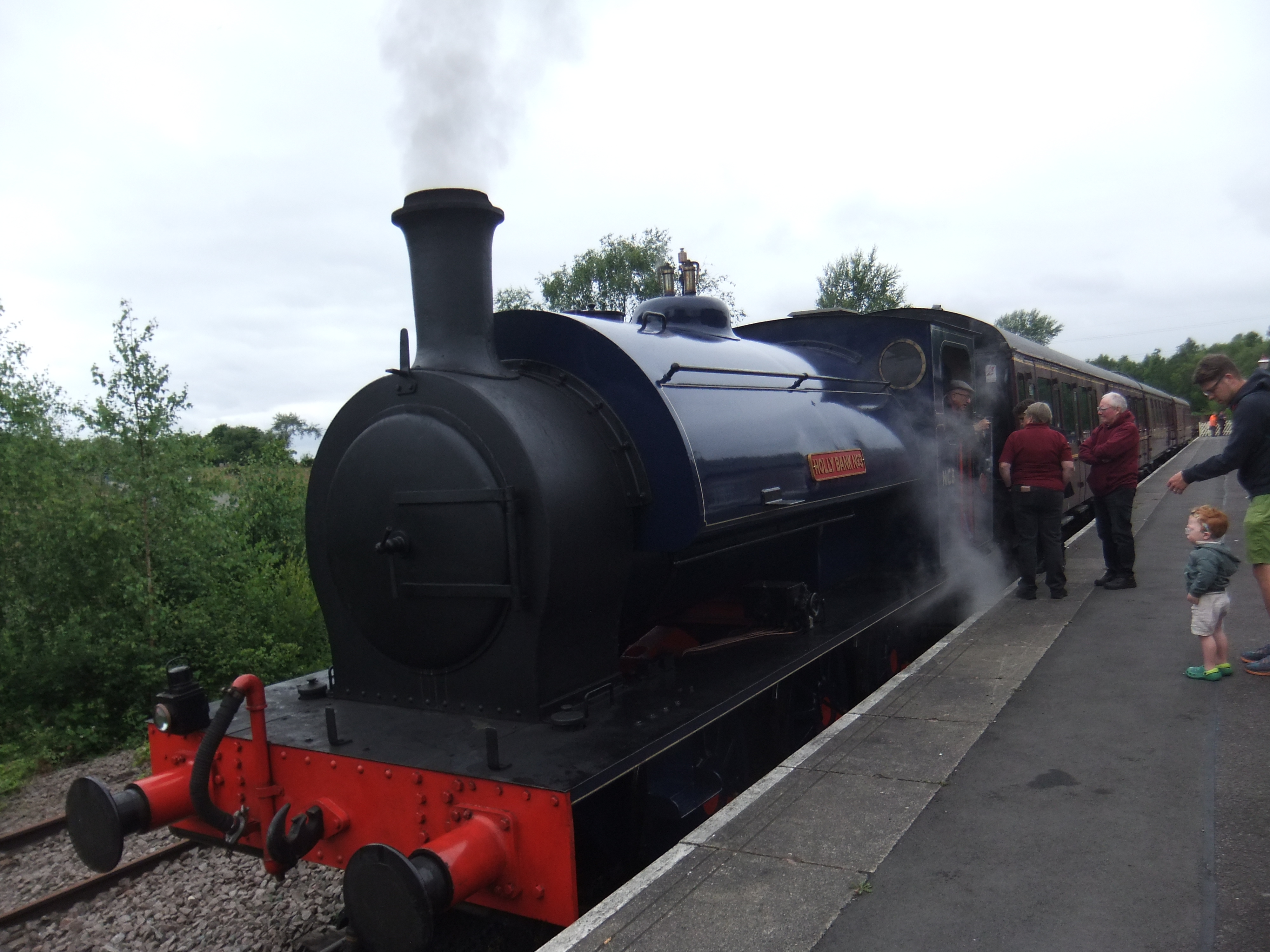
Holly Bank No.3 at Chasewater Heaths, 29-06-2024
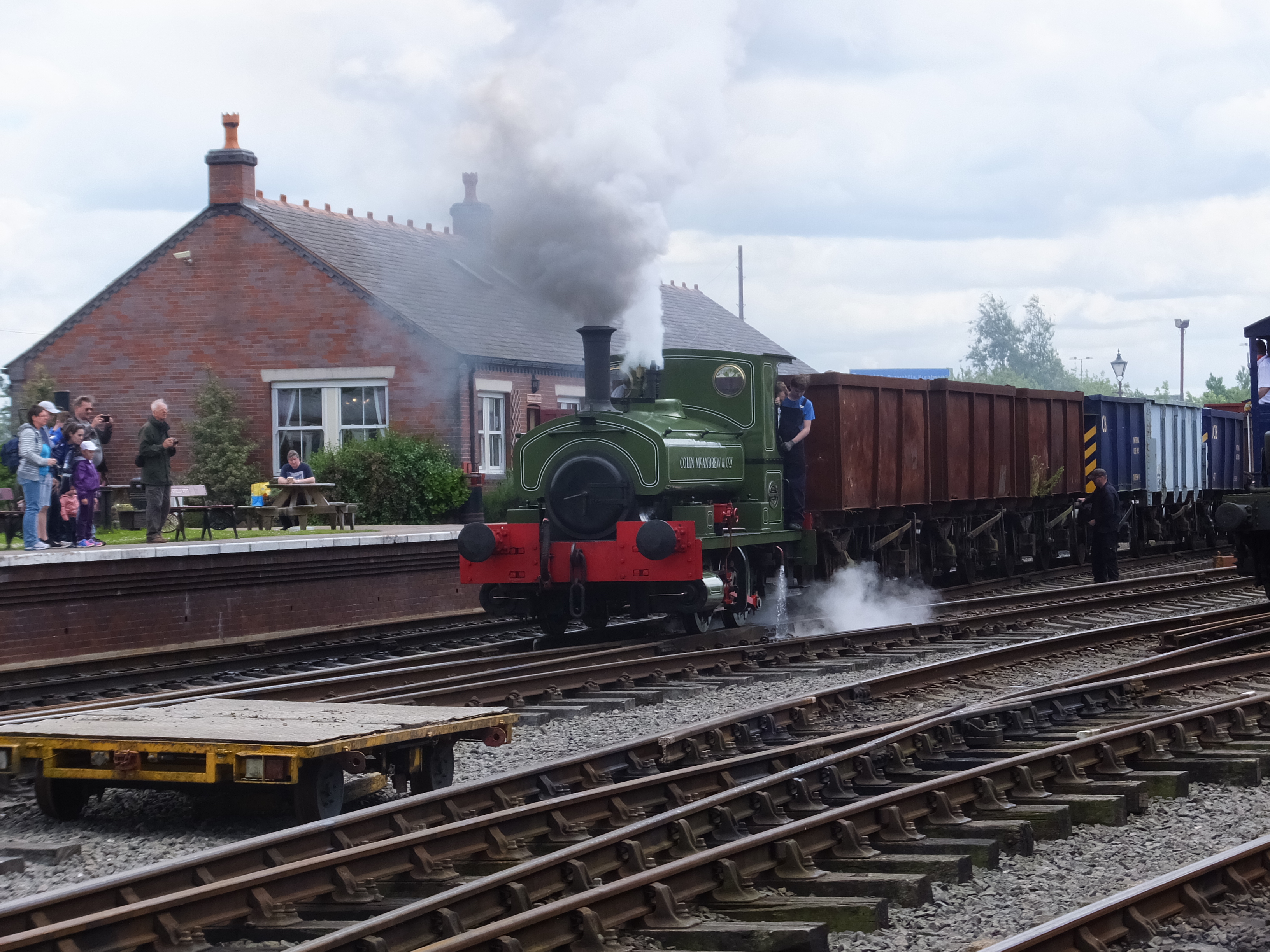
Barclay Loco ‘Colin McAndrew 1223-1911 at Brownhills West, Coal Train Day. 21-06-2015

Holly Bank No.3 at Chasewater Heaths, 29-06-2024
Barclay Loco ‘Colin McAndrew 1223-1911 at Brownhills West, Coal Train Day. 21-06-2015
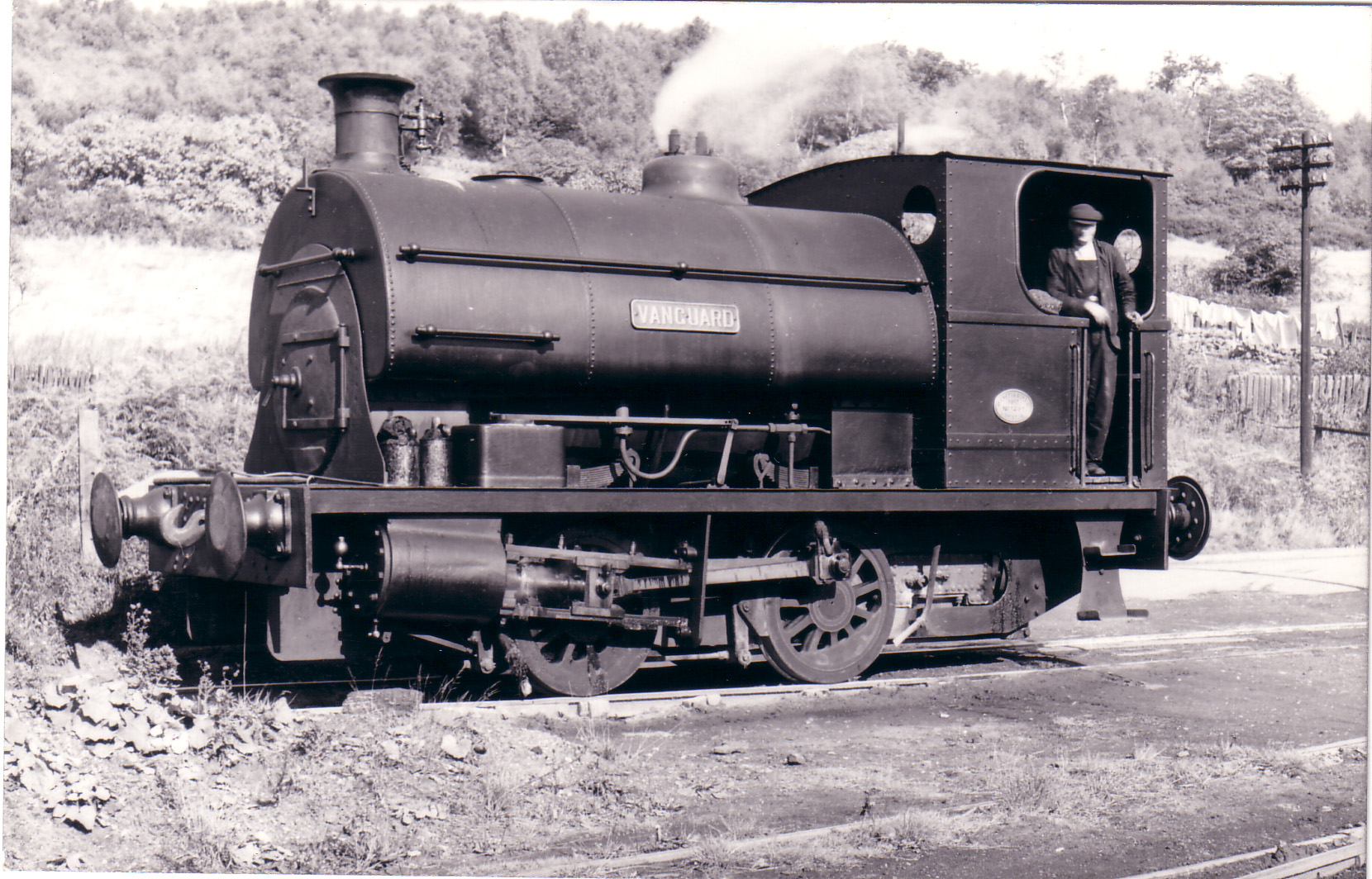
‘Vanguard’ 0-4-0ST Peckett 1491-1917 Brereton

Editorial
As the running season gradually winds down, the working members can look forward to another winter of further extension work and getting on top of the ongoing maintenance. As the number of working members has increased, the overall appearance of the railway has improved.
A large new sign on the A5 entrance to the park means that a large number of the general public have visited the railway for the first time, with the usual comment ;I only live up the road but I never knew you existed’. This in conjunction with a board at the entrance to the park advertising our excellent buffet service as well as train rides seems to have brought more people up to the top end of the park instead of them staying by the swings and slides. The overall reaction from the first time general public visiting us is very favourable, which can only reflect on the working members generally.
The vacant position of Publicity Officer has been filled by Kim Wilkins and she has made a start on getting the running dates published in the railway press. This is probably one of the most unglamorous jobs on the railway with a lot of effort going in for what can seem like very little reward. I would like to thank the previous holder of this post, Keith Day, for all the effort that he put into the job when he was doing it.
On the subject of members, as of the date of this magazine, we currently have the largest number of members in the Railway’s history with nearly 150 magazines going to different households, and this translates to approximately 250 current members.
Thursday 12th October saw the running of a special service train to Norton Lakeside Station for the planting of a Silver Birch tree in memory of Geoff Young, whose funeral took place the previous Friday at Sutton Coldfield Crematorium. A good proportion of working members attended as well as members of Geoff’s family for an oration and prayers. Geoff’s wife Brenda scattered Geoff’s ashes across the causeway. I’m sure that I speak for all the members of the Chasewater Railway in giving Brenda our deepest condolences at her loss.

Chris Chivers.
Loco Shed News
With the running season nearly over, the mainstay of the steam services have been carried out by No.4 Asbestos. The coal from Hatfield Colliery has proved to be a good British alternative to the Russian coal purchased in the past. The small size of the coal which was brought in as it was primarily to be used in the boiler of the Sentinel, and any further purchases will be made in a size to accommodate both the larger grates of Asbestos and any further restored locomotives.
The loco shed has also had installed an oil fired heater and ducting and this should provide a warmer environment during the winter months.
Steam Locomotives
No.4 Asbestos – With the coal problem sorted out, Asbestos has performed well during the season. Several new firebars have been purchased to replace a number of banana-shaped ones and several of the tubes have been replaced over the season. One of the springs has been mended and the pressure gauge has been re-calibrated and certified.
No.5 Sentinel – The repairs to the Sentinel have been progressing at a steady pace with the damaged area cleaned out and the front casting being inspected to find out the easiest way to mend the front casting of the locomotive. The front drive sprockets have been straightened out and the broken links of the drive chain have been de-greased. The rest of the drive chain has also been cleaned up in readiness to be re-assembled.

No.11 Alfred Paget – Work is continuing at a steady pace on the restoration of this locomotive and the fund raising efforts of the group are doing well. The boiler has now received a coat of primer to prevent any further rusting. The badly rusted base of the front boiler that sits on the steam chest has been cut away and a new piece of metal has been curved and welded into place. Various fitting studs on the firebox have been removed and the facings have been cleaned up and given a liberal coating of grease.
S100 – Work is still progressing at the usual rate, slow but steady, and Tony Sale is gradually putting more and more bits back onto the frames. It is still hoped to have S100 back on its wheels in the no too distant future.
Diesel Locomotives
Fowler diesel hydraulic No.422015 – The Fowler has had a number of outings this year on passenger workings. It continues to receive minor attention during the season and has held up well. Sooner or later the Fowler will need a major overhaul to cure the problem of ‘clag’ that is chucked out while running.
Fowler diesel mechanical No.410013 – A final coat of paint has been applied to the locomotive and the front cover panels have been replaced. The engine still needs some attention as well as the drive shaft. There is still no final date on when this loco can be returned to traffic.
L & Y No.1 – Work is still continuing on finishing the rebuild of the engine with further parts being obtained from our friends at Dormans. As soon as the body can be removed from the bay platform road then it can be shot-blasted and painted. The buffers have been removed to the shed where they have been stripped down and the springs cleaned and oiled. As they have been rebuilt they have been painted, waiting to be re-united with the chassis. Most of the brake gear has also been removed from the body to be cleaned and re-assembled.

No.21 – The first attempts to run the engine have met with mixed results. The problem seems to be with the timing chain set in the wrong position. This is being rectified but it could mean a new head gasket being required for part of the engine.
DMU Set – Cars 51412 and 51370 have now been reunited. They are currently having the roof painted light grey and the body is being painted green, the handles white and small yellow warning panels fro the front and rear driver’s cabs. The rotten portions of the bodies are being replaced as well as the route indicator being converted to four digit route indicator, before work starts on the interiors. Car 51412 is also receiving attention to the motors and control circuits.
Ruston Hornsby DM48 – The latest addition to the Chasewater diesel fleet has now had the body stripped down to allow access to the engine. A start has been made on locating a new cylinder head and various other parts.

Please note – the Museum will not be open this Sunday – 23-6-2024
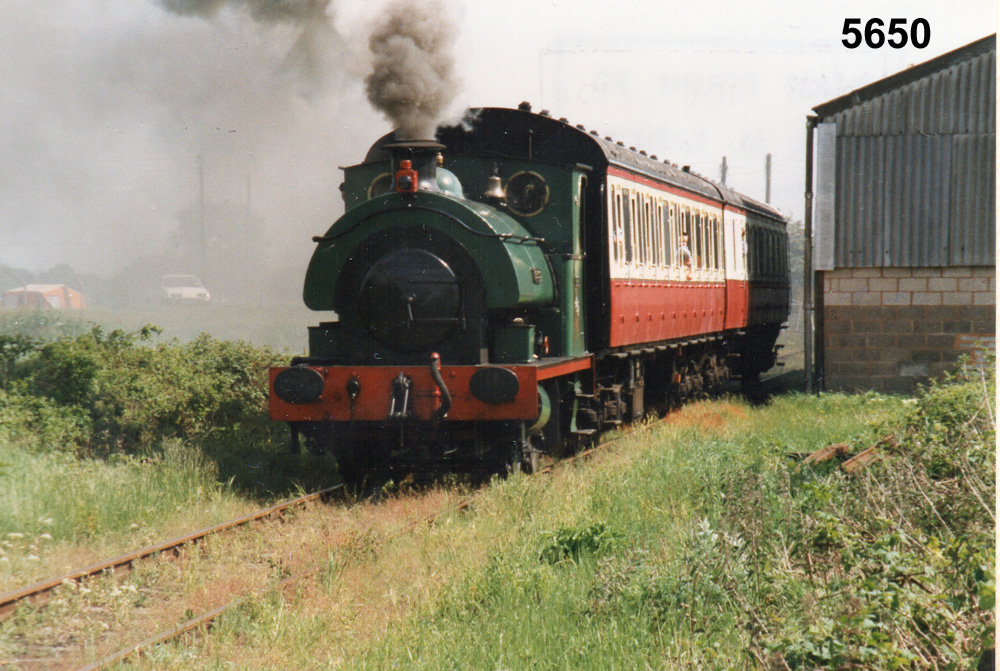
‘Asbestos’ Hawthorn Leslie 0-4-0ST 2780-1909 Passing the engine shed, before alterations!
Picture donated by David Bathurst

P Way News – Arthur Edwards
Since the last article was published the P Way gang has had a number of new members join us and the extra manpower has enabled us to carry on a number of tasks at a greater speed than originally planned. This has enabled us to fence in an area next to the lower compound entrance gates, so we now have a fenced in area for the storage of rail and other heavy items of P Way material.
Also the fence from the foot-crossing between the two compounds to the bottom compound has been realigned to allow the relaying of the sidings alongside the shed road. Work is also in progress to design the layout of a head shunt behind the current shed therefore allowing access to the shed from both ends.
Further down the line a number of fence posts have been replaced where they were broken down by trespassers onto the running line and along with bits of hedge growing up alongside is starting to make things much harder for the local idiots. The only bit of bad news about this fencing is that we can no longer use barbed wire where the public footpaths or public areas come up to our fence. I have mixed feelings about this as I know one or two of the members would like to use razor wire backed up with land mines!!
With the first decent spell of dry weather the perennial job of weed killing was carried out, and not before time as the track was starting to disappear beneath the undergrowth again. It has been proposed that a further application of the poisonous stuff be applied sometime later in the summer – weather permitting.
The P Way gang meet every Sunday at Brownhills West Station from 10.00am onward. Come and join us!!

Neilson Saddle Tank No.11 – Paget’s Progress – by Paul Whittaker
Neilson 2937/1882

Alfred Paget at Chasewater – June 1978
On the 13th January 1996, a freezing cold morning of -5ºC, I started the hard slog of removing the boiler tubes from No.11. After many a bruised finger and some colourful language, not to mention seven weekends at it, the final tube fell free from the boiler tube plate at 4.00pm on Saturday 6th April.
After long deliberation and much discussion I and several co-workers concluded that the next move would be to remove the water tank, thus allowing access to the boiler for closer inspection. As the cost of a crane was as yet out of our reach, we proceeded to jack up the tank until such time as it would be possible to slide it safely down two lengths of rail to its resting place on the platform in the engine shed compound.

The next job was to remove the boiler cladding and insulation, a dirty job but it had to be done. Meanwhile amongst the organised chaos that is generated when stripping a steam locomotive down, we removed the dome plate. This was in order to provide access to the interior of the boiler for a very slim young man, otherwise known as Christian Hatton to get inside and remove the remaining collapsed tubes, and around 3cwt of rust. While all this was going on, the washout and fusible plugs were removed from the firebox. The steam cleaner proved to be invaluable in removing the rust and crud from the water jacket around the firebox. As a result of all this, the boiler is now ready for the boiler inspector to cast a cursory eye over it a prelude to a proper test inspection.
As work progressed on No.11 that magic word ‘money’ reared its ugly head again, and after some serious consideration my very good friend and colleague David Borthwick and I decided to start a fund to raise the necessary cash to renovate Alfred Paget, and entitled the fund ‘Neilson Steam Aid’, to which my good wife Janet will administer and collect donations. In addition to this, Dave has put together a Stock Book, which documents basic information on most of Chasewater Railway’s rolling stock and locomotives. This booklet is on sale in the station buffet at 75p per copy.
On a more personal note, I would like to say that I am overwhelmed by the help and support, to say the least, and of the amount of technical information that I’ve received from fellow members at Chasewater, without which I would have been like a beached whale. And so I would like to take this opportunity to sincerely thank all of those involved with the on-going renovation of Neilson Saddle Tank No.2937, otherwise known as ‘Alfred Paget No.11.
Alfred Paget last steamed in 1982, and is still a way off yet – in 2012.

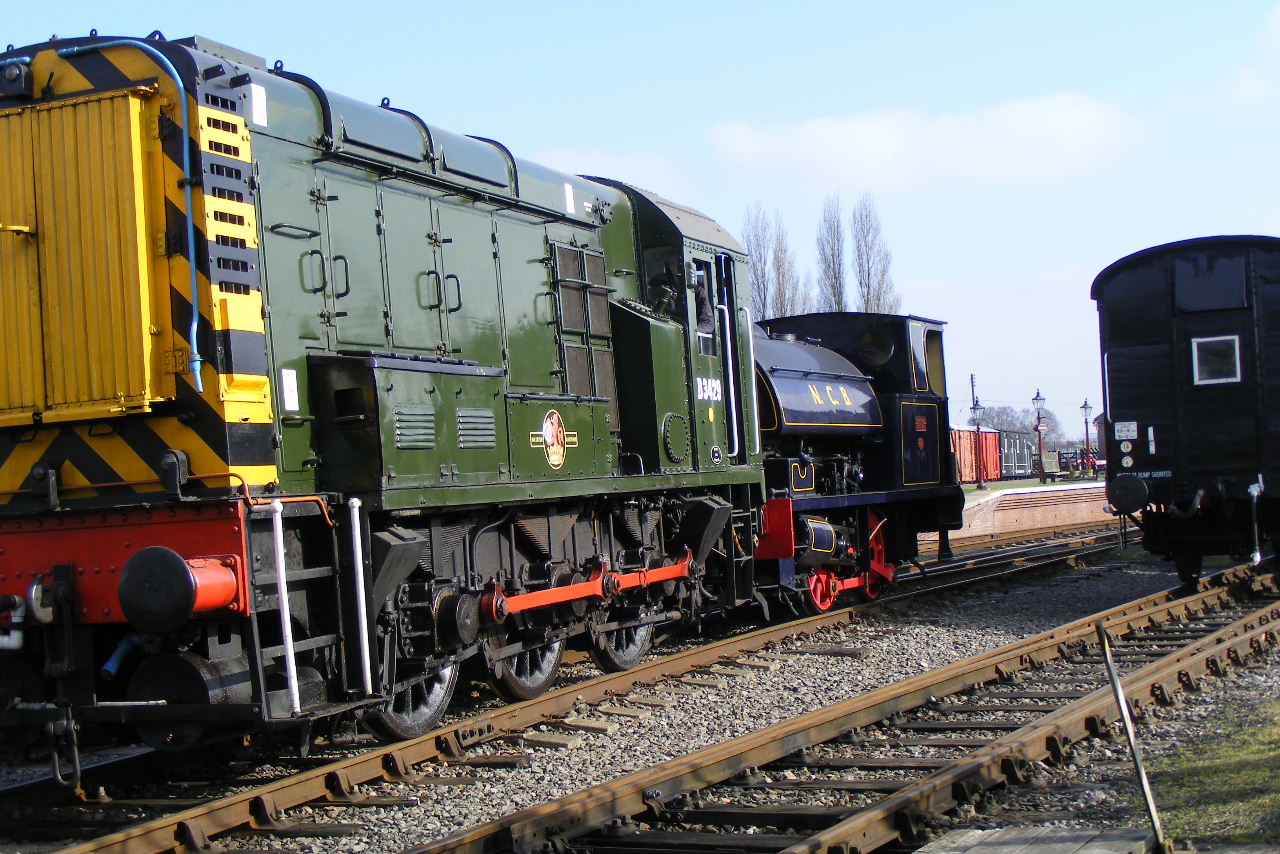
Class 08 and Bagnall ‘Linda’ 2-3-2011
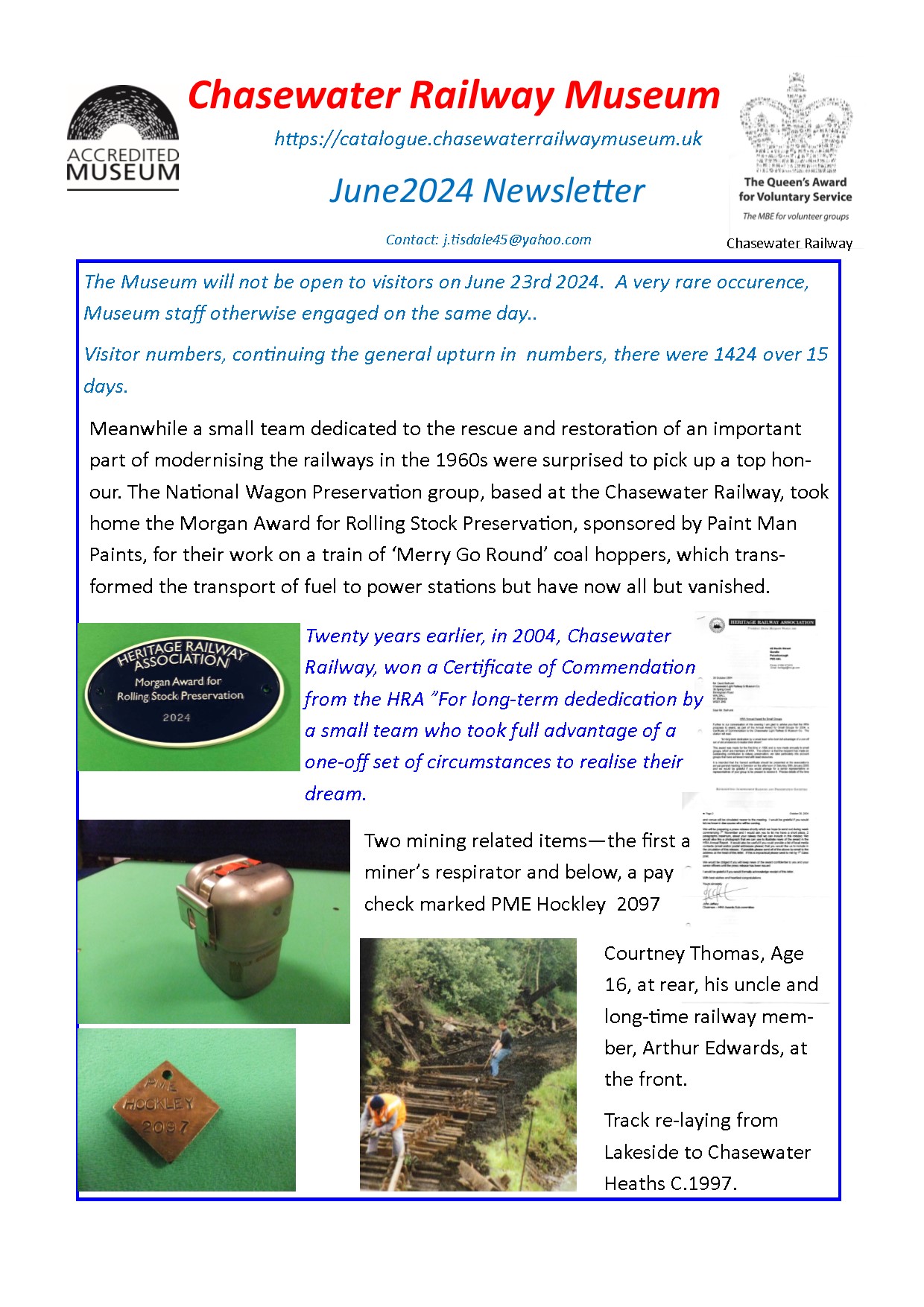
The Museum will not be open this coming Sunday, 23rd June 2024
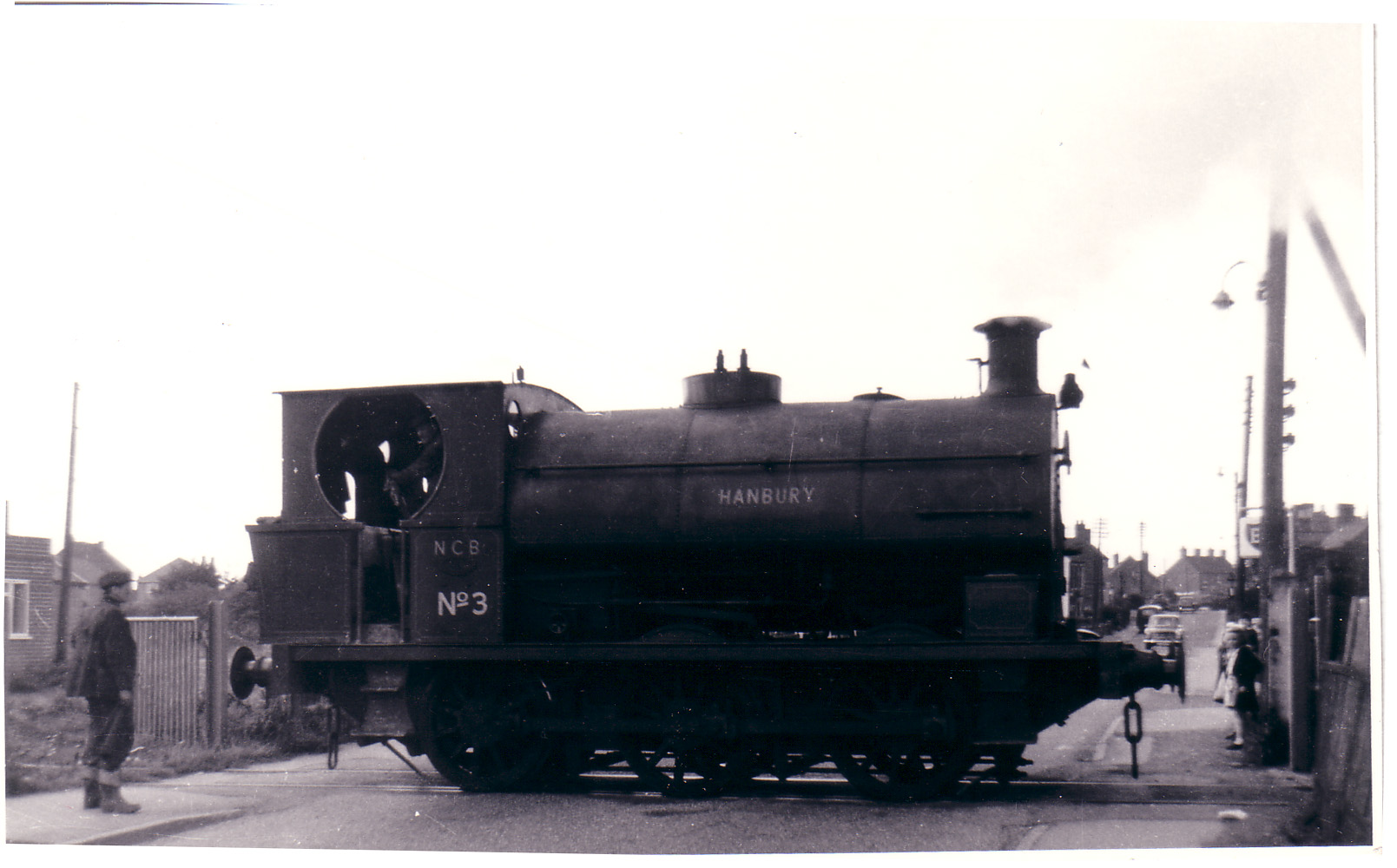
‘Hanbury’ No.3 Peckett 0-6-0 ST 567-1894 Crossing Brownhills Road, Norton Canes.
191 – Chasewater Railway Museum Bits & Pieces

Health and Safety Matters
Those of our members who are associated with other preserved railways cannot fail to have noted from their magazines the increasing importance of health and safety. This sudden interest in safety awareness is neither coincidental nor accidental, it is a direct consequence of legislation.
Along with our sister organisations, we have had to prepare and submit a Risk Assessment for approval by the Health and Safety Executive. To operate as a passenger-carrying railway without having obtained the necessary acceptance of our Risk Assessment is unlawful and would expose the ‘management’ to prosecution.
Our Risk Assessment, underpinned by the proposed revised Rule Book, is now in the hands of HMRI for consideration and, hopefully, approval. In the interim, the Company is in possession of a temporary exemption which permits us to operate lawfully pending a decision by the Health and Safety Executive.
This situation has arisen in consequence of the Railway (Safety Case) Regulations 1994 (SI 1994 No.237) which applies to all passenger-carrying operators, including operators of heritage railways. Despite the ‘universal’ nature of the regulations, it has been generally recognised that the safety implications (and risks) associated with a preserved railway such as ours, operating with a 20 mph speed limit, are significantly different to a railway running trains at 125 mph. Yet in many respects the considerations are the same – it is only a matter of differing magnitude and scale. For example, the need for operator protection when using electrical equipment is as important to a Chasewater Railway volunteer as it is to a RailTrack employee, the risk to the individual at the time is the same if something were to go wrong.

Most of us have a degree of cynicism regarding the ever-increasing effects of legislation on our day-to-day operations. The ARPS and other supportive bodies have fought hard (and are continuing to fight) on our behalf to ensure that preserved railways are protected against some of the more onerous obligations being placed – quite properly – on our bigger brothers. For this we are most grateful. But at the same time we need to recognise the simple fact that running trains – in its widest definition – is potentially dangerous. We need to ensure to the utmost best of our ability that risks to both the public and our members are minimised and that our practices and policies are driven by safety considerations.
To some degree it’s a matter of good sense and adopting practices which will ensure our safety – whether during the lifting of sleepers, working on the footplate, or preparing sandwiches in the refreshment room.
The preparation of the Risk Assessment involved a number of ‘key players’ with Andy Mould taking the lead. As the process developed, the point of the exercise came more clearly into focus. The document includes a commitment to introduce changes in certain areas of activity, including accountability and the maintenance of proper records. Sometimes it proves very valuable to examine carefully what we do, why, and how ‘dangerous’ it is and how we might make changes to reduce potential risks to volunteers and the travelling public.
During the forthcoming months, it will be necessary to introduce the changes required to honour the commitments contained in the Risk Assessment. Most will be self-obvious improvements in our working practices and procedures. Those members or groups of members affected by such changes will be informed directly and as widely as possible so that there can be no areas of doubt or uncertainty.
Stop Press
The following is the text of a letter dated 13th May 1996 from the Health and Safety Executive:
“RAILWAYS (SAFETY CASE) REGULATIONS, 1994
Further to your conversation…. On 24 April, I am pleased to inform you that the Health and Safety Executive has now completed its evaluation of your application for exemption from the above regulations, and has found it satisfactory. Accordingly, I enclose a certificate exempting the Chasewater Railway from regulations 3, 4 & 5 of the Railways (Safety Case) Regulations, 1994.
The assessor also asked me to commend you on the responsible approach towards the running of (the) railway which is demonstrated in your application.”

How we look to others
In the past, our Railway has been criticised for its ‘appearance’. We have been seen as just a little short of a scrapyard. Not that we are on our own! Such is the very nature of railway preservation, with locomotives and rolling stock at various stages of dereliction (with little or no prospect of restoration ‘within the foreseeable future’) and a whole array of items and equipment which might, perhaps one day, fins some form of use.
1996 has been declared a year of good old-fashioned consolidation, presenting the opportunity of finishing unfinished jobs without the distraction of some major enterprise. Looking over the site, particularly at Brownhills West, the scale of improvements is immediately apparent compared with say, 12 months ago. A concerted effort to tidy the whole place up is producing dividends at last. The amount of rubbish and scrap disposed of has been impressive, to say the least.
We still have a long way to go, however. Some (perhaps even ‘most’) of our working members still seem unable to adopt the culture of tidiness. My message is worth repeating: please do not simply leave YOUR rubbish for someone else to clear up. And if you see rubbish, litter and the like – particularly in the station areas – please take the trouble to pick it up and drop it in a bin. Empty drinks cans littered around the site leave an appalling impression. Take pride in your railway.

The 1996 Annual General Meeting
The 1996 AGM agenda was completed in just 6 minutes. As a formal business meeting it began at the appointed time; those who arrived late missed it! I am delighted to welcome Arthur Edwards to the Board as a Company Director. His support has always been much appreciated and I am confident that Arthur will have much to offer to the future management of the Railway.
For those present at (or arrived later) the AGM, perhaps the more interesting part was the traditional open forum which followed and resulted in discussions on the usual wide range of subjects. The thorny problem of vandalism generated quite a lot of feeling.
Social Evenings
My personal commitments cry out for the introduction of an 8-day week (but with a 3-day weekend of course). Thus, I cannot attend every event, much as though I would wish to. But how pleasing it was to join so many working members and friends at the April Social Evening, with some interesting slides and a pleasant drink or two on offer. The Railway can only be strengthened by such events, especially as the older members in particular have a massive fund of knowledge, information and anecdotes to share with our colleagues.
“Chasewater News”
Building on the excellent work of his predecessor, our current Editor is producing a magazine which is going from strength to strength. Of course, access to modern technology is the key to the appearance and layout of the magazine – despite the curious effects which from time-to-time result owing to the use of an American spell checker!
Appearance and layout are two aspects only. The Editor can only produce an interesting magazine if he has the materials to include. On his behalf, can I make a plea to members to provide articles – especially articles about the Railway itself – for inclusion in the magazine. Don’t worry if you think that your grammar or spelling is poor, it doesn’t matter. Chris will ensure that your material is corrected before publication (well, that’s the theory at least!). Similarly, if you have any photographs (whether ancient or modern) which might be of interest, then please let Chris Chivers know.

On the Volunteer Front
The Annual Report presented to the 1996 AGM included a reference to the need for working members to respect one another’s work. For a variety of reasons, some valid but many unsustainable, the closing months of 1995 produced a Chasewater version of ‘A Winter of Discontent’. Perhaps it really did have something to do with the weather. With the onset of spring, the spirit of co-operation and harmony between working members has improved beyond belief. Doom and gloom have been replaced by confidence and optimism. With so many positive things in hand or on the horizon, it is vital that this spirit is maintained and developed. When all said and done, we’re supposed to be enjoying ourselves! Additional working members are always welcome – and they need to feel welcome. All Departments are always on the lookout for additional resources, whether manpower or material-wise. If you feel able to assist in any way, please let someone on the Railway know next time you visit Chasewater.

The last three photographs are of ‘our’ railway trackbed on the other side of the M6 Toll road, the final one, with Ellie, was taken in the area of the old Brownhills Midland station.
A reminder: The Museum will not be open on June 23rd 2024

‘Nuttall’ 0-6-0 ST Hunslet 1685-1931 Ex Mowlem 1948 Cannock Wood

Editorial
So far this year the weather has been kind to us, with the exception of the Spring Bank Holiday, and unlike 1995 this has been reflected in the ticket receipts so far received. The number of passengers carried for the first two months of the season is significantly up on the same period last year. This has also had a knock-on effect within the catering and shop sales areas. It is welcome that our core business is starting the season off so well. If the trend and the weather keep up then the Railway should be back in profit by the second half of the running season.
Plans are also in hand for the further acquisition of track that should take the Railway to the end of its current lease if not further. There is no doubt that the Railway is enjoying a higher profile with the general public and railway fraternity. This has been dramatically shown by the speed of membership renewals and the number of new members joining since January. Also it is welcoming to see a number of old members whose membership has lapsed taking a renewed interest in the Railway. I would like to welcome all the new members who have joined this year and I hope that you will feel at home at Chasewater.

Loco No.8 at West Cannock – With kind permission geoffspages.co.uk
The Railway has had fewer instances of trespass over the past few years than used to be the case, and when it has occurred it has taken the form of a nuisance value rather than really serious damage, even though the damage caused has been b—– aggravating and has wasted our time in clearing up afterwards. However we look at the results of a break-in, the security of the site is still going to be a major headache. Do we spend a large amount of cash (which we haven’t got) in re-fencing the compounds, only to have it demolished within a few years by the BNRR (M6 Toll), or do we try to make do and mend until the BNRR issue is finally resolved. The dilemma is not an easy one. So far this year apart from a number of coach windows broken, and one raid into the buffet, the vandalism and theft is nothing compared with the break-in to the shed several years ago.
After the AGM, which was held in much more comfortable surroundings than in past years, a pub, the following people were elected:
David Bathurst Chairman
Steve Organ General Manager
Chris Chivers Financial Controller
Bob Duffill Commercial Manager
Andy Clegg Company Secretary
Arthur Edwards Director
Dave Ives Director
As Arthur is the new member to the Board I can only wish him the best and hope he doesn’t get as much grey hair as I’ve got!
Chasewater News is edited by Chris Chivers.

Loco Shed News
This year seems bedevilled by problems in trying to get steam traction out in traffic. The first problem was duff coal, a test batch was sent to us and then a further 10 tons was sent in replacement for the original 10 ton delivery. After spending an afternoon shovelling it out of the mineral wagon to send back I am still trying to get some feeling back into my legs. The new batch of coal, yet again British, as no Russian is available, has proved more volatile therefore freer steaming, but the problem of clinkering still remains. The diesel department has received yet another locomotive courtesy of Mr. A Clegg and this is stabled on 2-road in the top compound.
Steam Locomotives
No.4 Asbestos
The Boiler Inspector has seen Asbestos and subject to a small amount of welding around the bottom of the firebox along with the replacement of several tubes all looks well. If the Inspector gives it the all-clear after the steam test, Asbestos should be back in traffic by the time this mag is published.
No.5 Sentinel

Sentinel in original livery – 1
After several steamings the Sentinel suffered from a broken drive chain. This has been a blow to Nigel Canning after putting so much work over the past two years into the Sentinel’s overhaul. Apart from the broken drive chain the crank case and drive sprocket has suffered some damage and the full extent of the damage is still being assessed. Members of the loco department are looking into finding replacement links for the chain so therefore salvaging as much of the original chain as possible.

Sentinel in original livery-2
No.11 Alfred Paget
Work on Alfred Paget is continuing at a pace. Since the spring mag all the tubes have been removed and the saddle tank has also been moved onto the platform, along with the boiler cladding, cab and bunkers. This has allowed the boiler to be partially lifted out of the frames so that the stays can be checked. Along with the rotten smokebox being removed the boiler has been cleaned internally and externally. It has been decided that the work on restoring Alfred Paget will be funded separately and any offers of help and/or donations can be made to Paul Whittaker whose wife Janet is acting as treasurer for the Alfred Paget Fund.
S100
Tony Sale has now completed replacing the slide bars on S100 ready to re-install the cross-heads. This has included the manufacture of new slide bar shims so that they can be lined up correctly with the pistons. The framed should be receiving a final coat of paint along with the wheels before the bearings are checked so that the wheels can be put back into place.
Invicta
This locomotive is still stabled on the end of one-road and is still awaiting attention from Mike Wood as to its long term future. This locomotive provided the Railway with some sterling service before its boiler ticket ran out and it would be useful to see it back into traffic sometime in the future.
917
This has received a second coat of paint courtesy of Dave Borthwick and the Railway must think of the long term future for this engine, considering the repairs needed to the boiler.

Diesel Locomotives
Fowler diesel hydraulic No.422015
The Fowler is still running even though there are signs of water leaking into the sump. The overall work that the loco is carrying out is being kept to a minimum while the problem is being traced.
L&Y No.1
The body of No.1 has now been lifted out of the bay platform and has been prepared ready for needle gunning. One set of buffers and draw gear have been removed and are in the shed after being cleaned and painted. The brake gear and sand boxes have been removed as well as the wheels. A new set of spoked wheels are due to replace the current solid wheels so bringing No.1 back to its original condition. The gear box has now been stripped down and is undergoing repairs before being installed. The engine has now had the clutch mechanism attached and only awaits a few minor parts before being completed.
No.21
Work is still continuing on the restoration of No.21 and is only subject to the time available from Jonathan Clegg & Co.
DMU Set

Ken Dyde with the DMU at the new Lakeside Station
The bar is now all but completed and the broken windows were re[laced within 24 hours by Ken Dyde & Co. A number of additional spares have been purchased from Tyseley depot, including a replacement engine if required.
Ruston Hornsby DM48
This has recently arrived on site and a few basic jobs have been carried out to tidy up its appearance while an engine head and other spares are located.

Peckett ‘Teddy’ giving brake van rides, Easter Sunday, 05-04-2024 from behind the Heritage Centre at Chasewater Railway.
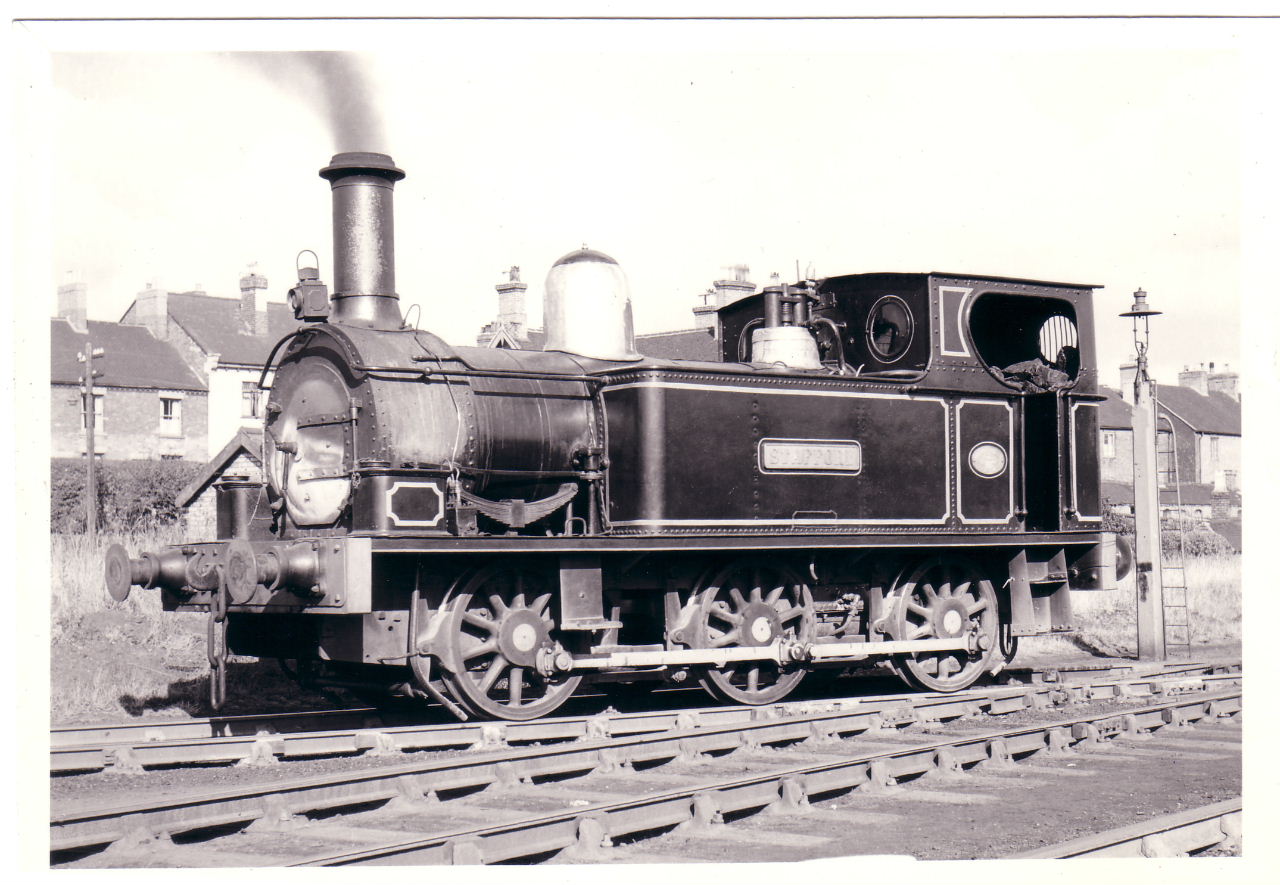
‘Stafford’ 0-6-0 ST Hudswell Clark 319-1889 Bought from T.W.Wood, Dealer, in 1915. Still at West Cannock Colliery, Hednesford 1957, since scrapped.

From the Board Room – David Bathurst – Chairman
Norton Lakeside Station Opening
After a couple of false dawns, the Railway has at last achieved its most significant ambition. We now have two ‘proper’ stations.
We can now advertise our operations on an entirely different basis, way beyond that of a mere leisure railway. Furthermore, in taxation terms, we are now recognised as a passenger railway. Our passengers can now be offered the additional option of convenience travel to the NorthShore, where vehicle cannot (or at least should not) interrupt their peaceful enjoyment of the area.

It was heart-stirring to see so many friends and guests at Brownhills West for the official opening ceremony on Saturday 16th December 1995. What was equally gratifying was the sight of ‘Asbestos’ at the front of the train, after a period of remedial works. Well done indeed to the volunteers who ensured that this locomotive was ready in time. The ‘Norton Collier’ headboard, manufactured specially for the occasion, added to the significance of the day.
With the train virtually full, departure was just after the advertised time of 11.00am, with Nigel Canning and Les Emery specially rostered together on the footplate for the event.

A leisurely rate down the line afforded some of our less regular supporters and guests the first view of the substantial works which have been necessary to reinstate the Causeway. Entrance into Norton Lakeside Station was accompanied by the sound of exploding detonators. The modest facilities of the new station belie both the cost and effort which has gone into providing this three coach platform. Despite the intensely cold and windy conditions (to which our members have become accustomed over many months), the Chairman of Lichfield District Council, Councillor John Walker, carried out a short opening ceremony before the photographers were let loose. To enable the photographers travelling on the train to capture the occasion, the train made a second ceremonial entrance across the Causeway into the new station. Some of the resulting pictures duly found their way into the local press.
Following the return journey, the Railway’s working members and official guests, including a number of Lichfield DC Members, enjoyed a buffet lunch, during which further formalities were completed. The return journey saw Councillor John Walker at the controls of ‘Asbestos’, although this fact was kept from his Council colleagues who may have preferred to find other transport back home!
Councillor Walker clearly enjoyed the day, and his letter to me after the event is reproduced for the information of members. To ensure that members do not start wondering whether they have failed to notice a new electrification scheme, it should be mentioned that Councillor Walker’s previous footplate experience involved a diesel-electric, rather than an outright electric locomotive!

To mark the occasion, the Railway commissioned special brass tickets which are capable of adaptation as key fobs. Previous editions of ‘Chasewater News’ have included articles on the causeway and construction of Norton Lakeside Station, and this article does not set out to repeat the story. Nor would it be appropriate to single out any individual members in respect of work undertaken either on the construction work or the official opening arrangements.

The events of 16th December 1995 are a testimony to all the Railway’s working members, whether they be regular or occasional visitors. The achievements celebrated on that important day demonstrate just what can be done by our membership and serve as an incentive for the further expansion of the Railway.
To everyone concerned: Congratulations and Well Done.
Councillor Walker’s Letter
Dear CLR members,
Can I convey my congratulations to all Chasewater Railway members for the excellent morning of 16th December 1995 on the occasion of the official opening of the new station at Norton Lakeside. Despite the bitterly cold weather Sandra and I enjoyed it tremendously and it was a particular highlight for me to undertake the return journey on the footplate. It brought back memories for me when in 1982 I drove an electric express train from Derby to Sheffield but you can’t beat steam, can you?
Here’s hoping that your organisation will go from strength to strength and that we as a Council will have co-operation now and in the future. Please convey my best wishes to all those at Chasewater and here’s wishing you all the best in 1996.
Yours sincerely,
Cllr. John Walker
Chairman of Council
Lichfield District Council
Lichfield District Council Plan
Members will recall from a previous edition of ‘Chasewater News’ that the Railway has objected to the Lichfield District Local Plan, insofar as – unlike the Walsall MBC Unitary Development Plan – it makes no reference to the Railway in context of ChasewaterPark.
The Railway was represented by the General Manager and myself (Steve Organ and David Bathurst) at the Public Local Enquiry on Thursday 25th January 1996, during which we sought to justify our objection during a session lasting some two and a quarter hours. The District Plan is fundamentally concerned with land use issues and we shall see, in due course, whether the Inspector is persuaded that the extent of our operations within ChasewaterPark is sufficient to merit an individual reference in the approved District Plan.
The Lichfield DC representative confirmed that he recognised that the Railway ‘had a place’ on the North Shore (thereby dispelling doubts previously expressed regarding our track relaying to the extent of our lease) and that the Council fully accepted that the Railway enjoys planning permission for its operations on the North Shore. The Council’s argument, based on their view of planning law, was that the Railway’s future development should be controlled by planning advice, and that a separate reference to the Railway in the District Plan is accordingly unnecessary. We do not agree; we are seeking a far more positive commitment from the Council, hence our objection.
Working Members’ Meeting
A further working members’ meeting was held at the Pear Tree public house on Wednesday 10th January 1996, with an encouraging number of working members present. Again, members had the opportunity of raising any matters of interest. Perhaps the item which attracted most discussion was concerned with locomotive restoration, particularly as ‘Asbestos’ loses its boiler certificate during 1996.
In addition to formal meetings, there was a general view that more social events should be held locally, including slide-shows, talks, etc.
Some of our members have a massive bank of photographic and other materials which might be shared with other members ‘over a pint’.
Great British Passenger Timetable
Members who have access to the Great Britain (All Lines) Passenger Timetable will be aware of the section on Private Railways. Although this section includes information on the ‘First Division’ private railways it appears to me that the publishers might be sympathetic to include Chasewater Railway, particularly in view of the opening of Norton Lakeside Station.
I am delighted to be able to report that following appropriate negotiations, Railtrack have agreed to include a short entry in the June 1996 Timetable – and thereafter in future editions. I don’t know how many purchasers actually read and absorb the section on Private Railways, but two things are certain; our status as a passenger railway has been acknowledged by Railtrack, and our existence will come to the notice of an extremely large and diverse number of readers.

P Way News – Arthur Edwards
The start of the New Year has seen some of the regular winter jobs being taken in hand. With several of the Sundays in January being a total washout due to the terrible weather, trying to dig ground frozen solid in winds with a wind-chill factor of minus (i.e. brass monkey weather) is no fun at all. The shed compound has been receiving some attention in the form of a tidy up, with special attention being paid to clearing the overgrowing vegetation from the fence behind the platform. The cab of 917 was moved farther back and all the rubbish, old rotten timber and some split sleepers were burnt. During the tidy up several parts from S100 came to light under the ferns and debris, and also as part of the clearance all loose scrap has been gathered together and a reliable scrap merchant has been asked to collect it. One of the activities which Tom and myself also got round to doing was to tidy up the loose sleepers lying around, which is not an easy job at this time of year. Wet sleepers are at least double the weight of dry ones.
The double-decker bus which has been on site for a while has now been taken to pastures new, so giving us more ground space so that we can ready the site for the future installation of new sidings. The provision of extra space for stock is now becoming as increasing problem as the activities of the Railway continue to grow.
The usual battle with the fence cutters will be joined in earnest within the next few weeks in the run up to the start of the running season. Parts of the hedge planted last year by the Forest of Mercia group are starting to grow, and with a bit of time should start acting as a deterrent to the local idiots who think it is a good idea to chop down fences.
The P. Way gang meet every Sunday at Brownhills West Station from 10.ooam onward. Come and join us!!

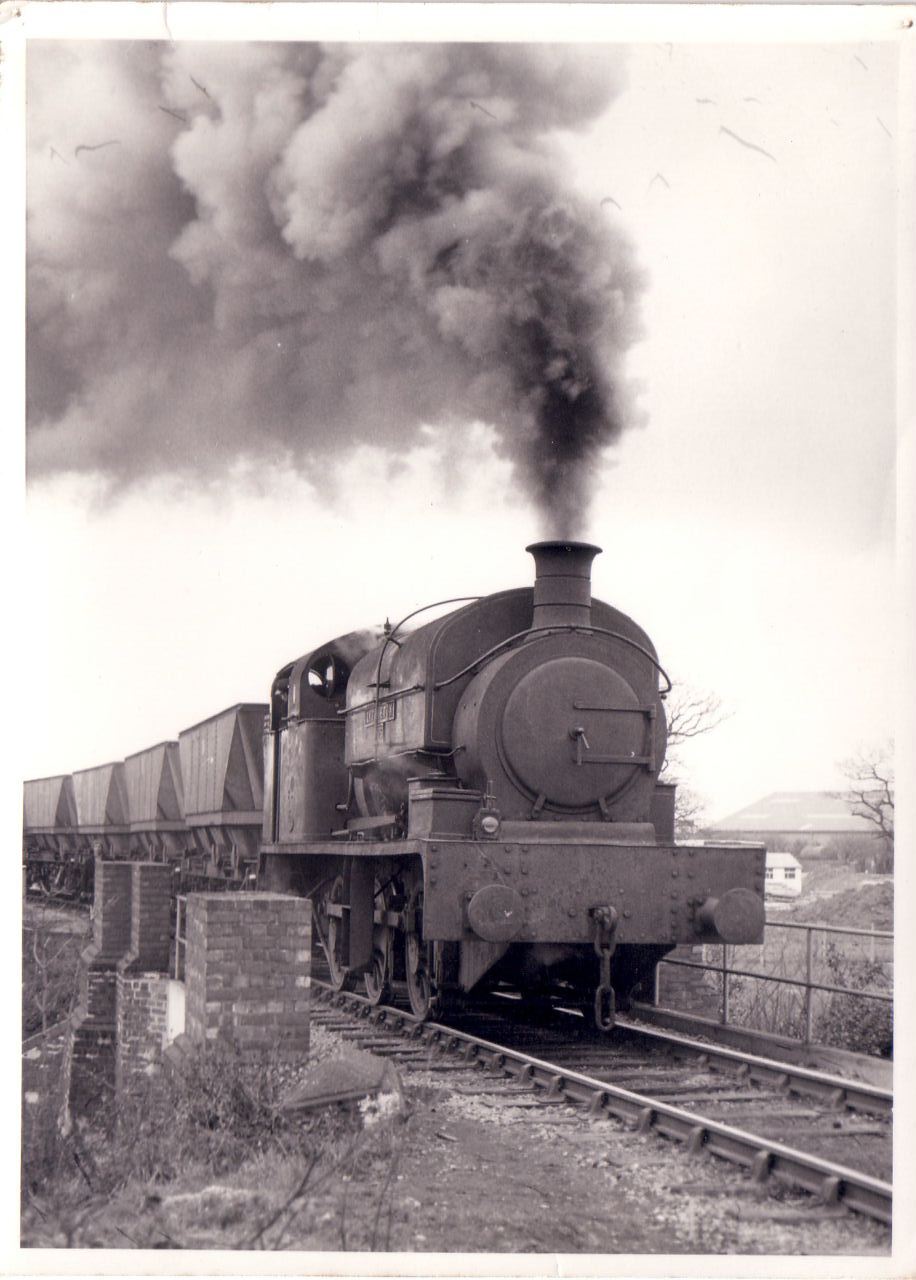
No.5 0-6-0STManning Wardle 2018-1922 Littleton
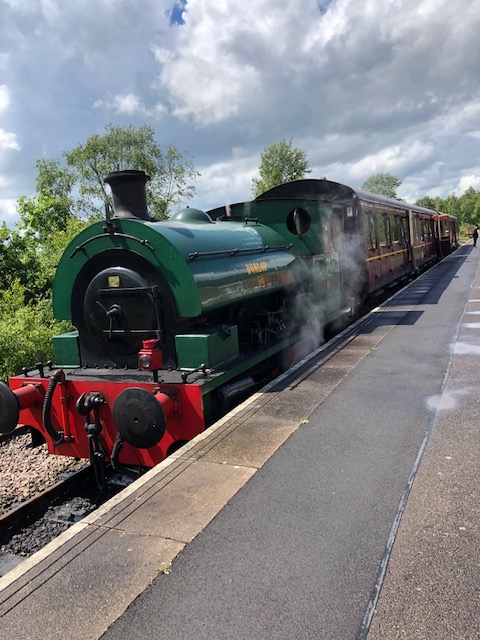
Bagnall Loco Dunlop No.6 0-4-0ST 2648-1941
on the first train to arrive at Chasewater Heaths 27-5-2024

Editorial – Chris Chivers
On December 16th 1995 a long-awaited dream of the Railway became a reality; the official opening of Norton Lakeside Station took place. The Chasewater Railway can at long last run from Station A to Station B. With the possibility of further track donations the Railway will be able to run over the entire length of the land which it currently leases. Hopefully, further parts of the original track bed can be obtained and the line extended first to Church Street and then to Anglesey Wharf. Great strides have been made over the past number of years to upgrade the Railway, and we have now moved into the middle rankings of railway societies in this country. We are no longer an occasional weekend steaming preservation society but we can now offer a regular Sunday service during the running season to passengers who wish to travel to the north shore of Chasewater.
1996 I’m sure will be a year of consolidation for the Railway, and in this, my tenth year as a member of the CLR, I have seen a lot of progress along with the occasional cock-up at Chasewater. When I first came to the Society the feeling amongst the membership at the time was one of ‘the Railway is run as our hobby and for our amusement only’. (Going through the magazines from day 1 I never got that impression – a great deal of work has been done over the years by a group of not too many people – a large debt of gratitude is owed to all of them!) This has changed over the years to a more business-like attitude, so fuelling the growth of the Railway. It will be interesting to see what happens in the next ten years.

Loco Shed News
Work is continuing at a steady rate on all the locomotive restoration projects, with some work being done to stop any further deterioration on several of the Company’s engines. Unfortunately the 16th December did not see a double-headed steam train on Chasewater metals, but it could happen in the near future.
Steam Locomotives
No.4 Asbestos – Asbestos returned to traffic in time for the Santa Specials after the refitting of part of the main steam pipe. The amount of maintenance carried out on the locomotive will now be cut back to a minimum as Asbestos’ boiler ticket is due to expire this year and a major overhaul will be required. All being well there should be sufficient funds to have the boiler sent away if need be, so reducing the overall time needed to be spent in the works.
No.5 Sentinel – The Sentinel has now been steam tested and should be returned to traffic within the next few weeks. After the initial steam test several minor adjustments were required to the steam brake, along with the tightening of a number of glands. All the minor adjustments should be done to Nigel’s satisfaction within the next few weeks.

No.11 Alfred Paget – No.11 has been moved from the top compound to the shed road where its boiler tubes are being removed. The operation is taking some brute force to move them due to the number of years that they have been in place. This is due to the length of time that Alfred Paget has been standing idle allowing the tubes to ‘flake up’ and rust in solid. Once the tubes have been removed a thorough inspection of the boiler can take place, with the long term view to bring another Company vehicle back into traffic. Most of the initial work is being carried out by Paul Whittaker who would be grateful for any additional assistance.

917 – Dave Borthwick has started to carry out some remedial work on the rolling chassis of 017 including repainting, so as to stop the weather taking its toll of the metal work. Another job for the near future will be to remove the tubes from 917’s boiler so allowing the boiler inspector to have a look at both 917 and Alfred Paget at the same time. Also it has been suggested that 917 could be called ‘Brightson’ (yuk!) as it originally came from Albright and Wilson at Oldbury.


Hudswell Clarke (431) – The fund (?) set up for this locomotive has now reached a reasonably modest amount and there is now some talk of making a start on the restoration of the only other 0-6-0 locomotive at Chasewater. After its coat of paint last year there has been very little further deterioration to the metalwork on this engine.S100 on arrival

14-11-2010
S100 – Work continues at a steady pace on restoring S100, and the work on the valve chest has now just about been completed. Within the past few weeks the connecting rods through the frames for the eccentrics have been connected and the holding taper wedges have been put into place. Tony Sale is now starting to sort out the axle boxes with a view to re-wheeling the frames during the summer.
Going through these magazines covering many years, and typing this in 2012 it can get rather depressing. This particular magazine was first published in 1996 and in the 16 years since none of the last four locos have steamed. No.11 Alfred Paget steamed here many years ago. Neither the Peckett No.917, the Hudswell Clarke No.431 nor the Hudswell Clarke S100 have ever steamed at Chasewater Railway.
Diesel Locomotives
Fowler diesel mechanical No.410013 – The ‘baby’ Fowler has started to receive a coat of paint and one side now looks quite respectable. Work is continuing on the locomotive but due to the weather it is in fits and starts.
Fowler diesel hydraulic No.422015 – The three injector pipes which were broken before Christmas 1995 have now been replaced, and with a few other minor jobs being completed the ‘Black Fowler’ is now back in operation.
L&Y No.1 – Most of No.1’s engine is now back together with the second cylinder head back in place. Some work has been done on the clutch as well as the brake mechanism and sand boxes being removed from the chassis. As soon as the main body of the locomotive has been lifted out of the bay siding work can continue on finishing the restoration of No.1.
No.21 – as with No.1 most of the engine has now been put back together and attention has been turned to the cooling system. Jonathan Clegg is investigating the possibility of uncovering a new radiator core similar to the original, or if not possible, the use of a new radiator supplied by Nigel Canning, which would take some modification to fit in No.21’s chassis.
DMU Set – The two coaches which comprise the DMU set have been receiving attention to the mechanicals. Routine maintenance has been carried out where possible due to the atrocious weather, and both coaches should receive an internal clean out before the start of the running season.

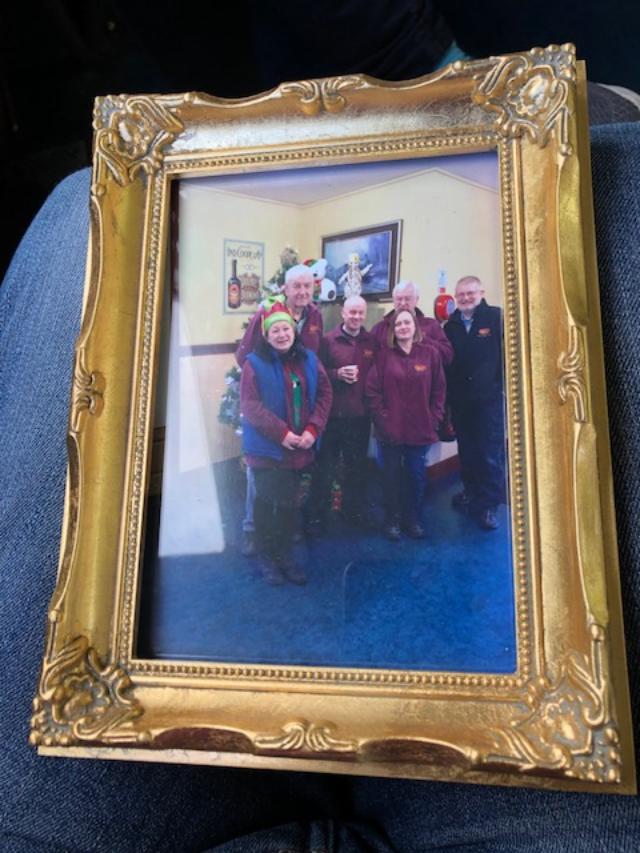
This is a picture of the staff at Chasewater Heaths Station 2010, give or take a few!
We’ve only managed to name of couple of them – Nick Fletcher and Mike Hurley. Can you help with any more names please? Su Westley found the pic in the CWH station and would like to know. Nice frame!!
Running round at Chasewater Church Street, 15-5-2010 as ‘Linda’
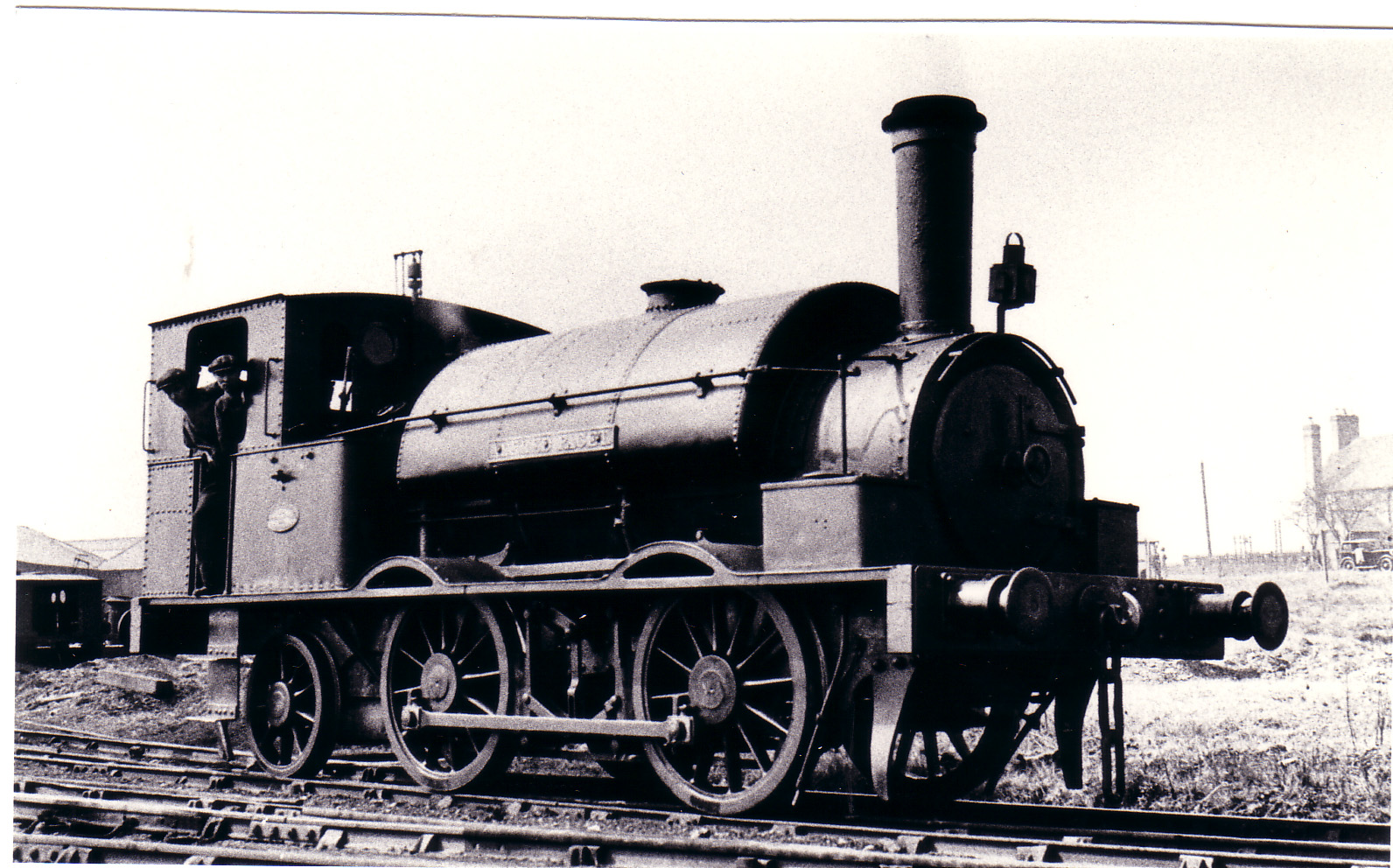
‘Alfred Paget’ 0-4-2ST Beyer Peacock 244-1861 Cannock Chase Colliery Company
Did you ever wonder where the track came from?
Here a couple of examples….
British Oxygen Company, Wolverhampton – Rob Duffill
Anyone who travels from Birmingham to Wolverhampton by train should look out to the left shortly before Wolverhampton station. There is still in use for steel traffic, the old canal interchange sidings and included is the canal/rail interchange building which is still standing. Until fairly recently also coming out of the site were several other sidings which have been lifted by BR. I noticed, while I had a brief view from a slowly passing train, that the line continued past the fence into the undergrowth and the British Oxygen Works at Wolverhampton. I mentioned it to David Bathurst who agreed to contact their Works manager to inquire if it was available. Fortunately David was able to get me an appointment to view the site. I duly turned up a few days later and was courteously received by the Works manager himself.

The track had been out of use for three to four years but had only been relayed in the 1970s to cope with heavy wagons and BR diesels. The track still in situ was from their boundary with BR into the works, a total of approximately 160 yards and a set of points, all in excellent condition. Unfortunately there was also approximately 300 yards of double siding set in concrete which it would be virtually impossible to remove. After describing Chasewater and our long term aims and also our lack of cash, I very nearly fell through the floor when I was told ‘you can have it if you want it’. It was as simple as that!
We’ve tried various approaches to acquire more track over the years and the simple direct approach seems to work best. If you ask for what you want you can only be told ‘no’, or you get it!
Hopefully we can lift and transport it in the autumn, after the running season, sorry lads more work for you to dismantle it, transport it and rebuild it again at Chasewater. I was also given a tour of their site, which was very interesting, for example, they used to supply many large Black Country factories using their own trunk pipe lines which went quite a distance from their production site. With the closure of so many factories the system was slowly cut back and finally taken out of use, hence the lack of rail traffic.
The Railway has more friends out there than it often thinks, we ought to ask for help more often with practical problems. Dorman’s springs to mind as an example of help.
Many thanks to British Oxygen and I hope that the reinstatement of the track will prove a boost to our running line.
Chasewater and Four Ashes – David Bathurst

It is probably unnecessary to describe in much detail the connection between the Railway and Four Ashes, Staffordshire. Suffice it to say that through the good offices of our colleague, Jim Bates, the Railway inherited the redundant track from Synthetic Chemicals – who offered a wonderful measure of co-operation in relation to its removal.
What is less certain, however, is whether many Chasewater members even knew of the existence of this modest industrial railway network before the track donation was made.
I rather suspect that even fewer members actually visited the network, but I am able to record, with some satisfaction, that I participated in a visit organised by the Branch Line Society on 17th February, 1981.
At that time, the site was owned by Croda Chemicals, who provided every facility to the BLS to travel (as is customary) over every last available inch of line, utilizing the famous fireless 0-4-0. I cannot recall in detail the precise arrangements of the visit, but I have managed to locate a series of slides which I took on the occasion. Unfortunately, some of them will not reproduce satisfactorily for The Chasewater News, but I hope that the Hon Editor (What’s with the Honorary, David?????) (I wondered about that too!!! cws) will be able to make something of the remainder.

What is evident from the slides is that the track was certainly maintained in good condition, and really it was quite a neat little layout. Others will be able to provide details of the Fireless locomotive whose small cab was hard pressed to accommodate the size (both in numbers and in girth) of the BLS party.
Once again the Editor has done his best with the print-from-slides; I shall be offering them to Jim Bates as a reminder of times gone by.

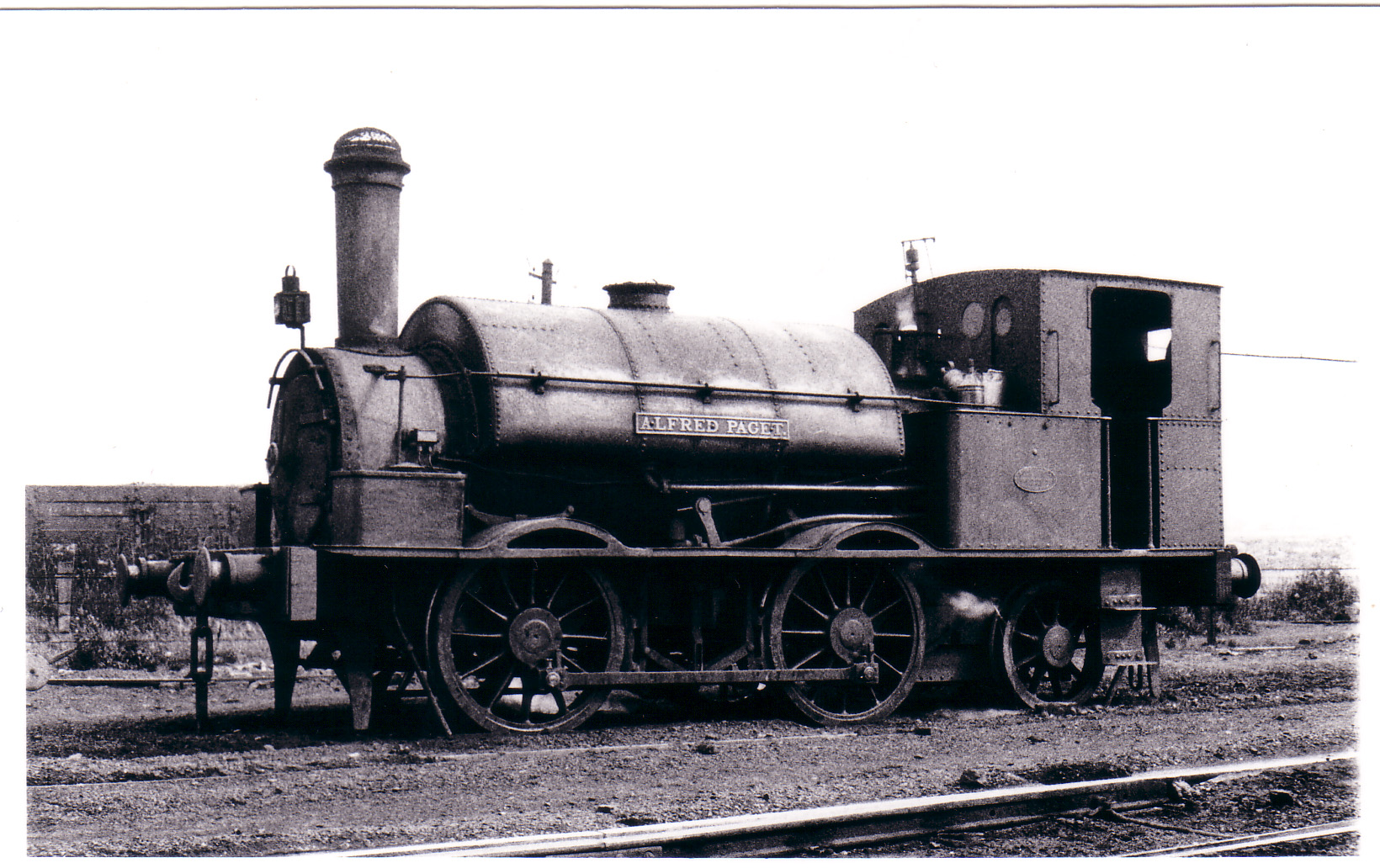
‘Alfred Paget’ 0-4-2ST Beyer Peacock 244-1861 Cannock Chase Colliery Company
Posted in Bits and Pieces
Tagged Alfred Paget, Beyer Peacock 0-4-2ST, Branch Line Society, British Oxygen Co., Brownhills, Burntwood, Chasewater Railway, Chasewater Railway Museum, Croda Chemicals, England, Fireless Locomotive, Hednesford, Norton Canes, Old Railway Lines, Railway Track, Synthetic Chemicals.
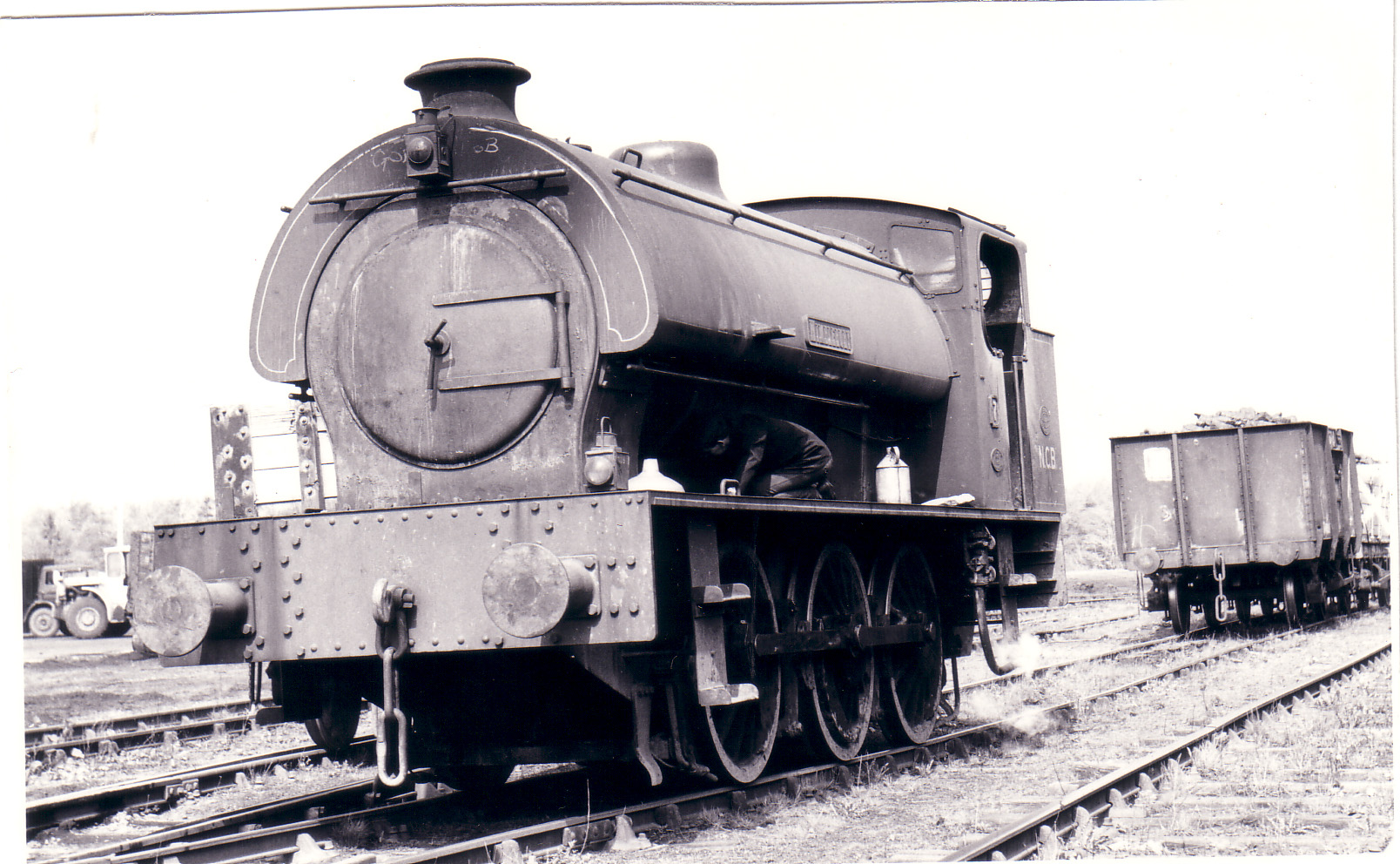
No.7 Wimblebury 0-6-0ST Hunslet 3839-1956 Cannock and Rugeley Collieries
Loco Shed News
With the overhaul of the Sentinel nearing completion and the repairs to Asbestos well in hand, it is possible that the opening of Norton Lakeside Station on the 16th December could be another first with the special train being double-headed, which as far as I know has never been done at Chasewater before. The work that has been done in the engine shed over the past few months has been incredible, and many thanks to Nigel Canning, Les Emery, Tony Sale and all the other willing hands that have helped.

Steam Locomotives
No.4 Asbestos – The casting for the main steam pipe was delivered during the second week in November. After heat treating to reduce the stress on the casting it was machined courtesy of Tony Sale and the first trial fitting was on the 19th November. A few minor adjustments were required but this has now been rectified and the casting fitted. This should keep Asbestos running over the Christmas period and into the start of the new season.

No.5 Sentinel – The Sentinel has just about completed its long overhaul and is due for its test steaming at the end of November/beginning of December. Hopefully this should be accomplished without any problems, and all credit to Nigel Canning for the first class job that he has done on his locomotive. With the work completed on the Sentinel this should give us two steam locomotives in traffic.
S100 – Work continues on putting S100 back together again. Two of the valve springs have had to be remade after a gap was found between the valve and the cylinder on one side. One of the brake hangers has been dismantled, then cleaned and primed. The work continues towards the completion of the chassis ready to receive its wheels.
Diesel Locomotives
Fowler diesel mechanical No.410013 – Further cosmetic work is being done to this locomotive to protect it from the winter weather and work will recommence on this locomotive after several other projects are finished. The diesel still remains nominally serviceable.
Fowler diesel hydraulic No.422015 – The ‘Black Fowler’ remains temporarily out of service due to the breaking of three of its injector pipes whilst on works train duties. The repairs to the pipes should be completed shortly and it should be back in service for Christmas and the start of the New Year.
L&Y No.1 – No.1 is well on the way to being put back together. Work is proceeding on the engine with one of the two cylinder blocks now fully finished, and work is rapidly continuing on the second. All being well the engine should be finished shortly after Christmas. The next job on the agenda is to crane out the chassis and wheels, clean and paint them. If all goes well No.1 could be running again by the end of 1996. (See post No.183).

No.21 – The engine of No.21 is going back together at a slow but steady rate. The second cylinder block has been replaced and the manifolds are being put back on. Most of the basic repairs to the engine are now complete. The next items on the agenda are the cooling system and the electrical systems. This locomotive could also be finished by the end of 1996 with a bit of luck.

P.Way News
Blood, Sweat and Tears – Arthur Edwards
Most of the past several months have been taken up, in between the service trains running, with getting the track ready for the Inspector’s visit in September and again in October. The ‘Blood, Sweat and Tears’ of the new extension has lived up to its name.
Blood – Because during the completion of the Causeway many a finger has been caught whilst either rolling in rail or keying up the track, so drawing blood.
Sweat – Of which a lot has flowed during the summer months, as it was one of the hottest few weeks on record, and for those who have done it, P.Way is hot and heavy work. (Is it not, Tom?)
Tears – When things have gone wrong, and believe me they have, such as when Lakeside Station was nearing completion and we ran out of bricks to finish the platform, due to vandals knocking off the laid bricks and throwing them in the lake. Then after the Inspector had been it was found that the rail was too close to the platform edge so that the clearances had to be altered by one or two inches, taking a dozen blokes to do it over a weekend. (My back still remembers it. Ed.)
In the end I received a phone call at about 5.20pm on the 25th October with the news that the extension had been passed for passenger traffic and we could now run into Norton Lakeside Station, which was very good news indeed. I have only one request – could the P.Way lads get their breath back before we get any more track in to extend the running line, please!!

My thanks to Nigel Canning for the photos
 Chasewater Railway Museum