Category Archives: Chasewater Railway Museum Bits and Pieces

Chasewater Railway Museum – Taken from our Archived Publications – Bits & Pieces No.20

Chasewater Railway Museum – Taken from our Archived Publications – Bits & Pieces No.20

Taken from the Mercian 2.1 June –July 1963

GC Special Issue

Part Editorial

The Flying Scotsman, 4472, certainly gets an airing in its ‘preserved state’, as many Societies now take advantage of hiring out this fine loco for their Specials.  Mr. Pegler has done a fine job in purchasing it for preservation. The RPS is most proud to have’4472’ to head its Great Central Special on June 15th which we are hoping will bring the Society much publicity and many more members.

D. B.

Hednesford Progress Report

As there has not been a ‘Mercian’ for some time now my report covers quite a few months of work at the depot.

Despite the Wintry conditions that prevailed in the early part of this year, small parties continued to press on with restoration work on the Maryport & Carlisle coach.  This consisted in the main of burning off the paint in two of the compartments and sanding down in preparation for priming paint.

The next job consisted of reglazing the windows in the same compartments already mentioned.  Some good work has also been done by two members renovating old books and documents that we have in our possession.  This is vital work!  As we all know, these items are completely irreplaceable.

The Webb Coal Tank continues to get regular attention and maintenance.  An excellent job has been made of the cab fittings by Mr. and Mrs. Roger Bell (Princess Elizabeth Fund) and all members join me in expressing their appreciation and thanks for their much devoted labour and wish them luck with their Princess Fund.

D. A. Ives Hon. Sec.

Great Central Rail Tour

Although the Railway and Model Press are carrying details of the GC trip, we would like here to give members a brief reminder.

The train will now depart Sheffield Victoria 8.50am and not 9.00am as previously advertised. There will be refreshment car facilities on the train, and also a short souvenir history of the Great Central Railway.

On the outward journey it will call at Chesterfield Central (if the loop is still open), Nottingham Victoria, Loughborough Central, Leicester central, Rugby Central, Woodford Halse, Quainton Road, Aylesbury Town, Harrow-on-the-Hill and Marylebone, with four hours stay in London, during which time a visit will be made to the BTC Museum at Clapham as both large and small relics are now on display.  On the return journey call at Rugby, Leicester and Nottingham only to set down passengers.Picture: Sharman-Corbis

The motive power will be 4472, Flying Scotsman, (by courtesy of Mr. Pegler) and coaching stock ex-LNER. Members who have not yet booked and would like to travel on this train may be lucky to get a ticket at this late date.  But it should be noted that seating accommodation is strictly limited.  For further information and details please contact Mr. E. Cowell, Sheffield, using the form which was enclosed with ‘Forum’ immediately. Our thanks and appreciation go to Mr. Cowell for the wonderful effort he has made to organise this trip in spite of a recent injury to his back.  We hope it is a great success and that many more trips of this nature spring from his idea.  The proceeds after expenses are to go to the Carriage & Wagon Preservation Fund.

Open Weekend at Hednesford

Members will probably have already read in the Railway Press that the Society is holding an open weekend at the depot.  It is hoped that members will give this function their utmost support, a lot of hard work has been put in by the ‘faithful few’ and we do appeal to the less active people to give a hand to act as stewards, etc.

Remember that these events are designed to give people an idea of the aims of the Society, and of course as money raising schemes without which, the aims cannot possibly be put into effect!

Therefore the depot will be open from 2.00pm Saturday, June 29th until 7.30pm, and again on Sunday, June 30th from 2.00pm until 5.30pm.

Working model layouts and a good photographic display, as well as all our vintage stock can be seen.  Please bring your friends, neighbours, etc.  A small admission fee will be charged, which we hope to help boost our funds with (as preservation is a costly business).

Refreshments will also be available.  Members who could, or wish to volunteer their services on either day should contact the Hon. Sec. — Please help!


Visit to Swithland Hall. Pic – Wikipedia

A small party of Midland Area members paid a visit to Lord Lanesborough’s ancestral home on Saturday, April 27th.  His Lordship entertained members by operating his extensive model layout.  This was followed by a trip to Swithland sidings, where his Lordship answered questions on the Great Central line; he also outlined the Great Central association’s scheme for the takeover from British Railways.

The Hon. Sec. proposed a vote of thanks to his Lordship in allowing members to visit the hall and sidings, the party then continued to Mountsorrel Granite Quarry to inspect the workings and railway installations.

David A. Ives

Carriage and Wagon Fund

BR are continually pressing for the final payment on the Midland Royal Saloon, some £240 is still owing on this vehicle and we would remind members to make a special effort and donate to the fund in order to clear the account.

Other items awaiting purchase include a LNWR lower quadrant home signal and a Midland dumb buffer crane, which the Society hopes to put to good use. The cost of the crane being £8.  A small fund for this crane has now been launched, and £2 has already been donated, we should like to cover the cost of transport for this very interesting relic.  All donations to the Hon. Treasurer please.

News in Brief

Council for British Archaeology

Thanks were expressed in this important National Report for the work that the Midlands Area of the RPS and the Stafford Railway Circle had done jointly in the survey of Railways for the Industrial Revolution section.

The Warwickshire and Worcestershire (May) Magazine have included an article on Lord Lanesborough and also mentions the Society.  There will be a follow up article in the June Edition with pictures of the RPS in action at Hednesford.

Late News

Chasewater Line

This line has been offered to the Society by the NCB for the very low rental of £10 per annum, other extras such as maintenance, fencing, etc. are not included.  A resolution was passed at the last committee meeting that the Society accept this very reasonable offer, a further meeting with the NCB to discuss the legal and other aspects is to be conducted very shortly.Pic – L. Hodgkinson

There are still seats left for the GC Tour on June 15th — book yours now if you have not already done so!

Chasewater Railway Museum – Taken from our Archived Publications – Bits & Pieces No.19

Chasewater Railway Museum 

Taken from our Archived Publications

I enjoyed this piece as it showed the stock available for preservation in the early 1960s – Princess Elizabeth would have looked nice in Hednesford and just imagine her in the Heritage Centre now!!

The Mercian – Sept,Oct, Nov,Dec, 1962

From the West Midlands District 3rd AGM

Held in Wolverhampton September 29th 1962

We were fortunate to have with us Mr. Bell, Secretary of the Princess Elizabeth Preservation Fund, and Mr. K Vincent of Dowty Sports.

Mr. Bell mentioned that No.46201 Princess Elizabeth must be purchased on withdrawal from service with B.R. for preservation.  As the money will have to be raised very quickly the Society concerned cannot possibly afford a site for the loco at the moment.

The W.M.D. said they might be able to help out for the time being by either accommodating the loco at the Hednesford Depot or with the help of Mr. Vincent to accommodate it at Messrs. Dowty’s Ashchurch or Tewkesbury factories. Not only is this going to save the loco but it would give added attraction to the R.P.S. and may even boost membership in both Societies.

Mr. Cotterell ( Hon. Treasurer of the 0-6-0 ex Midland Tank engine) reminded us that up until now he had not received any donations from any R.P.S. members!  He also mentioned that we are going to need a loco for our branch line to pull the stock that we already have, and at the moment this one (last off works) seems to be the most likely.  So it rests with us to support these funds and publicise them as much as possible as we all want to see our own train on our own branch line very soon.

The two loco funds were: 46201 Princess Elizabeth £2610 and ex Midland 0-6-0 tank £750.  Not much in 2010 but very large sums in 1962!

46201 was bought by the then Princess Elizabeth Locomotive Society straight from BR service when withdrawn in 1962. Initially kept at the Dowty Railway Preservation Society’s premises at Ashchurch, Glos, and then subsequently at the Bulmers Railway Centre in Hereford. When the Bulmers Centre closed in the 1990s the loco moved to the East Lancashire Railway. Since April 2009 it has been based at the Crewe Heritage Centre Princess Elizabeth is one of two preserved Princesses; the other being 46203 Princess Margaret Rose.

News in Brief

Chasewater

Chasewater, the piece of line which the West Midlands District were negotiating for might now seem impracticable for our Branch Line owing to inadequate storage and water supply, etc.  This matter has been left pending from the A.G.M. for the new Committee to discuss.

The Mysterious “Gents”!!

In the Autumn edition of Forum it was stated that the W.M.D. of the R.P.S. were negotiating with B.R. for a Victorian cast iron vintage ‘gents lavatory’, its position was on the disused Stowe-by-Chartley station in Staffordshire.

While negotiations were still in progress for the purchase of the above relic, it disappeared mysteriously from the station.  B.R. were contacted about the disappearance, they are looking into the matter.  Whereas the RPS are of the opinion it was (to quote our Hon. Sec.) the work of some unscrupulous scrap merchant, and he certainly went to a lot of trouble for half a ton of iron by dismantling it and carrying it away.

The National Press did get hold of the story and it may have given us some much needed publicity!!

East Midlands District News

The result of our second membership has been 100% successful. A collection of small relics has been donated by a new member – Mr. R. J. Buckler, including a LNWR signal wire pulley.

The Nottinghamshire members have been very active during the last few months, especially P. Gibbons, who has been concerned with a written survey.  The Northamptonshire members too have not been idle.  Messrs. Webb, Popham and myself have been occupied with the membership campaign, and Messrs. Gubbins and Buckler have written an historical account of one of our local disused branch lines.

Membership in Leicestershire and Derbyshire is very low.  Could members in these areas possibly remedy this?

J. M. Harvey (East Midlands District Organiser)

Chasewater Railway Museum – Taken from our Archived Publications

Chasewater Railway Museum – Taken from our Archived Publications

Taken from the Mercian May, June 1962 1.3

Anyone who has been reading this blog may have noticed, in ‘Bits & Pieces’ in the 1970s and early 80s, the mention of a Travelling Post Office (TPO). Our museum curator has recently acquired a book for the museum’s reference library – ‘An Illustrated History of the Travelling Post Office’ in which the Railway Preservation Society’s purchase is mentioned. It was bought for £200 and housed at Hednesford, later being transferred to Chasewater and sold in 1983 for £1,000,

Taken from the Mercian May, June 1962 1.3

From the Editorial

Everyone notices, even more so now, that Diesels are rapidly taking over and replacing steam on most trains.  If you are lucky you might chance to see a ‘Scot’ or even an ‘A4’ on a goods or shunting.

While standing on Welwyn Station the other evening Sir Nigel Gresley came thundering out of the tunnel with a south-bound express; a marvellous sight I might add, never to be replaced once the ‘Green Devils’ have fully taken over.  Sir Nigel would turn in his grave and shudder at the thought of his own engine being degraded to trundling goods trucks, let alone shunting them.

I suppose this is almost inevitable under the present modernisation plan, all we can do is wait and see what will happen.

D.B.

In the event of the following, I think that he would have been immensely proud!Leaving Bridgnorth March 2009 – Photo by Black Widow Productions

In 1937 the London and North Eastern Railway built its 100th ‘Pacific’ locomotive and the Railway honoured its designer by giving the locomotive number 4498 his name, Sir Nigel Gresley.  The locomotive was initially allocated to London Kings Cross ‘Top Shed’ where it returned in the 1950s after a spell at Grantham, by then carrying its British Railways number 60007. In this period it became associated with driver Bill Hoole and in 1959 Sir Nigel Gresley, driven by Hoole, achieved a post war speed record for steam of 112mph. The locomotive finished its British Railways career in Scotland, having run approximately 1,500,000 miles in revenue-earning service over some 30 years. In 1966 the locomotive was saved by a group of determined people, who set up the A4 Preservation Society.  This became the A4 Locomotive Society Ltd, which underwent a further evolution into a registered charity as The Sir Nigel Gresley Locomotive Preservation Trust Ltd.

After its 4th major overhaul in the ownership of the Trust, 60007 is now based at the North Yorkshire Moors Railway and continues to run on the UK main line network from time to time hauling rail tours to locations as diverse as Chester, York, Carlisle, Bristol, London and Dundee.

The Trust is dedicated to keeping the locomotive running, both on heritage railways and on the main line.  She is part of this nation’s history and our aim is to keep the locomotive as living history.  It is only when a locomotive is in steam and in action, truly alive, that you experience the full glory and feel the magic.  Nothing can match the spectacle and magnificence of a great steam engine running at full speed.  That is what the Trust aims to maintain.

The down side is that keeping a big express locomotive in good running order takes a lot of effort.  Sir Nigel Gresley is now over seventy years old.  There always seems to be something wearing out!  Dirty and often very hard work, too – her parts tend to be large, solid chunks of metal, immensely heavy to lift.  On top of the day-to-day repairs and maintenance, the locomotive must have a regular ‘heavy’ overhaul – every seven years if she is to run on Network Rail, extending to a maximum of ten when running on private railways.  The latest heavy overhaul took place at Grosmont on the North Yorkshire Moors Railway, at a total cost of around £800,000.  This has included fitting TPWS and OTMR safety systems to meet the latest Network Rail standards.  The Heritage Lottery Fund has supported this overhaul with a very generous grant of £322,000.

Whether operating on heritage railways or in full cry on the main line, she turns heads wherever she goes!

Reproduced with the permission of The Sir Nigel Gresley Locomotive Preservation Trust Ltd.”

Leaving Bridgnorth March 2009, Photo by  Black Widow Productions

Hon. Secretary’s Notes & Report

The West Midland District, Midland Area, acted as hosts on Saturday, 19th May for a full RPS meeting which was held in the TPO at our Hednesford depot.  We were pleased to welcome D. Noel Draycott and David Alexander London District, James Slater North West and John Harvey East Midlands Districts.   The meeting was also attended by some 12 members of the West Midlands.

A general discussion took place, and Society policy agreed upon.  It was agreed that the next Society conference should be held in York on 22nd September 1962 (provisional).

National Officers Elected

National President:                Rev. R. de Lacy-Spencer

General Secretary:                D. Noel Draycott

National Treasurer:                R. T. Yates, F.C.A.

The visitors enjoyed a visit to Chasewater the following day (Sunday), and a general inspection of the Depot in the afternoon.  I should like to thank very sincerely all members (Wives and Mothers) who offered such excellent overnight hospitality to our guests.

Working Parties

Work still continues at a steady pace each Sunday, we should still like to see a few more people attend however.  The Midland Block instruments and bells are now in working order, these were wired up by Peter Dring.  Any other member who is interested in telecommunications should come along to the depot and chat with Peter.

John Elsley and Terry Jones are now attempting to fix the side rode on the Coal Tank, all you loco enthusiasts – now is the chance to offer some practical help!

Work on the TPO still continues, this work is being carried out by Frank Harvey, Nigel Hadlow, George Cox and myself.  Tony Lewis and Bob Wormington continue to press on with repanelling the Maryport & Carlisle coach and are making steady progress.  The Midland horse-drawn van is being slowly renovated by Arthur Chatfield, please give him a helping hand someone?

Brian Kinder and Maurice Harper have made a good job of waterproofing the Great Eastern roof in the vicinity of the stove chimney pipe, Bob Wormington has also worked on the GE brake and painted the roof with bitumastic paint.

David Ives Hon. Sec.

Treasurer’s Report

In my report in the last issue of Mercian I seemed only to complain about the financial state of affairs.  I am afraid this must be the main theme thence in this report too.

(Nearly 50 years on now and nothing seems to have changed!! – but we’re still here!)

East Midlands

Results from our membership campaign have been good during these last few weeks, although the Crewe excursion was not fruitful, I must mention Michael Gubbins and David Webb who made the trip so enjoyable.

The major activity at the moment is the collection of many small relics and various photographic surveys are being completed, notably around Nottinghamshire by P. Gibbons of Southall.

J. M. Harvey.  East Mids. District Organiser.

London District

The London District of the RPS has been renamed The London Railway Preservation Society covering North London and three Home Counties, namely Essex, Hertfordshire and Middlesex.

Social Activities

The trip to Wolverton was very poorly attended, eight members making the effort.  We do hope that this can be improved on for future visits.

Much Wenlock Branch

The last passenger train will run on this line sometime in June.  This branch, as some members will be aware, is a very interesting one.  Please give us your support.

Coaching Stock Preservation Fund

A fund has now been launched to buy coaching stock; this will be published in the general railway press.  Vehicles under consideration are as follows: The Midland Royal Saloon, L & Y Inspectors Saloon, ECJS Bogie coach in original livery.  Other coaches which could be added are: Cambrian Bogie Coach, GWR Clerestory Bogie Coach, and WCJS Bogie Coach.

News in Brief

Our Hednesford Depot and Webb Coal Tank were mentioned on BBC TV’s Railway Roundabout of May 20th (my 19th birthday!! – seems a long time ago!) by John Adams and Patrick Whitehouse who said they might look in on their way up for a game of golf!

It has been officially stated that Paddington Station will not be closed yet!

Chasewater Railway Museum – Taken from our Archived Publications

Chasewater Railway Museum

Taken from our Archived Publications

Bits & Pieces 15

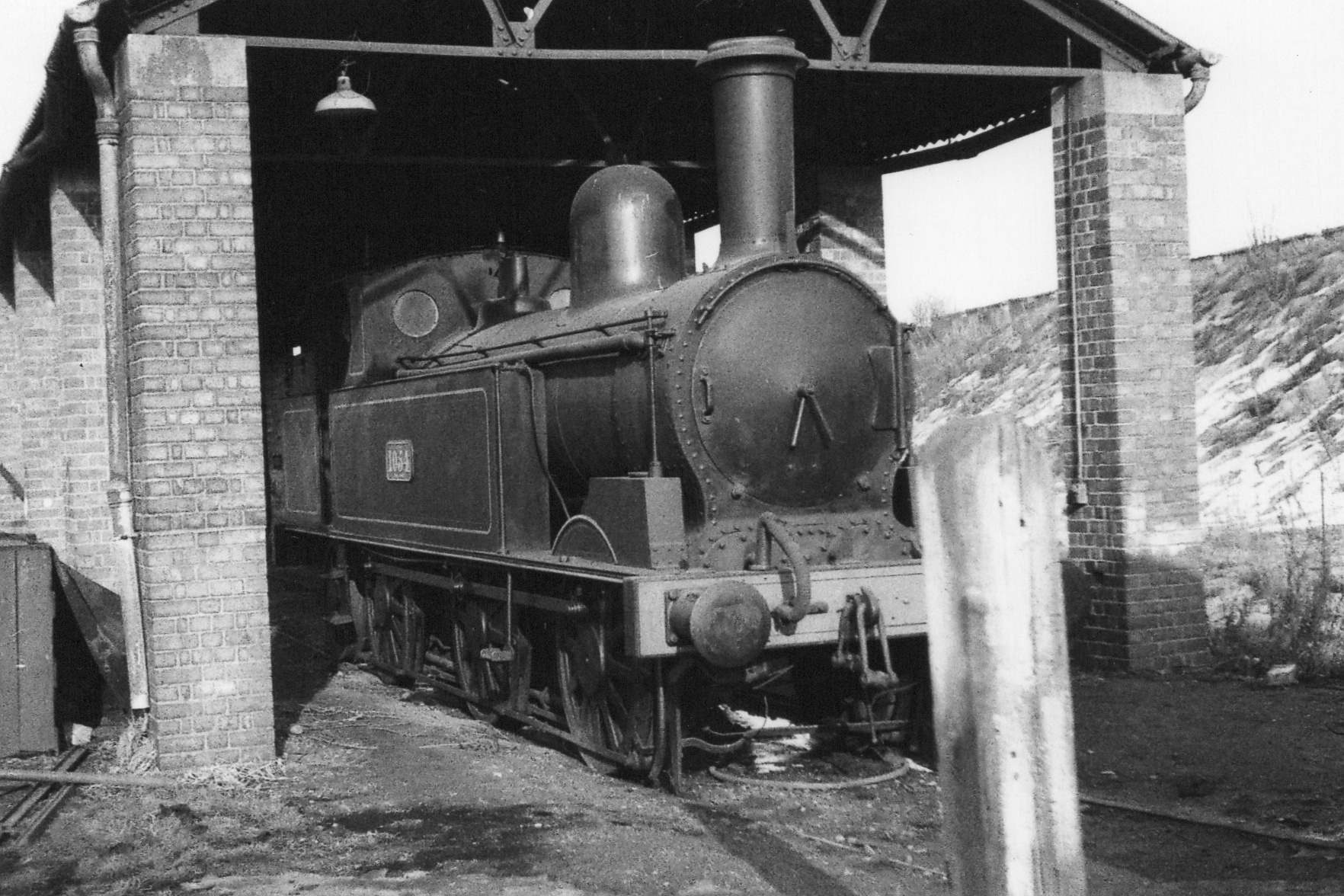
Coal Tank 1054 at Hednesford

Taken from the first ‘Mercian’ Jan/ Feb 1962

Bi-Monthly Newssheet for the Midlands District of the RPA

In my previous post I reported that the Railway Preservation Society was in future to be called the Railway Preservation Association.  For some reason, four times on the first page of the first ‘Mercian’ the RPS is referred to – curious.

The idea was to publish the Newssheet by the 23rd of each bi-month.  Anyone who takes on the job of Editor of a newssheet or magazine of this type has my greatest admiration (and sympathy!) as they always seem to struggle for articles after the initial burst of enthusiasm.

Progress report to date during 1961

Good progress has been made at our Hednesford depot, accomplishments to date include track lowering, to allow the stabling under cover of the Webb Coal Tank and our own TPO van, this vehicle has a lot more work to be done on it, but it has now been completed in undercoat livery of the LNWR on one side.  This was done by the very able direction of our Assistant Depot Master, and the woodwork renovations being done by our Hon. Treasurer, Frank Harvey.  The interior of the TPO is now in good shape due to the efforts of our Chairman, Arthur Chatfield.  Incidentally, he could do with some more help in this direction.  How about it some of you people who have not yet shown up?

Work continues on the Maryport & Carlisle coach, this is slow work and is mainly due to lack of materials which are most costly, perhaps any members who could help out in these matters in cash or kind would they kindly contact me?  Glass, wood and hardboard are most urgently required.Maryport & Carlisle coach before work started.

The Great Eastern brake has now been converted to a temporary workshop, and part is the museum.  It now has a genuine relic in the form of an LNWR signal box stove which has proved a most useful asset during this winter period.Great Eastern brake before work started.

John Elsley, the Assistant Depot Master and his usual few stalwarts namely, Bob Wormington, Terry Jones, David Bradbury, John Bradbury and Fred Lewis continue to press on with tracklaying in spite of the recent cold snap, all you people interested in tracklaying, now is your chance to give a hand.

Mention must be made last but by no means least of Maurice Harper and Brian Kinder who are always at hand to help out with any task which might crop up.  The tea is always made by these men and it is most appreciated by all the working parties.

A final word of gratitude to our President Charles E. Ives (no relation to David Ives) who so kindly allows the Society free and complete use of the depot.  Good luck to you all in 1962.

David A. Ives Hon. Sec.

East Midlands District Report

We in the East Midlands have just passed through the first stage of the intensive publicity campaign that was started in mid December.  So far the response has been quite good and I think the main contributory factor to this was the excursion to Ashford and Stratford Railway Works on January 3rd of this year.  Owing to bad weather we were delayed for over two hours but this did not dishearten the prospective members who found the visit very enjoyable.

One of our more recent members, Mr. Popham of Raunds has shown great interest in our cause, he rendered invaluable assistance on our Ashford venture.  He and I are making a survey of the Kettering – Cambridge branch line.  We hope to publish our results in the National Newsletter.  Another outing for prospective members will be arranged around April time to Lancashire and Cheshire.

J. M. Harvey, East Midlands District Organiser.

Diary dates were given for social gatherings of the West Midlands District and the Stafford Railway Circle.

Chasewater Railway Museum – And More From the Sixties

Chasewater Railway Museum

And More From the Sixties

More from the very early days of preservation, not a line in sight yet.

Chasewater Railway Museum Winter 1961/2 RPS 3.3 Bits & Pieces 14

Taken from the RPS Newsletter, Winter 1961/2

From RPS to RPA

Changes in Policy

Plan to encourage co-ordination.

On Saturday, October 21, representatives of Bluebell RPS., Middleton RPS., and the RPS itself, met at Leeds to discuss and agree upon a national organisation for the following objects:

a)    To act as a general clearing house and meeting place for all railway preservation societies.

b)    To circulate information on existing and proposed schemes.

c)    To foster and encourage co-ordination between existing and proposed schemes.

d)    To organise and assist full exchange of information between all societies on preservation of railway ethics.

e)    To co-ordinate and assist with publicity.

It was unanimously agreed this organisation should be known as the Railway Preservation Association, and that members of any constituent society should be welcome to meetings and to activities of other constituent societies.

The RPA will not be another society which will appeal for individual members. It is being established as a national organisation where representatives of schemes accepting the underlying principles will meet regularly. It is planned as a forum where consultations and co-operation can be mutually beneficial.

News from the Districts

West & East Midlands

We are still in the market for a branch line.  Members are probably aware that our negotiations with British Railways for part of the Coalport Branch have fallen through, due to the excessive annual rentals of £1,500.Coalport.  Would’ve been nice – including the Coal Tank!

But we are hoping that further news concerning the Mountsorrel mineral line.  This has been discussed with our Patron, the Earl of Lanesborough, and something should materialise in the not too distant future, and so provide a definite start for our East Midland members.

Response to a correspondence campaign launched to build up membership in the East Midlands, has so far been poor.  Several informal meetings are planned fro this winter to tell prospective members about our cause.

John Betjeman, the historian and an authority on railway architecture, has agreed to join Lord Lanesborough as a Patron.  Further details will be announced later.

A New Chapter Opens

Pooling our resources

This is the last issue of the ‘Newsletter’ in its present form.  Our National Council has decided that the Society shall in future be known as ‘The Railway Preservation Association’, to which all organisations connected with railways may seek affiliation and take advantage of our space and distribution scheme.

When we publish again in the Spring your news and features will appear in a new magazine called ‘Forum’, which will be distributed nationally, and which we hope will assist greatly in interesting the public in our endeavours.

During the three years that the ‘Newsletter’ has been circulated our achievements have been considerable.  We believe that ‘Forum’ will widen further the prospects that lie ahead for all of us.

As far as these posts are concerned, I shall continue to follow the interests of the West Midlands District though their magazine ‘The Mercian’ I assume that somewhere in our archives we have copies of the ‘Forum’ and if so, I shall have a look for items of local interest.

The organisations involved at the start of the Railway Preservation Association were given as: London District, West Midlands District, East Midlands District, North-West District, Scotland District, Bluebell RPS, and Middleton RPS.

Chasewater Railway Museum – More from the Sixties

Chasewater Railway Museum

More from the sixties

Taken from the RPS Newsletter Vol 3  No.2 – Date – Summer, 1961?

West Midlands District

Our covered space at the Hednesford depot now houses the London North-Western Webb coal tank, together with the London North-Western TPO van, Maryport & Carlisle and Great Eastern coaches, which are in various stages of restoration.. A considerable amount of really hard work has been carried out during the last three weekends.

Photo: Andrew Handley

Collection of small relics continues to grow, thanks in no small measure being due to two of our junior members, Brian Kinder and Maurice Harper, of  Walsall.  Donations to the TPO fund were received from some 18 members.


The West Midlands District also toured the railway system of the Bass, Ratcliff and Gretton Company at Burton-on-Trent.  The trip was organised as a joint effort by Stafford Railway Circle, and the party travelled in a four-wheeled directors’ saloon of 1889 vintage.  Acquired from the Midland Railway, the vehicle was built by the Railway Carriage & Iron Co. Ltd. at Manchester.Bass Locos – Published by Bass Museum

The following piece is taken from an article written by A. A. Chatfield (Vice-Chairman of the West Midlands District).

The Webb Coal Tanks of the LNWR


With the arrival at our Hednesford depot of number 1054, the last of the celebrated Webb coal tank engines, A. A. Chatfield has outlined a brief history of the class.

The first of these locomotives was constructed at Crewe works in 1881, and during the ensuing years no fewer than 300 were built.  Initially they were a tank version of the very successful coal engines with the addition of a pair of trailing wheels running in a radial axle box under the bunker and rear wheel tank.  Designated for working heavy mineral trains in the colliery areas of Lancashire and the South Wales valleys, the design changed very little over the years except that quite a few were fitting with the vacuum brake for working branch line passenger trains.

Main dimensions were: cylinders  17in. x 24in., pressure 150lbs., grate area 17 sq. ft., total heating surface 10,548 sq. ft., weight in working order 43 tons. Water capacity 1,150 gallons, height 13ft. 1in., and tractive effort 16,530lbs.

It is a strong testimony to the workmanship put into these locomotives that many of them survived for so long after the Grouping, as the total was still quite large even after the close of the second world war when some of the survivors were at least 60 years old.  It is strange that so many of Webb’s simple designs should have lingered on for so long, for by the time the railways were nationalised quite a few octogenarians of this design could be found happily and usefully employed in the quiet backwaters of the LMSR.

Naturally the coal tanks were very prominent in the ranks for 30 of them were still at work in these out of the way corners when the 1950s dawned.  By this time numbers were thinning out but still the coal tanks chuffed on until only one, 1054 or 58926 as she had become, remained – latterly employed ignominiously as a stationery boiler at Pontypool Road MPD.

However, the old lady still had her final fling to come, for she was cleaned up and hauled out to pilot an LNWR 0-8-0 on the last special train over the Merthyr – Abergavenny line on which duty she was filmed and recorded for posterity.  After this brief appearance in the limelight she was sumped in a siding at Pontypool Road depot to await the last call to Crewe for breaking up.

Fortunately the story has had a happy ending for through the good offices of Mr. J. M. Dunn and a large group of enthusiasts who were familiar with these engines in their hey-day, number 1054 has been saved for posterity, decked out in her original finery, and has been put into the custody of the West Midland District of the RPS at Hednesford within a stones throw of her old birthplace.

During 1963, Mr Dunn and his supporters arranged for 1054 to be transferred into the ownership of the National Trust for display at Penrhyn Castle in North Wales, not far from where the engine worked in the 1920s.

Although Penrhyn provided public access in safe and secure surroundings, facilities for effectively exhibiting the locomotive were limited. After nine years at Penrhyn, and with the growth of railway preservation groups providing improved facilities, some of the locomotive’s original trustees arranged for the engine to be cared for by the ‘Bahamas’ Locomotive Society at their Dinting Railway Centre near Glossop in Derbyshire.

London and North Western Railway Webb 0-6-2T ‘Coal Tank’ class locomotive number 1054 giving brake van rides on the demonstration line at the Dinting Railway Centre, Higher Dinting. Sunday 3rd October 1982. Photo:  David Ingham

In 1980 the engine was overhauled, put into working order, and restored to the LNWR condition in which it would have appeared just prior to the First World War. In May that year it attended the great exhibition at Rainhill near Liverpool. This was held to celebrate the 150th anniversary of the ‘trials’ won by George Stephenson’s famous Rocket, and the opening of the Liverpool and Manchester Railway in 1830.

In the years since, 1054 has performed reliably and well.

LNWR Loco 1054 at Hednesford depot.

To the best of my knowledge, 1054 is owned by The National Trust. It is currently undergoing overhaul by volunteer members of the’Bahamas’ Locomotive Society, who have cared for the engine since 1973.

The work is being undertaken at the Society’s Museum & Workshop –
Ingrow Loco – on the Keighley & Worth Valley Railway in
Yorkshire, and is supported by a grant from the Heritage Lottery Fund.Pictured at Oxenhope on the Keighley & Worth Valley Railway by John Winters.

For video footage go to:

www.geoffspages.co.uk/grp/Movies01/index.html

Chasewater Railway Museum – More Early Stuff

Chasewater Railway Museum 

More Early Stuff

From the RPS Newsletter Oct 1960 Vol 2 No.1

From the General Secretary’s Page

Following a proposal from the Middleton RPS that they would form part of the national organisation envisaged by the RPS, a plan was drawn up outlining an organisation of autonomous groups, each covering a heavily populated area and taking over all responsibility for voluntary preservation in their area.  The national level of the organisation would transact such matters as were more effectively handled on a country-wide basis and would provide a common pool of information for all groups to draw on.  This was expected to be the most important subject at the AGM on October 22nd 1960.

The District Report

West Midlands

The next item to be moved into Hednesford depot will be a LNWR travelling post office van built in 1909.  This carriage keeps most of its original fittings, though the ‘pick-up and drop’ apparatus has been removed at some time and a plain panel used to cover the resulting gap.  This is not only a fine relic in itself, but will give covered space for display of historic relics.  The British Transport Commission preserves a replica of the original TPO on the London and Birmingham Railway which was built by LMS.  Now we have preserved an example of the type used during the early years of the 20th century.

D. Ives Collection

Requirements of the post office were standard for all types of TPO and the appearance of these vehicles only varied with the roof contour and panelling details of the companies who operated them.  A very high proportion of pre-grouping types have remained in service until recently when British Railways put in hand the building of complete new trains.  An interesting survival was reported a few years ago in the model railway press.  This was a six-wheeler TPO of the GNWR stripped and used as a tool van on a break-down train.

Late Extra


Progress on Great Eastern Coach


West Midland District

Ray Hallworth

Despite rather thin attendance at working parties, progress of restoration work on the recently acquired Great Eastern coach has been very satisfactory.  It is hoped that the interior will eventually form the first railway museum in the West Midland District.  A temporary exhibition will be staged there for our annual meeting on October 22nd.

Inside walls have been scraped and have received a generous coat of priming paint.  Most of the woodwork has been repaired.  The small brake compartment at the end of the coach has been converted into a tool store.

Improvements are slowly but surely being made to the exterior, one side and end facing the main Hednesford – Cannock line having been completely stripped of paint.  Over half of this has been primed.  Quite o lot of the panelling had to be replaced, particularly at one of the corners where to our dismay, we found that not only had the panels gone rotten, but also the framework.  Fortunately this has now been repaired and new panels fitted.

Work has not yet begun on restoring the Maryport & Carlisle coach, and it may have to be next spring before a start is made.  Continual appeals are still being made for more members to come and lend a hand, especially the more local people.  Working parties are held every Saturday from 3.00pm to 6.00pm and on Sundays from 2.30pm to 6.00pm.

Visit to Oakamoor Station


Twenty-four members and friends of the WMD visited Oakamoor Station on the ex-North Staffordshire line in the Churnet Valley on June 18th.Rail37.com  Churnet Valley Railway Oakamoor Station

The Stationmaster, Mr. Lister, took members on a conducted tour of the station buildings and adjacent copper works sidings.  Much interest was shown in an ex-NSR battery electric locomotive, a relic of prime importance, being built at Stoke works in 1916.  Still in excellent working condition and used for shunting work in the siding, Mr. Lister demonstrated the vehicle by giving members a short trip up and down.Rail37.com Oakamoor Station –  same view as previous.

Returning to the station, members were shown several items of interest including an old print of Oakamoor station in North Stafford days, and two lovely old NS office chairs with the Staffordshire Knot carved on each back-rest.  Each member of the party was presented with a sealing wax impression of the NS Railway Oakamoor seal.

Above: The delightful crossing keeper’s house at Oakamoor, just south of Oakamoor Tunnel, which can be seen in the background. This building looks as if it is another of Pugin’s designs, but we have been unable to confirm this. Oakamoor station was situated a short distance behind the photographer and was the next stop north of Alton. 10 November 2007. (Bob Prigg)

Finally members went by train to Alton Towers, a local beauty spot – not without noticing the magnificent NSR stove at Alton station.

Above: This is Alton station in Staffordshire, which was renamed Alton Towers in 1954 – only to close ten years later. (Surely the line might still be busy with a modern theme park en route?) The station was designed by Augustus Pugin (1812-1852), an English architect of the Gothic revival who is better known for his church designs and his work on the interior of the Houses of Parliament. However, Pugin did accept some more modest commissions, including this one for the North Staffordshire Railway, and the railway cottages at Windermere, Cumbria. Alton station is now owned by The Landmark Trust and can be rented for self-catering holidays. The trackbed is used as a railway path linking Oakamoor to the north and Denstone to the south. 10 November 2007. (Bob Prigg)

Chasewater Railway Museum Bits and Pieces No.9 More from the Early Days – From 1960 April RPS Newsletter Vol 1 No.4

More from the Early Days

From 1960 April RPS Newsletter Vol 1 No.4

West Midlands District

This picture shows the old headquarters in Hednesford.  The building which the carriages are partly inside is still standing, although it is bricked up now.  The white buildings on the other side of the line to Rugeley was the wagon works – long gone.

Public Meeting, Saturday, March 5th 1960

Mr. G. T. Cox,  WMD Chairman, opened the meeting at 3.00pm.  He expressed his regret that there were not more people present, and said that possibly the unusually fine weather had diverted persons to outdoor pursuits.

Mr. Cox went on to say, “Many of us often look back to the bygone days.  We younger ones can only remember the pre-nationalisation days, whilst older ones can remember quite clearly the pre-grouping companies and put down their memories in black and white.”

“The best way of showing any exhibition piece is in its natural surroundings, and this is what the RPS means by a ‘living’ museum.  You will not get one by asking, but you will if you support the RPS to the best of your ability.  There is little preserved in contrast to the vast scrapped during the last 50 years.  It is within our reach to extend the range, if action is taken now.”

The General Secretary, D. Noel Draycott, briefly described the origins of the RPS and the district organisation which gives local groups the chance to build p local collections.  The first programme for the WMD has been drawn up, covering the purchase of rolling stock and other large relics.  The programme is divided into three stages, but it is not necessarily the order in which items will be purchased.  The selection of relics depends on the speed with which our funds grow.

Mr. R. De Lacy-Spencer pointed out that many relics were kept by persons who did not realise their historic interest to railway enthusiasts.  An example of this was the Midland Railway stationmaster’s hat which had been presented to the RPS by a lady living in Lincolnshire.

The WMD Secretary, D. A. Ives, gave an account of progress in the area.  Membership was growing and a keen committee were considering more plans for the future.  Members were contributing many smaller relics, and a good selection was on view.  He had been corresponding with BR for some time about a possible depot site, but with no result to date.

Mr. F. J. Harvey read a branch line survey he had recently made.  It was an account of the present condition of the MR branch from Aldridge to Brownhills and Chasewater.  The civil engineering features appeared to be in good condition, but the permanent way was neglected towards the end of the branch and part had been lifted.  At present only a section of it was used for a daily freight trip.

The meeting was wound up at 4.30pm and Mr. A. Holden from the audience proposed a vote of thanks to the speakers which was carried.

Stop Press! – Depot established in WMD

We are pleased to announce that negotiations for the establishment of a depot have reached a definite stage.  The site is at Hednesford, about 11 miles from Wolverhampton, and contains 150 yards of siding, part of which is under cover.  Fuller details were given to members at the visit to the Stafford/Uttoxeter branch on Sunday, March 27th.  These details are not to hand at the time of writing this, and a description with information about working parties will appear in the next issue of the newsletter.

This will enable the WMD to launch an intensive campaign to purchase rolling-stock, etc., of the Cambrian, Great Western, London & North Western, Midland and North Staffordshire Railways.  All persons interested in these railways are invited to send donations direct to the West Midlands Treasurer, RPS.

Chasewater Railway Museum Bits and Pieces No.8. From the Railway Preservation Society Newsletter Vol 1, No 3

Chasewater Railway Museum Bits and Pieces No.8.

RPS Newsletter Vol 1 No.3

Early days of the Railway Preservation Society

(West Midlands Division)

( Later to become Chasewater Railway)


The General Secretary’s page discussed the setting up of a Carriage & Wagon Section, to include as much information, as detailed as possible, about vehicles which are still used as well as those no longer seen other than in photographs.

For Posterity

On looking forward to the continued expansion of the RPS over the next 50 years, I wish to express the view that it will be desirable to reproduce the trains of main and branch lines at different periods in the steam age.

Settle & Carlisle Railway

Assuming that it may be possible to acquire such secondary main lines as Settle – Carlisle, Exeter – Plymouth, Midland & South West Junction Railway, and Somerset & Dorset Joint Railway among others, in the event of them being closed by British Railways, which occurrence is not entirely without the bounds of possibility, the running of semi-fast and local services forming scenic excursions and conveying intermediate traffic would be possible.

The bridge carries Pine Road over the old S&D trackbed (closed 1966) to the east of the site of Corfe Mullen Halt (closed 1956). © Copyright David Spencer and licensed for reuse under this Creative Commons Licence

In this connection the point to stress is the need to acquire a few of the older express types such as the ‘Sandringhams’, ‘King Arthurs’, ‘Patriots’ and ‘Schools’ which are threatened with extinction.  Whatever weight restrictions exist on original branch lines to be acquired let us at least endeavour to save a few more typically British express engines before it is too late.

This bridge crosses the dismantled Midland and South Western Junction Railway just west of Notgrove. It is now a Site of Special Scientific Interest because of the Jurassic limestones exposed here. © Copyright Tamara Kwan and licensed for reuse under this Creative Commons Licence

It is also obvious that the efforts of various small preservation societies dedicated to the saving of one particular branch line would be better used within the united effort of the RPS as not all such branches could hope to survive by themselves.  The selection of branches in each area could then be carefully considered.

The point concerning all lines is that ‘period’ trains reproducing the locomotives, rolling stock and livery of, say, a Southern ‘Green Train’ or a 1930  ‘East Anglian Express’ could provide not only variety and colour in a standardised age, but would be in itself a strong appeal.

Of course this is assuming that the RPS becomes a railway company at some future date.  But why not?  Will someone design a suitable crest to super-impose on ‘period’ liveries?

Let us all contribute to making this a reality some day.

Platforms 5 and 4, for trains to and from upcountry, from the southern end. An Exmouth train is waiting at platform 1. © Copyright Derek Harper and licensed for reuse under this Creative Commons Licence

West Midlands District


Inaugural Meeting

About 20 people met at the Station Hotel, Stafford, on Saturday 21st November for the inaugural meeting.  The General Secretary opened the meeting and sketched out the reasons leading to the formation of the RPS and future plans.  He explained that this was the first District to be inaugurated and though the general outline had been planned out, the detailed application of this would be the concern of the WMD committee.

Mr. D. A. Ives, who has been acting as Secretary, gave a report on progress to date.  He reported that membership was over 25 and that they had received a good response from individuals contacted.  The first step was to secure a small depot in a convenient locality, where relics could be stored and members work on their restoration.  The ideal site would contain a certain amount of covered accommodation as well as rail space for carriages and wagons.  He believed the support was there in the West Midlands, it was only a question of publicity and personal contact.

The committee to serve for the current year was then elected.

Future plans were discussed and the decision taken to launch a publicity campaign leading up to a public meeting in the New Year.  The site of the public meeting was fixed as being Birmingham, but emphasis was laid on arranging future meetings in different towns to give better contact with the public and members.

Three reporters attended the meeting, leading to reports in the ‘Stafford Newsletter’ and the ‘Staffordshire Weekly Sentinel’.

The public meeting was fixed for Saturday, March 5th in the Small Theatre at the Birmingham & Midland Institute, Paradise Street, Birmingham at 2.30pm.  Everyone welcome.

Chasewater Railway Museum Bits and Pieces No.7 – Oct 1959

Chasewater Railway Museum Bits and Pieces No.7

From the Railway Preservation Society Newsletter October 1959

Vol 1  No.2

Chairman’s Page

Anything from a button to a branch line

Yes, we are interested in anything of railway origin and historic interest.  We have no prejudices.  We are anxious to preserve all classes of relics from all pre-grouping companies, the big four and British Railways.  In fact, we want to build up a truly comprehensive collection of relics that will form a supplement to the British Transport Commission’s own invaluable collection of historic relics.

At the moment we do not possess either a button or a branch line!    We own about 50 relics from the range in between these two types.  Our largest is a 6-wheeled carriage, and we expect that we shall soon have satisfactory accommodation for this so that our members can work on its restoration.

The rest of our collection comprises small items, and until we have acquired the necessary rail space and land, we cannot expand our collection of large relics.  Both the West Midland and London & Home Counties Districts are working on this problem, and both hope to be able to announce a satisfactory conclusion to their searches.

We already have our eye on a few larger items such as signals, 4-wheeled, 6-wheeled and bogie coaches, as well as goods vehicles.  The number of larger items we buy each year is governed by the speed by which our membership grows.

Once again we are enclosing a second copy of this newsletter.  Please pass it on to somebody who is interested in the activities of the only national society dedicated to the preservation of standard gauge relics.

West Midland District


Outing to the Much Wenlock Branch, Saturday, 19th September.

A rather small but enthusiastic party attended the District’s first get-together and outing, exact figures being seven members, plus seven relations and friends.

The smallness of numbers did not mar the day, however, and a very enjoyable time was had by all.  The main party started from Stafford station and was joined by another member at Wellington.  The Station Master at Wellington came over prior to departure for Much Wenlock; he appeared most sympathetic to our aims, and reflected sadly on the closure of branch lines.

Wellington Station – Roger Shenton

The train pulled out on time from Wellington, headed by a 57xx class pannier tank No.3732.  The quaint halts en route to Buildwas Junction were noted, the driver, leaning through his cab window, pointed out several places of interest.  Coalbrookdale Iron Works were keenly watched by members, with interest in the fact that the first iron bridge in the world was cast there.  This was seen spanning the Severn as the train passed over a parallel bridge further up-stream.

Much Wenlock – Wellington

This delightful photograph epitomises the action on so many evocative branch lines in the West Midlands.  2-6-2T No.4142 was running under easy steam at Farley Dingle on 23rd April 1957 on a Much Wenlock to Wellington afternoon local service.  As so often happens when rural railway services are withdrawn, the trackbed was transformed into part of the modern road system.

Geoff Bannister

Buildwas Junction proved of interest, an ancient wagon turn-table being spotted, also the two platform levels, one for the Wenlock branch and one for the Severn Valley line.Buildwas Junction

The train passed Buildwas Abbey, a very picturesque sight on the west bank of the Severn.Buildwas Abbey

The gradients and curves then became very pronounced as the train made its way to the Wenlock terminus through the beautiful Shropshire countryside.

A member living at Much Wenlock met the party on arrival and very kindly took four members to Longville in his car, this line being open to freight only.  This excursion through the lovely Wenlock Edge was greatly appreciated.

The goods yard, sidings box and single engine shed (without loco) were inspected by the remaining members.  The ladies of the party visited the ancient Guildhall and Abbey, which proved full of historical interest.

After tea and a final look around Much Wenlock station, the party caught the 7.05 back to Wellington headed by the same pannier tank, but a different crew.

A vote of thanks must be recorded to the BR Staff at WR Wellington, for the kind way in which they answered questions, thus making the trip thoroughly worthwhile.

It is to be hoped that another outing of this nature will be better attended so that the RPS will continue to thrive and gain more publicity.  How about it, WMD members.

Date: 2002

Description: Buildwas Junction formed part of the Severn Valley line that ran from Hartlebury, near Droitwich, to Shrewsbury through Bridgnorth and Ironbridge. However, the line was disbanded in 1963 following Dr Beeching’s review of the railways. A section of track between Kidderminster and Bridgnorth has been preserved by the Severn Valley Company, but the track from Bridgnorth onto Shrewsbury was pulled up in the 1960’s and can no longer be used.