From Chasewater News Bromford Special 1994 – Part 2
A Weekend at Bromford Tube Works – Nigel Canning
When it was announced that the tube works was to be closed, the Freight Charter Group (who organised the Littleton Colliery steam weekend) made arrangements for steam to run once more at Bromford. As a Hawthorn Leslie similar to Asbestos had once worked there, the CLR was approached to provide the loco. This is a brief account of what happened.
Shortly after Christmas the Loco Dept. was asked if Asbestos could be made available fro traffic a couple of weeks before Easter as there was a possibility that it may be needed to run in Birmingham for a special event. Although the loco had been stripped for its annual boiler inspection and various repairs, this was agreed in principle as it would need to be steam tested prior to Easter anyway. As the weeks went by and the work progressed, the special event, which was to be at Bromford Tube Works, became a definite commitment but for various reasons would have to be earlier than planned.
The boiler inspector came and did a visual examination, and then in record time by Chasewater standards returned for the steam test. This was an achievement in itself, as with frozen points and snow drifts across the line, the engine had to be lit up in the shed with only the smokebox and chimney eventually venturing outside.
In addition to the boiler work, the loco was cleaned and repainted (not the sort of work ideally carried out in February) with the result that it looked better than it had for a long time, and still does for that matter. The 20 ton GW brake van which was also required at Bromford was cleaned out and repainted, and even had its roof re-felted for the occasion.
On Thursday March 3rd the brake van was first to be taken by low-loader to Bromford, followed later in the day by Asbestos. Due to problems with the ill-equipped low-loader and a somewhat over-cautious steelworks management, Asbestos was eventually unloaded in the dark. Following this, an attempt to fill the saddle tank with water from their ‘fire main’ had to be aborted when it was noticed, even in the dark, that the water appeared milky. A reassurance from the steelworks engineer that this was ‘only a bit of soluble oil’ resulted in the tank having to be drained, and as the promised indoor accommodation for the loco never materialised, the drain plug was removed on the spot ready for another attempt in the morning.
Next day we arrived back at Bromford for a trundle round to familiarise ourselves with the line before the main event on Saturday and Sunday. The steelworks people had been busily pumping water from a well overnight and had filled their large water tower ready for use in the loco. After raising steam and filling the tank we were given just one loaded bogie bolster to take for a run with the brake van. At first sight the trackwork appeared highly dubious with the sort of tight curves that would look more at home on a Tri-ang train set, but after a bit of running it became apparent that most of it was in excellent condition with the rail joints beautifully aligned allowing quite brisk running as long as the couplings were left well slack.
This view shows just how tight the curve between the two bridges was, requiring quite a bit of power just to crawl round! Pic – Ian Buswell
The line itself ran from a works yard down a bit of a gradient, round a tight curve, passed under Bromford Lane Bridge, and into a fan of five exchange sidings next to the site of the former BR (Midland) Bromford Bridge Station. The whole of the exchange sidings, and even some of the not unsubstantial works buildings were overshadowed by the elevated section of the M6 Motorway running overhead. Perhaps only thirty years ago a surreptitious excursion through the trap point onto BR metals followed by a left turn at Castle Bromwich, and right at Aldridge, would have taken us back to Chasewater without the need for a low-loader, but on this occasion we were required to stop about halfway along the sidings where we could watch the main line trains running to and from Birmingham New Street.
On the Saturday and Sunday we performed for the photographers who had apparently paid around £18 each for the privilege. Having raised steam for a 9am start on both days, it was well after ten by the time the security men had let people in and we were required to move.
Rather than spend time shunting wagons around as we would have preferred, we were restricted by the steelworks management to running backwards and forwards over a set route with initially just the one wagon, and it was only after very careful negotiations that this was increased to two on Sunday. These arrangements seemed to suit the photographers quite well as they wanted to photograph a series of ‘stage managed set piece’ movements.
Asbestos stands on the curve just short of the Bromford Lane bridge awaiting the signal to accelerate through for the photographers waiting on the other side – Ian Boswell
A typical example of this was to stop on the works side of the Bromford Lane Bridge, then when the photographers had positioned themselves on the other side, we would accelerate through and coast to a stand half way along the exchange sidings. After a brief delay we would then reverse through the bridge ready for a repeat performance. The number of repeat performances, and delay in between, depended apparently on the amount of sunshine (or short term prospects of it) and whether there had been enough smoke and steam from the loco.
In order to make the loco work harder and produce the spectacular results required, we ended up running with the brakes pinned down on the wagons, and wound hard on in the brake van, whilst accelerating briskly past the cameras. In the end this treatment took its toll on the loco resulting in a number of tubes leaking in the firebox by mid-afternoon on Sunday. In view of this, that afternoon’s running was cut short by around an hour, and the hoped for night photography was abandoned. No-one seemed too upset by this failure of the loco, and a number of national magazines have published photos showing that we achieved the desired effect.
On the Sunday another hard day was spent getting Asbestos and the brake van on and off the low-loader. On this occasion we managed to get the job done a little bit quicker, finishing at Chasewater at around 6pm.
As a result of its Bromford trip, Asbestos is now facing the ‘other way round’ with its cab at the Brownhills West end as it had been decided to take advantage of the low-loader journeys to achieve a turn round. This has put the driver on the platform side of the train, and the loco now faces up the causeway bank.
Financially the session at Bromford seems to have been well worth while, and in addition a lot of free publicity was obtained, but the condition of the boiler tubes still remains a problem and is likely to be until they are completely renewed. Whether any similar outings are attempted in the near future remains to be seen, but any loco used will need to be in more reliable condition if similar feats of performance are to be attempted.
Thanks to Nigel Canning for his kind permission to use his photographs.
From Chasewater News Winter 93 – Spring 94 – Part 4
From The Board Room – David Bathurst, Acting Chairman.
With so many initiatives being worked-up on the railway at the present time, the Board is finding itself with an ever-increasing agenda. Indeed, the Board Meeting held on 20th December failed to complete its business and had to be adjourned.
To enable members to be aware of the work being done on behalf of the Company, it is hoped to publish from time to time a brief resumé of matters currently under consideration by the Board.
This short note is not intended to cover all details of the Board’s business, but I trust it will be of interest to members.
1. Following damage to the park which occurred during the movement of rolling stock, which resulted in considerable correspondence from the Council, it has been agreed that all such movements must in future be cleared with the general manager, and the crossing of grassed areas under the Council’s jurisdiction will not be permitted.
2. A framework for crew training is to be considered in conjunction with the Roster Clerk, so as to maximise the potential of prospective crew members. This will include both steam and diesel traction.
3. The rostering of trainee firemen under the supervision of a passed fireman will be discontinued. Trainee firemen will in the future act under the direct supervision of the driver.
4. Only drivers and passed firemen acting under the supervision of the driver shall be permitted to drive steam locomotives while hauling passenger trains.
5. In view of steam locomotive footplate constraints, only rostered crew and other authorised persons (including official guests) shall be permitted to ride on the footplate.
6. The Board has agreed to the disposal of the crane, in view of its limited use by the CLR and the liabilities associated with it. The availability of the crane, by way of sale, is to be advertised in the railway press.
7. Paul Richards is to assume responsibility as Membership Officer as successor to Adrian Hall. The date for transfer of membership details has yet to be agreed, being dependent on the setting up of suitable computer software.
8. A shed fund has been opened, with a small sum banked to set the ball rolling.
9. In view of the shortage of siding accommodation, any future proposals to introduce further items of rolling stock to the railway will have to be cleared by a sub-committee constituted by the Board.
10. It is considered essential for the CLR to enter into proper agreements with private owners of rolling stock, and perhaps other plant and equipment, which is residing at Chasewater. The introduction of such agreements is intended to provide a clearer relationship between the parties, and to protect the interests of both the CLR and the private owners concerned.
11. Work on the causeway restoration scheme is proceeding rapidly, and should be completed during the spring/early summer. However, it will be necessary to obtain the approval of HMRI before long. Thanks to a donor who wishes to be anonymous, a footbridge has arrived on site on the causeway.The recently installed footbridge at the far end of the causeway. This bridge was located, donated and installed all in the space of a few days. It will provide pedestrian access alongside the existing railway bridge.
12. Consultations are proceeding with Lichfield District Council to secure the land which will be needed in the future to extend the line to Anglesey Wharf, but this may be delayed owing to the uncertainties associated with the line of the Burntwood Western By-pass.
13. Consultations are also proceeding with the Birmingham Northern Relief Road promoters regarding the relocation of Brownhills West Station. Track layouts have been prepared by Regional Railways as a basis for discussion.
14. The disposal to Llangollen of the Wickhams, following asbestos removal, has been confirmed by the Board, subject to suitable arrangements having been made with regard to replacement passenger stock.
169 – Bits and Pieces
169 – Chasewater Railway Museum Bits and Pieces
From the Editorial – Nigel Canning
This issue of Chasewater News records our recent visit with ‘Asbestos’ and a brake van to Bromford Tube Works. The majority of the magazine has been taken up by photos taken by members in an attempt to record the layout of the railway system in the works which has now sadly closed.
A great deal has been happening at Chasewater since the last issue. Our coaching stock problem has been solved, although it may have created another one – lack of siding space; and track is being laid to the new station, which now has a name.
Locomotive News
No.4 Asbestos – This loco got through its visual examination and steam test without problem, although the Inspector did comment on the condition of some of the boiler tubes, and that if any of them failed the entire set would have to be replaced. As if to emphasise the point, a number of tubes started to leak at Bromford following some energetic running, and have given trouble ever since.
Following renewal of the worst two tubes, the loco ran on Easter Sunday, but failed with further tubes leaking on the Monday. After that, a further dozen tubes were renewed enabling the loco to run on Bank Holiday Sunday, only to fail again on the Monday.
Enough new tubes have been ordered to renew the entire set, some of which must be in excess of fifteen years old. Whilst awaiting delivery of the full set, a further twelve have been renewed to enable trains to run at Spring Bank Holiday.
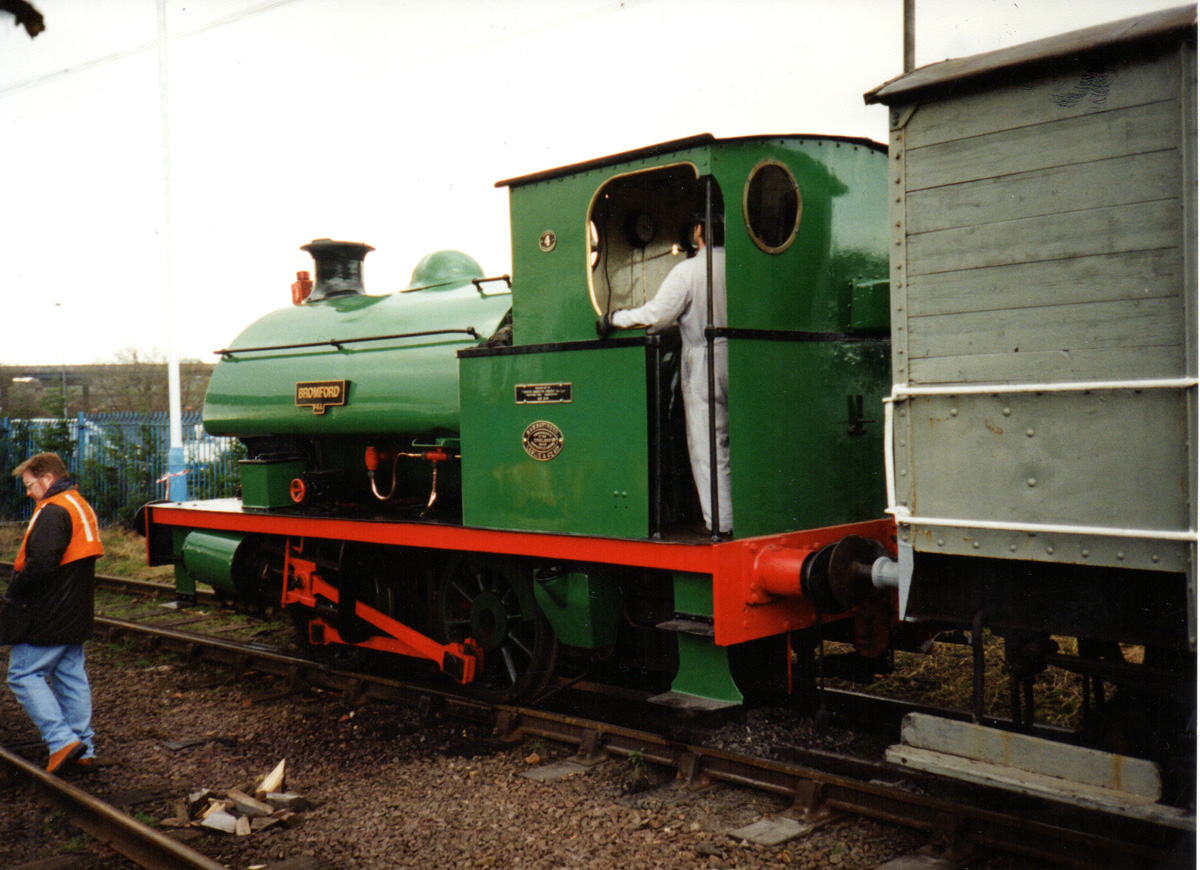
Apart from the tube problem the loco has continued to run well, and due to its being returned from Bromford facing the other way round, looks better hauling trains chimney first in its freshly painted green livery.
No.5 Sentinel – Very little progress has been made on this loco due mainly to the amount of work needed to try and keep Asbestos running. The boiler has, however, now been re-assembled, and the fittings are being refurbished off-site.
S100 – Work has continued on another of the four big leaf springs, the buckle of which was heated to expand it prior to assembly in Asbestos’s firebox. Various bits and pieces of brake rigging have also been fitted to the frames.
Fowler diesel – This loco has remained in service, used for shunting and works trains.
Ruston DL7 – In a surprise operation just prior to Easter this loco was fitted with an exhauster, valves and pipework to enable it to work vacuum braked passenger trains. Since then it has completed several days of passenger train operation including ’extra’ non-advertised days as well as standing in for Asbestos. Being unaccustomed to such intensive running, one of the axle boxes began to overheat, requiring stripping and cleaning. The drive belt for the low voltage dynamo also caused a problem by disintegrating half way down the line. This was, however, repaired fairly quickly without the train having to be rescued by another loco. The general public appear unaware of the difference between the diesel and Asbestos, although to be fair, they are both painted the same shade of green and produce roughly similar quantities of smoke when running!
L&Y petrol loco – This loco seems to have been abandoned for the time being with various bits scattered around the station yard and loco shed. Hopefully the re-assembly will commence shortly!
No.21 diesel – The engine for this loco is awaiting new cylinder head gaskets, and when fitted an attempt will be made to finally get it running again.
New Fowler – This four-coupled diesel mechanical loco appeared on site recently having been acquired from a preservation society in Redditch. Following an attempt to tow-start the loco, it was found that the fuel injection pump needed repair, and this has since been removed. Various other components have also been removed for attention so it could be some time before the loco is runnable.
Smith Rodley crane – this vehicle has remained out of use and has been pushed out of the way up No.3 road until a buyer can be found for it.
Carriage & Wagon News
New coaching stock – At long last replacements for the 2-car Wickham DMU and the recently departed Gloucester trailer have been found and began to arrive at Chasewater at the end of May. A total of four additional vehicles have been purchased from BR, a centre car and three power cars.
The first of these vehicles, a Pressed Steel Co. motor brake second, W51372, arrived in time to run at Whitsun. The recent history of this vehicle is quite interesting as it is one of several used by the contractors of the Channel Tunnel and has been through to France. A maintenance record book found in the drivers’ cab refers to various faults as being at “the French end” of the train.
Ultimately it is intended to retain two of the four for use as a working DMU in BR green livery, whilst the other two will be used as loco-hauled stock. Hopefully full details of the new stock will be included in the next magazine.
Wickhams E56171 & E50416 – The trailer car remained in service on passenger trains until just before Whitsun, when a vacuum leak in the brake system caused serious problems. In view of the impending arrival of the replacements it was withdrawn from use. The power car has also remained out of use.
Payment for the Wickhams has now been received from Llangollen, although a date has not yet been set for their removal from Chasewater. This is likely to cause a space problem, as with the new arrivals there will be a total of seven DMU cars on site for a while.
Derby centre car W59444 – This coach has remained in service although it has been noticed that the surface of one of its tyres has started to flake away. Advice is being sought as to whether it can be repaired.
20 ton Great Western Toad – This vehicle was ‘done up’ to run at Bromford Tube with Asbestos. If nothing else it has benefited from having the rust worn off its brake blocks, as it covered most of the distance at Bromford with its brake screwed hard on!
CRC 4-plank wagon – Progress on the wagon has continued and it now appears to be back in one piece. Tony Wheeler has started on the paintwork with the intention of finishing it in the livery of the ‘Conduit Colliery Company’.
Great Eastern six-wheel passenger brake – With the coming of better weather Dave Borthwick has started again on painting this vehicle.
Other vintage stock – No work appears to have been carried out on any other vehicles although this situation will hopefully improve during the course of the summer.
Shed Fund – This fund is now well underway so that by the time the route of the motorway is finally settled there may be enough money to make a start on this project. Meanwhile donations will be gratefully received by the Treasurer, Chris Chivers.
I’m sorry but I can’t remember who took the photographs.
From Chasewater News Winter 93 – Spring 94 – Part 3
Update on No.21 – Arthur Edwards
A long while ago I applied copious layers of red oxide to the outside of this loco in an attempt to preserve it, but once in the shed, Chris and Beth helped me to sand it down, fill it, sand it down again, apply gallons of primer and sand it down again! When Dave ‘Doc’ Baker arrived on the scene, Steve Organ approached me to ask if it would be ok for Dave to do the top coat as he was at one time employed as a signwriter. We all agreed, and now the result looks quite smart. Following the recent fitting of the Dorman engine into the frames, Chris has had a problem with lack of compression preventing it from starting. New cylinder liners are now being sought to match the new pistons we already have in stock as a solution to this problem.
News of the E1 – Barry Bull
The E1 has returned to steam at Cranmore where it featured in their three day Gala event on October 1st, 2nd and 3rd. Despite original plans to restore the loco in BR black livery as No.32110 (livery and number which of course it never carried) the loco has actually been turned out in Southern Railway olive green livery. Crews report that the loco is still a bit tight but runs well and will ‘run on a fag end’, which I presume means that she is economical. Perhaps a visit to Cranmore is called for, bearing in mind that another well-known ex-Cannock coalfield loco, Manning Wardle ‘Littleton No.5’ can be found a few miles away at Bitton.
Commercial News – Bob Duffill
For the first time in many years, the CLR took a stand at an outside event, the Warley Model Railway Exhibition on October 9th and 10th at the NEC. This clashed with our end of season rally and opening of the extension, and also my birthday on the Sunday. After 25 years of waiting to see proper passenger trains on the causeway, I missed it in order to raise funds.
Items for the stand had been collected from Chasewater the previous weekend and put in awkward places around the house for me to trip over. On the Friday afternoon John and I went to the NEC to set up the stand will a well-loaded Riley off down the M6.
Our first impression was that the hall was huge and well laid out, in fact we were able to drive the car up to the stand inside the hall to unload. There then followed attempts to disguise the various household furniture into a reasonable-looking display for our goods, some relics and Tony’s models. Compared with some stands, ours looked very homely. Whilst in the hall we had a severe electrical storm, heavy rain and a strong wind that blew over causing the large doors to be closed and the organisers to pray for better weather, and us for the event planned for Chasewater on Sunday.
On Saturday the hall was packed with bodies, and what had seemed like large aisles the night before were full. The day went on with steady sales of paperwork and odds and ends, and a steady stream of enquiries and much leaflet giving-out, the idea being to be there as much for publicity as to raise money. The new leaflet on Chasewater seemed to go down well.
Sunday dawned and John and I were there again but the day was not so busy. We were able to supply the Tal-y-Llyn Railway with some early GWR Tywyn paperwork for their archives which they appreciated with a donation. All in all attending the exhibition was a good exercise, raising some money and flew the flag.
Went the day well – Paul Whittaker
Excitement and fascination are the only words to describe the looks I saw on the children’s’ faces as they queued up to see Santa. Although some might say that the rosy red glow in their cheeks could only be attributed to the biting north wind that blows in across the lake.
I personally would like to think that a mixture of both contributed to the atmosphere that was created by the hard work and unceasing enthusiasm of the staff at Chasewater, without which this event would not be possible. Included was a vivid interpretation of Santa by our own Steve Organ, supporting cast being supplied by Geoff and relief Santa by Andy; not forgetting the mammoth task of decorating and preparing Mr. Claus’s Grotto, courtesy of Margaret and John. With all this plus a train ride provided by Les Emery, promptly followed by sherry and mince pies for the parents.
It only remains for me to say that the CLR is obviously going from strength to strength with its presentation of this seasonal event. Congratulations to everyone concerned.
From Chasewater News Winter 93 – Spring 94 – Part 2
FromA New Year’s Message from the Chairman
Without doubt, 1993 was a most interesting year for everyone associated with the CLR.
Obviously, the work on the ‘extension’ represents the most tangible of our successes in 1993, culminating in the decision of the Railway Inspector, Mr. Colin Law, to pass this further stretch of line in time for the Transport Rally in October. Immediately, our running line increased by over 50% in length, enabling us to market the CLR as a real railway with a real product on offer. With eminent guests from Lichfield District Council and Burntwood Town Council in attendance, after a very short, informal, ‘Opening Ceremony’, the Lichfield DC Vice Chairman Councillor Mrs. E.J.Bayliss waved off the 12 noon departure. This, as with most trains that day, was virtually full, with passengers having some little difficulty in finding seats of their choice.Photo: DMB
Councillor Mrs. Bayliss subsequently wrote a most charming letter to me, and I think it is appropriate to reproduce her letter in full –
“13th October 1993
Dear Mr. Bathurst,
Thank you very much for a lovely day at the Chasewater Light Railway and Museum Company’s Annual Transport and Machinery Rally and for the privilege of officially opening the new stretch of railway line. My husband and I found the Rally in Chasewater Park most enjoyable and interesting and we wish you well for the future.
The District Council looks forward to working with you further in the future when the whole of Chasewater comes within the boundaries of this Authority.
Yours Sincerely,
Cllr Mrs.E.J.Bayliss
Vice Chairman of Council.”
I hardly need to comment on how important it is for the CLR to enter into a good dialogue with both the elected members and officers of Lichfield DC, whose respect for the CLR will, for certain, be influenced by the professionalism with which we maintain our operations.
Please note: the Museum will not be open this coming Sunday, 8th October 2023
5 – ChasewaterRailwayMuseum Bits & Pieces
From Chasewater News Winter 93 – Spring 94 – Part 1
From the Editorial
The latest news is that ‘Asbestos’ is to spend the first weekend in March running on the internal railway system at Bromford Tube Works in Birmingham. The ‘Open Day’ comes just before the closure of the works and will involve running demonstration trains with the 20 ton GW Toad.
If you would like to put forward your views on a name for the new causeway station please complete and return the form later in the magazine.
Locomotive News
No.4 Asbestos – This loco ran passenger trains to the top of the causeway bank for the first time in October, and again in December for the Santa Specials. On both occasions the saddle tank was replenished at around mid-afternoon by a preserved fire engine, courtesy of Trevor Sharples of the Fire Service Preservation Society. This alleviated the need for us to fill the station water tower in potentially frosty weather, as the longer run to the causeway means that it is no longer feasible to rely on the station hose-pipe between runs. Following recent problems with firebars warping, a pattern has been made and a couple of samples cast from it. These were fitted for the Christmas running, and as they seem to have stood up to the last of our Columbian coal quite well, a further batch of replacements will be cast and fitted ready for Easter. The loco has now been partially stripped ready for a wash-out, cleaning and an intermediate boiler inspection. Work has also commenced on a number of minor repairs to cure amongst other things, a very tight regulator, a leaking steam manifold joint in the cab, and leaking injector water valves. If all goes well the loco should be ready to run again at Easter.
No.5 Sentinel – Some progress is now being made with the repair of this loco. A complete set of 96 new ¾” whitworth studs have been specially made to order in a special heat-resistant steel and fitted to the boiler. The two halves of the boiler shell are now being re-assembled ready for hydraulic testing, hopefully in February. The superheater coil will also be tested at the same time. Other work being carried out is the refurbishment of all steam fittings and the boiler water feed pump. All the fireman’s controls are being moved to the left-hand side of the cab to make life easier, as the loco was originally designed for one-man operation with all controls on the driver’s side.
New Peckett – Following the departure of ‘Lion’, another Peckett has arrived to take its place. The loco, purchased recently by Mike Wood, appears to have been supplied in kit form, complete with smokebox tubeplate, rods, fittings and various machined and un-machined castings as loose items. The loco is believed to be No.1903 ‘Little Lady’. No doubt we will be able to persuade Mike to write an article giving full details in due course.
Fowler diesel – This loco has remained in service without any mechanical problems, being used mainly for the regular Sunday works trains.
Ruston DL7 – Whilst nominally operational, this loco has remained out of use in favour of the Fowler.
L&Y No.1 petrol loco – Dorman Diesels of Stafford have very kindly had specially made for us a new set of camshaft drive gears to fit the petrol engine which is currently dismantled in the shed awaiting re-assembly. Work on the loco itself has continued with the refurbishment of its springs and axle boxes.
Carriage & Wagon News
Great Eastern six-wheel passenger brake – Work has continued on this coach during the winter, mainly on the interior for obvious reasons. There can now be little doubt that this will be the first of our vintage coaches to be fully restored, it is well on the way already.
CRC 4-plank wagon – Rebuilding of the new wooden planking of the body is now well advanced, and various items of steelwork are being prepared ready for fitting.
GW Fruit ‘D’ – Following a great deal of hard work to sand down and prepare the wooden body, this van has been painted in chocolate and even has the GWR emblems hand-painted on making it a very smart looking vehicle indeed. The only obvious outstanding work needed now is the re-covering of the roof to make it water-tight. Assuming that the vacuum works satisfactorily when new bags are fitted, it would be nice to see it added to the occasional passenger train just for show.
20 ton GW Toad – This vehicle has remained in regular use on Saturday and Sunday works trains throughout the winter. It is rumoured that it may go to Bromford Tube Works with ‘Asbestos’ in early March as part of a CLR arranged ‘closing down spectacular’ on that Company’s railway system.
Wickham DMU E56171 & E50416 – These two vehicles are now definitely destined for Llangollen at a time yet to be agreed, and dependant on our obtaining suitable asbestos-free replacements. Meanwhile, the trailer ran again on the Santa Specials in December but is looking exceedingly tatty, especially when coupled to the centre car. The power car has remained out of use.
Derby centre car W59444 – This coach is the only one of our four original DMUs destined to stay at Chasewater, and is therefore likely to be in constant use for the foreseeable future. It ran in December when, after quite a bit of preparation, even the heaters worked.
Replacement DMU stock – There is still nothing definite to report, although ‘The Management’ are still working on the acquisition of replacements, and are submitting tenders for suitable vehicles as and when opportunities arise.










 Chasewater Railway Museum