
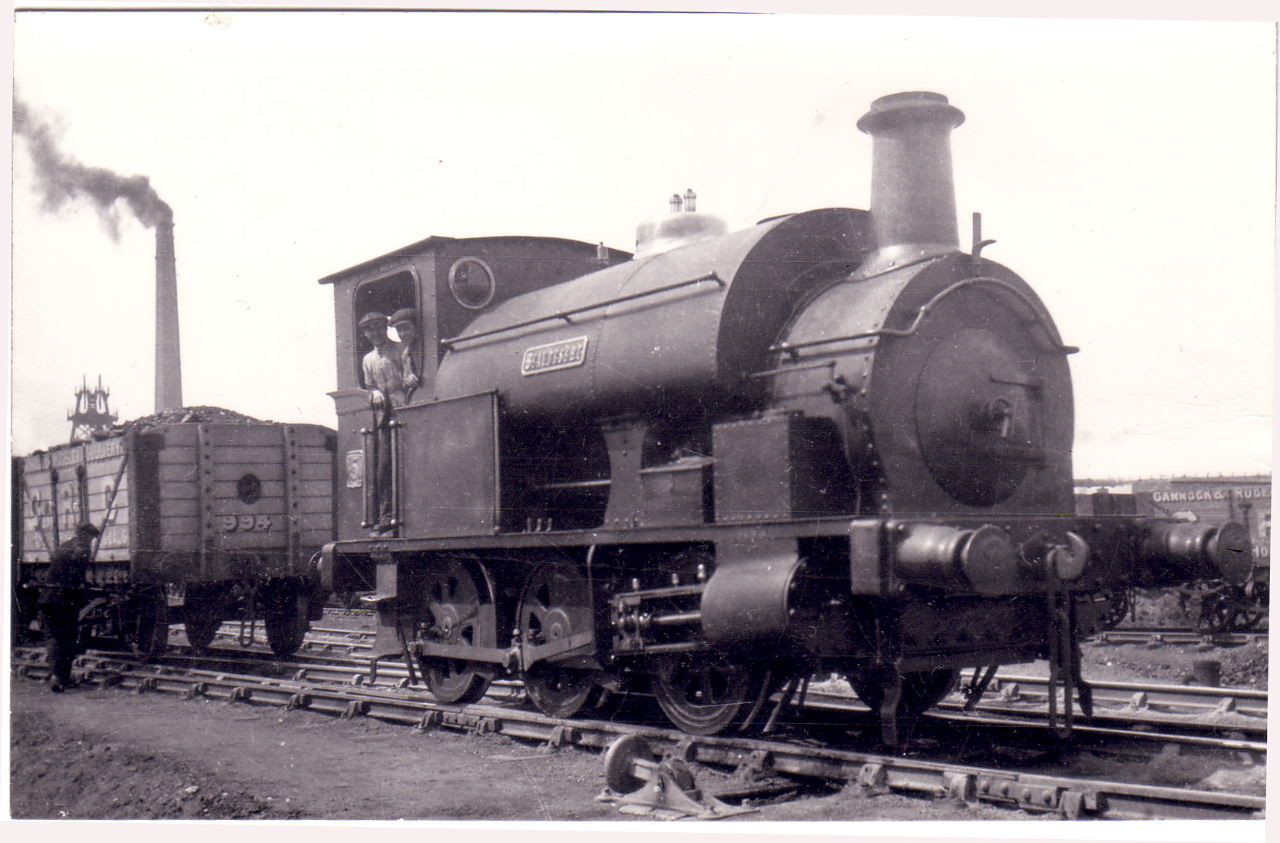
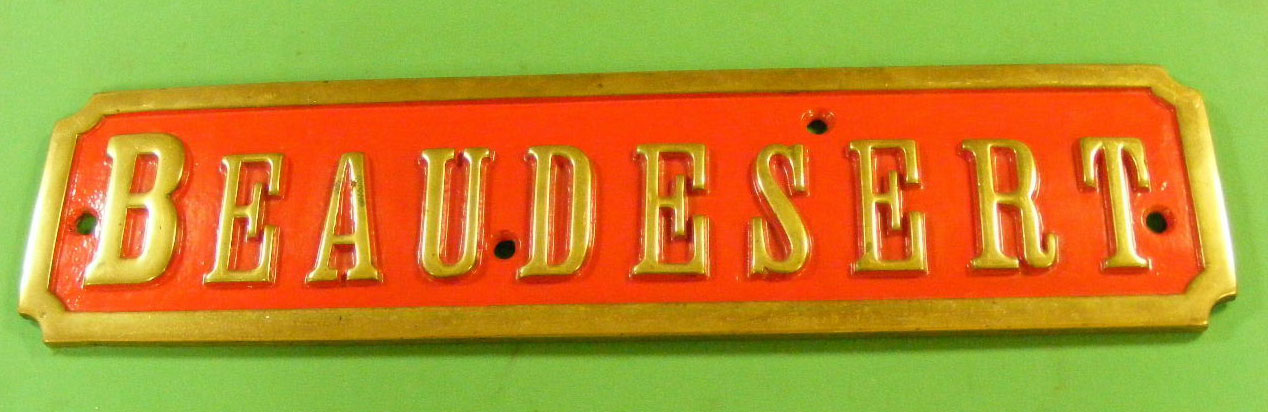
An opportunity presented itself recently to acquire by way of private purchase half a dozen items of local colliery railway interest. Not since the 1960s and early 1970s, when in that period a good relationship existed between the Railway Preservation Society and local National Coal Board management and which resulted in several donations of interest has the chance to obtain in bulk such star items for the museum collection. The third nameplate is that of Beaudesert from the little 0-6-0 saddle tank built by Fox Walker, works number 266 of 1875 supplied new to Cannock and Rugeley Collieries as their number 5. Beaudesert was the ancestral home of the Paget family who became Earls of Uxbridge before being given the title and Estate Marquis of Anglesey. Finally cut up in 1964 the other nameplate of the loco survives and is on display in Kidderminster Railway Museum.
Not much about steam locos in this article but an important part of Chasewater Railway’s history nontheless.. Written in the main by the General Manager at the time, Steve Organ with errors and omissions added by Barry Bull.
195 – Chasewater Railway Museum Bits & Pieces
From Chasewater News – Autumn 1996 – Part 3
***
Railcars on the Chase
27 Years of DMU Preservation
Steve Organ
The first ‘Modernisation Plan’ Diesel Multiple Unit vehicle to go into preservation was Gloucester Carriage & Wagon 1957 built Driving Trailer Composite (DTC) No.SC56301, which came to Chasewater from the Scottish region of British Railways at Easter 1969. The vehicle was one of a fleet formed into two car sets which worked in Scotland and in East Anglia, as well as in the West Midlands. The purchase was by the Railway Preservation Society (West Midlands District), as we then were, who had taken a lease on the line and trackbed at Chasewater which had formerly carried coal traffic.

The Park was being developed at the time by the local authorities keen to reclaim the spoil heaped, ruined landscape that had recently ceased production. A preserved railway was welcomed, and so much traffic was being carried in very old and fragile stock we had inherited from the Colliery at Rawnsley, that a more modern vehicle was needed to take the load, relieving the historic stock. The Gloucester, which seated 12 passengers in first class, and 54 in second was 57 feet 6 inches long and weighed only 25 tons.
Immediately on arrival at Chasewater, still in its recently acquired Rail Blue livery, with small yellow warning panel and 2-digit route indicator below the cab front window, the car was adapted with the buzzer circuit carried through the lighting circuit jumper and through to the locomotive which had a buzzer fitted to enable the vehicle to be used for push-pull working, with the Guard (or Coach Driver) signalling from the coach cab to the Loco Driver to stop, start, etc. by buzzer code. Permission was received from the Railway Inspectorate to operate in this fashion despite there being no through vacuum brake, thanks to the simple communication system, the excellent look-out position for the Guard, his access to a handbrake and the line’s ‘U’ shaped gradient profile at both ends!

The DMU was a great success, and we no longer worried about the underframe of the train snapping! The windows, large and almost continuous around the vehicle, together with the light green flecked Formica finish, and seating in vertically striped red and grey (second class) and blue and gold (first class), made for a very welcoming appearance, and the Chasewater system of working push-pull with DMU cars in conjunction with a steam or diesel locomotive was established.
The paytrain concept was adopted by BR in the sixties, and at Chasewater we often steamed on an unscheduled Sunday if the weather was fine (we only advertised trains every fortnight at this time), and used an ex Birmingham Corporation Transport Ultimatic ticket machine when the guard had to collect fares because no staff had been rostered for the station. Often in the summer of 1974 with trains running over the then 300 yards of track and with only five minutes to collect up to 90 fares, I felt as though my thumb was dropping off by the end of the day operating that machine.
1974 saw the Gloucester painted into maroon, with a light grey roof. A gold and white bodyside line was added below the windows in 1976. 1979 saw the front route indicator panel plated over, and a further coat of maroon paint applied.
In 1979, the Board identified two needs which could be satisfied with the purchase of a further two vehicles, firstly to use one as a ‘Railway environment’ buffet, and the other for use as a bar car, to be attached to the passenger train on busy or festival days. A two-car Wickham-built set, recently used as a General Manager’s Inspection Saloon was identified and purchased for £1500 plus VAT and transported by rail from Leeds to Wolverhampton steel terminal, then by road to Chasewater.
The Wickham two-car set had been converted into an inspection saloon car for the General Manager, British Railways Eastern Division, in the mid-sixties.

The diving motor brake second (DMBS) was No.E50416, 57 feet long and weighed 27 tons 6 cwt. Stripped of its original interior, a kitchen had been fitted in place of the original Guard’s compartment, and the Guard’s vestibule end windows had been plated over. A corridor ran from the gangway around the kitchen. The engines (two 150 HP BUT Leylands), transmission and general mechanical condition were fairly good.
The driving trailer composite, No.E56171, was 57 feet long and weighed 20 tons 10 cwt. Again, this vehicle was internally stripped for its inspection role, and was altered thus: one of the two toilets was removed and replaced with shelves: two huge seats, each 3’ 6” wide were installed next to the toilet, adjacent to a vacuum stand pipe, emergency brake handle and vacuum gauge. A single compartment installed and folding steps complete with vacuum pipe release trips (to prevent the train from moving whilst the steps were down) installed below the passenger doors. Both vehicles had had the passenger doorways nearest the front of the vehicles removed and plated over.
Both vehicles had aluminium bodies over angle-iron frames and were in good condition, however the gutters leaked and the gutter strip was eventually replaced – steel gutters fitted against aluminium bodysides need only water to start electrolytic transmission, resulting in bodyside holes against the gutter. (This was a problem we would encounter again later with the 1994 acquisitions). The doors were however a problem, with only a short production run, softwood frames with an aluminium skin were fitted, rather than the more normal single cast alloy that are on so many DMUs, so warping and rot were a constant problem.

At the time of the Wickhams’ arrival, the Company was suffering certain problems. The Society, which was the group founder, had formed a company in the early seventies for the purpose of administering the public services provided by the group, a YOPS (Youth Opportunities Programme) scheme was in progress, and the two parts of the group failed to see eye to eye, the result being ultimately that the volunteer-led Society failed to co-operate with the ‘employees’ of the Company. The track fell into rack and ruin and Society morale dissolved, members feeling squeezed out by the ‘Company’. Of course, in reality the two needed to co-exist.
The planned use of E56171 as a second train vehicle was not proceeded with, although a rudimentary bar, built in the Officers’ compartment, did see several static days of service in 1981, and after a few excursions with E50516, as a DMU was laid up. E56171 was however opened as a static buffet in 1981, parked against a sleeper-built platform.
1982 saw the Railway close down. The condition of the track was awful and volunteers had disappeared, also a huge debt had been run up by the YOPS scheme. The platform at Brownhills West was declared unsafe and demolished under the Company’s auspices, only to be found to be almost indestructible (but too late, the track had been removed and the ground excavated). The group’s only income for the next three years was from the static buffet car E50416 and very little of significance occurred on site.
1985 saw a new start for the Railway. A new Company was designed, and only a week after incorporation was registered as a Charity. The aim was to incorporate the assets and accumulated debts of the old Company and Society, safeguarding the vintage stock and line, and to address the debt, so that things could start moving away from the moribund state. With the track re-laid in concrete sleepers and a few of the old volunteers in harness, trains operated again for the first time in three years in October 1985.
The Gloucester car was repainted – yes – maroon again! And the now very worn maquette was replaced by yours truly in his first stab at upholstery. A straw and green cloth was used in the Second class and a deep purple in the First. Care was taken to retain and renovate all the other original fittings, wall covers, etc.
For the 1986 season both Wickham cars were repainted into – you guessed it – maroon to match the Gloucester. The buffet car remained static, but the now derelict E56171 was re-worked, starting with the replacement of19 windows which had been smashed during its three years of abandonment. A new large bar was built, and original pattern ‘curly back’ seats arranged around tables. An open lounge area was created using seats from BR Mk ll carriages and the Officers’ compartment was fitted with First class seating from a Mk l carriage. Whitsun Spring Bank Holiday) 1986 saw the car in service with the Gloucester on the now 400 yard shunt.
One special problem had arisen during the carriage repairs; a mechanical and structural survey had shown them all to be very contaminated with blue asbestos in the body side and roofs. A solution to the inevitable eventual stripping cost, at that time estimated at around £15,000, meant that something would have to be done!

From ‘Letters to the Editor’ Winter 1996 Chasewater News
While browsing through the next magazine to see if there was a part two to Steve Organ’s article (there is!) I came across this letter from our Museum Curator, Barry Bull. I decided to include it here to save any long-standing members commenting on any errors.
Dear Sir,
Having just received and read the Autumn 1996 Chasewater News I would like to add a little background detail and correct a few inaccuracies in Steve Organ’s article ‘Railcars on the Chase – 27 Years of DMU Preservation’.
I’m afraid that Steve has exaggerated by some 4 years here as the Gloucester trailer E56301 did not arrive at Chasewater until May 1973. As the E prefix indicates it came from the Eastern Region and not, as Steve suggested, from Scotland. The vehicle was on open tender from BR and lay at March, Cambridgeshire. We had been looking for a suitable vehicle to relieve the use of the Maryport and Carlisle six wheeler and the 16 ton GWR Brake van on passenger services, and needed something suitable for push-pull use, the Gloucester, as Steve mentioned was just right. Our bid of £330 with our proviso that this included removal at BR’s cost to our nominated place for transfer to road transport (Long Street, Walsall) was accepted.
However, before the Gloucester trailer arrived at Chasewater, we could have disposed of it! The North Yorkshire Moors Railway had acquired off the same BR tender list two Gloucester power cars and just one trailer. As you can imagine they were probably a trifle peeved at having lost a trailer and we were duly contacted with a request to forego our new acquisition. Our response was to give the NYMR a short time to provide and transport to Chasewater at their cost a similar suitable vehicle with an amount of cash to be paid to us for our ‘inconvenience’. We received no response and the Gloucester duly arrived at Chasewater with its road journey from Walsall featured on the local independent TV News, thanks to Paul Mason who apparently drank in the same pub as Bob Warman. At least one RPS member who knocked a day off work to help in the operation was spotted on TV and got into a bit of bother at work the day after.
It wasn’t until 1977 that the Gloucester was repainted maroon, with the work being done by outside contractors, just in time for the Queen’s Silver Jubilee celebration when we ran in conjunction with a local Brownhills West street party and we squeezed in 108 passengers on one run. It was around that time when Adrian Pearson took the photograph of the Neilson together with the Gloucester which John James had 5.000 postcards printed at a cost of just 2.8 pence each. John stood the cost of these cards himself as the Society couldn’t afford the bill. I wonder how many are still left to sell? (Enough. Ed.) (All gone now, given to young visitors as a memento and much appreciated. CWS).

The Wickhams were inspected as lying at Stourton, Leeds and I must admit to being keen on them as soon as I saw them there. The purchase price I seem to recall was £1,000 for the power car and £750 for the trailer – plus I suppose VAT. The deal was concluded by Derek Cartwright then working on the YOPS programme at Chasewater.
Finally may I congratulate you on the quality of the Chasewater News these days including the photographic reproductions.
Barry Bull

In through the farm gate (Transport photos from Laurence Hodgkinson’s Collection)
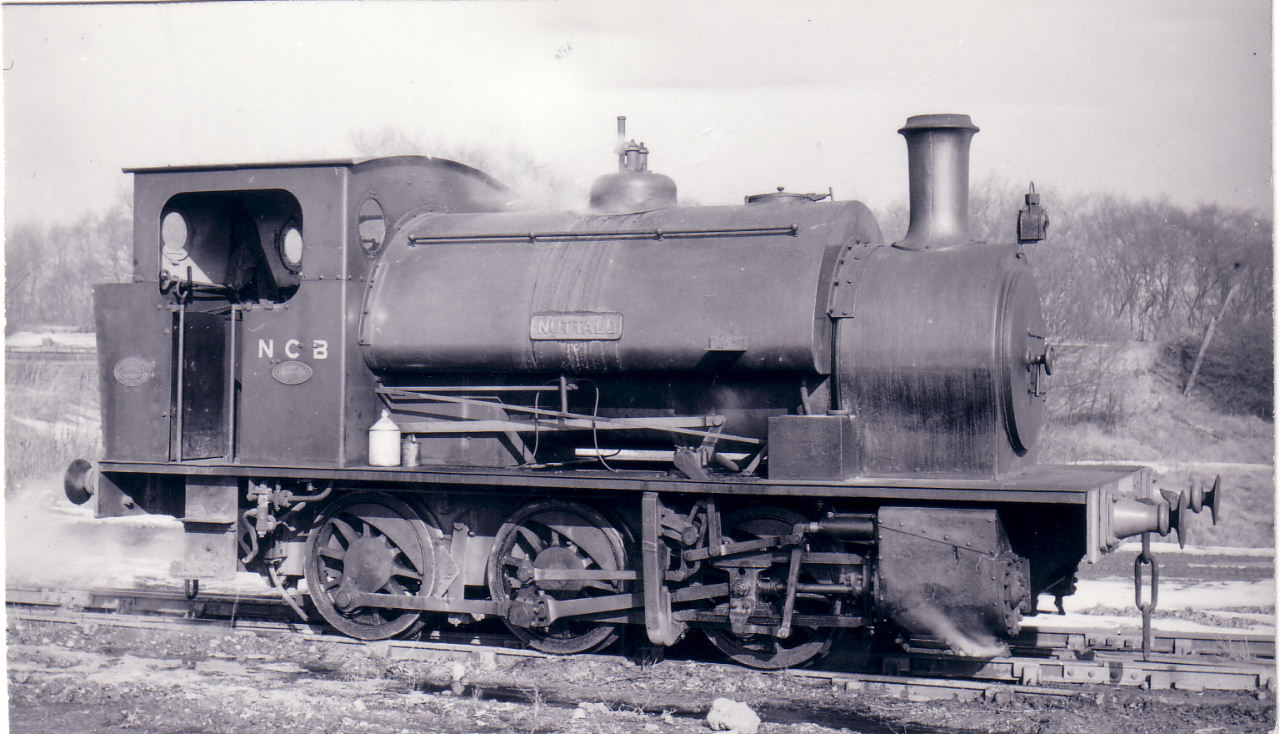
‘Nuttall’ 0-6-0 ST, HE, 1683-1931. Cannock Wood 2-3-1963


 Chasewater Railway Museum