Tag Archives: Railway Preservation Society

Chasewater Railway Museum Bits & Pieces 48 Mercian July 1969, plus a few photos from 2009

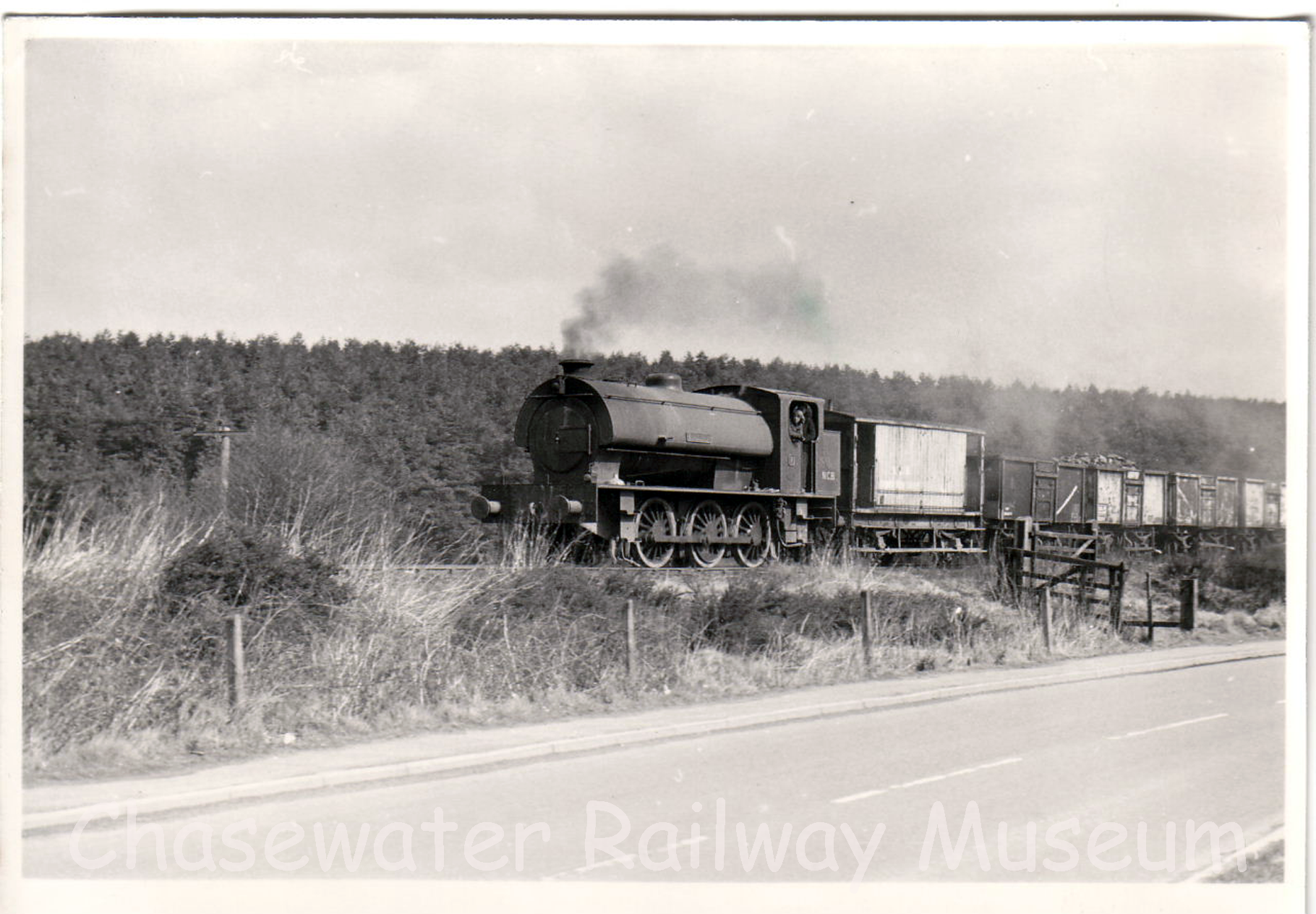
5448 Wimblebury No.7 0-6-0ST H 3839-1956 June 1969 Hunslet

Chasewater Railway Museum Bits & Pieces 48 Mercian July 1969, plus a few photos from 2009

From the Mercian of July 1969

Following a disagreement the Committee published a special message announcing the resignation of the Hon. Secretary, Hon. Treasurer and Vice-Chairman.

The acting Hon. Sec. A.A.Chatfield put together a report at short notice, stating that the usual progress is being slowly maintained, but more hands were still needed.

Mike Lewis had been packing the track near the compound and helped to alleviate the flooding problem.  Steve Allsopp and Brian Hames have completed the overhaul of No.21 and have given her a spanking new coat of paint.

Derek Luker has been working on the steam locos with his small band of helpers and ‘Asbestos’ is now ready for a hydraulic test.  New tubes are on order for the other locos and it is hoped to deal with them as soon as labour becomes available.

A limited amount of maintenance has been started inside the Royal Saloon thanks to Richard Middle and Arthur Chatfield, again a couple more members here would help out, particularly while the weather holds good.

Two of the younger members whose names escape me at present have been putting a coat of protective paint on the E1, again a much needed job well done.

From time to time we get requests from various bodies and individuals to help in storing rolling stock and in particular steam locomotives.

I feel that in the interests of all concerned it would be a sensible idea to say that while we have every sympathy and will try to advise such bodies and individuals, we cannot offer any hope of storage space either at Chasewater or Hednesford.  Our present commitments with our own existing stock preclude us from offering help.  I would ask all who read this to realise the difficult position that we are in with regard to this matter, for it is better to put you in the picture than to disappoint you later.

Make no mistake about it however, for as soon as we are able I am sure that we shall assist all we can.

Chasewater Railway Museum Bits & Pieces 47, Mercian April 1969

Chasewater Railway Museum Bits & Pieces 47, Mercian April 1969

Manchester, Sheffield & Lincolnshire coach pre-Chasewater


This post was taken from various reports in the Mercian of April 1969

This Mercian seems to cover March/April and May/June 1969.

There as a new Editor for the magazine and the poor man in charge appears to have similar problems to any other magazine – a lack of articles!


Secretary’s Report – T.G.Cousens

After slow progress during the winter months at Chasewater, in which time only the arrival of the Manchester, Sheffield & Lincoln Railway coach broke the monotony of packing the track with red ash, progress is again in evidence.MSL Coach at Easingwold

The appointment of Mr.A.Holden to General Manager has seen marked changes in only a few short weeks, the most noticeable being the complete levelling of the compound and laying of track foundation into it.  Behind the scenes however, small departments have been formed to work on various aspects of the line with people responsible for each of the allocated tasks.

However, working parties are small so progress will be slow – do we have to wait until the line is operating to see 90% of the membership?!  Why not come down one Sunday afternoon and do a bit of shovelling, things will then begin to come to life.

A successful Open Day was held in conjunction with Messrs. Courtaulds Ltd., Coventry and organised by Gerald Wildish with the Company.  Many visitors arrived to photograph the two Pecketts, one, ‘Rocket’ was seen at work on the Foleshill Railway.  Many items were sold from the RPS stand which resulted in a fair profit to us.

The exhibition team was also at work at Huyton, Liverpool, at the preservation exhibition, the Open Day at Chasewater during the Easter week-end and the Stafford Railway Circle exhibition.

Well done to the members who attended these stands, especially the Huyton one.

The Barclay ‘Colin McAndrew’ was in steam on Easter Sunday and Monday under the able direction of Mike Lewis and Derek Luker.  She unfortunately blew a tube on the Sunday but after a quick trip by Rob Duffill (our hero!!) to Hixon for a spare, the locomotive crew replaced the defective tube and raised steam for a second time the same day!  No stock was hauled because of work required on the track – members please note.  Until this work is done Open Days will be severely restricted, so may we see more of you assisting at Chasewater.Colin McAndrew at Greening Wireworks, Warrington.

From the Public Relations Officer’s Page – G. Wildish


The first mention was of the next Open Days, June 28th and 29th 1969, with the expectation of large numbers of visitors and asking for members to come along and help.

There was a request for more photographs for the cover of the magazine, which unfortunately do not reproduce very well.  The Foleshill Railway Open Day had to be cut short and apologies were given to anyone affected.

A number of publications were mentioned – ‘Preserved locomotives of the World’ and ’Narrow Gauge Steam 1969’ for which a second impression is being prepared, later to be followed by ‘Narrow Gauge Steam 1970’

A publication for continental travellers – ‘German Steam’ has been prepared by an RPS member, so the Society is getting half of the profits, with thanks.

The final two publications were – ‘Railway Modeller’ which contained an article by Gerald Wildish and ‘Railway Enthusiasts Guide 1969/70’ which contained some information about the RPS.

There was an appeal for funds to move a locomotive of the Taff Vale Railway, and another appeal for volunteers to join a ‘paint in’ at Chasewater to give the rolling stock a much needed coat of paint.

Chasewater Railway Museum Jan 1969 Bits & Pieces 46

From the ‘Mercian’ of January 1969

From the Secretary’s Report  – Trevor G. Cousens

On 21 September 1968, the Society held its 9th Annual General Meeting at the Pear Tree Inn, Brownhills.  The attendance was very poor considering the attraction of a steam trip down the line afterwards.

After the meeting, sandwiches were supplied by Pete Parker, proprietor of the Pear Tree, and then members crossed the road where in brilliant evening sunshine stood the Andrew Barclay 0-4-0ST, (Colin McAndrew) immaculate in green and red, with polished brass and copper-work.

Members were invited on to the train comprising the Midland (or Coal Board) brake van, the Midland brake coach and the Great Western brake.  The train departed with Mr. Civil driving and Mr. Luker firing, the team, who with Mike Lewis had so painstakingly restored the locomotive.  She was opened up to pull the train up the 1 in 50 bank to the causeway causing the steam pressure to drop rather drastically to 40 lbs per square inch, but this is probably the longest run the loco has ever made without running over the same tracks twice, and its small boiler and firebox being designed more for a 3’ 6” gauge loco, this is not surprising.

Over the causeway, we ran on to the shore again until we were held up by some rather enthusiastic ditching by Bob Wormington, which caused the loco cylinders to come into contact with the spoil.  We ran on until we reached the end of the line, where a stop was made to raise steam for the return journey.  The loco was once again admired by the members, its rather peculiar mechanical pump a feature of interest on the running plate.

The return journey was made almost without incident, a point switched the wrong way round caused a minor sensation, but we returned safely to the Compound, where some rather complicated shunting was carried out before putting the engine to bed.  In fact, it was 9.00pm and dark when Laurence Hodgkinson finally put the diesel in with the rest of the stock which had been parked in the loop out of the way.

So ended the third RPS steaming at Chasewater, giving some encouragement to those who had worked so painstakingly to make this event possible.  But, it made one think about the amount of work still to be done, principally on track, but also on locos and stock before these steamings become a regular feature.

In the Treasurer’s Report by Frank Harvey, it was noted that, among others, Mr. R. Duffill  joined the Society!

Chasewater Railway Museum Bits & Pieces 45 More Aug 1968 Mercian

Chasewater Railway Museum

Photo: Robin Stewart-Smith.

More from the August 1968 ‘Mercian’

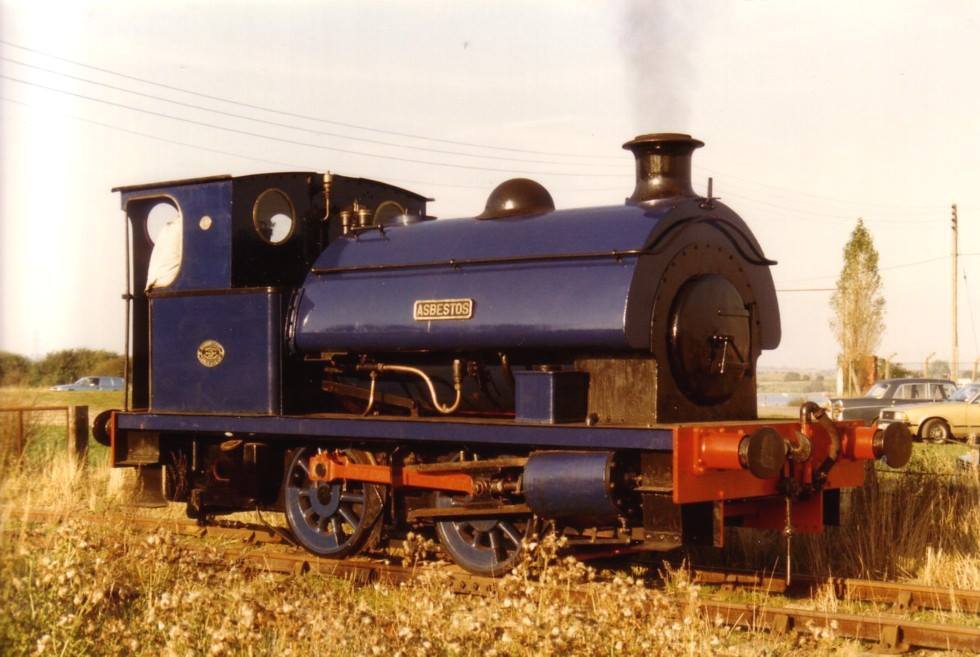
Turner’s Asbestos Cement Co. Ltd ‘Asbestos’

Hawthorn Leslie 2780 of 1909

By Gerald Wildish

Many of you will by now have seen our splendid new locomotive.  Two years ago exactly to the day that she left Trafford Park, I first found ‘Asbestos’ – 15th June 1966.  She was not working on that particular occasion and had been specially hauled out of the shed for me and put in a photographic position.  She appeared in excellent condition.  On the occasion of my visit I learnt that she was likely to finish working that September, and I duly put in a bid for the RPS.  I was informed that the Society’s interest had been noted.

A little over a year later a letter arrived from Turner’s asking me if I would care to bid for the engine – I made an offer of £50, and shortly afterwards received a telephone call informing me that a scrap merchant had offered £100 – we could have her if we could reach that figure.  By this time we were in October and I was already engaged in trying to raise funds for the Neilson.  My reply said that if they could hold the locomotive until after our Christmas raffle, we would do our best, but I did not hold out a great deal of hope.  Considering all things, the raffle was a success, but we did not raise the sums necessary to allow us to move in two directions and I informed the Company that we would have to let her go.

My surprise could not have been greater, when Mr. Francis, the manager of the buying department, rang me to say that we could have ‘Asbestos’ free of charge.  Without doubt this was one of the happiest days of my life.  I made arrangements to go to Trafford Park to arrange the handover and had an excellent morning.  The handover was arranged for a date three weeks later when the presentation plaque could be fixed to the locomotive.

I could not have been dealing with nicer people throughout the negotiations, right from the time of my first visit to the works.  Our thanks must go to Mr. A.H.Wailes, the Works Director, Mr. T.Noble, the Purchasing Director, Mr. T.N.Chadwick, the Works Manager, who also arranged for the locomotive to be ‘done up’ for us during the week before the handover, to Mr. W.D.Francis, the Purchasing Manager, who dealt with most of the negotiations and Mr. S.McCormick.

Little is known of the history of ‘Asbestos’.  She was built by Hawthorn Leslie in 1909, for the Washington Chemical Co. in County Durham, where she became No.2, along with two other Hawthorn Leslies and a Fox Walker engine.  A further Hawthorn Leslie was added in 1918, and presumably replaced the Fox Walker.  In 1920, the Company became part of the Turner and Newall group.

In 1933, two of the locomotives were transferred to the Turner’s Asbestos Cement Company works at Trafford Park, becoming ‘Turnall’ and ‘Asbestos’.  Turnall was scrapped in 1965, leaving ‘Asbestos’ with two diesel locomotives (Planets).  ‘Asbestos’ was placed in store as the reserve engine in 1966 and presented to the RPS on 25th May of this year(1968);  she was transferred to Chasewater on 15th June, and started work in revenue service eight days later.

Photo: Oct 1985 – Tony J.Griffin

Photo – Russ Hillier

Chasewater Railway Museum Bits & Pieces 44 Aug. 1968

Chasewater Railway Museum Bits & Pieces 44 Aug. 1968

Latest Arrivals at Chasewater

People living in the houses adjacent to the line have by now become used to seeing various types of low-loaders arriving with miscellaneous items of rolling stock, in fact on one memorable day two vehicles arrived at the same time.  One often wonders what the thoughts of these people are as more and more large relics appear at Chasewater.

Several items have arrived over the last two months.  The first and in many ways the most important was the Midland Railway crane from Hednesford.  Without this, our track laying project could not have been fulfilled and over the last eight weeks it has more than made up for its three years of inactivity at Hednesford.  Apart from being a valuable historic item, it is a most useful piece of equipment.

The Whitsuntide holiday saw the arrival of the South Eastern and Chatham Railway 6-wheel full brake from the Derwent Valley Light Railway at York.

Pic: http://www.bluebell-railway.co.uk

SECR Brake No.1601

This six-wheeled van, built in 1905, is unusual in that it has both a “birdcage” lookout on the roof and side duckets for the guard. In addition to accommodation for the guard, the rest of the space was used for luggage. On withdrawal it was transferred for service use as an ARP Cleansing Van, based at Bricklayers Arms Locomotive Depot in London.

With no further use for it after the war, in 1947 it was sold to the independent Derwent Valley Light Railway in Yorkshire. On its second withdrawal from service it was bought by the Southern Locomotive Preservation Co., who moved it, with the rest of their stock, to the Bluebell in late 1971 and early 1972.

The van’s eventual restoration will require, as its first stage, the complete reconstruction of its wooden/flitch-plated underframe.

It was at Chasewater for five years before being transferred to the Bluebell Railway.  It had to be left outside for the haulage company to make an early start, and in those few hours every window was smashed. ( I know there aren’t many but…..)

This was most eventful since it arrived a day early.  The usual entrance was locked and the haulage contractors came through the main entrance.  This involved a considerable amount of shunting on their part and eventually necessitated the complete removal of the main gates.  After becoming entangled with overhead power cables the vehicle was finally unloaded without a hitch!  The carriage is in the nature of a joint venture between the Society and our good friends the Southern Locomotive Preservation Company, the latter having purchased the coach while the RPS provided the bulk of the money needed for transportation.

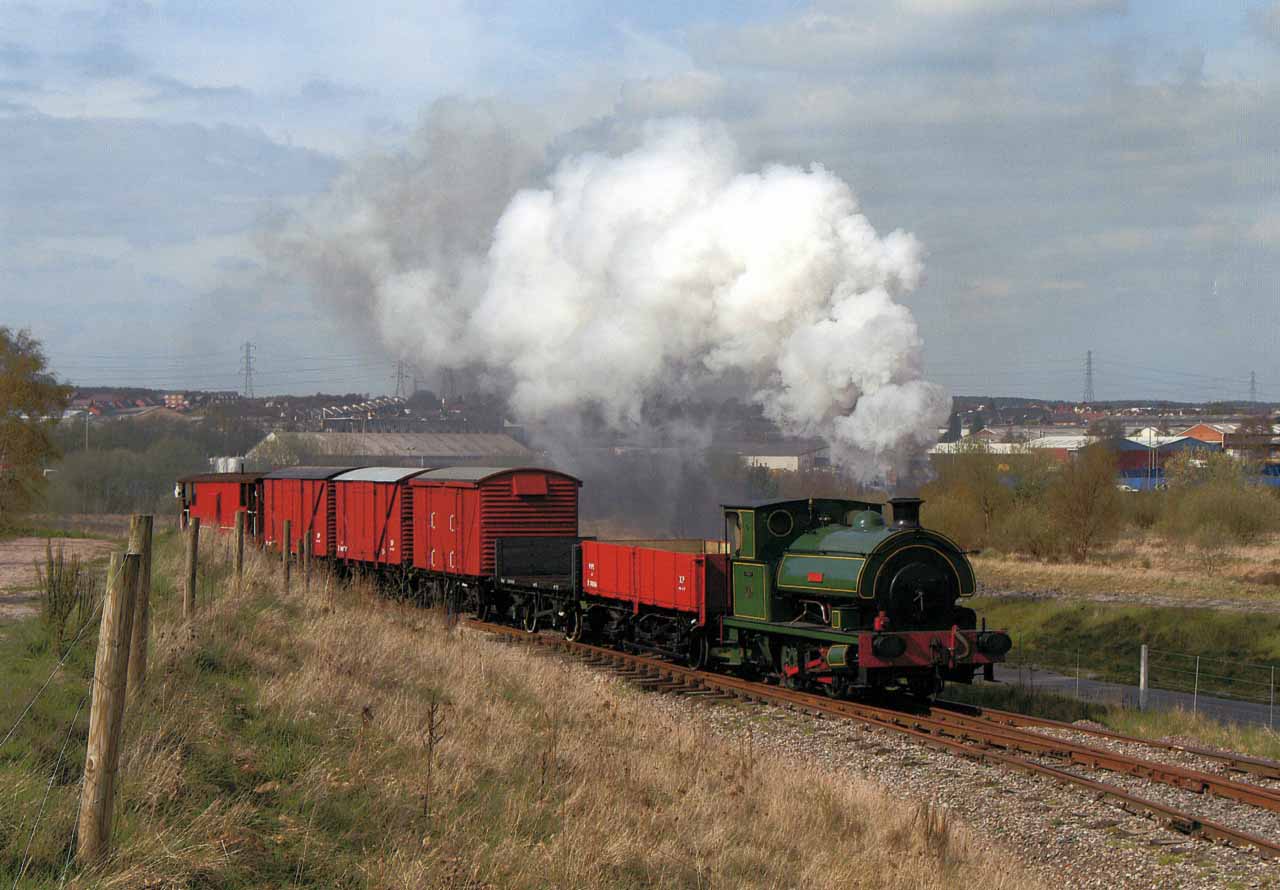
The next arrival, on June 15th, was the Hawthorn Leslie 0-4-0ST ‘Asbestos’ from Turners Asbestos Cement, Trafford Park, Manchester.  In contrast to the previous item, this arrived about five hours late and completely disrupted work for the day.  However, the sight of this immaculately maintained locomotive more than made up for any inconvenience.Pic: DM Bathurst

This was followed one week later by our most distant acquisition, the Neilson 0-4-0ST from Glasgow, vandalised the day before collection, as posted elsewhere.

Before the next influx of new items, more track will have to be laid into the compound. As soon as this is done, the peace of the neighbourhood will once again be shattered by the noise of heavy haulage vehicles.

Frank Harvey

Chasewater Railway Museum Bits & Pieces 43.1 – Neilson on its way – most of it!

Chasewater Railway Museum Bits & Pieces 43.1 – Neilson on its way – most of it!

A not very satisfactory day

By G. Wildish

June 16th 1968, we were on our way to collect the Neilson locomotive – ‘we’ being Mary Grisdale and myself, Gerald Wildish.  The 4.00am train landed us in Glasgow shortly before 8.00am and after breakfast we arrived at Gartsherrie at 8.30.  Since our last visit, the works had been completely taken over by the scrap merchants, T.W.Ward, and this was the beginning of our trouble.

Reporting at the works – the manager said ‘Oh yes, the engine is there – go up and I will join you later.’  I went to the shed and was disgusted.  Some scrap thieves had removed all the brass clack and water valves.  The coupling and connecting rods had also been removed and cut up by oxy-acetylene equipment and were lying in pieces around the engine.  I returned to the manager and told him the story, ‘Oh yes, that happened yesterday, the police have been told’ – but why hadn’t he mentioned it to me earlier!

There was one locomotive with its motions still intact – No.3, and the manager agreed that we should tale these rods.  The next job was to remove them, they were stuck fast!  Mary traced some welders nearby with some cutting equipment and I gave them a back-hander to remove these for me – it took two and a half hours to get these pieces off satisfactorily. (It is highly probable that these men were the culprits from the day before).

Meanwhile the other problem was to remove the locomotive.  The line which we were to use for the removal – which it had been promised would be left for us – had been taken up!  At 9.00am the Wrekin Haulage people arrived and I took the driver on a tour of the lines and eventually we found one road-level stretch of line, but this was a mile and a quarter away.  The problem was to get the loco there.  The diesel loco of T.W.Ward was also in trouble and was unlikely to work.  However, I prevailed on two men to start and operate the diesel, but the brakes failed.  We agreed that I should operate the Neilson as a brake.  At 11 o’clock we succeeded in getting the Neilson to the low loader.  Two hours later we had got the coupling rods off the other Neilson and taken over to the low loader by a dumper truck.On her way!

Just before 4 o’clock the Neilson was loaded, but on arrival at the works entrance, the driver estimated that he could not get out!  Half-an-hour later, with the police controlling the traffic, the lorry nosed its way out and we set off for home.

Despite all our efforts, we are still two water and clack valves and injectors short.  New piping will be required to connect them with the loco and screws holding them to the boiler will have to be renewed as these have been mutilated by the acetylene equipment.  However, we have the loco – I pray that No.3’s rods fit.  Now that Millom Haematite Iron Ore Co. is to close down, we may be able to obtain spares from their Neilson, I sincerely hope so – I have written to them in anticipation.

Steaming at Chasewater

That is the end of Gerald Wildish’s article, but just to conclude – the Neilson locomotive took a while before it was used at Chasewater but was steamed successfully from 1975 till 1982.  After some years in storage and in the Heritage Centre it has now been moved into the workshop ready for renovation work, probably after the Hudswell Clarke S100 has been completed.In the Heritage Centre workshop

PS from Barry Bull – steamed September or October 1982 for her 100th birthday together with McLaren traction engine ‘Little Wonder’, also 100 years old, owned by the late John Mayes.Picture from http://www.steamscenes.org

Chasewater Railway Museum 1968 Vol.1 No.3 Bits & Pieces 42.3

Chasewater Railway Museum 1968 Vol.1 No.3 Bits & Pieces 42.3

Plus Stocklist – 1968

This is one of a number of articles included in this magazine – there will be another couple to follow later. I don’t know what happened to this loco, but in spite of it being purchased and delivered to Chasewater, it hasn’t steamed since!

Hudswell Clarke 0-6-0ST No.431 – By Frank Harvey

Working at Desborough – V F Hall


The previous issue of the Mercian featured several photographs of this, our latest locomotive, and it was felt that a short article about it would not be out of place.

It was built by Hudswell Clarke & Co., Leeds in 1895, works number 431 and spent most of its life in the hands of the Sheepbridge Coal & Iron Company in whose fleet she became No.15.  It was allocated the name ‘Sheepbridge No.25’, but this was never carried and with the removal of its official number and works plates ran its last years without any identification at all.

It has on two occasions been rebuilt, first in 1928 and secondly in 1944, by the Sheepbridge Company themselves.

The engine was first suggested as a suitable candidate for preservation some two years ago when it was one of several locomotives at work at Desborough Warren Quarry near Kettering.  One by one its companions were withdrawn leaving No.15 as the only workable source of motive power.  After closure of the quarry it assisted with the lifting of the track, until the early part of 1967 when it too was withdrawn and stored in the engine shed at Desborough in company with an Avonside 0-6-0T.

The RPS then stepped in and after pleasing, successful negotiations with Stewarts and Lloyds Ltd., the locomotive was purchased.  The firm kindly allowed us to steam the engine before purchase – and members will have read about this eventful weekend in the last issue of the magazine. (CRM Bits & Pieces No.41).

It proved to be in good working order and required little in the way of attention save for the fitting of two new injectors which have now been purchased, and the repairing of a cracked blower pipe.  Evidence of this can be seen clearly in the photographs!

Desborough, 1968

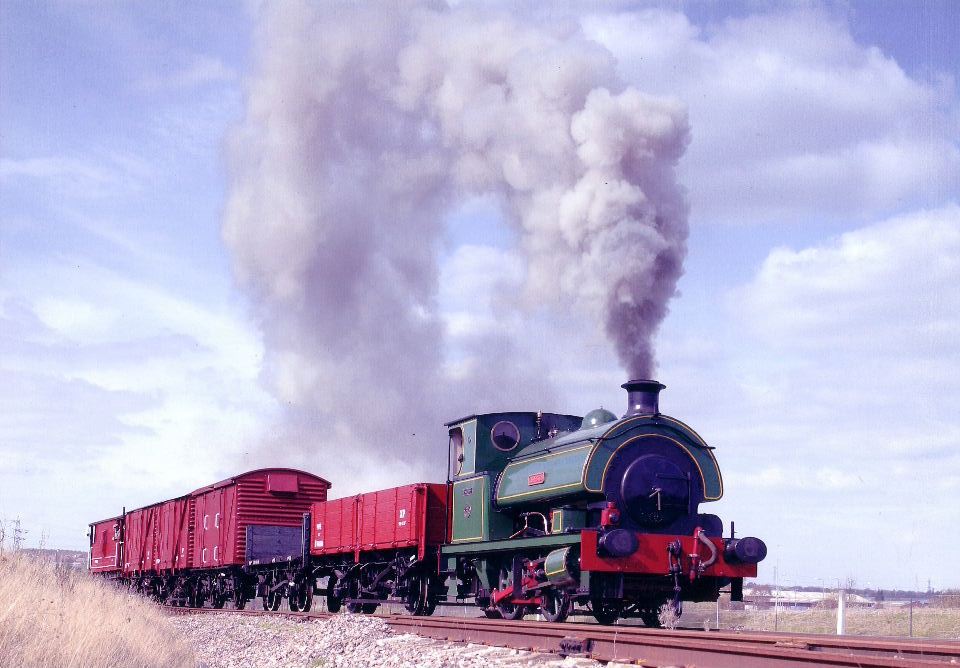
The locomotive was delivered to Chasewater in November and restoration is now well under way.  When completed it will be resplendent in apple green, lined black, edged white and a high standard is being achieved.Chasewater August 1969

Purchase and transport charges tended to deplete the Society’s funds somewhat, but all agree that it was money well spent and in common with all other RPS stock, no money is outstanding, a fact of which we are justifiably proud.

Although restoration is unlikely to be completed before 1969, we look forward to seeing No.15, the oldest working Hudswell Clarke, in steam at Chasewater later this year.In the Heritage Centre, 2010

Stocklist – 1968

With so many new additions, it was decided to publish a stocklist in the 1968 Mercian, Vol.1 No.3

I hope you can read it ok, it’s interesting to see what’s still here after 40-odd years, and what’s gone.

Chasewater Railway Museum 1968 Vol.1 No.2 Bits & Pieces 42.1 & 2

Chasewater Railway Museum 1968 Vol.1 No.2 Bits & Pieces 42.1 & 2

From the Chairman’s Notes 1968 Vol.1 No.3.

The Society is now passing through a difficult stage, this is common with individual members, indeed the country as a whole, is suffering from a severe depression with the economic climate.  The loan for our museum building has now been deferred, may we hope for better tidings later in the year?  We are, however, most grateful to members who are coming forward with loans to cover the cost of the museum compound.  Once this compound has been erected and the track into it laid, we should have two of the locomotives installed in the compound and ready for steaming.  The target date is late June and should not prove too difficult, if help, both financial and practical, is immediately forthcoming.  Your committee is working extremely hard, both on administration and practical work.  I therefore appeal to all members to back the committee and so push the work along faster.  A colossal amount of work has to be done this summer.  I am going to itemise the list of vehicles which require immediate attention.

D. A. Ives.

From the other reports 1968 Vol.1 No.3. 42.2

From the Hon. Secretary’s Report

The work on the Andrew Barclay loco (Colin McAndrew) at Hixon is almost finished.

Trevor Cousens and Allen Civil visited Stewarts and Lloyds at Bromford Bridge to buy loco spares to replace parts on the Hudswell Clarke and the Barclay locomotives.

Early in March 1968 some track was stolen from Chasewater.  It has since been replaced and measures are in hand to prevent any further occurrence.  A security compound will be constructed in the very near future to house the stock there.

Restoration Work at Hednesford.

Slow progress has been made on the MR Royal Saloon, the clerestory roof has had pitch applied.  The damp has caused the roof inside to crack up.  We understand that work is now in hand to the two side panels which need attention.  The outside is now being given a coat of undercoat.

The LNWR TPO needs a good coat of red oxide, some of the woodwork needs replacing.  The roof has had some attention and is more waterproof.

The TPO needs a good sort out inside, with new relics arriving all the time, we are getting very short of room in this vehicle.  A great number of relics have to be stored because there is not enough space to display them.

The Maryport & Carlisle 3rd Class carriage is almost completed, the wheels need finishing with a white rim.  The underframes require another two coats of paint.  One door has been made complete by Frank Harvey and another door by Laurence Hodgkinson – this needs to be hung.

It is hoped to move the Midland Railway crane to Chasewater in the near future, where it will be used for track laying purposes.

The Midland Railway Crane at Chasewater 1969

The Midland Railway horse drawn delivery van requires another coat of paint and the roof needs re-canvassing.  Two of the wheels need repairing.  (I knew that we had this van, but I’ve never seen it and have no idea where it came from – there has been nothing in the magazines so far.  It is now on loan at Shugborough)

Robert A. Ives.

The Chasewater Report

At last we have permission to start the compound, I hope work will commence within the next month as so much depends on getting this site ready for steaming of locomotives this summer.  I think it is most important that we make an effort to attract the general public.

New arrivals this summer (all being well) will be a bolster wagon from Holly Bank and the Midland Railway crane from the Hednesford depot.  We hope during May, the Neilson from Glasgow and a Hawthorn Leslie from Manchester will have arrived, and there is also a likelihood of two salt wagons from Sandbach, Cheshire; and providing suitable transport can be found at a reasonable cost, the Manchester, Sheffield and Lincoln coach and the South Eastern and Chatham Railway brake from the Derwent valley should also be here by the late summer.  (There was an appeal for £400 for the transport costs later in the magazine.)MSL Coach in the Heritage Centre 2010

Track clearing is still making steady progress, although there have been one or two setbacks, e.g.  the extensive re-packing of the point at the south end of the passing loop, due to the continual burning of the bank; the work has now been successful.  The latest bit of vandalism as you no doubt have read was the removal of three lengths of track from the north end of the line by people of low moral character (I would have expressed it somewhat differently! Starts with a ‘b’ and ends with an ‘s’!), resulting in the derailment of the tool van and the flat wagon.  This has now been completely relaid.

During the next two months a total of 1053 feet of track has to be lifted and relaid on the compound site, as you will no doubt gather this will require a great deal of hard work by the Chasewater working party to meet the deadline, and we would appreciate very much the appearance of members whom we have not seen so far.

The Chasewater Working Party 1968

Due to the rapid expansion of the relics at both Hednesford and Chasewater, I think the need arises in the centralisation of work at these two depots.  There is a strong case for forming various departments i.e. loco footplate crews, signalling department fitters and permanent way staff.  If anyone has any ideas on the above departments, please let Frank Harvey or myself know.

Laurence Hopkins.

Hednesford Depot

This article was written as an appreciation of the work done at Chasewater and Hixon towards getting the Chasewater site and loco ready for steaming later this year (1968).

But it also asked for more work to be done at Hednesford, as the state of the Travelling Post Office and the Royal Saloon was giving rise to some concern.  Mr. Siberry was asking for a weekend in May to concentrate on painting these two items.

There are still more articles to come from this edition – about the Hudswell Clarke, the Neilson and the Chasewater Line – not to mention the stock-list!

Chasewater Railway Museum 1968 Vol.1 No.2 Bits & Pieces 41

More on the history of Chasewater Railway, now coming to the end of the 1960s

Taken from Mercian Early 1968 Vol.1 No.2

Hon. Secretary’s Report

This is the first time I have had the pleasure of writing a report for the ‘Mercian’.

As some of you are aware Mr. D.A.Ives resigned at the AGM from the post of Secretary, after eight years of Secretaryship of the Society, in which he has put in a tremendous amount of work.  I was elected Secretary for the coming year at the AGM, and Dave has very kindly stayed on as Joint Secretary, until I am fully conversant with the job.

There have been several interesting developments recently, which I might briefly mention, as they are all very new.  Firstly the Brownhills-Aldridge UDC have kindly filled in and levelled the plot of our proposed Museum at Chasewater.  Secondly our line at Chasewater is now an isolated railway – we have been cut off from BR by the removal of a level-crossing.  (Presumably the one at the entrance to Anglesey Sidings) Thirdly on Saturday 2nd December, 1967, a long-awaited member of our loco stud arrived – by road – a Hudswell Clarke 0-6-0ST, used until December, 1966, in the Ironstone Quarries at Desborough.  This locomotive was steamed by Mr. Civil and Mr. Luker (our expert loco-fitters) before purchase, and ran for some little while before they declared it a good purchase.  Fourthly we are now in possession of a weed-killing wagon from Holly Bank Colliery, which will be a useful vehicle.  Lastly we have the MR covered wagon ex bass Breweries, now at Chasewater.

Things have been happening in the last week or two, but as we still have to transport two coaches from Yorkshire, an engine from Warrington , and are assisting Mr. Wildish with the purchase of another engine for the Society, we cannot afford to be complacent.  We still desperately need labour and money!  Any help at all, in either of these directions, will be more than welcome, especially in the selling of Tote tickets amongst your friends, or coming along on a Saturday or Sunday afternoon fro a bit of track digging , or painting.

T.G.Cousens  Hon. Secretary


From the Chairman’s Notes

The Society had a new Chairman as well as a new Secretary, with Mr.C.E.Ives taking over from Albert Holden, who was thanked for his work for the Society, especially as the organiser of the weekly Tote, which has brought in hundreds of pounds to the Society.

In addition to the usual appeal for members to help with track work, there was also an appeal for help with the smaller relics in the museum, Mr. Nigel Hadlow was the Hon. Curator.

Also grateful thanks to our engineering staff both at Chasewater and Hixon, who are both restoring and maintaining motive power, I understand that before long, steam will be up at Chasewater.  Long may it blow off!!!

In conclusion a special thank you to one of our junior members Doug Hood, who spent most of his summer holiday painting and restoring stock at Hednesford.

Progress at Chasewater

As regular members will know a considerable amount of progress is taking place at Chasewater.  The present project is the complete clearing of all track.  This is a formidable operation but already a good portion of the Norton passing loop is complete and if progress is maintained the causeway over Chasewater should be reached by winter.  A weed killing wagon has been purchased and this will be put to use as each section is cleared.  The removal of the undergrowth has revealed the track to be in a remarkable state of preservation.

During the summer months the level of Chasewater dropped several feet ( the 2010 version really showed how it should be done!!) and the opportunity was taken to do some work on the bridge at the end of the causeway.

The works trains are now hauled by the ex Worthington diesel No.21 with diesel No.1 acting as spare engine.  The third diesel No.20 is at present being overhauled and will no doubt be in use in the near future.

At the beginning of October contractors working on behalf of Aldridge-Brownhills Urban District Council commenced the preparation of the ground on the site of the proposed museum and this stage is due to be completed by December bringing us one step nearer to our goal.

Although the winter is ahead work will proceed as usual.  General maintenance will continue to be done on Saturdays and track clearing on Sundays.  All members, old and new, are welcome.  The job is a hard one but as everyone who has helped agrees the sight of nice, clean permanent way is one of the most rewarding experiences we have yet had at Chasewater.

F.J.Harvey


Report on the Neilson Locomotive Fund

The fund was helped in no small measure by the running of a raffle, which made a profit of £92. 16s. 9d. (£92.84p) The figures seem very small by 2010 standards!

The income was £32.50 donations, £ 92.84 raffle and a loan of £80.00. The first payment on the loco of £75.00 had been made.  Payment for the locomotive has been guaranteed by the end of March – that is the other £75.  This leaves us £57.36 to move the Neilson which may well have to be moved to Chasewater in April, and another £100 will be required by then.

There followed an appeal for more funds – public appeals in the Railway Observer and the Railway Word had not brought in a penny despite good billings in both magazines.

Thanks to everyone for help with the raffle.  It is hoped that before the summer is very old we shall have Baird and Scottish Steel’s No. 11 in steam at Chasewater.

From an article by Gerald Wildish


A Weekend at Desborough by Laurence Hopkins.

Saturday 21st October, 1967. In spite of typical RPS weather, as members set out for Desborough we were in high spirits, and were looking forward to seeing the Hudswell Clarke in steam.  On arrival the members found a difficult task before them in that nearly three lengths of track had been lifted, between the points on the shed road.  While Mr. Civil and Mr. Luker got steam up, a start was made in lifting three lengths of track from an adjoining line.  This being done, and the engine having sufficient steam up, we proceeded to move the rail 60ft lengths up to the points.  This task was carried out in filthy weather, and half the distance was completed by nightfall.

Sunday 22nd October,1967. Transport was by Mike Lewis’s van, and having made ourselves comfortable, we proceeded on the way via the Chester Road, as Trevor had run out of petrol at New Oscott.  We then did a grand tour of Coventry City.  On arrival at Desborough, the remaining lengths of track were laid.  The track being completed, the engine was run out over the section laid.  After lunch the engine was put through its paces and found to be mechanically sound.  To sum up – we must thank Mr. Civil and Mr. Luker for the fine work they put in, getting the engine ready for its steaming test.

Chasewater Railway Museum May June 1967 Bits & Pieces 40

Taken from the new look Mercian of 1967 Vol.1 No.1

Manning Wardle Littleton No.5 – RPS Trip May 1967

Progress at Chasewater

Work has continued throughout the winter and members are now looking forward to the lighter evenings.

A temporary siding has been laid in the vicinity of the platelayers’ cabin, on which the stock that is not normally in use can be stored.  The works train now consists of the ‘Planet’ diesel, which is in the process of being repainted, a Midland Railway flat wagon and a colliery company brake van.

Ditching at the north end of the line is almost complete and it is hoped that work on track re-alignment and clearing will take place later this summer.

Restoration work is in progress on the GWR brake van and NSR open wagon while the Midland Railway passenger brake has received a temporary coat of red oxide.  Much more work has to be done on theses vehicles and anyone prepared to help will be most welcome.

Stop Press

A major step forward fro the Society came a few weeks ago when it was announced that Aldridge-Brownhills Council have finally given us planning permission for our museum at Chasewater.  We have been awaiting this news for several months, and our grateful thanks for all the hard persistent work he has put in to keep things moving with the Council go to our President Mr. Charles Ives.  We are now obtaining estimates from firms so that the building can be started as soon as possible.

Progress on the Andrew Barclay loco at Hixon has been very good over the last few weeks thanks to the efforts of several members.  Painting of the underframes is nearing completion, and it should not be many weeks before the wheels can be put back.  When they are, the rest of the engine can have its final coat of paint and the motion re-assembled.  We are still hoping it will be ready to go up to Chasewater this year, so if you can spare a couple of hours and can use a paint-brush, please go along and do your bit.

We now have both of the Worthington diesels from Burton at Chasewater, fetched by our good friend Jake Bacon, where they have been put through their paces and proved themselves to be excellent machines.

Full Circle – L.E.Hodgkinson

No doubt some members were surprised, and perhaps apprehensive, when it was announced last year in the ‘Mercian’ that the Society had purchased a diesel loco.  A number of working party members put up the £50 to buy it, and our good friend John Bacon transported it from ‘Pitrails’ of Aldridge to Chasewater on his low-loader.  It is a very small machine, built by Hibberds to a very ancient design, and has to be started by means of a handle.Chasewater No.1 Diesel Loco being painted by Frank Harvey.

Since then it has been used to move track materials and shunt stock.  It has also been used for uprooting bushes and for ditch-digging!

Its mechanical condition was appalling, but has now been improved to such an extent that it is merely shocking!  Its low power and difficult starting caused us to look for a replacement.  We were fortunate in being able to purchase two Hibberd type diesels from Bass Breweries of Burton for the very modest sum of £50 each.  Bob Wormington purchase one, and a number of members donated the other.  The locos are of very robust construction, with modern Dorman engines complete with electric start.  Coupled in tandem they will move any stock that we have.  When they arrive at Chasewater in the near future, old No.1 will be retired as ‘spare engine’ and will once more be ‘stored out-of-use’.

Lest any member be disturbed by this ‘dieselisation’, remember that these are only departmental engines to prepare the track for when the steam engines arrive.  If anyone wants to speed up the return of steam to Chasewater, volunteers are wanted to help with the painting of the ‘Barclay’ engine at Hixon.

A Breath of Wales – N.Hadlow

A breath of Wales came to Hednesford on Sunday 16th April, when we collected a large bi-lingual cast iron notice from Bala Junction that had been purchased by one of our members.   The sign tells passengers to cross the line by the bridge, or as the Welsh version puts it –

‘Ni oddefir I deither I groes’r rheilffordd ond dros y bont’

and according to the BR invoice it weighed 2 cwts., but after four of us had carried it ¼ mile over a field to the road in the blazing sun, we reckoned it could easily have been 2 tons!  It is certainly nearer 4 cwts.  There are only two signs of this kind in existence, both at Bala Junction, and we would have had them both but for the fact that somebody else had purchased the other one!

Other relics keep on coming in from time to time, such as a GWR hotels fruit salad bowl, GWR luggage labels, forms, appendices to rule books and other paperwork, an LNWR gate notice, GWR and LNWR padlocks and several other items.