A photo for the older members, and maybe a history lesson for the younger ones.
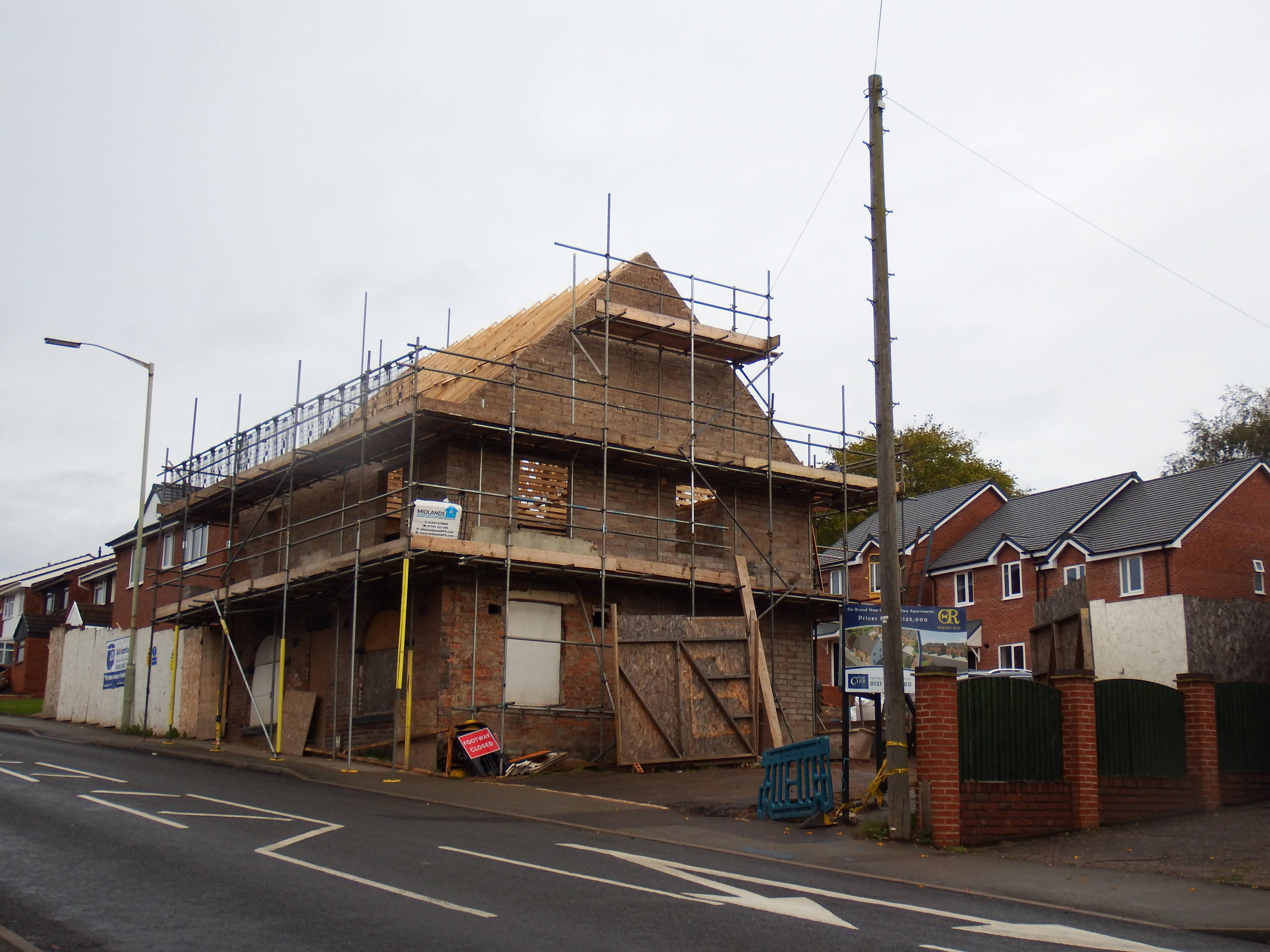
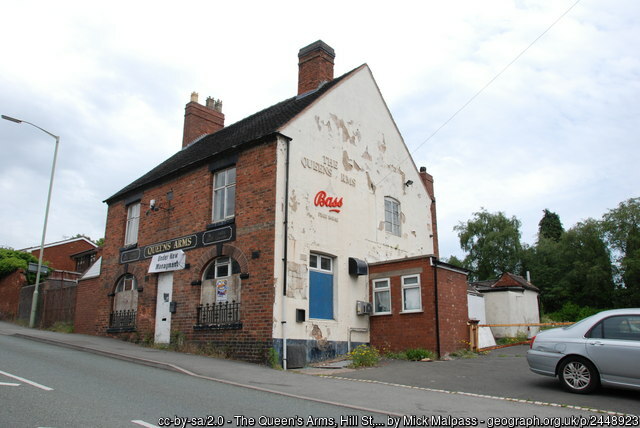
Do you recognise the building in the photograph?
It is, or was, the Queens Arms in Hednesford, now, in 2021, undergoing considerable changes.
Notice the houses where the car park used to be.
After a hard day’s work at the Railway Preservation Society’s Hednesford Headquarters, members would retire to the Queens Arms for a swift ‘alf and to get the result of the Weekly Tote – a major source of income at the time.
It was the first of a number of pubs used by members, there was the Pear Tree, now demolished, off the Brownhills Road, and when I first started in 2002, the Prince of Wales on the A5 was frequented.
98 – Chasewater Railway Museum Bits & Pieces Summer 1983
Editorial – Chasewater in Crisis
On behalf of the Society I must apologise for the long gap between this and the last magazine due to a long list of reasons. There has just not been either the time or the money to expend on such a publication.
At present our membership wavers around the 100 mark, of which around 10% manage to visit regularly. It seems unfortunate that each week we rely on the same members attending to the Railway’s needs, without the active support of the other 90%. It is little wonder that the veterans are fast becoming despondent with the work load being foisted on them.
Unless there is a significant change in the attitude of our membership, one of two things will happen: either the Railway stock will have to be drastically pruned to the minimum required to run a service, or we shut the doors and sell the lot.
I beg more of you to attend, if only on an occasional basis. It always seems strange to me how many of you can attend the AGM and that’s the last we see of you for twelve months.
Tony Sale – Assistant General Manager.
Locomotives
Asbestos – This engine has now been in the process of restoration for about five years, due mainly to shortage of manpower. The frames and wheels have been re-assembled, the boiler tubed and the tank and cab are being repainted. Now we have to complete the boiler repairs and drop it into the frames and one day we may have a working engine.
Invicta – This engine is now in store pending the fitting of vacuum brake gear and the overhaul of the main bearing brasses. Work is hoped to commence on completion of Asbestos.
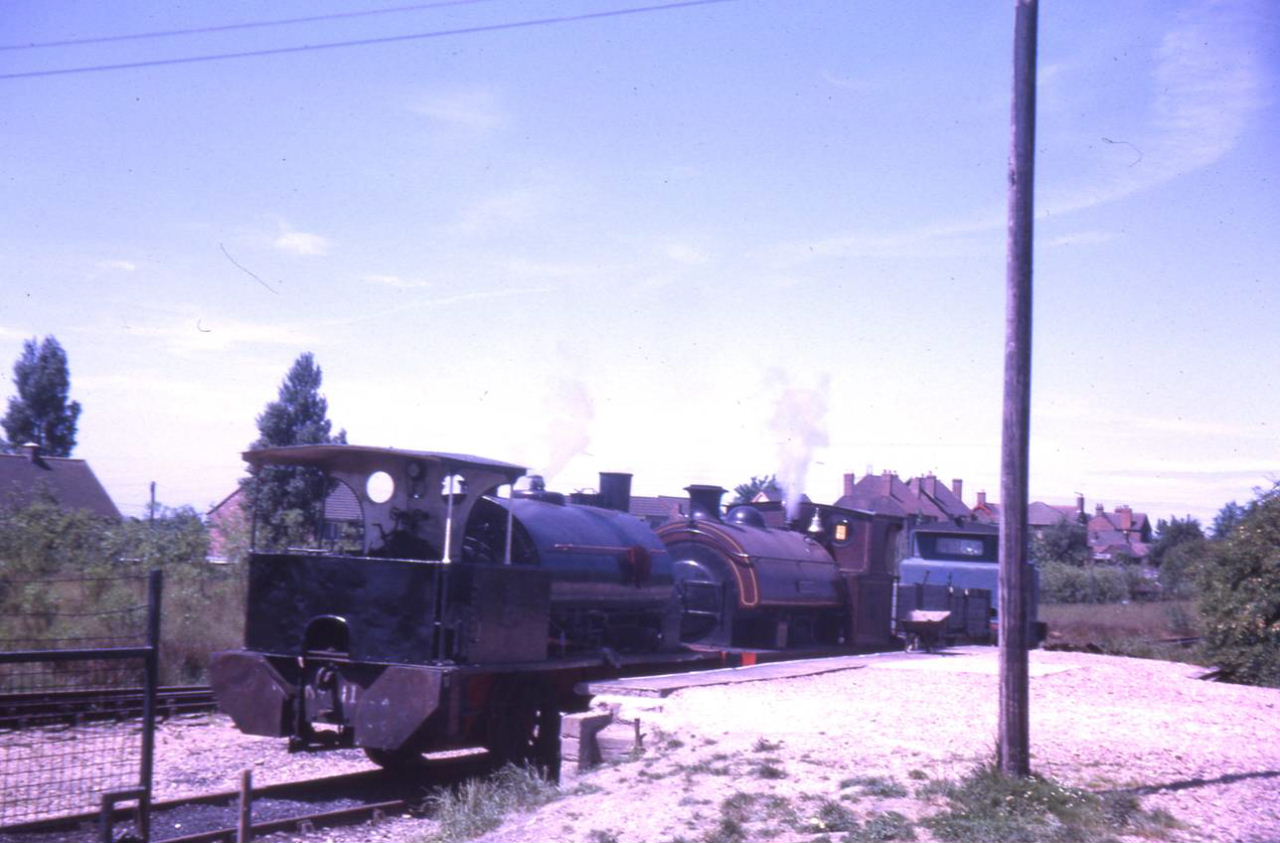
Sentinel taking water at our old HQ
Sentinel – The boiler was split to reveal the inner firebox for the boiler inspector but work has now been shelved in order to concentrate work on Asbestos.Ruston & Hornsby DL7 entering the old Brownhills West Station
DL7 – The mainstay of our shunting force has performed reasonably well over the last two years and it holds the distinction of being our only regularly working engine. This diesel locomotive is subject to an appeal to maintain its presence at Chasewater, which you may or may not like to subscribe to.
S100 – If I didn’t have to assist running the Railway I might find more time to devote to this rather large jigsaw puzzle, but despite all, progress is still being made, weather permitting, you would be amazed how much one person can achieve by himself, so if someone would like to assist, twice as much could be accomplished.
All other locomotives are stored unserviceable for the foreseeable future, including the Neilson, which requires new tubes. It can only be hoped that decay can be kept to a minimum to ensure resurrection in years to come.
Carriages and Wagons
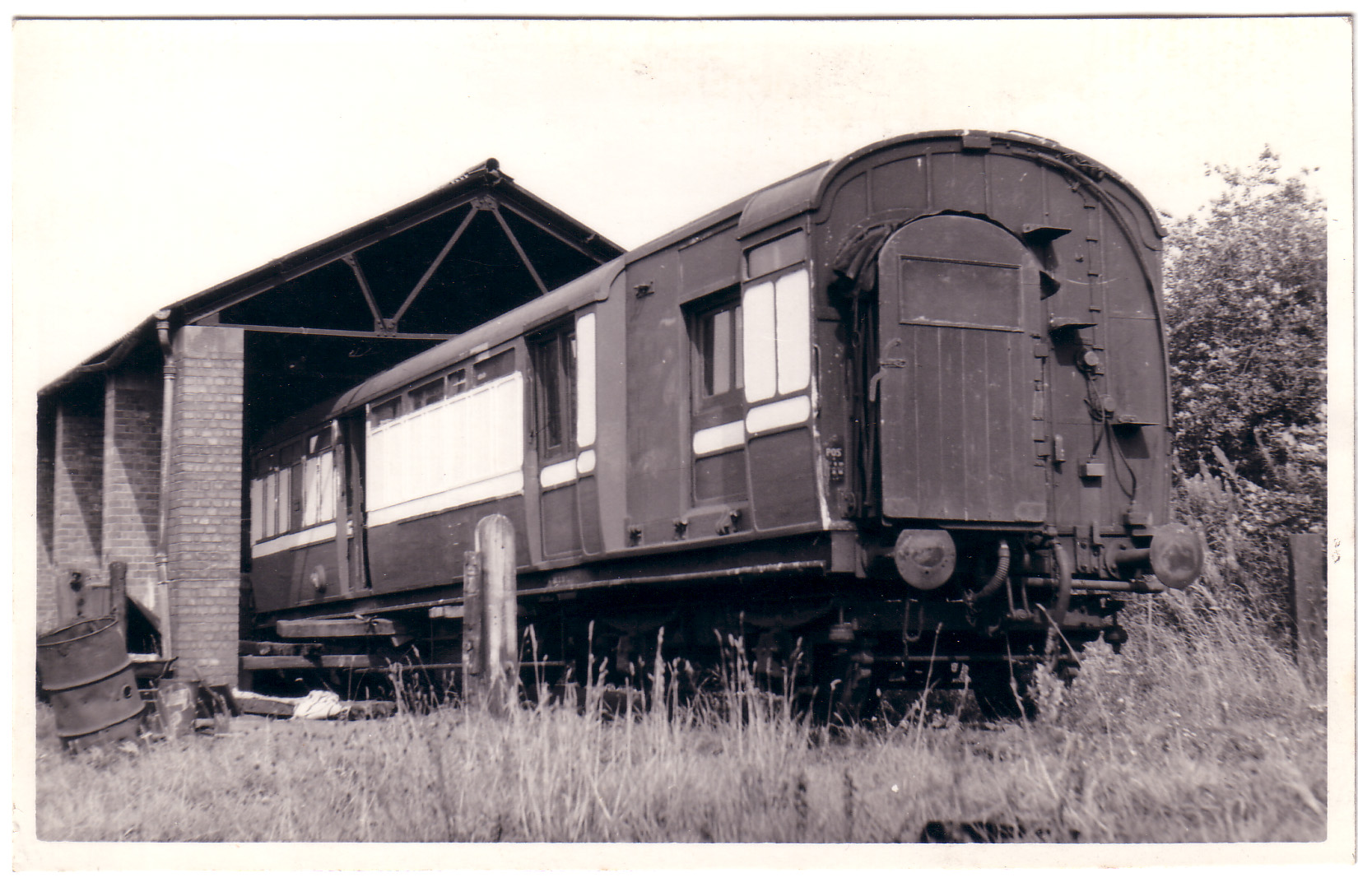
Here I hoped to bring glad tidings, but unfortunately the only news is that the MSLR carriage is still in the shed and has been largely untouched due to the fact that there are no carpenters in our midst. The only other news is that a few more doors have dropped off the Maryport & Carlisle coach and the rest are generally suffering from many years of neglect.
The other snippet is that the Midland Crane had to be dismantled in order to stop it falling apart over the rails.What about it lads – who still cares?
Another late snippet is that someone wants to buy the TPO. Your Committee is in favour and I myself fully support them, but the choice is yours, so make it known fast, it will be no good grumbling after it has left.
Catering
As many of you know, much of the money needed to support the Railway is generated in the form of sales of soft drinks and chocolates. Recently the Wickham DMU was acquired in order to branch out further into the prepared food department, all we need is one interested member prepared to buy, prepare and sell. If anyone would come to volunteer we would be only too happy to assist in any way, as well as supplying a warehouse card which could also be used for their own benefit.
Shed News
The new loco shed has certainly proved to be one of the most important developments at Chasewater. Not only does it supply ideal conditions for thorough restoration, it also allows work to continue after dark. Although this building has been with us for over a year there are still improvements to be made, i.e. fitting of three phase electric cables within the building and also fitting of a compressed air circuit. Once the former has been completed, all our machinery can be powered and the shed can be said to be fully operational.Taken from DL7, approaching the loco shed from the same direction as we do now – obviously before the changes!
Task Force Notes
A new task force was supplied together with finance and a new Manager, to commence work on the track layout. After last season the Railway lost its powers of running the line until such times as the whole of the permanent way was relaid in order to comply with the Railway Inspectorate’s standards.
In short, the platform front has been demolished to supply the necessary clearance, (rebuilding is now underway) and a run round loop is being built in the vicinity of the compound. Next the line will be lifted and replaced with better quality materials down to the old exchange sidings where another run round loop will be constructed. Upon completion a further visit by the Railway Inspectorate will then be made, and hopefully we shall run again. I can only say that I hope all goes well for the Task Force and both luck and weather is on their sides.
On behalf of the Company I have been asked by our Chairman to include the following appeal.
Save DL7 for Chasewater
The Company needs money to service a large overdraft and whilst the Railway is not running, little money is being repaid and understandably the Bank Manager is a little distressed.
If you would like to give some money to this appeal, you will be helping DL7 because if the Company is declared bankrupt, DL7 will certainly be seized as an asset. If the engine belongs to the membership it is safe along with the rest of the Society’s collection from the grips of the Liquidators
If you cannot afford a share, buy one together with some friends – you may buy as many as you like.
In common with many other railways, the Chasewater Light Railway has had a mixed season and if the success of the 1970s in the preservation world is to be sustained into the 1980s then two problems need solving and solving fast. The first is the much publicised fuel crisis, caused in the main by the sharp increase in the price of crude oil (1979 or 2011 – some things don’t change much!). This undoubtedly has, and will continue to do so, restricted the freedom of people to go out in leisure time as often as in recent years. As the CLR is on the fringe of a large conurbation the problem should not be as great as on a good many of the standard gauge railways and perhaps we will gain an increase of visitors being close at hand.
The other problem is the ending of the Government sponsored job creation schemes, on which many railways have benefited over the past few years. The sudden termination of paid 5 day week staff will surely hit routine maintenance on our longer brothers and will lead to the need for railway sponsored full-timers or greater numbers of regular volunteers.
Perhaps it is fair comment to say that at Chasewater the era of Government sponsored full-time staff is ending at the right time. Throughout the year the number of volunteers has slowly dwindled, all too often comments being along the lines of ‘Oh, if I don’t turn up, STEPS will do it during the week.’ Well next year there won’t be any full-time staff so if a job is left undone by a volunteer then that’s the way it will remain. There has also been a feeling of it not being ‘our’ railway with full-time staff, and the communal atmosphere of Sundays at Chasewater is one of the nicest things about the CLR. Perhaps these factors and the end product of the STEPS scheme (i.e. a longer serviceable railway) will pull back the missing faces and some new ones as well, and with effort applied in the right directions our 21st year should be the most successful yet. Looking down ‘The Branch’ before clearing (towards the Norton East Road)
STEPS Report
The scheme Is scheduled to finish on the 31st December although a limited extension with a few workers may see work carry on into March 1980.
The only way to describe the work being done is to give a list of the jobs done so far. Any comments about the scheme and the feeling of CLRS members is, in the final analysis, rendered somewhat superfluous by the sheer volume of hard physical graft that has gone on as well as the supply of materials for rebuilding the railway. One thing is certain and that is that Society members have been saved from 3 to 4 years of hard, back-breaking work, and that alone is something to be thankful for.
The jobs that have been done are listed in no particular order. (This sentence was written long before Philip Schofield and ‘Dancing on Ice’ or any of the other singing and dancing shows were on the telly. It was new then – it drives me crackers now!!)
1. Packing and repair of main running line which has resulted in a smoother ride, especially in the DMU trailer.
2. Finishing of point on south end of the loop – started by members last year.
3. Shortening of loop and removal of the two points at the northern end of the loop. In fact the whole of the loop has been lifted; the shortened loop awaits arrival of extra sleepers before it can be relaid.
4. Lessening of gradient of bank up to causeway.
5. Tipping on causeway and subsequent levelling.
6. Relaying of causeway – at present the causeway is wide enough for the railway but further tipping is necessary to widen the formation to provide adequate footpath facilities.
7. Digging out of top end of line – this has revealed the track to be in a very poor state and much work is needed to bring the track into a comparable state to the rest of the railway.
8. Digging out of ‘Branch’ prior to reclaiming track materials.
9. Moving of point and lengthening of ‘Elsley’s Siding’. This was completed in three weeks during a lull in train services at the end of July and beginning of August.
10. Building of compound and loading platform at ‘Elsley’s Siding’. This is a great improvement and the addition of a box van body will make it very griddy, very Colonel Stephens.
11. Relaying of level crossing, which is now much smoother.
12. Fencing the line from Brownhills West to bottom of causeway bank with concrete posts and five strands of wire.Looking up the causeway bank after clearance.
The transformation upon the railway is somewhat devastating to the casual observer and if you haven’t seen the work done yet, then come on over – it’s YOUR taxes that have paid for it!
Looking Ahead
1980 should see consolidation of the work done under the auspices of the STEPS programme and promises to be every bit as exciting as 1979 has been.
The CLR Co. are planning to purchase a further passenger carrying coach as well as locomotive DL7, and making money available for any further capital expenditure needed.
Providing the purchase of the land and track (plus associated Light Railway Order) finally goes ahead then there is every confidence of services being extended to at least the north end of the causeway, with passengers being able to alight there and explore the previously out of reach NE shore of Chasewater. This will enable fares to be increased to give more much needed revenue as well as being far more interesting than the present 800 yard shuttle to enthusiasts, public and volunteers alike.
Of course, hopefully more volunteers will turn up to help (or else the improvements won’t be realised to their full potential) or will they……?Ruston & Hornsby 458641-61 at Brownhills West (Later known as DL7)
In recent years the final steam day of the year, on the second Sunday in October, has taken a different form from the normal twice-monthly summer season steaming. Amongst popular attractions with photographers has been the freight train run pasts at intervals during the day and this will again feature.The success of the first steam spares and tools sale held at Chasewater last February has prompted the organisation of another similar event to coincide with this ‘Gricers’ Day’. The idea of the sale is to provide an avenue for preservationists to get together, discuss mutual problems and conduct exchanges or sales of parts and tools surplus to their own requirements, but perhaps much sought after by other preserved lines.
Alfred Paget with Asbestos and one of the Kent Construction diesels – 1976
At least two locos will operate during the day – ‘Alfred Paget’ built by Neilson & Co., Glasgow (works no. 2937 of 1882), the oldest loco regularly at work in the Midlands, and ‘Invicta’ built by Andrew Barclay, Sons & Co. Ltd., Kilmarnock – 2220/1946. It is likely that one of the two Kent Construction diesel locomotives will also see use during the day, as well as the 5-ton capacity Smiths of Rodley diesel crane (formerly steam powered).The ex Cambrian Railways Merryweather fire pump will also be steamed and a 1929 ex West Bromwich Corporation single decker bus has been booked to attend.
Apart from the Chasewater Light Railway Society sales stand which enjoys a good reputation locally for reasonably priced Railwayana, we would ask you to support the other stalls attending today; at the time of writing these are expected to be Mercian Model Rail, selling both new and second-hand model railway items and who also enjoy a reputation for fair prices, Walsall Railway Museum and Winchcombe Railway Museum who specialise in relics, the Princess Elizabeth Society who are in urgent need of funds for re-staying their famous LMS Pacific, and finally the Worcester Loco Society who carry a reasonable range of books.
We hope that everyone attending has an enjoyable and interesting day out, perhaps even an amusing one – how about a real ale tombola for instance?
For those wishing to partake of liquid refreshment, opening hours are 12.00 – 14.00 hours, the nearest hostelry being the Pear Tree Cottage Inn (Ansells) on the Hednesford Road where excellent cheese flans, etc., can be obtained, or the White Horse almost adjacent to the A5 road heading south which serves an excellent pint of Banks’.
Review of the Year
The year has been both happy and sad for the small but faithful band of followers of the Chasewater Light Railway, January was a disastrous month as vandals broke into the compound and set fire to our former Easingwold Railway MSLR coach, completely burning out the brake end and destroying materials contained therein, as well as partially damaging the exterior of the LNWR brake third which thoroughly deserves the nickname ‘the football special’. Our grateful thanks go to the Transport Trust who have granted the Society £275, being approximately half the cost of materials needed for renovation, although this cannot take into account the number of man hours needed to restore the vehicle.
Following the fire, thought was given to moving one or two of the wooden bodied coaches elsewhere for safekeeping, but as the obvious answer lay in providing covered accommodation at Chasewater this matter was pursued with renewed vigour and two buildings have since been acquired. Both are of agricultural type – one has been dismantled and removed to Chasewater; the other, larger, building has still to be dismantled.
New arrivals during the year included S100, a Hudswell Clarke 0-6-0T No.1822/1949, privately owned and previously preserved on the Yorkshire Dales Railway, Embsay. The loco is presently being dismantled to enable firebox repairs, de-tubing and wheel turning to take place. The whole project will probably take another three years to complete (still counting!).
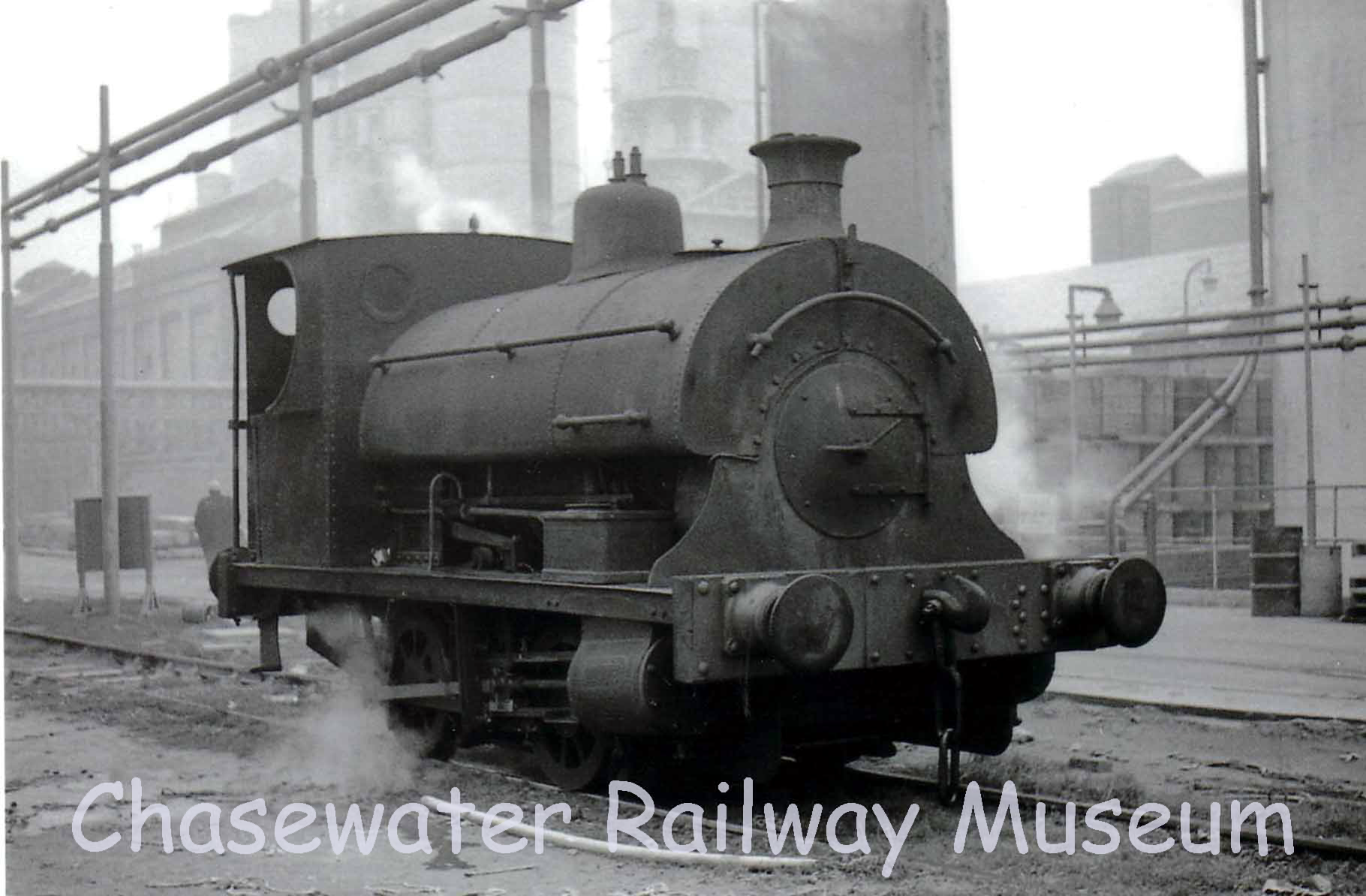
5263 P 0-4-0ST 917-1902 Albright -Wilson Peckett
Through the kindness of the Directors of Albright and Wilson Ltd., Peckett 0-4-0ST, 917/1902 arrived on loan together with coal, 27 spare boiler tubes and various tools.
The day following the arrival of the Peckett saw the arrival of the Smith’s of Rodley 5-ton diesel crane, a purchase from the Mersey Docks and Harbour Board, Victoria Dock, Birkenhead. The crane’s first job on arrival was the lifting of the two tanks off S100.
To enable the purchase of the BR owned 600 yards of double track immediately beyond our present operating limit to be effected, the former LBSCR E1 loco was sold to the Lord Fisher Loco Group, Cranmore (see previous post). The monies from the sale of the loco together with that put aside from donations, etc., has given the railway a financial security never enjoyed previously, although this will be greatly depleted when the £5,400 purchase price of the track is paid.
Current projects include the erection after repair of the former Manchester Ship Canal water tank, and the preparation of the oil-fired Peckett (The Colonel) for a major boiler examination. The Hawthorn Leslie ‘Asbestos’ is being de-tubed and the boiler sent away to Park Holland for the raising of the foundation ring about four inches to overcome the problem of badly wasted corners at the bottom of the firebox. A complete retube with tubes purchased earlier this year will follow.
It is hoped that the Chasewater Light Railway Company will be able to take advantage of the Government Special Temporary Employment Scheme whereby lads of nineteen plus, out of work for a period of at least six months can be employed and paid their wages by the Government.
1979 promises to be a year to look forward to and it is to be hoped that some of you visiting us today will return again next year.
From the Chasewater News Magazine No. 24 July 1978 – 2
E1 Locomotive
‘Lord Fisher’ Barclay 0-4-0ST 1398/1915 – Pic by John CorneliusThis loco is now at the Yeovil Railway Centre where it will be restored with the Gartell Light Railway.
At the committee meeting of the 22nd March it was decided that positive action to safeguard the loopline was needed and in the view of the committee the best course of action was to offer the ex. LBSCR (London, Brighton & South Coast Railway) ‘E1’ locomotive for sale. This decision was reached after much heated discussion, during the course of the meeting Andrew Louch resigned. The rest of the members of the committee present were unanimous in their decision to sell the locomotive. The Hon. Sec. was instructed to obtain offers for the locomotive and at the meeting of 24th May it was decided to sell the loco to ‘The Lord Fisher Loco Group’ who reside at the East Somerset Railway at Cranmore, Somerset. ‘Lord Fisher’ Barclay 0-4-0ST 1398/1915 – Pic by John CorneliusThis loco is now at the Yeovil Railway Centre where it will be restored with the Gartell Light Railway.
The LFLG own five engines at present, the ‘E1’ will be their sixth locomotive and if it is restored to their previous standards, then it will be well worth a visit. They have every confidence of seeing the loco in steam during the early eighties and work will start as soon as it leaves Chasewater.
Members of the Chasewater Light Railway Society will be informed of progress upon the locomotive in this newsletter and the locomotive’s plates will remain at Chasewater as well as the unique tapered Rawnsley chimney, which will be mounted on the platform at Brownhills West.
The sale of the locomotive realised £5,000, which has virtually paid for the loopline. Appeals in the newsletter and elsewhere have raised over £2,000, which gives us room to breathe a little easier, though we estimate at least another £5,000 is needed to realise our plans for the Chasewater Light Railway during the next three years.
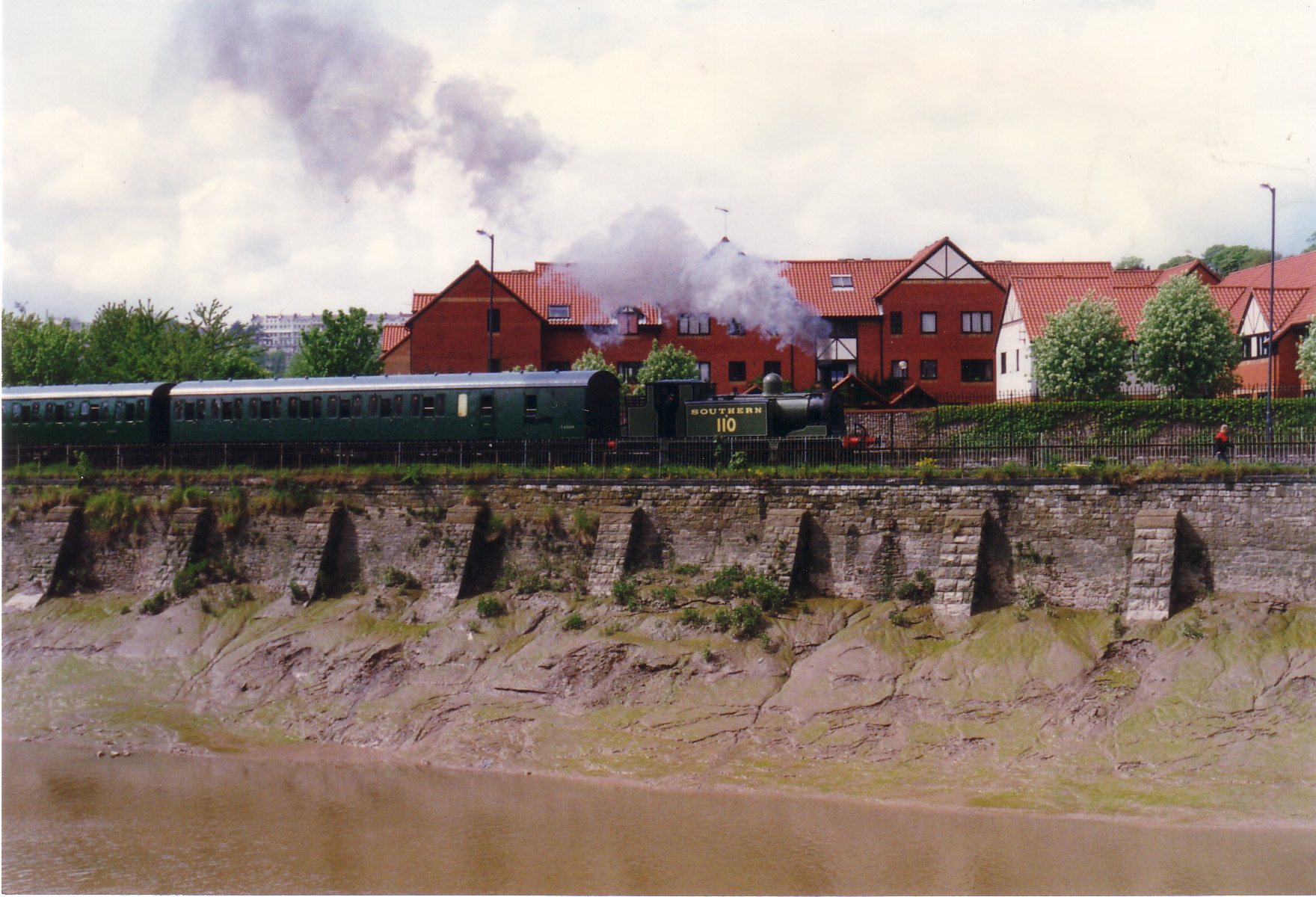
The E1 arrived at Cranmore, Somerset in September, 1978. The overhaul started in 1986 and she returned to service in 1993 – in green livery, number 110. Firebox problems forced a premature withdrawal from traffic in 1997. During 2000 work commenced stripping the loco down to assess the state of the firebox.The chimney is still at Cranmore, last heard of being used as a donation box.In the yard at Cranmore – Pic Bob Fowler
News from the line
The main news is that the purchase of the loopline is secure, as we have the money. British Rail granted access to works trains as from the 18th April and completion of the purchase should be made by the end of this month (July). However, this is just the start, as the line must be completely fenced before we can think of extending our services to satisfy the Railway Inspectorate and quite a bit of trackwork is needed, though generally the loop is in excellent condition.
Engineering Works
Over Easter weekend the point at the south end of the loop was dismantled and a start made upon reassembling it on a new alignment away from the edge of the embankment. Part of the loop has been slewed to meet the new alignment and hopefully the gap will be completed before August Bank Holiday, to enable works trains to start removing scrub from the loopline. The extension to the platform is now virtually complete, lacking only coping stones before it can be put into use. The majority of the wall was built by Brian Hames over Spring bank Holiday weekend, infilled with hardcore supplied by courtesy of Walsall Council and surfaced with red ash by courtesy of Chasewater Power Boat Club.
Train Operations
This year has seen a welcome increase in the amount of money taken per steaming, only partially due to the modest fare increase implemented at the start of the season. After 13 steamings receipts were 230% up on last year with an average of 380 people visiting the railway per operating day.
Small Relics Collection.Recent additions to the collection include a St. Helens Canal & Railway memo; an LMS/GWR joint lines trespass sign; a Midland and Great Northern Tyers tablet (Long Sutton – Gedney) and an LNER ‘Carter to Call’ card.Tyers Tablet
Brownhills CID has apprehended two local youths (thanks to the help of several CLRS members), who are due in court shortly to explain why they were in possession of many items from the museum coach. Following the trial the missing items will be returned – at present Brownhills Police Station has a fair collection of railway relics!!
A visit to Derby Carriage Works is being arranged so that Society members can view progress on the restoration of our Royal Saloon (ex Midland Railway), which many members will know is on loan to Derby Corporation until 2020 if they take up their full option. (I think this was another of the crown jewels to be sold!)
Chasewater Railway Museum Bits & Pieces
No. 85
From the Chasewater News Magazine No. 24 July 1978
Time to get back to some Bits & Pieces – I found this article in Magazine 24.
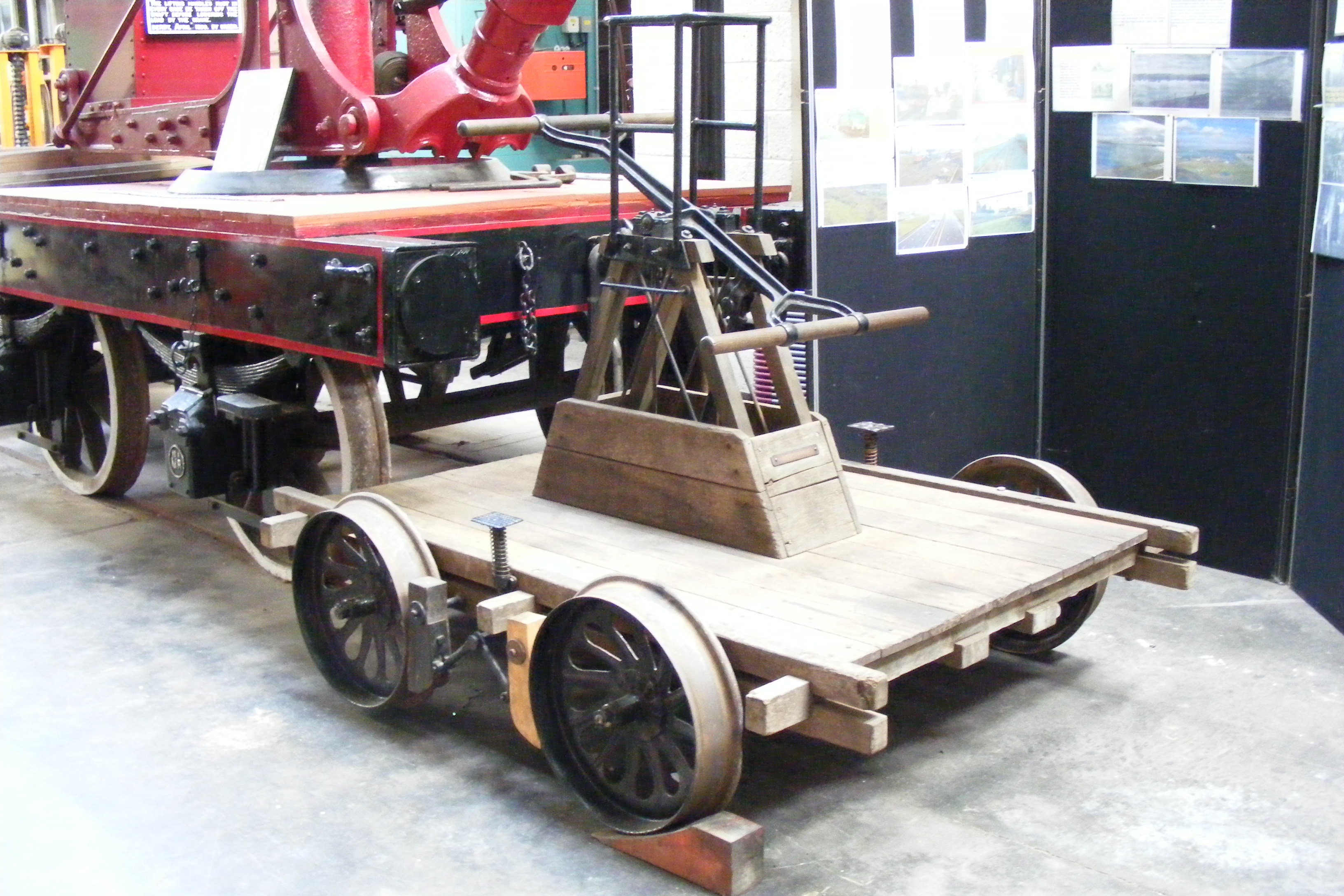
The Society’s Pump Handle Trolley’s next adventure.
Since the summer of 1975, when three anonymous persons were jettisoned off the causeway at great speed, the Society’s pump handle trolley has been living in retirement (or was it disgrace?) off the rails, festooned with various cast iron signs.
During a recent tidy-up the trolley was ‘re-discovered’ by one of our younger members and once the day’s running was over the trolley was re-railed, oiled and found to be in a rather sorry state of repair. Gary Kay foolishly offered to rebuild the trolley, so it was decided to give it a final run prior to overhaul. The party was formed of the more lunatic fringe of the Society (though Graham has since had his hair cut) namely Messrs. Attwood, Bull, Owen, Webb, Patterson and last but not least, the brothers ‘Grimm’.
At first the run was to be to the crossing and return, but before we could say ‘every confidence’ or even ‘doom and despondency’ we were carrying the trolley across the infamous ‘gap’ (the ‘gap’ was out of the Brownhills West gate and over the bridge by the fishing pool) and onto the loopline. The loopline was found to be passable – well almost – despite a few hassles with the odd wayward bush, but an attempt at a run down the Norton branch (to the Norton East Road and Conduit No. 3, not the Pelsall to Hednesford line) was thwarted by the locals having covered the track with rubbish – everything from a three piece suite to a dead cat. After this an attempt at ascending the causeway was made, but this too was blocked, this time by several tons of hardcore tipped by the Council.
The return trip provided more excitement, a hasty start left Mr. Bull stranded brandishing a shovel, and quite a speed was attained. Unfortunately we were halted in full steam by a large overgrown gorse bush, which forced an evacuation of the trolley rather sooner than most of the crew anticipated as they were jettisoned, arms and legs akimbo, and ended up with rather sore arms and legs and backs, though the elder ‘Grimm’ was more concerned about his station master’s hat which landed dangerously near a large puddle.
After several minutes of recovery time the trolley was re-railed and a slow return to Brownhills West was made, and although it had been proved that track still existed beyond the ‘gap’ there are several members who are beginning to think that perhaps 800 yards of railway is more than enough, especially for pump handle trolley racing!!Following the successful re-enactment of the bucket-chain a couple of years ago, I asked Mr. Bull about a possible re-enactment of the trolley trip- unfortunately his reply is not for publication!
Now tucked away in the Heritage Centre
Hand Pump Trolley
This trolley was purchased (after a whip –round!) from the British Rail permanent way yard in Walsall in the 1970s. A few years later, in their 1981 session, it was renovated by students of the WestBromwichCollege of Commerce and Technology.











 Chasewater Railway Museum