157 – Chasewater Railway Museum Bits and Pieces

157 – Chasewater Railway Museum Bits & Pieces from Chasewater News Spring 1993

– Part 3 The Very Special Day

This part of the post is written in 2023, Chasewater Railway has a regular group working on the P Way, but they could always do with more!  This post, as the introduction says, is a solute to the P Way gang back in 1993, including, in the bottom picture, a photo of Tony Wheeler, who recently passed away. Tony is on the extreme right of the pic.

A salute to our PW gang – By Dave Borthwick

It began with Keith Day phoning round mid-week to prepare everyone for the last track bash of phase 1, planned for Sunday.It was good to see all the regulars arrive, those same members who put themselves out most weekends to carry out hard, heavy work in both scorching sun and freezing drizzle.  The train left for the railhead leaving behind me – Dave Borthwick (part-timer), Keith Day and Arthur Edwards to select a pair of 30 foot match conditioned bull-head rails from the shed area.  Ian Buswell, JCB driver, with the help of Arthur slung the rail and transported it the long distance to the railhead.  Part time PW dept members like myself have constantly moaned when arriving at the railhead what a bloody long walk it has become following the recent track relaying.  Car transport is a must these days!

The JCB dropped the rail in the position it was needed and work continued as normal, selecting sleepers, chairs and keys.  At around dinner time Ian suggested hunting, catching and roasting a wild boar (because the line is really at the northernmost part of our railway world, in the wilderness), but his net had a hole in it and his mo-ped wouldn’t start, so Jonathan Clegg popped down to Tescos for 2 lb. of middle-cut bacon.  As we were unable to get enough heat from the mess van’s pot-bellied stove, a small fire was made from old sleepers and sacrificial bacon sandwiches were produced and consumed.Towards mid-afternoon our goal was reached, with sleepers laid, chairs secured, rails in keys in, jacked and packed.  The final moment had come.  Some 18 months ago, Little Tony, as we called him then, had scrubbed up and painted gold a rail key.  This was to be the ceremony, the fitting of the golden last key of the PW gang, track extension, phase 1.Amongst those present at this ceremony were Elizabeth, or Beth as she is called, surrounded by – Arthur Edwards, the oldest member of the PW gang, Tony Wheeler, who came to us three years ago and began watching from the other side of the fence and now is the hardest working member on the railway, strimming, weeding and hedging most days mid-week, especially Wednesday and Friday nights with Arthur.  Next, Keith Day who, despite family commitments and a rigorous working shift system at Bass Brewery, comes down and works on the railway’s greatest asset – the track.  Tom Mitchell, who, like Keith, comes down to the CLR to simply use the Sunday working hours from 9.00am to 5.00pm to the full on track laying and repair.  Ian Buswell, whose work with the JCB has put the PW dept schedule months ahead.  Junior members Dave Gardener, Jonathan Clegg and Paul.  Chris Chivers, whose help has been great, but recently limited due to other commitments.  Left until last purposely, is Les Emery, a man who is obviously successful in every way, chooses to come down to work in an open field and spend his day weeding, shovelling, lifting sleepers and poking life into a group of lazy ignorant peasants – author included!  Because of Les’s dogged determination he has forged a PW department  which began with a trolley loaded with shovels and tools which had to be pushed manually, making frequent trips loaded with ash ballast.  Nowadays a works train leaves Brownhills West at 9.00am consisting of a heated mess van, tool van and flat wagon, with JCB and dumper truck assistance following behind to work a full day, returning at 5.00pm.The thing that has come across from this exercise is that if you can form a group to carry out a task, results can be achieved more quickly than by individuals mooching around the railway doing odd jobs.  No-one other than Les and his lads organise their work schedules that is why work on projects take so long.  No-one envies these lads ’down the line’ because of the sheer hard, heavy, dirty work, but it is my belief that track across the lake supporting a variety of locomotives pulling coaches full of tourists is the answer to our future.  Please support our PW lads!So we salute Les, Arthur, Chris, Tony, Keith, Tom and many more.  Phase 2 is just around the

corner

corner!

156 – Chasewater Railway Museum Bits and Pieces

 Postcards  – 156 – Chasewater Railway Museum Bits & Pieces

from Chasewater News Spring 1993 – Part 2

‘Official’ Picture Postcards – by Barry Bull

The hobby of collecting postcards began in Edwardian times within just a few years of the first cards being accepted for postage by the Post Office in 1894, The charge for postage only being a halfpenny and the cards themselves being very cheap soon led to a collecting tradition that has remained with us through to these inflationary times almost a hundred years later.

The ‘Official’ railway cards is the term used for those cards produced by and for over 60 of the old pre-grouping companies plus those issued by the 4 post-grouping railways and British Railways. The earliest official cards generally showed views of London and various other cities and towns throughout the land.  Many depicted views of castles, cathedrals, river bridges and the like, and were known as court cards.

The court cards were printed by such companies as the Picture Postcard Company and were often half-tone pictures in decorative frames with a small space to the right of the picture to write a few words.  At this time the back of the card was for the address only to be written, plus of course a space for the stamp to be affixed.  Examples of these early cards can occasionally be found and carry the names of such railways as the LSWR and the SECDR.

By the turn of the century, full size sepia postcards were being produced, that is, the picture occupied all of one side with the reverse being provided for both the address and message.  The cards were still being produced by postcard printers with the same views being supplied for several different railway companies, it not being until about 1903-4 before the larger railway companies in particular had cards printed specifically for their use and sale only.  Most of the official pre-grouping railway cards seen today date from the period 1904-14, when the production and sale of these cards was at its peak.

In this short history it is not possible to go into too much detail, but the casual observer and collector cannot fail to have noticed that by far the most common examples of cards to be seen are those of the London & North Western Railway.   This, however, is hardly surprising when one considers that from 1904, when Raphael Tuck & Sons produced a set of twelve cards on behalf of the LNWR, until September 1914 when production of LNWR cards was discontinued; over 11 million cards had been sold – most at two pence for a set of six!

The LNWR cards covered a wide range of subjects.  There were some 60 sets and a hundred or so non-set cards.

Interestingly, the success of the LNWR cards, undoubtedly due to their quality and subject range, was in no way matched by the concern who many feel to be elite in printed publicity – the Great Western Railway.  Cards produced by the GWR tended in the main to be of rather mundane subjects in sepia.  Only occasionally were rolling stock, locomotives, stations or engineering subjects featured.  After the Great War the GWR produced little of significance for the postcard market and when one considers their other publicity successes, the GWR certainly disappoints its supporters in this matter.

Other prolific producers of postcards who spring to mind are the Midland Railway with nice coloured examples of stately homes and tourism resorts; the Furness Railway with a variety of Lakeland scenes; and the Great Eastern Railway with a pleasant range from seaside towns, cathedrals, the Norfolk Broads and ships.

Irish, Isle of Man as well as Scottish and English companies were well represented in postcard issues and several minor railways also produced cards.  Cards issued by minor railways are avidly collectable today and may cost several pounds each, dependent on condition and rarity.  Quite common cards to find from a small company are the photographic views published for, and sold by the Corris Railway.  These usually fetch about £5.00 each at stamp or postcard collector fairs.

Following the 1923 grouping, the production of postcards continues albeit in smaller numbers and these cards, although collectable, do not generally reach such prices as some pre-grouping and minor railway examples.

The Southern Railway issued 140 odd cards with over 100 depicting locomotives, while both the LMS and the LNER took the opportunity to market many cards which showed their hotels, with ships and locomotives being well represented.

Other cards which still sell very well today, often commanding prices between £3.00 and £10.00 each, once again dependent on rarity and condition, are those of the various London Underground Railways.  Many of these depict posters and are particularly attractive to collectors. The only ‘official’ Chasewater Light Railway’ postcards issued so far is one depicting the Neilson with the Gloucester DMU trailer, a card which owed its origins to an Adrian Pearson colour photograph.  5,000 examples were produced at a cost I recall of 2.4 pence each.  I wonder how many remain unsold?Neilson with the Gloucester DMU Trailer – Adrian Pearson

I can’t say exactly how many were left, but those that were have been given to the younger visitors to the Chasewater Railway Museum – and very much appreciated as a memento.

All postcards from the Chasewater Railway Museum Collection – compiled by Barry Bull and David Bathurst (sorry, not on public view at the moment).

155 – Chasewater Railway Museum Bits and Pieces (1993)

155 – Chasewater Railway Museum Bits & Pieces

 From Chasewater News Spring 1993 – Part 1

I’m guessing that the Editor was still Nigel Canning, with contributions from Dave Borthwick and Steve Organ.

Editorial

On the back cover of this magazine (reproduced below) is a copy of the 1993 timetable, and for the first time in the history of the CLR it is actually a timetable rather than just a calendar.  It remains to be seen whether the trains will actually run on time, or whether we can stretch the journey time to suit, but at least it will give the operating staff something definite to work to, and hopefully create a more business-like impression for potential passengers.  In addition, all the usual special events are planned for this season and will keep us all stretched to the limit.  If anyone would like to help out at any of these events they would be most welcome. 

Locomotive News

No.4 Asbestos – This loco ran successfully at Christmas on the Santa Specials, and will continue in use this year.  In order to guarantee a water supply for the loco in the event of frost, the water tower had to be put back into use, a job which required the removal of a large amount of green slimy pond weed and the fitting of two new plastic floats to the supply valves, hopefully early this year the long-missing balance pipe will be fitted to Asbestos’ saddle tank thus helping to prolong the interval between top-ups.

No.5 Sentinel – The two halves of the boiler have now been cleaned and await a visit from the Boiler Inspector when a decision will be made as to whether a new set of tubes will be required.  Work has progressed with the moving of the injector to the fireman’s side of the cab and re-routing of all the water and steam pipes to make them more easily drainable in frosty weather.  Work is also being carried out to refurbish various steam fittings which had been leaking towards the end of last year.

Sentinel – Jan 2012 – Now heading for completion of the major inspection following the one written about.  It had a good ten years running in between.

No.2 Lion – This loco is still progressing towards its first steam test with the continued manufacture of replacement pipework.  Work has also been carried out to repair a turbo generator which is to be fitted to the loco to provide cab lighting and battery charging for the coaching stock.

Work is still progressing, albeit slowly, on S100. 

S100 – 2011  A lot of work has gone into this loco over the last few years but there is still a lot of boiler work to be done.

The Fowler diesel has again remained in use on works trains throughout the winter.

Contrary to the report in the last magazine, DL7’s engine has been re-assembled and the loco run on test.  Once one or two minor faults have been corrected the loco should be able to re-enter service.

No.21 diesel and the Smith Rodley crane have remained out of use.

Carriage & Wagon News

The good news to begin with is that Ken Dyde has agreed to fill the void and represent the C&W dept until the next board meeting.  Ken has past experience working in the C&W dept on the SVR, and one of his valuable talents is that he can organise a team to tackle most jobs.  Ken lives locally and spends most weekends at Chasewater.

Great Eastern 6-wheel passenger brake – All of the doors have now been fitted, although the missing door from the end compartment has been found, 75% destroyed, which highlights the problems of past abandoned projects.  A dummy door has been modified from one, which according to Chris Hatton, came off a DMU.

Midland Box Van – Tony has continued scraping and painting.  On one side he has exposed from beneath layers of paint a red triangle not too dissimilar to the Bass Charrington sign.  Black letters are also distinguishable which could read ‘Bass Railway’.

North Eastern box van – During his winter Saturdays when not carrying out his PW duties, Arthur Edwards has started replacing some of the rotten side planking prior to repainting.

CRC (CCCC) brake van An inspection has been carried out on the rotting timbers around the spring hangers.  Use of temporary steel plate cladding will strengthen the solebars enough for the vehicle to be shunted to where more substantial work can be carried out on the 6” x 12” timbers after jacking.

In the past a number of projects on wooden-bodied stock have been started with no plan of attack or materials in stock.  Consequently, main frame timbers, vital metal items and wagon parts left scattered around the yard have all been left to rot in the open with no work being carried out for months on end.  I think all members must agree that a restoration project started on a whim should not be accommodated by the C&W dept.  In the future, any members who would like to start restoration projects on wooden-bodied stock should please request permission in writing from the Carriage & Wagon Director, who will offer all possible assistance.

Dave Borthwick

 Maryport & Carlisle 5 compartment all 3rd coach – Thorough examination has revealed a need for urgent attention to panelling.  A survey was carried out on the vehicle in January revealing almost all waist and lower panelling rotten and with very active wet rot fungus, roof galvanising starting to fail, and several doors in need of removal, de-rotting and repair.  There was only minor rot to the main frame, but soft wood noggins are in need of replacement.  Many windows and droplights are also in need of replacement or repair.  All springs need to be replaced, all running boards need to be repaired and replaced and the complete vehicle needs to be treated against rot.

The first job was to erect a tent, then a platform alongside to work from.  These were in place in late January and restoration is now proceeding.

New panels of beech marine ply have been cut and fitted for most of the lower and waist panelling following removal of most of the old panelling.  The new panelling is being treated and painted at a member’s home workshop, to be fitted to the coach after the body frame has dried out and been rot treated.  Doors will be repaired off-site to enable a rapid restoration to take place.

Manchester Sheffield & Lincoln composite brake – This lovely vehicle has had a little luck lately.  During conversation with the Butterley C&W team, it was revealed that they had recently stripped a derelict MS&L coach body and had some doors from it.  Hasty retreat to the stores and hey presto! Four doors of exactly the right profile, window pattern and size to fit the opening left in the doorway of the guard’s compartment of our own fire-damaged vehicle!  Enthusiastic fitter now required!

CRC 4 plank coal wagon – Examination of this vehicle in January revealed a completely rotten floor, some completely rotten side planks and very corroded springs.  Other than that, the frame and most of the ironwork, apart from some straps, appear to be very good.  An immediate start was made on removing rotten timbers to reveal the frame properly so that it could be dried out and rot-treated.  New side and floor planking has been acquired, and this vehicle should be coupled to the Midland box van in a resurrected state by Easter.

LNWR West Coast Joint Stock 50’ Brake – The new roof has been fitted and ventilators replaced.  New toplights have been fitted to completely seal the roof.  Much attention has been given to interior panelling, and three-quarters of the interior repainted.  Following use of the vehicle as Santa’s Grotto at Christmas, the historic displays are now being mounted, and re-opening as a museum is on line for Easter!  Repairs to upright framing and solebars will commence after the Maryport repairs are complete, and will be followed by re-panelling, subject to raising a further £500.

Wickham DMU E56171 & E50416 – These vehicles are the subject of much discussion.  At present they have a liability value in that £14,000 is needed to strip them of asbestos.  On the other hand, as a unique, working DMU they could be very useful.  Ken Dyde and his gang (The Battery Boys!) continue to work on the mechanics and body of the power car, and replacements for the missing windows are now on site, thanks to a very generous price from Brownhills Glass.

Gloucester trailer E56301 – This coach has remained out of use and would require repairs to the bodywork to be carried out before it could be used in service again.  There have been rumours that an outside party is interested in purchasing the vehicle for preservation elsewhere, but so far nothing definite has been agreed and it remains stored on No.2 road

Derby Centre Car W59444 – This coach ran in service at Chasewater for the first time at Christmas on the Santa Specials coupled to the Wickham trailer.  This looks likely to be the train formation used for the foreseeable future, meaning that the loco will remain on the ‘north’ end of the train.  The ‘blood & custard’ livery still requires top coating but hopefully this will be finished by Easter.

Steve Organ

Image

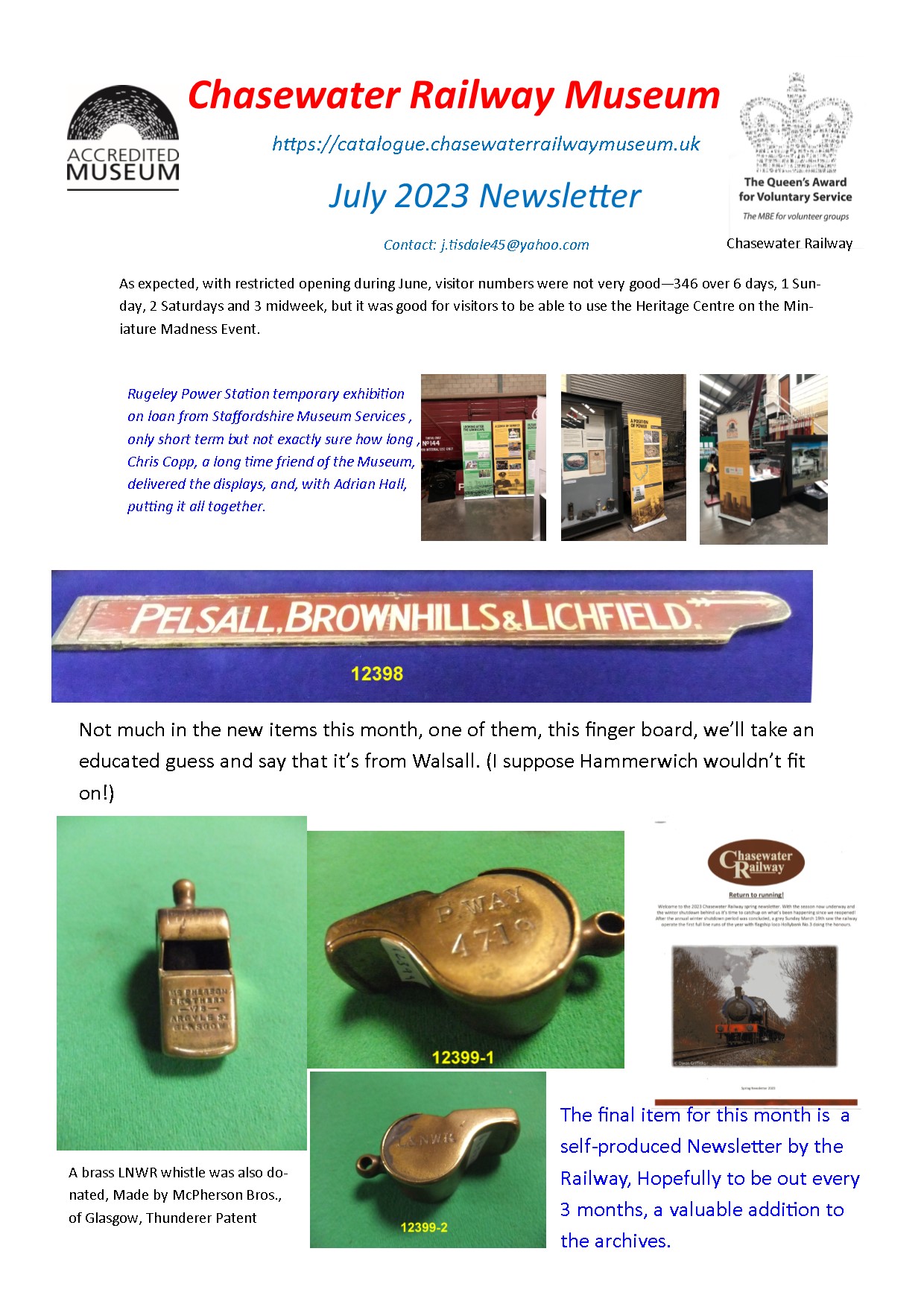
Chasewater Railway Museum July 2023 Newsletter

153 – 154 Chasewater Railway Museum Bits and Pieces

153 – Chasewater  Railway Museum Bits & Pieces from Chasewater News Dec 1992 – Part 3

This small gauge loco, with Isle of Man connections, used to make fairly regular visits to Chasewater , this picture and the one at the end of this post have absolutely nothing to do with ‘Carriage & Wagon News’, but they were in the magazine and I just wanted to use them!

Carriage & Wagon News

A sad note to start with is that at the last Board meeting, Dave Whittle stood down as C & W director.  There are many problems concerning the stock, and with Dave’s other duties including our very successful rallies which Dave helped to arange, the work load was too much.

Maryport & Carlisle six-wheel coach – Work has begun on the far side of the coach where a canopy has kept dry the rotting window frames and doors.  These will be treated and painted, but the stock of plywood has completely dried up with no funds for further supplies.

Midland four-wheel passenger brake – Tony Wheeler has undercoated the exposed main end timbers to protect against the weather until plywood sheeting becomes available.

Manchester, Sheffield & Lincoln six-wheel coach – This vehicle has remained sheeted up but will shortly be needed for the local colliery railway history information centre when the Southern brake van goes to Chatham in 18 months time.

16 ton Great Western Toad – Tony Wheeler has re-painted the superstructure of this vehicle which looks good on our permanent way train.  Unfortunately Tony could not gain permission to paint the mess van.

CCCC brake van – Unfortunately due to other projects, Keith Poynter has not had much time to work on his pride and joy.  Photographs from our museum showing this vehicle in service on local lines will soon prove their value during the restoration.

Great Eastern six wheel passenger brake – But for a missing door and one or two small panels, the whole of one side has been completed – albeit in four different colours.  The age of this coach has now been established in the preserved carriage handbook as being 1894, and being numbered 44, ties in with other coach dates.  So 1994 will be its centenary year.

Midland box van – Tony Wheeler has begun work on the exterior paintwork of this vehicle, scraping and painting.

Southern brake van – Work on re-painting this vehicle has been suspended for the time being at the request of its owner.  Tarpaulins have been put over the roof, and a pot-bellied stove fitted inside in an attempt to dry the inside out so that a start can be made on our colliery history information display.

Museum Coach – Although we have just suffered the worst November rain for ten years, Steve and Keith have almost completed the re-roofing (in a new tar-based material) of the LNWR ‘James’ coach.  The inside has been scraped and painted, with the help of the Duffs, to house our Santa’s Grotto before the relic collection is moved back in.

Gloucester trailer E56301 – Having remained in use throughout the year, this vehicle has now finally been withdrawn from service and will not run on the Santa Specials.

Wickham trailer E56171 – This coach has also been in use all year, and now that the loco is attached to the northern end of the train, it is the only one with the driving cab at the correct end for the guard.  A recent trip by CLR members to Tyseley produced an amazing amount of spare parts for our DMUs, bought at scrap prices.  As a result, this vehicle has benefited to the rune of a new set of batteries, a new heater and a new heater control in readiness for the Santa trains.

Derby centre car W59444 – This coach has also received a new set of batteries in the last few weeks and will run in service for the first time on the Santa trains.  Although still in undercoat the coach looks very impressive, possibly due to its being around 7½ft longer than our driving trailers and certainly helps fill the platform.

Wickham power car E50416 – Work has continued on the refurbishment of this vehicle which will also be receiving a new set of batteries (four coach sets in all were obtained).  A lot remains to be done to the interior and some broken windows renewed before it can enter service.

Dave Borthwick

Beyer Peacock Anglesey inside shed with McClean. Cannock Chase Colliery Company

154 – Chasewater Railway Museum Bits & Pieces

 From Chasewater News Dec 1992 – Part 4

Cannock Chase Colliery Company

Transport Development – The Formative Years

Mike Wood

Cannock Chase prior to 1840 was an expanse of barren, desolate heathland with no centres of population and without developed rail, road or water networks – on of the last great wildernesses of England.  The villages of Chasetown and Chase Terrace did not yet exist and were twenty years into the future.  Its few inhabitants made a living from the land selling agricultural produce at market in Cannock or extracting coal from shallow bell pits or drift mines.  There was not only coal on the Chase but also ironstone.  Local opencasters had been aware of its presence for many years but made no use of it as the smelting of iron required organisation and equipment well beyond their primitive means.  For the mineral resources of Cannock Chase to be exploited to the full, big business had to take a hand.  In the form of Henry William Paget, landowner and Marquis of Anglesey, and John Robinson McClean, civil engineer, big business was just around the corner.

The Marquis of Anglesey, whose estate encompassed almost entirely what was to become the Cannock Chase Coalfield, did not begin exploitation of the mineral wealth on his lands until the mid 1840s.  By this time, coal had superseded water as the new power base of the industrial revolution with the increasing use of steam driven machinery in factories and for producing iron.  The success of Stephenson’s ‘Rocket’ at Rainhill in 1829 had also led to the widespread adoption of steam traction on the new fast-growing railway network.  The comparative late development of the Chase as a coal producing area is almost certainly attributable to the absence of a satisfactory transportation network of roads, railways or canals.

The first canal to enter the region was not completed until 1797, when the Wyrley & Essington completed its north easterly course from Wolverhampton to Huddlesford Junction near Fradley where it joined the Trent & Mersey Canal.  In connection with this W&E scheme, a large feeder reservoir was created in 1798 by damming Crane Brook at a point one mile north of Watling Street between what are now the villages of Brownhills West and Chasetown.  Norton Pool, as it became known as, was constructed as a storage facility in connection with maintenance of water levels on the main W&E canal. Access from reservoir to canal was via a narrow drain-off channel of approximately 1¼ miles in length to Ogley along the exact course of what eventually became the Anglesey Branch of the W&E or ‘Curly Wyrley’ as it was known locally.

By 1840 the national canal network comprised over 4,000 miles of navigable waterways providing a means of high capacity, low cost transportation,

It is certain that the presence of a new waterway crossing the southern boundaries of his estate plus imminent construction of the South Staffordshire Railway, due to be opened in 1849, and padding by in the same area as the canal, finally encouraged the Marquis to exploit his underground wealth.

In 1845 the Marquis directed that shafts be sunk at Uxbridge, Hammerwich and Four Mounts on the south eastern shores of Norton Pool, 1½ miles north of the W&E canal and the proposed South Staffs Railway.

This photograph was taken from the same spot as the previous one – but after the M6 Toll road came into being!   The old bridge in Wharf Lane can be seen through the newer one.

The canal company built its Anglesey Branch in 1850 by enlarging its drain-off channel from a main line junction at Ogley.  This branch terminated at Anglesey Basin, a few yards south of Norton Pool where facilities included stables, offices, coal loading chutes and gantries, plus a railway interchange which opened in 1858.  Deep moorings accommodated the endless stream of high capacity canal boats which were to pour their black wealth south down the Birmingham Canal Navigation to fire the industries of Birmingham and the Black Country.

151/152 Chasewater Railway Museum Bits and Pieces

You will be pleased to hear that the Museum will be open this Sunday – 25th June 2023.
Could we ask members, while we are still using the rear entrance, to take care parking their cars to leave room for mobility scooters to access the path to the rear of the Heritage Centre.


151 – Chasewater Railway Museum Bits & Pieces from Chasewater News Dec 1992 – Part 1

Editorial – Nigel Canning

Many thanks to all the people who have helped with the magazine this year either by providing articles of historical or technical interest, or by helping to create the news on our railway.   Both of these forms of contribution make the magazine easier to produce and as a result it has increased in size slightly.

Towards the end of 1991 certain people predicted that we could be running trains to the causeway by the end of 1992.  As you will see in this magazine they then proceeded to prove their point by relaying all the necessary track which now awaits a visit by the Railway Inspector.  This is a magnificent achievement which shows just what can be done.

Will Santa Specials be running across the causeway to Norton Bog in 1993??  Wait and see, or even better, come and make sure!!

Locomotive News

No.4 Asbestos – Following rectification of a large number of minor faults this loco will now be used on the Santa Specials on December 13th and will hopefully remain in traffic throughout next year.

No.5 Sentinel – Having run all year, this loco has now been taken out of service for its major boiler examination.  All steam fittings have been removed and the firebox separated from the boiler shell.  Over the winter various outstanding repairs and modifications will be carried out, and the loco repainted before re-entering service early next year.

No.2 Lion – Progress on this loco has continued with the casting of a complete new set of firebars.  The saddle tank has been bolted into place, the cast iron chimney cap fitted and new injector steam pipes and fittings made.  It is hoped that the loco will be seam tested early next year.

S100 – Work has continued on machining of the hornguides of this loco!!!!!!

Fowler – This loco has recently had a much needed service carried out and has remained in regular use on the Sunday works train to Norton.

DL7 – The cylinder heads for the main engine and for the donkey engine have now been re-worked, but due to a burned out piston revealed during cleaning of the bores, new pistons, rings and cylinder liners may now be required.  This means that the loco is unlikely to re-enter service very quickly.

No.21 Diesel

The spare engine has been rebuilt ready for re-fitting into the loco as soon as the crane is available.  As the radiator has rotted through beyond repair a complete new core will have to be found and fitted.

Smith Rodley Crane

This vehicle has remained out of use pending its annual inspection by the insurance company.

Permanent Way News – Arthur Edwards

Track laying on the extension has now come to a stop as we have finally got to the top of the causeway bank and are awaiting news of how and when the causeway will be repaired.  That doesn’t stop us from jacking and packing all the rail joints and so forth back towards Brownhills West.

The causeway, Dec 1992. Pic – D.M.Bathurst

During the run up to us finishing the track laying you probably heard that I had a slight accident with the dumper truck.  Since then it has been re-commissioned as ‘Dunk-an’ or ‘General Belgrano’ equipped with rubber ring and outboard propeller.

Well it happened like this.  I had had the bucket filled by the JCB and taken the load to the edge of the causeway for dumping.  When I started the hydraulic lifting mechanism, the load transferred from all four wheels to the front two.  I heard a crack-k-k and it started to slide down the bank.  No way was I going to stop it, the thing had been in neutral but as it went down it went into first gear and the sound was CHUG CHUG CHUG GLUG GLUG.  ‘Oh dear’, or words to that effect were said, and there was I, hands over my head trying to keep my ears warm, screaming at Ian for help, but he couldn’t hear me.  When he came over he did what everyone else did – laugh!  At the time I couldn’t see the funny side of it, but I can now.

There was nothing else for it but to get a hawser to pull it out, and who had to get in the water to attach it?  Yes – yours truly!  I kept looking round for Jeremy Beadle, and I’m sure that if we had a video of it we’d have got £250 for it being shown.

Full gratitude to Ken Dyde for taking time out from doing other things which were probably more important to strip down the dumper and get rid of the water – cheers Ken!


152 – Chasewater Railway Museum Bits & Pieces from Chasewater News Dec 1992 – Part 2

Restoration of the Causeway and Derelict Land Grant 

David BathurstCauseway 1992 DMB

Norton Bog Reclamation 1992 – DMB Norton Lakeside 1992.  DMB

Chasewater Railway News – June 2023

A few stills and random video clips taken on the weekend of the Miniature Madness Event.

I must say it was good to see the Heritage Centre being used for something other than a workshop.

Chasewater Railway Museum News – June 17th & 18th 2023

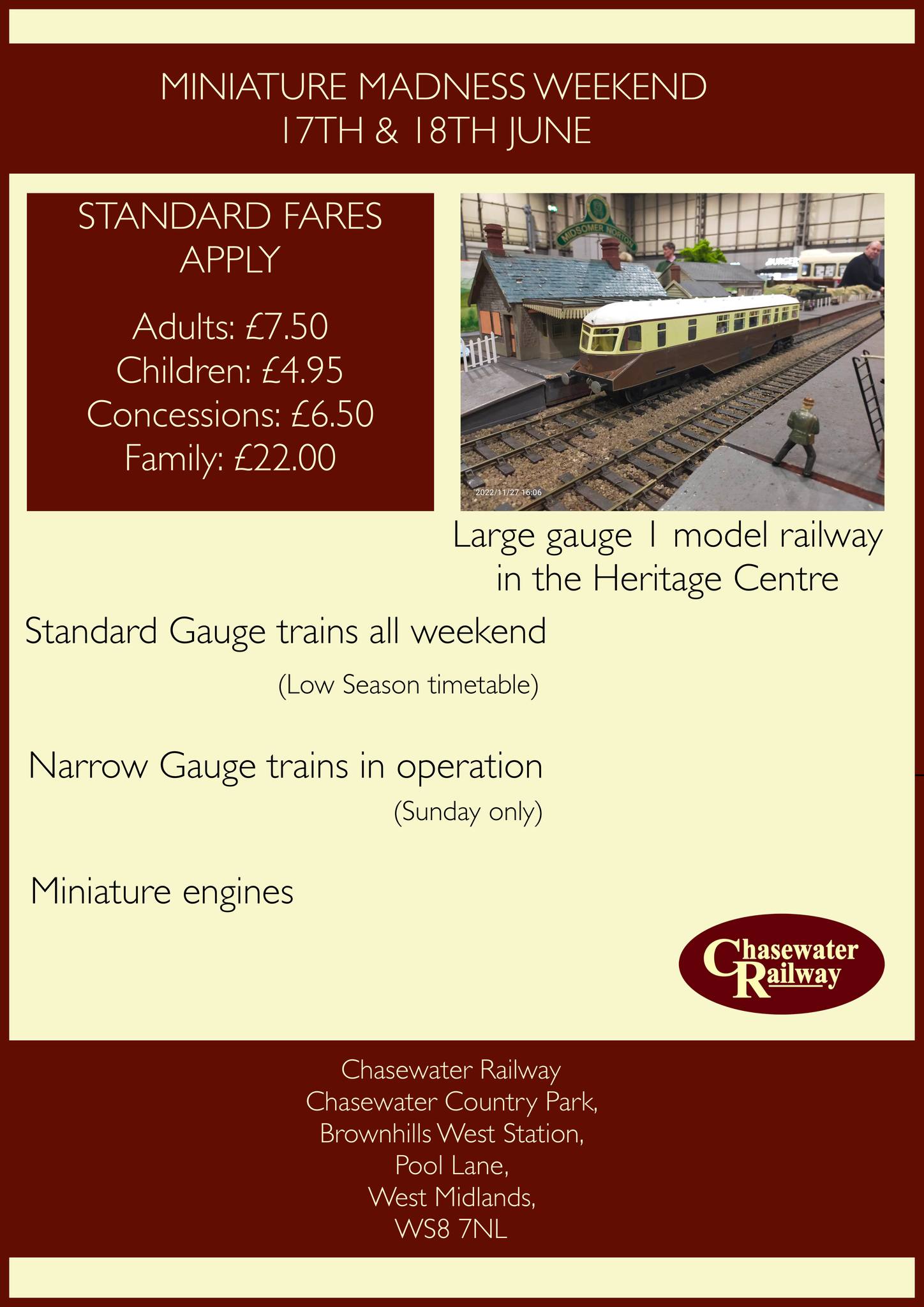
This weekend! Miniature madness weekend! Large gauge 1 model railway in our heritage centre, miniature engines, Narrow Gauge (Sunday only) The Museum will be closed on Sunday. Standard Gauge trains operating all weekend.

Standard fares apply! Don’t miss out!

150 – Chasewater Railway Museum Bits and Pieces

Please Note –  The Museum is closed next Sunday, 18-6-2023

150 – Chasewater Railway Museum Bits & Pieces

From Chasewater News Autumn 1992 – Part 3

Carriage & Wagon News

Maryport & Carlisle six-wheel coach – During early May Keith Day uncovered the coach from its winter wraps to find no further deterioration has occurred.  He then fitted small plastic sheets to deflect the rain from the missing windows.  Work was also carried out to make doors and windows fit on the other side.  All seems to be intact now, but on close inspection every coach panel was suffering from weather rippling due to the use of plywood, and I’m afraid that even a coat of paint couldn’t make this vehicle look any better.

Midland four-wheel Passenger Brake – This vehicle remains sheeted up awaiting attention, but strides have been made for attaining roof timbers from Butterley.

Manchester, Sheffield and Lincoln six-wheel coach – This coach has remained sheeted up for some time.  John Elsley unfortunately hasn’t been down to see us recently.  ‘Are you well John?’ Please contact us.

16 ton Great Western Toad – Repainting the visible end of this vehicle has helped the appearance of this trusty tool van.

CCCC (CRC) Brake Van – The flooring has been prepared and painted, but the theft of valuable plywood sheeting from underneath the vehicle has put Keith Poynter back several months.  Members please note not to leave items around the yard.  Lock them up either in the C&W shed or conceal them in the coaches, otherwise they will get used for other projects, burnt or stolen.

Wickham Trailer E56171 – Due to the loco changing ends this season, a rather shabby cab end has been exposed on this vehicle especially when the train enters the station n the return journey.  For the day of the transport rally a hurried black, red and maroon coat of paint was applied, producing a better result.  A cab front window had been fitted a few weeks earlier, so all isn’t too bad.

Wickham Power Car E50416 – Again great steps have been made towards the restoration of this vehicle.  In April, after a major shunt of the station yard, the power car ventured down through the platform under its own power and the reversed onto No.2 road where work on the interior, brakes and exhausts is being carried out.  When stuck for details and internal components fro the brake air receiver bypass valve, Andy Clegg and Chris Hatton visited BR Tyseley and were given everything they needed.  Our thanks to all those concerned!

Derby Centre Car W59444 – During March and April much work was carried out to get this coach into reasonable condition externally, all be it in engineering grey.  Through three weekends of rain and sun the seating upholstery was vacuumed, the floors mopped and windows cleaned, however a management decision was made to put the Gloucester back into service.  Since then work has resumed with Dave Whittle pink undercoating and rubbing down for top coats.

Gloucester Trailer E56301 – This vehicle has remained in service with the Wickham Trailer to form the passenger train.  Initially this was necessary as the Railway Inspectorate had not given permission for the loco to propel the train from the northern end.  Permission was, however, eventually received and on Monday May 4th the loco changed ends.  Since then the Gloucester seems to have remained in service instead of 59444 as originally intended.

Maunsell Southern Brake Van 62861 – This vehicle has received attention from two of our new members, Helena Day and Kate Rogersin, in the form of painting the side visible from the park.  After preparing one side and the two ends, members may be surprised that a 5 litre tin of undercoat was used just to cover them.  Work on this vehicle had to be suspended in May due to a pair of blue tits nesting between the panelled sides.

Great Eastern six-wheel passenger brake – The doors have had their frames undercoated and painted, with slide windows fitted when possible.  A recent trip to the East Anglian Railway was to determine the outside panel design, but variations from 1876-1895 contrasted quite considerably.  It appears that a number of such vehicles were constructed at the Birmingham Carriage and Wagon Works under contract from either Holden or Wordsell.  If anyone has details or photographs of this or any vintage GER coaches please contact Dave Borthwick.

Midland Box Van – During another wet weekend this vehicle was tidies up and has now become our spare sparks van where our electrical equipment can be stored.  As many of us will appreciate, cable, switch gear, starter motors, etc. must have a secure home.  Repairs made good the detached sliding door by the addition of a new top runner and bottom door support bracket.

Cadbury Van – this vehicle has been tidied up internally by ‘righting’ the two fallen diesel engines which had been stored in there.  This will give clearance for Chris Hatton to inspect each engine in turn with a view to restoring No.21 to working order.

16 ton Mineral Wagon – This has been prepared and painted in grey top coat by Arthur and Tony.  Numbers and markings will be researched and applied shortly.  This vehicle, which is currently standing on No.1 road siding gives the railway a touch of its origins, and also shields the rusting parts of S100 from the public gaze!   Dave Borthwick.

The Peak Rail Jolly Boys Outing

During May, early one Saturday morning, the twin steer Bedford ‘Fair Spares’ coach drew to a halt in Brownhills West station yard, and so began a very enjoyable day at and around the Peak Railway.

A few of us remarked on the £3 return ticket price on the railway for a trip to Matlock (Riverside) in the middle of nowhere and back.  At the CLR you can travel all day on our train to nowhere and back for half the price.

 There was one pathetic occurrence that happened with all the natural beauty of the Peak District hills, dales and river walks, with the delight of art and craft museums everywhere, the depraved few, namely the PW Gang, Catering and C&W Depts all homed in with no prior arrangement, on the nearest boozer – where silliness began!

Thanks to Sue and Les, and the driver who kept us laughing with his ‘Murphy’ tapes.   Dave Borthwick

149 – Chasewater Railway Museum Bits and Pieces

Chasewater Railway, including the Sidings Tea Room, will be closed this coming weekend, the 10th and 11th of June 2023, due to the Staffordshire Iron Man Competition.

149 – Chasewater Railway Museum Bits & Pieces


From Chasewater News Autumn 1992 – Part 2

Permanent Way News

Track Update – Keith Day

Work on the track is progressing well.  On most Sundays there is a regular crew working at the end of the line.  Timbers recovered from Hams Hall have already been used in extending the track.  In mid-July we calculated that we were only nine 60ft panels away from the causeway, and since then several of these have been laid.  Work has been made easier by the professional way in which we use the JCB and in Ian Buswell’s skill in driving it.A view of newly laid track on the extension curving towards the causeway bank.  A comparison between this photo and the one in the previous post reveals the fantastic improvement made during the first half of this year.

If anyone reading this article would like to join the permanent way gang, if only for an occasional Sunday, we would be pleased for you to come and join us.  Just ask for Les Emery or Arthur Edwards at Chasewater, or phone the station or just come along on any Sunday.

Willow Vale Bridge

Work on the metalwork has been completed with the addition of ”Chasewater Steam Railway” painted in large letters on the road side of the bridge.  Tony Wheeler and Arthur Edwards have cut back the trees and undergrowth compassionately before the nesting season, and now the railway has come alive to the many people who pass that way daily – another case of free advertising!

Brownhills West Station News

All weather working with power tools can now be accomplished safely following the installation of RCCBs (Residual Current Circuit Breakers) on all the power circuits at Brownhills West.

Adrian has almost finished the lighting on the station platform following his success with the shunters’ cabin, public loos and bric-a-brac stall.

We can be seen from the other side of the park now!In preparation for the spring and summer season a tidy up was needed around the station site.  A number of things have consistently offended the eye, such as the abandoned signal post once sited on the platform, but recently cut down on instruction from the Railway Inspectorate.  It was too heavy to lift very far, and too big to hide, so the ideal thing to do was to raise the damn thing.  A hole was dug; bull-head rail was pestered out from around the site and drilled to form two bracing pieces which were fixed to the base of the post.  The next week with the help of Keith Day, Ken, Larry, Dave whittle, Andy, and Paul Whittaker, and with no help from the rain we arrived to find our hole full of water.  With a rope on each side of the signal top (maypole-like) we heaved and stood the signal erect.  Newton’s gravitational theory nearly took effect on two occasions, but with frantic assembly of the other two bracing pieces of bull-head rail, and Paul Whittaker arc welding them into position, all became steady and perpendicular.  The signal mechanism can now be operated from just above ground level.

Turf was planted around the base and is now growing profusely.  Total cost of the project was just the welding rods supplied free by Paul Whittaker, but the main thing that was achieved was the free advertisement of the signal arm being visible from the other side of the park.

Donation boxes are a feature at most railways and bring in a modest income to fund various projects.  The chimney from our Peckett 917 was rusting away on its saddle tank, but painted and planted on the station it offers a home to our passengers’ nuisance change.

Can members think of ideas to utilise any other railway components?  Perhaps our modellers could show off their engines in a glass case where a donation could power the driving wheels to show off the workings.  We must amuse the mums and dads and kids as well as the rivet counters!  Pennies into Pounds!!

Dave Borthwick 

Meeting with Walsall Council – David Bathurst

A number of CLR members will have been aware of correspondence from Walsall Council instructing the railway to stop work on track preparation and re-laying and certain remedial works to repair the breach in the causeway.  It was suggested by the Council that the railway required planning permission for its works, and that the railway might be acting against the various nature conservation designations (SSSI & SINC) within Chasewater Park.

The Council’s ‘instructions’ caused some concern to the working members.

However, a meeting was quickly arranged between the Council and representatives of the railway, at the Council House, Walsall, on 14th May 1992.  Steve Organ, Les Emery and John Selway represented the railway, with the meeting both convened and chaired by David Bathurst – who was faced with the dilemma of having a foot in both camps!!

The meeting proved to be immensely satisfactory from the railway’s point of view with the Council conceding early on that the railway is in fact in possession of all the necessary planning permissions to carry out its immediate future programme.  It seems that the Walsall Council did not have on its files a copy of a very important planning consent granted in the 1970s by its predecessor planning authority, Staffs County Council, which fortunately was able to be located within the railway’s records.

Perhaps more important was the clear impression gained from the Council’s Officers that they wish to assist, and not obstruct, the railway in its proposals, while at the same time offer advice as to how best proceed in the best interests of preserving the environment.  Indeed, a meeting took place on site a couple of weeks later, when Steve Organ and others enjoyed a high-speed programme of plant recognition.  It should not be construed that the railway can do what it likes because certain future projects may well require planning consent, but at least proper lines of communication now exist between the railway and the Council.

In conclusion, the need for a good working relationship between the railway and the Council cannot be over-emphasised.  What could have been a confrontation resulted in exactly the opposite, thanks to a professional presentation by the railway’s representatives and good will on the part of the Council’s Officers.  At least on this front, the future looks good indeed. – David Bathurst

Vacancy Filled

Of the three posts recently advertised, the best job has already gone!  The successful applicant for the position of Company Treasurer checks the takings following Transport Scene.  Such youthful enthusiasm!!  Whatever happened?!

Is that really Chris Chivers??