Chasewater Railway Museum
November Newsletter


Last Day on the Churnet Valley Line
By R. A. Reed
In 1849, a line from North Rode, near Macclesfield, to Uttoxeter was opened by the North Staffordshire Railway Company. This was known as the Churnet Valley line and was over 27 miles long. The section from North Rode to Leek was closed a few years ago and some of the track is now lifted.
On Saturday, January 2nd 1965, the remainder of the line from Leek to Uttoxeter was closed to passenger traffic. The day was cold but bright and sunny, and, accompanied by the Hon. Editor and friend, we set off from Stoke to Uttoxeter. As we booked our tickets, from Stoke to Leek via Uttoxeter, 9/- (45p) single, the ticket clerk jovially remarked that it would be ‘cheaper by bus from Hanley – 1/10d (9p) single!’ Probably, these tickets were the first to be issued by this very devious route.
When we arrived at Uttoxeter, we had over an hour to wait, so we went to the waiting room where we found two seats of the North Staffordshire Railway, engraved with NSR and the Staffordshire Knot. These were in excellent condition and one would be suitable for preservation. Uttoxeter Pic: Wikipedia
It was not long before the train arrived; three non-corridor coaches headed by Standard Class 4, No.75035 of Stoke shed. The driver was J. Dickson and the fireman was S. Tabinor. This was the last passenger train from Uttoxeter to Leek. We occupied the first compartment nearest the engine and waited until the booked departure time at 11.18am, but this was changed to 11.30am at the last minute. By now the train was filling up, most of the passengers being railway enthusiasts equipped with cameras and tape recorders.
As 11.30 approached the last photographs were taken, and carriage doors closed. The Guard waved his flag and we were off, amidst shrieking whistles from the engine, detonators on the track and thunderflashes thrown by an enthusiast. Rocester Station Pic & Info: Genuki, Staffs Pasttrack
shannieslittleworld.co.uk
Description: Rocester Train Station 1905. This station was completed in the early 1850s. The North Staffordshire Railway Company’s Churnet Valley line ran through this station taking passengers to Leek and Macclesfield. Another service took passengers to Ashbourne and Buxton. The Ashbourne line closed to passengers in 1954, and regular passenger trains on the Churnet Valley line in 1960.
This picture shows signs on the platform for the Porter’s Room, Gentleman’s First Class Waiting Room, and a Ladies Waiting Room. There are also milk churns on the platform, awaiting collection .
All along the line people were waving as we passed, and the driver acknowledged this by long blasts on the whistle. Soon we were speeding along and fast approaching the first stop, Rocester. Here the train was well photographed and after a few minutes we set off again but only as far as the crossover, where we reversed onto the other track and back into the station. A pilotman then boarded the locomotive and after much waving of green flags by hand-signalmen we finally set off, running on the ‘wrong’ line from here. Site of Denstone Station: Linda Bailey
We had a fast run to Denstone, the next stop, and again there were many spectators, and as we left the station, more firecrackers were thrown. The section of the line from here to Alton is particularly beautiful and it is surprising that the line would not pay in the summer months. Alton Station: Humphrey Bolton
The next station was Alton, where we crossed back to the down line. It was extremely tidy and well-kept and typical of NSR design. The run from Alton to Oakamoor is continuous up-grade and the sound of the engine was music to the ears. When we arrived at Oakamoor the platforms were quite crowded and many photographs were taken. Just as we left, the last train from Leek to Uttoxeter passed, headed by a Stanier Class 4 (2-6-4T), and then we plunged into a short tunnel. Oakamoor Station: Rail37.com
Then on to Froghall, which is in an industrial area, but the factories between Leek and Oakamoor will not lose their rail connection. This section of the line is to be kept open for freight and worked on the ’one engine in steam’ principle. Kingsley & Froghall Station: John Proctor
 Consall Station: Black Widow Productions
After leaving Froghall, we were soon in the beautiful country surrounding Consall. This village has no public road to it and ‘outsiders’ cannot get in by car, therefore the railway was the only link (unless one prefers a long walk). Cheddleton Station: John Webber
We quickly arrived at Cheddleton, where most of the passengers left the train to take photographs, and the train waited until they were sure that everyone had finished and boarded the train. Leek Brook Station, Churnet Valley Platform: Wikipedia
The journey was almost over, and as we emerged from a short tunnel we could see Leek in the distance. When we drew into the station, the engine rapidly uncoupled and ran round the train to haul the stock from the station. As we left, the station was locked up – the last train had gone.
What a Comeback! Churnet Valley Railway – 2010 version. Pic: Black Widow Productions
The first passenger services outside the confines of Cheddleton yard began on August 24th 1996, this being a “push and pull” operation of a little over a mile between Cheddleton and Leek Brook Junction, the latter being the junction with the mothballed Railtrack line between Stoke on Trent and Caldon Quarry. Trains were initially operated by hired-in “Jinty” tank loco 47383, this and resident 4F 44422 being the mainstays of the service for the first season’s operations. Although only a short run, this operation proved to be an ideal training ground for the railway’s staff, and got everyone used to operating outside the goods yard.
Saturday 11th July 1998 saw the first southward extension of the railway, when the section between Cheddleton and Consall was reopened for passenger traffic. This brought the railway’s operational length to approximately 3 1/4 miles. The next extension, to Kingsley and Froghall, opened to traffic on 11th August 2001, giving an operational length of approximately 5 1/2 miles. Pic: Black Widow Productions
Taken from The Mercian, February 1965 4.1
The front page shows the map of the line, including the amusement park and the go-kart track, both long gone. 
Then follows an interesting Editorial about the future of the RPS movement after a change in government.
Editorial
Over the last few months of 1964, the winds of change swept through Parliament. A Government which favoured the railways taking the form of a profit making concern was replaced by a Government which believes that the railways should provide a complete social service.
With this news came the resignation of Dr. Richard Beeching, Chairman of the British Railways Board. What effect will these major changes have on our Society and its fellows?
Although the internal affairs of British Railways are nothing to do with our Society, their attitude – based on the policy of the BRB certainly does affect us. Up to the present, the attitude has been somewhat cold, and certainly not what could be called encouraging. British Railways appear to be trying to make a profit on anything that they possibly can, with no sympathy to museums or museum societies, as we have found.
We have been charged extremely high prices for coaches that would be sold to scrap merchants at one third of the price. We do accept the fact that the railways are trying to work at a profit, but this exploitation of an historical society, in its first years and struggling to survive is surely uncalled for.
With the introduction of a socialist Government, we certainly expect the greater part of the Beeching plan to be abandoned, and concerning the connecting branch line to Brownhills and our Chasewater line, we would greatly appreciate a reprieve, but how does the remainder of the plan concern us? Very little indeed! It does affect some small branch lines for sale – at rather high rents, and on the other hand some well loved and beautiful branches which no society could afford to maintain or buy will be swept away.
On the whole, the RPS should look forward to the abandonment of the Beeching plan and perhaps a softening of BR policy towards us, although my personal feelings on the plan are the contrary to those of society in general. Our own attitude seems rather selfish but we aren’t the wealthiest of Societies, and at this critical stage we must be selfish to survive. As it has been said many times before in dealing with other problems, ’the world does not owe us a living!’
Hon. Ed. M.D.Willis
The Titfield Thunderbolt
It’s interesting to see that back in 1965 the Society held a film show at Walton Village Hall and 70 people attended in dreadful weather in January. We have a copy in the Museum right now!
The Chasewater Project
As you will read in the Officers’ reports, work on the Chasewater line will begin in the near future, and a great deal of organisation will be necessary to make it the great success on which we are planning. A great deal of hard work will have to be done by our members, and in order to discuss it openly, individual members will be receiving a visit from an official. (In long macs and dark glasses??!)
With this project will come a great deal of publicity for the Society, and in order to assure that this will be put to the maximum possible use for effect, we must have one united outlook. In order to prevent any contradictions, however petty, will members please send any correspondence about the project to the Committee, via the Secretary so that any such ‘slips of the pen’ may be pointed out.
The Chasewater project was repeated in the Chairman’s report.
Hon. Secretary’s report
Due to wintry conditions, restoration work has temporarily come to a halt at the depot. Work has been maintained on the smaller relics. John Elsley has however continued working on the generator set in spite of the cold. The TPO dynamo coupled to an Austin 6-cylinder lorry engine, donated by the President, comprises the set. It is now in full working order and provides adequate power for our coach batteries. Many thanks to John and his small band of helpers.
Hinges have now been cast for the Maryport & Carlisle carriage doors, an effort will be made to clean up these castings in the near future and fit to the doors.
Plans are now being formulated for our line at Chasewater, and the Committee will be discussing and drawing up plans for the project for some months to come.
A small party of members (7) braved the elements on Sunday 17th January to attend the last train run from Walsall to Rugeley. Two members – D. J. and J. J. Bradbury – attended as official mourners, vintage MR and GWR caps were worn. For our Treasurer, Frank Harvey it was a nostalgic journey, Frank having travelled on the line for some 7 years to and from school.
(The line from Walsall to Hednesford was reopened in 1989, and to Rugeley in 1997.)
D.A.Ives, Hon Sec.
Treasurer’s Report
Without doubt, 1965 will prove a most expensive year if all our plans are to be achieved. For the benefit of our more distant members, (And for those of us reading this some 45 years later!) I would like to outline a few of these.
First we must consider the lease of the Chasewater branch. Naturally, we have made preparations for this and the general fund is in a position to be able to settle this account without delay. However, before any of the stock can be moved up there, a building will have to be constructed to provide accommodation. The building which we have in mind will be large enough to house our present collection of large relics with room to spare for future acquisitions. The estimated cost of such a building has been put at around £3,000. This matter is urgent and the full support of all our members is needed. (As a comparison, a three bedroomed detached house in Hednesford at that time would have cost about £3,500, so the equivalent cost would be in the region of some £160,000).
Apart from this, repairs to the line and its accessories will account for another large sum of money.
The time limit given to us by the NCB to raise the money for the Stroudley E1 (Cannock Wood No. 9) has now been reached. £100 out of the £300 needed has been collected. We are hoping that negotiations with the Board to keep the locomotive for a further period of time will be successful. I would like to thank those people who have donated to the fund, but generally speaking, I am rather disappointed at the response shown by our own members. The attitude I am afraid has been rather apathetic. Most of the money has been donated by people who live well outside our own area!
A branch line without a locomotive is a rather ludicrous situation. It is up to us to rectify the position since we will require at least two engines. The Stroudley E1 could so easily be one of these.
Sound coaching stock will also be required. The stock we have at present will not be suitable for service until a vast amount of restoration work has been completed. Carriages which require little or no repair work need to be purchased. These will cost in the region of £300 each.
I realise that our expense problems sound formidable but they can be overcome. After all, preserved standard gauge lines are still very few and far between. There is certainly room for one in the Midlands.
With all the development work done by Lichfield Council on the Chasewater Country Park, the Chasewater Railway is better situated than ever in the heart of the West Midlands.
Taken from the ‘Mercian’ December 1964, 3.3
The Chasewater Branch Line

By Brian Kinder.
The Chasewater line is situated round half the perimeter of the Chasewater Pool. The pool itself is now being extensively developed as one of the largest amusement areas in the Midlands, and to this end Brownhills Council is spending several thousands of pounds. When development work is completed, it is hoped that a large proportion of Birmingham and area’s population will visit the pool annually. It will therefore be appreciated, the great potential of a railway museum situated in this location, where there will be such a great concentration in the summer months, of day-trippers.
The proposed track itself was constructed in the main by the Midland Railway, and a small section by a colliery company. The line was used for mineral traffic from the collieries, however a station was built at Brownhills, at which all passenger traffic terminated.
Due to our section of the line’s sole use for mineral traffic, the track is in a poor state of repair, the poorest part being from the marshalling yard to the north. The main work therefore will be to relay the track in certain places, and clean out and in some places repipe the drainage system.
The work on the line will have to be completed by the end of 1965, if not sooner, depending on the closure of the connecting line by British Railways. Therefore we will need everyone’s help to get the work done.
We will not be able to manage with the present sized work party of 14 or so members, as it takes these fellows every Sunday to keep the stock at the depot in order. We are not asking you to attend every week, but if you could attend monthly or bi-monthly periods, it would help to clear up the situation tremendously.
The line is only one mile from Brownhills Station (BR – LMR) (Still a few months before closure!) and if you could see it, you would see its great potential if a success was made of it. Success however can only be achieved with 100% help from YOU!!
 North Staffordshire Railway – 1845/1923
NSR Signals
The National Coal Board has donated four NSR lower quadrant signals to the RPS. They are in good condition, with only one exception, when on being removed from the site at the Pinnox Crossings (South of Tunstall Station in the Potteries), Burslem, Stoke-on-Trent, left its base firmly implanted in the muddy ground.
The largest of the four has been erected at the depot at Hednesford – an excellent view of the surroundings being commanded from the top. We hope to plant the other three on the Chasewater Branch.
NSR Rolling Stock
On a recent survey of the internal railway of Shelton Iron & Steel Ltd., several wagons and three box-vans of the North Staffordshire Railway were found.
After talks with the company, we agreed on the following:
It is probable that early this year we may be able to have a tour of their railway, which should prove far more interesting than it appears at first sight. There are 36 miles of internal railway and there are still several steam locomotives operating. The most interesting is perhaps an 0-4-0, which has a crane mounted over the boiler. (Now at Foxfield Railway, by Dubs & Co Dubsy to his friends!)
North Staffs Area Meetings
It is hoped that in the new year, meetings of the members who live in or near North Staffordshire will commence at bi-monthy intervals. Interesting lectures are planned as well as slides and cinematograph shows concerning railway preservation. Will any members who wish to attend please send a postcard to the Hon. Editor, who will send full details when they become available (emails make life so much easier nowadays!)
The meeting place is at present being arranged, and we need a good turn-out to make them worth while. A small fee for admission may be charged, and any non-members will be very welcome. If you live within reasonable travelling distance of the Potteries, do try to attend. I assure you that you will not regret it!
Then followed reports on various social events, including the first Annual Dinner and Social Evening, held at the Eaton Lodge Hotel, Rugeley.
At Hednesford, members are still working on the Royal Saloon and the TPO, and, as ever, more help is needed!
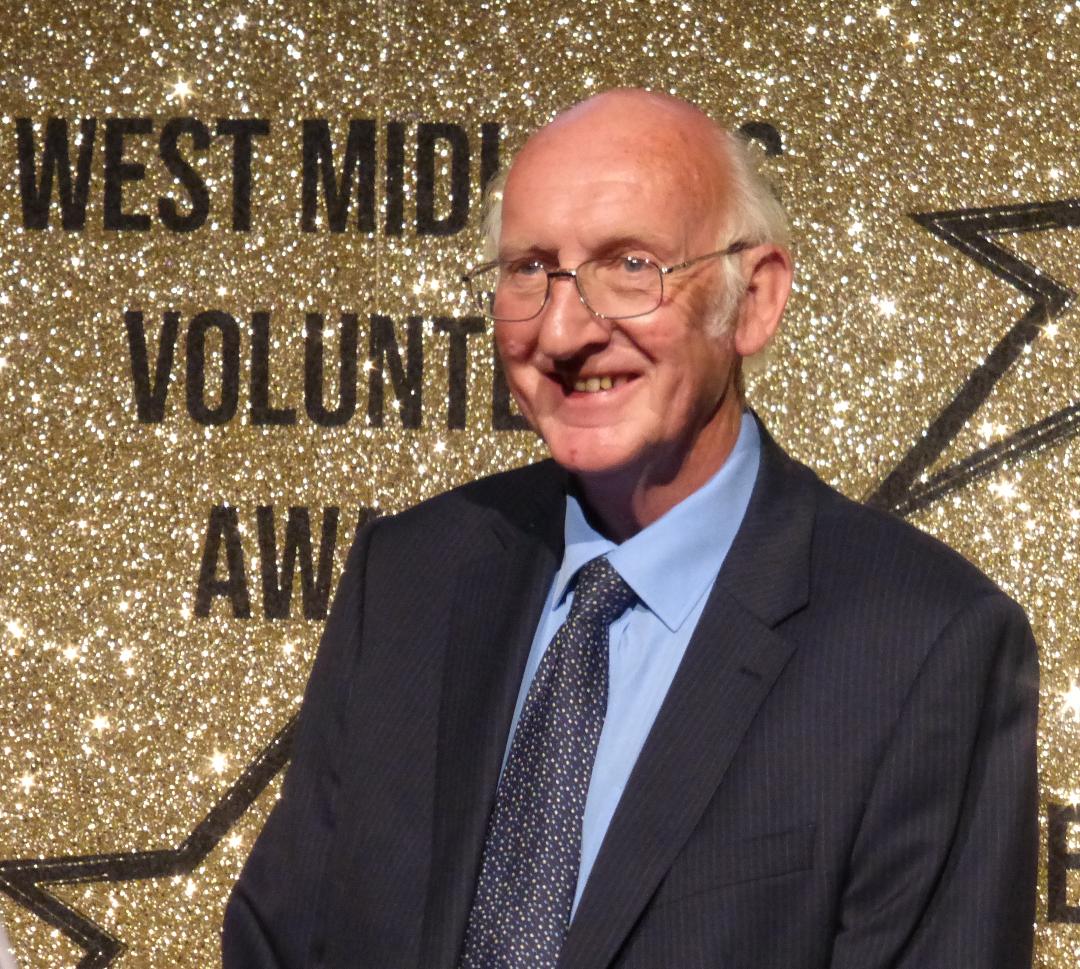
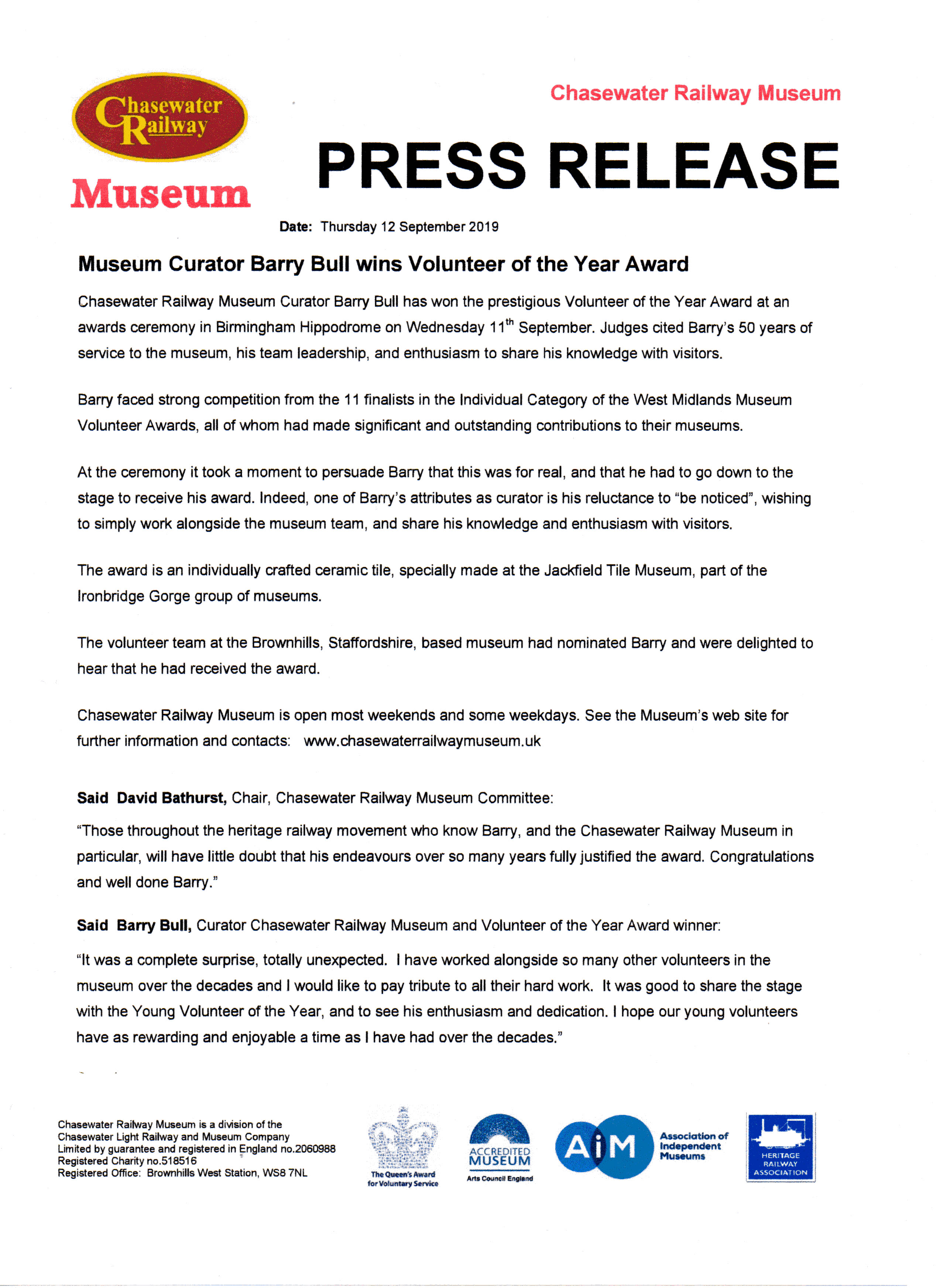
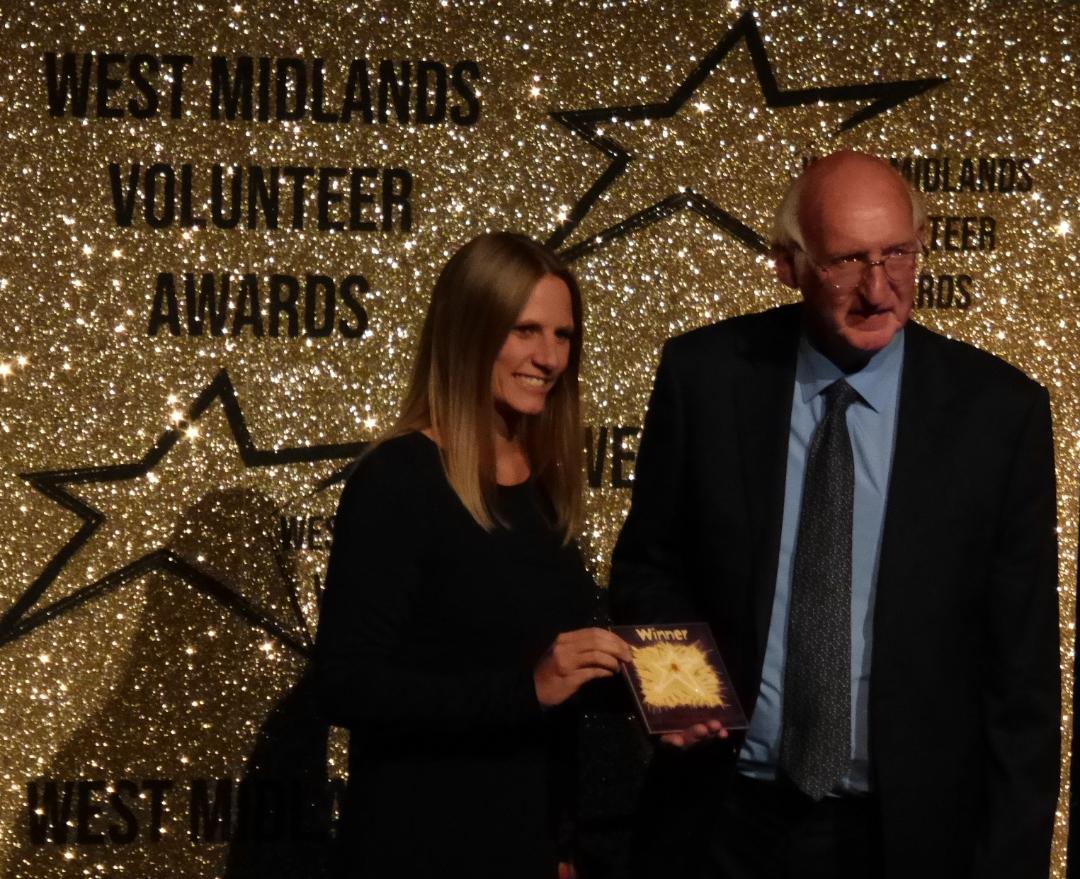
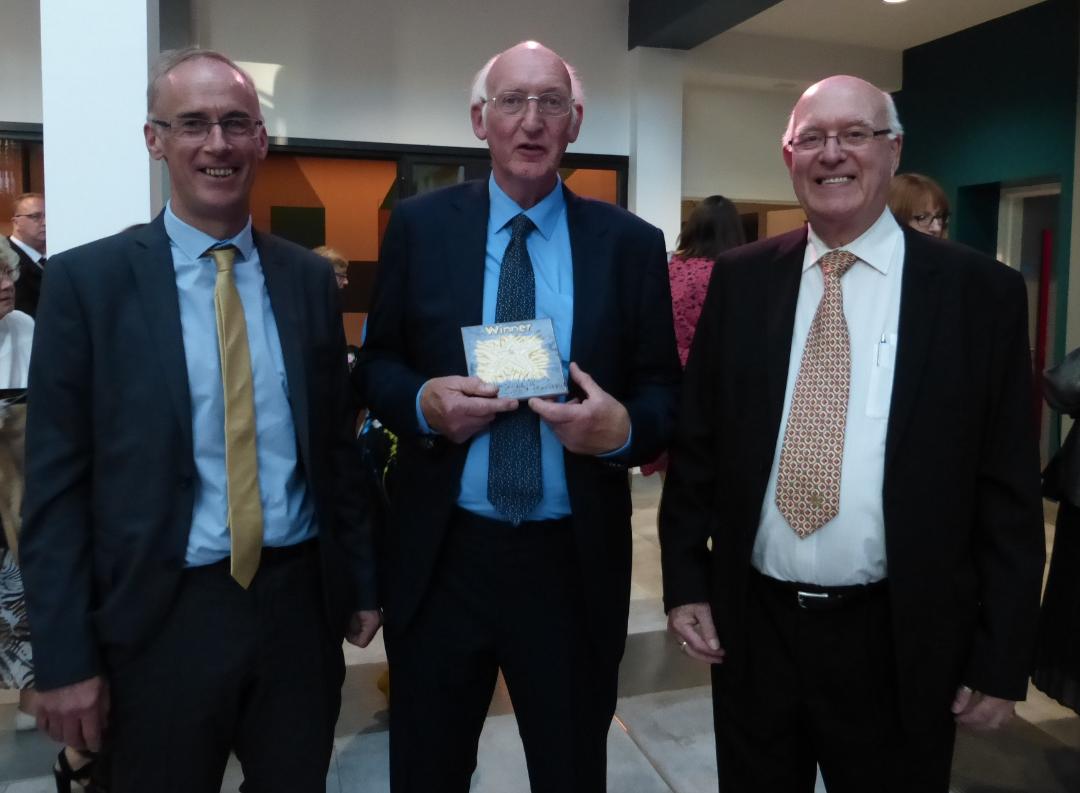
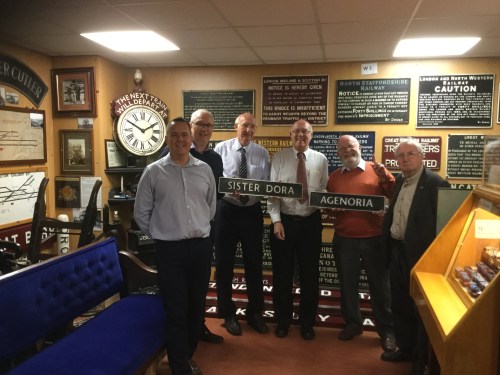
The latest artefact to be donated to Chasewater Railway Museum is the nameplate AGENORIA
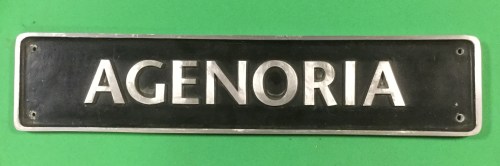
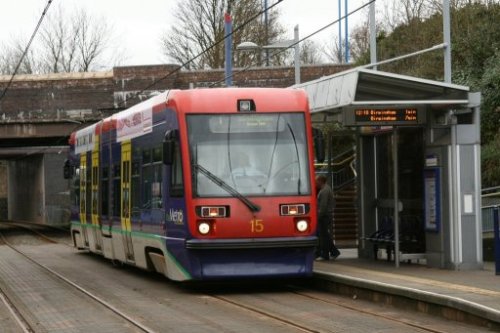
The nameplate was originally fitted to a Midland Metro Tram No 15.
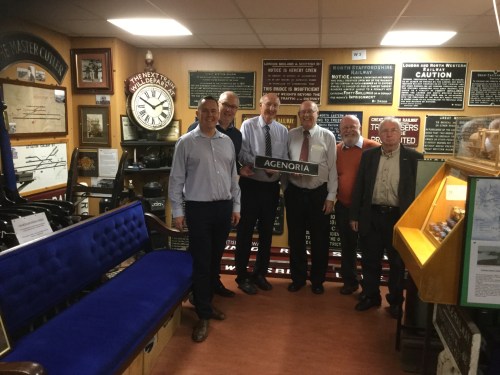
Arranged by Councillor Richard Worrall, and Graham Wilkes, the plate was presented on September 10th 2019, by Anthony Stanley & Carl Williams from Midland Metro
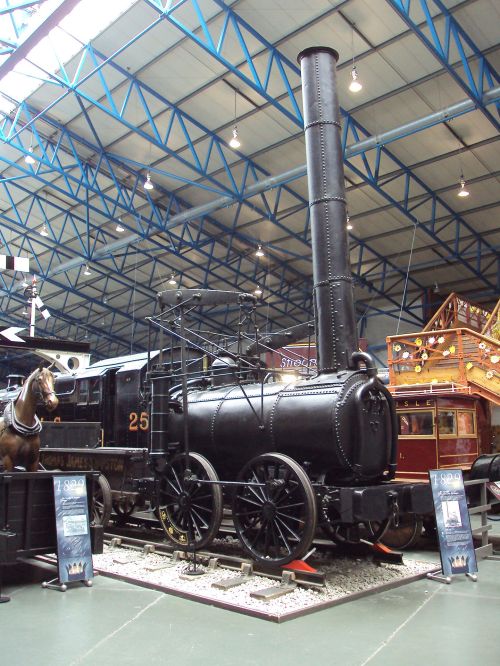
Although not strictly a Railway item there is a Railway connection, as Agenoria was the name of a historic local steam locomotive built in Stourbridge in 1829.
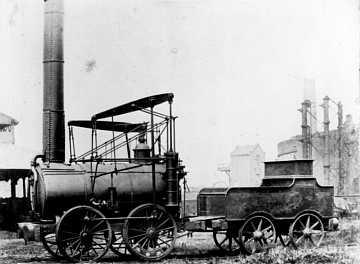
Named Agenoria after the Roman Goddess of Industry, the 0-4-0 loco hauled coal from the Earl of Dudley’s Collieries in Shutt End, down to the Staffs & Worcester canal at Ashwood Basin. Withdrawn from service in 1864, it as been preserved and now stands proudly in the National Railway Museum at York.
This nameplate compliments the other tram nameplate in the Museum’s collection, from No 5 Sister Dora.
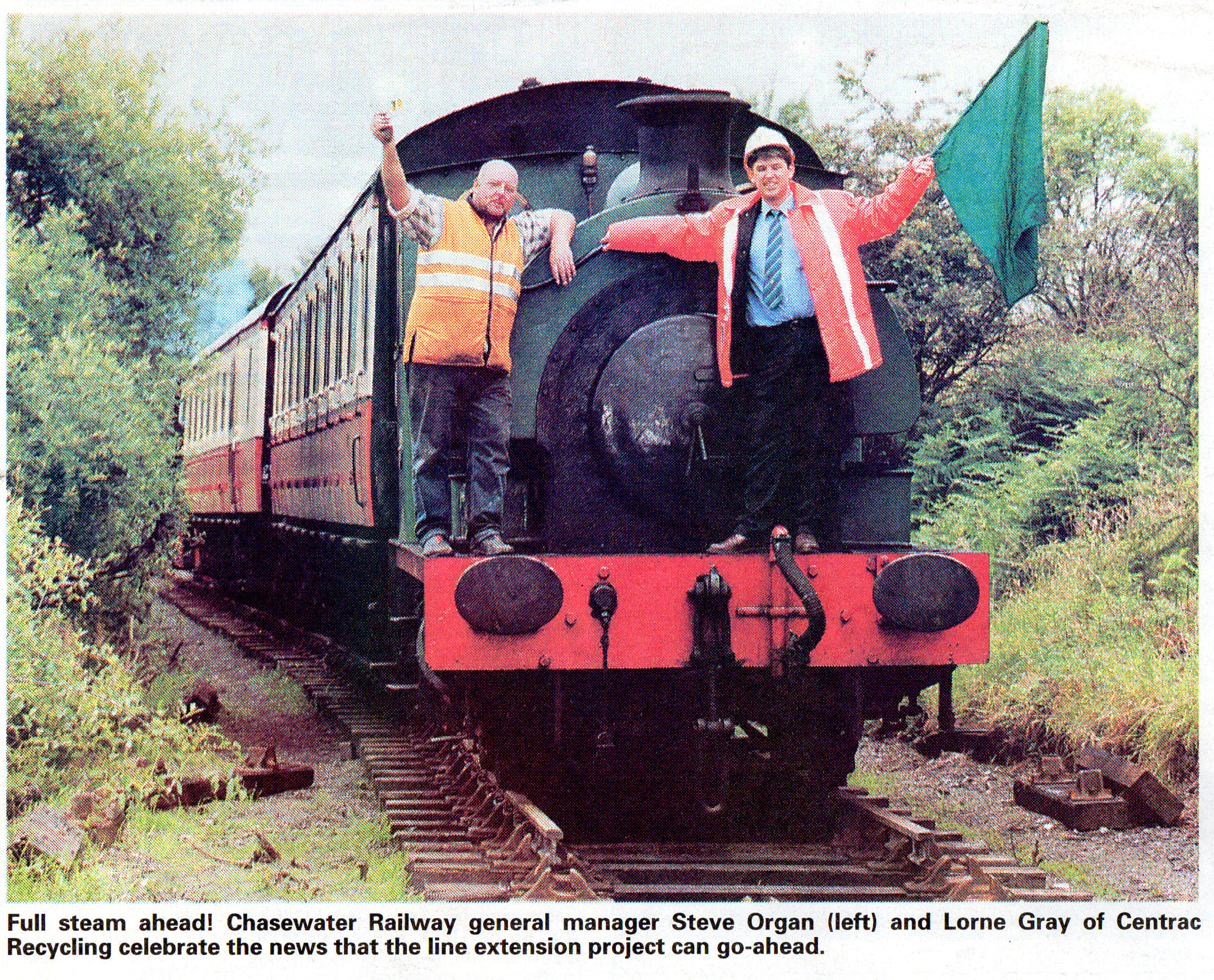
Rail contractor Centrac, Tarmac’s track renewal company, came to the rescue when it heard that Chasewater Railway at Burntwood, Staffordshire, was struggling to extend its line due to a shortage of sleepers.
Birmingham-based Centrac offered to supply 600 sleepers from its main recycling depot at Northampton.
The Donated sleepers mean that Chasewater Railway’s volunteer workforce can extend its line to a planned new station near the proposed Burntwood by-pass entrance to the Chasewater Country Park.
The line currently serves the Brownhills West end of the park, carrying passengers around Chasewater Lake – and across the lake on a recently rebuilt causeway – to a station opened 18 months ago in the Norton wildfowl reserve.
The track represents the only remaining mineral line from the vast Cannock Chase coalfield network, and runs small tank locomotives retrieved from industrial locations, including a steam shunting engine from Pleck gasworks, providing scenic leisure trips for passengers.
Chasewater Railway general manager Steve Organ welcomed the donation of the sleepers saying “We are absolutely delighted with Centrac’s generous help – quite simply we could not have achieved so much without them. This shows the value of recycling materials.”
Lorne Gray, who is in charge of Centrac’s recycling operations, commented: “The particular type of sleeper we have donated would normally be stripped down to the bare components. The baseplates and fixings would be sold off by the tonne to scrap merchants and the sleepers sold for use in heavy industry and agriculture.
“The fact that they will now be used for their intended purpose, albeit on a reduced specification basis, is very satisfying.”
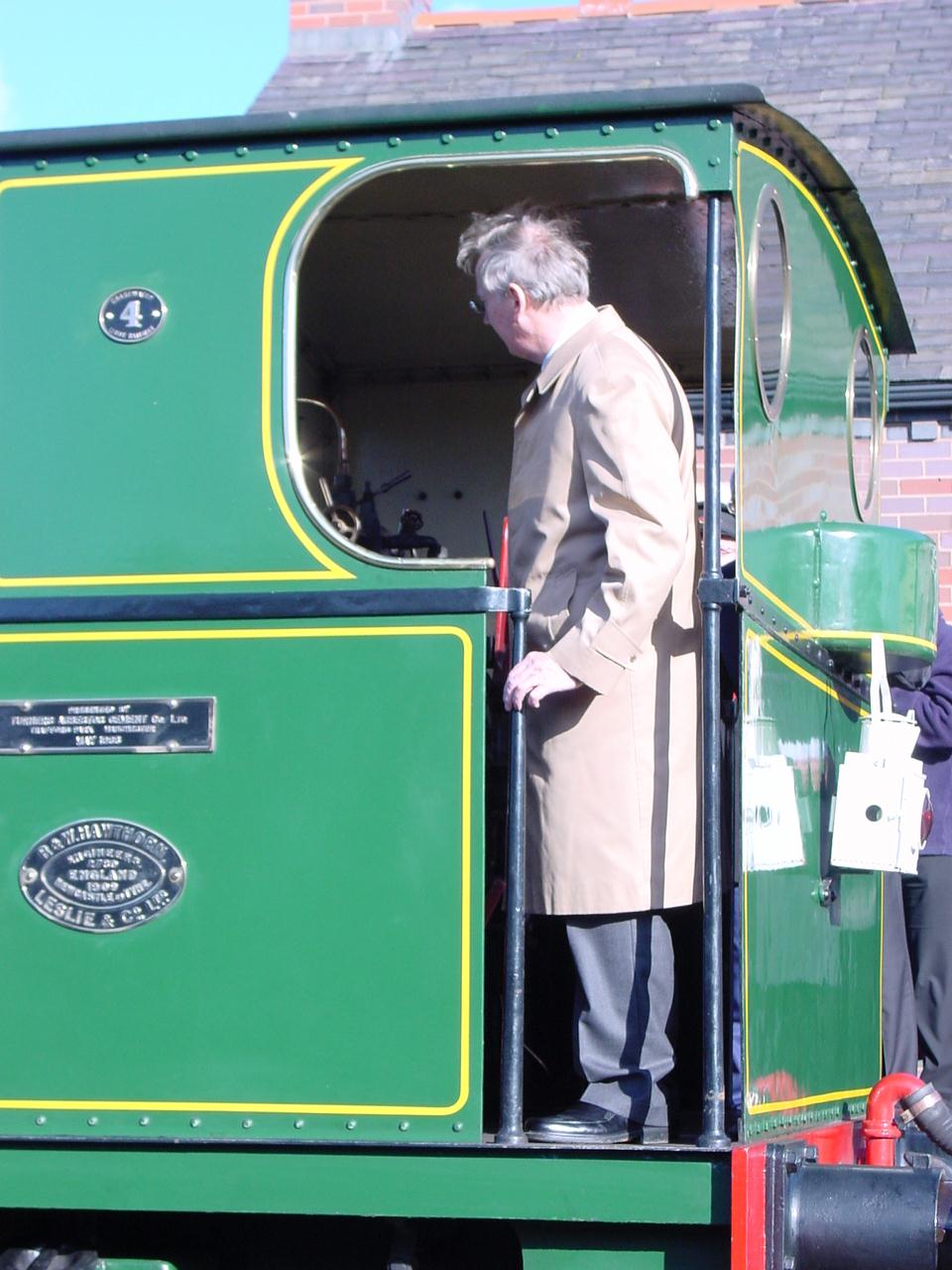
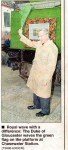
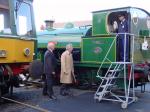
The Duke of Gloucester was in his element as he took control of ‘Asbestos’ – Chasewater Railway’s flagship steam locomotive.
With a blast on the whistle the Duke shifted the regulator and the steam engine edged forward.
For the next ten minutes the Duke indulged one of his greatest passions – steam trains – oblivious to the wired-up security agent positioned half-way along the section of track.
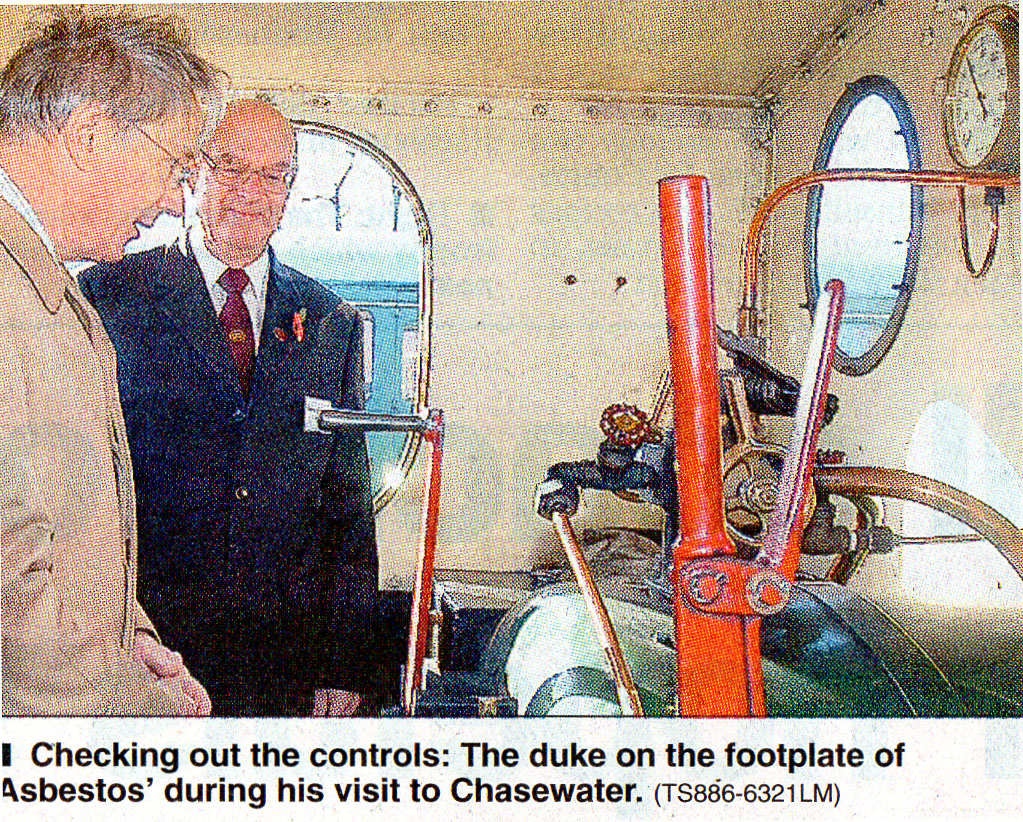
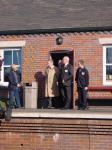
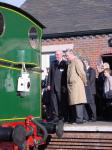
The royal visit to Chasewater Railway was the third stop on the Duke of Gloucester’s tour of the area last Thursday (4-11-2004).
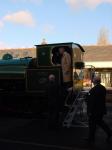
Accompanying the Duke in the engine’s cab were Driver Mark Sealey and Fireman Steve Williams.
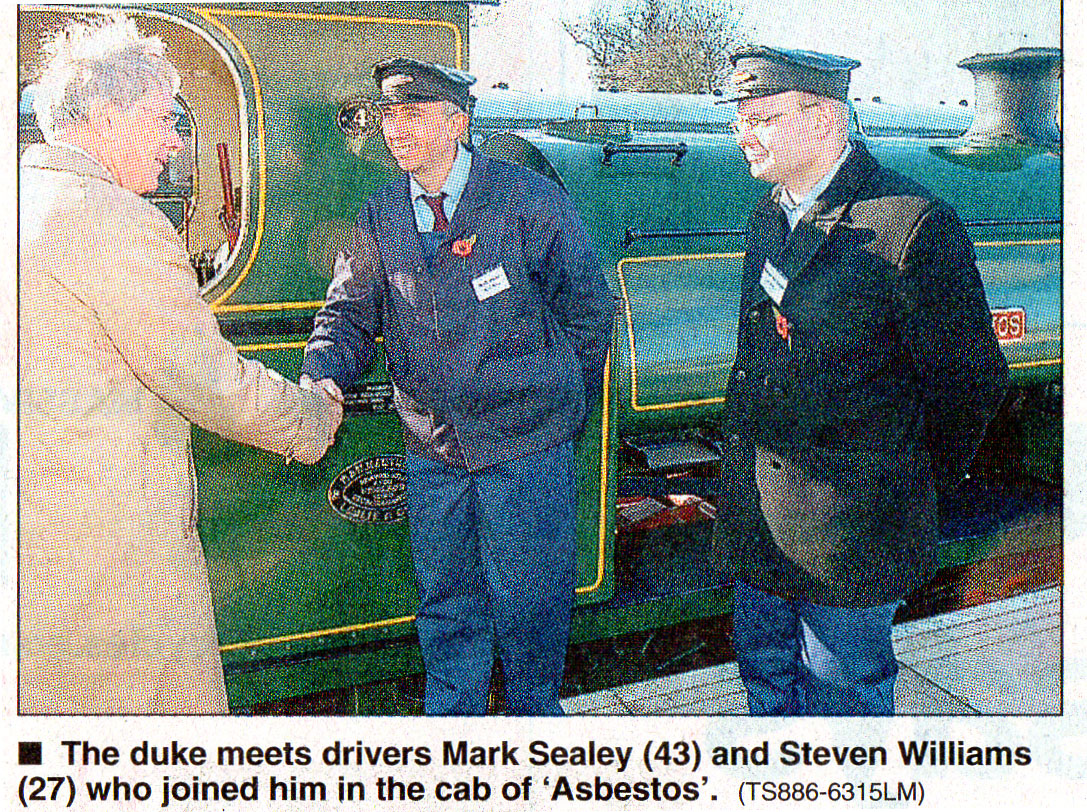
Steve said ” He knew exactly where all the controls were, we didn’t really have to help him. I think he would have liked to have gone a bit further down the track.”
Mark added “We talked about the engine and where it had come from and he asked us about the length of the track.”
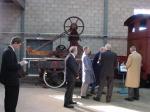
The Duke also toured the newly constructed Heritage Centre where restoration work on Chasewater’s collection of railway carriages takes place.
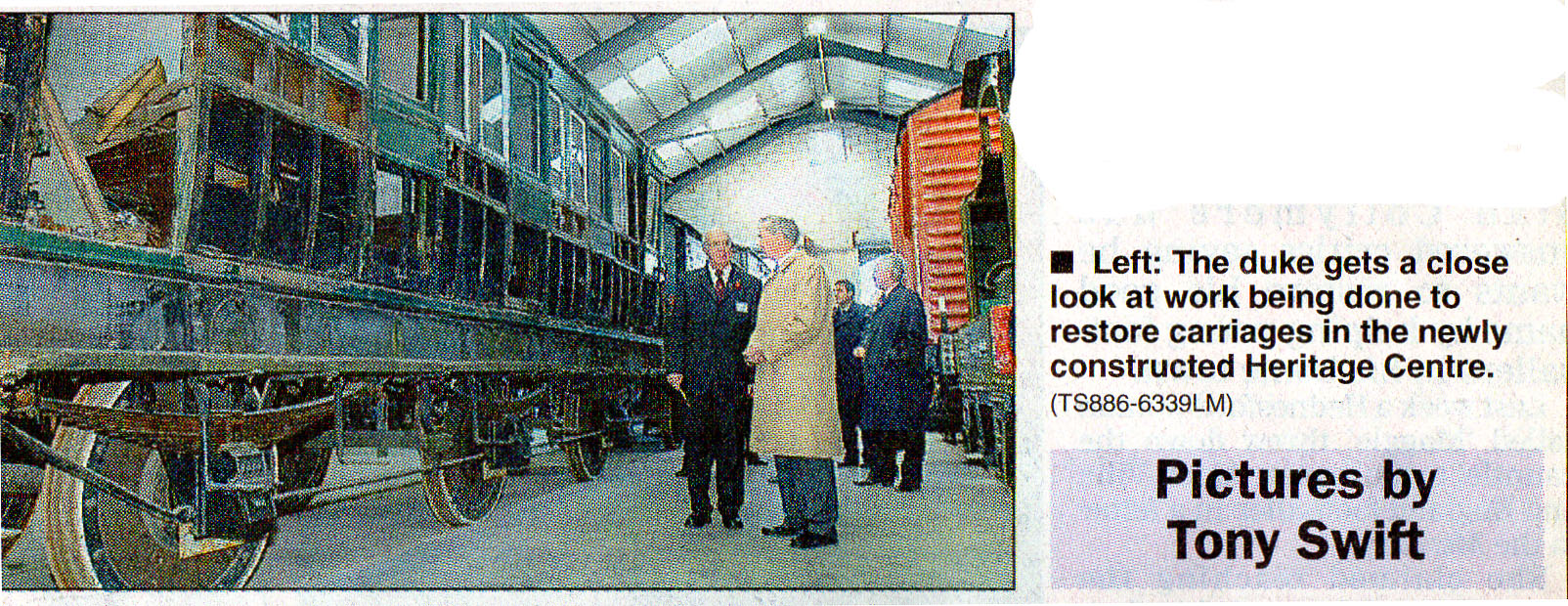
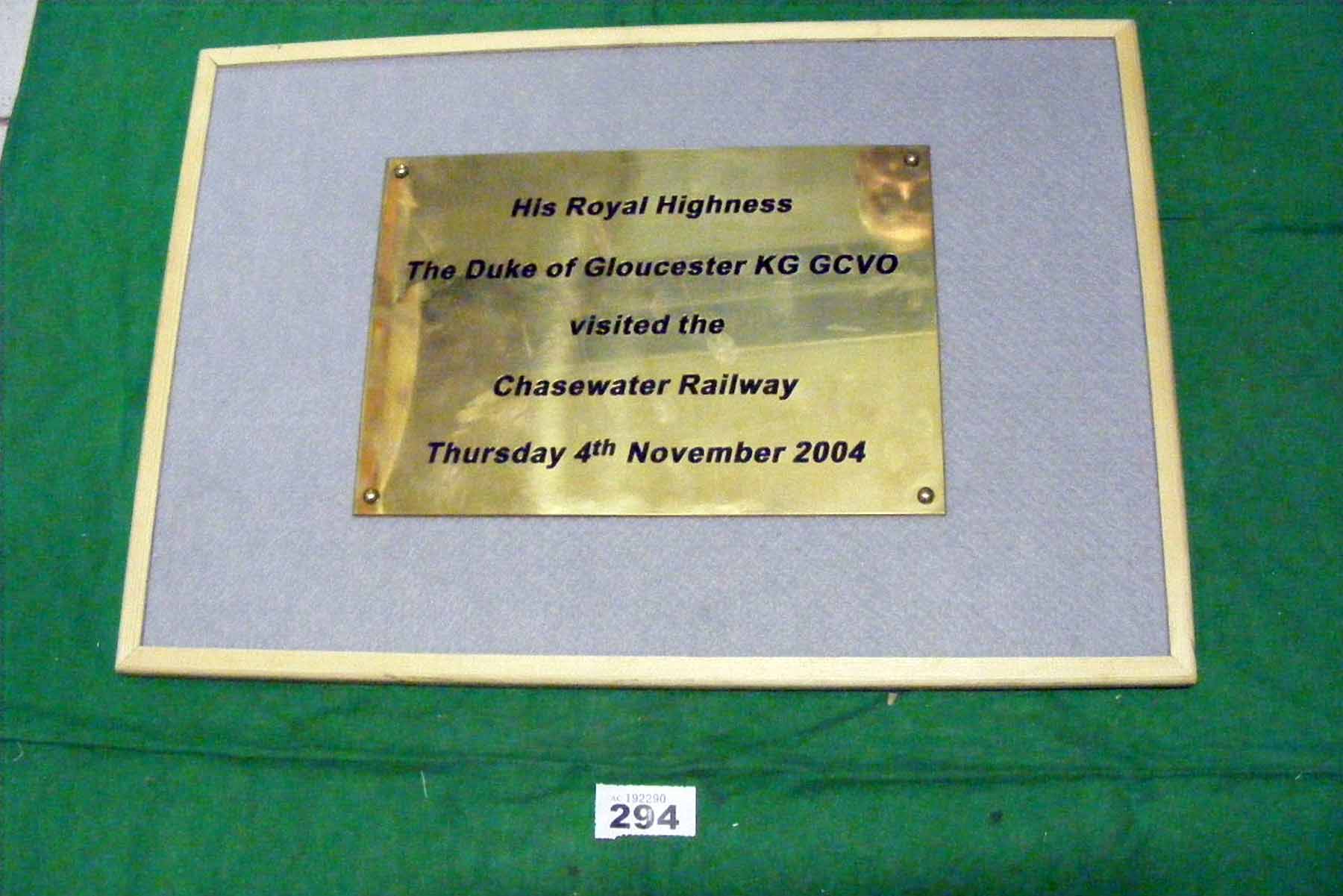
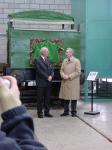
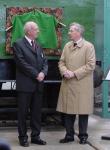
And while in the Centre he unveiled a plaque to commemorate the visit.
Restoration engineers Jim Twigge and Don Mitchell chatted with the Duke.
“He is the kind of person you can speak with easily,” said Jim.
Don added ” We knew he was a train enthusiast and former architect.
Architecture and railways are his two passions.”
Before leaving, the Duke took an impromptu trip on a modern engine – the Parry People Mover – and the clockwork coordination of the event suddenly seemed at risk!
Station Master Eric Balaam remarked ” The Duke said it is nice to see people restoring the carriages for future generations to appreciate.”
As the bespectacled Duke in dark grey suit and beige overcoat climbed into his Jaguar, Chasewater Railway’s general manager Steve Organ reflected on the Royal visit.
“I think it has gone really well with this our first Royal visit.
This is a very significant milestone, giving credibility to the railway and enabling members to take a pride in it.”
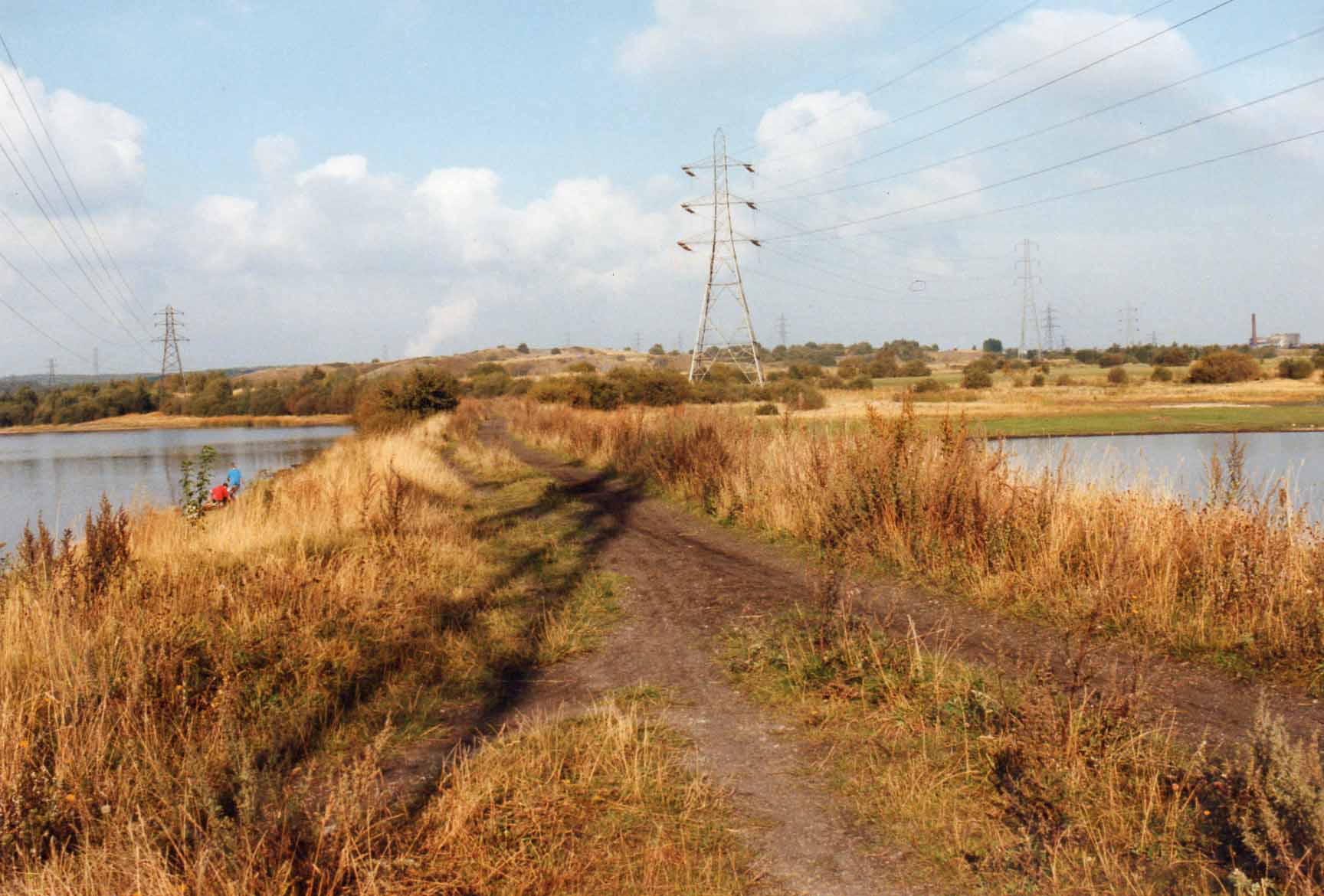
Chasewater Causeway – No Rails
WE HAVE A BRANCH LINE AT LAST! And many of you will probably by now know that we have acquired the Chasewater Line from the NCB. The legal details, lease, etc., are to go through the usual channels to be tied up, and we will keep you informed of progress made.
Every member (and non-members) who travelled on the Great Central Special agreed that it was a very enjoyable day all round, although the train ran at a very heavy loss. The loss mainly being due to the lack of support by our own members. We appeal to you all now to donate what you can to help clear this deficit on the Special. The Flying Scotsman uncoupled at Marylebone Station
This trip was organised by Mr. Eric Cowell on 15th June 1963. The Flying Scotsman hauling the train down the Great Central Line from Sheffield Victoria to Marylebone and back. Only 27 out of a possible 160 members attended, resulting in a loss of £100.
Open Weekend at Hednesford Depot (June 29th-30th 1963)
In spite of the awful weather the attendance both on Saturday and Sunday exceeded all expectations, approx. 300 people attending for the two days. People came from as far afield as Halifax, Manchester, Leicester, London and Somerset. It is sad to report however that there was a noticeable absence of members, just the usual faithfuls plus a few of the not so active.
A great deal of interest was aroused by our modest collection of relics, the Maryport & Carlisle coach was pushed out on the Sunday for photographic purposed, cameras were clicking all over the place. Maryport & Carlisle Coach in 1905 Livery
All in all it was a most successful weekend. A very special thanks to our lady members Mrs. F. Watson, Miss Mary Watson, Mrs. J. Harvey, Mrs. D. Ives and Mrs. Townsend for manning the buffet car (Great Eastern Brake) and to Mrs. F. Lewis and Mrs. Wormington for providing refreshments. What would we do without the ladies? Bless ‘em!
Thanks must also be expressed to the Sutton Coldfield and North Birmingham Model Engineering Society (Affiliated Member) for displaying the lovely Live Steam Models. A big thank you to all members who worked hard and long to make the show the success that it was.
RPS on the air
Mr. C. Ives and Mr. D. Ives were interviewed when BBC’s ‘Down Your Way’ team visited Hednesford on Sunday October 6th.
News in Brief
The ex London, Brighton and South Coast Railway E1 Stroudley loco should soon be stabled in the depot at Hednesford, the NCB has very kindly consented to us having it on free loan for 12 months.
Three new items for Hednesford
We are expecting delivery of the Midland Royal Saloon, L. & Y. Van and Midland Crane all within the next two or three weeks. The Stroudley E1 is expected about the same time as the above rolling stock.
Through the very kind auspices of Mr. K. Vincent (member) Secretary of the Dowty RPS we are taking delivery of the L & Y van. Two vans were donated to the Dowty RPS and Ken Vincent has very kindly offered one to us at Hednesford.
This goods van was constructed at Newtonheath in 1895, eventually passing from the L & Y to the London, Midland & Scottish Railway at the 1923 grouping. At an unknown date the vehicle was sold to the Rolling Stock Company, Darlington and, after renovation, sold on to the well-known chocolate manufacturers, Cadbury’s of Bournville and numbered 144 in Cadbury’s wagon fleet.
During 1963, with the arrival of new all-steel box vans at Cadbury’s, the majority of the old internal user vans were withdrawn, with 144 being donated to the Railway Preservation Society and transported to the Hednesford depot before later being transferred to Chasewater.
The van carried the ‘Cadbury’ logo in white at the top of one end, with its stock number at the opposite, lower end. Overall livery was reddish brown.
Of particular note is the canvas roof flap, a once-common feature enabling goods vans to be loaded from overhead hoists.
Rail traffic at the Bournville factory ceased in 1976.
Some recent additions at Chasewater Railway, are 3 Wickham Trolleys on display in the Heritage Centre at Brownhills West Station. The Wickham Trolley was a Railway Engineering personnel carrier used on track inspection duties.

Also at Chasewater is the Wickham No 6878, which was used by the ministry of supply at Longmoor Camp, and also used in the film The Great St Trinians Train Robbery.

 Chasewater Railway Museum

