
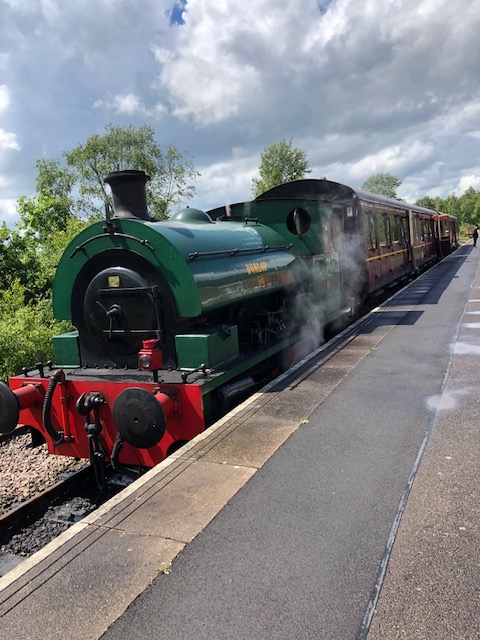
Bagnall Loco Dunlop No.6 0-4-0ST 2648-1941
on the first train to arrive at Chasewater Heaths 27-5-2024
188 – Chasewater Railway Museum Bits & Pieces
From Chasewater News – Spring 1996 – Part 1

Editorial – Chris Chivers
On December 16th 1995 a long-awaited dream of the Railway became a reality; the official opening of Norton Lakeside Station took place. The Chasewater Railway can at long last run from Station A to Station B. With the possibility of further track donations the Railway will be able to run over the entire length of the land which it currently leases. Hopefully, further parts of the original track bed can be obtained and the line extended first to Church Street and then to Anglesey Wharf. Great strides have been made over the past number of years to upgrade the Railway, and we have now moved into the middle rankings of railway societies in this country. We are no longer an occasional weekend steaming preservation society but we can now offer a regular Sunday service during the running season to passengers who wish to travel to the north shore of Chasewater.
1996 I’m sure will be a year of consolidation for the Railway, and in this, my tenth year as a member of the CLR, I have seen a lot of progress along with the occasional cock-up at Chasewater. When I first came to the Society the feeling amongst the membership at the time was one of ‘the Railway is run as our hobby and for our amusement only’. (Going through the magazines from day 1 I never got that impression – a great deal of work has been done over the years by a group of not too many people – a large debt of gratitude is owed to all of them!) This has changed over the years to a more business-like attitude, so fuelling the growth of the Railway. It will be interesting to see what happens in the next ten years.

Loco Shed News
Work is continuing at a steady rate on all the locomotive restoration projects, with some work being done to stop any further deterioration on several of the Company’s engines. Unfortunately the 16th December did not see a double-headed steam train on Chasewater metals, but it could happen in the near future.
Steam Locomotives
No.4 Asbestos – Asbestos returned to traffic in time for the Santa Specials after the refitting of part of the main steam pipe. The amount of maintenance carried out on the locomotive will now be cut back to a minimum as Asbestos’ boiler ticket is due to expire this year and a major overhaul will be required. All being well there should be sufficient funds to have the boiler sent away if need be, so reducing the overall time needed to be spent in the works.
No.5 Sentinel – The Sentinel has now been steam tested and should be returned to traffic within the next few weeks. After the initial steam test several minor adjustments were required to the steam brake, along with the tightening of a number of glands. All the minor adjustments should be done to Nigel’s satisfaction within the next few weeks.

No.11 Alfred Paget – No.11 has been moved from the top compound to the shed road where its boiler tubes are being removed. The operation is taking some brute force to move them due to the number of years that they have been in place. This is due to the length of time that Alfred Paget has been standing idle allowing the tubes to ‘flake up’ and rust in solid. Once the tubes have been removed a thorough inspection of the boiler can take place, with the long term view to bring another Company vehicle back into traffic. Most of the initial work is being carried out by Paul Whittaker who would be grateful for any additional assistance.

917 – Dave Borthwick has started to carry out some remedial work on the rolling chassis of 017 including repainting, so as to stop the weather taking its toll of the metal work. Another job for the near future will be to remove the tubes from 917’s boiler so allowing the boiler inspector to have a look at both 917 and Alfred Paget at the same time. Also it has been suggested that 917 could be called ‘Brightson’ (yuk!) as it originally came from Albright and Wilson at Oldbury.


Hudswell Clarke (431) – The fund (?) set up for this locomotive has now reached a reasonably modest amount and there is now some talk of making a start on the restoration of the only other 0-6-0 locomotive at Chasewater. After its coat of paint last year there has been very little further deterioration to the metalwork on this engine.S100 on arrival

14-11-2010
S100 – Work continues at a steady pace on restoring S100, and the work on the valve chest has now just about been completed. Within the past few weeks the connecting rods through the frames for the eccentrics have been connected and the holding taper wedges have been put into place. Tony Sale is now starting to sort out the axle boxes with a view to re-wheeling the frames during the summer.
Going through these magazines covering many years, and typing this in 2012 it can get rather depressing. This particular magazine was first published in 1996 and in the 16 years since none of the last four locos have steamed. No.11 Alfred Paget steamed here many years ago. Neither the Peckett No.917, the Hudswell Clarke No.431 nor the Hudswell Clarke S100 have ever steamed at Chasewater Railway.
Diesel Locomotives
Fowler diesel mechanical No.410013 – The ‘baby’ Fowler has started to receive a coat of paint and one side now looks quite respectable. Work is continuing on the locomotive but due to the weather it is in fits and starts.
Fowler diesel hydraulic No.422015 – The three injector pipes which were broken before Christmas 1995 have now been replaced, and with a few other minor jobs being completed the ‘Black Fowler’ is now back in operation.
L&Y No.1 – Most of No.1’s engine is now back together with the second cylinder head back in place. Some work has been done on the clutch as well as the brake mechanism and sand boxes being removed from the chassis. As soon as the main body of the locomotive has been lifted out of the bay siding work can continue on finishing the restoration of No.1.
No.21 – as with No.1 most of the engine has now been put back together and attention has been turned to the cooling system. Jonathan Clegg is investigating the possibility of uncovering a new radiator core similar to the original, or if not possible, the use of a new radiator supplied by Nigel Canning, which would take some modification to fit in No.21’s chassis.
DMU Set – The two coaches which comprise the DMU set have been receiving attention to the mechanicals. Routine maintenance has been carried out where possible due to the atrocious weather, and both coaches should receive an internal clean out before the start of the running season.

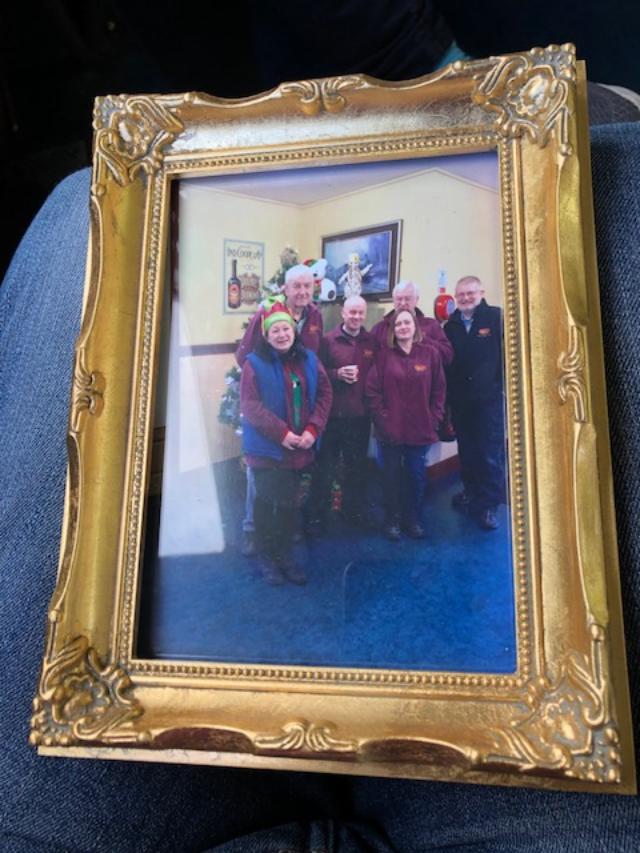
This is a picture of the staff at Chasewater Heaths Station 2010, give or take a few!
We’ve only managed to name of couple of them – Nick Fletcher and Mike Hurley. Can you help with any more names please? Su Westley found the pic in the CWH station and would like to know. Nice frame!!
Running round at Chasewater Church Street, 15-5-2010 as ‘Linda’
 Robert Nelson No.4 HE 0-6-0ST 1800-1936

 Chasewater Railway Museum