Category Archives: Bits and Pieces

167 – Chasewater Railway Museum Bits and Pieces

167 – Chasewater Railway Museum Bits & Pieces

From Chasewater News Winter 93 – Spring 94 – Part 3

Update on No.21 – Arthur Edwards

A long while ago I applied copious layers of red oxide to the outside of this loco in an attempt to preserve it, but once in the shed, Chris and Beth helped me to sand it down, fill it, sand it down again, apply gallons of primer and sand it down again!  When Dave ‘Doc’ Baker arrived on the scene, Steve Organ approached me to ask if it would be ok for Dave to do the top coat as he was at one time employed as a signwriter.  We all agreed, and now the result looks quite smart.  Following the recent fitting of the Dorman engine into the frames, Chris has had a problem with lack of compression preventing it from starting.  New cylinder liners are now being sought to match the new pistons we already have in stock as a solution to this problem.

News of the E1 – Barry Bull

The E1 has returned to steam at Cranmore where it featured in their three day Gala event on October 1st, 2nd and 3rd.  Despite original plans to restore the loco in BR black livery as No.32110 (livery and number which of course it never carried) the loco has actually been turned out in Southern Railway olive green livery.  Crews report that the loco is still a bit tight but runs well and will ‘run on a fag end’, which I presume means that she is economical.  Perhaps a visit to Cranmore is called for, bearing in mind that another well-known ex-Cannock coalfield loco, Manning Wardle ‘Littleton No.5’ can be found a few miles away at Bitton.

 Commercial News – Bob Duffill

For the first time in many years, the CLR took a stand at an outside event, the Warley Model Railway Exhibition on October 9th and 10th at the NEC.  This clashed with our end of season rally and opening of the extension, and also my birthday on the Sunday.  After 25 years of waiting to see proper passenger trains on the causeway, I missed it in order to raise funds.

Items for the stand had been collected from Chasewater the previous weekend and put in awkward places around the house for me to trip over.  On the Friday afternoon John and I went to the NEC to set up the stand will a well-loaded Riley off down the M6.

Our first impression was that the hall was huge and well laid out, in fact we were able to drive the car up to the stand inside the hall to unload.  There then followed attempts to disguise the various household furniture into a reasonable-looking display for our goods, some relics and Tony’s models.  Compared with some stands, ours looked very homely.  Whilst in the hall we had a severe electrical storm, heavy rain and a strong wind that blew over causing the large doors to be closed and the organisers to pray for better weather, and us for the event planned for Chasewater on Sunday.

On Saturday the hall was packed with bodies, and what had seemed like large aisles the night before were full.  The day went on with steady sales of paperwork and odds and ends, and a steady stream of enquiries and much leaflet giving-out, the idea being to be there as much for publicity as to raise money.  The new leaflet on Chasewater seemed to go down well.

Sunday dawned and John and I were there again but the day was not so busy.  We were able to supply the Tal-y-Llyn Railway with some early GWR Tywyn paperwork for their archives which they appreciated with a donation.  All in all attending the exhibition was a good exercise, raising some money and flew the flag.

Went the day well – Paul Whittaker

Excitement and fascination are the only words to describe the looks I saw on the children’s’ faces as they queued up to see Santa.  Although some might say that the rosy red glow in their cheeks could only be attributed to the biting north wind that blows in across the lake.

I personally would like to think that a mixture of both contributed to the atmosphere that was created by the hard work and unceasing enthusiasm of the staff at Chasewater, without which this event would not be possible.  Included was a vivid interpretation of Santa by our own Steve Organ, supporting cast being supplied by Geoff and relief Santa by Andy; not forgetting the mammoth task of decorating and preparing Mr. Claus’s Grotto, courtesy of Margaret and John.  With all this plus a train ride provided by Les Emery, promptly followed by sherry and mince pies for the parents.

It only remains for me to say that the CLR is obviously going from strength to strength with its presentation of this seasonal event. Congratulations to everyone concerned.

166 – Chasewater Railway Bits and Pieces

166 – ChasewaterRailwayMuseum Bits & Pieces

From Chasewater News Winter 93 – Spring 94 – Part 2

 From  A New Year’s Message from the Chairman

Without doubt, 1993 was a most interesting year for everyone associated with the CLR.

Obviously, the work on the ‘extension’ represents the most tangible of our successes in 1993, culminating in the decision of the Railway Inspector, Mr. Colin Law, to pass this further stretch of line in time for the Transport Rally in October.  Immediately, our running line increased by over 50% in length, enabling us to market the CLR as a real railway with a real product on offer.  With eminent guests from Lichfield District Council and Burntwood Town Council in attendance, after a very short, informal, ‘Opening Ceremony’, the Lichfield DC Vice Chairman Councillor Mrs. E.J.Bayliss waved off the 12 noon departure.  This, as with most trains that day, was virtually full, with passengers having some little difficulty in finding seats of their choice.Photo: DMB

Councillor Mrs. Bayliss subsequently wrote a most charming letter to me, and I think it is appropriate to reproduce her letter in full –

“13th October 1993

Dear Mr. Bathurst,

Thank you very much for a lovely day at the Chasewater Light Railway and Museum Company’s Annual Transport and Machinery Rally and for the privilege of officially opening the new stretch of railway line.  My husband and I found the Rally in Chasewater Park most enjoyable and interesting and we wish you well for the future.

The District Council looks forward to working with you further in the future when the whole of Chasewater comes within the boundaries of this Authority.

Yours Sincerely,

Cllr Mrs.E.J.Bayliss

Vice Chairman of Council.”

I hardly need to comment on how important it is for the CLR to enter into a good dialogue with both the elected members and officers of Lichfield DC, whose respect for the CLR will, for certain, be influenced by the professionalism with which we maintain our operations.

165 – Chasewater Railway Museum Bits and Pieces

Please note: the Museum will not be open this coming Sunday, 8th October 2023

5 – ChasewaterRailwayMuseum Bits & Pieces

From Chasewater News Winter 93 – Spring 94 – Part 1


From the Editorial

The latest news is that ‘Asbestos’ is to spend the first weekend in March running on the internal railway system at Bromford Tube Works in Birmingham.  The ‘Open Day’ comes just before the closure of the works and will involve running demonstration trains with the 20 ton GW Toad.

If you would like to put forward your views on a name for the new causeway station please complete and return the form later in the magazine.

 Locomotive News

No.4 Asbestos – This loco ran passenger trains to the top of the causeway bank for the first time in October, and again in December for the Santa Specials.  On both occasions the saddle tank was replenished at around mid-afternoon by a preserved fire engine, courtesy of Trevor Sharples of the Fire Service Preservation Society.  This alleviated the need for us to fill the station water tower in potentially frosty weather, as the longer run to the causeway means that it is no longer feasible to rely on the station hose-pipe between runs.  Following recent problems with firebars warping, a pattern has been made and a couple of samples cast from it.  These were fitted for the Christmas running, and as they seem to have stood up to the last of our Columbian coal quite well, a further batch of replacements will be cast and fitted ready for Easter.   The loco has now been partially stripped ready for a wash-out, cleaning and an intermediate boiler inspection.  Work has also commenced on a number of minor repairs to cure amongst other things, a very tight regulator, a leaking steam manifold joint in the cab, and leaking injector water valves.  If all goes well the loco should be ready to run again at Easter.

No.5 Sentinel – Some progress is now being made with the repair of this loco. A complete set of 96 new ¾” whitworth studs have been specially made to order in a special heat-resistant steel and fitted to the boiler.  The two halves of the boiler shell are now being re-assembled ready for hydraulic testing, hopefully in February.  The superheater coil will also be tested at the same time.  Other work being carried out is the refurbishment of all steam fittings and the boiler water feed pump.  All the fireman’s controls are being moved to the left-hand side of the cab to make life easier, as the loco was originally designed for one-man operation with all controls on the driver’s side.

New Peckett – Following the departure of ‘Lion’, another Peckett has arrived to take its place.  The loco, purchased recently by Mike Wood, appears to have been supplied in kit form, complete with smokebox tubeplate, rods, fittings and various machined and un-machined castings as loose items.  The loco is believed to be No.1903 ‘Little Lady’.  No doubt we will be able to persuade Mike to write an article giving full details in due course.

Fowler diesel – This loco has remained in service without any mechanical problems, being used mainly for the regular Sunday works trains.

Ruston DL7 – Whilst nominally operational, this loco has remained out of use in favour of the Fowler.

L&Y No.1 petrol loco – Dorman Diesels of Stafford have very kindly had specially made for us a new set of camshaft drive gears to fit the petrol engine which is currently dismantled in the shed awaiting re-assembly.  Work on the loco itself has continued with the refurbishment of its springs and axle boxes.

Carriage & Wagon News

Great Eastern six-wheel passenger brake – Work has continued on this coach during the winter, mainly on the interior for obvious reasons.  There can now be little doubt that this will be the first of our vintage coaches to be fully restored, it is well on the way already.

CRC 4-plank wagon – Rebuilding of the new wooden planking of the body is now well advanced, and various items of steelwork are being prepared ready for fitting.

GW Fruit ‘D’ – Following a great deal of hard work to sand down and prepare the wooden body, this van has been painted in chocolate and even has the GWR emblems hand-painted on making it a very smart looking vehicle indeed.  The only obvious outstanding work needed now is the re-covering of the roof to make it water-tight.  Assuming that the vacuum works satisfactorily when new bags are fitted, it would be nice to see it added to the occasional passenger train just for show.

20 ton GW Toad – This vehicle has remained in regular use on Saturday and Sunday works trains throughout the winter.  It is rumoured that it may go to Bromford Tube Works with ‘Asbestos’ in early March as part of a CLR arranged ‘closing down spectacular’ on that Company’s railway system.

Wickham DMU E56171 & E50416 – These two vehicles are now definitely destined for Llangollen at a time yet to be agreed, and dependant on our obtaining suitable asbestos-free replacements.  Meanwhile, the trailer ran again on the Santa Specials in December but is looking exceedingly tatty, especially when coupled to the centre car.  The power car has remained out of use.

Derby centre car W59444 – This coach is the only one of our four original DMUs destined to stay at Chasewater, and is therefore likely to be in constant use for the foreseeable future.  It ran in December when, after quite a bit of preparation, even the heaters worked.

Replacement DMU stock – There is still nothing definite to report, although ‘The Management’ are still working on the acquisition of replacements, and are submitting tenders for suitable vehicles as and when opportunities arise.

Image

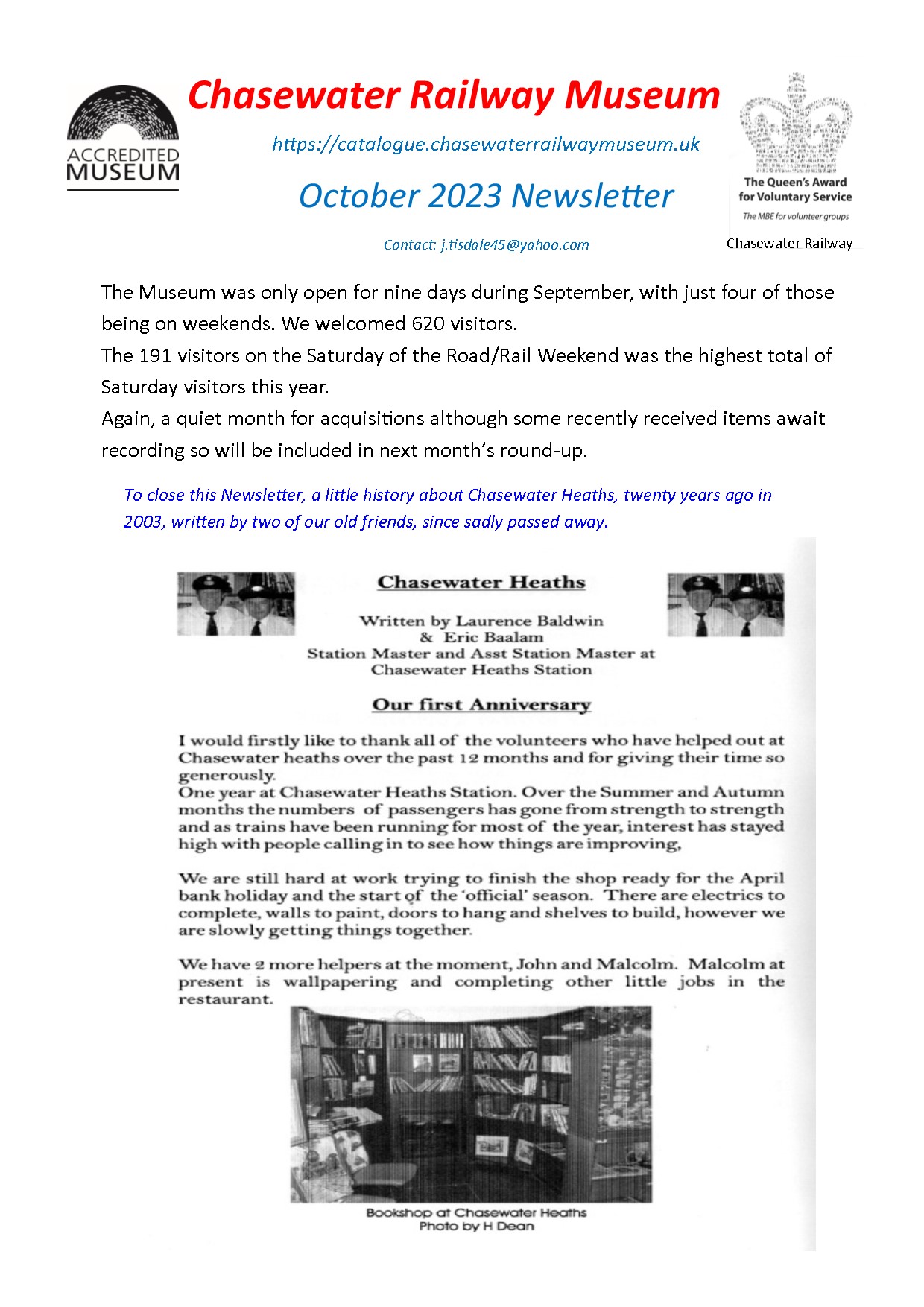
Chasewater Railway Museum October 2023 Newsletter

164 – Chasewater Railway Museum Bits and Pieces

164 – Chasewater Railway Museum Bits & Pieces

From Chasewater News Autumn 1993 – Part 3

General Manager’s Report and Boardroom Notes – Steve Organ

At the last meeting, the Board decided that certain changes should be made to reflect more accurately the roles required to be played by certain Board members.  As a result, I have relinquished the role of Chairman after seven years in office, and have been appointed General Manager.  David Bathurst has consented to act as Chairman.  The changes reflect the fact that I have perhaps more time than other Board members to supervise works being carried out during the week, and my new role gives me the opportunity to act as a liaising officer for the various projects being worked on at the railway.  I think that the Board also wants me to have the task of seeing to fruition the various projects that I have initiated during my tenancy as Chairman!

I first wish to thank Tony Sale for the work that he carried out as General Manager for more years than I care to remember, and to say how grateful I am that he has offered to administer the engineering records and locomotive examinations, as well as overseeing the Loco Department.

When Adrian Hall and I arranged the present company and administration in 1986, and engineered the amalgamation of the old Society and Company into the present Charitable Trust, the membership made it quite clear that the most desirable change to the old ‘set-up’ was to transform the Company into a real railway, running trains all the way along our leased trackbed to Burntwood, and perhaps towards Anglesey Basin and beyond.  In the first magazine produced by the new Company, I wrote a long piece entitled ‘The Lost Causeway’, about the perilous state of the old causeway that once carried the railway across the northern part of Chasewater, then severely eroded by wave action. It was quite clear that if we were ever to fulfil our ambitions, the causeway would need a huge scheme of works tore-establish the old link.  Mindful of that, it was decided that we would seek ways of carrying out those works, whilst in the meantime rebuilding the permanent way to the causeway from Brownhills West.  David Bathurst has described in previous magazines some of the ways we have attempted to bridge the causeway gap.  That scheme is at last well under way, with well over 30,000 tons of infill having already been delivered and landscaped, with completion envisaged around December 1993.  In the meantime, tracklaying gangs have achieved a great milestone marked by a visit  by HM inspector of Railways in September, during the course of which visit we were given authority, subject to completion of certain works, to operate passenger trains to the start of the causeway on and from our Autumn Vintage and General Rally on October 10th.A recent view of the causeway showing the scale of the earthworks, and the track in place.  The pylon on the left has been demolished since this photo was taken greatly improving the scene.

The most difficult of the outstanding works are to re-pack the whole of the relaid section as a certain amount of settlement has occurred, an inevitable result of the complete rebuilding of that section of line, so any Saturday or Sunday that you have time to spare, come on down.  We will find plenty for you to do.  This doubling of the railway’s operational line with passenger traffic to the start of the causeway for the first time ever can only happen if our efforts continue apace.

August Bank Holiday weekend saw an historic event, when the first four lengths of concrete-sleepered track were placed on the new causeway.  Using a sleeper refurbishment technique developed by Dave Borthwick and Keith Day, which received very favourable comment from the Railway Inspector, a very hard worked team really showed their pace.  No further tracklaying is likely to take place before early December, as the rest of the causeway is nowhere near complete.  It is also necessary to stockpile huge quantities of ash ballast and topsoil ready for the final shaping of the causeway once the arrival and compacting of fill materials is complete, and the only place available to stockpile is on the completed areas of the causeway itself.

The station on the northern side of the causeway is under construction, and by the time you read this, the platform should be complete except for coping stones and the northern ramp.

Our aim is to open to a Civic Reception on Good Friday, 1st April, 1994.  Come and help!!!Norton Lakeside 1992

Motorway Update

Revised plans for our new relocated station at Brownhills West, with associated works yard, are under preparation by Ove Arup and Partners after consultation between Midland Expressway and the Railway’s negotiators (i.e. David Bathurst and Steve Organ).  MEL’s Consultation Manager, John Burton, has told me today (21st September) that ‘a scheme’ will be ready by mid-October.  I hope that he is right, because new sidings are urgently needed, and we must plan them to tie up with the motorway’s scheme.

The railway is an exciting place just now.  Dreams have become plans and are now hardening into reality.  All members of our group have a part to play – come and help make it so!!

Halloween Specials

Chasewater Railway (Brownhills West), Walsall, WS8 7NL

Sat 28th October 2023 – Sun 29th October 2023

Board our Terrifying Train at Brownhills West Station for a spooky trip to the Haunted Heaths, beware the Ghostly Ghouls. 

If you make it back pay a visit to our Scare Centre if you dare!!!

There will be Spooky Stories in our Blood Curdling Brake Van and the Night time Narrow Gauge in operation.

159 – Chasewater Railway Museum Bits & Pieces from Chasewater News Summer 1993 –Part 2

159 – Chasewater Railway Museum Bits & Pieces

from Chasewater News Summer 1993 –Part 2

The Re-opening of the Museum

Bob Duffill

I am sitting in a Midland Railway chair, aptly for the article, in the museum which is housed in our LNWR full brake.  The rain is tipping it down and Easter Sunday has Chris’s pipe in danger of being flooded!  As it is not very busy I’m writing this article as for some time we’ve called ourselves the Chasewater Railway and Museum Co. but have not had a museum for the last few years.

Firstly, I would freely acknowledge past members who have gathered together a very good collection of railway relics and artefacts.  The last curator  being Barry Bull, who put in many hours over the years. (This was first published in 1993, now, in 2023, 30 years later, Barry Bull is still Curator, still putting in many hours. See below).

My involvement began when, a couple of years ago, I went into the museum to tidy up and dust and polish the display cabinet.  It was soon obvious, however, that all was not well.  The roof leaked badly, the exhibits had become dirty and run down, and many items were being ruined due to lack of care and attention.

The next few weeks were spent in desperation salvaging items that had become wet and taking them home to dry out as best I could.  The house began to look like a waste paper collection point as rare items were carefully dried out.  The smaller exhibits were also taken away for safe keeping, and the larger ones moved to drier spots in the brake.

Eventually the L&NW Society found that it had enough money to re-roof the vehicle, and after much reminding and being a nuisance, Steve Organ and his helpers re-roofed the vehicle, and the top-lights were rebuilt.  Adrian Hall re-wired the vehicle and installed new light fittings.  All of the remaining exhibits were taken down and moved to one end to enable a start to be made on painting the interior.  It was decided to use the coach for Santa’s Grotto, and John Duffill did most of the scraping down and painting.  Once Christmas was over and Santa’s Grotto was taken away, I re-arranged the interior to look a bit like an office and rebuilt and varnished the display case.

Keith Poynter has made a start on painting our metal signs.  He is making an excellent job of it but it is a bit like painting the Forth Bridge, there’s a lot more to do yet!

A view of one end of the museum which has been re-roofed and re-decorated and is now open to the public once more.   Pic – Nigel Canning

Anyway, the museum re-opened on our first steaming of 1993, March 21st, it still needs work but at least we’ve made a reasonable start, and hopefully it will be an added attraction for the public, and reveal our collection to members who just did not know what we had in store.

The latest news is an attempted break-in during the week before Easter when two local youths broke open a door.  Fortunately they were heard by Chris Hatton, and he and Steve Organ apprehended one of them who will shortly be appearing in court.  The burglar alarm fitted to this vehicle is in perfect working order, so hopefully this will be our last break-in and I look forward to the museum being further re-opened in stages.

Part of the 2012 museum

Finally, if anyone has photos of the local engines or collieries we are always willing to copy them for the collection in order that we get a comprehensive display.

This final sentence still holds good in 2012.(And 2023!)

Lancashire & Yorkshire Railway Van

Bob Duffill

As Tony Wheeler has been busy working on the L&Y (ex Cadbury) van recently, I have found some information on this unusual vehicle.  The original design goes back to the 1860s when an 8 ton version was introduced with a single roof door.  With the improvement in springs and wheels, this was later uprated to 10 ton in the mid 1870s.  The vans continued in production until 1916 when the last few were made, these having double roof doors.

I am unable to date ours yet, but it is between 1875-1913.  The LMS started scrapping them in earnest from the mid-1930s and ours was probably acquired by private industry shortly after.

The van should be painted in grey (Tony’s favourite colour) with white lettering, but as a change there was a variation which I feel we should adopt.  If they were shopped in Lancashire they had white roofs, but if they were shopped in Yorkshire they were painted red oxide, carrying old favours into newer times.

Some of our wooden-bodied vehicles are in fact quite interesting and well worth having restoration work carried out.  More paint to the C&W dept’s elbow! It won’t be long before we can have a decent goods train.

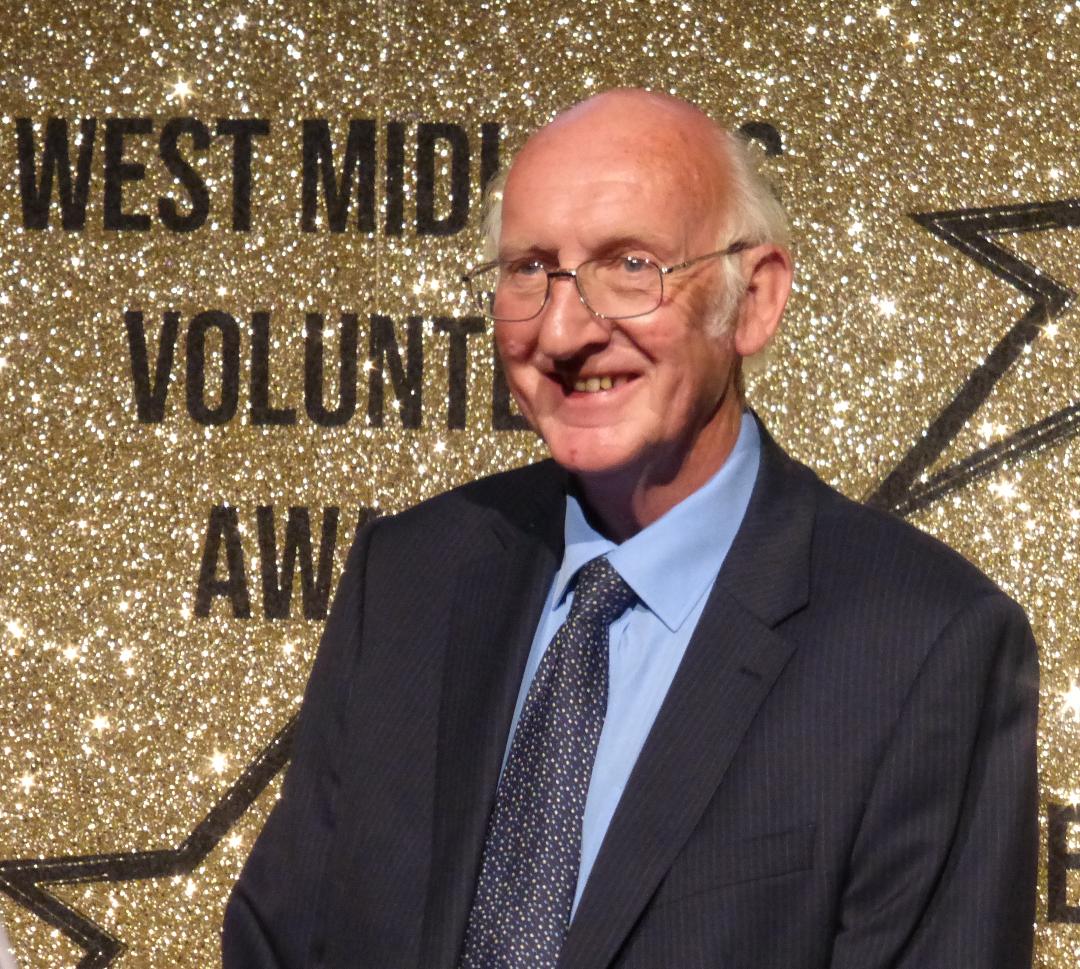
Barry Bull – Curator extraordinaire

Volunteer of the Year awarded to

Barry Bull, Curator, Chasewater

Railway Museum in individual

category, West Midlands Museum

Development Awards 2019

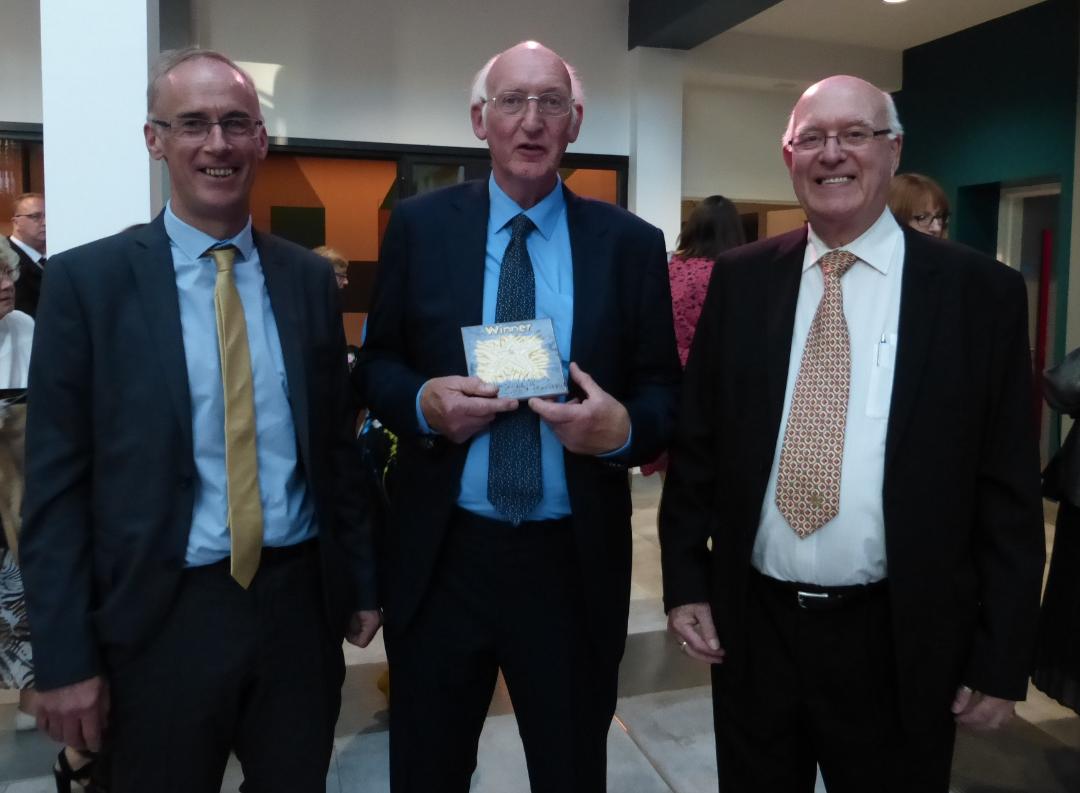
Museum Curator Barry Bull (centre)

holds his Volunteer of the Year Award,

with Chris Copp, Staffordshire

Museums Service (left) and David

Bathurst, Chair Chasewater Railway

Museum Committee (right).

If only he hadn’t dropped it!!

158 – Chasewater Railway Museum Bits and Pieces

158 – Chasewater Railway Museum Bits & Pieces

from Chasewater News Summer 1993 –Part 1

I had a ride on the train this morning, very smooth behind ‘Myfanwy’

The locals were out:

From the Editorial

The Editor observed that there was a lot of news to report about Chasewater Railway making it difficult to find space for non-news items.  This must be a good sign as it means a lot more progress is being made on our railway.

Locomotive News

No.4 Asbestos – This loco has remained in service and operated all of our passenger trains so far this season and even passed an intermediate boiler examination in May.  Efforts are still being made to cure a number of minor faults, the worst of which is a badly leaking left-hand boiler clack.  Various attempts at reseating it have failed so a replacement component is now being machined.

No.5 Sentinel – This loco passed its major five-yearly boiler examination in May with no serious repair work being necessary.  The boiler water spaces will now be shot-blasted and painted and some ninety odd ¼” whitworth studs and nuts renewed before the two halves can be re-assembled.  There is a lot of work to be done, but hopefully the loco should be completed in late autumn.

No.2 Lion – This loco also had a visit from the Boiler Inspector in May when it passed its steam test.   The only serious problem is a persistently leaking mud door on the right hand side of the firebox which will require rectification.  Completion of the vacuum brake system and a repaint is now all that is required for the loco to be ready to enter service.

S100 – Still plodding along!

Fowler diesel – This loco has remained in service, being used on works trains and for shunting.  A problem has arisen recently in that it will not start unless the batteries are re-charged immediately beforehand.  Visually it is improving week by week as it is gradually being repainted in black with red buffer beams.  Hopefully once the repaint is complete it will remain in that livery.

DL7 – Following recent work on the main engine and traction electrical system the loco is runable again.  It was used for the evening shunting on June 6th and performed well with the exception of the brake which requires adjustment.  Only minor superficial repairs and a repaint are now required to complete the job.  It is likely that we will soon have a genuine need for two diesels, as with the track being extended all the time, one will be required for the works train and the other for shunting the passenger stock.  This will be of benefit as it will ensure both locos are started and used regularly.

No.21 diesel – Work on this loco has continued with the filling, sanding and undercoating of its cast iron body members.  When painting is complete the recently repaired engine will be refitted.

Smith Rodley crane – untouched.

Carriage & Wagon News

Great Eastern six-wheel passenger brake – This coach has now, but for a few small areas of panelling and trim, been completed on the wooden superstructure.  The multi-coloured first coat of gloss has been repainted in BR blue to seal it, but unfortunately one or two of the original wooden panels have dried out and now have ¼” cracks appearing.  These will be filled again, and like the rest of the body will be monitored until stable when the top coat will be applied.  The interior of the coach remained warm and dry throughout the winter months to my disadvantage for now we have an unpaid member living-in – a mouse!  Work will soon begin on the frames so as to be ready for the coach’s 100th birthday celebration in June 1994.

CRC 4-plank coal wagon – Keith has progressed well with the re-planking of this vehicle, and during the best thunderstorm so far this year Tony Wheeler successfully freed off the seized brake rods using Calor gas heat.

Keith Poynter poses next to the CRC 4-plank wagon during a pause in restoration work.

Southern brake van – This van has become our colliery information centre, and judging by the comments overheard from visitors the prospect of brake van rides down the line would certainly be another interest which we could offer to the public.

16 ton Great Western Toad – This van has remained out of service but has now been moved to the C&W yard where restoration can begin.

Dave Borthwick

The Maryport & Carlisle coach, the Midland 4-wheel coach and the Manchester Sheffield & Lincoln coach have remained sheeted up to protect them from the weather.

Wickham DMU E56171&E50416 – a firm offer has now been received from a preservation group based at Llangollen who wish to purchase a two-car set for restoration as a working DMU.  In view of the fact that it would cost the CLR a great deal of money to strip the vehicles of their asbestos insulation, the offer has been accepted.  Exact details of the deal are yet to be finalised but the vehicles are likely to leave Chasewater later this year in return for cash or a replacement coach direct from BR.

44806 waits by Goods Junction signal box whilst the Wickham DMU set passes ...llangollen-railway.org.uk

Gloucester trailer E56301 – This vehicle has also remained out of use, and is also the subject of a purchase offer from another preservation society. The group interested in this vehicle are based at British Nuclear Fuels in Preston and need a coach to get them started in the passenger carrying business.  This coach also poses the problem of asbestos insulation.  Again, details are yet to be finalised but the coach is likely to leave Chasewater this year.

56301 at County School Station on the Mid-Norfolk Railway on 17th December en.wikipedia.org

Derby centre car W59444 – This coach has remained in service and is quite popular with the public.  It does, however, cause the occasional headache for the station staff as with so many doors (10) the passengers sometimes manage to open them faster than the staff can shut them!  With three out of four of our revenue earning passenger vehicles set to leave Chasewater, members may be wondering how we intend to continue running a train service.  In fact replacement  (asbestos-free) DMUs are being sought, and staff at Tyseley Depot have been very helpful in this.  What will arrive and when?  Watch this space!!

157 – Chasewater Railway Museum Bits and Pieces

157 – Chasewater Railway Museum Bits & Pieces from Chasewater News Spring 1993

– Part 3 The Very Special Day

This part of the post is written in 2023, Chasewater Railway has a regular group working on the P Way, but they could always do with more!  This post, as the introduction says, is a solute to the P Way gang back in 1993, including, in the bottom picture, a photo of Tony Wheeler, who recently passed away. Tony is on the extreme right of the pic.

A salute to our PW gang – By Dave Borthwick

It began with Keith Day phoning round mid-week to prepare everyone for the last track bash of phase 1, planned for Sunday.It was good to see all the regulars arrive, those same members who put themselves out most weekends to carry out hard, heavy work in both scorching sun and freezing drizzle.  The train left for the railhead leaving behind me – Dave Borthwick (part-timer), Keith Day and Arthur Edwards to select a pair of 30 foot match conditioned bull-head rails from the shed area.  Ian Buswell, JCB driver, with the help of Arthur slung the rail and transported it the long distance to the railhead.  Part time PW dept members like myself have constantly moaned when arriving at the railhead what a bloody long walk it has become following the recent track relaying.  Car transport is a must these days!

The JCB dropped the rail in the position it was needed and work continued as normal, selecting sleepers, chairs and keys.  At around dinner time Ian suggested hunting, catching and roasting a wild boar (because the line is really at the northernmost part of our railway world, in the wilderness), but his net had a hole in it and his mo-ped wouldn’t start, so Jonathan Clegg popped down to Tescos for 2 lb. of middle-cut bacon.  As we were unable to get enough heat from the mess van’s pot-bellied stove, a small fire was made from old sleepers and sacrificial bacon sandwiches were produced and consumed.Towards mid-afternoon our goal was reached, with sleepers laid, chairs secured, rails in keys in, jacked and packed.  The final moment had come.  Some 18 months ago, Little Tony, as we called him then, had scrubbed up and painted gold a rail key.  This was to be the ceremony, the fitting of the golden last key of the PW gang, track extension, phase 1.Amongst those present at this ceremony were Elizabeth, or Beth as she is called, surrounded by – Arthur Edwards, the oldest member of the PW gang, Tony Wheeler, who came to us three years ago and began watching from the other side of the fence and now is the hardest working member on the railway, strimming, weeding and hedging most days mid-week, especially Wednesday and Friday nights with Arthur.  Next, Keith Day who, despite family commitments and a rigorous working shift system at Bass Brewery, comes down and works on the railway’s greatest asset – the track.  Tom Mitchell, who, like Keith, comes down to the CLR to simply use the Sunday working hours from 9.00am to 5.00pm to the full on track laying and repair.  Ian Buswell, whose work with the JCB has put the PW dept schedule months ahead.  Junior members Dave Gardener, Jonathan Clegg and Paul.  Chris Chivers, whose help has been great, but recently limited due to other commitments.  Left until last purposely, is Les Emery, a man who is obviously successful in every way, chooses to come down to work in an open field and spend his day weeding, shovelling, lifting sleepers and poking life into a group of lazy ignorant peasants – author included!  Because of Les’s dogged determination he has forged a PW department  which began with a trolley loaded with shovels and tools which had to be pushed manually, making frequent trips loaded with ash ballast.  Nowadays a works train leaves Brownhills West at 9.00am consisting of a heated mess van, tool van and flat wagon, with JCB and dumper truck assistance following behind to work a full day, returning at 5.00pm.The thing that has come across from this exercise is that if you can form a group to carry out a task, results can be achieved more quickly than by individuals mooching around the railway doing odd jobs.  No-one other than Les and his lads organise their work schedules that is why work on projects take so long.  No-one envies these lads ’down the line’ because of the sheer hard, heavy, dirty work, but it is my belief that track across the lake supporting a variety of locomotives pulling coaches full of tourists is the answer to our future.  Please support our PW lads!So we salute Les, Arthur, Chris, Tony, Keith, Tom and many more.  Phase 2 is just around the

corner

corner!

156 – Chasewater Railway Museum Bits and Pieces

 Postcards  – 156 – Chasewater Railway Museum Bits & Pieces

from Chasewater News Spring 1993 – Part 2

‘Official’ Picture Postcards – by Barry Bull

The hobby of collecting postcards began in Edwardian times within just a few years of the first cards being accepted for postage by the Post Office in 1894, The charge for postage only being a halfpenny and the cards themselves being very cheap soon led to a collecting tradition that has remained with us through to these inflationary times almost a hundred years later.

The ‘Official’ railway cards is the term used for those cards produced by and for over 60 of the old pre-grouping companies plus those issued by the 4 post-grouping railways and British Railways. The earliest official cards generally showed views of London and various other cities and towns throughout the land.  Many depicted views of castles, cathedrals, river bridges and the like, and were known as court cards.

The court cards were printed by such companies as the Picture Postcard Company and were often half-tone pictures in decorative frames with a small space to the right of the picture to write a few words.  At this time the back of the card was for the address only to be written, plus of course a space for the stamp to be affixed.  Examples of these early cards can occasionally be found and carry the names of such railways as the LSWR and the SECDR.

By the turn of the century, full size sepia postcards were being produced, that is, the picture occupied all of one side with the reverse being provided for both the address and message.  The cards were still being produced by postcard printers with the same views being supplied for several different railway companies, it not being until about 1903-4 before the larger railway companies in particular had cards printed specifically for their use and sale only.  Most of the official pre-grouping railway cards seen today date from the period 1904-14, when the production and sale of these cards was at its peak.

In this short history it is not possible to go into too much detail, but the casual observer and collector cannot fail to have noticed that by far the most common examples of cards to be seen are those of the London & North Western Railway.   This, however, is hardly surprising when one considers that from 1904, when Raphael Tuck & Sons produced a set of twelve cards on behalf of the LNWR, until September 1914 when production of LNWR cards was discontinued; over 11 million cards had been sold – most at two pence for a set of six!

The LNWR cards covered a wide range of subjects.  There were some 60 sets and a hundred or so non-set cards.

Interestingly, the success of the LNWR cards, undoubtedly due to their quality and subject range, was in no way matched by the concern who many feel to be elite in printed publicity – the Great Western Railway.  Cards produced by the GWR tended in the main to be of rather mundane subjects in sepia.  Only occasionally were rolling stock, locomotives, stations or engineering subjects featured.  After the Great War the GWR produced little of significance for the postcard market and when one considers their other publicity successes, the GWR certainly disappoints its supporters in this matter.

Other prolific producers of postcards who spring to mind are the Midland Railway with nice coloured examples of stately homes and tourism resorts; the Furness Railway with a variety of Lakeland scenes; and the Great Eastern Railway with a pleasant range from seaside towns, cathedrals, the Norfolk Broads and ships.

Irish, Isle of Man as well as Scottish and English companies were well represented in postcard issues and several minor railways also produced cards.  Cards issued by minor railways are avidly collectable today and may cost several pounds each, dependent on condition and rarity.  Quite common cards to find from a small company are the photographic views published for, and sold by the Corris Railway.  These usually fetch about £5.00 each at stamp or postcard collector fairs.

Following the 1923 grouping, the production of postcards continues albeit in smaller numbers and these cards, although collectable, do not generally reach such prices as some pre-grouping and minor railway examples.

The Southern Railway issued 140 odd cards with over 100 depicting locomotives, while both the LMS and the LNER took the opportunity to market many cards which showed their hotels, with ships and locomotives being well represented.

Other cards which still sell very well today, often commanding prices between £3.00 and £10.00 each, once again dependent on rarity and condition, are those of the various London Underground Railways.  Many of these depict posters and are particularly attractive to collectors. The only ‘official’ Chasewater Light Railway’ postcards issued so far is one depicting the Neilson with the Gloucester DMU trailer, a card which owed its origins to an Adrian Pearson colour photograph.  5,000 examples were produced at a cost I recall of 2.4 pence each.  I wonder how many remain unsold?Neilson with the Gloucester DMU Trailer – Adrian Pearson

I can’t say exactly how many were left, but those that were have been given to the younger visitors to the Chasewater Railway Museum – and very much appreciated as a memento.

All postcards from the Chasewater Railway Museum Collection – compiled by Barry Bull and David Bathurst (sorry, not on public view at the moment).

155 – Chasewater Railway Museum Bits and Pieces (1993)

155 – Chasewater Railway Museum Bits & Pieces

 From Chasewater News Spring 1993 – Part 1

I’m guessing that the Editor was still Nigel Canning, with contributions from Dave Borthwick and Steve Organ.

Editorial

On the back cover of this magazine (reproduced below) is a copy of the 1993 timetable, and for the first time in the history of the CLR it is actually a timetable rather than just a calendar.  It remains to be seen whether the trains will actually run on time, or whether we can stretch the journey time to suit, but at least it will give the operating staff something definite to work to, and hopefully create a more business-like impression for potential passengers.  In addition, all the usual special events are planned for this season and will keep us all stretched to the limit.  If anyone would like to help out at any of these events they would be most welcome. 

Locomotive News

No.4 Asbestos – This loco ran successfully at Christmas on the Santa Specials, and will continue in use this year.  In order to guarantee a water supply for the loco in the event of frost, the water tower had to be put back into use, a job which required the removal of a large amount of green slimy pond weed and the fitting of two new plastic floats to the supply valves, hopefully early this year the long-missing balance pipe will be fitted to Asbestos’ saddle tank thus helping to prolong the interval between top-ups.

No.5 Sentinel – The two halves of the boiler have now been cleaned and await a visit from the Boiler Inspector when a decision will be made as to whether a new set of tubes will be required.  Work has progressed with the moving of the injector to the fireman’s side of the cab and re-routing of all the water and steam pipes to make them more easily drainable in frosty weather.  Work is also being carried out to refurbish various steam fittings which had been leaking towards the end of last year.

Sentinel – Jan 2012 – Now heading for completion of the major inspection following the one written about.  It had a good ten years running in between.

No.2 Lion – This loco is still progressing towards its first steam test with the continued manufacture of replacement pipework.  Work has also been carried out to repair a turbo generator which is to be fitted to the loco to provide cab lighting and battery charging for the coaching stock.

Work is still progressing, albeit slowly, on S100. 

S100 – 2011  A lot of work has gone into this loco over the last few years but there is still a lot of boiler work to be done.

The Fowler diesel has again remained in use on works trains throughout the winter.

Contrary to the report in the last magazine, DL7’s engine has been re-assembled and the loco run on test.  Once one or two minor faults have been corrected the loco should be able to re-enter service.

No.21 diesel and the Smith Rodley crane have remained out of use.

Carriage & Wagon News

The good news to begin with is that Ken Dyde has agreed to fill the void and represent the C&W dept until the next board meeting.  Ken has past experience working in the C&W dept on the SVR, and one of his valuable talents is that he can organise a team to tackle most jobs.  Ken lives locally and spends most weekends at Chasewater.

Great Eastern 6-wheel passenger brake – All of the doors have now been fitted, although the missing door from the end compartment has been found, 75% destroyed, which highlights the problems of past abandoned projects.  A dummy door has been modified from one, which according to Chris Hatton, came off a DMU.

Midland Box Van – Tony has continued scraping and painting.  On one side he has exposed from beneath layers of paint a red triangle not too dissimilar to the Bass Charrington sign.  Black letters are also distinguishable which could read ‘Bass Railway’.

North Eastern box van – During his winter Saturdays when not carrying out his PW duties, Arthur Edwards has started replacing some of the rotten side planking prior to repainting.

CRC (CCCC) brake van An inspection has been carried out on the rotting timbers around the spring hangers.  Use of temporary steel plate cladding will strengthen the solebars enough for the vehicle to be shunted to where more substantial work can be carried out on the 6” x 12” timbers after jacking.

In the past a number of projects on wooden-bodied stock have been started with no plan of attack or materials in stock.  Consequently, main frame timbers, vital metal items and wagon parts left scattered around the yard have all been left to rot in the open with no work being carried out for months on end.  I think all members must agree that a restoration project started on a whim should not be accommodated by the C&W dept.  In the future, any members who would like to start restoration projects on wooden-bodied stock should please request permission in writing from the Carriage & Wagon Director, who will offer all possible assistance.

Dave Borthwick

 Maryport & Carlisle 5 compartment all 3rd coach – Thorough examination has revealed a need for urgent attention to panelling.  A survey was carried out on the vehicle in January revealing almost all waist and lower panelling rotten and with very active wet rot fungus, roof galvanising starting to fail, and several doors in need of removal, de-rotting and repair.  There was only minor rot to the main frame, but soft wood noggins are in need of replacement.  Many windows and droplights are also in need of replacement or repair.  All springs need to be replaced, all running boards need to be repaired and replaced and the complete vehicle needs to be treated against rot.

The first job was to erect a tent, then a platform alongside to work from.  These were in place in late January and restoration is now proceeding.

New panels of beech marine ply have been cut and fitted for most of the lower and waist panelling following removal of most of the old panelling.  The new panelling is being treated and painted at a member’s home workshop, to be fitted to the coach after the body frame has dried out and been rot treated.  Doors will be repaired off-site to enable a rapid restoration to take place.

Manchester Sheffield & Lincoln composite brake – This lovely vehicle has had a little luck lately.  During conversation with the Butterley C&W team, it was revealed that they had recently stripped a derelict MS&L coach body and had some doors from it.  Hasty retreat to the stores and hey presto! Four doors of exactly the right profile, window pattern and size to fit the opening left in the doorway of the guard’s compartment of our own fire-damaged vehicle!  Enthusiastic fitter now required!

CRC 4 plank coal wagon – Examination of this vehicle in January revealed a completely rotten floor, some completely rotten side planks and very corroded springs.  Other than that, the frame and most of the ironwork, apart from some straps, appear to be very good.  An immediate start was made on removing rotten timbers to reveal the frame properly so that it could be dried out and rot-treated.  New side and floor planking has been acquired, and this vehicle should be coupled to the Midland box van in a resurrected state by Easter.

LNWR West Coast Joint Stock 50’ Brake – The new roof has been fitted and ventilators replaced.  New toplights have been fitted to completely seal the roof.  Much attention has been given to interior panelling, and three-quarters of the interior repainted.  Following use of the vehicle as Santa’s Grotto at Christmas, the historic displays are now being mounted, and re-opening as a museum is on line for Easter!  Repairs to upright framing and solebars will commence after the Maryport repairs are complete, and will be followed by re-panelling, subject to raising a further £500.

Wickham DMU E56171 & E50416 – These vehicles are the subject of much discussion.  At present they have a liability value in that £14,000 is needed to strip them of asbestos.  On the other hand, as a unique, working DMU they could be very useful.  Ken Dyde and his gang (The Battery Boys!) continue to work on the mechanics and body of the power car, and replacements for the missing windows are now on site, thanks to a very generous price from Brownhills Glass.

Gloucester trailer E56301 – This coach has remained out of use and would require repairs to the bodywork to be carried out before it could be used in service again.  There have been rumours that an outside party is interested in purchasing the vehicle for preservation elsewhere, but so far nothing definite has been agreed and it remains stored on No.2 road

Derby Centre Car W59444 – This coach ran in service at Chasewater for the first time at Christmas on the Santa Specials coupled to the Wickham trailer.  This looks likely to be the train formation used for the foreseeable future, meaning that the loco will remain on the ‘north’ end of the train.  The ‘blood & custard’ livery still requires top coating but hopefully this will be finished by Easter.

Steve Organ