Chasewater Railway Museum –
May 2020 Newsletter

A look back at a proud moment for the Museum in 2011, nine years ago
Industrial Railway Society Day at Chasewater Railway.
The Chasewater Railway was honoured to host the Annual General Meeting of the Industrial Railway Society on Saturday 16th April 2011.
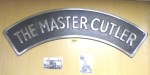
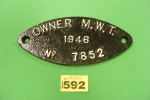
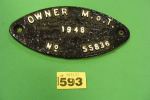
 The day started with the unveiling of the Eric Tonks Collection of locomotive nameplates and worksplates, this was, of course held in the Museum.
 Following this, and many photographs, a number of rides down the line with ‘Asbestos’ and ‘Linda’ taking turns in hauling the train. I think that ‘Colin McAndrew’ was in steam later.
 Pic by oakparkrunner
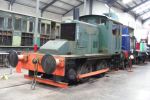
The Marston’s Baguley diesel shunter and the Class 08 were also put through their paces.
There was a buffet lunch on the first floor of the Heritage Centre which was well appreciated – well done Linda and Mavis and anyone else involved.
The Annual General Meeting was held after lunch, followed by more railway activity. Pic by oakparkrunner
Our visitors’ book bears testimony as to how well Chasewater Railway’s efforts were appreciated. Well done everyone.
Occasionally, some of your visitors may see an advertisement here,
Thirty Years Plus Ten

 Travelling Post Office
Much as I enjoyed reading about Chasewater Railway in thirty years time, it never stood a realistic chance of happening.
After the cessation of coal traffic in the 1960s the line over the causeway was abandoned and the causeway itself fell into disrepair. The track was lifted and passenger traffic suspended for a number of years. The main part of the 30-years-on idea had also gone missing in the intervening years – the line from the proposed Norton Junction to Norton Crossing. The track which ran below the dam for the Swag pool was lifted and presumably sold for scrap. The idea of a railway with a main line and a short branch disappeared.
It was not until 1985 that regular steamings began again, but in the intervening three steam-less years, membership had dropped by some 50 per cent. The Society deemed it necessary to prune its stock as it was realised that without an injection of cash, the whole affair might fold. The L&NWR Travelling Post Office went to Tyseley, a small “Planet” diesel went to Brian Roberts’ Tollerton Farm Railway, while individual members purchased two steam locos and one diesel loco in order that they could remain safely at Chasewater.
IN 1993 a successful scheme to restore the causeway was started. About 120,000 tons of fill material were imported to the site. This work was completed in 1994 and Lakeside Station was reopened in December. From 1985 till the reopening of Lakeside trains only ran push-pull from the old station to the Willow Vale Bridge.
Since 1995 a great deal of work has been done, firstly to extend the line to Chasewater Heaths and Chasetown. Next came the new Brownhills West station and yard, to replace the old station and compound, now buried beneath the M6 Toll. The engine shed was refurbished and another station opened at Chasewater Heaths – finally, so far, the Heritage Centre was built to hold the heritage stock and Museum.
The 30-years-on idea was not to be, it would have been fun in my opinion, and at that time, as stated in Post No.50, the rolling stock was owned by the railway – no steaming fees to be paid. Of the stock mentioned in Post 51, the E1 left, never having steamed at Chasewater. The Hudswell Clarke also has never steamed here – but it is still with us, although not owned by the railway. The Peckett went too, although we now have another one. The Royal Saloon and Travelling Post office have also gone.

 The Royal Saloon
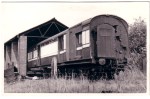
From the Mercian of September 1969
Secretary’s Report – A.A.Chatfield Acting Hon. Secretary
Vandalism at Hednesford
It is my sorry duty to inform all members that as a result of a break-in by some unknown gang of juvenile delinquents the interior of the Royal Saloon – our most priceless vehicle – looks as if it has been under the axe of some demolition contractors. Irreplaceable panelling has been deliberately smashed in, interior door panels including glass mirrors stove in completely and a wanton trail of damage to the tune of at least £150 done to the interior. (A great deal of money some 40 years ago!).
The police have been to the depot but without some positive information they are unable to do very much at this stage. The depot at Hednesford is vulnerable seven days a week and until the stock is moved to Chasewater en bloc where it will be afforded more protection then we are going to suffer even more vandalism which will not only delay the restoration process, but increase our expenditure and, what is more important, lose us our most valued working members to whom these sorts of acts are extremely disheartening.
Then followed an appeal for £800 to move the bogie vehicles at least from Hednesford to Chasewater.
The acting Hon. Treasurer, Laurence Hodgkinson, repeated the appeal and stated that, if the work at Chasewater continued at its present rate, the compound would be ready for the stock from Hednesford by the Autumn.
Amongst the new members joining the Society – B.J.Bull Esq.
The next three posts are sort of connected.
The first sets out the thinking behind the Railway Preservation Society,
The second takes a look into a possible future for the railway.
The third tries to give the reason why the second didn’t happen!
From the Editorial of the November/December 1969 Mercian
Food for Thought
It has often been said that the first ten years of marriage are the most difficult and if this is any yardstick then our first ten years have been one continuous struggle. Members may ask the question ‘Why?’ when they can see all around us other schemes, which are as little as two years old, flourishing with membership in the thousands. Here we are in our eleventh year and what have we got to show for it? May I try to explain a very subtle difference between our Society and other schemes which flourish around us and leave us completely in the shade?
We are a preservation Society first and foremost, we are not interested in ‘playing trains’ on some unwanted British Railways branch which can be snapped up for anything from £200 to £400,000 in order to be re-opened as a tourist attraction with weekend traffic to satisfy the ‘locals’. Our first aim is to preserve, what we do with the items after that depends a great deal upon what they are. Our range is therefore very extensive, running from a button to a carriage or locomotive, and to this end our record at the moment is pretty formidable.
We do not rely, as do many of our competitors, on other people loaning us locos or rolling stock with which to operate, we have paid for all our relics the hard way – THEY ARE OURS.
You might then ask ‘but if we are a preservation group only, why are we hoping to run trains at Chasewater?’ This can be answered quite simply. We are restoring, within the confines laid down by the Local Authority, a stretch of track which formed part of the old Midland Railway branch line from Brownhills, and by restoring I mean every sleeper, chair, nut, bolt and rail completely from scratch, in other words, preserving something which is part of the local railway history.
Obviously it would be a complete waste of time if after doing this we let the track become derelict again, and so primarily for the benefit of our members and also for the enjoyment of the visiting public, we hope that we shall be able to put some of our assets to workup and down the short stretch of line which has been relaid.
We have started from scratch, from the ballast upwards, that is where our difference lies from the other preservation groups around us who are enjoying more success.
It seems that every enthusiast will interest himself in a scheme if he can be an engine driver, but when it comes down to relaying track, restoring locos and carriages or doing the other thousand and one back-breaking menial jobs that have to be done he just does not want to know.
Who is going to be the loser in the long run? I do not think it will be our Society because we have so much in preservation experience from the bottom to the top to offer and yet still have a long way to go.
‘We have never had it as good’ if I may alter a well known saying. (For those who remember Harold MacMillan – Prime Minister 1957/1963).
Other schemes may fade away when the novelty wears off or when setbacks arise but we have had more than our fair share of setbacks over the past ten years and we have learned to take them on the chin and what is more, to come back fighting again as full of spirit as ever.
Pockets may be very deep when it comes to paying out hard cash and this may be very good for the enthusiast’s conscience, but when you ask yourself honestly – ‘am I really preserving?’ – is the answer always YES. I often wonder. After ten years as a Society may we all hope that the next decade will see the realisation of the efforts which have been put into the Society by a list too long to mention.
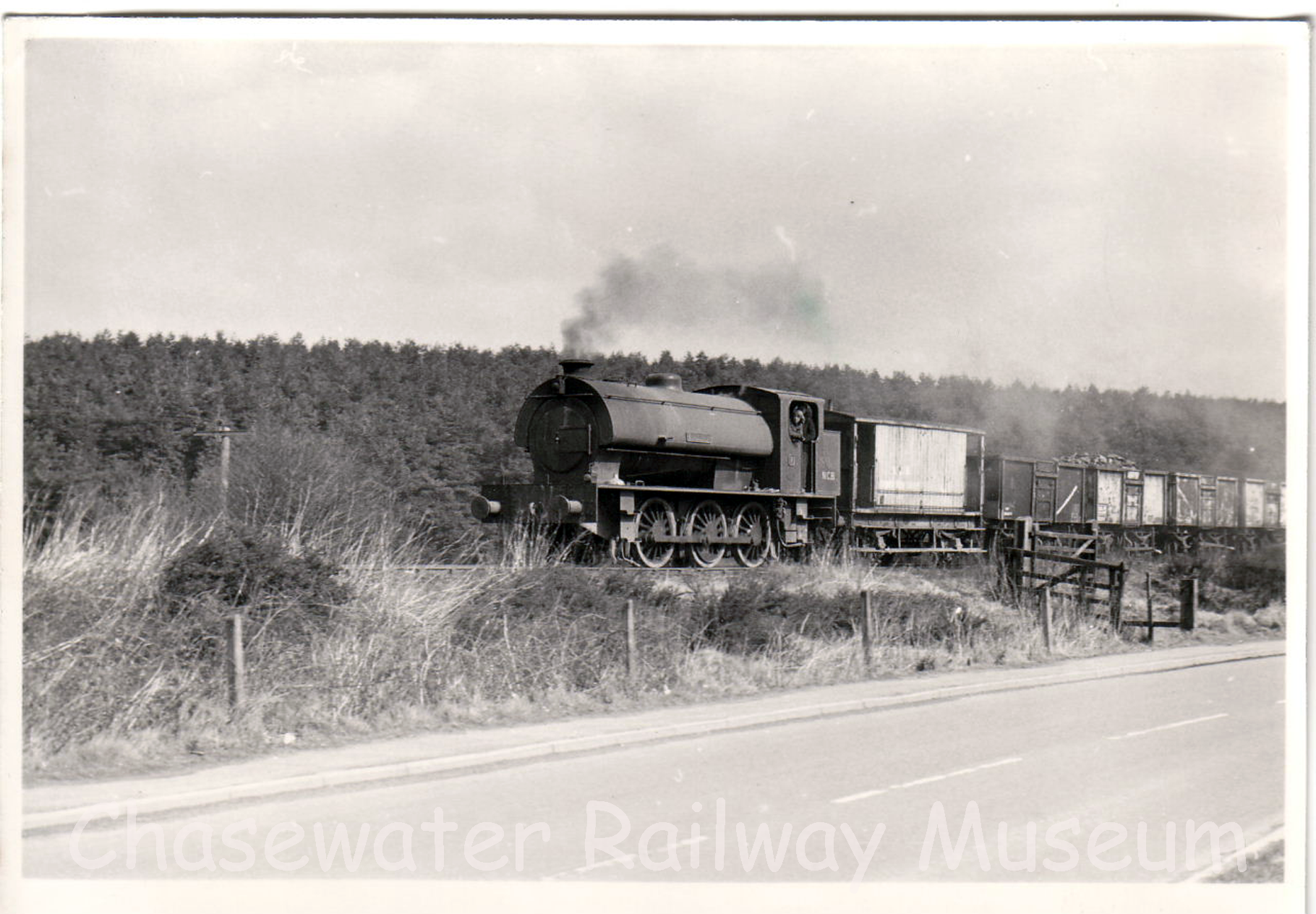
5448 Wimblebury No.7 0-6-0ST H 3839-1956 June 1969 Hunslet
From the Mercian of July 1969
Following a disagreement the Committee published a special message announcing the resignation of the Hon. Secretary, Hon. Treasurer and Vice-Chairman.
The acting Hon. Sec. A.A.Chatfield put together a report at short notice, stating that the usual progress is being slowly maintained, but more hands were still needed.
Mike Lewis had been packing the track near the compound and helped to alleviate the flooding problem. Steve Allsopp and Brian Hames have completed the overhaul of No.21 and have given her a spanking new coat of paint.
Derek Luker has been working on the steam locos with his small band of helpers and ‘Asbestos’ is now ready for a hydraulic test. New tubes are on order for the other locos and it is hoped to deal with them as soon as labour becomes available.
A limited amount of maintenance has been started inside the Royal Saloon thanks to Richard Middle and Arthur Chatfield, again a couple more members here would help out, particularly while the weather holds good.
Two of the younger members whose names escape me at present have been putting a coat of protective paint on the E1, again a much needed job well done.
From time to time we get requests from various bodies and individuals to help in storing rolling stock and in particular steam locomotives.
I feel that in the interests of all concerned it would be a sensible idea to say that while we have every sympathy and will try to advise such bodies and individuals, we cannot offer any hope of storage space either at Chasewater or Hednesford. Our present commitments with our own existing stock preclude us from offering help. I would ask all who read this to realise the difficult position that we are in with regard to this matter, for it is better to put you in the picture than to disappoint you later.
Make no mistake about it however, for as soon as we are able I am sure that we shall assist all we can.
 Manchester, Sheffield & Lincolnshire coach pre-Chasewater
This post was taken from various reports in the Mercian of April 1969
This Mercian seems to cover March/April and May/June 1969.
There as a new Editor for the magazine and the poor man in charge appears to have similar problems to any other magazine – a lack of articles!
Secretary’s Report – T.G.Cousens
After slow progress during the winter months at Chasewater, in which time only the arrival of the Manchester, Sheffield & Lincoln Railway coach broke the monotony of packing the track with red ash, progress is again in evidence. MSL Coach at Easingwold
The appointment of Mr.A.Holden to General Manager has seen marked changes in only a few short weeks, the most noticeable being the complete levelling of the compound and laying of track foundation into it. Behind the scenes however, small departments have been formed to work on various aspects of the line with people responsible for each of the allocated tasks.
However, working parties are small so progress will be slow – do we have to wait until the line is operating to see 90% of the membership?! Why not come down one Sunday afternoon and do a bit of shovelling, things will then begin to come to life.
A successful Open Day was held in conjunction with Messrs. Courtaulds Ltd., Coventry and organised by Gerald Wildish with the Company. Many visitors arrived to photograph the two Pecketts, one, ‘Rocket’ was seen at work on the Foleshill Railway. Many items were sold from the RPS stand which resulted in a fair profit to us.
The exhibition team was also at work at Huyton, Liverpool, at the preservation exhibition, the Open Day at Chasewater during the Easter week-end and the Stafford Railway Circle exhibition.
Well done to the members who attended these stands, especially the Huyton one.
The Barclay ‘Colin McAndrew’ was in steam on Easter Sunday and Monday under the able direction of Mike Lewis and Derek Luker. She unfortunately blew a tube on the Sunday but after a quick trip by Rob Duffill (our hero!!) to Hixon for a spare, the locomotive crew replaced the defective tube and raised steam for a second time the same day! No stock was hauled because of work required on the track – members please note. Until this work is done Open Days will be severely restricted, so may we see more of you assisting at Chasewater. Colin McAndrew at Greening Wireworks, Warrington.
From the Public Relations Officer’s Page – G. Wildish
The first mention was of the next Open Days, June 28th and 29th 1969, with the expectation of large numbers of visitors and asking for members to come along and help.
There was a request for more photographs for the cover of the magazine, which unfortunately do not reproduce very well. The Foleshill Railway Open Day had to be cut short and apologies were given to anyone affected.
A number of publications were mentioned – ‘Preserved locomotives of the World’ and ’Narrow Gauge Steam 1969’ for which a second impression is being prepared, later to be followed by ‘Narrow Gauge Steam 1970’
A publication for continental travellers – ‘German Steam’ has been prepared by an RPS member, so the Society is getting half of the profits, with thanks.
The final two publications were – ‘Railway Modeller’ which contained an article by Gerald Wildish and ‘Railway Enthusiasts Guide 1969/70’ which contained some information about the RPS.
There was an appeal for funds to move a locomotive of the Taff Vale Railway, and another appeal for volunteers to join a ‘paint in’ at Chasewater to give the rolling stock a much needed coat of paint.

From the ‘Mercian’ of January 1969
From the Secretary’s Report – Trevor G. Cousens
On 21 September 1968, the Society held its 9th Annual General Meeting at the Pear Tree Inn, Brownhills. The attendance was very poor considering the attraction of a steam trip down the line afterwards.
After the meeting, sandwiches were supplied by Pete Parker, proprietor of the Pear Tree, and then members crossed the road where in brilliant evening sunshine stood the Andrew Barclay 0-4-0ST, (Colin McAndrew) immaculate in green and red, with polished brass and copper-work.
Members were invited on to the train comprising the Midland (or Coal Board) brake van, the Midland brake coach and the Great Western brake. The train departed with Mr. Civil driving and Mr. Luker firing, the team, who with Mike Lewis had so painstakingly restored the locomotive. She was opened up to pull the train up the 1 in 50 bank to the causeway causing the steam pressure to drop rather drastically to 40 lbs per square inch, but this is probably the longest run the loco has ever made without running over the same tracks twice, and its small boiler and firebox being designed more for a 3’ 6” gauge loco, this is not surprising.
Over the causeway, we ran on to the shore again until we were held up by some rather enthusiastic ditching by Bob Wormington, which caused the loco cylinders to come into contact with the spoil. We ran on until we reached the end of the line, where a stop was made to raise steam for the return journey. The loco was once again admired by the members, its rather peculiar mechanical pump a feature of interest on the running plate.
The return journey was made almost without incident, a point switched the wrong way round caused a minor sensation, but we returned safely to the Compound, where some rather complicated shunting was carried out before putting the engine to bed. In fact, it was 9.00pm and dark when Laurence Hodgkinson finally put the diesel in with the rest of the stock which had been parked in the loop out of the way.
So ended the third RPS steaming at Chasewater, giving some encouragement to those who had worked so painstakingly to make this event possible. But, it made one think about the amount of work still to be done, principally on track, but also on locos and stock before these steamings become a regular feature.
In the Treasurer’s Report by Frank Harvey, it was noted that, among others, Mr. R. Duffill joined the Society!
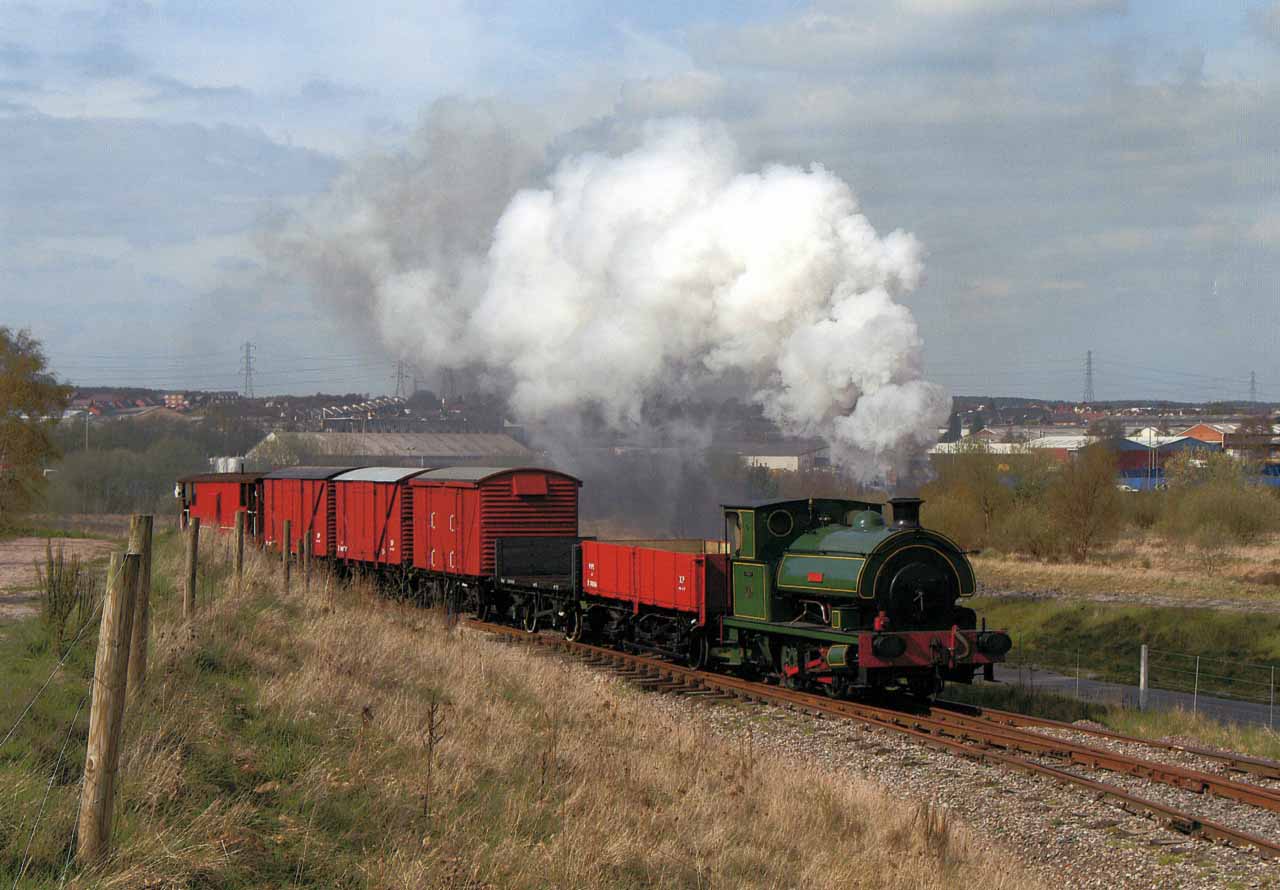
Photo: Robin Stewart-Smith.
More from the August 1968 ‘Mercian’
Turner’s Asbestos Cement Co. Ltd ‘Asbestos’
Hawthorn Leslie 2780 of 1909
By Gerald Wildish
 Many of you will by now have seen our splendid new locomotive. Two years ago exactly to the day that she left Trafford Park, I first found ‘Asbestos’ – 15th June 1966. She was not working on that particular occasion and had been specially hauled out of the shed for me and put in a photographic position. She appeared in excellent condition. On the occasion of my visit I learnt that she was likely to finish working that September, and I duly put in a bid for the RPS. I was informed that the Society’s interest had been noted.
A little over a year later a letter arrived from Turner’s asking me if I would care to bid for the engine – I made an offer of £50, and shortly afterwards received a telephone call informing me that a scrap merchant had offered £100 – we could have her if we could reach that figure. By this time we were in October and I was already engaged in trying to raise funds for the Neilson. My reply said that if they could hold the locomotive until after our Christmas raffle, we would do our best, but I did not hold out a great deal of hope. Considering all things, the raffle was a success, but we did not raise the sums necessary to allow us to move in two directions and I informed the Company that we would have to let her go.
My surprise could not have been greater, when Mr. Francis, the manager of the buying department, rang me to say that we could have ‘Asbestos’ free of charge. Without doubt this was one of the happiest days of my life. I made arrangements to go to Trafford Park to arrange the handover and had an excellent morning. The handover was arranged for a date three weeks later when the presentation plaque could be fixed to the locomotive.
I could not have been dealing with nicer people throughout the negotiations, right from the time of my first visit to the works. Our thanks must go to Mr. A.H.Wailes, the Works Director, Mr. T.Noble, the Purchasing Director, Mr. T.N.Chadwick, the Works Manager, who also arranged for the locomotive to be ‘done up’ for us during the week before the handover, to Mr. W.D.Francis, the Purchasing Manager, who dealt with most of the negotiations and Mr. S.McCormick.
Little is known of the history of ‘Asbestos’. She was built by Hawthorn Leslie in 1909, for the Washington Chemical Co. in County Durham, where she became No.2, along with two other Hawthorn Leslies and a Fox Walker engine. A further Hawthorn Leslie was added in 1918, and presumably replaced the Fox Walker. In 1920, the Company became part of the Turner and Newall group.
In 1933, two of the locomotives were transferred to the Turner’s Asbestos Cement Company works at Trafford Park, becoming ‘Turnall’ and ‘Asbestos’. Turnall was scrapped in 1965, leaving ‘Asbestos’ with two diesel locomotives (Planets). ‘Asbestos’ was placed in store as the reserve engine in 1966 and presented to the RPS on 25th May of this year(1968); she was transferred to Chasewater on 15th June, and started work in revenue service eight days later.
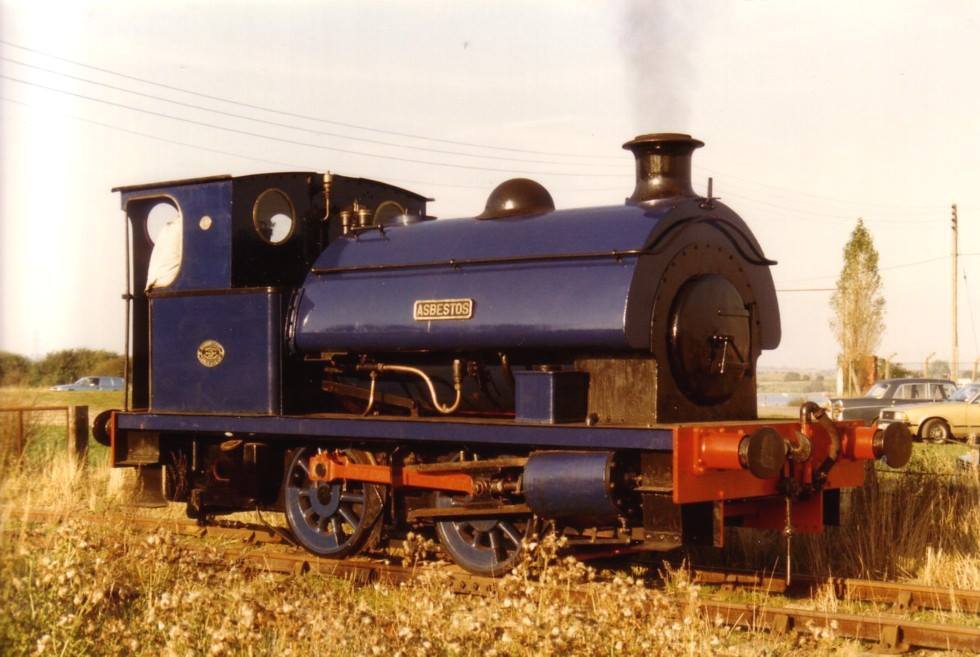
Photo: Oct 1985 – Tony J.Griffin
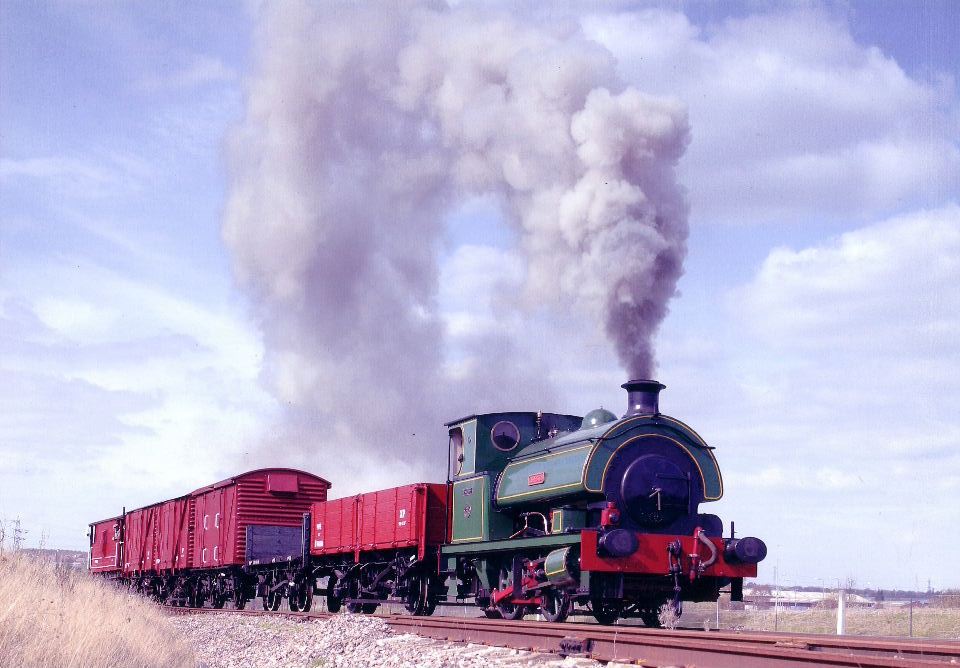
Photo – Russ Hillier
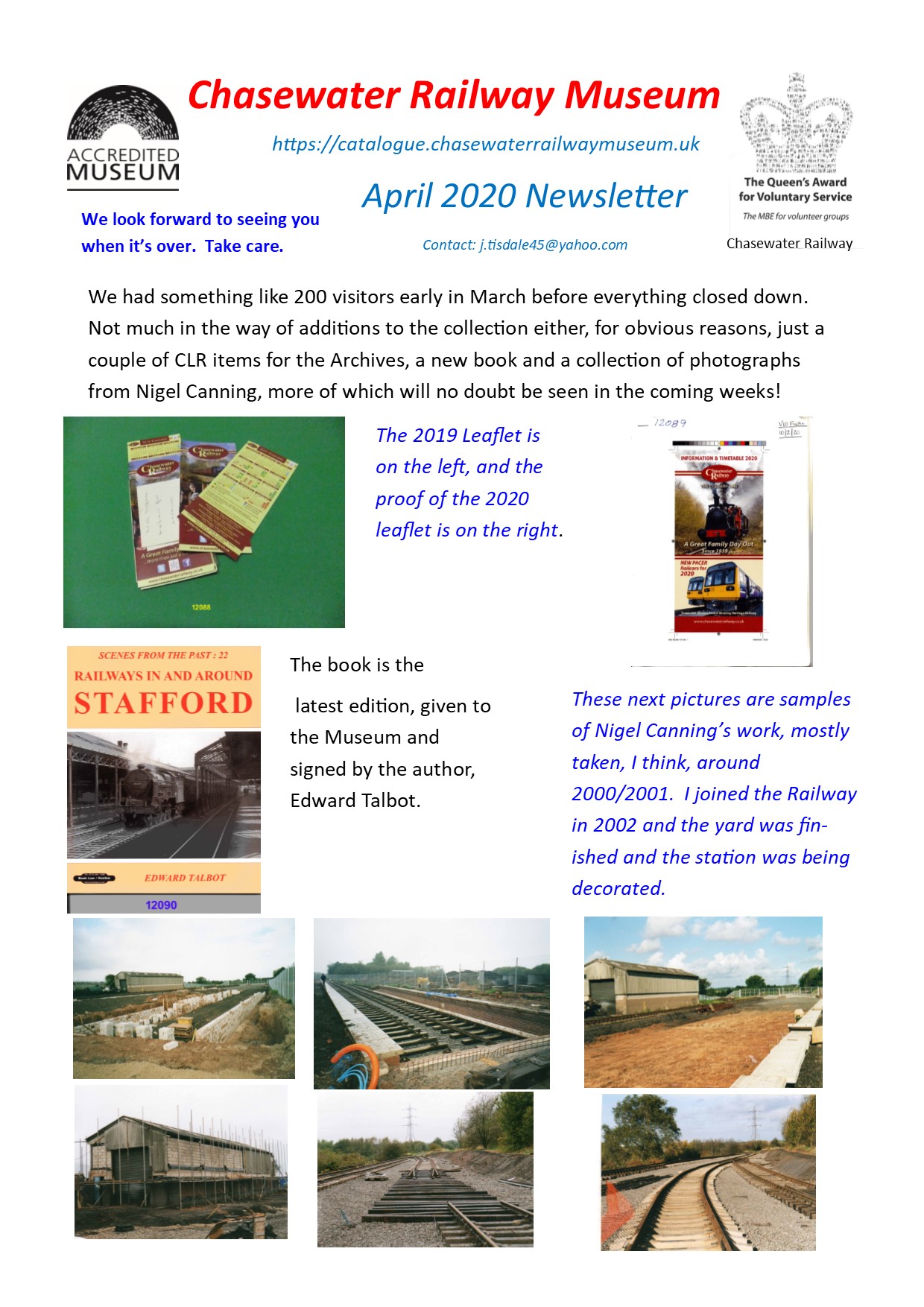
 Chasewater Railway Museum