Tag Archives: Asbestos

Chasewater Railway Museum – Bits and Pieces 54 from the ‘Mercian’ May 1970

Chasewater Railway Museum – Bits and Pieces 54 from the ‘Mercian’ May 1970


Rolling Stock Report

Chasewater Site

The following schedule of commitments refers only to the present stock on site; these will be greatly enhanced when certain other stock has been safely delivered from Hednesford.  We have a tight schedule to keep if we are going to provide a steam operated line this year and it is imperative that we get under way as soon as possible.


Asbestos

Boiler lagging and fittings have been removed and all applicable joints packed for a hydraulic test.  The initial inspection has been carried out by the boiler inspector who has okayed the boiler as fit, subject to some plugs being replaced and another test run before he issues the certificate.

The boiler barrel and underside of the tank are being red-leaded and painted.  Work is under the supervision of Mike Lewis who will need another two reliable assistants as soon as possible.  Work on lowering the tank, etc. will be done as soon as the boiler inspector has finished his tests.


Barclay – Colin McAndrew

This has been completely dismantled in preparation for repairs to the firebox stays by an outside contractor.  All the old tubes have also been withdrawn and will be replaced when the other repairs are done.  A lot of work will then be required to put the loco together ready for the boiler tests and final restoration including painting.  Mike Lewis is again supervising and needs two more assistants.


Neilson, Hudswell & Lance

Work on these three will have to be confined to oiling, greasing and generally touching up of paintwork, etc. until work has been satisfactorily done on the other two locos.  Volunteers are required for this.


Diesel No.1

This is at present out of commission with gear and clutch trouble.  Have we any reliable members who have knowledge of the workings of diesels and who could take this loco in hand?  Our regular fitters are already taxed to the limit with the other diesels.


Diesels Nos. 20/21

Minor repairs to the injectors and other routine work is well in hand on these two.  Both are due for a complete repaint and again volunteers conversant with the trade are asked to come forward.  Arthur Chatfield would be pleased to hear from you.


Petrol No.1

Cleaning down work is now well in hand.  This loco has to be ready for exhibition at Dorman’s Ltd., Stafford for week commencing June 22nd.  This leaves very little time for the two regulars seconded to the job.  More help is needed here; again, volunteers are required most urgently.


Other Rolling Stock

This has been lumped together because the variety of jobs required on most of the vehicles is almost identical.  Two of the coaches are sheeted over due to leaking roofs, anybody care to take on the job of re-felting them?  It will need at least two people.  There are also a considerable number of loose or cracked panels which need attention before they are painted in undercoat.  The running board on the Great Western brake needs repairing and re-bolting and of course a real good start on painting the interiors of the passenger stock would not be amiss.  There is enough work to allocate at least three people to each item of stock or a gang of five regulars tackling each item in order of urgency.  We cannot spare this number from the present compliment; we need more of you on site to help us do this vital work.

It may also be stated that there is a lot of work to be done to the Trackwork and again more help is needed.

No offer of assistance will be refused – this cannot be afforded.

A. Holden – General Manager, Chasewater Site.


Secretary’s Report from the ‘Mercian’ May 1970


It seems that my forecast for the movement of the smaller items of stock from Hednesford to Chasewater was way off the beam.  Let me hasten to add that several snags cropped up which had to be examined with regard to the transport.

Those of you who are familiar with the layout of the yard at Hednesford will know that there is an acute angle bend to be negotiated by any road vehicle which is delivering to or conveying from the yard any bulky items.  This unfortunately precludes all but the smallest type of low-loader, and the one that we had lined up for moving the four wheelers would not go round the corner.

We have, through the good offices of our President, made another approach to a different operator and we hope that he has a vehicle which can do the job.  If this fails then we shall have to dig out the point to the spur upon which the wagons are standing, this having sunk into the thick mud, so that we can shunt the wagons onto the main siding for removal by rail with the other stock.  The Coal Board have informed us that they will move the stock up to Cannock Wood Colliery yard either the first or second week of May and we now await clearance from British Rail that the stock is fit to run over the line to the Colliery which is their property.  Once the stock is at the Colliery yard it will be put under lock and key in the compound and the smaller items, such as the six-wheelers, E1, and, if necessary the four-wheelers will be shipped from there to Chasewater by road as there are better loading facilities at the Colliery yard to manoeuvre a big low-loader.

I sincerely hope that my forecast that most of the smaller stock will be at Chasewater by the time you either read this or receive the next edition will in fact be true for we shall require some of it for use at the Festival of Sport and also for the late Bank Holiday in August.

To impress upon you the need for better turnouts at working parties, you will find included in this issue (following) a run down on the various items of rolling stock and brief details of work which urgently needs to be either started and carried through, or which has already been started and which needs completing.

It is an impossible task for the present working parties to cope with the amount of work available, and I plead to all members with cars to try and get along to the site prepared to put in at least a couple of hours graft.  The weather seems to be picking up so we must pray for plenty of sunshine as we rely on this due to the present lack of covered space where we can operate if it rains.  May I count on your help over the next few Saturdays and Sundays???

May I, before closing this report, welcome on your behalf our newly co-opted Social Organiser, Gordon Loach.  Gordon has had many years experience in running carnivals, garden parties and other such fund raisers, and with the help of his good lady Mrs. Loach and, we hope, a ladies committee, he will be able to bring a bit of social life to the society which is lacking at the present.

Hon. Sec. A.A.Chatfield
Chasewater Railway Museum Bits & Pieces 45 More Aug 1968 Mercian

Chasewater Railway Museum

Photo: Robin Stewart-Smith.

More from the August 1968 ‘Mercian’

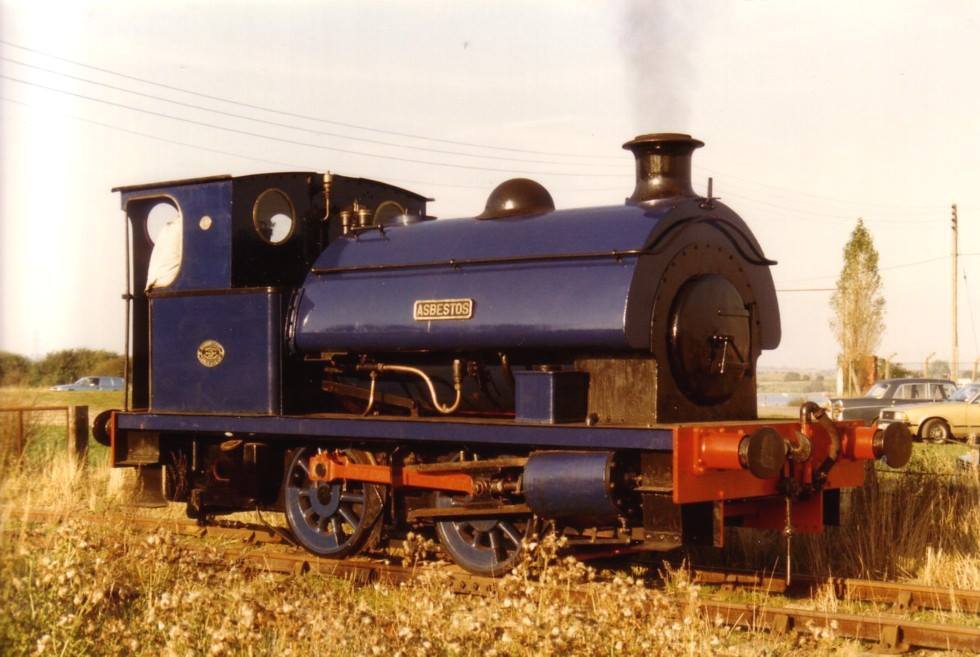
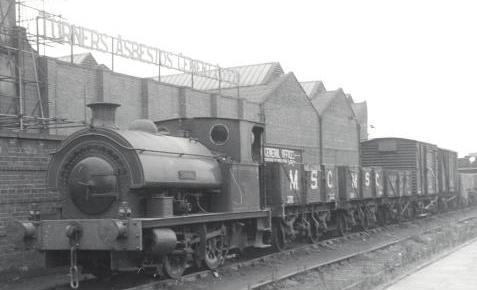
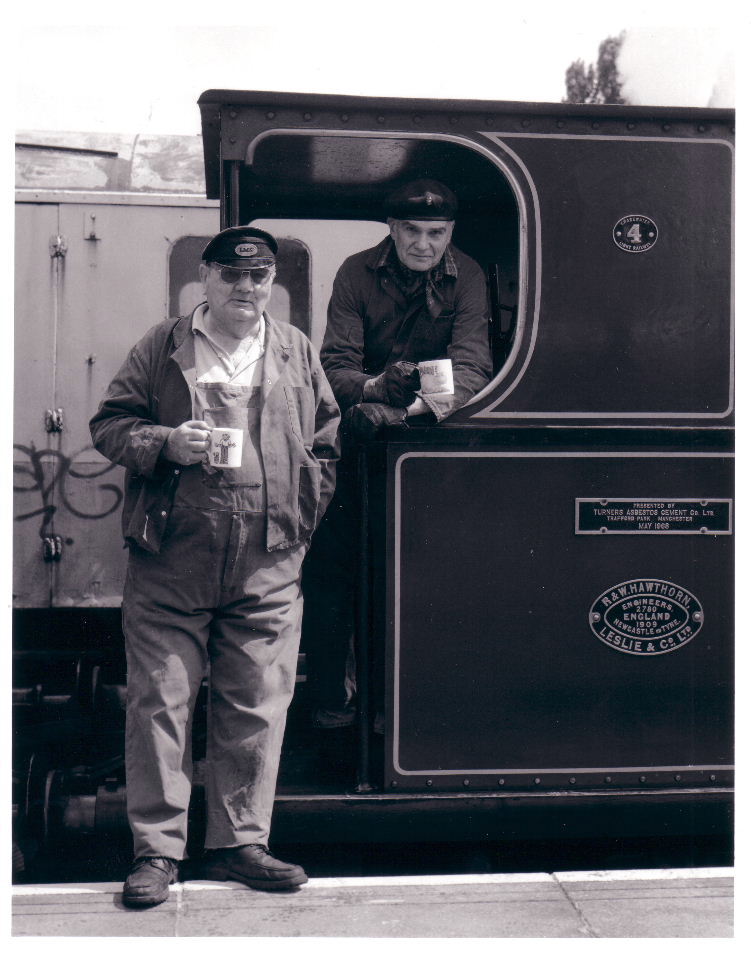
Turner’s Asbestos Cement Co. Ltd ‘Asbestos’

Hawthorn Leslie 2780 of 1909

By Gerald Wildish

Many of you will by now have seen our splendid new locomotive.  Two years ago exactly to the day that she left Trafford Park, I first found ‘Asbestos’ – 15th June 1966.  She was not working on that particular occasion and had been specially hauled out of the shed for me and put in a photographic position.  She appeared in excellent condition.  On the occasion of my visit I learnt that she was likely to finish working that September, and I duly put in a bid for the RPS.  I was informed that the Society’s interest had been noted.

A little over a year later a letter arrived from Turner’s asking me if I would care to bid for the engine – I made an offer of £50, and shortly afterwards received a telephone call informing me that a scrap merchant had offered £100 – we could have her if we could reach that figure.  By this time we were in October and I was already engaged in trying to raise funds for the Neilson.  My reply said that if they could hold the locomotive until after our Christmas raffle, we would do our best, but I did not hold out a great deal of hope.  Considering all things, the raffle was a success, but we did not raise the sums necessary to allow us to move in two directions and I informed the Company that we would have to let her go.

My surprise could not have been greater, when Mr. Francis, the manager of the buying department, rang me to say that we could have ‘Asbestos’ free of charge.  Without doubt this was one of the happiest days of my life.  I made arrangements to go to Trafford Park to arrange the handover and had an excellent morning.  The handover was arranged for a date three weeks later when the presentation plaque could be fixed to the locomotive.

I could not have been dealing with nicer people throughout the negotiations, right from the time of my first visit to the works.  Our thanks must go to Mr. A.H.Wailes, the Works Director, Mr. T.Noble, the Purchasing Director, Mr. T.N.Chadwick, the Works Manager, who also arranged for the locomotive to be ‘done up’ for us during the week before the handover, to Mr. W.D.Francis, the Purchasing Manager, who dealt with most of the negotiations and Mr. S.McCormick.

Little is known of the history of ‘Asbestos’.  She was built by Hawthorn Leslie in 1909, for the Washington Chemical Co. in County Durham, where she became No.2, along with two other Hawthorn Leslies and a Fox Walker engine.  A further Hawthorn Leslie was added in 1918, and presumably replaced the Fox Walker.  In 1920, the Company became part of the Turner and Newall group.

In 1933, two of the locomotives were transferred to the Turner’s Asbestos Cement Company works at Trafford Park, becoming ‘Turnall’ and ‘Asbestos’.  Turnall was scrapped in 1965, leaving ‘Asbestos’ with two diesel locomotives (Planets).  ‘Asbestos’ was placed in store as the reserve engine in 1966 and presented to the RPS on 25th May of this year(1968);  she was transferred to Chasewater on 15th June, and started work in revenue service eight days later.

Photo: Oct 1985 – Tony J.Griffin

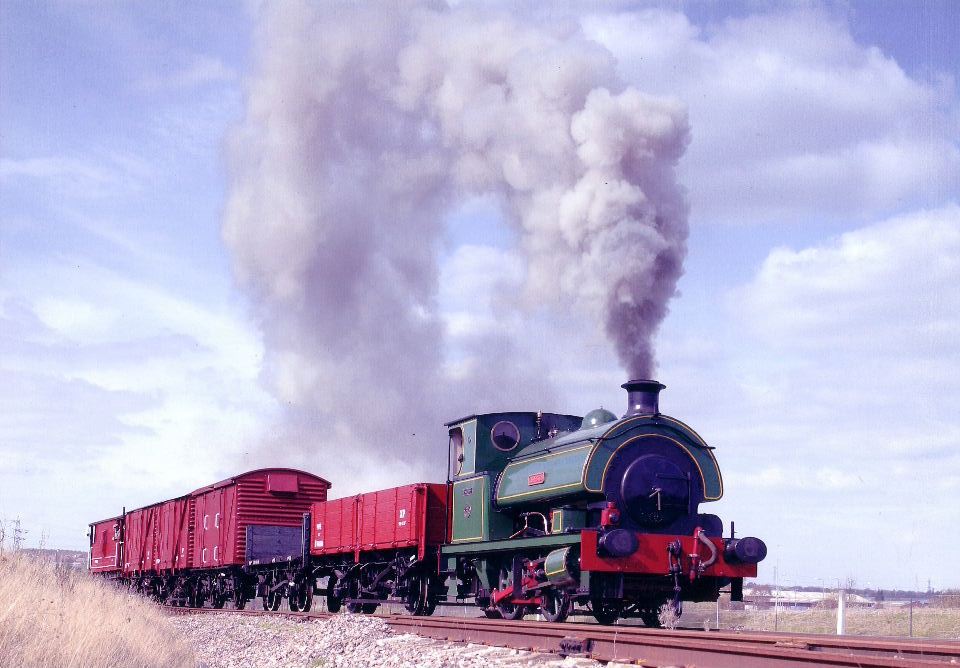
Photo – Russ Hillier

Chasewater Railway Museum – 2004 Royal Visit

Chasewater Railway Museum 

2004 Royal Visit

It’s full steam ahead – royal style

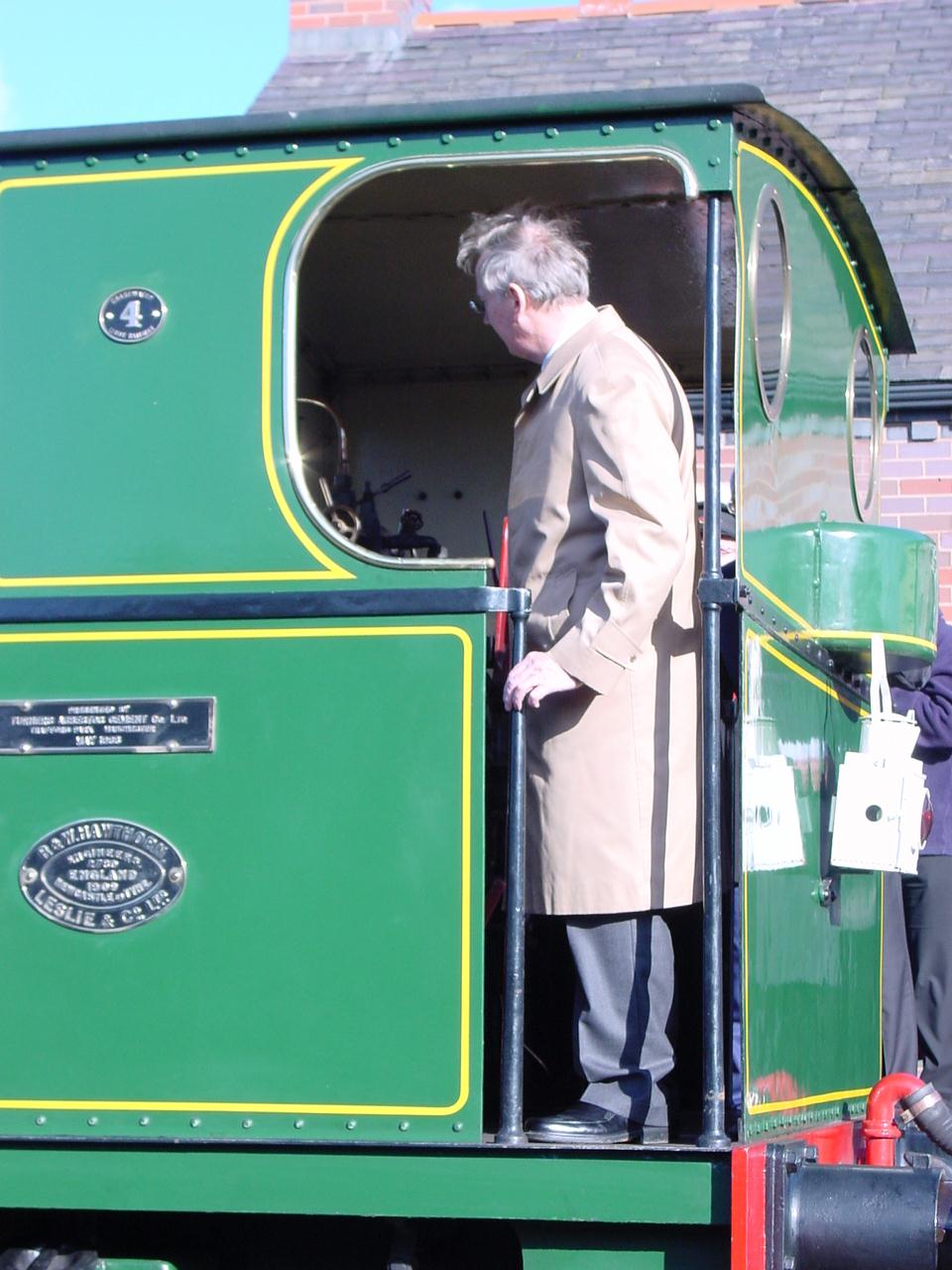
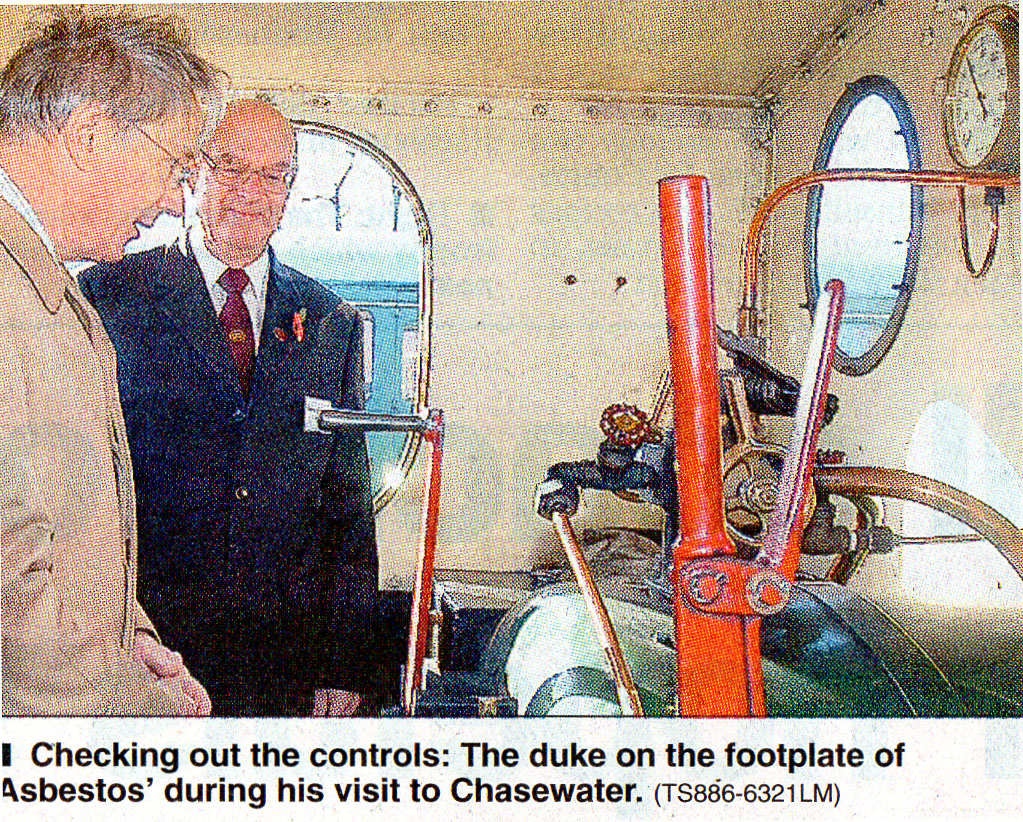
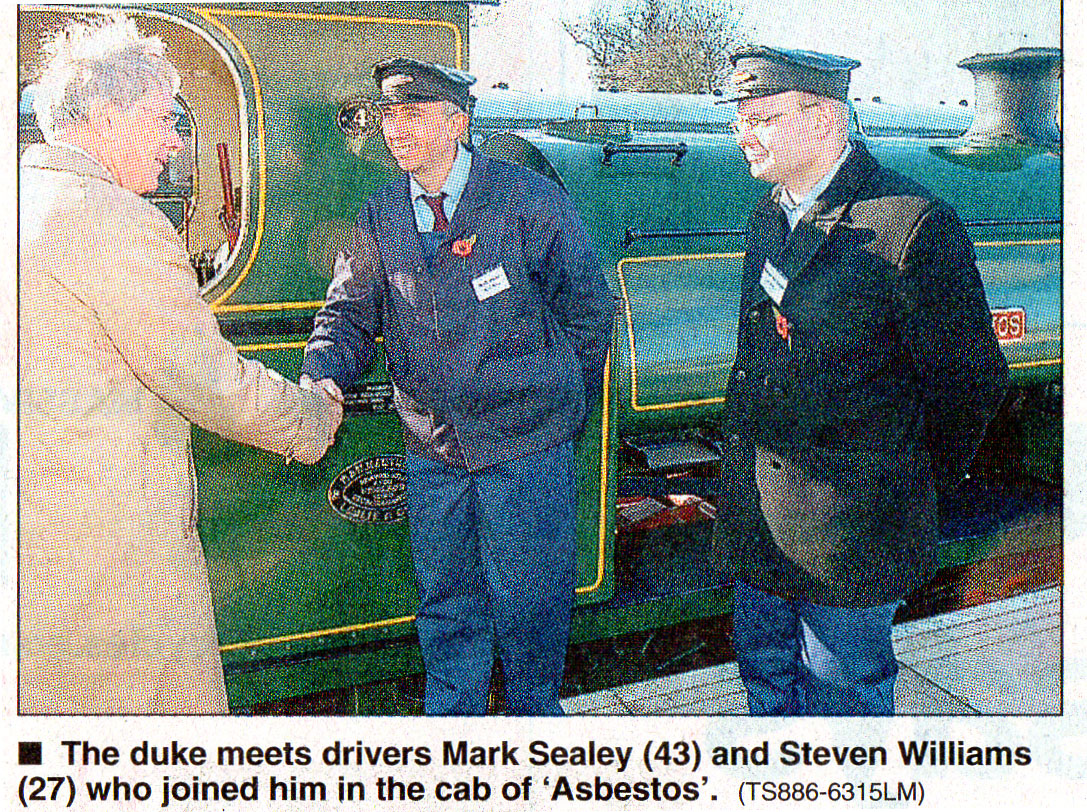
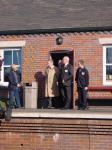
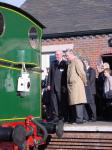
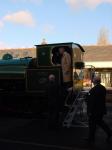
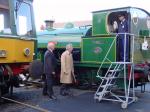
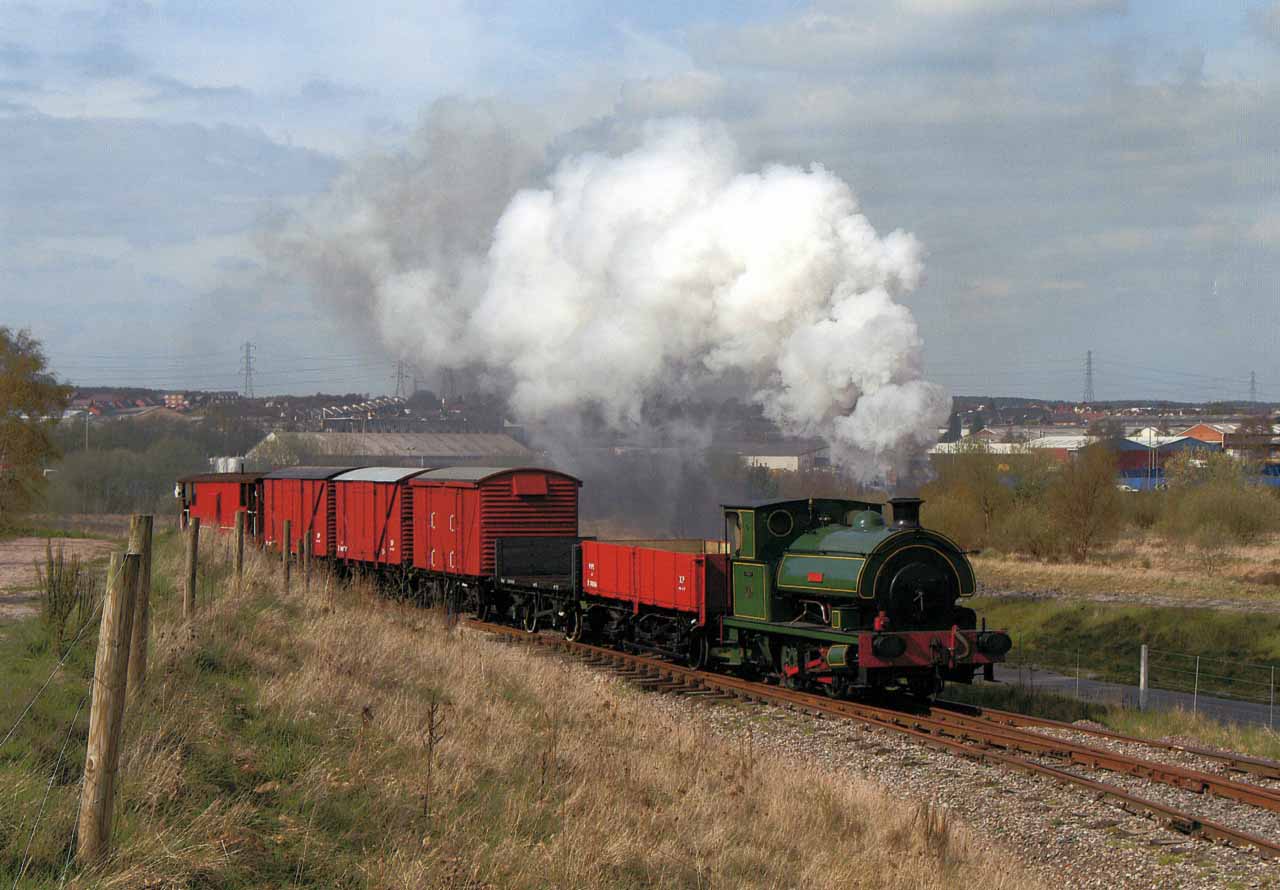
The Duke of Gloucester was in his element as he took control of ‘Asbestos’ – Chasewater Railway’s flagship steam locomotive.

With a blast on the whistle the Duke shifted the regulator and the steam engine edged forward.

For the next ten minutes the Duke indulged one of his greatest passions – steam trains – oblivious to the wired-up security agent positioned half-way along the section of track.

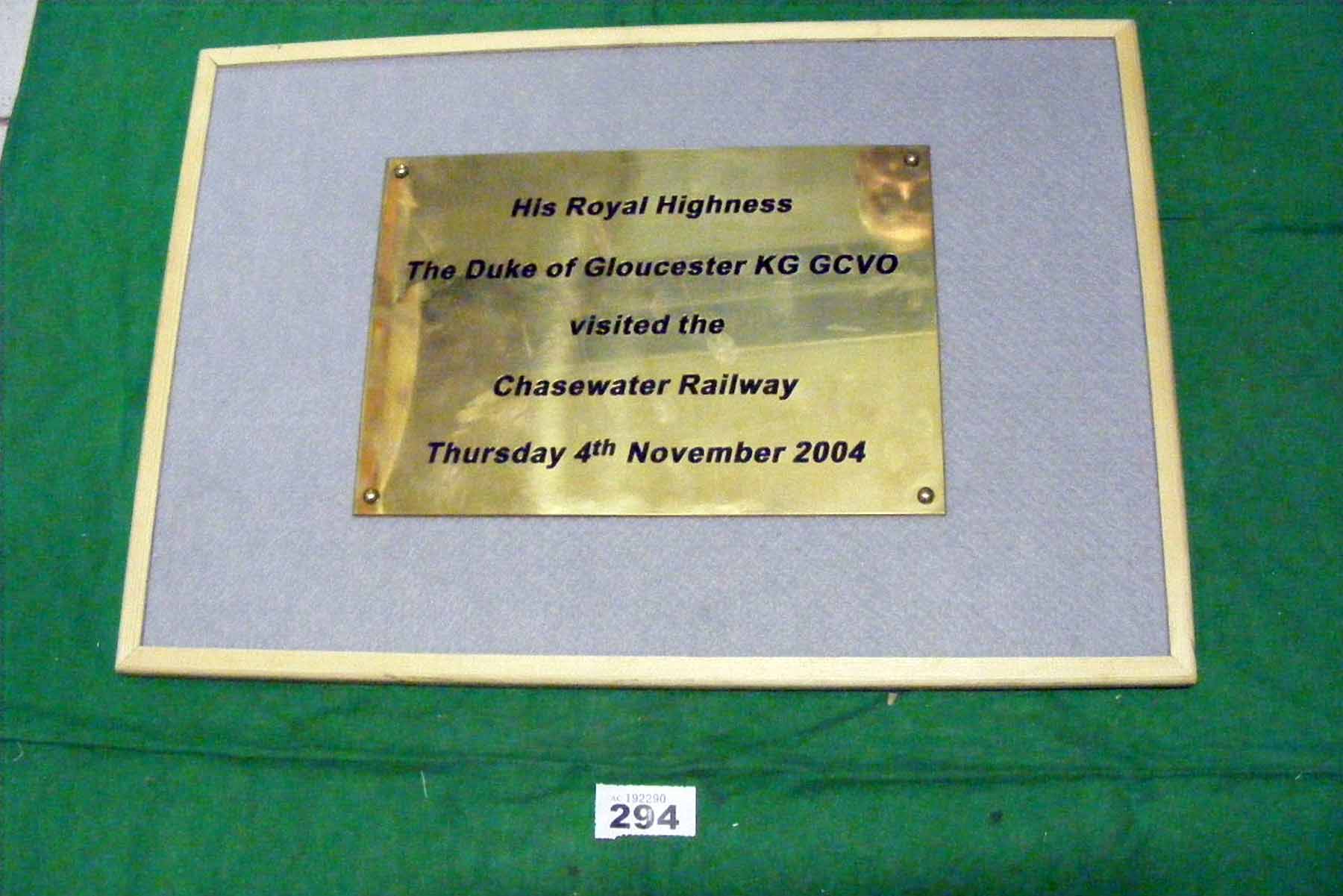
The royal visit to Chasewater Railway  was the third stop on the Duke of Gloucester’s tour of the area last Thursday (4-11-2004).

Accompanying the Duke in the engine’s cab were Driver Mark Sealey and Fireman Steve Williams.

Steve said ” He knew exactly where all the controls were, we didn’t really have to help him.  I think he would have liked to have gone a bit further down the track.”

Mark added “We talked about the engine and where it had come from and he asked us about the length of the track.”

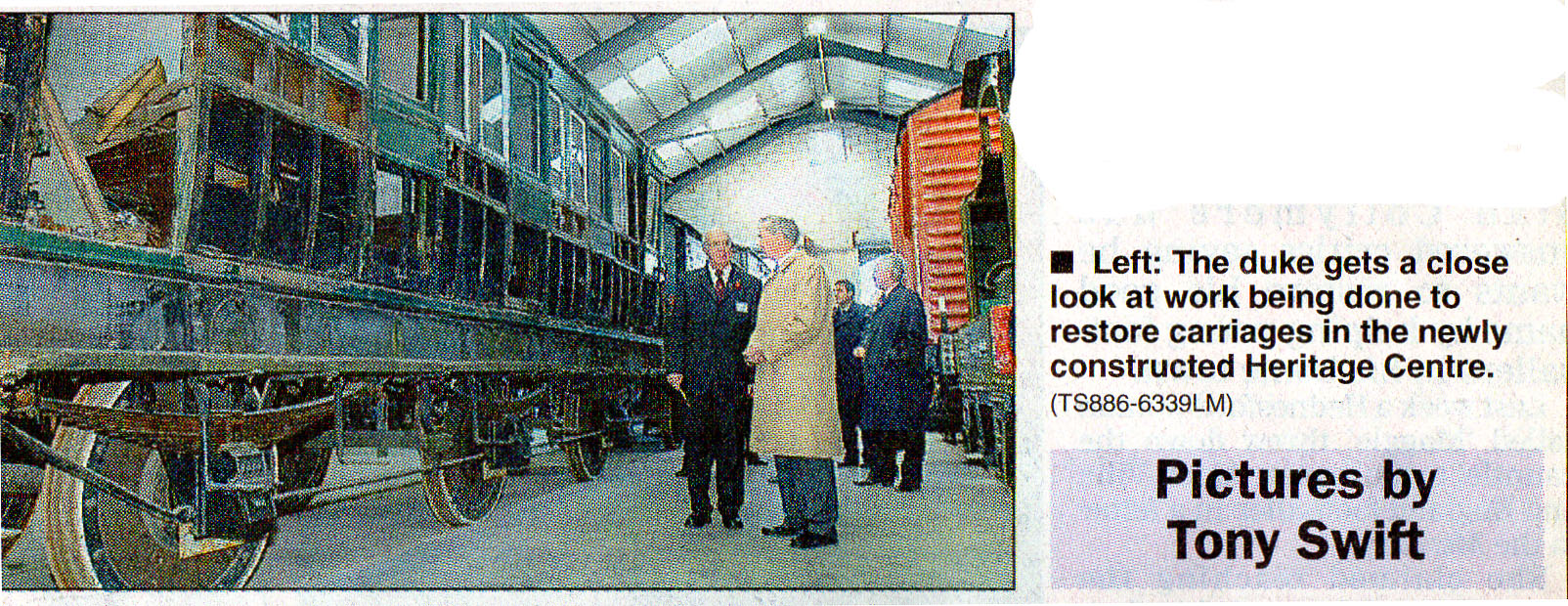
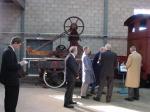
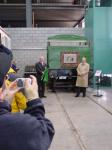
The Duke also toured the newly constructed Heritage Centre where restoration work on Chasewater’s collection of railway carriages takes place.

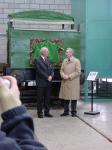
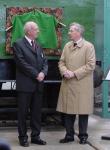
And while in the Centre he unveiled a plaque to commemorate the visit.

Restoration engineers Jim Twigge and Don Mitchell chatted with the Duke.

“He is the kind of person you can speak with easily,” said Jim.

Don added ” We knew he was a train enthusiast and former architect.

Architecture and railways are his two passions.”

Before leaving, the Duke took an impromptu trip on a modern engine – the Parry People Mover – and the clockwork coordination of the event suddenly seemed at risk!

Station Master Eric Balaam remarked ” The Duke said it is nice to see people restoring the carriages for future generations to appreciate.”

As the bespectacled Duke in dark grey suit and beige overcoat climbed into his Jaguar, Chasewater Railway’s general manager Steve Organ reflected on the Royal visit.

“I think it has gone really well with this our first Royal visit.

This is a very significant milestone, giving credibility to the railway and enabling members to take a pride in it.”

Some photos from 8 years ago today – 25 April 2011

Some photos from 8 years ago today

25 April 2011

Selected by Google Photos


Click on a pic to see a larger version

Two of the newspaper cuttings from Sue and Diana Windsor’s donation.

Two of the newspaper cuttings from Sue and Diana Windsor’s donation.

An unusual view of the Coppice Colliery (Fair Lady) at Heath Hayes.  Certainly one that I hadn’t seen before.

Coppice Colliery, Heath Hayes (Fair Lady)

The Transport Scene at Chasewater in the early days.

This photo shows Neilson loco ‘Alfred Paget’ and Hawthorn Leslie ‘Asbestos’ with The MSL coach.

More from the August 1968 ‘Mercian’ Turner’s Asbestos Cement Co. Ltd ‘Asbestos’ Hawthorn Leslie 2780 of 1909

More from the August 1968 ‘Mercian’

 Turner’s Asbestos Cement Co. Ltd ‘Asbestos’

Hawthorn Leslie 2780 of 1909

 By Gerald Wildish

 asbestos at trafford park 2At Trafford Park

Many of you will by now have seen our splendid new locomotive.  Two years ago exactly to the day that she left Trafford Park, I first found ‘Asbestos’ – 15th June 1966.  She was not working on that particular occasion and had been specially hauled out of the shed for me and put in a photographic position.  She appeared in excellent condition.  On the occasion of my visit I learnt that she was likely to finish working that September, and I duly put in a bid for the RPS.  I was informed that the Society’s interest had been noted.

A little over a year later a letter arrived from Turner’s asking me if I would care to bid for the engine – I made an offer of £50, and shortly afterwards received a telephone call informing me that a scrap merchant had offered £100 – we could have her if we could reach that figure.  By this time we were in October and I was already engaged in trying to raise funds for the Neilson.  My reply said that if they could hold the locomotive until after our Christmas raffle, we would do our best, but I did not hold out a great deal of hope.  Considering all things, the raffle was a success, but we did not raise the sums necessary to allow us to move in two directions and I informed the Company that we would have to let her go.

My surprise could not have been greater, when Mr. Francis, the manager of the buying department, rang me to say that we could have ‘Asbestos’ free of charge.  Without doubt this was one of the happiest days of my life.  I made arrangements to go to Trafford Park to arrange the handover and had an excellent morning.  The handover was arranged for a date three weeks later when the presentation plaque could be fixed to the locomotive.

I could not have been dealing with nicer people throughout the negotiations, right from the time of my first visit to the works.  Our thanks must go to Mr. A.H.Wailes, the Works Director, Mr. T.Noble, the Purchasing Director, Mr. T.N.Chadwick, the Works Manager, who also arranged for the locomotive to be ‘done up’ for us during the week before the handover, to Mr. W.D.Francis, the Purchasing Manager, who dealt with most of the negotiations and Mr. S.McCormick.

Little is known of the history of ‘Asbestos’.  She was built by Hawthorn Leslie in 1909, for the Washington Chemical Co. in County Durham, where she became No.2, along with two other Hawthorn Leslies and a Fox Walker engine.  A further Hawthorn Leslie was added in 1918, and presumably replaced the Fox Walker.  In 1920, the Company became part of the Turner and Newall group.

In 1933, two of the locomotives were transferred to the Turner’s Asbestos Cement Company works at Trafford Park, becoming ‘Turnall’ and ‘Asbestos’.  Turnall was scrapped in 1965, leaving ‘Asbestos’ with two diesel locomotives (Planets).  ‘Asbestos’ was placed in store as the reserve engine in 1966 and presented to the RPS on 25th May of this year(1968);  she was transferred to Chasewater on 15th June, and started work in revenue service eight days later.

7423 B-Hills West 20-6-09

Brownhills West 2009