Tag Archives: Burntwood

Image

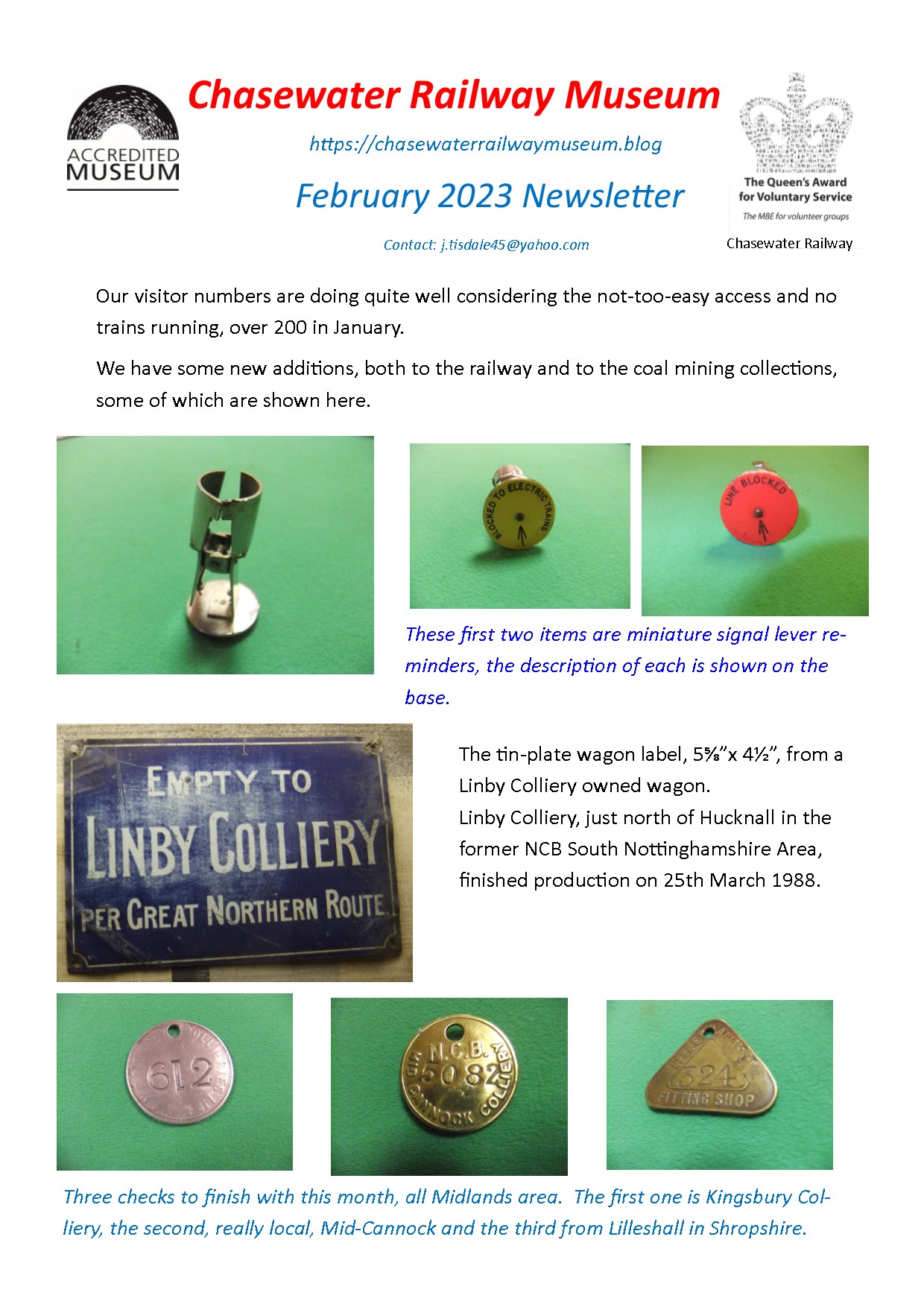
Chasewater Railway Museum – February 2023 Newsletter

133 – Chasewater Railway Museum Bits & Pieces From Chasewater News April 1991

133Chasewater Railway Museum Bits & Pieces

From Chasewater News April 1991

Editorial – Nigel Canning

This looks like being the year that the Railway Inspector finally pays us another visit, as he has written saying he will inspect our railway ‘in the summer’.  If what he sees meets with his approval we may have a longer length of line to run on, if it does not we might not have a line at all.  It is now up to all of us to do our best to ensure that he sees an improvement in the existing railway, and that the extension to Willow Vale and beyond meets his requirements.

Later this year ‘Lion’ should enter service, and hopefully after that, ‘Asbestos’, which means that by Gricers Day we could have three engines in steam together for the first time in nine years, and even the new platform fro them to run trains into.  Let us just hope the Railway Inspector is impressed during his visit!

Locomotive News

No.4 Asbestos – Work on this loco has continued through the winter months and in March it passed its visual/ultrasonic boiler inspection.  Examination, however, has revealed that part of the firebox crown is nearing its limit on plate thickness and it is only a matter of time before serious repairs will be necessary.  The boiler will now be prepared for its hydraulic test.

No.5 Sentinel – This loco also passed its boiler examination in March and again looks like being the only serviceable steam loco for at least the first half of the season.  Repair work over the winter has included re-machining of the steam brake valve, fitting of a new cast fire grate and work on the paintwork in preparation for the ‘gasworks red’ livery to be applied as soon as weather permits.

No.2 Lion – A brand new saddle tank was delivered to Chasewater and temporarily fitted to the loco in January to check its dimensions; it was virtually perfect!  Other work has included the installation of sliding cab shutters and the boiler has been washed out.  The boiler now awaits the fitting of new washout plugs before the hydraulic test can be carried out.

S100 – Work has continued on this loco with the redesign of the hornguide grinding machine.  Another of the four main leaf springs has been stripped, cleaned and re-assembled.

DL7 – This loco was taken out of service for a couple of weeks recently while the injectors were removed, overhauled and refitted.

Fowler – This loco has remained in service without problem over the winter hauling works trains to the extension pastWillow Vale.

Smith Rodley Crane – This vehicle has seen only minimal use lately although work has continued on its repair and restoration.

Permanent Way News

The majority of work carried out by this department recently has been concentrated on the extension of track pastWillowVale.  Whilst the number of volunteers has fallen slightly, those brave enough to carryon through the worst of the winter have at least had a comfortable works train.  The favourite formation for this appears for some reason to be: the Fowler diesel, the DMU centre car and the two GWR brake vans with, of course, the stove kept well stoked.

The concrete platform for Willow Vale Halt has yet to be collected from theSevernvalley Railway as it is planned to carry out this job when the evenings become lighter allowing longer hours to be worked if necessary.

One extra job urgently requiring attention is the repair of the bridge handrails, which having recently been repaired and increased in height, have now been totally destroyed by the local toe rags.

Carriage & Wagon News

Midland four-wheel passenger brake – This vehicle has remained sheeted over during the winter, but work will continue as soon as the weather improves.

Manchester, Sheffield & Lincoln six-wheel coach – Some progress has been made on this vehicle, but again the damp weather has limited the type of work that can be carried out.

Great Eastern six-wheel passenger brake – All of the doors have been removed from this vehicle for repair ‘off-site’, and the bodywork has been prepared and painted in yellow primer.

Wickham 2 car DMU E56171 & E50416 – The trailer car of this set has remained coupled to theGloucesterover the winter, and work has been carried out on refurbishment of the bar.                                                                                               A start has bee made on repairing, rubbing down and priming the bodywork of the power car ready for a repaint.  Work has also been carried out inside, removing seats and tables to make room for re-decoration.                                                                  Since the last issue of Chasewater News a preservation group dedicated to restoring the Wickham as a working DMU has been formed.  This organisation is currently drawing up its proposed constitution which is expected to be similar to that of the Hudswell Group in that the DMU will remain at Chasewater.

Gloucestertrailer E56301 – Little work has been carried out on this vehicle over the winter and there are rumours that another society may be interested in purchasing it for preservation elsewhere.  In the meantime it will be used on trains at Chasewater coupled to either the Wickham trailer or the new centre car.

Derby centre car W59444 – This coach arrived at Chasewater in January, having travelled from Tyseley diesel depot by low loader.  Before it enters passenger service, it is planned to fit a bar as a replacement for the one in the Wickham trailer.  Livery will probably remain BR blue and grey for the time being, although early BR carmine and cream has been rumoured as the intended replacement.  One problem has become apparent in that being a centre car, it has no handbrake so it has to be marshalled between another braked vehicle and the loco or the buffer stops.

General News From The Line

It now seems that the large portacabin which had been intended for use as a station buffet will not now be coming to Chasewater.  In view of this, work has started on renovating and converting the two smaller units which arrived in December to form a smaller buffet and separate kitchen.  As this work is likely to take quite a while, catering on a limited scale will take place on the train and possibly in the Wickham power car once more.                                                                                                                                           The portaloo is now in its final position next to the south end of the platform where it will be much appreciated by the loco dept.  Work on its refurbishment is progressing well and a race is now on to see whether the buffet or portaloo opens for business first.

Human Resources

An interesting meeting of working members was held in March to discuss ideas to improve work output on the railway by providing more organisation and planning so that priorities can be agreed in advance and last minute panics avoided.                 To achieve this, four departmental ‘foremen’, listed below, were appointed, whose job it is to liaise with each other to agree priorities and to suggest suitable jobs for anyone arriving at the railway and wishing to help out.

Permanent Way         Les Emery

Carriage & Wagon     Dave Whittle

Loco Dept                  Tony Sale

Station & Site             Steve Organ

If you don’t already have a project of your own and wish to help out, please contact any of the above people, or ask at the booking office where to find them.

 All photos – Nigel Canning

Image

Chasewater Railway Museum – January 2023 Newsletter

130 – Chasewater Railway Museum Bits & Pieces Alfred Paget nearly got to Bescot – August 1990 – (Or the Not-so-Flying Scotsman) – P. Aldridge

130Chasewater Railway Museum Bits & Pieces

Alfred Paget nearly got to Bescot – August 1990

(Or the Not-so-Flying Scotsman) – P. Aldridge

BR’s ‘Bescot Open Day’ took place on Sunday, 6th May.  BR had requested that they borrow our venerable Neilson ‘Alfred Paget’ for the event.  We replied ‘yes’ but only if they cosmetically restored the engine, insured it and provided the transport.

Photo: P.Aldridge

Ian Edwards then spent many hours repainting the loco and even applied ‘No.11’ to the tank sides and buffer beams, so that the old engine looked very fine.  Arrangements were made to move the loco on Good Friday – but were then cancelled (pity no-one thought to tell me!) and re-scheduled for 3rd May.  Various Society members told the BR representative that a lifting frame would be needed and that trying to lift the loco with slings under the frames would not be permitted for fear of damaging our loco.

‘Don’t worry’ they said ‘we are professionals.’

The day arrived, and the said ‘professionals’ brought a low loader and a crane, but no lifting frame! Predictably they were unable to lift the loco, and, after six hours of struggling, gave up!

Thanks are due to Ian Edwards for restoring the loco, even though it did not get to Bescot.  Thanks are also due to Messrs. Emery, Newbold and Organ, plus a hologram of myself (I wasn’t there as I was off work sick) for organising the shunting and supervising the ‘lift’ – or lack of it!

Photo: P.Aldridge

Further thanks are also due to BR who provided the low loader and the crane.  Perhaps next time the ‘professionals’ will listen to us ‘AMATEURS’ who do, after all , have some idea what we are talking about!

Despite this disappointment it wasn’t a total waste of time, for even though our Neilson did not get to the Open Day, our sales stand did, and Mr. Bull added £200 to our coffers in a very successful day’s sales.

Image

Chasewater Railway Museum- December 2022 Newsletter

127 – ChasewaterRailwayMuseum Bits & Pieces From Chasewater News January 1991

About time for another Bits and Pieces! Thank you Nigel


127Chasewater Railway Museum Bits & Pieces

From Chasewater News January 1991

Editorial – Nigel Canning

At the end of this, another, year we have made further modest progress on our railway.  As yet, the proposed platform at Willow Vale has not been built, but only because a pre-fabricated concrete one, well worth waiting for, has been acquired and awaits removal to Chasewater.

The fact that we have run for the whole year with only one steam loco is in some ways a disappointment, but on the other hand it does show that our engineering standards are as good as anyone’s with no failures having occurred.

With the main line steadily being extended towards the causeway, carriage and wagon restoration proceeding at a pace not seen at Chasewater for many years, and the station site and line in general becoming tidier and more businesslike by the week, 1991 could be the year when we do finally expand and prosper.

Locomotive News

No.4 Asbestos – Progress on this loco is still very slow and as a result it is likely to be well into next year before it steams again.  The boiler and firebox are slowly being cleaned for inspection and following removal of the firebox lagging, which left a lot of mess, the motion has been thoroughly cleaned.Photo: N.Canning

No.5 Sentinel – This is still the line’s only working steam loco and as such will work all the Christmas and New Year trains.  It was painted in camouflage as WD 79632 for the military weekend in September and is now in red undercoat prior to being repainted in its original gasworks red livery.

A number of outstanding minor repairs have recently been carried out, including fitment of a new blower pipe and firing chute, re-machining of a leaking clack shut off valve, and rectification of an engine oil pressure problem followed by an engine oil change.  The loco will shortly be fitted with a new fire grate to replace the rapidly disintegrating one currently held in place with a piece of angle iron secured to the sander pipe by fencing wire.

No.2 Lion – This loco is currently being fitted with sliding cab shutters and is likely to be hydraulic tested at the same time as Asbestos.  The saddle tank has been sent away for repair by contractors and should return shortly in pristine condition.

S100 – The major work being carried out on this loco is still the construction of a machine for grinding the hornguides, which posed more problems than had originally been anticipated.

No.7  Ruston – This loco is still in good running order although there was a minor mishap in July.  After its having stood unused for a number of weeks, the engine bent a pushrod during start-up.  Further investigation revealed that one of the fuel elements in the injection pump was also seized.  Repairs were affected fairly quickly and the engine appears to start more easily than it has for a long while.

No.9 Fowler – This loco is now running reliably and sharing shunting duties with No.7

Smith Rodley 5 ton crane – This vehicle has received a lot of attention recently in preparation for forthcoming work on the track.  The bodywork is being repaired with new windows and a complete repaint.  Work is also being carried out to repair the wooden floor and fit a guard around the open gearing in the cab.

 Permanent Way News

A prefabricated concrete platform has been acquired from the Severn Valley Railway and will shortly be brought to Chasewater.  This is obviously ideal for Willow Vale Halt and will be far superior to the sleeper built affair originally proposed.

Work has continued on extension of the track past Willow Vale in addition to maintenance of the existing running line.  The increased number of working members mentioned in the last magazine seems to have been more than maintained to the extent that we are handling the 45ft and 60ft rails with relative ease.  Unfortunately the overhead power lines which pass over this section of line preclude the use of the crane for quite a distance either side.

Carriage & Wagon News

Activities in this department have continued to increase so that there are currently a number of historic coaches and even wagons being worked on, as follows:

Midland four wheel passenger brake – Following extensive research, this vehicle is being restored to its original Midland Railway condition.  This has so far involved the removal of various post-MR additions, such as the internal partition, door and a bench seat.  Part of the roof is being rebuilt and various bad body panels renewed.

Manchester, Sheffield and Lincoln six wheel coach – Restoration of this vehicle has continued with renewal of broken windows and repair or replacement of damaged body panels.

Great Eastern six wheel passenger brake – Restoration of this long-abandoned vehicle has also recently commenced, initially with the stove, but also body panels and windows.  Hopefully the boiler from S100 which has blocked its movement for a number of years will soon be removed to the shed yard allowing the Great Eastern to be moved again.

Ex Cammel Laird hopper wagon – Having been little used since the hopper body was removed for scrap a number of years ago, this wagon has now been completely decked over with chequer plate to form a very sound flat wagon.  Minor repairs have also been carried out to the brake linkage and the whole thing painted in Tri0ang Big-Big Train bright blue.

Wooden five plank wagons – Both of the two examples of this type of wooden framed, wooden bodied wagons at Chasewater have badly deteriorated over the years.  At last a start has been made on one of these to renew all the rotten timbers in the floor and sides.

DMU Coaching stock – The Gloucester and Wickham trailer cars have remained coupled together as our passenger train throughout the season.  The left hand side of the Gloucester, which for some reason always seems to be more susceptible to body rot than the other, has received a few more patch repairs and a repaint.

The Wickham power car has remained in use as the station buffet.  However, when the new portacabin is opened for business, this coach could re-enter passenger service, steam hauled, or even under its own power.

New Acquisition – One of our members has just purchased from BR via Tyseley diesel depot, a DMU centre car.  Full details are not yet available, although it is No.59444, asbestos-free, in excellent condition and until very recently running on BR.  Further details, and hopefully an article, will appear in the next magazine.  This of course makes possible some very interesting train formations and raises the question ‘will we shortly be needing longer platforms?’

General News From The Line

A large portacabin has been acquired and will be put next to the booking office, and when fitted out will become the station buffet.  Mains power will be provided from the newly rewired site supply and it is rumoured that running water will also be plumbed in.

Photo: N.Canning

Work has continued on tidying up the station area by clearing away the assorted rubbish which continually seems to appear from nowhere.  Grass is now being encouraged to grow in the area in the middle of the run round loop to form a rough lawn and kept trimmed with a strimmer.  The stationary engine displaced by the new buffet is likely to be permanently mounted in the middle of the loop, and possibly made operational by a buried pipe to a compressed air or steam supply from one of the locos.

Sewer pipes have been run from the portacabins and portaloo out into the culvert in the park.  Most of the trench digging was done by a rented (cheaply!) JCB but a lot of work had to be finished off by hand.  This involved around a dozen or so people and is another example of what can be achieved by our steadily expanding volunteer workforce.

Stop Press

Following a problem with the release of the portacabin mentioned above from its current owners, a further two smaller portacabins have been acquired and arrived on site on December 1st.  Due to various problems, these units took two days to unload from the lorry and a further three Sundays to winch them through the fence and into position.  There are plans afoot to make one of the cabins into a mess room for members, and the other into a washroom with showers, lockers, etc.

Image

Chasewater Railway Museum News

126 – Chasewater Railway Museum Bits & Pie

126Chasewater Railway Museum Bits & Pieces

From Chasewater News August 1990

Editorial

This year has seen a continued increase in volunteers and therefore in the amount of work carried out on the railway.  For the first time in a long while a number of major jobs have been carried out simultaneously, such as trackwork, carriage and wagon repairs and loco maintenance, even when trains are running.

A lot still remains to be done, and with a visit from the Railway Inspectorate now promised within the next couple of months, it is even more important that this level of activity continues.

Following the Railway Inspector’s visit we should know exactly what work is required to extend the line, or indeed to continue running the existing section, and will be able to plan accordingly.  After all, it would still be nice to run trains into a platform at Willow vale Halt later this year.  (Nigel Canning – Editor))

Locomotive News

No.4 Asbestos – Having been at a virtual standstill for a number of months, work has now re-commenced in earnest on the firebox repairs and preparation for the major boiler examination of this loco.  A number of new tubes are to be purchased and will be fitted to replace those leaking when the loco was taken out of service.  Hopefully the loco will re-enter service before No.5’s boiler certificate expires in October.Sentinel pausing at Willow Vale – Nigel Canning

No.5 Sentinel – This loco has so far handled all of this year’s trains.  Recently adjustments have been made to the camshaft driven valve gear with, eventually, improved running as a result.  Various minor steam leaks still remain to be attended to.

No.2 Lion – The new boiler tubes for this loco have now been fitted and work is progressing towards its first hydraulic examination.

S100 – Work is still progressing with the machining of the hornguides of this loco.

No.11 Alfred Paget – This loco received a very nice paint job and superficial restoration for the Bescot Open Day and has been placed on display at Brownhills West station.

No.7 – Ruston – This loco is still in good running order.

No.9 Fowler – Investigation into the starting problems of this loco which had been thought to be due to a damaged starter ring, revealed that in fact a multi-plate clutch built into the starter motor had become fouled with oil and was slipping under load.  This clutch was cleaned and re-tensioned giving perfect first time starting on this loco.

Carriage & Wagon News

Work has recently started on two of our historic coaches, the Midland four-wheel passenger brake, and the Manchester, Sheffield and Lincoln Railway six-wheeler.  Both have been in need of extensive renovation for some time, but now look set to receive it.

The Gloucester and Wickham trailer cars are still running coupled together to form the passenger train whilst the Wickham power car remains in use as the station buffet.

Permanent Way News

Brownhills West Loop – Nigel Canning

The new points at Brownhills West are now virtually complete along with their associated trap point set and lever frame.  This means that we now have a complete run round loop for the first time in our railway’s history.

Weedkilling of the running line took place, rather belatedly, during May.  Bad weather and financial restrictions having prevented this vital job being done earlier in the year.  In addition, a number of worn sleepers have been renewed, and on particularly bad joint repaired.  It is intended to grease the remaining fish plates on the line and re-pack any dipped joints in the next month or so.

The dramatic increase in members in recent months means that work continues even on event days when trains are running.  In the near future the large steel gate at the shed yard entrance is to be moved down to the level crossing to complete the pair of gates there.  A replacement for the shed yard has recently been donated in the form of a pair of wooden gates which when in position, will give slightly wider access for the large vehicles such as the coal merchant’s lorry.

125Chasewater Railway Museum Bits & Pieces

125Chasewater Railway Museum Bits & Pieces

From Chasewater News April 1990

Midland Railway – Brownhills Branch – B. Bull

Copy of what may have been a locally commercially available postcard depicting a MR Johnson design 3F 0-6-0 of the type introduced in 1885 and rebuilt by Fowler from 1916 with Belpaire boiler.

Looking back through various back numbers of ‘Mercian’, ‘Chasewater News’ and ‘Railway Focus’ it becomes apparent that little has been published to inform members of the history of this branch, part of which trackbed provides us with the base for our own Chasewater Light Railway operations.  An even more glaring omission is that we have not made available for publication the few interesting photographs in the museum collection.

 On July 1st, 1879 the Midland Railway had opened a line from Castle Bromwich to Walsall with intermediate stations at Penns, Sutton Coldfield, Sutton Park, Streetly and Aldridge.  Whilst this line was being constructed, a branch from Aldridge to Walsall Wood was authorised on July 13th, 1876, with further extension to the western shores of Norton Pool being authorised on August 6th, 1880 to give an end-on connection with the Cannock Chase & Wolverhampton Railway, just south of the causeway.

The contractors for this 3¾ mile branch were H.Lovatt & Co.Ltd.  I am unable, however, to discover any details of the contractor’s locomotives which would undoubtedly been used on this project.

On April 1st, 1882 the branch opened as far as Brownhills West for goods only, with the connection to the CC & WR being opened on November 1st, 1882.

Just north of the A5 road there was a short lived spur to the Coppice Colliery, Wilkin, owned by J.Owen Ltd.  (Later the Coppice Colliery Company.  This spur closed when the colliery was shut in 1894.

Passenger services commenced to the newly opened stations at Walsall Wood and Brownhills Midland on July 1st, 1884, but colliery traffic continued to be the mainstay of the branch.

Brownhills Midland was over half a mile out of town just north of the A452 Chester Road, whereas the LNWR station on the South Staffs Walsall line was handily situated at the end of High Street so it was no surprise when the LMS withdrew the passenger service on March 31st, 1930, Brownhills Midland being demolished soon afterwards.One amazing survivor is a wooden ‘finger’ which used to point the way to the platforms.  This piece owes its continued existence to the gentleman who fortuitously purchased from the site a pile of wood to build himself a garden shed, the finger surviving long enough to find its way by means of a donation to the RPS collection.  However, I digress slightly, goods traffic continued on the branch until the closure of former Cannock Chase Colliery pits by the National Coal Board in the late 1950s, the line being lifted between Aldridge and Brownhills West in 1960, with the CC & WR remnants left around the northern shores, mainly going by 1963.  Last day of passenger services at Brownhills Midland.  A Johnson 3F, No.3277, with two coaches of compartment stock including a clerestory probably dating from the period 1897 to 1916.  The porter seems to be holding up a closure notice or something similar perhaps.

What was left owed its continued existence to the NCB Area Workshops which was then just rail connected to the former LNWR Norton Branch via a circuitous route through the closed Conduit Colliery yard reached by a spur just south of the causeway.  A small amount of the original Midland Railway metals had been left as a headshunt, this being part of the former exchange sidings with the CC & WR and it was some nine years after the Railway Preservation Society came to Chasewater before British Railways ‘rediscovered’ the sidings left for NCB use in 1960 when the rest of the branch had been lifted.  By then of course the Society had extended their track into the park so the still BR owned piece fell in the middle of the Chasewater Light Railway.  How this problem was surmounted will be the subject of a future article, as it is a story in itself.Standard MR platform lamps on hexagonal posts are in evidence, but the sawn paled fence seen in the postcard view has been replaced with the sawn diagonal variety by the time these photos were taken.

The photographs

These form part of the Museum’s collection of local photographs, some of which will be made available to the Editor to feature in future issues of Chasewater News.  With 1990 being some 60 years since Brownhills Midland closed its doors to passengers, it is especially pleasing to be able to provide photos of the last day of services, March 31st, 1930.

124 – Chasewater Railway Museum Bits & Pieces from April 1990

The Museum will be open on Sunday, 5th June. 11.00am Entry from the rear of the heritage centre

124Chasewater Railway Museum Bits & Pieces

From Chasewater News April 1990

 A telephoto view of a Sentinel hauled train passing the shed yard – Dave France

Editorial

This winter’s mild weather seems to have promoted a lot of activity at Brownhills West station, and with much of the work being carried out by new members.  In addition to the trackwork mentioned in ‘PW News’, a hell of a lot of effort has been put in n the platform and buildings to the extent that this very public face of our activities is on the verge of looking even better than it did in 1982 before the old platform was demolished.  Work already carried out includes re-levelling of the Booking Office and fitting of an extended canopy, installing an old GPO phone box on the platform, laying a concrete path to the buffet coach and laying of grassed areas at the back of the platform.  If only we could keep this level of progress up for the rest of the season!

Locomotive News

No.4 Asbestos – This loco has now had all fittings removed and the tank lifted in readiness for its six-yearly boiler examination.  A professional boilersmith has been contracted to carry out repairs around the foundation ring where the rivets have become wasted with consequent leakage past the inner wrapper.  Work is also progressing on other minor repairs and adjustments and it is hoped that the loco will be back in service before Transport Scene.

No.5 Sentinel – This loco is still in working order, although drained down, having worked the Christmas and New Year trains.  The recently re-routed ejector exhaust has proved to be a lot quieter, allowing the driver and fireman to chat politely across the cab when running.  Only a few minor adjustments and a crank case oil change remain to be carried out before next season’s running.

No.2 Lion – Progress is still being made re-tubing the boiler and mounting of cab fittings.

S100 – Both crossheads have been separated from their piston rods, another job involving a great deal of heat and force.  Preparations are also underway for the machining of the hornguides using a patent homemade machine which grinds as it sweeps as it cleans!

No.7 Ruston – This loco is still in good running order.

Fowler – This loco performs well once running, but due to a number of teeth missing from the starter ring is tricky to start when cold.  The only recent minor failure was that of one of the vee belts which drives the air compressor.  Looking on the positive side, the dynamo control box has now been rebuilt allowing the batteries to charge correctly.

Other locos – No work has been carried out on any other loco.

Carriage & Wagon News

A number of minor but important jobs have been carried out to the interior of the Gloucester and Wickham trailers which still remain coupled together.  Hopefully the bodywork will be tidied up and repainted as soon as weather permits.

No other C & W work has been carried out.

Permanent Way News

Pete,Arthur & Steve ballast new track at Willow Vale – Dave France.

Quite a lot of progress is being made in this area despite the pitiful number of people involved.  At last a start has been made on completing the run-round loop at Brownhills West by installing the missing turnout from the end of the platform across to the buffers on No.2 road.  This work will be completed mostly using parts already on site, although a few additional timbers will probably have to be bought.  In order to ease the construction of the new loop at Norton, a complete turnout has been purchased from the Baddesley Colliery Railway, currently being demolished.  In addition to this, a large number of fishplate bolts have also been acquired involving four or five members making repeated trips to the site to unbolt them from the sidings there.

Work has continued to progress on the extension of track through the site of the new Willow Vale Halt towards the causeway.  This is now likely to be curtailed slightly during work on Brownhills West loop and on the Willow Vale platform.

Operating

Sentinel 59632 eases stock out of (21G) Hednesford Road shed yard. – Dave France

Luckily this winter the weather has again been very mild and so there was no problem with water supplies for the locos, or in attracting passengers.  The running of Christmas and New Year trains went smoothly and was financially successful.

Father Christmas was in attendance on 17th December and distributed presents to the children from his grotto in the ‘blue van’.  On 31st December the mince pie specials did good business attracting plenty of people to ride on the railway.

On 28th January there was an extra steaming when the ARPS visited us following their meeting in Birmingham.  In addition to this there was a car rally in the park so again we had a very profitable day.

The 1990 season proper looks set to start on Easter Sunday, which being a little later this year, will give us valuable extra time to carry out maintenance and repairs.

Any member wishing to volunteer to work on the train or on the station should obtain a roster form from the Booking Office.