Tag Archives: Staffordshire

131 Chasewater Railway Museum Bits and Pieces – From Chasewater News January 1991 Out and About – Peter Aldridge and 132 – Chasewater Railway Museum Bits & Pieces From Chasewater News January 1991 Pssst – Wanna buy a steam loco? – Ian Newbold

131Chasewater Railway Museum Bits & Pieces

From Chasewater News January 1991

Out and About – Peter Aldridge

Regular members and visitors to our railway will probably remember a red Reliant Robin three wheeler belonging to Pete Aldridge.  When not working at Chasewater, Pete visits many of the other preservation centres throughout the country.  These trips, irreverently known as ‘Flying Pig Tours’ often involve travelling four or five hundred miles in a day, but it is always worth the long drive, and many features of Chasewater have been inspired after visits to other lines.  The reaction of the other societies is often amusing.

After arriving very early at the Yorkshire Dales Railway one morning, the members of one ‘Fling Pig Tour’ were told to ‘Sod off back to Chasewater and work on your own line!’

The West Somerset Railway was rather more appreciative.  The station staff at Bishops Lydeard had managed to padlock themselves out of the signal box.  Fortunately, theCLR members produced a large hacksaw and soon chopped the offending item off.  This earned theCLR members a free drink at the bar, not to mention some very strange looks from the operating staff who thought that the box was being burgled!

The Isle of Wight Society at Havenstreet are obviously an enlightened society.  When they found that we were from Chasewater they pulled two ‘Terriers’ and the ‘02’ from the engine shed and asked ‘How’s Asbestos?’  Few other societies have even heard of Chasewater, let alone any of our engines!

‘Terriers’ were also in evidence at the Kent & East Sussex Railway at Tenterden.  The K &ESRis a wonderful railway, but it illustrates one of the pitfalls of preservation.  Much of the light railway atmosphere of the Colonel Stephens Line has sadly gone.  In fact, Chasewater looks far more like the K &ESRthan the K &ESR– if you see what I mean!

132 – Chasewater Railway Museum Bits & Pieces From Chasewater News January 1991 Pssst – Wanna buy a steam loco? – Ian Newbold

Posted onSeptember 6, 2011| Leave a comment|Edit

132Chasewater Railway Museum Bits & Pieces

From Chasewater News January 1991

Pssst – Wanna buy a steam loco? – Ian Newbold

There I was sitting in the Holloway pub, Birmingham, enjoying a Thursday evening drink with a group of fellow gricers, better known as ’You lot Tours’ (where are you lot off to next?), when a wall known Chasewater member turned around and asked me if I wanted to buy a loco.  I will admit to being somewhat surprised, not that surprised that I was put off my beer mind you; it’s just that it’s not something that had ever crossed my mind, its being the sort of thing that someone else does.

Anyway, after a few weeks thinking about it and actually seeing the loco, which turned out to be ‘Lion’, I had a problem.  If I decided against it, I would probably regret it later on in life, and if I decided to buy it, I (and/or my bank manager) would also probably end up regretting it but for different reasons.  In this sort of heads you win, tails I lose situation, my parents were against me wasting my money on such a project but on the other hand, my girlfriend (now my wife) didn’t scream when I tentatively raised the subject, in fact she seemed quite relieved, having been wondering why I had been so pensive over the previous weeks.

So the decision was made, and after parting with my hard scrimped savings I became the owner of one slightly derelict Peckett.  My parents, still thinking I was mad, probably are not that far off the mark.

Writing about a loco which has had so many owners during its spell in preservation is something of a minefield, probably most other people know more about ‘Lion’ than I do, so I beg their indulgence for any ‘goof-ups’ which follow.

‘Lion’ was built by Peckett & Sons of Bristolas works number 1351 of Class E, completed  on 8th August, 1914.  It is an 0-4-0 saddle tank with 15 inch diameter by 21 inch stroke cylinders working at 160 lbs./sq. inch (originally 180 lbs./sq. inch as built) generating 16,810 lbs. tractive effort or 448 hp at 10 mph (as built with the higher boiler pressure).

‘Lion’ was supplied new to the Royal Arsenal Railway, Woolwich,London, where according to the very scant records now in existence at theArmyTransportMuseum,Beverly, the name ‘Lion’ originated.  From a very poor reproduction of a photograph taken at Woolwich it can be seen that it was here that the unusual shaped rear cab window originated.  The loco also carried a bell (steam operated?) and a water tank gauge on its left-hand side, just forward of the spectacle plate.

At this point I would like to digress slightly to talk about the railway systems of Woolwich.  In 1824 a primitive narrow gauge tramway system using horse or human propulsion was started, the various departments operating their own traffic.  It seems that the standard gauge first put in an appearance in 1870, initially as mixed gauge track.  A standard gauge connection from near Plumstead through a hole in the arsenal’s defensive wall was installed in 1876, initially worked by the SER.  The first standard gauge loco appeared in 1890 and from then until 1918 the standard gauge system of the RAR expanded to over 120 miles of track.  The early system of each department maintaining its own stock and organising its own traffic movements left something to be desired, and it fell to the Royal Engineers, initially responsible for track maintenance, to maintain and operate the system.  After the 10th Railway Company RE returned to Woolwich in 1885, it was arranged that the RAT should be used as a transport training centre, a function it fulfilled until the Woolwich instructional (later Longmoor Military) Railway took over these duties.  The RAR came under civilian control in 1921.

A passenger service was operated on the standard gauge during the First World War and diesel traction started to appear in 1939.  The standard gauge railway extended outside the arsenal perimeter with a connection to the Royal Dockyard, which was used as a WD store, and extensive sidings on the Plumstead and Erith Marshes.  The traffic required the use of gun ‘sleighs’ of up to 170 tons, and up until 1946 two barges called ’GOG’ and ‘MAGOG’, which were fitted with railway tracks, were used to carry guns between Woolwich and Shoeburyness gun ranges.

The narrow gauge had mostly gone after a 1923 decision to limit its use solely to feeding certain magazines.  The last narrow gauge loco to be delivered was an articulated Hunslet diesel built in 1954.  The last narrow gauge loco left in 1959, and by late 1960 the narrow gauge had been abandoned, although the last of the stock was not disposed of until 1971.  The standard gauge line to the Royal Dockyard closed in 1949 and the last standard gauge diesel left in 1967.  Nothing now remains of the Royal Arsenal Railway, much of the area now being factory or housing estates.

‘Lion’ was sold from Woolwich in 1950, from which it may be deduced that it was probably rendered surplus by the closure of the link to the Royal Dockyard.  G>E>Simms (Machinery)Ltd. then sold the 36 year-old loco to the Wallsend Slipway and Engineering Company where it became their No.2.

The Wallsend Slipway Co. was formed in 1871 with works  situated on the north bank of the River Tyne, and was served by a branch from theNERa quarter mile east of Point pleasant Station.  The firm later became a wholly owned subsidiary of the Swan Hunter Group.  In 1959 the loco was converted to burn light fuel oil, and in 1964/5 it was given a major overhaul after which it saw comparatively little use.  Railway traffic ceased at Wallsend in 1972 after which the loco came to Chasewater.


Image

Chasewater Railway Museum – January 2023 Newsletter

130 – Chasewater Railway Museum Bits & Pieces Alfred Paget nearly got to Bescot – August 1990 – (Or the Not-so-Flying Scotsman) – P. Aldridge

130Chasewater Railway Museum Bits & Pieces

Alfred Paget nearly got to Bescot – August 1990

(Or the Not-so-Flying Scotsman) – P. Aldridge

BR’s ‘Bescot Open Day’ took place on Sunday, 6th May.  BR had requested that they borrow our venerable Neilson ‘Alfred Paget’ for the event.  We replied ‘yes’ but only if they cosmetically restored the engine, insured it and provided the transport.

Photo: P.Aldridge

Ian Edwards then spent many hours repainting the loco and even applied ‘No.11’ to the tank sides and buffer beams, so that the old engine looked very fine.  Arrangements were made to move the loco on Good Friday – but were then cancelled (pity no-one thought to tell me!) and re-scheduled for 3rd May.  Various Society members told the BR representative that a lifting frame would be needed and that trying to lift the loco with slings under the frames would not be permitted for fear of damaging our loco.

‘Don’t worry’ they said ‘we are professionals.’

The day arrived, and the said ‘professionals’ brought a low loader and a crane, but no lifting frame! Predictably they were unable to lift the loco, and, after six hours of struggling, gave up!

Thanks are due to Ian Edwards for restoring the loco, even though it did not get to Bescot.  Thanks are also due to Messrs. Emery, Newbold and Organ, plus a hologram of myself (I wasn’t there as I was off work sick) for organising the shunting and supervising the ‘lift’ – or lack of it!

Photo: P.Aldridge

Further thanks are also due to BR who provided the low loader and the crane.  Perhaps next time the ‘professionals’ will listen to us ‘AMATEURS’ who do, after all , have some idea what we are talking about!

Despite this disappointment it wasn’t a total waste of time, for even though our Neilson did not get to the Open Day, our sales stand did, and Mr. Bull added £200 to our coffers in a very successful day’s sales.

128 –129 Chasewater Railway Museum Bits & Pieces, From Chasewater News April 1990 More Sid Browne Memories – Pete Aldridge

128 – Chasewater Railway Museum Bits & Pieces

From Chasewater News April 1990

More Sid Browne Memories – Pete Aldridge

Sid Browne worked on the railways for nearly fifty years and had many anecdotes recalling his long experience.  Here is another tale, as remembered by his grandson.

After working at Brownhills for some time, Sid was promoted and transferred to Monument Lane in Birmingham.  This presented quite a problem, as Sid still lived in Brownhills.  Sid had to travel by push bike to New Street each morning, and back again at night.

One winter’s morning, with the roads covered in snow and a force eight gale blowing, Sid set off for work.  Unfortunately, he arrived just four minutes late.  He hurried down onto the platform to catch the train to Monument Lane, confident that the Inspector would have held the train long enough for Sid to catch it.

The platform, however, was empty except for the Inspector, Mr. Smith.

“You’re late!” he shouted “And you’ve just lost a day’s pay”

Very angry, Sid returned home.

The following spring, Sid was guard on an evening train from Coventry to New Street.  The train arrived at Stechford, and there, on the platform was Inspector Smith.  As the train was the last one of the day, Smith wanted to catch a lift back to Monument Lane, where he could ‘book off’ for the night.  Smith climbed into the brake end of the train.

“And where do you think you’re going?” asked Sid.

“Back to Monument Lane” replied Mr. Smith.

“Not on this train you’re not”

“But it’s the last train”

“That’s right, but some of us have got long memories, now get off!”

“Right!” said Mr. Smith “I’ll go and ride on the engine with the driver!”

“Oh no you won’t” said the fireman, who had come back down the train to see what the delay was.  “If you even touch that engine I’ll unhook it and go ‘light engine’ toMonument Lane.”

Absolutely furious, Inspector Smith was left standing on the station with a long walk ahead of him.

Photo – An old Midland Railway Class ‘2F’ 0-6-0 nears the end of the line on the three mile long branch from Monument Lane to Harborne, Birmingham, in July, 1961. –Birmingham Post

There are two morals to this tale:

  1. It pays to have friends in high places.
  2. Don’t get mad, get even.

Working at Monument Lane did have its benefits.  In particular, excursions could prove very lucrative, as being invariably overcrowded, children had to sit on parent’s laps all the way.  Sid made sure that the doors on one coach were locked as it arrived at New Street.  Once the rest of the train was full, Sid auctioned off the remaining seats to the highest bidder, earning more than a week’s pay.

Moral:  A fool and his money are soon parted.

Crime does not pay, unless you avoid being caught!

129– Chasewater Railway Museum Bits & Pieces From Chasewater News August 1990 – More Sid Browne Memories by Peter Aldridge

129– Chasewater Railway Museum Bits & Pieces

From Chasewater News August 1990

More Sid Browne Memories – Pete Aldridge

Pines Express

More recollections from a local railwayman, Sid Browne.

The name ‘Pines Express’ will always be associated with the Somerset and Dorset Railway, but it is often forgotten that the famous train ran through some rather less picturesque parts of the world, for instance, Walsall!

 Jubilee class locomotive 45687 arriving at Walsall Station with Pines Express 1958 Jack-Haddock

One overcast August day, Sid Browne stood at Walsall Station.  He was to relieve the guard on the northbound ‘Pines’ and take it as far as Derby.  Usually this was a cushy job, but today was to be very different.  For a start, the train was late.

The train arrived ten minutes late.

‘Injectors playin’ up’ called the fireman as the engine, a Black 5, rumbled past.  ‘Be lucky to reach Ryecroft at this rate’ he moaned as the engine once again disappeared in a cloud of steam.  Sid got on, and the train departed.  Sid saw that the train was almost empty and that the loco’s injectors were now working.  Everything seemed OK.  Just after Ryecroft shed, however, the injectors failed again and the train was coaxed into Aldridge.

‘Damn thing’ cursed the driver, ‘It just got past Ryecroft and then packed up’.

‘Hang on’ said Sid, ‘I’ve got an idea’ and he walked over to the ‘4F’ that was sitting in the Brownhills branch siding.  A few moments later Sid walked across to the signal box ‘It’s all sorted out’ he called.  The Black 5 duly came off the train and the 4F coupled on.

‘Quicker than getting an engine from Ryecroft’ said Sid, and the train set off once more.

The train arrived at Castle Bromwich Junction, half-an-hour late.

The signalman called out from his box.  ‘You’ve had it mate!  I’ve got no gaps onto the Derby line for hours’.

The handful of passengers complained, and the fireman from the 4F also had a gripe.  ‘My shift should have finished ten minutes ago’ he complained.

After a while, the steward from the dining car came along.

‘As we’ll be here till Christmas, why don’t you have a bite to eat?  I’ve got all this food left and no passengers to eat the stuff.’

Reluctantly Sid left his cheeses sandwiches and somehow managed to force himself to eat the soup, roast lamb (with a choice of vegetables) and even the apple pie and cream.  Double portions of everything, of course.  (Railwaymen were often prepared to make such sacrifices in the course of their work!)

So engrossed was Sid in this work that he quite failed to notice the 4F as it trundled past, heading for Bescot.  Some time later, looking at empty plates, and congratulating himself on a job well done, Sid felt the train start to move.  Looking out of the window he was surprised to see that not only were the signals still against them, but they had no loco on the train.  Sid ran to the brake end and screwed the handbrake on.  The train stopped, inches from the trap point protecting the main line.  Obviously the vacuum brakes had gradually leaked off after the engine had uncoupled.  The signalman returned to the train.

‘Your driver was fed up’ he explained ‘and as we’re having an engine off Saltley, they said they’d go.  They said they’d told you all about it.’

‘Well’ said Sid ‘we’re well and truly in it now.  The train’s fouling the crossover.  The Saltley engine will have to go round the triangle and come up behind.  Then he can pull us back clear of the crossover, run round, and get on the front.’

‘Can’t do that’ exclaimed the signalman, ‘I’ve got trains queuing for miles as it is.  I’ll have to get your 4F back.’

The signalman hurried across to the box and got on the phone to get the 4F sent back.

The replacement engine arrived from Saltley, but could not get onto the train as it was blocking the points.  The train was now nearly three hours late.

‘Disgraceful’ complained the passengers.

Eventually the 4F returned.  The loco crew were not amused!

An ordinary locomotive celebrated by its unique number, seen at Stockport View SE,LMS 4F 0-6-0 No. 44444 is shunting just south of Stockport (Edgeley) station, which was on the main ex-London & North Western line from Manchester (London Road) to Crewe, also Macclesfield and Stoke-on-Trent, also Buxton. No other British Rail locomotive had a number with five identical digits.

Creative Commons Attribution Share-alike license 2.0 Ben Brooksbank – geograph.org.uk

‘We got to Ryecroft and then we were told to come back here,’ the driver moaned.  I’d almost thought I’d get home tonight!’ he grumbled.

The 4F dragged the train back clear of the crossover and the Saltley engine coupled onto the front.  The 4F returned from whence it came, and the ‘Pines’ got under way once more.

The ‘Pines’ finally made it to Derby, three hours late, and Sid got off.  He had missed his booked working back to Walsall and was faced with a long wait for another train.

As luck would have it, he just happened to have a cheese sandwich to keep him going till he got home to his dinner!

Image

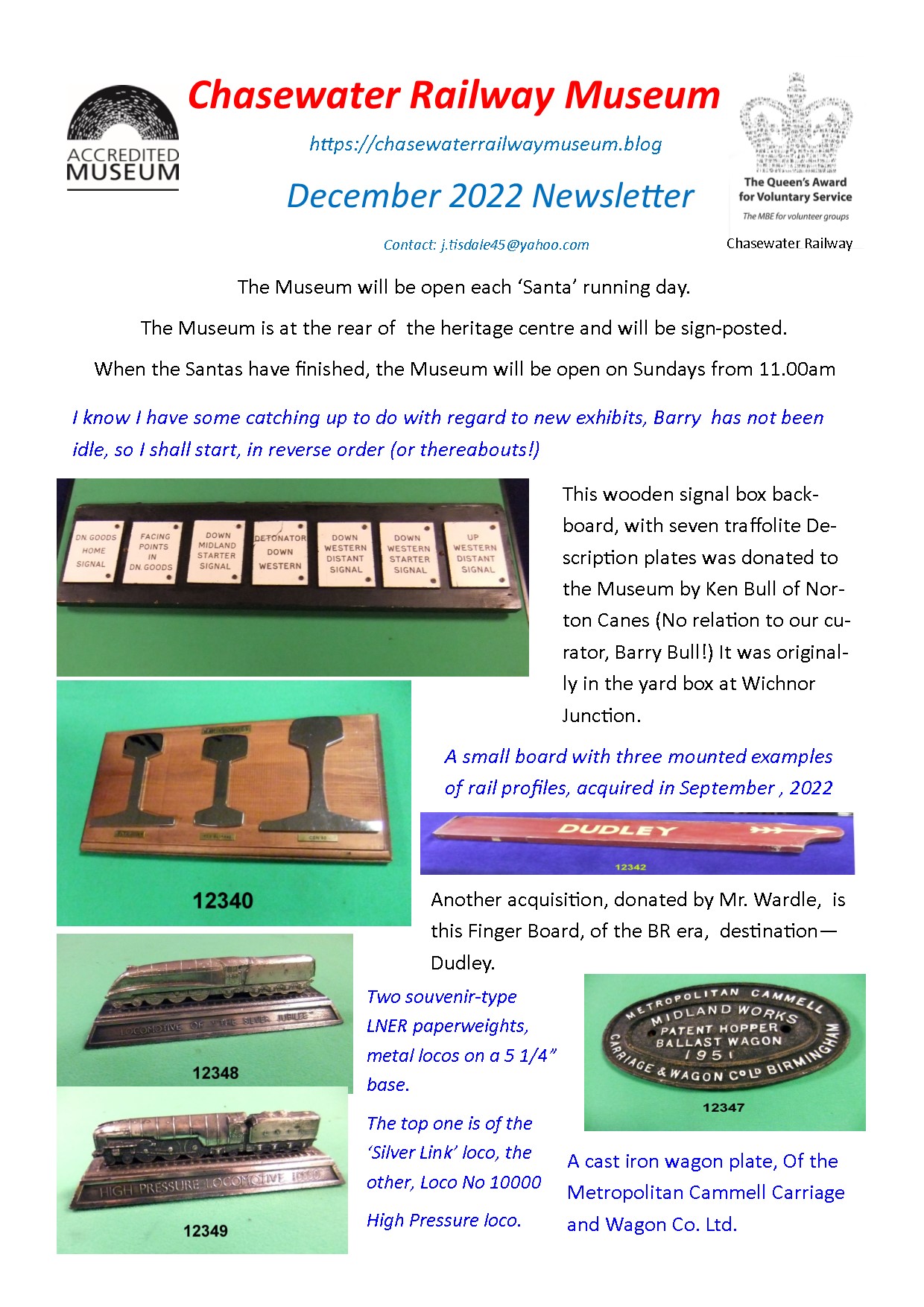
Chasewater Railway Museum- December 2022 Newsletter

Image

Chasewater Railway Museum News

126 – Chasewater Railway Museum Bits & Pie

126Chasewater Railway Museum Bits & Pieces

From Chasewater News August 1990

Editorial

This year has seen a continued increase in volunteers and therefore in the amount of work carried out on the railway.  For the first time in a long while a number of major jobs have been carried out simultaneously, such as trackwork, carriage and wagon repairs and loco maintenance, even when trains are running.

A lot still remains to be done, and with a visit from the Railway Inspectorate now promised within the next couple of months, it is even more important that this level of activity continues.

Following the Railway Inspector’s visit we should know exactly what work is required to extend the line, or indeed to continue running the existing section, and will be able to plan accordingly.  After all, it would still be nice to run trains into a platform at Willow vale Halt later this year.  (Nigel Canning – Editor))

Locomotive News

No.4 Asbestos – Having been at a virtual standstill for a number of months, work has now re-commenced in earnest on the firebox repairs and preparation for the major boiler examination of this loco.  A number of new tubes are to be purchased and will be fitted to replace those leaking when the loco was taken out of service.  Hopefully the loco will re-enter service before No.5’s boiler certificate expires in October.Sentinel pausing at Willow Vale – Nigel Canning

No.5 Sentinel – This loco has so far handled all of this year’s trains.  Recently adjustments have been made to the camshaft driven valve gear with, eventually, improved running as a result.  Various minor steam leaks still remain to be attended to.

No.2 Lion – The new boiler tubes for this loco have now been fitted and work is progressing towards its first hydraulic examination.

S100 – Work is still progressing with the machining of the hornguides of this loco.

No.11 Alfred Paget – This loco received a very nice paint job and superficial restoration for the Bescot Open Day and has been placed on display at Brownhills West station.

No.7 – Ruston – This loco is still in good running order.

No.9 Fowler – Investigation into the starting problems of this loco which had been thought to be due to a damaged starter ring, revealed that in fact a multi-plate clutch built into the starter motor had become fouled with oil and was slipping under load.  This clutch was cleaned and re-tensioned giving perfect first time starting on this loco.

Carriage & Wagon News

Work has recently started on two of our historic coaches, the Midland four-wheel passenger brake, and the Manchester, Sheffield and Lincoln Railway six-wheeler.  Both have been in need of extensive renovation for some time, but now look set to receive it.

The Gloucester and Wickham trailer cars are still running coupled together to form the passenger train whilst the Wickham power car remains in use as the station buffet.

Permanent Way News

Brownhills West Loop – Nigel Canning

The new points at Brownhills West are now virtually complete along with their associated trap point set and lever frame.  This means that we now have a complete run round loop for the first time in our railway’s history.

Weedkilling of the running line took place, rather belatedly, during May.  Bad weather and financial restrictions having prevented this vital job being done earlier in the year.  In addition, a number of worn sleepers have been renewed, and on particularly bad joint repaired.  It is intended to grease the remaining fish plates on the line and re-pack any dipped joints in the next month or so.

The dramatic increase in members in recent months means that work continues even on event days when trains are running.  In the near future the large steel gate at the shed yard entrance is to be moved down to the level crossing to complete the pair of gates there.  A replacement for the shed yard has recently been donated in the form of a pair of wooden gates which when in position, will give slightly wider access for the large vehicles such as the coal merchant’s lorry.

125Chasewater Railway Museum Bits & Pieces

125Chasewater Railway Museum Bits & Pieces

From Chasewater News April 1990

Midland Railway – Brownhills Branch – B. Bull

Copy of what may have been a locally commercially available postcard depicting a MR Johnson design 3F 0-6-0 of the type introduced in 1885 and rebuilt by Fowler from 1916 with Belpaire boiler.

Looking back through various back numbers of ‘Mercian’, ‘Chasewater News’ and ‘Railway Focus’ it becomes apparent that little has been published to inform members of the history of this branch, part of which trackbed provides us with the base for our own Chasewater Light Railway operations.  An even more glaring omission is that we have not made available for publication the few interesting photographs in the museum collection.

 On July 1st, 1879 the Midland Railway had opened a line from Castle Bromwich to Walsall with intermediate stations at Penns, Sutton Coldfield, Sutton Park, Streetly and Aldridge.  Whilst this line was being constructed, a branch from Aldridge to Walsall Wood was authorised on July 13th, 1876, with further extension to the western shores of Norton Pool being authorised on August 6th, 1880 to give an end-on connection with the Cannock Chase & Wolverhampton Railway, just south of the causeway.

The contractors for this 3¾ mile branch were H.Lovatt & Co.Ltd.  I am unable, however, to discover any details of the contractor’s locomotives which would undoubtedly been used on this project.

On April 1st, 1882 the branch opened as far as Brownhills West for goods only, with the connection to the CC & WR being opened on November 1st, 1882.

Just north of the A5 road there was a short lived spur to the Coppice Colliery, Wilkin, owned by J.Owen Ltd.  (Later the Coppice Colliery Company.  This spur closed when the colliery was shut in 1894.

Passenger services commenced to the newly opened stations at Walsall Wood and Brownhills Midland on July 1st, 1884, but colliery traffic continued to be the mainstay of the branch.

Brownhills Midland was over half a mile out of town just north of the A452 Chester Road, whereas the LNWR station on the South Staffs Walsall line was handily situated at the end of High Street so it was no surprise when the LMS withdrew the passenger service on March 31st, 1930, Brownhills Midland being demolished soon afterwards.One amazing survivor is a wooden ‘finger’ which used to point the way to the platforms.  This piece owes its continued existence to the gentleman who fortuitously purchased from the site a pile of wood to build himself a garden shed, the finger surviving long enough to find its way by means of a donation to the RPS collection.  However, I digress slightly, goods traffic continued on the branch until the closure of former Cannock Chase Colliery pits by the National Coal Board in the late 1950s, the line being lifted between Aldridge and Brownhills West in 1960, with the CC & WR remnants left around the northern shores, mainly going by 1963.  Last day of passenger services at Brownhills Midland.  A Johnson 3F, No.3277, with two coaches of compartment stock including a clerestory probably dating from the period 1897 to 1916.  The porter seems to be holding up a closure notice or something similar perhaps.

What was left owed its continued existence to the NCB Area Workshops which was then just rail connected to the former LNWR Norton Branch via a circuitous route through the closed Conduit Colliery yard reached by a spur just south of the causeway.  A small amount of the original Midland Railway metals had been left as a headshunt, this being part of the former exchange sidings with the CC & WR and it was some nine years after the Railway Preservation Society came to Chasewater before British Railways ‘rediscovered’ the sidings left for NCB use in 1960 when the rest of the branch had been lifted.  By then of course the Society had extended their track into the park so the still BR owned piece fell in the middle of the Chasewater Light Railway.  How this problem was surmounted will be the subject of a future article, as it is a story in itself.Standard MR platform lamps on hexagonal posts are in evidence, but the sawn paled fence seen in the postcard view has been replaced with the sawn diagonal variety by the time these photos were taken.

The photographs

These form part of the Museum’s collection of local photographs, some of which will be made available to the Editor to feature in future issues of Chasewater News.  With 1990 being some 60 years since Brownhills Midland closed its doors to passengers, it is especially pleasing to be able to provide photos of the last day of services, March 31st, 1930.

120 – Chasewater Railway Museum Bits & Pieces

From Chasewater News December 1989

120 – Chasewater Railway Museum Bits & Pieces

From Chasewater News December 1989

From the Editorial

Looking back, this year has been quite successful for the Railway with relatively few problems to contend with and a number of major advances made.  Train operation, although hectic for the staff involved, ran smoothly and every special event seemed to go well to the extent that our period of ‘survival’ of the last few years has begun to progress into a time of modest expansion.

As 1989 draws to a close and we all wait for Santa’s Special to arrive at Brownhills West, we can begin to plan next year’s work on the line.  It is all very easy to draw up a long list of jobs, but short of ‘asking Anneka’, they wouldn’t get done.

Realistically, in addition to all the regular maintenance work, we could have a platform built at Willowvale Halt ready for Easter, carry on to complete the run round loop at Brownhills West and relay enough track past Willowvale to run a goods train up and down on Gricers Day.  That would be an excellent season’s work, but it is only possible if people put the effort in. Locomotive News

Asbestos – Having worked the majority of this year’s trains, this loco is now due to be taken out of service for its six-yearly major boiler inspection.  The work will involve the removal of the saddle tank and boiler lagging as well as all fittings.  It is likely that a certain amount of repair work will be necessary around the firebox foundation ring and also renewal of a number of boiler tubes.

Sentinel – This engine finally re-entered service on Sunday 6th August when it took over from Asbestos to work he last two trains of the day.  The recent introduction of two-coach trains meant that this little loco has to work really hard against the gradient on the return run to Brownhills West with the regulator wound wide open for most of the distance.  The result of this is that coal consumption appears to have increased slightly over last year’s running, so that the bunker needs topping up towards the end of the day.  To cure the problem it is planned to fit coal rails to the bunker to increase capacity to around 8cwt.

Lion – The good news is that the Boiler Inspector has done his preliminary examination and has given the go ahead for the loco to be re-tubed and prepared for its hydraulic test.  Painting of both the frames and boiler shell has continued, along with work on new fittings and pipework needed before the engine can be steamed.

S100 – The frames of this loco are currently being jacked up in the back of the loco shed so that the wheels can be removed to allow machining of the horn guides.

DL7 – this remains our only working diesel and has continued to run well, although on the morning of the Bonfire Night steaming its contactors had to be quickly cleaned as the traction motor suddenly refused to ‘switch in’.

Fowler – At last the necessary information for the renewal of the blowing cylinder head gasket has been found and the repair work was carried out on Sunday 12th November.  With train operations gradually expanding it is becoming more important that at least one of the two diesels be vacuum brake fitted so that it can be used to work passenger trains if required at short notice or on quiet non-steam days.  Hopefully the work will be carried out shortly.

Other Locos – No work has been carried out on any other locos.

 Carriage & Wagon News

The Gloucester & Wickham trailers have remained coupled together since June to form the operational passenger stock.  The bodywork of the Gloucester is now looking positively tatty and will require repairs and a repaint before next season’s running.  Again no work has been carried out on any rolling stock other than the three DMUs. Permanent Way News

A few dedicated men are still pushing on with the trackwork and as a result the old turnout which marked the start of the Norton loop has been completely removed and the line is gradually increasing in length towards the causeway.  Progress on this work quite honestly is very slow, but when only three or four people on average seem to be prepared to help, and even the shorter rails which have to be moved weigh about a third of a ton, this is to be expected.  Just to give the P. Way gang a break from trackwork and to provide variety in their work, the local toe-rags managed to cut every strand of wire between every fence post from the level crossing right down to the bridge.  This had to be patched up again before trains could run on Gricers Day when everyone was already pushed to near the limit. Operating

August bank Holiday Monday marked the end of the two months of weekly running allowing a very welcome break for all the operating staff.  Gricers Day saw both Asbestos and the Sentinel in steam, with the last two trains of the day being double-headed.  Rumours that this was brought about by one case too many of a certain lager in the buffet car causing the gross train weight to exceed the maximum allowable Sentinel loading were untrue, but merely an example of the Midland Railway Company’s small engine policy in action!   The Sentinel will now work the remaining trains of this year to allow Asbestos to be stripped for boiler examination.

New arrival in 1961

119 – Chasewater Railway Museum Bits & Pieces From Chasewater News Autumn 1989

119 – Chasewater Railway Museum Bits & Pieces

From Chasewater News Autumn 1989

From the Editorial

This magazine sees another change of Editor as I (Nigel Canning) volunteered to take some of the load off Steve Organ.  We both spend a lot of time at Chasewater so we have up to date material for the magazine, but perhaps the problem is recognising it.  A number of members and visitors who had not been to Chasewater for a while have expressed amazement at the recent improvements and are obviously delighted, whilst those of us who work there every week tend to have on our minds want we haven’t done yet rather than what we have.  As you read the various sections of this magazine you will see the usual excuse for jobs not being completed, ‘lack of manpower’, however, if you look back through previous magazines the problem has subtly changed, hopefully for the better.

It used to be:  ‘Insufficient manpower to rebuild the railway to allow train operation’.

Then:  ‘Insufficient manpower to run trains more often’.

Now:  ‘Insufficient manpower to open the bar every week’.

Next perhaps:  ‘Insufficient manpower to sell tickets at Willowvale Halt’.

All of this shows that we must be making progress and makes me wonder what we will have insufficient manpower for in, say, ten years time???

Locomotive News

Asbestos – This engine has worked all of this year’s trains so far with only various minor leaks having needed attention.  The recent introduction of two coach trains has proved to be no problem at all for it, with only apparent minimal increase in coal consumption.

Sentinel – Getting this loco through the various stages of a major (five yearly) boiler examination has proved to be a long drawn out business, however it is now ready for its steam test and should be back in traffic by the time you read this magazine.   In addition to the statutory inspection work, an extra water level gauge has been fitted to the boiler, also a new, larger ashpan ready for working the new Norton Expresses.

Lion – Much enthusiastic work has continued on this engine, mainly getting the boiler ready for its initial major examination.  In addition to this, various new boiler fittings have been procured and machined, further vacuum brake pipework added and more paint applied to the frames.  Hopefully the loco will enter service during 1990.

S100 – Work has concentrated on splitting, cleaning and re-assembling the springs of this loco, a job involving a lot of heat and brute force.

DL7 – This loco has again run well, performing all the shunting and works train movements.  The only minor failure was that of a bearing in the small battery charging dynamo which was repaired fairly easily.  Following a bout of vandalism by local tow-rags the loco has been repainted in ‘Rail Blue’ complete with yellow and black striped ends to cover the graffiti.

Fowler – This has remained ‘standby diesel’ due to a blowing cylinder head gasket.  Attempts at finding the necessary details required for the repair, type of head gasket, torques and torquing sequence, etc. gave been somewhat protracted due to the engine manufacturer’s inability to provide the information even when the block number was quoted.  This loco is also in the process of being repainted, but in Longmoor Military style of blue with the motion and other details picked out in red.

Other Locos – Little or no work has been carried out on any other loco since the last magazine.Carriage & Wagon News

The big news is that the Wickham trailer entered service on Saturday 17th June coupled to the Gloucester to form the first regular two-coach train.  The following day there was another first when the bar was opened and refreshments were served on the moving train.  Although a certain amount of finishing off work is still required to the interior, the coach has run every week since its inaugural day and has been a great success.  A finishing touch currently underway is a pub sign ‘The Wickham Bar’ being painted on the large unglazed body panel at the gangway end of the vehicle.  A precedent for this was the Southern Region ‘Tavern Cars’ which ran for a while in the fifties in ‘ blood & Custard’ livery with brickwork and a pub sign painted at one end.  Other than the three DMUs, no work has been carried out on rolling stock due to lack of manpower.Permanent Way News

One problem with running trains every Sunday is that it doesn’t leave enough people to do much in the was of trackwork.  However, the track we are currently running on is in reasonable condition and, by our standards, is remarkably free of weeds.  In view of the above situation, all efforts will be concentrated later in the year, starting around September, on a number of projects.  These will be; packing rough bits of the existing line, repairing the fencing again, completing the run round loop at Brownhills West, building a platform at Willowvale and then extending the line towards the causeway.  Any volunteers for this work will receive a warm welcome and a choice of shovels!

Operating

So far this year operating the railway has been even more hectic than usual for a number of reasons.  A lot more trains have been scheduled, running every Sunday in July and August, which is another ‘first’ for the railway.  In addition to this, steam trains were run on Monday July 3rd, two school specials, and the first ever Birthday Party Special, all of which were very successful and will hopefully be repeated regularly.  The recent addition of two-coach trains in itself has been no problem, but when the bar is in use at least one extra person is needed to staff it.  For the obvious security reasons the day’s work involves loading every item of stock onto the train and unloading every remaining item at the end of the day.  As a result, so far this year the bar has been open only on special days when staff have been available.  A similar problem has of course existed for a long time with the Wickham buffet car with all stock having to be transported to and from safe storage.  As usual any volunteers will receive a warm welcome and a choice of whatever the apparatus for this work might be!