Chasewater Railway Video Clips – 2009-2010

Five video clips taken over 10 years ago.

Chasewater Railway Museum – Bits and Pieces 72, December 1976

Chasewater Railway Museum Bits & Pieces 72 – Dec 1976

The Railway Preservation Society Newsletter

Chasewater News – Part 1

From the ‘Editorial’

Less than 24 hours ago, I was standing in the compound with a group of members, discussing the lack of recent Society literature, when jokingly I suggested I could piece together a newsletter.  Well here I am trying to write one.

Sincere apologies are due for the non-arrival of ‘Chasewater Express’ No.3, due to printing problems, etc.  Hopefully the next edition will revert to the magazine format, which has produced some favourable comments. (Sorry folks – it didn’t!).

Much activity has taken place at Chasewater during the long dry summer and the short wet autumn.  No less than three engines have been seen in steam at Chasewater this year, a record for the Society.  It is estimated that over 8,000 people visited us, so there is every confidence of getting into five figures in 1977.  ‘Alfred Paget’ the Neilson 0-4-0ST handled the bulk of the season’s traffic faultlessly (well almost!),

Alfred Paget and Invicta

whilst ‘Asbestos’ was steamed on a couple of occasions, but succumbed to rotten tubes in August and so was taken out of service pending the annual boiler inspection.

The big news however has been the completion of the overhaul of ‘Invicta’ the Barclay 0-4-0ST and its use in service pulling the vintage train on a couple of occasions at the end of the season.  Already it has proved to be quite powerful, despite its somewhat diminutive size.  Many thanks are due to Mike Wood for the purchase of this engine.

The boiler inspector has visited the site and passed ‘Alfred Paget’ and ‘Invicta’ for use next year, subject to steam tests.  Unfortunately ‘Asbestos’ is due for a major test entailing the removal of tank and lagging, so it may not steam next year, for the first time in five years. 

Paget with Asbestos

It is hoped that work will start on the Peckett 0-4-0ST ‘Lion’ in the New Year, so there is plenty of work for anyone interested in loco repairs – don’t be shy, come and volunteer to strengthen our loco fleet.

Both ‘Invicta’ and ‘Paget’ are to be repainted prior to next season.  The little Barclay, ‘Lion’ and the Hudswell Clarke 0-6-0ST have been repainted this summer, considerably improving the ‘scrap-yard’ image of the compound.  The planned repaint of ‘Asbestos’ will also be done, made easier by the need to dismantle it.

The other major scene of activity has been the current terminus of the line where the burning embankment has been dug out and refilled with non-combustible material.  The track here has been slewed across to avoid placing stress on the edge of the embankment.  Further relaying has taken place using concrete sleepers, extending the line by 50 yards or so.  Many thanks to Colin Vincent for the loan of his bulldozer.

Further relaying has ceased pending purchase of the loopline from British Railways.  It seems that the purchase will have to be completed without financial aid from the Council in view of the current economic and political climate (sound familiar!).  To this end several interested bodies have offered substantial sums of money for the ‘E1’ locomotive ‘Cannock Wood’. A subject of much heated discussion at the moment. (See separate letter. In the next post – cws). The selling of E1 can only be done as a last resort, if all other means fail.  Any sensible suggestions regarding fund-raising, etc. should be forwarded to the Hon. Sec.

Other progress has been seen with regard to re-fencing of the compound following two break-ins, when £40 worth of relics were stolen from the museum vehicle.  The police have the addresses of the probable culprits so the items may be recovered.

Major Olver of the Railway Inspectorate visited the line and was reasonably satisfied with the current state of affairs – the full report will appear in the next magazine.  It is to be hoped that the Chasewater Light Railway Company will finance the repainting of the DMU coach, so that it can match the current excellence of the two six-wheelers.

The Model Railway Exhibition held in September was another financial success, though the level of help, especially of the Friday night, was poor.  Many thanks to Andrew Louch, the organiser and to Mr. and Mrs. Duffill for the refreshments.

Chasewater Railway Museum – November 2020 Newsletter

The Museum Newsletter fro November 2020 – Barry Bull keeping it going!

Chasewater Railway Video Clips

Not strictly Museum items but it’s nice to look back sometimes.

Chasewater Railway Museum Bits and Pieces No. 71, April 1976

Chasewater Railway Museum Bits & Pieces 71

From the ‘Chasewater Express’ April 1976

I have no idea where the picture of the LP came from – it’s not on my preview or anywhere else on this post??

Editorial

Steve’s Bit

Considerable activity has been occurring on site in recent weeks. This is no doubt due largely to the long stretches of dry and sometimes mild weather. I hardly need say however, that those present were more or less the usual crowd. Still, spring is near, and the prospect of a few more members turning out occurs as a dream to those of us tied to the site every weekend. There are many fingers to be pulled out and bumps in the track to be smoothed, as well as a crossing and a siding to be laid, engines and carriages to be cleaned, painted, steamed and pulled in order to grab any stray waif, family of four or local loony for a ride, on which we depend so very much for our cash intake. The Society has ‘just about’ ticked along financially – we must this year raise enough cash for active members to realise their ambitions, i.e. re-panel and refit what is known as the ‘Football Special’

The LNWR compo brake; and more importantly, the TPO, which is in a shocking state for a vehicle of its importance.

Travelling Post Office at Hednesford.

Engines too need cash, which they tend to consume in greater quantities than coal during the period of their restoration – not to mention Keith Sargeant.

Steve Organ – Editor, Station Master and Order of the most meritorious school of tipyng errrorz.

(Listen for loud popping noises as people pull their fingers out in what for many will be their only physical response to this apple peel!)

Not to mention K.S. who complained that he wasn’t mentioned enough in the last mag!

Chasewater Site Notes

Some lunatic has stuck pieces of wood in the platform, painted them pink, and left them – saying nothing to anyone regarding them. (This is a sight worth seeing! Ed.)

Invicta arriving 1975

Mike Wood has been seen in his role as scrubber extraordinaire (Special duties – preparing his engine Invicta for painting prior to its introduction to Chasewater service, at… well let’s say ‘as soon after April 11th as possible.  Said scrubber Mike, ‘this is going to look the most impressive engine at Chasewater.  It is going to be rather lavishly lined over Easter, you know’. (Not to mention this last bit to Keith Sargeant, the Neilson freak!)

The LNWR full brake has been completely painted and laid out as a museum.  Nearly 1,500 square feet of wall space is now devoted in this vehicle to the exhibition of relics, as well as exhibits in cases therein ( not to mention the nameplates of Alfred Paget, which are to be fixed by K.S. to the Neilson at some point in the future, we are given to hope). (Vaguely).

Concrete sleepers? Bloody ‘ell mate, what do you think we are, main line to Euston?  I mean – what? Donated by the Ministry of Agriculture and Fisheries? Lying in the grass at Lichfield for years?  Enough for seven lengths did you say?  Bloody ‘ell mate, how many?  22 letters to get them?  Three cheers for DEREK JUNIOR!

The Midland is being spruced up externally and painted properly internally in order to preserve it until we have time and money to do it properly.  If any member would like to dismantle and rebuild two of the doors on this vehicle, would he please come to the site and report to Andrew Louch or Steve Organ?  Ta.

The Great Western water tower, complete with tower, tank and cap were cut up on site and removed during the week ending 20th February.  We know not the perpetrators of this terrible deed – the police have no idea.  What to do?  Someone buggered off with two tons of steel and no-one saw them.  We have our suspicions but no proof.

Credits:

Pink posts – Steve Organ

Invicta scrubbing – Mike Wood

LNWR brake – Albert Haywood, Derek Junior, Nigel Canning, Steve Foster, Barry Bull, Richard Louch, Andrew Louch (who painted the doors a different green to the rest of the vehicle – is this man colour blind?), Adrian (I don’t know his surname but he’s nearly always here).

The Midland – As the LNWR brake, plus Steve O.  Not to mention K.S., who is preparing Invicta, in league with Derek Luker and Brian Hames. Advertisements

Occasionally, some of your visitors may see an advertisement here,

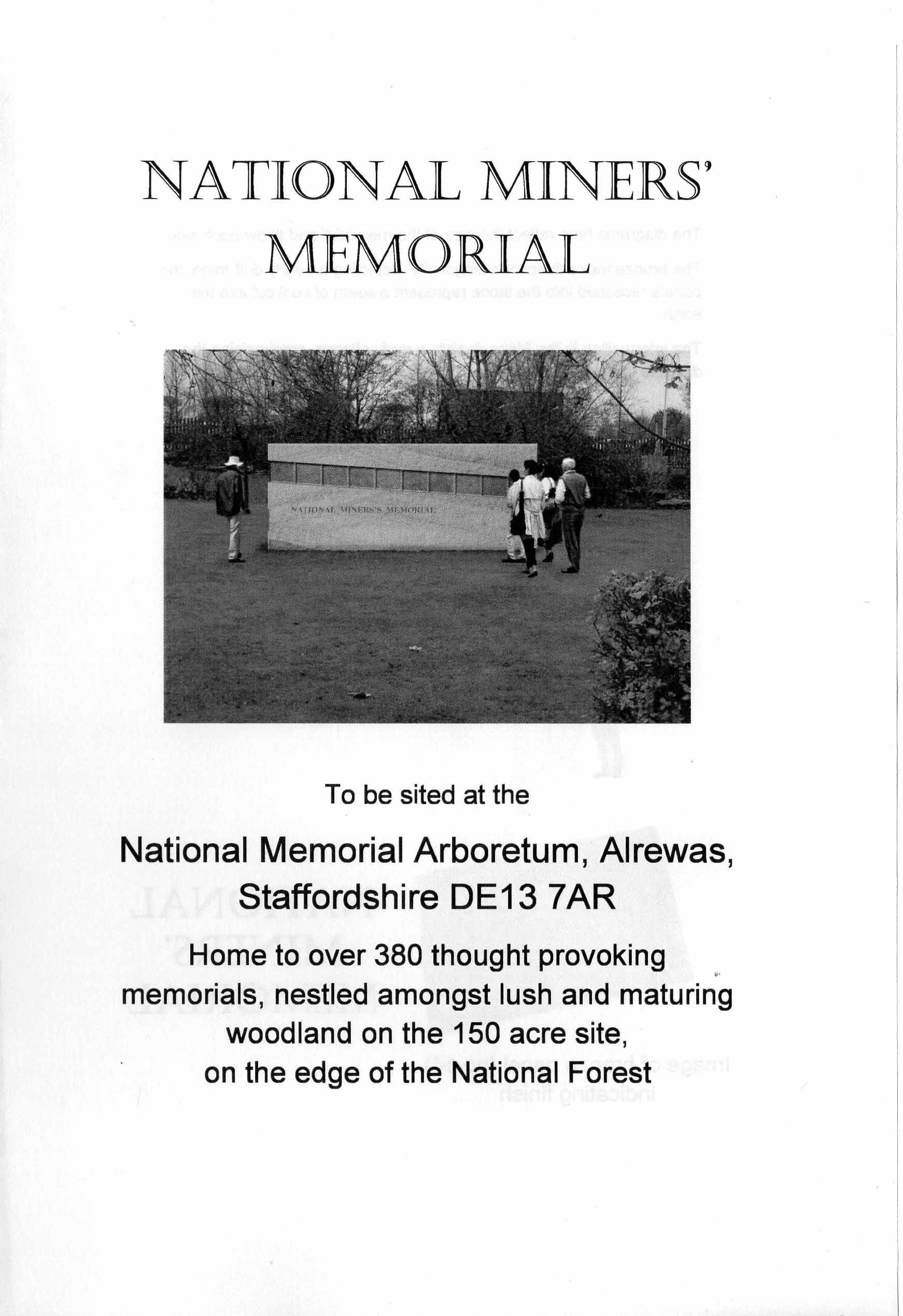
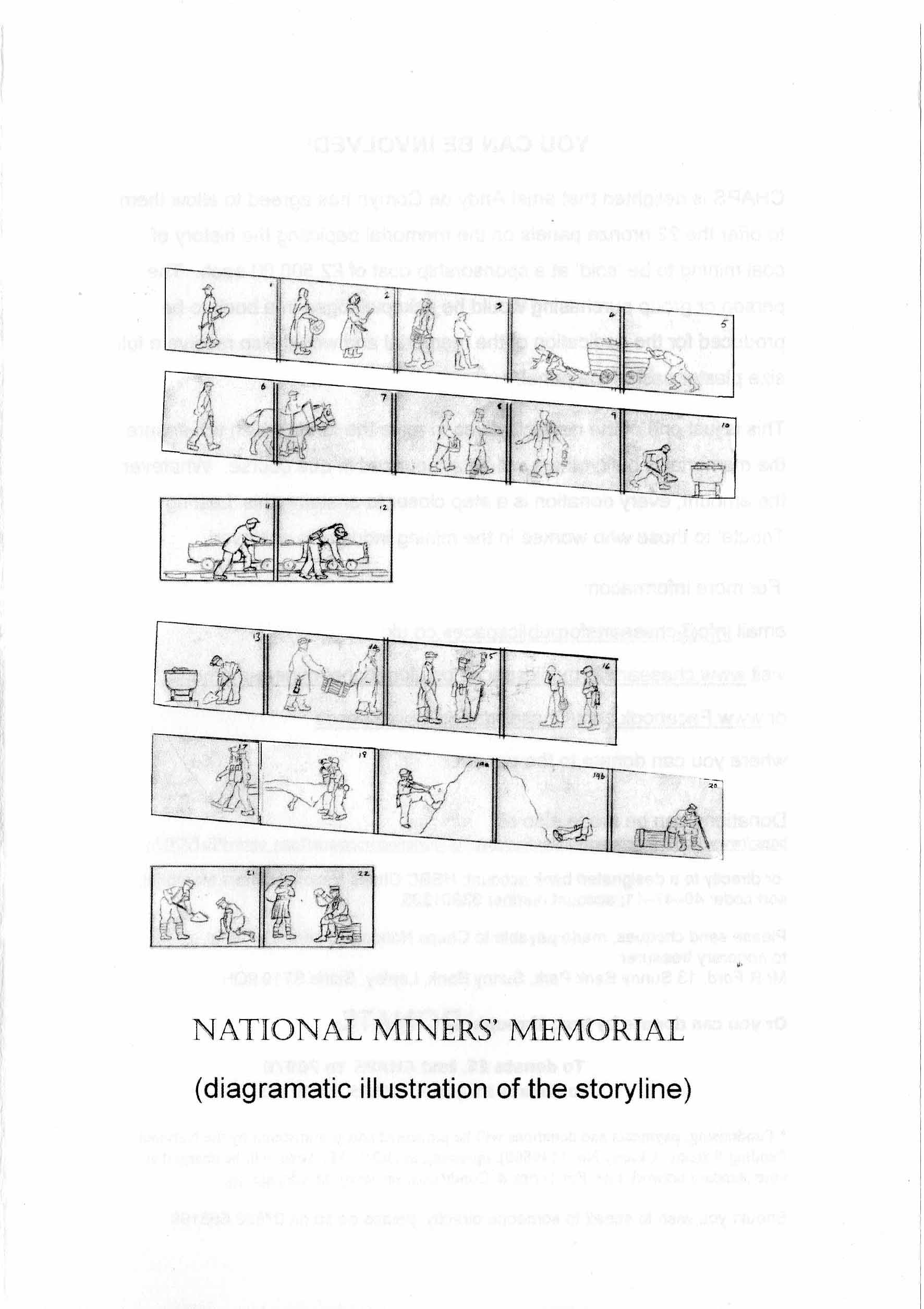
News about the National Miners’ Memorial

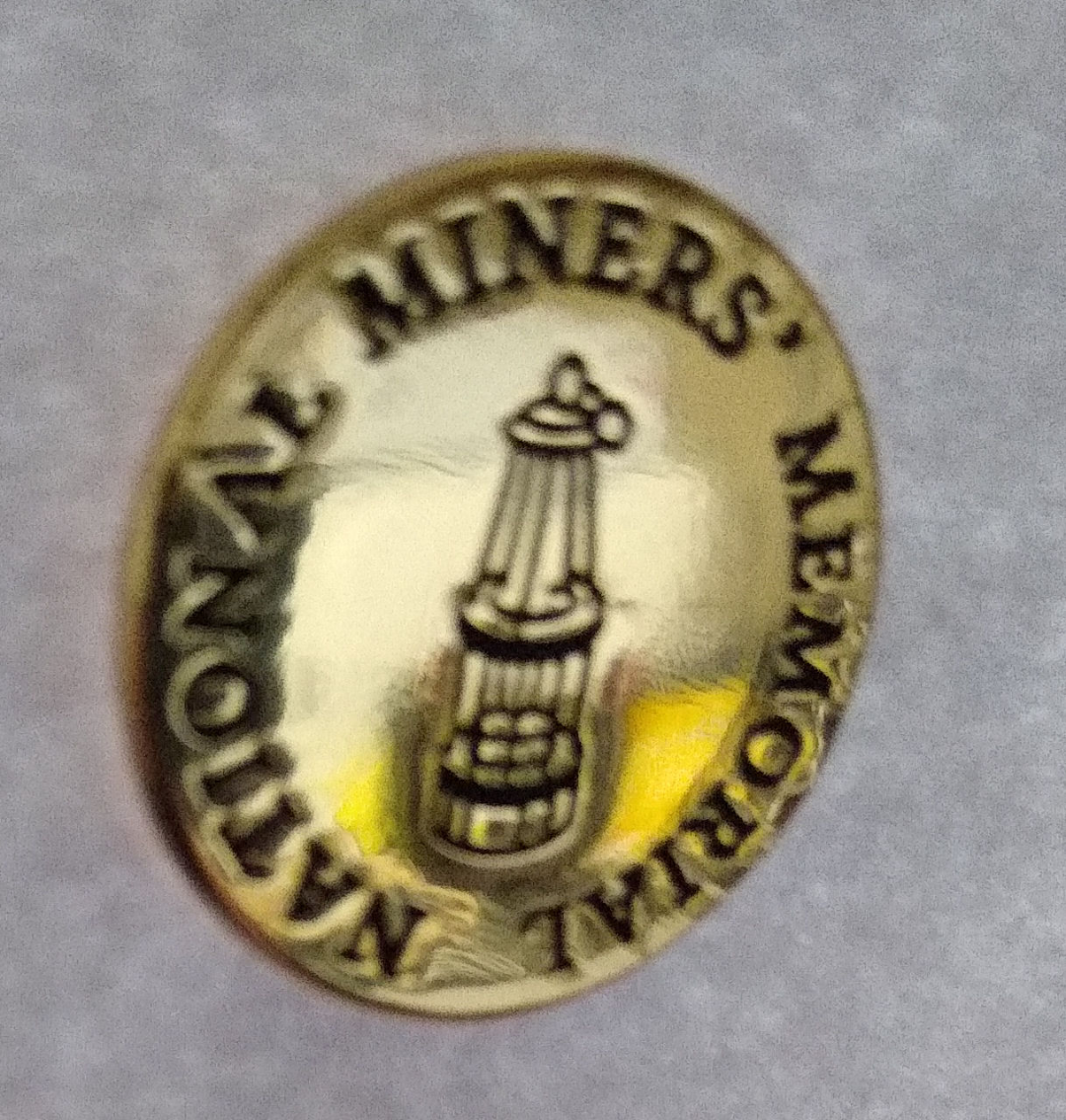
Lapel badges are available to support the Memorial Funds, costing £5.00 + p&p.

If you are interested in purchasing a badge, please contact Alan Dean on 07889 728097

Chasewater Railway Museum Bits & Pieces 70

Chasewater Railway Museum Bits & Pieces 70

From the ‘Chasewater Express’ April 1976

A poem which follows on from the previous post

The Neilson without nameplates and Asbestos

Neilson  – complete with Alfred Paget nameplates

One of the ‘Puddings’

Chasewater Railway Museum – Bits and Pieces No.69

Chasewater Railway Museum Bits & Pieces 69

More from the ‘Chasewater Express’ January 1976

Editorial

The Editor wishes to state that he is in no way responsible for the ensuing passages, which emanate from the pen of a Black Country ex- butcher who nowadays works (?) for the only railway company in the country which is known to have in its stocklist a few hundred Brush 4s, a couple of dozen class 87 locos, etc.  Spelling and grammatical errors are his, not mine.

The Restoration of a Rusty Beast

Or

The Gospel According to Keith Sargeant

One particularly wet and generally normal Chasewater morning whilst shovelling (rubbish!) out of one very rusty coal bunker, I thought ‘will this thing ever go again?’ ‘’Course it will’ cried D.Luker, as he walked by for the tenth time that morning.

Well, it does go now and I will attempt to show how it was done.

In the winter of 1973/74, the boiler was stripped down and cleared of all the rotten lagging upon it, the firebox was cleared out in the space of one Sunday, the smokebox, however, was a completely different matter.  A very crude but effective spark arrester was cut out, never to be replaced; the next four hours (was!) were spent devoted to the removal of the blastpipe which was only held in with two taper cotters.  Evidence of neglect was showing through, on removal of the blastpipe a cup of tea was summoned and obtained.  ‘I’m not working on that thing in the rain any more’ Derek grunted through a sort of mist that arises off Chasewater tea.

The next weekend was devoted to building a ‘Tent’ upon the loco and fitting electric lights up to work on the loco in the dark.  Once it was completed, three weeks were devoted to clearing off the front tube plate.  To our horror, Derek’s clearing off of this revealed that the tube plate was less than half its original thickness for most of the lower 3” and non-existent at the flange with the barrel.  The smokebox bottom, which is formed of an extension of the boiler barrel, was also gone without trace.  A very awesome sight that left us wondering if the knuckles we had lost were lost in vain.

Work was suspended while Derek went cap-in-hand to the man with the money to ask for £300 which the Society had not got.  The remarkable thing was, they gave it to him.  He then got in touch with a bloke what mends boilers and after lengthy discussions with our boiler inspector and the boiler mender it was decided that the boiler was in such a good state that it was worth spending money on expensive repairs to it.  The contractor’s job was to replace 13 1” rivets and build up the smokebox tube plate to its original thickness and build up the corners of the firebox likewise.  This work was carried out in the space of three days, and restoration by Society members then re-commenced.

During the repairs, 10 flue tubes were replaced – bloody good ones they were too.  All boiler fittings were overhauled and replaced.  The regulator valve was taken home by Derek to Stafford where his neighbours were worried at the sound of him grinding ‘IT’ on the hearth rug.

The boiler was hydraulically tested and passed with flying colours.

Now with the boiler out of the way, the mechanics were looked at – ‘Boy, what a mess!’

4 tattered main bearings, 2 seized pistons, no side rods brassed, 2 valve spindles worn like egg-timers, and a partridge in a pear tree – PEAR TREE! Oh yes Boyo, we spent a few hours in there sampling the delicious tremblings, Boyo!

Work was suspended from the summer of ’74 to the winter of 74/75 fro work to be done on ‘Asbestos’, and also we built a workshop containing several mechanical works of art enabling Derek and Brian to while away the winter months machining the main bearings.  When they were done and fitted, the loco was lowered back on its wheels, the boiler was lagged and the tank was found to have more holes in it than a hairnet!  Six weeks were taken filling these in – we found the rest when it was on the loco!!

The loco was re-mated with the tank and the (Barkeus? Sorry, can’t decipher – Editor) nicely patched up and painted a delicate shade of black and red.  Now we had what looked almost like a steam loco, it was then decided to borrow the lubricator off of the Hudswell-Clarke.  This is where Brian Hames came into his own.  His short, Coal Board figure was just the ticket for getting round the little bits of engine that get in the way when you are laying lubrication pipes all over the place.  After that was done a steam test was made, the boiler steamed well and the injectors worked like two humming birds.  After eight months derelict and 18 months stripped down, only one leak in sight – and a very tiny one from a blown joint at that!

Now the moving parts.  As she stood they listed two seized pistons and valves, two weighbar shaft bearings (ready for a gallop) and one very rusty steam brake valve, complete with bent brake gear (a relic from Bruno days).  Something tells me I have (Sorry about this next bit of indecipherable script – Ed.) Wol’t fhat Bit a £ove –

After re-metalling the four main bearings and weighbar shaft brasses we set to putting it together again, first the pistons and valves, the valves took a lot of buggering about with and a great deal of patience on Derek’s part.  The siderods took about twelve weeks to fit as we had to make all the brasses from a similar but younger loco.

When Alfred Paget (as we had decided to call it) was back together again and had been made to look respectable with the aid of two gallons of black paint, we steamed it – what a day!!

06.30 we lit the fire and raised steam Lewis fashion (slowly – Ed).  By 11.00 we had got 50 lbs of steam, and it would not budge – what had we forgotten to do, I thought?  ‘Give it a nudge’ said a very dirty and unhygienic NCB Brian.  So we did.  Chuff, chuff, wheeze she went, like a ‘Super D’ with not a bit of trouble.  The brakes didn’t work  for a few weeks until they were worn in – but now we have one beautifully repaired Neilson 0-4-0ST loco of 1882 vintage and it was in steam for the 150th Anniversary to boot!

No mention yet has been made of the carriage and wagon tapping fraternity who are a body of MEN?? Who delight in making life difficult for us engine bashers.  Still, as I haven’t mentioned them before, I won’t bother now!!

Jotted by the most photographed driver at Cheesewater and published by the Keith Sargeant Appreciation Society.1975 Open Day – He’s in the middle! Andrew Louch on the right, with Brian Hames on the left.  Thanks Bob.

Summary of dimensions

Neilson standard 14” design

Weight: 28tons

Overall length: 23’ 7”

Height: 10’ 10”

Boiler Pressure: 120 lbs/sq.in.

Tractive Effort: 8885 lbs.

Cylinders (Outside) 14” x 20”

Chasewater Railway Museum Bits & Pieces 68

Chasewater Railway Museum Bits & Pieces 68

From the ‘Chasewater Express’

January 1976

Editorial

Steve’s Bit

Here we are, into 1976, and once again the Society is crying out.  Crying for cash and for help.  Once again it is up to members to try and help us over the winter patch, which, as in other years, is hit by poor attendance of volunteers.  Our Society is by no means unique in this respect.

I ask you then to do this:  there is enclosed in this mag a loose membership form: persuade a friend to fill it in and send it to us.  If each member gets just one new member, then our workforce should double.  Sounds glib – but is it too much to ask?

Hope you like the new magazine.  This is the ‘cheap’ winter edition, with duplicated insides, but the summer edition – in April – which will be on wide sale to non-members, will be a classier affair altogether.

Your adverts are welcome – send them to me.  I intend to widen our circulation by acting as a ‘Notice Board’ for vendors and collectors of Railwayana.

Steve Organ, Hon.Editor

Steve Organ has now taken over the editorship of the newsletter, though he tells me that he is going to modify the format slightly.  I must thank Steve for relieving me of the job, which has at times been rather difficult to achieve due to business commitments,

We are in the winter now and a difficult time to try and maintain our stock and locomotives at Chasewater due mainly to a lack of covered accommodation.

We are now in our sixteenth year, and can be fairly called a viable society; we do emphasise, however that we must have all the help that anyone can give, to continue to be viable.

Laurence Hodgkinson and I made a very enjoyable trip to Ludgvan, near Penzance, during November, and collected six gas lamps intact from an old GWR clerestory body – this entailed a lot of hard work, particularly for Laurence, who had to cut through all the plumbing.  We returned through fog, gale and rain to offload the lamps at Chasewater around midnight that evening.

Our sincere thanks to Mr. Davey Thomas who owned the coach body for his generosity and hospitality.

May I wish everyone a prosperous and happy New Year – Dave Ives – President.

I hope that at least one of these lamps will be restored and on the exhibition stands this year – Editor.

Recent Happenings at Chasewater

A pump handle trolley (YES, BUSTER KEATON STYLE!) has been restored to working order after many years of use as a timber stand.  Already, since being commissioned around 1st January, it has claimed two victims.  First Rob Duffill, who has a wrenched arm, and now Barry Bull, who the Machine’s handle lifted from the platform and hurled him through the air, to be deposited, muttering oaths and obscenities, into the Chasewater quagmire. (No photographs are available so I may ask them for an action replay!!). Thanks are due to John Elsley for the restoration of this museum piece for our torture-chamber exhibit.

The line has now been relaid and ballasted to the BR Boundary, but much packing is needed.

Negotiations twixt BR and the Council continue – developments hoped for very soon.

The compound is now fully lit by 240 volt lighting equipment – thank you Brian Hames.

Invicta arriving July 1975 – D.Bathurst’s collection

Invicta, the 0-4-0ST Barclay, ex Chatham Docks, has passed its hydraulic test – steaming soon.

Staging has been erected alongside the MSLR coach for public viewing.

Harold Wilson, the Rt. Hon. Prime Minister has made a donation to Society funds (true!)

Original Stones lighting equipment for the ‘Paddy Train’ LNWR bogie brake compo is on order – thank you J.C.James

The TPO has been re-roofed and glazed.

Chairman’s Message

Once again we are well into the closed season, a time when the Railway has to be made ready for the next season of passenger operation.  This is a vital time for the Society, for if we are to operate trains we must make good the wear and tear of last year and make improvements where necessary, and whenever possible, and to do these things, we need YOU!  You are the Society’s greatest asset – without you we do not exist!

Working members are about 5% of the Society’s membership – a good percentage when compared to other Societies – i.e. SVR’s 4%.  Unfortunately for us, our membership as a whole is much less than the SVR, so I would urge you to take up the Editor’s scheme – with the enclosed form get just one new member, more if you can, and really help the Society in this way – if you can’t help on site, is this too much to ask?

We will start the season with two steam locomotives and soon there will be three, next year probably another will be added – these are as well as diesels – never before has the Society been in a position of such strength, but this alone is not enough.  We need track to run on, serviceable vehicles, coaches, to carry fare-paying passengers and station staff.

Come and help us then.  Make 1976 a year to remember.  If you cannot come to Chasewater but can offer us some other service, or have constructive proposals to make, please write to us via the editor.  Best wishes for the New Year – Albert Haywood, Chairman.

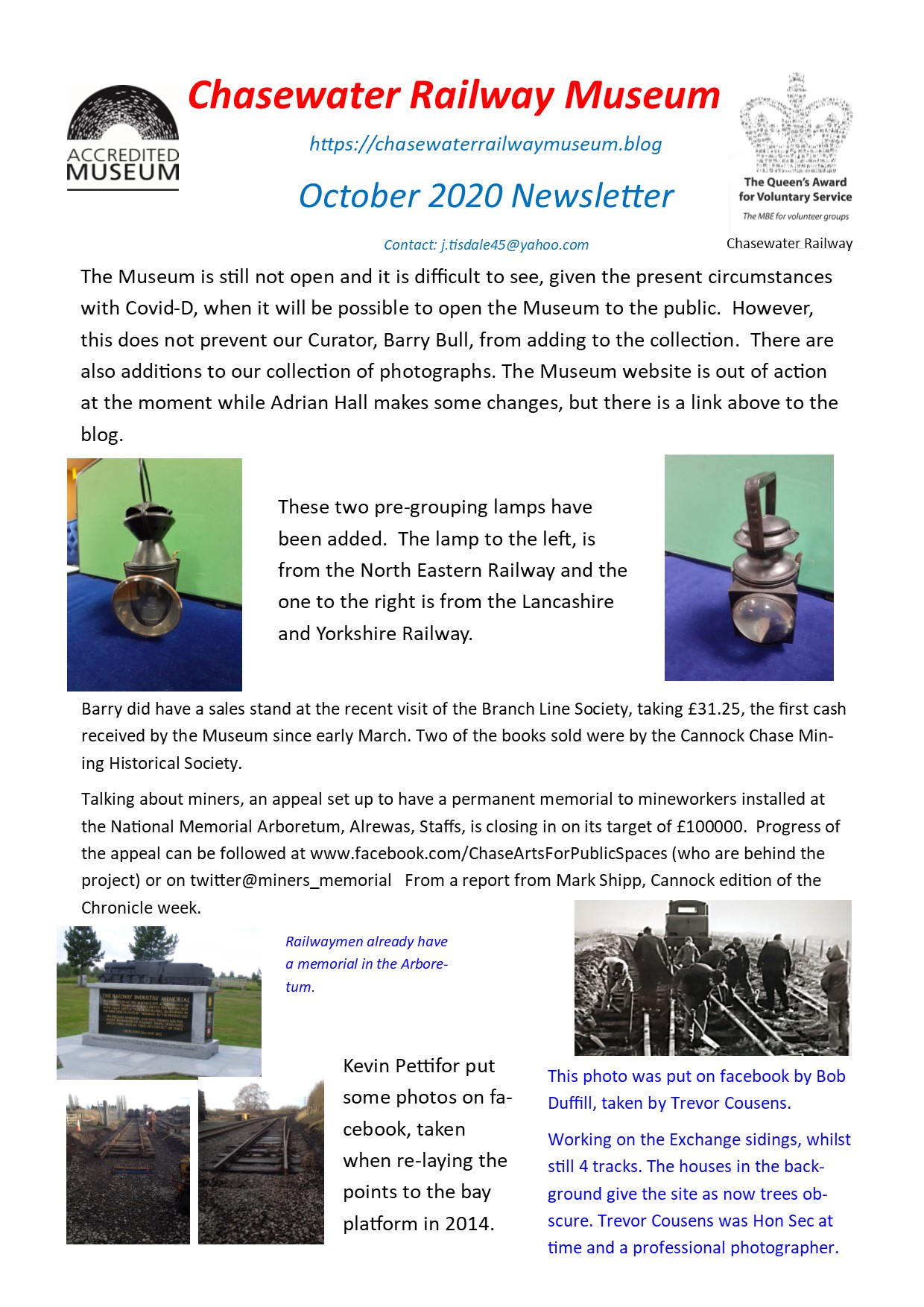
Chasewater Railway Museum – October 2020 Newsletter

Chasewater Railway Museum

October 2020 Newsletter