Tag Archives: Railway Preservation Society

Chasewater Railway Museum – Bits and Pieces No. 76

Chasewater Railway Museum Bits & Pieces 76 – April 1977

The Railway Preservation Society Newsletter

Chasewater News 19

Editorial

With the operating season nearly upon us, it is becoming increasingly obvious that the same few regular volunteers will be responsible for the operation of the railway during the coming season.  Appeals for extra help during the closed season have had the usual minimal response but the usual crowd have ensured that the railway will reopen as scheduled on the 10th April.  In many ways the RPS is the Cinderella of the operating preserved railways, but it reflects great credit upon the dozen or so people who have turned up week in, week out, enduring rain, sleet and snow, that we have entered our sixth season of steam-hauled services, which promises to be our most successful yet.

Locomotives

Pride of place must go to the ancient Neilson ‘Alfred Paget’.  Although built as long ago as 1882 it passed its steam test on 17th March with flying colours.  This was the result of much hard work by the engineering department in re-machining parts of the motion, which had earned it the nickname of ‘shake, rattle and roll’ in some circles.  The planned repaint for the Neilson has had to be delayed due to the adverse weather conditions.

‘Invicta’ the Andrew Barclay saddletank has passed its visual inspection and now awaits re-assembly of cab fittings, etc., and then a steam test before re-entering service again.  Its owner is still threatening to complete its restoration by giving it a uniform coat of Great Western green!

Unfortunately ‘Asbestos’ repairs are beyond our financial resources at the moment and so it has been put to one side until we have the necessary cash.

The next major locomotive job is to strip the Peckett 0-4-0ST ‘Lion’ in preparation for its major hydraulic test.  The two Worthington diesels have had repairs as and where necessary and are both serviceable at the moment.

Lion in 1978 with ‘Colonel’  Plate

It is pleasing to report that the Company are financing a complete repaint of the DMU trailer coach by a local firm of contractors, in the early stages of the season.  The expected final livery is grey roof, crimson lake bodywork and black underframe and running gear.  Great progress has been made with regard to trackwork with the construction of a point for a siding at the crossing.  This took less than a month despite the fact that the recently restored petrol crane broke its main shaft whilst lifting the first piece of rail into place.  Several crossing timbers were obtained by our general manager at a bargain price.  Ballasting and packing has been completed, considerably eased by the use of the tractor and bucket scoop, kept in trim by Brian Hames.

The footings of the lever frame have been laid.  The necessary walls should be built during Easter week, enabling the platform to be extended to its full length.

Other work carried out on site has been mainly in tidying up in preparation for the coming season.  A scrap drive resulted in a load of scrap being sold to bolster the Society’s coffers.  The sale of the engine out of the scrapped J4 van realised £25.

The Travelling Post Office has been partially re-roofed, with more to follow to make it water-tight again.  Re-panelling of this vehicle is to commence when the weather becomes drier.

The visit to South Yorkshire area of the Coal Board 9mentioned in the last Newsletter) was not entirely unsuccessful, as, although we failed (only just) to obtain the locomotive ‘Beatrice’, the Hon. Sec. was successful in obtaining many locomotive spares, notably boiler tubes and firebars from Rockingham Colliery.

Stroudley E1 Locomotive Centenary FundNo.110 Southern No. 4

Not a lot to report this month, but ads in Railway Magazine have been paid for to counter the apathy amongst Society members.  A rather neat handout has been produced and is obtainable.   Certain preservative work has been done on the locomotive and a repaint is planned before the high season.  More help and money is urgently needed for this project to succeed.

Track Fund

Negotiations within Walsall Council continue and a final decision is awaited.

The Chasewater Light Railway Company has awakened from its apparent siesta and a general meeting will shortly be arranged.

Meanwhile all members are urged to take up the offer of buying a yard of track, as the success of this fund will decide the fate of our Society.  Albert Haywood is the person to contact regarding the track fund and every £10 donation is certified.

Museum
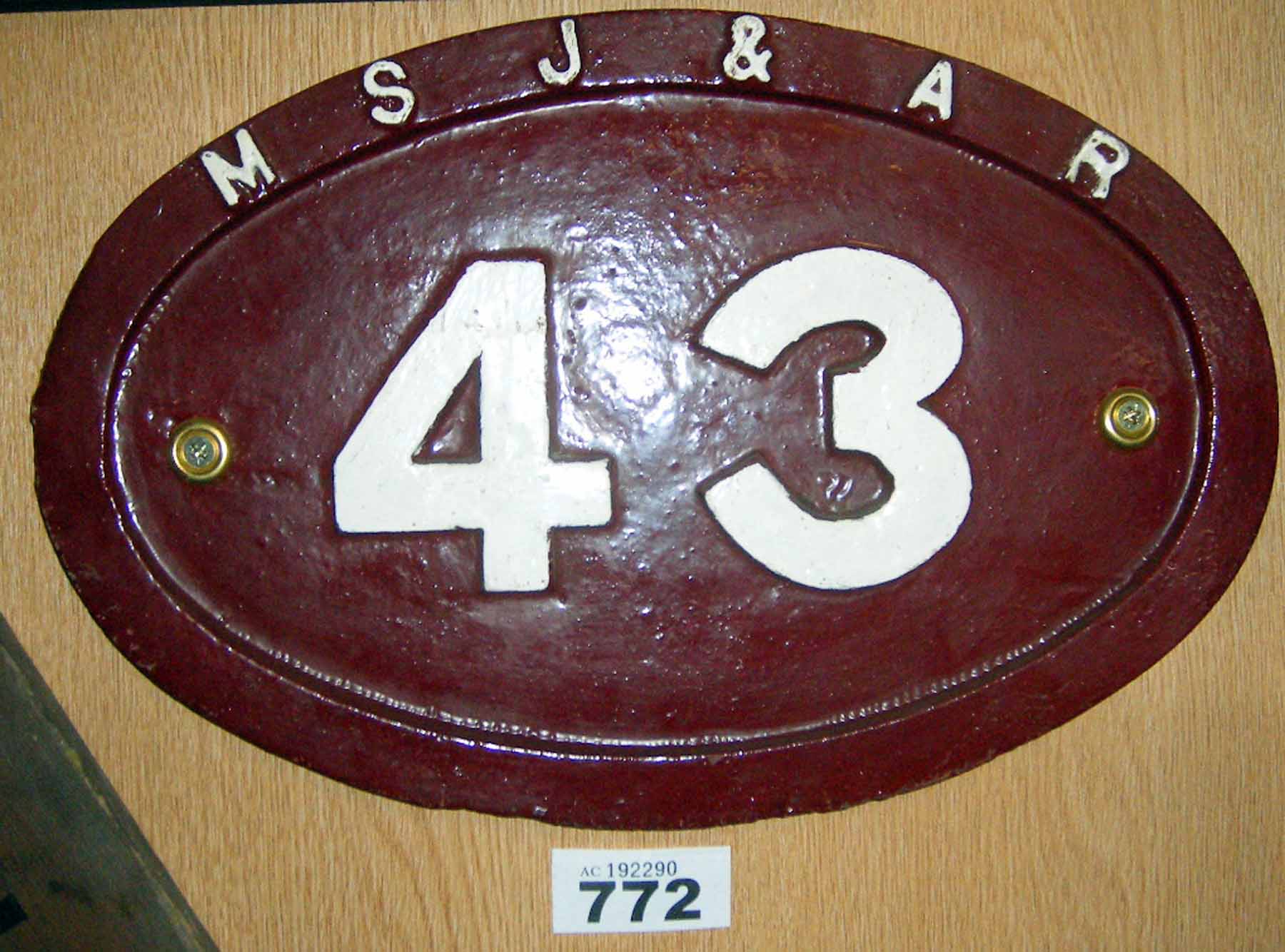
Thanks are due once again to Mr. Clift of Chase terrace, who has donated a 25 ton locomotive jack, once used in the Central Workshops at the far end of our line, and a pile of magazines for resale.  On the museum front latest acquisitions have included a Great Western and Midland Railway joint cast iron notice and two very nice bridge numbers of Manchester South Junction and Altrincham and West Riding and Grimsby Joint origins.  Smaller items include a GWR paycheck, an LNWR (Walsall) paycheck, an LNWR 1894 handbill, LSWR carriage blind, a small GWR cream jug complete with crest and six LMS tickets, mostly from the Brownhills area.

The March meeting was a slide competition and there were close on 100 entries of varying quality, though every entrant had at least one slide in the last twenty.  The competition was won convincingly by Nigel Canning’s photo of ‘Asbestos’ taken from within the dark confines of the cab of the Hudswell Clarke.

Chasewater Railway Museum Bits and Pieces 75

Chasewater Railway Museum Bits & Pieces 75 – Feb 1977

The Railway Preservation Society Newsletter

Chasewater News 18 – Part 2

On 26th January Barry Bull, Adrian Pearson and myself (Ian Patterson?) journeyed up to the North Yorkshire area of the NCB to inspect some redundant steam locos for possible purchase.  On the way up we visited Rom River Engineering of Lichfield and noticed the unique Kerr Stuart diesel alongside the ex-Cadbury’s North British diesel hydraulic.

Further north we passed the Butterley Headquarters of the Midland railway Project Group.  I understand from Derek Cartwright that our Royal Saloon, at present on loan to the Group, is at present undergoing considerable restoration at Derby Carriage Works.

The first colliery we visited was Ackton Hall at Featherstone.  This revealed a surprise in the form of Bagnall Austerity No. 2746 of 1944, which had arrived the previous week from nearby Prince of Wales Colliery.  This loco is of great interest to me because it used to work over the Shropshire and Montgomery Line.  The other engine at the colliery was the purpose of our visit, being No.S119 ‘Beatrice’, a 16” inside cylindered six coupled loco built by Hunslet, No.2705 of 1945.  This engine was in excellent condition, the fitters confirmed this, wishing it wasn’t for sale.  This engine is of the same class as ‘Robert Nelson No.4’ and others which worked at Littleton Colliery.  We also enjoyed a trip down the line to the BR exchange sidings on a diesel with the chief fitter, who told us several interesting facts about the history of the colliery and its locos.

The next colliery visited was Parkhill Colliery which revealed S102 ‘Cathryn’ a six coupled Hudswell Clarke side tank No.1884 of 1955 of the PLA Class.  This too appeared in excellent condition but inspection of the boiler report confirmed to the worst our suspicions about its firebox which needed well over £1,000 worth of repairs.

‘Monckton No.1’

Passing under the footbridge into a very quiet looking Embsay station – possibly the last train of the day? Note the bunting on the station and the stone flags through the gap by the ticket office and cabman’s shelter.

(c) Tom Ireland

North Gawber Colliery revealed a rather battered Austerity Hunslet 3212 of 1945, which was unlikely to be saved.  The same colliery also revealed another Austerity ‘Monckton No.1’ HC 3788 of 1953 which is spare engine at the colliery.  Out of the three on offer, we have bid only for ‘Beatrice’, an engine of ideal size for use at Chasewater.

The recent ARPS meeting at York was also of interest, several RPS members travelling up on BR, who managed to put an engine with no form of heating at all on the front of the train!

The National Railway Museum is well worth a visit, but the display of small relics is very poor and if the officers there care to visit Winchcombe Museum they will see what can be done with railway bric-a-brac.

David Ingham from Bury, Lancashire, England

One of the two preserved Princess Royals, 6201 Princess Elizabeth at Castleton East Junction signal box.

The meeting itself was of interest as the Annual RPS Award was given to the Princess Elizabeth Locomotive Society, a sister group of the RPS, for their efforts in restoring ‘Lizzie’ to main line condition despite enormous odds.

Well done the ARPS in choosing such a worthy group of so few members as opposed to one of the larger, richer groups, and Well Done the ‘Lizzie’ Society, in achieving such a remarkable feat.

It is pleasing to note that the Police have recovered many of the stolen objects from the museum vehicle, though the fact that the culprits were aged nine and ten is not so pleasing.

Recent acquisitions have included:

1.    A diamond weight restriction sign of Sheffield and South Yorkshire Navigation origin (once owned by MSLR)

2.    An Oxford Canal Navigation sign.

3.    Sharpness New Locks and Gloucester Canal Company weight restriction sign

4.    Two different sets of six official LNWR postcards from the early 1900s.  One set depicts castles and the other, Welsh Inland Resorts.

We now have 58 different LNWR official postcards, but over 1,000 different ones are known to exist.

Important

Pic from Barry Bull’s Collection

The RPS is organising a Transport Festival at Chasewater Park over the weekend of July 23rd and 24th.  This will feature vintage cars, buses, steam rollers and traction engines as well as the RPS.  We need your help for this venture, the first of its kind to be held by us.  This event may prove vital to our finances this year.

Late News

On the second of February an open meeting regarding the financial aspects of the RPS was held.  This meeting was very poorly attended despite the fact that many members were aware of its existence.  Despite this setback it was decided to launch an appeal to buy the loopline.  The people present were seen to represent an accurate cross-section of active RPS members and a majority of the executive committee were present to authorise the steps taken.  In brief these were:

1.    To set up a fund to purchase the loopline, as a proposed rent of £1,400 per year is beyond the Society’s reach.

2.    This appeal is to go under the slogan of “BRIDGE THAT GAP, BUY A YARD OF TRACK”.

3.    Money shall be raised by donations, those exceeding £10 or in multiples thereof being certified as representing the purchase of one yard of track.

4.    There will be no ceiling on the appeal as in future years the NCB may press for purchase of the northern end of the line.

5.    All monies raised will be placed in a Building Society to maximise its purchasing power.

6.    This appeal will be fully advertised in ‘Railway Magazine’ and ‘Railway Modeller’ as these are the two magazines with the highest circulation in their field.

7.    Handbills will be produced and sent to all interested persons and visitors to Chasewater this year.

8.    All RPS members are urged to start the ball rolling.

BRIDGE THAT GAP, BUY A YARD OF TRACK

The future of the Chasewater Light Railway depends on YOU.

Steam Loco Drivers

Albert Haywood, Chairman of the RPS, has asked me to inform all members of the need for fully trained drivers for the season’s trains.  To this end, training will be given at Chasewater before the start of the running season.  All persons wishing to be considered should apply in person or in writing to Albert.  When a list of all members wishing to take part is gained then a scheme of training and passing out will be drawn up.

Chasewater Railway Museum Bits and Pieces No.74

Chasewater Railway Museum Bits & Pieces 74 – Feb 1977

The Railway Preservation Society Newsletter

Chasewater News 18 – Part 1

From the Editorial

Recent activity at Chasewater has mainly centered on general maintenance, including some considerable tidying up of the entrance to the compound.  Footings for a lever frame have been dug at the present end of the platform and we now await some good weather to mix the necessary concrete.  The flat wagon on which the petrol crane sits has been re-timbered and strengthened and the crane itself has had some much needed maintenance.  On the locomotive side, work has been centred on the Neilson ‘Alfred Paget’ which has been re-assembled after its boiler test.  The coupling rods are at present dismantled to enable the crosshead slippers to be replaced with a spare pair which have been re-metalled.  It is hoped this will cure some of the knocks emanating from the front end of this engine.

Neilson in 1978

Extracts from the report of the visit of Major Olver of the Railway Inspectorate to Chasewater on 22-7-1976.

1.    Major Olver stated that he was quite satisfied with the present mode of passenger operation at Chasewater.  He asked that a facing point lock be fitted at the end of the main running line.

2.    When the tipping within the park has stopped, a concrete raft with the rails set into it should be installed at the road crossing.

3.    There is a major problem of trespass in the region of the causeway which is used as a public right of way.  This problem must be looked into in detail before the Society even thinks of running trains along this section of line.

4.    The arrangements for repair and restoration of locos are perfectly satisfactory.

5.    In reference to the need for a Light Railway Order, Major Olver explained that the section of line owned by British Railways was a statutory railway and therefore a Light Railway Order was needed to transfer its ownership.  He went on to say that common sense indicated that any Light Railway Order obtained should be made to apply to the whole of the Railway.  The Railway Inspectorate and Railway Administration side of the department will be happy to advise on the question of the Light Railway Order at the appropriate time.  Major Olver suggested that the most satisfactory solution may lie in the precedent set by the West Somerset Railway, which would be for Walsall Metropolitan Council to obtain the LRO and to incorporate it into the leasing arrangements.

6.    Training for drivers – the present arrangements were far from ideal as the Society relies on its own resources to train drivers.  Major Olver stated that drivers should be passed out by an independently qualified supervisor from either British Railways or the National Coal Board.  Major Olver explained that in the case of an accident there should be no room to question the basic abilities of the loco driver to drive the locomotive efficiently.  At the present time this was not proven.  Editor’s Note – This was the only point on which we were criticised and steps to rectify this are underway.

News on the purchase of the line

The executive committee heard that the Council couldn’t purchase the land and track until the 15th July.  There appear to be two present options:

1.    The Council buy the loopline and we repay £1,400 rent for ten years.

2.    We buy and pay a nominal rent to the Council.

Much discussion is at present taking place amongst members on this question and further suggestions are welcomed by contacting the Hon.Sec.

The Stroudley E1 Restoration Fund

E1 at Cannock Wood

This body is the result of the meeting held at Chasewater on 22nd January.  Only nine people turned up to this meeting, perhaps indicating the level of interest for this project within the Society.

The first aim of the Society is to raise enough money to purchase the E1 from the Society, a figure in excess of £3,000.  There are now four Societies at least, interested in buying the E1 if the RPS has to sell it.

£155.50 has so far been raised and local press coverage has been good but due to the lack of local interest the appeal must go national.  Offers of help, monetary or otherwise, should be sent to Mr. Albert Haywood.

Chasewater Railway Museum – Bits and Pieces No. 73

Chasewater Railway Museum Bits & Pieces 73 – Dec 1976

The Railway Preservation Society Newsletter

Chasewater News – Part 2

Outline Planning Permission has been granted for an engine shed between the platform and the crossing.  Anyone knowing the whereabouts of a suitable building which could be obtained cheaply or be donated is urged to contact the Hon. Sec.  Also needed are sources of cheap, good condition crossing timbers and sleepers, the latter preferably concrete.

Whilst on the subject of wants it is interesting to note that a small group of members have been trying to purchase another locomotive for the line, but have been outbid on three successive occasions.  The locos in question were the Bagnall 0-4-0ST at Northampton Power Station, the Hudswell Clarke 0-4-0ST at Carlisle Power Station and most recently, a Robert Stephenson & Hawthorn 0-4-0ST at Leicester Power Station.  With the current prices being paid for locos it may be that we need more cash.  Any offers of help should be directed to the Hon. Editor.  We have several more locos in the pipeline, all of which are in, or near to, working order.  We really want an 0-6-0ST or Tank, but these are few and far between and so a four-coupled is more likely.

Littleton Colliery. A successful open day was held here on November 20th, many RPS members being in attendance.  The Austerity No.7 performed in its usual vociferous style.  Thanks are due to Messrs. Matthews and Worgan of the National Coal Board.

Austerity No.7 at Littleton

Winter Work Programme. This is largely centered on the long awaited completion of the platform and installation of a lever frame.  Associated trackwork. Manly involving packing, is already in hand.  Other projects are the dismantling of ‘Asbestos’, general maintenance and tidying up and when the weather improves, a start on re-panelling the TPO.  Once again more help is needed and no offers refused, don’t be shy, we don’t bite!

The loco shed siding is also due for laying before Easter, involving construction of another point.

Museum Exhibits. Despite the break-in several interesting items have been added, notably a Cannock Chase colliery bridge plate – many thanks to Mr. Clift of Chase Terrace for this unique item.

Cannock Wood with Asbestos at Chasewater

E1 Locomotive – ‘Cannock Wood’

The E1 locomotive came into the possession of the Railway Preservation Society in 1964.  Had it not been for the RPS the locomotive would probably have been scrapped at that time.

From that time until the present, it has received a couple of coates of paint and a tidy up sufficient for a Boiler Inspector to shake his head in dismay at the firebox.

Its future depends on you! As some of you will recall, the AGM of 1975 gave the Committee permission to sell the E1 as a last resort to raise cash for the purchase of the British Railways section of track and land.

The Walsall Metropolitan Council, it would appear, will be unlikely to supply the cash for the purchase of land and track, although this has not been confirmed.

Two verbal offers have been received for the E1 and a written offer is being obtained by the Committee from the interested parties.  The locomotive is likely to bring in £3,500 which is probably about a third of the cost of the land and track.

Notice of Meeting

A meeting will be held at Chasewater at 2.30pm on the 22-1-1977.

The meeting will be for the purpose of bringing interested parties together with a view to the following:

1.    To set up a restoration fund to purchase the E1 from the RPS at current price.  The fund should be a separate body from the RPS.

2.    After purchasing the Locomotive, raise the cash to restore it.

3.    Operate the Locomotive at Chasewater.

It should be noted that only a few months are available to raise the first £3,500.  If we have the ability to do that, we have the ability to restore and operate it.

If we are not able to raise the purchase price, the Locomotive will be better off elsewhere, where it can be restored and operated.

Remember

London, Brighton and South Coast Railway.

Built 1877  Brighton Works.

No.110.

Name: ‘Burgundy’

100th engine built at Brighton Works under Stroudley.

Sold 1926 to Cannock & Rugeley Collieries Ltd.

Name: ‘Cannock Wood’

No.9

Sold 1964 to the Railway Preservation Society.

1877 – 1977 Centenary

No other locomotive of this type survives.

Happy 100th birthday ‘Cannock Wood’

A.W.Haywood – Chairman RPS

The following is from the East Somerset Railway website:

Withdrawn for a second time in 1963, the engine was sold to the Railway Preservation Society and stored at Hednesford until 1970, when it was moved to the Chasewater railway. There it remained until sold to three members of the East Somerset Railway, finally arriving at Cranmore in September 1978.

A general overhaul was commenced in 1986 and it returned to active service in 1993, painted in green livery and numbered 110. It pulled it first train in service on Sunday 24th October of that year. In 1996, No. 110 could be found transporting visitors to the Festival of the Sea on Bristol’s Harbour Railway. Unfortunately, firebox problems resulted in No. 110 being prematurely withdrawn from traffic in 1997.

During 2000, work commenced on stripping the locomotive down to assess the extent of the firebox problems, after which the locomotive will be rebuilt. Current progress on this project can be found on the <a href=”http://www.railwayweb.com/clf”>Cranmore Loco Fund website</a>.

In 2012, B110 was sold to the Isle of Wight Steam Railway, in return for LMS Ivatt Class 2 no. 46447 moving to the ESR. The railway plans to restore the engine and run it as No. W2 Yarmouth, which was an identity previously worn by one of the Isle of Wight-based E1s.

Chasewater Railway Museum – Bits and Pieces 72, December 1976

Chasewater Railway Museum Bits & Pieces 72 – Dec 1976

The Railway Preservation Society Newsletter

Chasewater News – Part 1

From the ‘Editorial’

Less than 24 hours ago, I was standing in the compound with a group of members, discussing the lack of recent Society literature, when jokingly I suggested I could piece together a newsletter.  Well here I am trying to write one.

Sincere apologies are due for the non-arrival of ‘Chasewater Express’ No.3, due to printing problems, etc.  Hopefully the next edition will revert to the magazine format, which has produced some favourable comments. (Sorry folks – it didn’t!).

Much activity has taken place at Chasewater during the long dry summer and the short wet autumn.  No less than three engines have been seen in steam at Chasewater this year, a record for the Society.  It is estimated that over 8,000 people visited us, so there is every confidence of getting into five figures in 1977.  ‘Alfred Paget’ the Neilson 0-4-0ST handled the bulk of the season’s traffic faultlessly (well almost!),

Alfred Paget and Invicta

whilst ‘Asbestos’ was steamed on a couple of occasions, but succumbed to rotten tubes in August and so was taken out of service pending the annual boiler inspection.

The big news however has been the completion of the overhaul of ‘Invicta’ the Barclay 0-4-0ST and its use in service pulling the vintage train on a couple of occasions at the end of the season.  Already it has proved to be quite powerful, despite its somewhat diminutive size.  Many thanks are due to Mike Wood for the purchase of this engine.

The boiler inspector has visited the site and passed ‘Alfred Paget’ and ‘Invicta’ for use next year, subject to steam tests.  Unfortunately ‘Asbestos’ is due for a major test entailing the removal of tank and lagging, so it may not steam next year, for the first time in five years. 

Paget with Asbestos

It is hoped that work will start on the Peckett 0-4-0ST ‘Lion’ in the New Year, so there is plenty of work for anyone interested in loco repairs – don’t be shy, come and volunteer to strengthen our loco fleet.

Both ‘Invicta’ and ‘Paget’ are to be repainted prior to next season.  The little Barclay, ‘Lion’ and the Hudswell Clarke 0-6-0ST have been repainted this summer, considerably improving the ‘scrap-yard’ image of the compound.  The planned repaint of ‘Asbestos’ will also be done, made easier by the need to dismantle it.

The other major scene of activity has been the current terminus of the line where the burning embankment has been dug out and refilled with non-combustible material.  The track here has been slewed across to avoid placing stress on the edge of the embankment.  Further relaying has taken place using concrete sleepers, extending the line by 50 yards or so.  Many thanks to Colin Vincent for the loan of his bulldozer.

Further relaying has ceased pending purchase of the loopline from British Railways.  It seems that the purchase will have to be completed without financial aid from the Council in view of the current economic and political climate (sound familiar!).  To this end several interested bodies have offered substantial sums of money for the ‘E1’ locomotive ‘Cannock Wood’. A subject of much heated discussion at the moment. (See separate letter. In the next post – cws). The selling of E1 can only be done as a last resort, if all other means fail.  Any sensible suggestions regarding fund-raising, etc. should be forwarded to the Hon. Sec.

Other progress has been seen with regard to re-fencing of the compound following two break-ins, when £40 worth of relics were stolen from the museum vehicle.  The police have the addresses of the probable culprits so the items may be recovered.

Major Olver of the Railway Inspectorate visited the line and was reasonably satisfied with the current state of affairs – the full report will appear in the next magazine.  It is to be hoped that the Chasewater Light Railway Company will finance the repainting of the DMU coach, so that it can match the current excellence of the two six-wheelers.

The Model Railway Exhibition held in September was another financial success, though the level of help, especially of the Friday night, was poor.  Many thanks to Andrew Louch, the organiser and to Mr. and Mrs. Duffill for the refreshments.

Chasewater Railway Museum Bits and Pieces No. 71, April 1976

Chasewater Railway Museum Bits & Pieces 71

From the ‘Chasewater Express’ April 1976

I have no idea where the picture of the LP came from – it’s not on my preview or anywhere else on this post??

Editorial

Steve’s Bit

Considerable activity has been occurring on site in recent weeks. This is no doubt due largely to the long stretches of dry and sometimes mild weather. I hardly need say however, that those present were more or less the usual crowd. Still, spring is near, and the prospect of a few more members turning out occurs as a dream to those of us tied to the site every weekend. There are many fingers to be pulled out and bumps in the track to be smoothed, as well as a crossing and a siding to be laid, engines and carriages to be cleaned, painted, steamed and pulled in order to grab any stray waif, family of four or local loony for a ride, on which we depend so very much for our cash intake. The Society has ‘just about’ ticked along financially – we must this year raise enough cash for active members to realise their ambitions, i.e. re-panel and refit what is known as the ‘Football Special’

The LNWR compo brake; and more importantly, the TPO, which is in a shocking state for a vehicle of its importance.

Travelling Post Office at Hednesford.

Engines too need cash, which they tend to consume in greater quantities than coal during the period of their restoration – not to mention Keith Sargeant.

Steve Organ – Editor, Station Master and Order of the most meritorious school of tipyng errrorz.

(Listen for loud popping noises as people pull their fingers out in what for many will be their only physical response to this apple peel!)

Not to mention K.S. who complained that he wasn’t mentioned enough in the last mag!

Chasewater Site Notes

Some lunatic has stuck pieces of wood in the platform, painted them pink, and left them – saying nothing to anyone regarding them. (This is a sight worth seeing! Ed.)

Invicta arriving 1975

Mike Wood has been seen in his role as scrubber extraordinaire (Special duties – preparing his engine Invicta for painting prior to its introduction to Chasewater service, at… well let’s say ‘as soon after April 11th as possible.  Said scrubber Mike, ‘this is going to look the most impressive engine at Chasewater.  It is going to be rather lavishly lined over Easter, you know’. (Not to mention this last bit to Keith Sargeant, the Neilson freak!)

The LNWR full brake has been completely painted and laid out as a museum.  Nearly 1,500 square feet of wall space is now devoted in this vehicle to the exhibition of relics, as well as exhibits in cases therein ( not to mention the nameplates of Alfred Paget, which are to be fixed by K.S. to the Neilson at some point in the future, we are given to hope). (Vaguely).

Concrete sleepers? Bloody ‘ell mate, what do you think we are, main line to Euston?  I mean – what? Donated by the Ministry of Agriculture and Fisheries? Lying in the grass at Lichfield for years?  Enough for seven lengths did you say?  Bloody ‘ell mate, how many?  22 letters to get them?  Three cheers for DEREK JUNIOR!

The Midland is being spruced up externally and painted properly internally in order to preserve it until we have time and money to do it properly.  If any member would like to dismantle and rebuild two of the doors on this vehicle, would he please come to the site and report to Andrew Louch or Steve Organ?  Ta.

The Great Western water tower, complete with tower, tank and cap were cut up on site and removed during the week ending 20th February.  We know not the perpetrators of this terrible deed – the police have no idea.  What to do?  Someone buggered off with two tons of steel and no-one saw them.  We have our suspicions but no proof.

Credits:

Pink posts – Steve Organ

Invicta scrubbing – Mike Wood

LNWR brake – Albert Haywood, Derek Junior, Nigel Canning, Steve Foster, Barry Bull, Richard Louch, Andrew Louch (who painted the doors a different green to the rest of the vehicle – is this man colour blind?), Adrian (I don’t know his surname but he’s nearly always here).

The Midland – As the LNWR brake, plus Steve O.  Not to mention K.S., who is preparing Invicta, in league with Derek Luker and Brian Hames. Advertisements

Occasionally, some of your visitors may see an advertisement here,

Chasewater Railway Museum Bits & Pieces 70

Chasewater Railway Museum Bits & Pieces 70

From the ‘Chasewater Express’ April 1976

A poem which follows on from the previous post

The Neilson without nameplates and Asbestos

Neilson  – complete with Alfred Paget nameplates

One of the ‘Puddings’

Chasewater Railway Museum – Bits and Pieces No.69

Chasewater Railway Museum Bits & Pieces 69

More from the ‘Chasewater Express’ January 1976

Editorial

The Editor wishes to state that he is in no way responsible for the ensuing passages, which emanate from the pen of a Black Country ex- butcher who nowadays works (?) for the only railway company in the country which is known to have in its stocklist a few hundred Brush 4s, a couple of dozen class 87 locos, etc.  Spelling and grammatical errors are his, not mine.

The Restoration of a Rusty Beast

Or

The Gospel According to Keith Sargeant

One particularly wet and generally normal Chasewater morning whilst shovelling (rubbish!) out of one very rusty coal bunker, I thought ‘will this thing ever go again?’ ‘’Course it will’ cried D.Luker, as he walked by for the tenth time that morning.

Well, it does go now and I will attempt to show how it was done.

In the winter of 1973/74, the boiler was stripped down and cleared of all the rotten lagging upon it, the firebox was cleared out in the space of one Sunday, the smokebox, however, was a completely different matter.  A very crude but effective spark arrester was cut out, never to be replaced; the next four hours (was!) were spent devoted to the removal of the blastpipe which was only held in with two taper cotters.  Evidence of neglect was showing through, on removal of the blastpipe a cup of tea was summoned and obtained.  ‘I’m not working on that thing in the rain any more’ Derek grunted through a sort of mist that arises off Chasewater tea.

The next weekend was devoted to building a ‘Tent’ upon the loco and fitting electric lights up to work on the loco in the dark.  Once it was completed, three weeks were devoted to clearing off the front tube plate.  To our horror, Derek’s clearing off of this revealed that the tube plate was less than half its original thickness for most of the lower 3” and non-existent at the flange with the barrel.  The smokebox bottom, which is formed of an extension of the boiler barrel, was also gone without trace.  A very awesome sight that left us wondering if the knuckles we had lost were lost in vain.

Work was suspended while Derek went cap-in-hand to the man with the money to ask for £300 which the Society had not got.  The remarkable thing was, they gave it to him.  He then got in touch with a bloke what mends boilers and after lengthy discussions with our boiler inspector and the boiler mender it was decided that the boiler was in such a good state that it was worth spending money on expensive repairs to it.  The contractor’s job was to replace 13 1” rivets and build up the smokebox tube plate to its original thickness and build up the corners of the firebox likewise.  This work was carried out in the space of three days, and restoration by Society members then re-commenced.

During the repairs, 10 flue tubes were replaced – bloody good ones they were too.  All boiler fittings were overhauled and replaced.  The regulator valve was taken home by Derek to Stafford where his neighbours were worried at the sound of him grinding ‘IT’ on the hearth rug.

The boiler was hydraulically tested and passed with flying colours.

Now with the boiler out of the way, the mechanics were looked at – ‘Boy, what a mess!’

4 tattered main bearings, 2 seized pistons, no side rods brassed, 2 valve spindles worn like egg-timers, and a partridge in a pear tree – PEAR TREE! Oh yes Boyo, we spent a few hours in there sampling the delicious tremblings, Boyo!

Work was suspended from the summer of ’74 to the winter of 74/75 fro work to be done on ‘Asbestos’, and also we built a workshop containing several mechanical works of art enabling Derek and Brian to while away the winter months machining the main bearings.  When they were done and fitted, the loco was lowered back on its wheels, the boiler was lagged and the tank was found to have more holes in it than a hairnet!  Six weeks were taken filling these in – we found the rest when it was on the loco!!

The loco was re-mated with the tank and the (Barkeus? Sorry, can’t decipher – Editor) nicely patched up and painted a delicate shade of black and red.  Now we had what looked almost like a steam loco, it was then decided to borrow the lubricator off of the Hudswell-Clarke.  This is where Brian Hames came into his own.  His short, Coal Board figure was just the ticket for getting round the little bits of engine that get in the way when you are laying lubrication pipes all over the place.  After that was done a steam test was made, the boiler steamed well and the injectors worked like two humming birds.  After eight months derelict and 18 months stripped down, only one leak in sight – and a very tiny one from a blown joint at that!

Now the moving parts.  As she stood they listed two seized pistons and valves, two weighbar shaft bearings (ready for a gallop) and one very rusty steam brake valve, complete with bent brake gear (a relic from Bruno days).  Something tells me I have (Sorry about this next bit of indecipherable script – Ed.) Wol’t fhat Bit a £ove –

After re-metalling the four main bearings and weighbar shaft brasses we set to putting it together again, first the pistons and valves, the valves took a lot of buggering about with and a great deal of patience on Derek’s part.  The siderods took about twelve weeks to fit as we had to make all the brasses from a similar but younger loco.

When Alfred Paget (as we had decided to call it) was back together again and had been made to look respectable with the aid of two gallons of black paint, we steamed it – what a day!!

06.30 we lit the fire and raised steam Lewis fashion (slowly – Ed).  By 11.00 we had got 50 lbs of steam, and it would not budge – what had we forgotten to do, I thought?  ‘Give it a nudge’ said a very dirty and unhygienic NCB Brian.  So we did.  Chuff, chuff, wheeze she went, like a ‘Super D’ with not a bit of trouble.  The brakes didn’t work  for a few weeks until they were worn in – but now we have one beautifully repaired Neilson 0-4-0ST loco of 1882 vintage and it was in steam for the 150th Anniversary to boot!

No mention yet has been made of the carriage and wagon tapping fraternity who are a body of MEN?? Who delight in making life difficult for us engine bashers.  Still, as I haven’t mentioned them before, I won’t bother now!!

Jotted by the most photographed driver at Cheesewater and published by the Keith Sargeant Appreciation Society.1975 Open Day – He’s in the middle! Andrew Louch on the right, with Brian Hames on the left.  Thanks Bob.

Summary of dimensions

Neilson standard 14” design

Weight: 28tons

Overall length: 23’ 7”

Height: 10’ 10”

Boiler Pressure: 120 lbs/sq.in.

Tractive Effort: 8885 lbs.

Cylinders (Outside) 14” x 20”

Chasewater Railway Museum Bits & Pieces 68

Chasewater Railway Museum Bits & Pieces 68

From the ‘Chasewater Express’

January 1976

Editorial

Steve’s Bit

Here we are, into 1976, and once again the Society is crying out.  Crying for cash and for help.  Once again it is up to members to try and help us over the winter patch, which, as in other years, is hit by poor attendance of volunteers.  Our Society is by no means unique in this respect.

I ask you then to do this:  there is enclosed in this mag a loose membership form: persuade a friend to fill it in and send it to us.  If each member gets just one new member, then our workforce should double.  Sounds glib – but is it too much to ask?

Hope you like the new magazine.  This is the ‘cheap’ winter edition, with duplicated insides, but the summer edition – in April – which will be on wide sale to non-members, will be a classier affair altogether.

Your adverts are welcome – send them to me.  I intend to widen our circulation by acting as a ‘Notice Board’ for vendors and collectors of Railwayana.

Steve Organ, Hon.Editor

Steve Organ has now taken over the editorship of the newsletter, though he tells me that he is going to modify the format slightly.  I must thank Steve for relieving me of the job, which has at times been rather difficult to achieve due to business commitments,

We are in the winter now and a difficult time to try and maintain our stock and locomotives at Chasewater due mainly to a lack of covered accommodation.

We are now in our sixteenth year, and can be fairly called a viable society; we do emphasise, however that we must have all the help that anyone can give, to continue to be viable.

Laurence Hodgkinson and I made a very enjoyable trip to Ludgvan, near Penzance, during November, and collected six gas lamps intact from an old GWR clerestory body – this entailed a lot of hard work, particularly for Laurence, who had to cut through all the plumbing.  We returned through fog, gale and rain to offload the lamps at Chasewater around midnight that evening.

Our sincere thanks to Mr. Davey Thomas who owned the coach body for his generosity and hospitality.

May I wish everyone a prosperous and happy New Year – Dave Ives – President.

I hope that at least one of these lamps will be restored and on the exhibition stands this year – Editor.

Recent Happenings at Chasewater

A pump handle trolley (YES, BUSTER KEATON STYLE!) has been restored to working order after many years of use as a timber stand.  Already, since being commissioned around 1st January, it has claimed two victims.  First Rob Duffill, who has a wrenched arm, and now Barry Bull, who the Machine’s handle lifted from the platform and hurled him through the air, to be deposited, muttering oaths and obscenities, into the Chasewater quagmire. (No photographs are available so I may ask them for an action replay!!). Thanks are due to John Elsley for the restoration of this museum piece for our torture-chamber exhibit.

The line has now been relaid and ballasted to the BR Boundary, but much packing is needed.

Negotiations twixt BR and the Council continue – developments hoped for very soon.

The compound is now fully lit by 240 volt lighting equipment – thank you Brian Hames.

Invicta arriving July 1975 – D.Bathurst’s collection

Invicta, the 0-4-0ST Barclay, ex Chatham Docks, has passed its hydraulic test – steaming soon.

Staging has been erected alongside the MSLR coach for public viewing.

Harold Wilson, the Rt. Hon. Prime Minister has made a donation to Society funds (true!)

Original Stones lighting equipment for the ‘Paddy Train’ LNWR bogie brake compo is on order – thank you J.C.James

The TPO has been re-roofed and glazed.

Chairman’s Message

Once again we are well into the closed season, a time when the Railway has to be made ready for the next season of passenger operation.  This is a vital time for the Society, for if we are to operate trains we must make good the wear and tear of last year and make improvements where necessary, and whenever possible, and to do these things, we need YOU!  You are the Society’s greatest asset – without you we do not exist!

Working members are about 5% of the Society’s membership – a good percentage when compared to other Societies – i.e. SVR’s 4%.  Unfortunately for us, our membership as a whole is much less than the SVR, so I would urge you to take up the Editor’s scheme – with the enclosed form get just one new member, more if you can, and really help the Society in this way – if you can’t help on site, is this too much to ask?

We will start the season with two steam locomotives and soon there will be three, next year probably another will be added – these are as well as diesels – never before has the Society been in a position of such strength, but this alone is not enough.  We need track to run on, serviceable vehicles, coaches, to carry fare-paying passengers and station staff.

Come and help us then.  Make 1976 a year to remember.  If you cannot come to Chasewater but can offer us some other service, or have constructive proposals to make, please write to us via the editor.  Best wishes for the New Year – Albert Haywood, Chairman.

Chasewater Railway Museum Bits & Pieces 67

Chasewater Railway Museum Bits & Pieces 67

RPS Newsletters No. 14, 15 & 16  May – Oct 1975.

From No.14

I am pleased to report a fair influx of new members these last couple of months, several of these members have already proved their worth and capabilities.  I only wish that a few of our absent, long-standing members could pay a visit to the site now and again, I am sure that they would enjoy the odd weekend.

Trackwork

A very good effort has been done by our track laying gang, the bed has been levelled, sleepers and rail relaid almost to the underbridge.  A splendid effort by the usual stalwarts!!

Maryport & Carlisle Carriage

Work is progressing slowly but surely towards the final repaint of this vehicle, this carriage is being shown at the Stockton & Darlington 150th Railway Anniversary Exhibition at Shildon, Co. Durham.  It is going to be a race against time to finish it by the end of July!!  A few more skilled painting volunteers would be very welcome.  Messrs. Pomlett Sen & Jnr, I am pleased to report have answered the call, but further help would be very much appreciated.

Horizontal Single Cylinder Engine, Staffordshire Industrial Archaeology

This engine has been collected by the RPS and is now undergoing restoration on Chasewater site.  Staffordshire Industrial Archaeological Society have promised help in this work.  During this excursion the Midland Railway horsedrawn box van was loaned to Shugborough Museum.  (It’s still there – Jan 2011).(Back home for a couple of years now – 2020)

The horse-drawn box van can just about be seen to our left of the building

Spring Bank Holiday – Sunday and Monday

Thanks must be expressed to all members running the trains over this period, the effort was quite fruitful.  Thanks to Andrew Louch, Albert Haywood and helpers who prepared the site and erected the Birkenhead Railway Bookstall, this bookstall has great potential.

The bookstall is top left in the picture – above ‘BROW’ of Brownhills West

Thanks again to Mr. J.C.James for purchasing same.  A large number of visitors also went round the compound.  Many thanks to the stewards who held the fort in the TPO and LNWR brake.

LNWR, TPO & 60ft Brake

Urgent maintenance work is required on the roof of the TPO during the dry summer months.  Volunteers please!!  Rob Duffill has also made a start on the painting and restoration of the second half of the LNWR brake, he would appreciate help in this venture, also painting of the exterior of both vehicles.

Dave Ives.  President & Editor.


From No.15

We are still in the midst of this marvellous weather, what a glorious summer indeed.  We have had a long run of steaming and train running these last two months, but takings, alack, have been sadly down on last year, also lack of members to run the trains, the task of running the trains has fallen yet again on the same old crew.  May I appeal for members to get over to Chasewater and give a turn, we shall be running until October.

This month of course sees the 150th Anniversary of the Stockton & Darlington Railway, I expect and hope most members will attend.  As most members are aware, we are exhibiting the Maryport & Carlisle carriage, also we are manning a sales stand.  Barry Bull, our Hon. Sec. is in charge and would appreciate a little help, he will be on duty all week from 25th August to the 31st – a long stint.  We shall appreciate a little help in this direction.  We also look forward to a good attendance at the AGM in September, see separate notice from the Hon. Sec.

Maryport & Carlisle CarriageM & C  on show at Shildon

Andrew Louch has truly done a first class job getting this vehicle ready for the Anniversary.  I am sure it is really credit due to him and his few helpers!  All members will be sorry to learn that Andrew’s mother has broken her ankle, with an unfortunate accident at their home.  All members, along with me, will I’m sure wish her well during what will be a drawn out recovery.

Neilson Locomotive

Work continues to progress on this engine.  I understand that we should see her moving, possibly in service, before the season ends.

Pump Action Mechanical Trolley

Keith Sargeant has spotted and bought a trolley for the Society.  We are however having a members’ whip round to offset the cost for Keith.  The total amount being £30 + transport.  £19 has been donated to date.  Please don’t forget to add the odd £1 next time you renew your subscription.  The trolley will be a valuable acquisition.

Dave Ives – President & Editor

From No.16

Several events have now come and gone since the publication of the last Newsletter.  The 150th Anniversary at Shildon was probably amongst the most memorable.  The Cavalcade at the end of the week was to me the most memorable and unforgettable experience.  A lot has already been said and reported on this subject, but I still have my personal experience, one that I would not have missed!!  Our very sincere thanks to our Hon. Sec., his friend Ken, Adrian Pearson, Iain Patterson, Andrew and Richard Louch and Bob Ives, Mike Wood and Gerald Wildish for manning the RPS Stand at Shildon through a long and somewhat arduous week.  I understand that a clear profit in the region of £350 was made.  A truly excellent effort on the part of the above mentioned members.

My wife and I also had an invitation to attend the Official Opening of York Railway Museum by H.R.H. the Duke of Edinburgh.  This again was quite an impressive ceremony, and of course yet again, a chance to meet several old friends and colleagues.  I understand that a visit to York Railway Museum is being planned by one or two Chasewater members; it is certainly well worth a visit.

AGM

The meeting was quite well attended this year, the highlight event being after the meeting and members were able to participate in trips behind the Neilson down the line.  I am sure that all members were thrilled to make this trip and sincere thanks to loco staff and operating staff for the wonderful effort put into getting this loco back in working order.

Maryport & Carlisle Carriage Exhibited at Shildon

We are all justifiably proud of the fact that this carriage was duly exhibited at Shildon.  We must again thank Andrew Louch and his helpers for making this possible.  We had the misfortune to have two door handles stolen by a ‘souvenir hunter’; these were replica handles but will cost the Society something like £10 to replace.  We must all agree that this was a despicable act!!

Progress at Chasewater

The running season has now come to a close.  Passenger receipts this year were a little down on last year, but this is to be expected with the expensive, inflationary times we live in.

Miniature Railway

Albert Haywood very successfully negotiated with the Council (Walsall) for the RPS to run and maintain the 7½” gauge railway in the park.  This has been operated and run by our members during the closing weeks of the season.  This should prove a very worth-while project, the Society receiving 50% of passenger receipts.  Our very grateful thanks to Albert and his operating staff, Ted West and Colin Finch.

(I haven’t managed to get a photo of this yet – can anyone help, please?)

Trackwork

This arduous but necessary work continues, thanks to our general Manager Derek Luker and his gang of stalwarts.

Platform

The slotted signal at our original Brownhills West Station

Steve Organ (that’s the first time that I’ve seen that name mentioned!) has made good progress with the station platform, he intends to extend it to its full length during the winter season, weather permitting.  The Cannock Wood Colliery signal has been installed, a start signal, this is all good progress, thanks to Steve and his helpers.

Cannock Forum Theatre RPS Exhibition

This exhibition was held again fro the third occasion and was a great success, financially and publicity wise.  Our sincere thanks to Andrew Louch, the organiser, Barry Bull, our energetic Hon. Sec. and all other members who helped with this successful event, in particular to the non-stop catering team led by Rob Duffill.  I understand that a profit of £125 was made.

Nigel and Helena Hadlow

Our very sincere congratulations to Nigel and his wife on their marriage in September.  Nigel is one of our stalwart members, having served the Society for some 15 years.  I am sure that all members will join in wishing them a long and happy marriage.

Obituary

Eric Haswell.  It is with sadness and regret that I write these lines.  Eric died suddenly whilst on a visit to our old friend Teddy Boston at Cadeby Rectory on Tuesday 14th October.  I am sure that all members will sadly miss that tall figure at the exhibition, with that wonderful talent for locomotive drawing.  Thus passes another Gentleman.

Dave Ives – President and Editor.

After something like 30 years outside, the Maryport & Carlisle could do with another Andrew Louch!!