
170 – Chasewater Railway Museum Bits & Pieces
From Chasewater News Bromford Special 1994 – Part 2
A Weekend at Bromford Tube Works – Nigel Canning

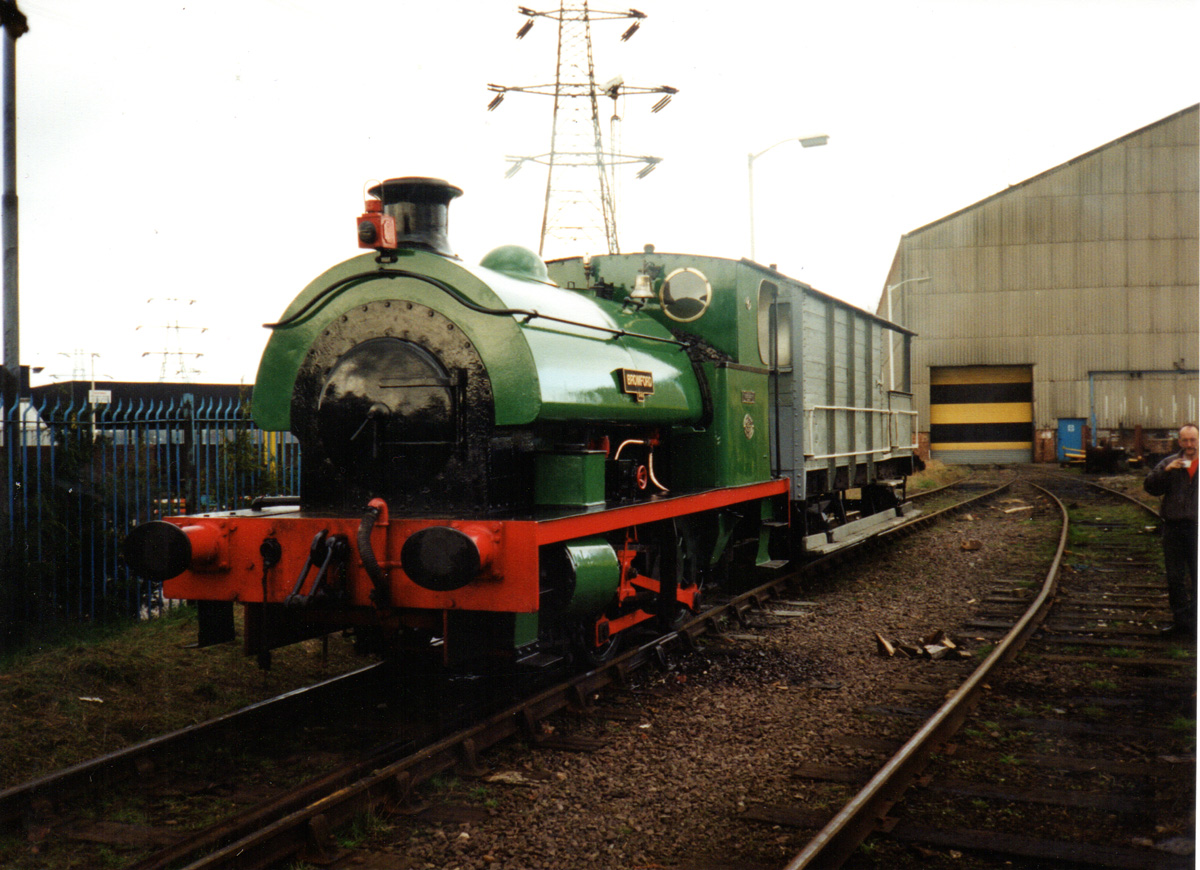
When it was announced that the tube works was to be closed, the Freight Charter Group (who organised the Littleton Colliery steam weekend) made arrangements for steam to run once more at Bromford. As a Hawthorn Leslie similar to Asbestos had once worked there, the CLR was approached to provide the loco. This is a brief account of what happened.
Shortly after Christmas the Loco Dept. was asked if Asbestos could be made available fro traffic a couple of weeks before Easter as there was a possibility that it may be needed to run in Birmingham for a special event. Although the loco had been stripped for its annual boiler inspection and various repairs, this was agreed in principle as it would need to be steam tested prior to Easter anyway. As the weeks went by and the work progressed, the special event, which was to be at Bromford Tube Works, became a definite commitment but for various reasons would have to be earlier than planned.
The boiler inspector came and did a visual examination, and then in record time by Chasewater standards returned for the steam test. This was an achievement in itself, as with frozen points and snow drifts across the line, the engine had to be lit up in the shed with only the smokebox and chimney eventually venturing outside.

In addition to the boiler work, the loco was cleaned and repainted (not the sort of work ideally carried out in February) with the result that it looked better than it had for a long time, and still does for that matter. The 20 ton GW brake van which was also required at Bromford was cleaned out and repainted, and even had its roof re-felted for the occasion.

On Thursday March 3rd the brake van was first to be taken by low-loader to Bromford, followed later in the day by Asbestos. Due to problems with the ill-equipped low-loader and a somewhat over-cautious steelworks management, Asbestos was eventually unloaded in the dark. Following this, an attempt to fill the saddle tank with water from their ‘fire main’ had to be aborted when it was noticed, even in the dark, that the water appeared milky. A reassurance from the steelworks engineer that this was ‘only a bit of soluble oil’ resulted in the tank having to be drained, and as the promised indoor accommodation for the loco never materialised, the drain plug was removed on the spot ready for another attempt in the morning.

Next day we arrived back at Bromford for a trundle round to familiarise ourselves with the line before the main event on Saturday and Sunday. The steelworks people had been busily pumping water from a well overnight and had filled their large water tower ready for use in the loco. After raising steam and filling the tank we were given just one loaded bogie bolster to take for a run with the brake van. At first sight the trackwork appeared highly dubious with the sort of tight curves that would look more at home on a Tri-ang train set, but after a bit of running it became apparent that most of it was in excellent condition with the rail joints beautifully aligned allowing quite brisk running as long as the couplings were left well slack.
This view shows just how tight the curve between the two bridges was, requiring quite a bit of power just to crawl round! Pic – Ian Buswell

The line itself ran from a works yard down a bit of a gradient, round a tight curve, passed under Bromford Lane Bridge, and into a fan of five exchange sidings next to the site of the former BR (Midland) Bromford Bridge Station. The whole of the exchange sidings, and even some of the not unsubstantial works buildings were overshadowed by the elevated section of the M6 Motorway running overhead. Perhaps only thirty years ago a surreptitious excursion through the trap point onto BR metals followed by a left turn at Castle Bromwich, and right at Aldridge, would have taken us back to Chasewater without the need for a low-loader, but on this occasion we were required to stop about halfway along the sidings where we could watch the main line trains running to and from Birmingham New Street.
On the Saturday and Sunday we performed for the photographers who had apparently paid around £18 each for the privilege. Having raised steam for a 9am start on both days, it was well after ten by the time the security men had let people in and we were required to move.

Rather than spend time shunting wagons around as we would have preferred, we were restricted by the steelworks management to running backwards and forwards over a set route with initially just the one wagon, and it was only after very careful negotiations that this was increased to two on Sunday. These arrangements seemed to suit the photographers quite well as they wanted to photograph a series of ‘stage managed set piece’ movements.
Asbestos stands on the curve just short of the Bromford Lane bridge awaiting the signal to accelerate through for the photographers waiting on the other side – Ian Boswell

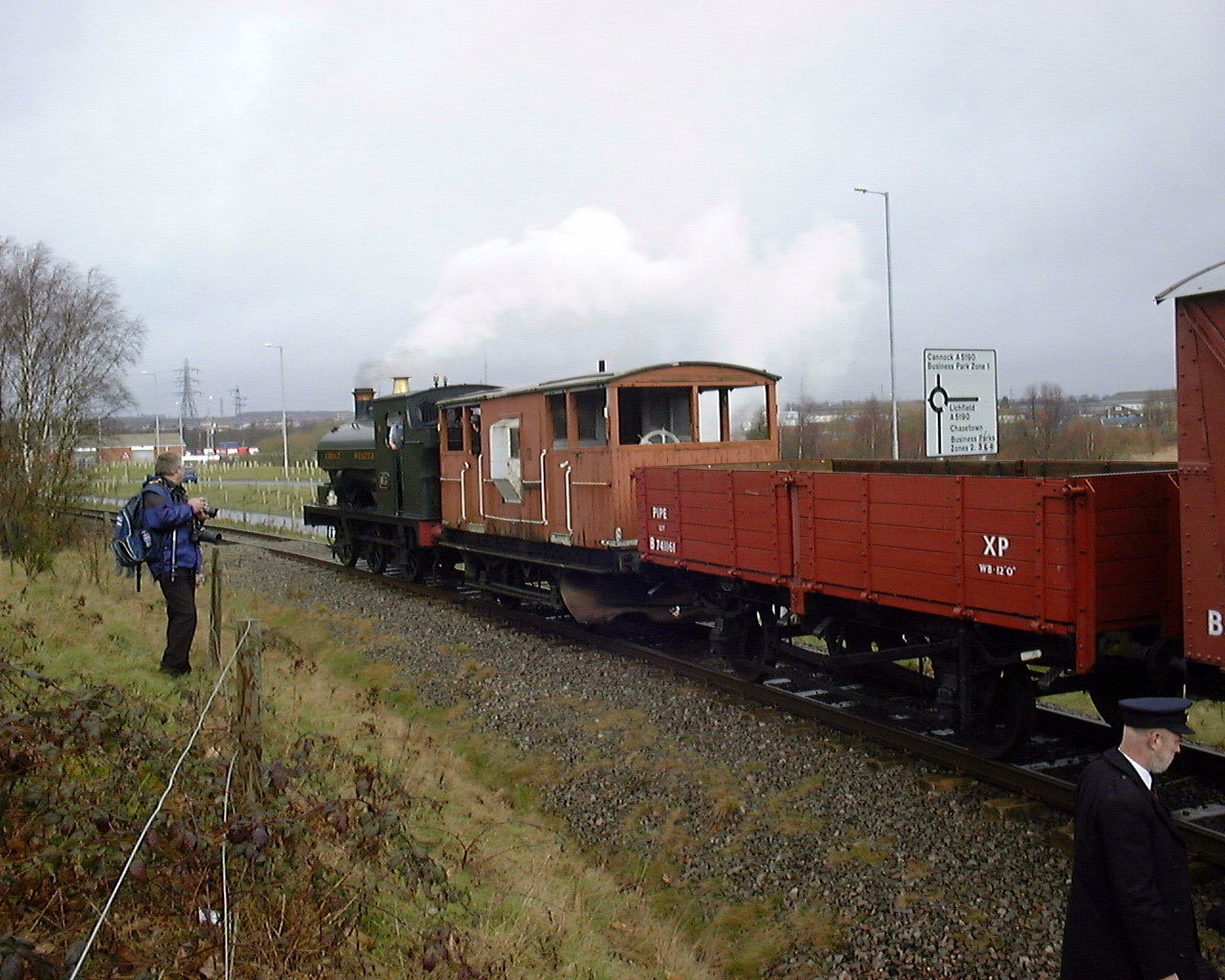
A typical example of this was to stop on the works side of the Bromford Lane Bridge, then when the photographers had positioned themselves on the other side, we would accelerate through and coast to a stand half way along the exchange sidings. After a brief delay we would then reverse through the bridge ready for a repeat performance. The number of repeat performances, and delay in between, depended apparently on the amount of sunshine (or short term prospects of it) and whether there had been enough smoke and steam from the loco.

In order to make the loco work harder and produce the spectacular results required, we ended up running with the brakes pinned down on the wagons, and wound hard on in the brake van, whilst accelerating briskly past the cameras. In the end this treatment took its toll on the loco resulting in a number of tubes leaking in the firebox by mid-afternoon on Sunday. In view of this, that afternoon’s running was cut short by around an hour, and the hoped for night photography was abandoned. No-one seemed too upset by this failure of the loco, and a number of national magazines have published photos showing that we achieved the desired effect.

On the Sunday another hard day was spent getting Asbestos and the brake van on and off the low-loader. On this occasion we managed to get the job done a little bit quicker, finishing at Chasewater at around 6pm.
As a result of its Bromford trip, Asbestos is now facing the ‘other way round’ with its cab at the Brownhills West end as it had been decided to take advantage of the low-loader journeys to achieve a turn round. This has put the driver on the platform side of the train, and the loco now faces up the causeway bank.

Financially the session at Bromford seems to have been well worth while, and in addition a lot of free publicity was obtained, but the condition of the boiler tubes still remains a problem and is likely to be until they are completely renewed. Whether any similar outings are attempted in the near future remains to be seen, but any loco used will need to be in more reliable condition if similar feats of performance are to be attempted.
Thanks to Nigel Canning for his kind permission to use his photographs.
And David Jackson for the video clip.
 Chasewater Railway Museum